
Mental Health & Stress: Understanding the Mind-Body Connection
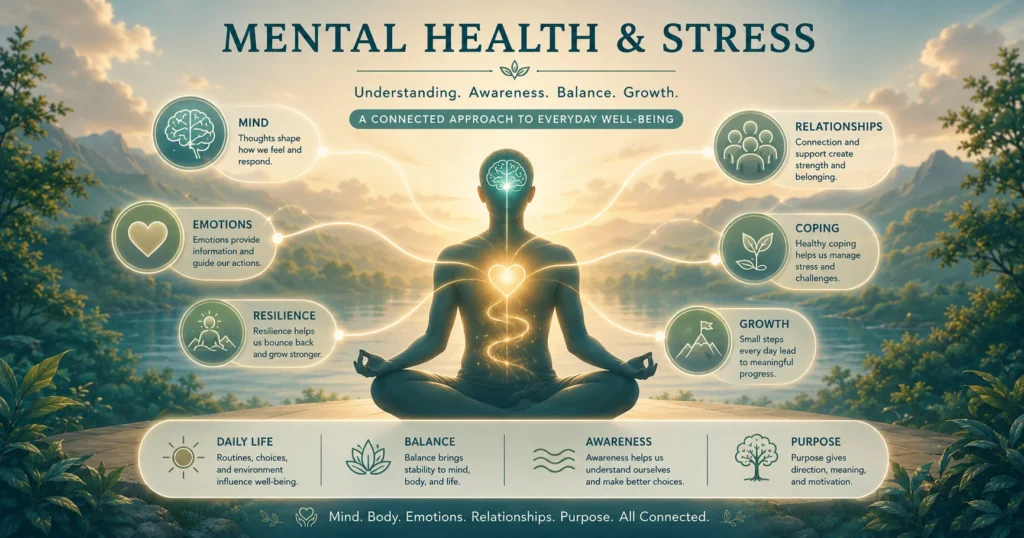
Mental Health & Stress are part of everyday life. They affect how people think, feel, learn, communicate, and respond to the world around them. Every person experiences stress at some point. Likewise, everyone experiences emotions, worries, hopes, and challenges. Because of this, Mental Health & Stress play an important role in overall well-being.
Life is always changing. New responsibilities appear. Unexpected situations arise. Daily demands can increase or decrease over time. As a result, people constantly adjust to different experiences. Some days feel easy and manageable. Other days may feel more demanding. Therefore, understanding Mental Health & Stress can help people better understand their everyday experiences.
Many people believe mental health only matters during difficult periods. However, mental health influences daily life even when everything seems normal. It can affect concentration, motivation, decision-making, relationships, communication, and problem-solving. In addition, it can influence how people respond to opportunities, challenges, and change.
Stress as a Normal Daily Response
Stress is also a normal part of life. A person may feel stress before an important meeting, a school examination, a job interview, or a major life event. Sometimes stress comes from positive situations. For example, starting a new job or moving to a new home may create excitement and stress at the same time. Therefore, stress is not always negative. Instead, it is often a response to situations that require attention and adjustment.
Mental Health & Stress are closely connected to the nervous system. Every thought, emotion, memory, and experience creates information that the brain and body process throughout the day. Because of this ongoing process, mental and emotional experiences can influence focus, energy, behavior, and daily responses. Likewise, physical experiences can also influence thoughts and emotions. As a result, the mind and body constantly interact with one another.
Another important point is that Mental Health & Stress affect people in different ways. Two people may experience the same situation but respond very differently. One person may feel confident. Another person may feel uncertain. This does not mean one response is right and the other is wrong. Instead, it shows that experiences, learning, personality, environment, and coping skills can all influence how people react.
Mental Health & Stress are also connected to learning and adaptation. Every experience teaches something. Over time, people develop habits, coping strategies, emotional awareness, and problem-solving skills. Because of this, responses can change as new experiences are gained. Situations that once felt difficult may eventually feel more manageable.
Mental Health & Stress as an Educational Topic
This topic explores Mental Health & Stress from an educational perspective. Rather than focusing on diagnosis, treatment, or medical conditions, it explains how thoughts, emotions, behavior, experiences, and stress responses work together. Understanding these connections can help readers recognize patterns, build self-awareness, and develop a broader understanding of well-being.
Most importantly, Mental Health & Stress remind us that people are constantly learning and adapting. Life includes challenges, opportunities, successes, and setbacks. Even so, growth often happens through experience. Therefore, learning about Mental Health & Stress can help people better understand themselves, their responses, and their everyday lives.
Quick Navigation
- What Is Mental Health & Stress?
- Plain Meaning / Glossary Box
- How Mental Health & Stress Work
- Key Layers of Mental Health & Stress
- Emotional Layer of Mental Health & Stress
- Cognitive Layer of Mental Health & Stress
- Behavioral Layer of Mental Health & Stress
- Physical Layer of Mental Health & Stress
- Social Layer of Mental Health & Stress
- Real-Life Symptom Language Bridge
- Mental Health & Stress and Human Systems
- Mental Health & Stress Interactions
- Practical Daily-Life Examples
- Mental Health & Stress Visual Flow
- Why Mental Health & Stress Matter
- Common Misunderstandings About Mental Health & Stress
- Related Condition Connections
- How Mental Health & Stress Connect With Other Nerve Health Pages
- Topic Cluster Placement
- Mental Health & Stress FAQ
- Continue Learning
- Sources / References
- Author / Editorial Trust Note
- Educational Trust Note
- Safety & Education Notice
Plain Meaning / Glossary Box
Plain Meaning
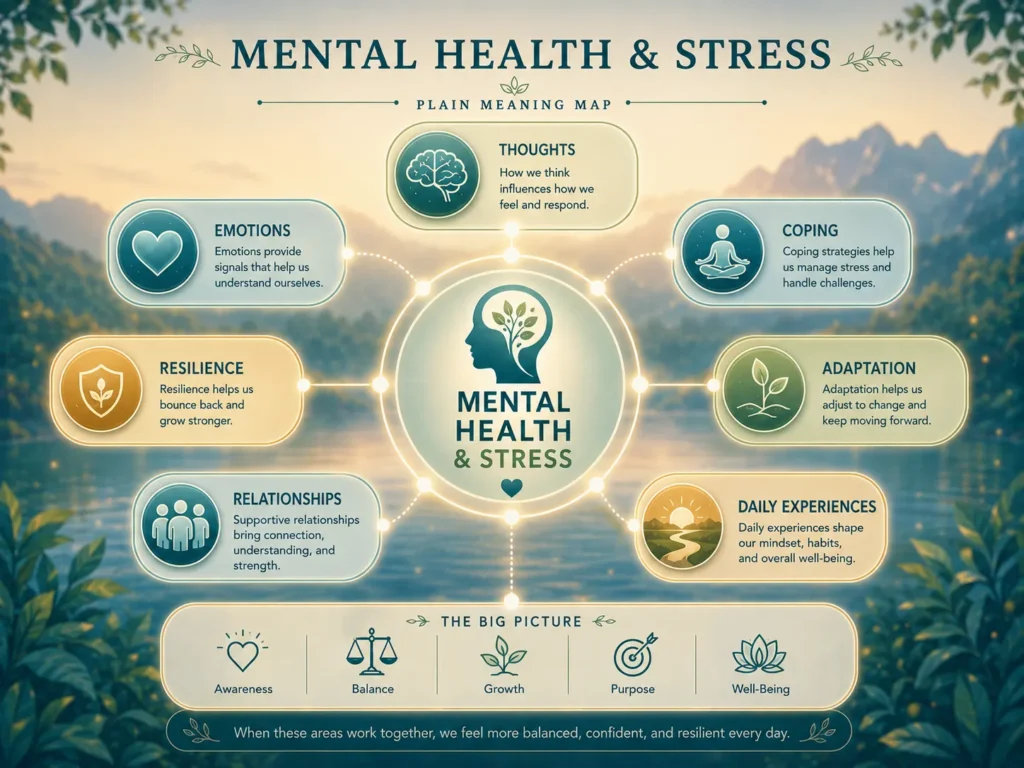
Mental Health & Stress describe how people think, feel, respond, and adjust to daily life. Mental health includes emotional well-being, clear thinking, relationships, self-awareness, and the ability to manage everyday challenges. Stress is the body and mind’s response when life asks for effort, attention, change, or adjustment.
Everyone experiences stress at some point. Also, everyone experiences different emotions throughout life. Some days may feel calm and easy. Other days may feel busy, uncertain, or demanding. Because of this, Mental Health & Stress are normal parts of human life. They are not only topics for difficult moments. Instead, they help explain how people experience daily life.
Mental Health & Stress can also change over time. A situation that feels hard today may feel easier later. For example, a new job, new school, new routine, or major life change may feel stressful at first. However, experience can create learning. As a result, people may slowly feel more prepared, confident, and steady.
Simple Definition
Mental Health & Stress is the study of how thoughts, emotions, daily experiences, relationships, and life demands influence well-being, behavior, coping, and adaptation.
In simple words, this topic helps explain how people handle life. It looks at how the mind responds to pressure, how emotions affect choices, how stress changes daily energy, and how people learn to adjust over time.
Simple Example
Imagine preparing for an important presentation. Before the event, you may feel nervous, focused, excited, or unsure. Your mind may think about what to say. Your body may feel more alert. Your emotions may change several times before the presentation begins.
After the presentation ends, those feelings may change again. You may feel relieved, proud, tired, or thoughtful. This simple example shows how Mental Health & Stress can influence thoughts, emotions, body responses, and behavior during everyday situations.
Another example is a busy week. When many responsibilities happen at once, a person may feel more tired or distracted. However, after rest, planning, or support, the same person may feel more balanced again. Therefore, stress and mental well-being often shift with daily life.
Key Idea
The key idea is simple. Mental Health & Stress are not separate from everyday life. They are part of how people think, feel, learn, connect, and adapt.
Stress does not always mean something is wrong. Sometimes it simply means the mind and body are responding to a demand. However, if stress becomes strong, long-lasting, or disruptive, support from qualified professionals may be important.
Quick Glossary
Mental Health – Emotional, psychological, and social well-being. It affects how people think, feel, connect, and respond to life.
Stress – The body and mind’s response to demands, challenges, pressure, change, or uncertainty.
Resilience – The ability to keep moving forward, adjust, and recover after challenges or difficult periods.
Coping – The ways people manage stress, emotions, responsibilities, and life experiences.
Emotional Well-Being – The ability to notice, understand, and respond to emotions in a balanced way.
Adaptation – Adjusting to new situations, new demands, new routines, or new experiences over time.
What Is Mental Health & Stress?
Mental Health & Stress are about how people think, feel, respond, and manage daily life. They are not only about emotions. They also affect choices, focus, relationships, routines, motivation, and problem-solving. Because these parts of life happen every day, mental health and stress can influence many areas of well-being.
Mental health does not mean life is always easy. Instead, it means having the ability to understand emotions, handle challenges, connect with others, and keep moving through daily life. Likewise, stress does not always mean something is wrong. Sometimes stress simply means the mind and body are responding to a demand, change, or important situation.
For example, a student may feel stress before an exam. A worker may feel stress before a deadline. A parent may feel stress while managing many responsibilities. These experiences are common. However, each person may respond differently. Therefore, Mental Health & Stress should be understood as personal and changing experiences.
Mental Health in Everyday Life
Mental health appears in ordinary daily moments. It can affect how people talk to others, handle responsibilities, solve problems, and respond to change. It may also influence energy, patience, confidence, and motivation.
For example, learning something new may create excitement. A difficult task may create frustration. A supportive conversation may create relief. Reaching a goal may create satisfaction. These moments are part of normal mental and emotional life.
Because of this, mental health is not only important during crisis or illness. It matters during regular days too. It helps shape how people experience work, family, learning, relationships, and personal growth.
Stress in Everyday Life
Stress appears in many forms. Deadlines, bills, family needs, work pressure, school demands, uncertainty, and life changes can all create stress. Sometimes stress comes from difficult events. At other times, it may come from positive changes, such as starting a new job, planning an event, or moving to a new home.
Stress can affect thoughts, emotions, and behavior. A person may feel focused, tense, motivated, worried, or tired. However, stress responses are not the same for everyone. One person may see a challenge as exciting. Another person may see the same challenge as overwhelming.
Therefore, stress should be understood with context. The situation matters. The person’s experience matters too.
Why Mental Health & Stress Matter
Mental Health & Stress matter because they influence daily well-being. They can affect learning, communication, relationships, choices, habits, and resilience. They can also influence how people recover after difficult periods and how they adapt to change.
When people understand these topics, they may begin to notice useful patterns. For example, they may notice what increases stress, what supports calm, what improves focus, or what helps them cope. As a result, awareness can become the first step toward better understanding daily life.
Most importantly, Mental Health & Stress are educational topics that help explain how the mind, body, behavior, and environment work together. They do not define a person. Instead, they help readers understand how everyday experiences can shape well-being over time.
How Mental Health & Stress Work
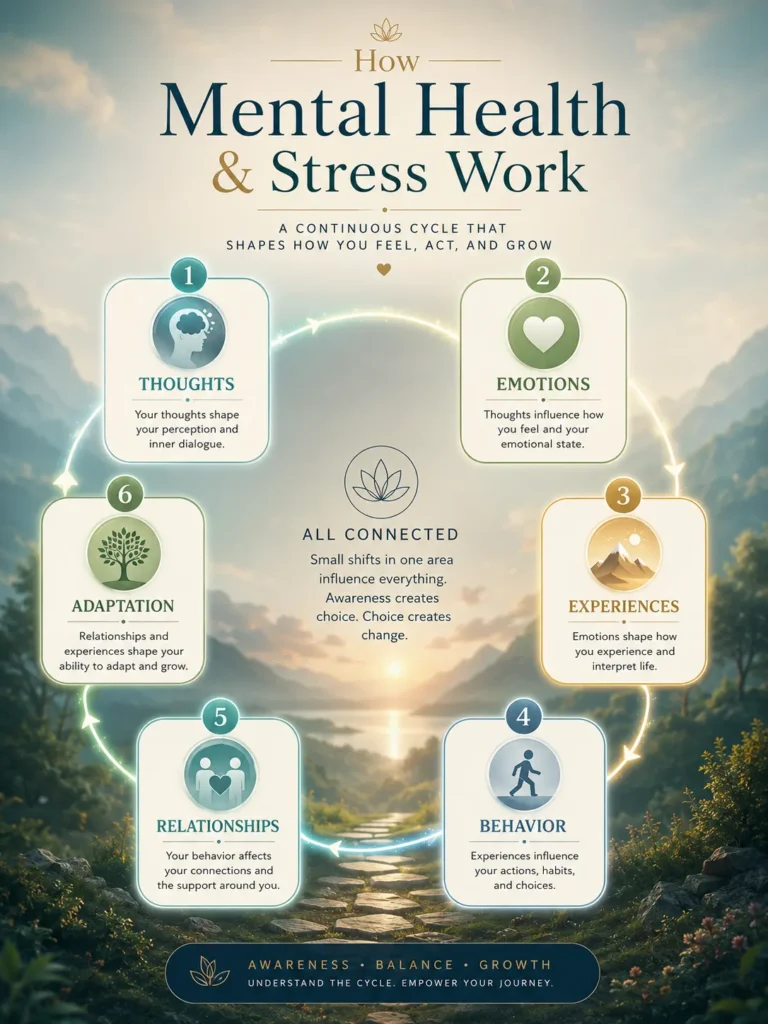
Mental Health & Stress work through continuous interactions between thoughts, emotions, experiences, behavior, and the nervous system. Every day, people encounter situations that require attention and response. Some situations feel easy to manage. Others require more effort. Because of this, the mind and body are constantly processing information and adapting to changing circumstances.
When a situation occurs, people often interpret its meaning. Thoughts may appear first. Emotions may follow. Physical reactions may also occur. At the same time, previous experiences can influence how the situation is understood. As a result, Mental Health & Stress involve many connected processes rather than a single reaction.
This process is not the same for everyone. Different experiences, environments, personalities, and learning histories can influence responses. Therefore, two people may react differently to the same situation.
Thoughts Influence Responses
Thoughts play an important role in how people understand situations. A person may view an event as exciting, challenging, uncertain, or rewarding. These interpretations can influence emotions and behavior.
For example, one person may see a new opportunity as a chance to learn. Another person may feel nervous about the same situation. Because thoughts shape perception, they often influence how people respond to daily experiences.
Emotions Influence Actions
Emotions provide valuable information about experiences. Feelings such as happiness, excitement, frustration, concern, or confidence can influence behavior and decision-making.
Emotions do not appear in isolation. Instead, they interact with thoughts, experiences, and surroundings. Therefore, understanding emotions can help people better understand their responses to different situations.
Experiences Shape Future Responses
Past experiences often influence future reactions. Familiar situations may feel easier to manage because the nervous system has encountered similar experiences before. On the other hand, unfamiliar situations may require additional learning and adjustment.
Because experience influences learning, Mental Health & Stress often change over time. As a result, people may respond differently to situations as they gain knowledge and familiarity.
Key Layers of Mental Health & Stress
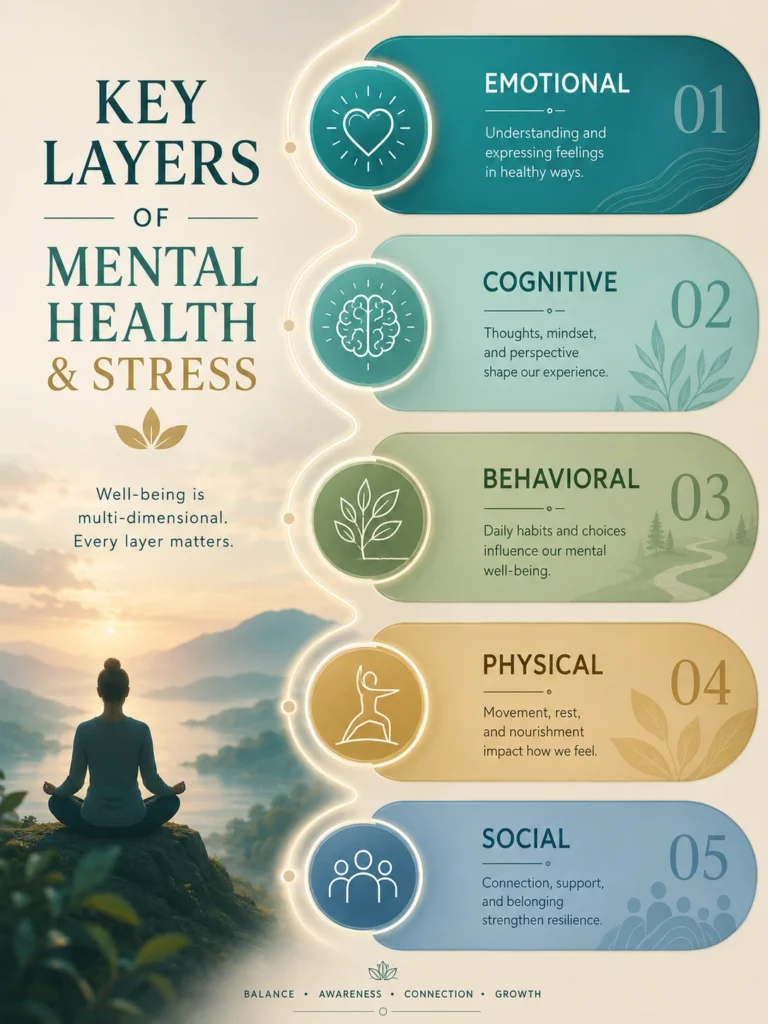
Mental Health & Stress involve several connected layers. Each layer influences daily experiences in different ways. Although these layers can be discussed separately, they constantly interact with one another.
For example, thoughts may influence emotions. Emotions may influence behavior. Behavior may influence relationships. Relationships may influence future experiences. Because these connections exist, Mental Health & Stress are best understood as whole-person experiences.
The following layers provide a simple framework for understanding how Mental Health & Stress operate in everyday life.
Emotional Layer of Mental Health & Stress
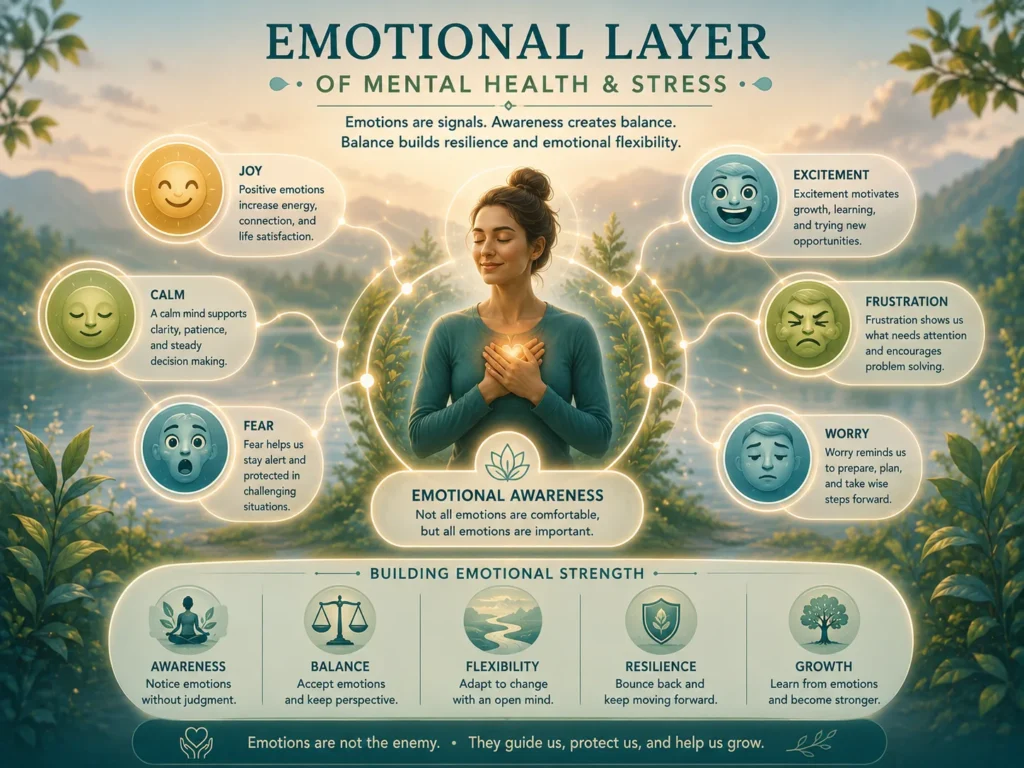
The emotional layer focuses on feelings and emotional experiences. Every person experiences a wide range of emotions throughout life. Some emotions feel pleasant. Others may feel uncomfortable. However, all emotions provide information about experiences and situations.
Emotions often change throughout the day. A person may feel excited in the morning, frustrated during a challenge, and relieved after completing a task. Because emotions respond to circumstances, they are a natural part of everyday life.
Understanding emotions does not require eliminating them. Instead, emotional awareness involves recognizing emotions and understanding how they influence responses.
Emotional Awareness
Emotional awareness is the ability to notice feelings without immediately reacting to them. People who recognize emotional patterns may better understand how situations affect them.
For example, a person may notice that uncertainty creates worry. Another person may notice that success creates motivation. Recognizing these patterns can support self-awareness and learning.
Emotional Flexibility
Emotional flexibility refers to the ability to experience different emotions while continuing to function and adapt. Life includes positive experiences, difficult situations, and unexpected changes. Therefore, flexibility often plays an important role in emotional well-being.
Rather than avoiding emotions, emotional flexibility focuses on responding to them in constructive ways.
Emotions and Daily Life
Emotions influence communication, decision-making, relationships, learning, and behavior. Because of this influence, emotional experiences remain an important part of Mental Health & Stress education.
Cognitive Layer of Mental Health & Stress
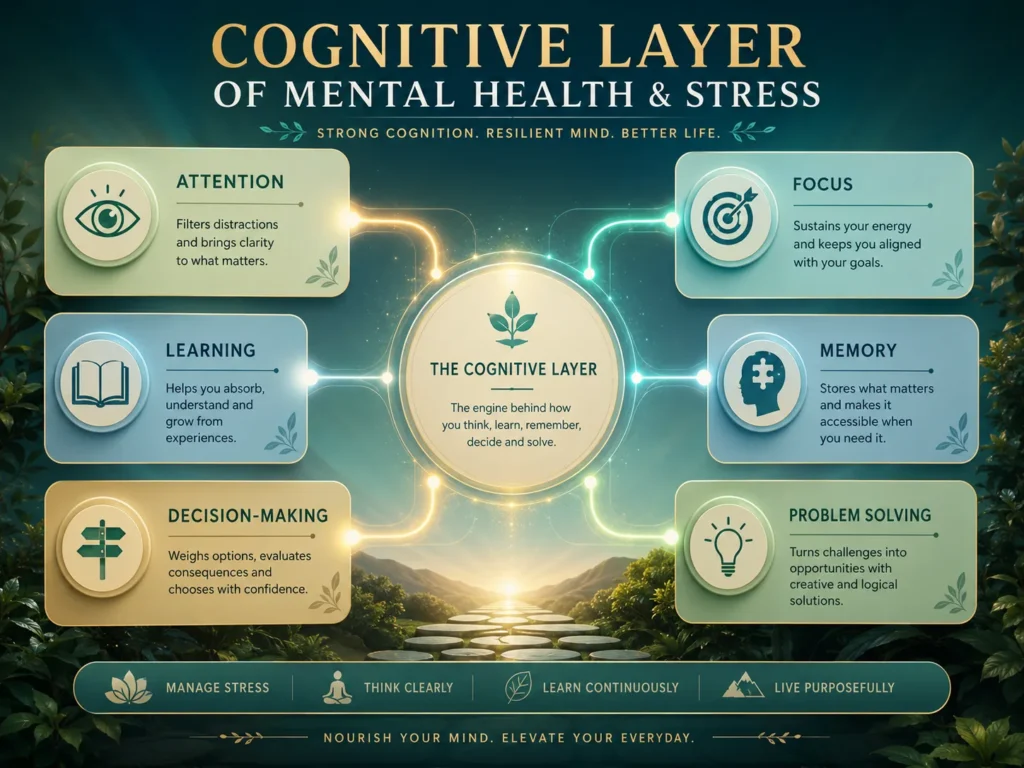
The cognitive layer is about thinking. It includes attention, focus, memory, learning, problem-solving, and decision-making. These thinking processes help people understand what is happening around them. They also help people choose what to do next.
Every day, the mind handles many kinds of information. Some information comes from work, family, school, relationships, or personal goals. Other information comes from memories, emotions, and body signals. Because so much information is present, the mind must sort it and decide what matters most.
Stress can affect this process. When life feels busy or uncertain, thinking may feel slower, faster, scattered, or more intense. However, this does not mean something is wrong. Instead, it shows that the mind is responding to daily demands.
Attention and Focus
Attention helps people notice what matters in the moment. Focus helps them stay with one task, idea, conversation, or goal. Without attention and focus, daily life would feel confusing.
For example, a person may need focus while reading, working, studying, driving, or listening to someone speak. However, stress can sometimes make focus harder. A person may think about several problems at once. As a result, it may be harder to stay with one task.
At the same time, some situations can increase focus. An important deadline, a meaningful goal, or an exciting project may help the mind become more alert. Therefore, attention can change depending on stress, interest, energy, and the situation.
Decision-Making
Decision-making means choosing what to do. Some choices are simple, such as what to eat or what task to do first. Other choices need more thought, such as changing a plan, solving a family problem, or making a long-term decision.
Stress can influence decision-making. For example, when a person feels calm, it may be easier to compare options. However, when stress feels high, choices may feel more urgent or confusing. Because of this, decisions are often shaped by thoughts, emotions, past experience, and current pressure.
This is why mental health and stress are closely connected to daily choices. The mind does not make decisions in isolation. Instead, it uses information from many parts of life.
Learning and Problem Solving
Learning helps people gain new knowledge and skills. Problem-solving helps people use that knowledge to handle situations. Both are important parts of the cognitive layer.
For example, a person may learn how to manage time better after a busy week. Another person may learn how to communicate more clearly after a misunderstanding. Over time, these experiences can improve future responses.
Stress can sometimes make learning harder, especially when a person feels overloaded. However, manageable challenges can also create opportunities to learn. Therefore, the goal is not to remove every challenge. Instead, it is to understand how thoughts, stress, rest, and support can affect learning.
Why the Cognitive Layer Matters
The cognitive layer matters because thoughts shape how people understand life. A situation may feel different depending on how it is interpreted. For example, one person may see a new task as a chance to grow. Another person may see the same task as too much pressure.
Because thoughts influence emotions and actions, cognitive patterns can affect daily well-being. Over time, awareness of these patterns may help people better understand their own responses.
Behavioral Layer of Mental Health & Stress
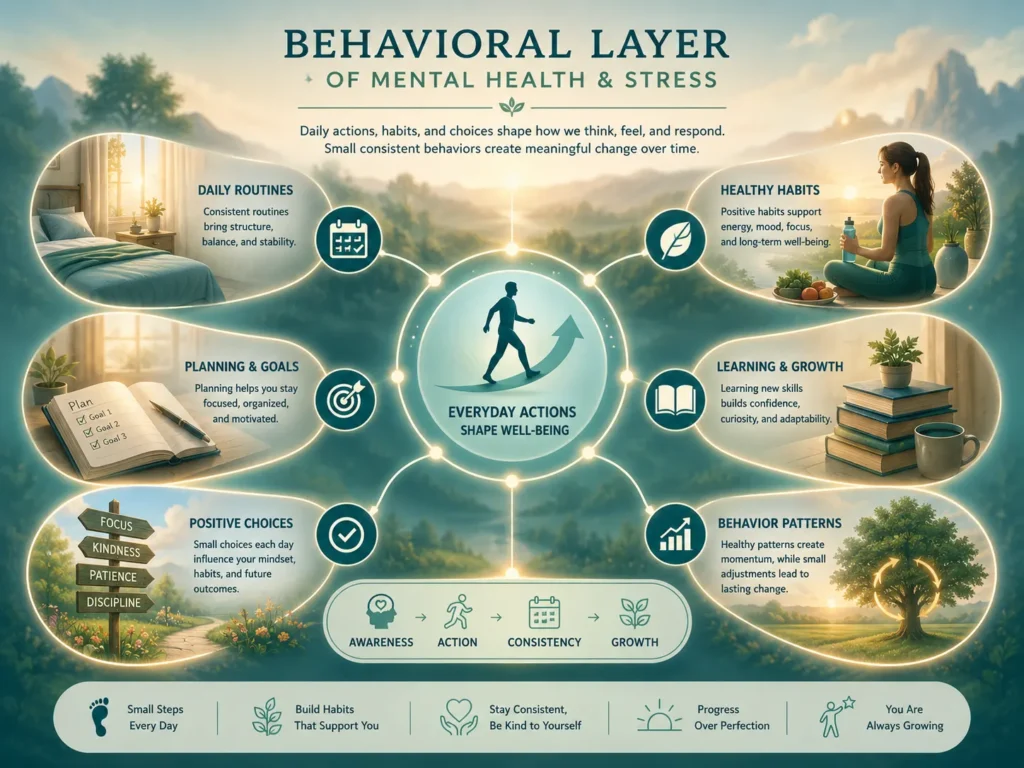
The behavioral layer focuses on actions. It explores how people respond to situations through habits, routines, choices, and daily activities.
Behavior matters because actions influence experiences. Experiences influence learning. Then learning influences future behavior. Because of this cycle, behavior plays a major role in adaptation and well-being.
Habits and Daily Patterns
Many behaviors occur repeatedly. Morning routines, work habits, social interactions, and leisure activities all contribute to daily patterns.
Over time, repeated actions often become familiar habits. These habits can influence well-being, productivity, and coping abilities.
Responses to Challenges
Behavioral responses often appear during challenging situations. Some people seek information. Others seek support. Another person may focus on planning or problem solving.
Different approaches can lead to different outcomes. Therefore, behavior remains an important part of understanding Mental Health & Stress.
Small Actions Matter
Many people focus on major changes. However, small daily actions can also influence long-term well-being. Consistent habits, repeated choices, and regular routines often create meaningful effects over time.
Because of this, behavior is one of the most practical layers of Mental Health & Stress.
Physical Layer of Mental Health & Stress
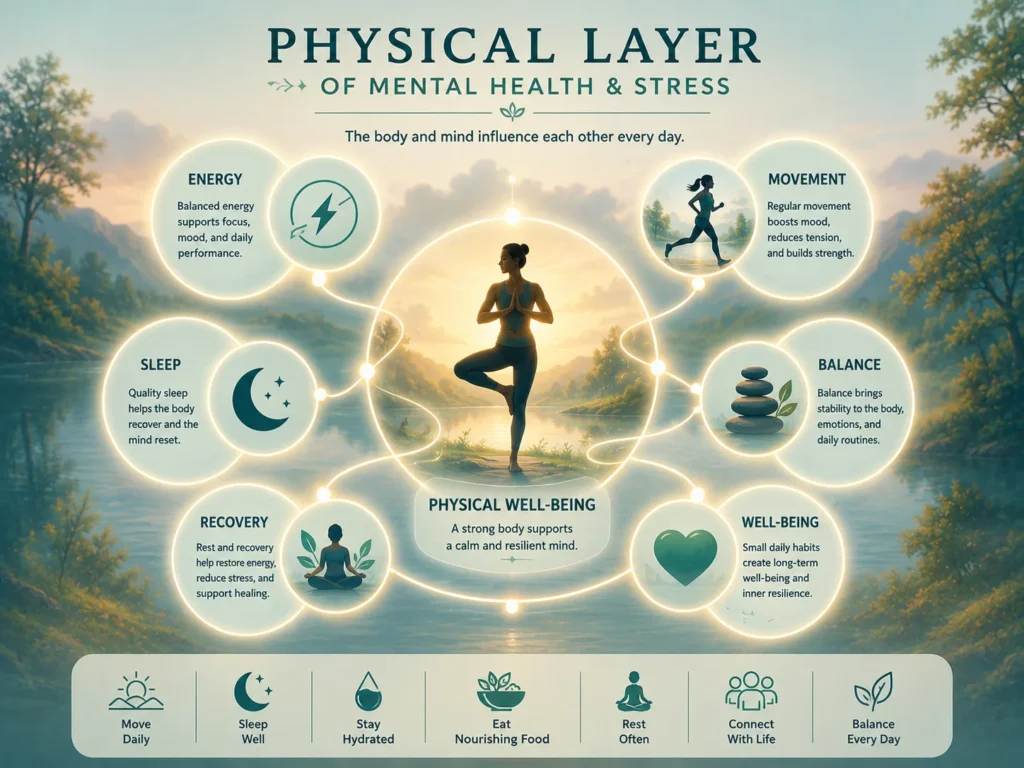
Mental experiences and physical experiences often influence one another. Because the mind and body constantly communicate, physical reactions frequently accompany emotional and psychological experiences.
For example, excitement may increase energy. Nervousness may create tension. Relief may create a sense of relaxation. These reactions demonstrate how physical and emotional processes can interact.
Energy and Recovery
Energy levels often change throughout the day. Sleep quality, activity levels, routines, and daily demands can all influence energy.
Recovery also plays an important role. Periods of rest and restoration help support future performance and well-being.
Physical Responses to Daily Demands
People often notice physical reactions during stressful or demanding situations. Increased alertness, muscle tension, or changes in focus may occur.
These responses are normal parts of how the body responds to experiences. Therefore, physical reactions are often included when discussing Mental Health & Stress.
The Mind-Body Connection
The physical layer highlights an important idea: mental experiences and physical experiences are closely connected. Understanding this relationship can help create a broader understanding of well-being.
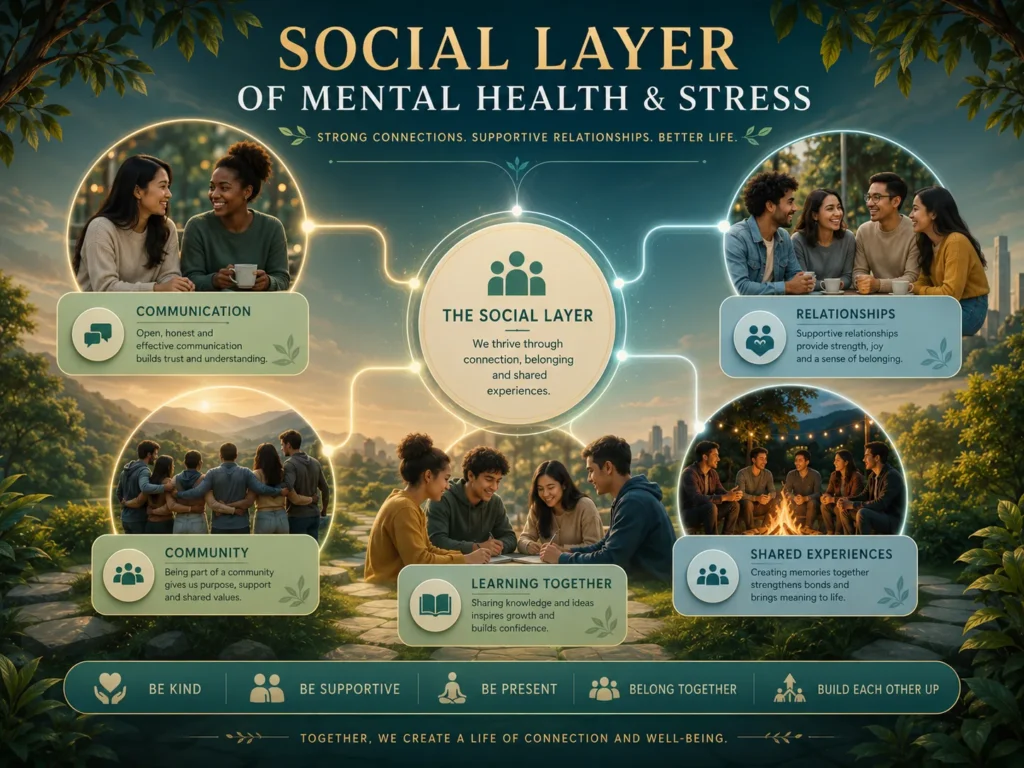
Social Layer of Mental Health & Stress
Humans are social beings. Relationships, communication, community, and social experiences influence well-being throughout life. Because of this, the social layer is an important part of Mental Health & Stress.
Family members, friends, coworkers, teachers, and community groups all contribute to social experiences. These interactions can influence learning, emotional experiences, and coping abilities.
Relationships and Well-Being
Relationships often provide opportunities for connection, support, learning, and growth. Positive social interactions can contribute to feelings of belonging and understanding.
At the same time, relationships may also involve challenges. Therefore, social experiences can influence Mental Health & Stress in many different ways.
Communication
Communication helps people share ideas, emotions, needs, and experiences. Effective communication can support understanding and cooperation.
Because communication influences relationships, it remains an important part of social well-being.
Community and Connection
People often benefit from feeling connected to larger groups and communities. Shared experiences, common goals, and meaningful interactions can contribute to social well-being.
As a result, the social layer plays a valuable role in understanding Mental Health & Stress.
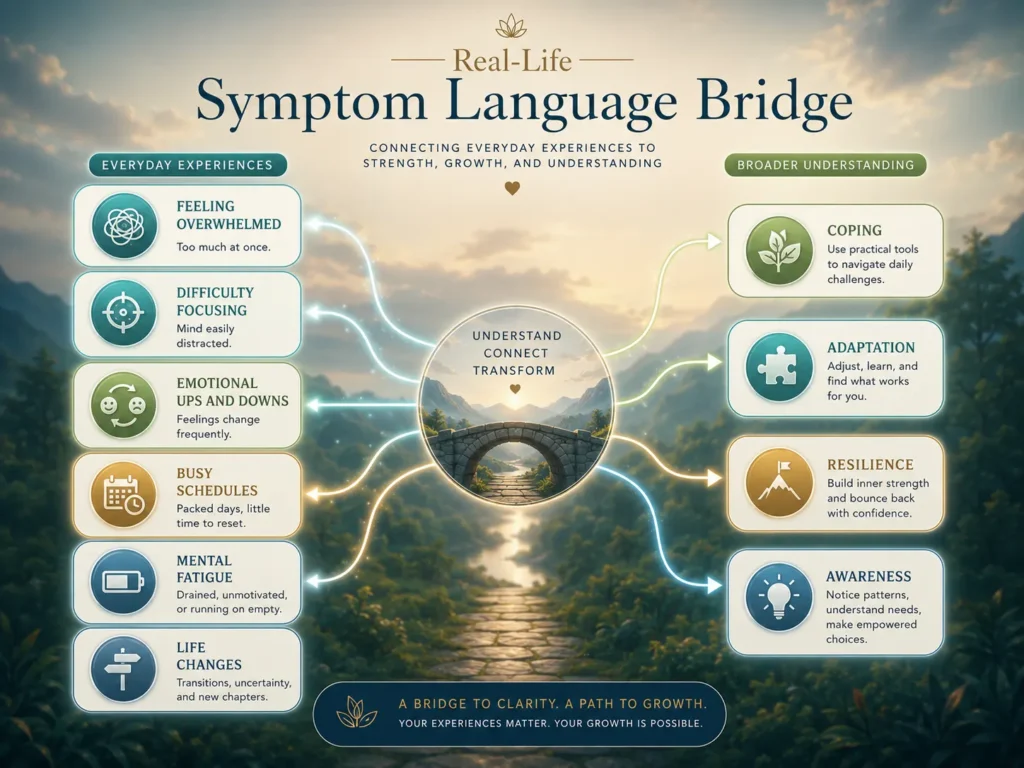
Real-Life Symptom Language Bridge
Many people search for Mental Health & Stress information because they notice changes in daily life. Some people feel overwhelmed during busy periods. Others struggle to concentrate when facing multiple responsibilities. Another person may notice changes in motivation, patience, or emotional balance.
These experiences can feel confusing at times. However, they often reflect the interaction between thoughts, emotions, behavior, and daily demands. Therefore, understanding Mental Health & Stress can help people better understand what they are experiencing.
For example, someone may say, “I feel mentally exhausted after a busy week.” Another person may say, “I find it harder to focus when I have too many responsibilities.” Others may notice that they become more irritable, distracted, or emotionally sensitive during demanding periods.
These experiences do not automatically indicate a health condition. Instead, they show how mental and emotional processes can influence daily life.
Understanding Everyday Experiences
Mental Health & Stress can influence many areas of life. Attention, learning, motivation, confidence, communication, and decision-making may all change depending on circumstances.
For example, a person facing a major deadline may find it difficult to relax. Someone adjusting to a life change may experience uncertainty. Another person learning a new skill may notice frustration during the early stages of learning.
Because people experience situations differently, responses can vary widely. Therefore, Mental Health & Stress should be viewed as highly individual experiences.
Important Educational Note
This page is educational. It does not diagnose medical conditions, mental health conditions, or emotional disorders. Symptoms can have many possible causes. Therefore, Mental Health & Stress should never be used as the only explanation for ongoing concerns.
If symptoms become severe, persistent, disruptive, or concerning, professional evaluation is important.
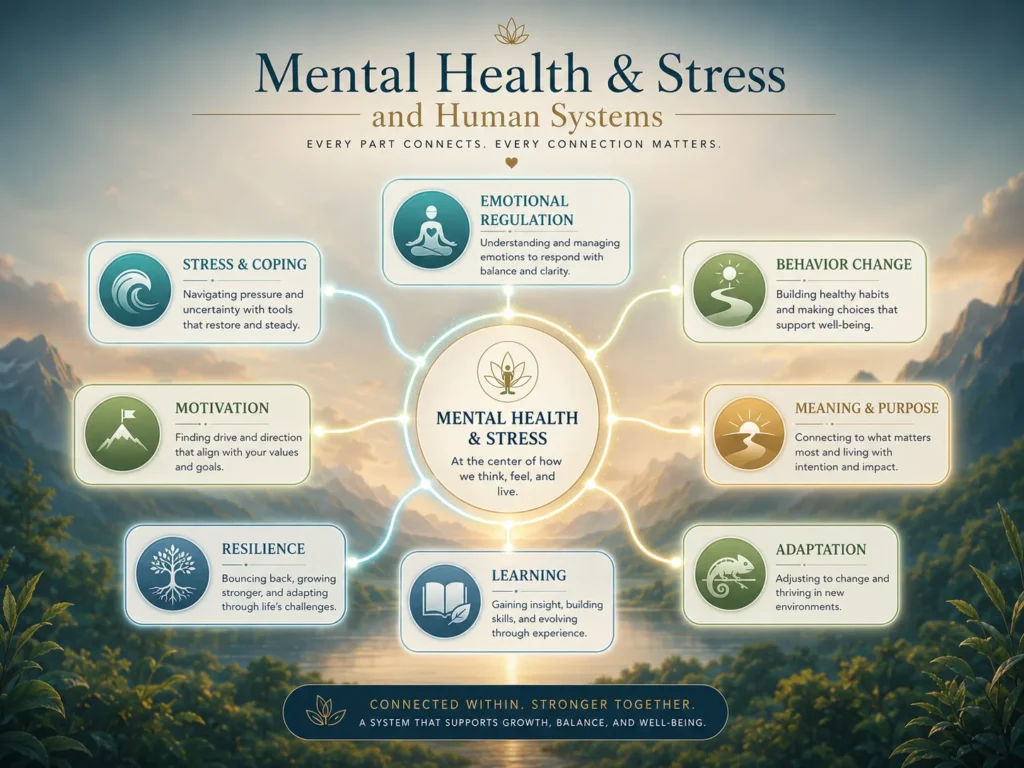
Mental Health & Stress and Human Systems
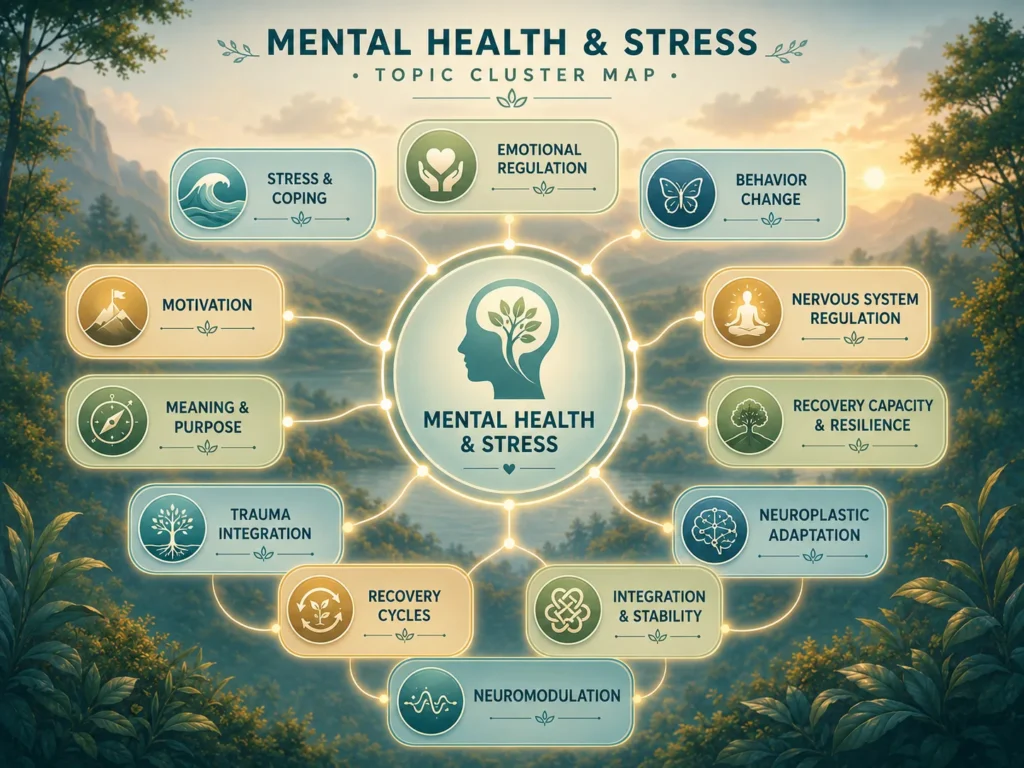
Mental Health & Stress connect with many Human Systems topics. This is because emotions, thoughts, motivation, behavior, meaning, coping skills, and adaptation often influence one another.
Rather than operating separately, these systems frequently interact throughout daily life. As a result, understanding one topic often helps explain another.
Emotional Regulation and Mental Health & Stress
Emotional Regulation focuses on understanding and responding to emotions. Since emotions influence stress responses, decision-making, and behavior, emotional regulation is closely connected to mental well-being.
For example, greater emotional awareness may help people recognize emotional patterns during challenging situations. Therefore, Emotional Regulation supports many aspects of Mental Health & Stress.
Stress & Coping and Mental Health & Stress
Stress & Coping explores how people respond to challenges and demands. Coping skills influence how situations are managed and interpreted.
Because stress responses play an important role in daily life, Stress & Coping remains one of the strongest connections within this topic cluster.
Behavior Change and Mental Health & Stress
Behavior Change focuses on habits, routines, and actions. Daily behaviors often influence emotional experiences, motivation, and resilience.
Small actions repeated consistently may influence long-term well-being. Therefore, behavior change and Mental Health & Stress frequently work together.
Motivation and Mental Health & Stress
Motivation influences effort, persistence, and engagement. During some periods, motivation may feel strong. During others, it may feel lower.
Because motivation influences learning, action, and goal pursuit, it remains closely connected to Mental Health & Stress.
Meaning & Purpose and Mental Health & Stress
Meaning & Purpose help people connect daily actions with larger goals and values. A strong sense of purpose often influences motivation, resilience, and long-term growth.
As a result, Meaning & Purpose naturally connect with Mental Health & Stress education.
Mental Health & Stress Interactions
Mental Health & Stress involve many ongoing interactions. Thoughts influence emotions. Emotions influence behavior. Behavior influences experience. Experiences influence future thoughts and emotions. Because of these connections, Mental Health & Stress are best viewed as dynamic systems rather than isolated events.
For example, a challenging situation may influence thoughts. Those thoughts may affect emotions. Emotions may influence behavior. The resulting experience may then create new learning. Therefore, many interactions occur simultaneously.
Understanding these interactions helps explain why well-being is often influenced by multiple factors rather than a single cause.
Thoughts, Emotions, and Behavior
One of the most important interactions involves thoughts, emotions, and behavior. These three elements constantly influence one another.
A positive experience may influence emotions. Emotions may influence behavior. Behavior may create additional positive experiences. Similarly, difficult experiences may also affect multiple layers at once.
Because these systems are connected, small changes in one area may influence other areas over time.
Relationships and Experiences
Social experiences also influence Mental Health & Stress. Communication, support, community, and shared experiences often contribute to well-being.
At the same time, challenges within relationships may create additional demands. Therefore, social experiences remain an important part of the overall picture.
Learning and Adaptation
Every experience provides opportunities for learning. Over time, learning can influence confidence, coping skills, and future responses.
Because learning supports adaptation, Mental Health & Stress often change as people gain experience and familiarity.
Practical Daily-Life Examples
Mental Health & Stress become easier to understand when viewed through everyday situations. Most people encounter challenges, responsibilities, changes, and opportunities throughout life. These experiences provide practical examples of how thoughts, emotions, and behavior interact.
Managing a Busy Schedule
A busy week may include work responsibilities, family obligations, appointments, and unexpected tasks. During these periods, some people may notice changes in focus, patience, or energy.
As responsibilities increase, stress levels may also change. However, planning, organization, and support can help people manage demands more effectively.
Preparing for an Important Event
Many people experience stress before an important presentation, interview, examination, or performance. Thoughts may focus on preparation and outcomes. Emotions may fluctuate throughout the process.
After the event, feelings often change again. This example shows how Mental Health & Stress can shift throughout a single experience.
Adjusting to Life Changes
Life changes often require adaptation. Moving, changing careers, starting school, becoming a parent, or entering retirement can all create new demands.
At first, these situations may feel unfamiliar. Over time, experience often helps people adjust. Therefore, adaptation remains an important part of Mental Health & Stress.
Building Healthy Habits
Many people work toward goals such as improving routines, managing time more effectively, or developing healthier habits.
Although progress may feel slow during the beginning, small actions often accumulate over time. As a result, consistent habits may support long-term well-being.
Mental Health & Stress Visual Flow
Mental Health & Stress can be understood as a continuous cycle of experience, interpretation, emotion, behavior, learning, and adaptation.
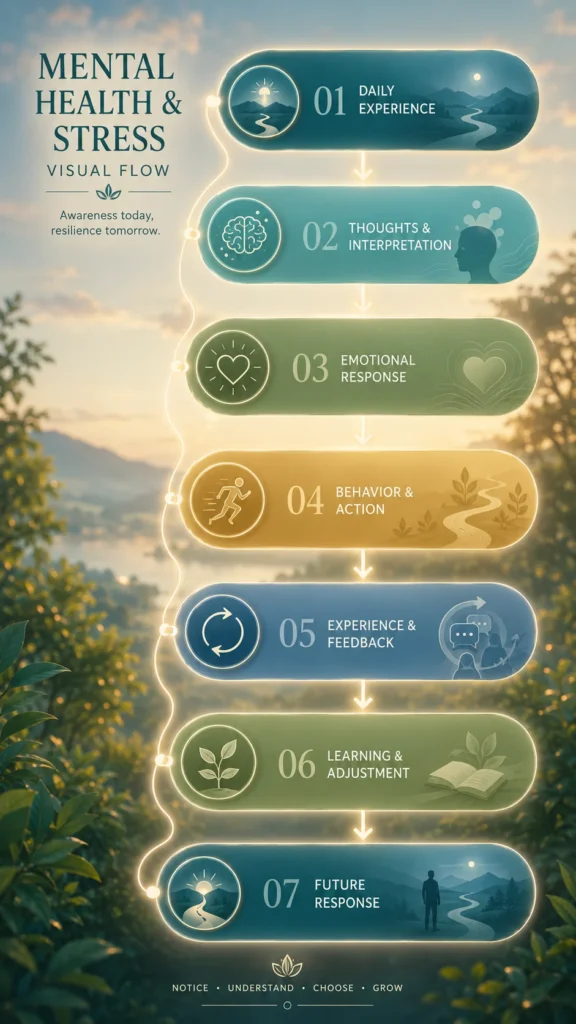
Daily Experience
↓
Thoughts and Interpretation
↓
Emotional Response
↓
Behavior and Action
↓
Experience and Feedback
↓
Learning and Adjustment
↓
Future Response
This visual flow highlights how thoughts, emotions, behavior, and experiences continuously influence one another.
Why Mental Health & Stress Matter
Mental Health & Stress matter because they influence nearly every area of daily life. They affect learning, relationships, communication, decision-making, behavior, resilience, and overall well-being.
Understanding these topics can help people recognize patterns, develop self-awareness, and better understand how experiences influence them over time.
Mental Health & Stress also influence adaptation. Life is constantly changing. Therefore, people must continue learning, adjusting, and responding to new situations. Understanding these processes can help create realistic expectations about growth and personal development.
Most importantly, Mental Health & Stress remind us that well-being involves many connected systems. Thoughts, emotions, behavior, relationships, experiences, and learning all contribute to the larger picture.
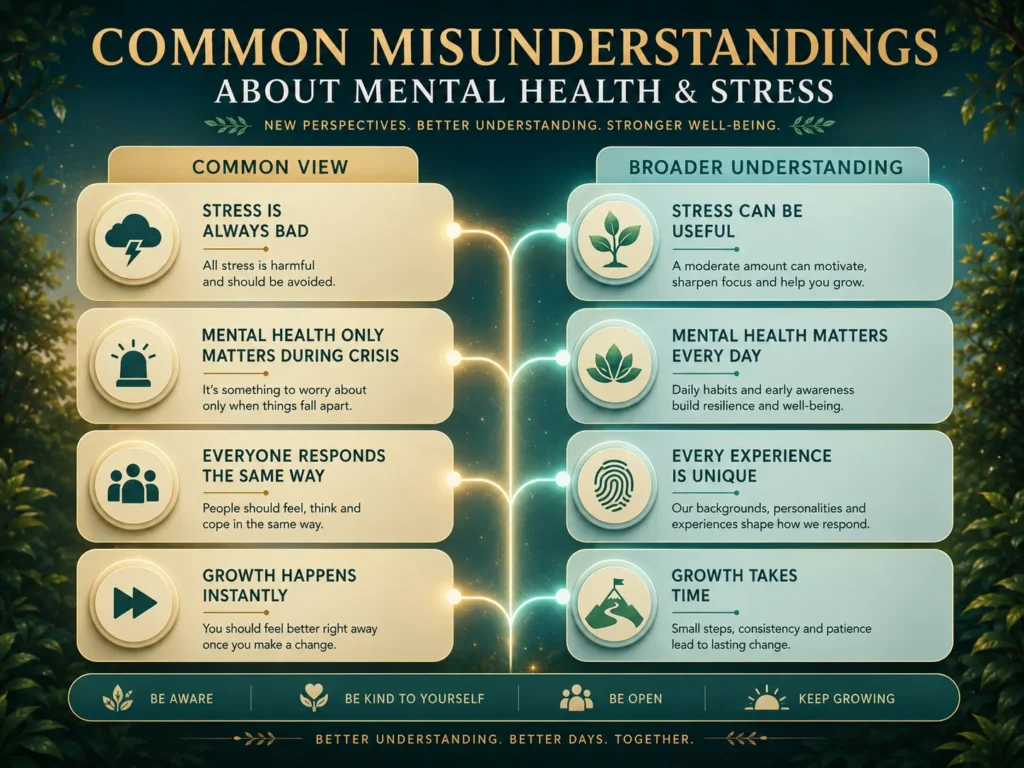
Common Misunderstandings About Mental Health & Stress
Mental Health & Stress are often misunderstood. Many people hear these terms and immediately think about severe problems or major life crises. However, Mental Health & Stress are part of everyday life for everyone. Understanding common misconceptions can help create a more balanced view of these topics.
Misunderstanding 1: Stress Is Always Bad
Many people assume stress is always harmful. In reality, stress is a normal response to demands, challenges, and change. For example, preparing for an important event may create stress. Learning a new skill may also create stress.
The key issue is not simply whether stress exists. Instead, it is how people respond to situations over time. Therefore, stress should be viewed as a normal part of life rather than something that automatically indicates a problem.
Misunderstanding 2: Mental Health Only Matters During Difficult Times
Mental health is important every day, not only during challenging periods. Thoughts, emotions, decision-making, communication, and relationships are all influenced by mental well-being.
Because mental health affects daily experiences, it remains relevant even when life feels stable and comfortable.
Misunderstanding 3: Everyone Responds to Stress the Same Way
People have different personalities, experiences, environments, and coping styles. As a result, individuals may respond differently to the same situation.
For example, one person may view a challenge as exciting. Another person may find the same challenge overwhelming. Therefore, stress responses are highly individual.
Misunderstanding 4: Mental Health Is Only About Emotions
Emotions are important, but mental health includes much more. Thoughts, learning, behavior, relationships, resilience, communication, and adaptation all contribute to mental well-being.
Because many factors are involved, Mental Health & Stress should be viewed from a whole-person perspective.
Misunderstanding 5: Growth Happens Instantly
Many people expect immediate improvement. However, learning, adaptation, and resilience usually develop over time. Small experiences often create gradual changes.
Therefore, progress is often best understood as a process rather than a single event.
Related Condition Connections
Some readers explore Mental Health & Stress while researching nerve-related conditions, recovery, resilience, or overall well-being. These connections do not mean mental health causes a specific condition. Instead, they help explain how different educational topics may overlap.
Related educational condition pages include:
Each condition has its own causes, contributing factors, and health considerations. Therefore, Mental Health & Stress should be viewed as one educational topic within a much larger learning framework.
Why These Connections Matter
Many readers begin with one topic and later explore related areas. Someone researching stress may become interested in resilience. Another person learning about recovery may later explore emotional regulation.
Because educational topics often overlap, these connections can help readers build a broader understanding of nervous system health and well-being.
How Mental Health & Stress Connect With Other Nerve Health Pages
Mental Health & Stress connect with many other pages across the Heal Your Nerves Naturally educational framework. This is because thoughts, emotions, behavior, coping skills, adaptation, and resilience often influence one another.
Rather than existing as separate topics, these areas frequently interact throughout daily life. Therefore, understanding one topic often helps explain another.
Connections With Human Systems
Human Systems topics provide some of the strongest connections. For example, Emotional Regulation explores how people understand and respond to emotions. Stress & Coping focuses on responses to challenges. Behavior Change examines habits and routines. Likewise, Motivation and Meaning & Purpose explore engagement, values, and personal growth.
Together, these topics help explain how people respond to everyday experiences and long-term challenges.
Connections With Recovery Systems
Recovery-related topics also play an important role. Recovery Capacity and Nervous System Resilience explores flexibility and recovery after demands. Recovery Cycles focuses on restoration and balance. Meanwhile, Integration and Stability examines long-term adjustment and consistency.
Because recovery influences adaptation and resilience, these topics naturally connect with Mental Health & Stress.
Connections With Nervous System Topics
Several nervous system topics provide additional context. Nervous System Regulation, Neuromodulation, and Neuroplastic Adaptation help explain how learning, experience, and adaptation influence future responses.
As a result, Mental Health & Stress can be viewed as part of a larger system that includes learning, behavior, resilience, recovery, and nervous system function.
Topic Cluster Placement
Within the Heal Your Nerves Naturally educational framework, Mental Health & Stress belong primarily within the Human Systems cluster.
This topic acts as a bridge between emotional experiences, stress responses, coping skills, resilience, behavior, and personal growth. Because of this role, it connects naturally with multiple educational systems across the site.
Primary Cluster
Direct Connections
Supporting Connections
• Recovery Capacity and Nervous System Resilience
As a result, Mental Health & Stress serve as one of the foundation topics within the Human Systems educational framework.
Mental Health & Stress FAQ
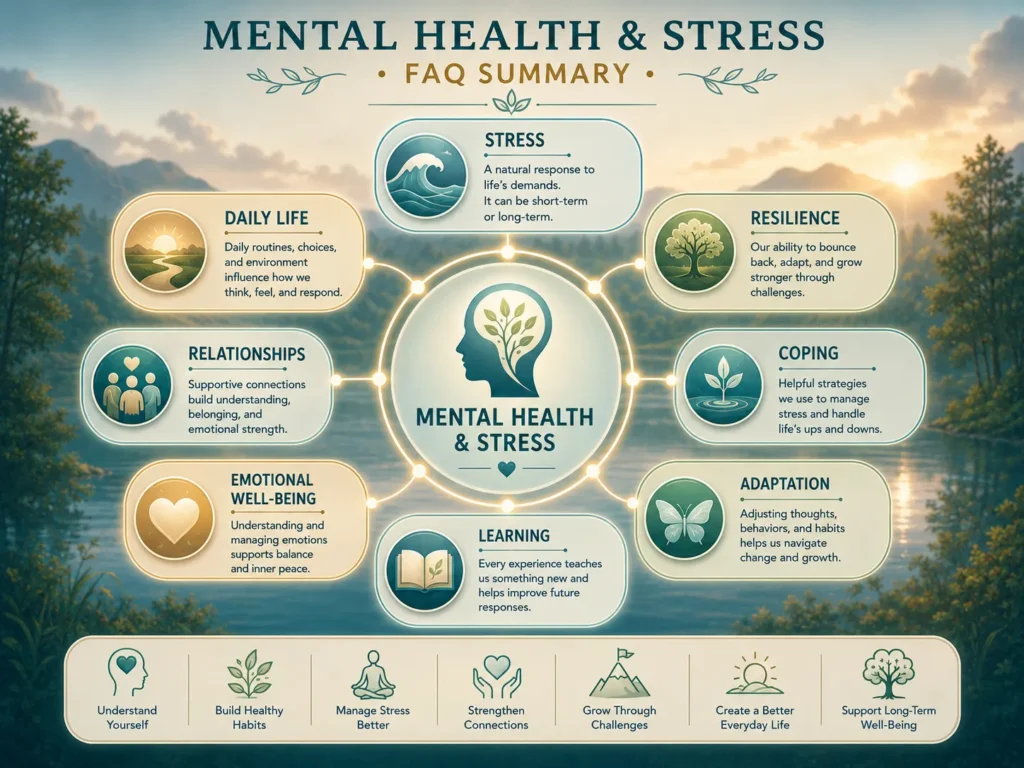
What are Mental Health & Stress?
Mental Health & Stress refer to the ways thoughts, emotions, experiences, and daily demands influence well-being, behavior, coping, and adaptation.
Is stress a normal part of life?
Yes. Stress is a normal response to challenges, change, responsibilities, and new situations.
Do all people experience stress?
Yes. Although experiences differ, everyone encounters stress in some form throughout life.
Can stress influence emotions?
Yes. Stress and emotions often interact with one another. Because of this, stressful situations may influence emotional experiences.
Why do people respond differently to stress?
People have different experiences, personalities, environments, learning histories, and coping styles. Therefore, responses can vary from person to person.
Is Mental Health only about emotions?
No. Mental health also involves thoughts, behavior, relationships, communication, coping skills, resilience, and adaptation.
Can Mental Health & Stress change over time?
Yes. Experiences, learning, relationships, and life circumstances can influence mental well-being throughout life.
What is resilience?
Resilience refers to the ability to adapt and continue moving forward through challenges and change.
How do coping skills help?
Coping skills help people manage situations, demands, and experiences more effectively.
Is this page a medical guide?
No. This page is educational and does not provide diagnosis, treatment, or medical advice.
Continue Learning
Mental Health & Stress are only one part of a larger learning journey. The topics below explore related areas such as emotional awareness, coping, resilience, motivation, behavior change, adaptation, and nervous system function. Together, these pages can help create a broader understanding of well-being and everyday life.
To continue exploring related topics, consider reading:
• Recovery Capacity and Nervous System Resilience
Sources / References
The information presented on this page is based on educational concepts from psychology, neuroscience, behavioral science, stress research, emotional well-being, resilience research, and nervous system education. To support accuracy and encourage further learning, the resources below were selected from trusted health, science, and educational organizations.
Readers who want to explore Mental Health & Stress, emotional well-being, resilience, coping skills, stress responses, and nervous system function in greater depth may find these sources helpful. However, this page is designed as an educational overview rather than a scientific review or medical guideline.
Recommended educational resources:
• National Institute of Mental Health (NIMH)
• National Institutes of Health (NIH)
• National Center for Biotechnology Information (NCBI)
• American Psychological Association (APA)
• Centers for Disease Control and Prevention (CDC)
These organizations provide educational information about mental well-being, stress, resilience, coping, learning, and overall health.
Author / Editorial Trust Note
This page was created as part of the Heal Your Nerves Naturally educational platform. The goal is to help readers understand important health and well-being topics in a clear, practical, and easy-to-follow way.
Many topics related to Mental Health & Stress can feel confusing because they often involve emotions, thoughts, behavior, relationships, and daily life experiences. Therefore, this page focuses on explaining these ideas using simple language whenever possible. The aim is not to overwhelm readers with technical terms. Instead, the goal is to make complex information easier to understand.
Throughout this page, Mental Health & Stress are discussed from an educational perspective. Rather than focusing on diagnosis, treatment, or medical advice, the content helps explain how thoughts, emotions, coping skills, resilience, learning, and everyday experiences can influence well-being over time.
In addition, information is organized in a step-by-step format so readers can build understanding gradually. Many people arrive with different levels of knowledge. Some may be completely new to the topic. Others may already be familiar with certain concepts. Because of this, the content is designed to be useful for a wide range of readers.
Whenever possible, technical language is simplified while maintaining educational accuracy. Furthermore, examples, explanations, and practical descriptions are included to help connect information with real-life experiences. As a result, readers can explore Mental Health & Stress in a way that feels more relevant and easier to understand.
The Heal Your Nerves Naturally platform is dedicated to education, awareness, and learning. Therefore, every effort is made to present information in a balanced, responsible, and reader-friendly manner. The purpose is to support understanding, encourage curiosity, and help readers explore how mental well-being, stress, resilience, adaptation, and nervous system function connect within everyday life.
Educational Trust Note
Mental Health & Stress are studied across psychology, neuroscience, behavioral science, public health, education, and human development. Research in these fields continues to evolve as scientists learn more about the connections between thoughts, emotions, behavior, resilience, adaptation, and nervous system function.
This page focuses on broad educational principles rather than clinical guidance. The goal is to help readers understand how Mental Health & Stress fit within a larger framework of learning, adaptation, recovery, and well-being.
Safety & Education Notice
This page is for educational purposes only. It does not diagnose, treat, cure, or prevent any disease, mental health condition, or medical condition.
Mental Health & Stress can be influenced by many factors. Therefore, information presented here should not be used as a substitute for professional medical, psychological, or mental health advice.
If symptoms become severe, persistent, disruptive, or concerning, support from qualified healthcare professionals is important.
Mental Health & Stress should be viewed as educational topics that help explain emotional experiences, coping, resilience, learning, adaptation, and everyday well-being. They should not be used as a replacement for professional evaluation, diagnosis, treatment, or crisis support.