
Nerve Recovery Guides: Find the Right Path for Your Symptoms and Recovery Stage
These Nerve Recovery Guides are built for real life. You may have a tingling hand, a numb foot, burning pain at night, new weakness, or an old injury that still does not feel normal. You probably do not need another vague lesson about nerves. Instead, you need help deciding what matters today, what you can change, what to watch, and when to go deeper.
That is what this page is for.
Nerve recovery rarely fits neatly into a single article because “nerve damage” can describe very different problems. A mildly compressed nerve, an injured peripheral nerve, diabetic neuropathy, a vitamin deficiency, an inflammatory neuropathy and a nerve affected by poor circulation do not have the same cause, timeline or treatment. The National Institute of Neurological Disorders and Stroke notes that more than 100 types of peripheral neuropathy have been identified, with symptoms and recovery patterns depending on which nerves are affected and why.
Therefore, you do not have to read these Nerve Recovery Guides from top to bottom in one sitting.
Use these Nerve Recovery Guides as a recovery home base. Start with the question that sounds most like your life today. Try the practical steps that are safe for your situation. Notice what changes. Then come back when your symptoms, function or questions change.
A useful recovery question is not only “Does it hurt less?” It is also “Can I do more, sleep better, move more comfortably, tolerate daily life longer, and recover from activity more predictably?”
How to Use These Nerve Recovery Guides
Use one section at a time. First, pick the problem that matters most today. Next, try one safe step that fits your situation. Then, watch what changes before you add more.
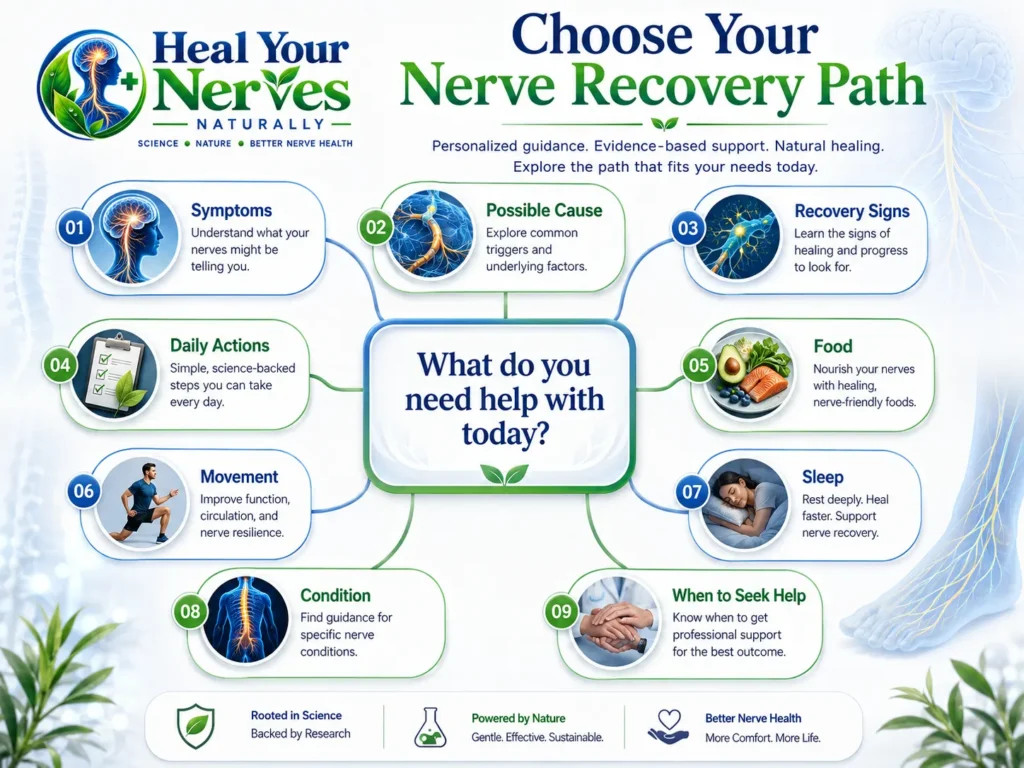
Nerve Recovery Guides: Start Here With What You Need Today
First, choose the route in these Nerve Recovery Guides that sounds closest to your current problem.
- Tingling, pins and needles, burning or altered sensation: start with symptoms of nerve dysfunction and the symptom guide below.
- Numbness that makes you unsure whether you are improving: go to Is This Nerve Healing—or Is the Nerve Still Irritated?
- Weakness, dropping objects, tripping or reduced control: read the weakness section and the medical-safety section before focusing on lifestyle changes.
- Symptoms that change with posture, sitting, wrist position or repetitive work: explore nerve compression and mechanical causes of nerve irritation.
- Symptoms after a fall, fracture, surgery, stretch, cut or other injury: visit post-injury nerve damage.
- Symptoms with diabetes or unstable blood glucose: review diabetic neuropathy and metabolic factors that can affect nerves.
- You want to know what to eat: use the practical Nerve Food Repair guide.
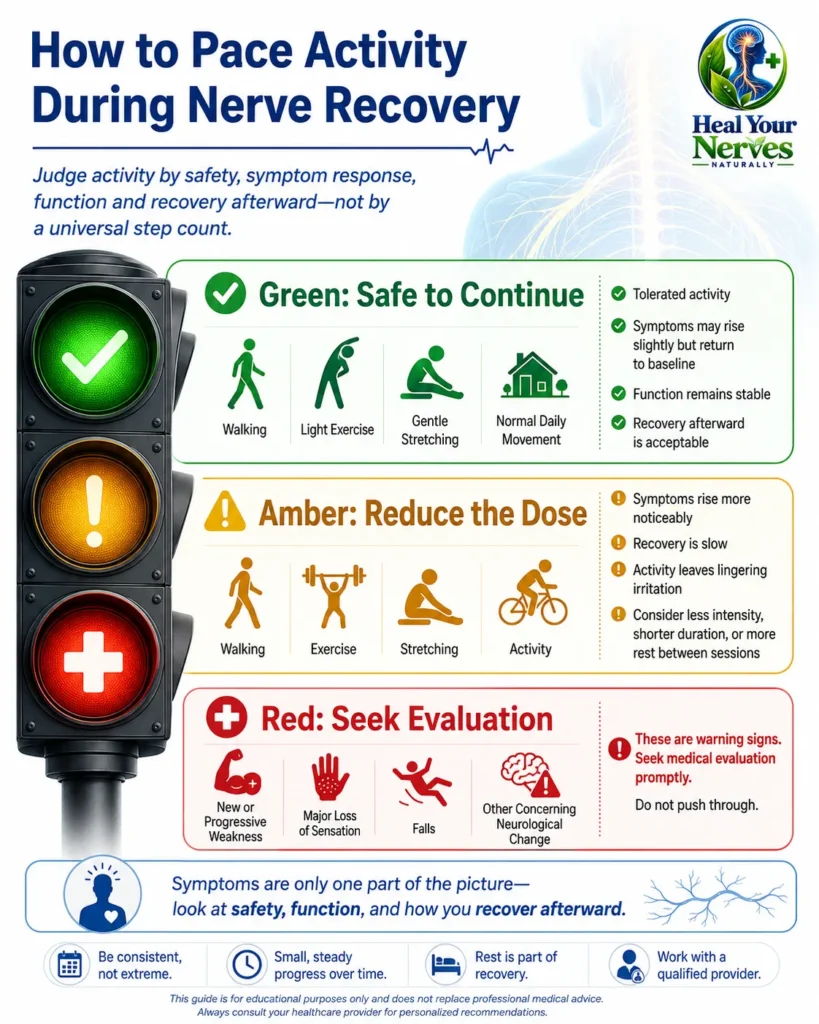
- You want to move but do not know how much is too much: jump to Rest, Walk, Stretch or Exercise?
- Symptoms are worse at night: jump to When Nerve Symptoms Interfere With Sleep.
- You are having good days and bad days and cannot tell whether you are progressing: jump to Good Days, Bad Days and Flare-Ups.
- You simply do not know where to begin: start with the next section and complete the 7-Day Practical Recovery Reset later in this guide.
Nerve Recovery Guides by Symptom: What Are You Feeling Right Now?
In addition, the words people use for nerve symptoms are often imprecise because abnormal nerve sensations are difficult to describe. Tingling may feel like static, fizzing, tiny electric pulses or “ants.” Burning may feel hot, sunburn-like or deep inside the skin. Numbness may mean complete loss of sensation, dulled sensation, or the strange feeling that a sock is present when it is not.
That variability is one reason diagnosis depends on more than one sensation. According to MedlinePlus, peripheral nerve problems can include tingling, burning, deep pain, numbness, weakness, muscle control problems and balance changes. The pattern, timing, location and associated symptoms matter.
Tingling or Pins and Needles
Nerve Recovery Guides check-in: Notice the pattern before you judge the symptom.
For example, a brief episode of tingling after sitting in one position can be very different from tingling that returns every night, spreads over weeks, follows an injury, or appears with weakness.
Ask yourself:
- Where exactly is the tingling?
- Is it on one side or both?
- Which finger, toe, arm or leg does it follow?
- Notice whether sitting, bending, leaning on an elbow, crossing your legs or using a keyboard changes it.
- What happens when you walk: better, worse or no change?
- Did it begin after an injury, illness, medication change or period of repetitive work?
- Is it becoming more frequent, more widespread or more intense?
What you can do today: stop trying to judge the symptom from intensity alone. Write down the trigger, location and duration. A repeated pattern can be more informative than a single “7 out of 10” score.
Habit worth reviewing: prolonged pressure. If you often lean on your elbows, sit with one leg tucked under you, keep your wrist bent for long periods or wear equipment that presses on a sensitive area, experiment with reducing sustained pressure.
Go deeper: if the symptom clearly changes with position or pressure, read about pressure-related nerve compression.
Numbness
Nerve Recovery Guides safety note: Reduced feeling changes what you need to protect, not only what you need to treat.
In addition, numbness deserves respect because reduced sensation can affect safety as well as comfort. If you cannot reliably feel temperature, sharp objects or pressure, you may not notice an injury when it happens. MedlinePlus specifically recommends protecting numb feet from heat, sharp objects and prolonged pressure and checking the feet regularly when sensation is reduced.
What you can do today:
- Identify the exact numb area rather than saying “my whole leg” or “my foot.”
- Compare the area every few days, not every five minutes.
- Protect reduced-sensation skin from heat and injury.
- Notice whether the numbness is stable, shrinking, spreading or accompanied by new weakness.
- If numbness is ongoing or unexplained, get a medical review rather than assuming it is “just a nerve waking up.”
If numbness affects both feet in a stocking-like pattern, particularly with diabetes or other metabolic risk, review peripheral neuropathy. If it follows a clear injury, use the post-injury nerve damage guide.
Burning, Electric, Shooting or “Hot” Nerve Pain
Nerve Recovery Guides check-in: Ask what triggers the burning, how long it lasts, and what else changes with it.
Likewise, neuropathic pain can be burning, electric, stabbing, shooting or painful even with light touch. NINDS notes that neuropathic pain may be worse at night and that even normally non-painful contact, such as bedsheets, can sometimes hurt.
For example, a common search question is: “Is burning a sign of nerve healing?”
The safest answer is: not by itself.
Changing sensations can occur during recovery, but burning pain is not a reliable home test of successful nerve regrowth. Burning can also occur when a nerve remains irritated or when neuropathic pain signaling is still active.
Instead of asking only, “Is this burning good or bad?” ask:
- Is the area of symptoms getting smaller or larger?
- Has daily function improved?
- What is happening to strength: better, stable or worse?
- Does burning appear after a clear movement or task?
- Has sleep become better or worse?
- Are new nerve-related symptoms appearing?
If ongoing nerve pain is becoming a major part of daily life, review chronic nerve pain and how pain processing can change.
Weakness, Reduced Grip or Trouble Walking
Nerve Recovery Guides safety note: New or worsening weakness deserves more attention than a simple change in sensation.
However, weakness is different from pain avoidance. A painful hand may be used less because it hurts; a neurologically weak hand may actually be unable to generate normal force.
Examples worth paying attention to include:
- often dropping objects,
- difficulty lifting the front of the foot,
- a leg unexpectedly buckling,
- inability to perform a movement you could recently perform,
- worsening grip,
- difficulty rising from a chair that is new for you,
- visible muscle shrinking,
- progressive difficulty walking.
Do not make a new or worsening weakness problem into a home-exercise challenge. NINDS identifies weakness and muscle atrophy among motor-nerve symptoms, and medical review can help determine whether a nerve, muscle or another nerve problem is responsible.
Go deeper: how nerve dysfunction is evaluated.
Back-to-Leg or Sciatic-Type Symptoms
Pain, tingling or numbness that travels from the lower back or buttock into the leg often leads people to search for “sciatic nerve recovery.” The practical issue is that not every leg sensation has the same mechanism, and symptoms can change with posture, movement and spinal loading.
If this sounds familiar, use sciatic nerve pain for the condition-specific explanation rather than trying to turn this general guide into a sciatica diagnosis.
For daily life, start by recording:
- how long you can sit before symptoms change,
- how walking affects symptoms,
- which positions relieve them,
- whether numbness or weakness is progressing,
- and whether symptoms return to baseline after movement.
That pattern is more useful than forcing yourself to reach a random step-count target.
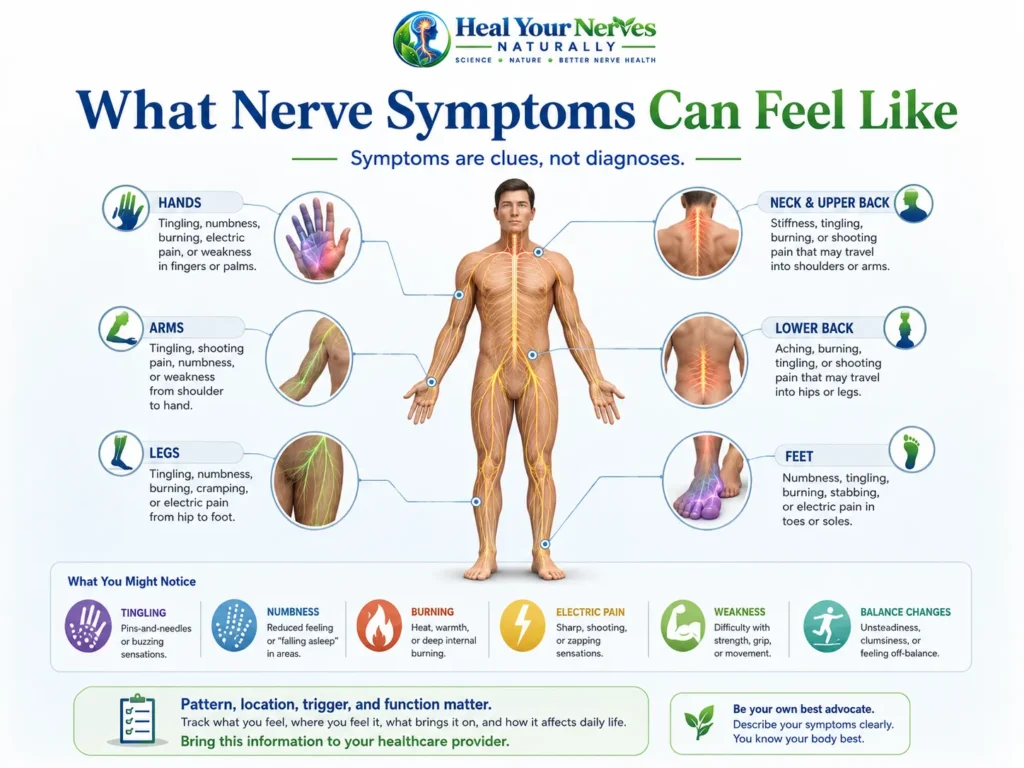
Nerve Recovery Guides: Is This Healing—or Is the Nerve Still Irritated?
Therefore, this is one of the hardest parts of nerve recovery: sensations can change before you understand what the change means.
For example, a person may have less severe pain but more tingling. Also, another may walk farther but still have numb toes. Someone recovering after decompression may feel better lying down but notice tingling after sitting. Likewise, another person with metabolic neuropathy may have symptoms that change with sleep, glucose control, movement or illness.
The biology also differs by injury type. In peripheral nerve injury, mild conduction-block injuries can recover more quickly, while axonal injuries may require regrowth over a distance. The NCBI StatPearls review on peripheral nerve injury describes very different recovery expectations depending on whether the nerve is mildly compressed, has axonal disruption, or is more severely injured. It also notes that axonal regeneration is slow and variable.
Better Questions Than “Is Tingling a Healing Sign?”
Try these instead:
Is the symptom distribution changing?
A smaller area of numbness may be meaningful. A symptom spreading into a completely new region may deserve reassessment.
Is your function changing?
Can you hold a mug more securely? Type longer? Walk farther? Sleep without waking as often? Stand long enough to prepare a meal? Climb stairs with less difficulty?
Function is often easier to compare than strange sensory qualities.
Is your movement tolerance changing?
If you could previously sit for 10 minutes before symptoms intensified and now you can sit for 30 minutes, that is a practical change even if some tingling remains.
Are flare-ups shorter?
If symptoms increase after movement but return to baseline more predictably, that may represent a different situation from symptoms that escalate and remain elevated day after day.
Is strength stable or improving?
Progressive weakness is not something to reinterpret as “healing pain.”
What Nerve Recovery Guides Should Help You Notice in Real Life
However, recovery is rarely a clean line from “bad” to “good.”
It may look like:
- a numb patch becoming smaller,
- burning becoming less constant,
- fewer sleep interruptions,
- longer walking tolerance,
- improved grip,
- fewer sharp electric episodes,
- better balance,
- being able to work longer before needing a position change,
- symptoms settling faster after normal activity,
- fewer “lost days” after doing too much.
That is why we recommend tracking function, tolerance and recovery after movement, not just pain.
Do Nerves Really Regrow?
Some peripheral nerves have meaningful ability to regrow, but the potential depends heavily on the type and severity of damage. A nerve that is mildly compressed but structurally intact is a very different problem from a nerve that has been severely disrupted.
If you want the biology rather than the practical overview, read how nerve regrowth works, axonal regrowth and myelin regeneration.
Nerve Recovery Guides by Cause: Why Might Your Symptoms Be Happening?
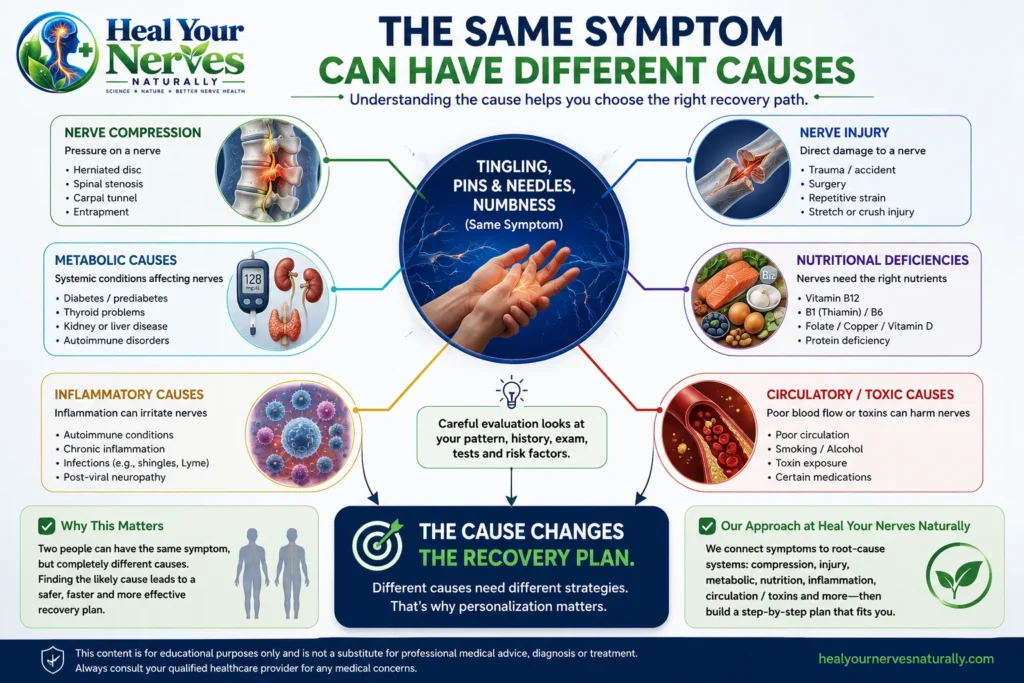
In addition, the most useful recovery plan often begins with cause. If the cause remains active, adding more supplements, stretching harder or chasing “nerve regrowth hacks” can distract from what actually needs attention.
Mechanical Pressure or Repetitive Irritation
Nerve Recovery Guides practical step: Look for pressure, position, or repeated movement that you can change today.
Clues may include:
- symptoms change with posture,
- prolonged sitting or leaning triggers symptoms,
- wrist or elbow position changes hand symptoms,
- repetitive work consistently aggravates the same distribution,
- symptoms improve when pressure is removed.
NINDS lists trauma, prolonged pressure, repetitive forceful activities and compression among causes of acquired peripheral neuropathy or nerve injury.
Explore mechanical causes of nerve irritation and nerve compression.
Injury
Falls, fractures, dislocations, cuts, surgical procedures and severe stretching can injure peripheral nerves. The recovery question after injury is not only “How do I make the nerve heal faster?” but also:
- What type of injury occurred?
- Could pressure still be affecting the nerve?
- Has the nerve stayed intact?
- Can you see function returning?
- Would rehab now be useful?
- Does the injury require specialist follow-up?
Mayo Clinic emphasizes that treatment depends on the extent and cause of peripheral nerve injury and on whether the nerve is healing appropriately. Some injuries can be observed and rehabilitated; severe disruption may require surgery.
Explore post-injury nerve damage.
Metabolic Factors, Especially Diabetes
Nerve Recovery Guides next step: When metabolism is part of the picture, lifestyle support and medical care need to work together.
High blood glucose can damage nerves over time. The CDC notes that diabetic nerve damage often affects the feet and may cause tingling, pain, sensitivity, numbness or weakness. Foot injuries can also go unnoticed when sensation is reduced.
If diabetes is part of your picture, glucose management is not a side topic; it is part of the nerve-health plan.
Explore diabetic neuropathy and metabolic factors that can affect nerves.
Nutritional Deficiency—or Too Much of a Supplement
Vitamin B12 deficiency can produce numbness and tingling and can affect the nervous system even without obvious anemia. The NIH Office of Dietary Supplements emphasizes that nerve-related symptoms can occur with B12 deficiency and that early diagnosis matters.
However, “nerve vitamins” are not always harmless. Excess vitamin B6 from supplements can itself cause sensory neuropathy; the NIH vitamin B6 fact sheet specifically describes neuropathy as a risk of excessive chronic intake.
That makes a supplement audit more useful than blindly adding another B-complex.
Explore nutritional deficiencies linked with nerve dysfunction and micronutrients involved in nerve function.
Inflammation and Immune-Mediated Neuropathy
Some neuropathies involve immune attack on peripheral nerves or myelin. These are not conditions to manage with lifestyle measures alone.
If symptoms are progressive, widespread, associated with major weakness, or occur in the context of a known autoimmune condition, the right question is not “Which anti-inflammatory food should I try first?” It is “Has the underlying neurological process been properly evaluated?”
Explore inflammatory pathways affecting nerves, neuroinflammation and autoimmune nerve disorders.
Circulation, Toxins, Alcohol and Medication Context
Peripheral nerves depend on adequate blood supply and can also be affected by toxins, heavy alcohol exposure and some medications. NINDS includes vascular problems, toxins, alcoholism and several medication classes among possible causes of acquired neuropathy.
Do not stop prescription medication because you read a list online. Instead, make a complete medication and supplement list and discuss timing and risk with the clinician who is evaluating your symptoms.
Explore circulatory impairment and nerve health and toxic load and nerve health.
When Nerve Recovery Guides Cannot Identify the Cause
Not knowing the cause can be frustrating, but it is also a reason not to overcommit to a single self-treatment theory.
For example, a clinical work-up may include history, nerve exam, blood tests, imaging, nerve conduction testing or EMG depending on the pattern. NINDS describes these tools as ways clinicians assess the type, extent and possible cause of neuropathy.
Use how nerve dysfunction is evaluated as your next step if the cause remains unclear.
Nerve Recovery Guides: What Can You Realistically Do Today?
For example, when people are frightened by nerve symptoms, they often swing between two extremes: doing nothing. This is because they are afraid to move, or trying ten supplements, stretches and treatments at once.
For example, a better starting point is usually smaller.
1. Remove One Obvious Aggravator
Nerve Recovery Guides practical step: Start with one clear stressor. Do not redesign your whole life at once.
If a symptom often appears after prolonged elbow pressure, wrist bending, crossed-leg sitting, tight footwear or one repetitive task, reduce that exposure before adding a complicated recovery routine.
The goal is not “perfect posture.” It is less unbroken stress on the same tissue.
2. Change Position Before Symptoms Become Intense
If your job requires sitting, “never sit” is not practical advice. Instead, learn how long you can currently stay in one position before symptoms change.
For example, if symptoms reliably increase around 45 minutes, try changing position earlier. Stand briefly. Walk a short distance if appropriate. Adjust the task. Then return.
Explore movement and posture for nerve regulation.
3. Keep a Simple Symptom-and-Function Note
Nerve Recovery Guides check-in: Track function as well as discomfort. That gives you a better view of change.
Track only a few variables:
- main symptom,
- location,
- movement trigger,
- sleep quality,
- walking or sitting tolerance,
- one functional task,
- whether you returned to baseline after movement.
This creates useful clues without turning your day into constant symptom surveillance.
4. Protect Numb Areas
If you have reduced sensation in your feet, hands or another area, safety becomes part of recovery.
MedlinePlus recommends daily foot inspection for people with neuropathy, checking footwear for rough areas or objects, using lukewarm rather than untested hot water, and avoiding prolonged pressure on numb areas.
These are not glamorous “nerve hacks.” They are practical ways to prevent a second problem while sensation is impaired.
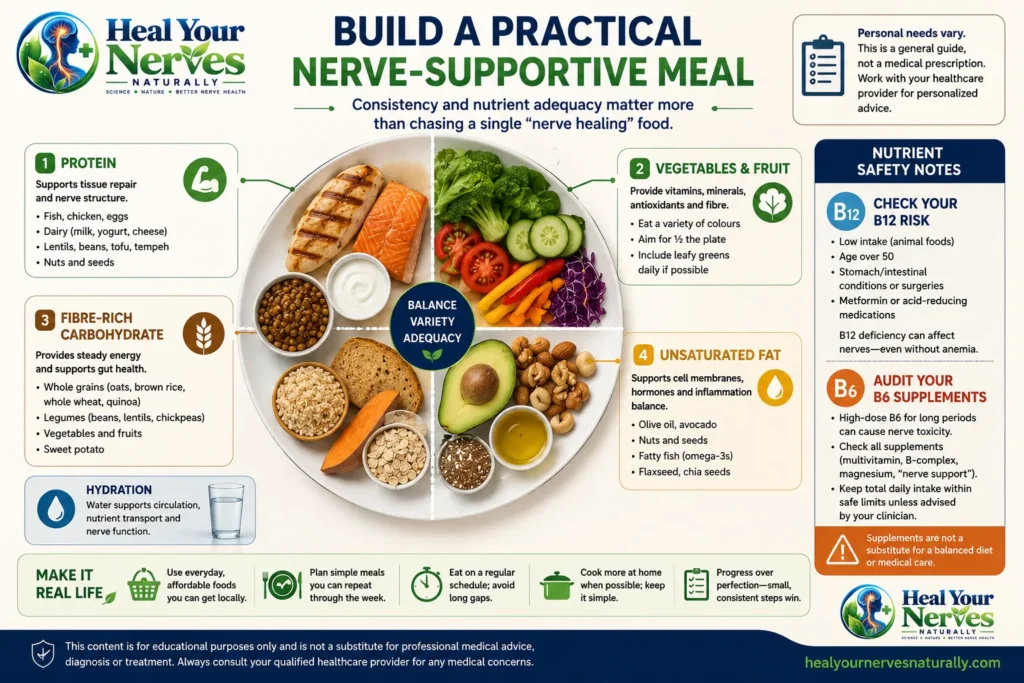
5. Make One Meal More Reliable
Do not redesign your entire diet in one day. Pick the meal that is currently most chaotic.
Aim for a practical combination of:
- a protein source,
- vegetables or fruit,
- a fibre-rich carbohydrate where appropriate,
- unsaturated fat,
- and attention to nutrients that may be relevant to your diet or medical history.
For meal-by-meal help, use Nerve Food Repair. For the deeper science, see how nutrition supports nerve repair.
6. Review Supplements Before Buying More
Look at the labels of every supplement you take. B6 can appear in multivitamins, B-complex products, energy products and “nerve support” formulas. Add the amounts together.
If you have neuropathy symptoms and take multiple supplements, discuss the total with a clinician or pharmacist rather than assuming higher doses are safer.
7. Make Sleep More Predictable
If symptoms are worse at night, start with regular sleep and wake times, a more comfortable pressure-free position, and a plan for what you will do when symptoms wake you.
Explore sleep and nerve recovery rather than treating sleep as an optional extra.
8. Move Within Your Current Capacity
Nerve Recovery Guides movement rule: Use a dose you can recover from. Then adjust it from your response.
movement can support strength, mobility, balance and overall health, but your dose matters.
The Foundation for Peripheral Neuropathy recommends a personal exercise plan and notes that physical therapy can help maintain strength, balance and function. If you are greatly deconditioned, weak, at fall risk or unsure what is safe, professional rehab guidance is more useful than copying a generic workout.
Explore movement therapy for nerve recovery.
9. Address the main condition
If diabetes, B12 deficiency, compression, inflammatory disease or another identifiable cause is driving the problem, managing that cause is part of nerve recovery—not a separate project.
10. Decide What You Will Observe for the Next Seven Days
Choose one or two variables. Not ten.
For example:
“For one week I will change position before the tingling becomes strong and track how long I can comfortably work.”
Or:
“For one week I will protect my numb foot, check it daily, keep breakfast consistent and record whether nighttime burning changes.”
Small experiments create useful clues. Those clues help you make better next decisions.
Nerve Recovery Guides for Movement: Rest, Walk, Stretch or Exercise?
Therefore, this may be the most common practical dilemma in nerve recovery.
For example, a person reads that movement is good, walks much farther than usual, then develops more tingling and concludes they have caused new damage. Another becomes so fearful of symptoms that they barely move for weeks and loses strength and confidence.
Neither extreme is a universal recovery strategy.
Should You Walk Through Tingling?
Nerve Recovery Guides movement check: The answer depends on the pattern, cause, and what happens during the next several hours.
There is no single rule because “tingling” can occur in different conditions.
Use context:
- mild, stable tingling during a clinician-approved rehab plan is different from rapidly increasing numbness plus weakness;
- a symptom that settles quickly after a modest walk is different from one that escalates for the rest of the day;
- walking for general neuropathy fitness is different from walking during an acute mechanical flare;
- an exercise plan after nerve surgery should follow the surgical team’s restrictions.
A better question is:
What dose of activity can I currently tolerate while maintaining safety and a reasonable recovery afterward?
Use the 24-Hour Response, Not Only the 10-Minute Response
during movement, note what happens. Then ask how you are doing later that day and the next morning.
If every session creates a multi-day setback, the dose may be too high even if the exercise looked “easy” on paper.
If you recover predictably and tolerance slowly improves, that is useful clues.
This is the logic behind managing recovery load and using feedback to guide recovery.
Stretching: More Is Not Automatically Better
Stretching muscles and aggressively tensioning an irritated nerve are not the same thing. If a stretch produces sharp electric pain, spreading numbness or marked symptom escalation, forcing deeper into it is not evidence-based courage.
A physical therapist can help distinguish mobility work, strengthening, nerve-gliding techniques and movements that are inappropriate for a particular injury.
Strength, Balance and Function Matter
For peripheral neuropathy, rehab may include strength, balance, mobility and functional training. The goal is not simply to “feel the nerve healing.” It is to help you move more safely and maintain or rebuild capacity.
If weakness, poor balance or falls are part of your picture, professional assessment becomes more important.
Eat for Everyday Nerve Support—Without Chasing a Perfect “Nerve Diet”
In addition, food can support general health, metabolic control and enough nutrient intake. It cannot mechanically decompress a trapped nerve or reconnect a completely severed nerve.
That boundary matters.
Start With the Cause
If B12 deficiency is confirmed, correcting the deficiency matters.
If diabetes is driving neuropathy, glucose management matters.
If your diet is adequate and no deficiency is present, taking megadoses of vitamins is not always a faster route to nerve regrowth.
What Should a Normal Day Look Like?
Think in meals rather than isolated “superfoods.”
Breakfast when you are rushed
Choose a reliable protein source plus a minimally processed carbohydrate or fruit. Examples might include eggs with whole-grain toast and fruit, yogurt with oats and nuts, or a fortified plant-based option if that better fits your diet.
Lunch at work
Aim for something repeatable: protein, vegetables, a fibre-rich carbohydrate and a source of unsaturated fat. The goal is not a photographic “healing bowl.” It is a meal you can actually eat consistently during a workweek.
Dinner
Build around the same basics and choose portions that fit your health goals and medical needs.
Vitamin B12 Deserves Attention—Not Guesswork
Nerve Recovery Guides nutrition note: Correct a real deficiency when it exists. Do not assume more supplement is always better.
B12 deficiency can cause nerve-related symptoms including numbness and tingling. Risk can be higher with certain dietary patterns, malabsorption conditions and medication contexts.
If B12 deficiency is plausible, testing and the right treatment are more useful than randomly trying a low-dose supplement and waiting to see whether numbness disappears.
Vitamin B6: A Good Example of Why “More” Can Be Wrong
B6 is essential, but excessive supplemental intake can cause sensory neuropathy. This is one reason our approach to supplements is audit first, add second.
If you use multiple products, check the combined B6 content.
Protein, Energy and Adequacy
Recovery is not helped by a diet that is chronically too restrictive for your needs. Adequate energy and protein are part of maintaining tissue, muscle and overall rehab capacity.
For a practical food-first page, use Nerve Food Repair. For deeper nutrient mechanisms, explore micronutrients and nerve function and protein and amino acids.
Nerve Recovery Guides for Sleep: When Symptoms Interfere With Rest
Nighttime can magnify nerve symptoms for several reasons: fewer distractions, different positions, pressure from bedding, temperature changes and the natural experience of neuropathic pain. NINDS specifically notes that neuropathic pain can be worse at night and disrupt sleep.
In addition, the practical question is not simply “How do I make nerve pain disappear tonight?” It is “How do I make nights safer, more predictable and less disruptive while the cause is being addressed?”
If Your Arm or Hand Goes Numb in Bed
Notice position.
Does the wrist stay bent? Is the elbow tightly flexed? Are you sleeping directly on the arm?
If symptoms often follow one pressure position, changing that position may be more relevant than adding a new supplement.
If Your Feet Burn at Night
Nerve Recovery Guides sleep check: Look at pressure, heat, bedding contact, and what happened earlier in the day.
Check whether pressure, bedding contact, temperature, glucose patterns or daytime activity correlate with the problem.
If reduced sensation is also present, avoid using very hot water or heating devices in a way that could burn skin without you noticing.
If Pain Wakes You often
Track how many times you wake for a week. Sleep interruption is a functional outcome. If the number drops from four awakenings to one, that is meaningful even if some discomfort remains.
If pain often prevents sleep, discuss pain management and the root cause with a clinician.
For deeper guidance, use sleep and nerve recovery, regeneration processes during sleep and sleep stages and nervous-system repair.
Habits That May Be Quietly Working Against Recovery
Therefore, this section is not about blaming you for nerve symptoms. Many nerve problems are caused by disease, injury or factors a person did not choose.
However, daily patterns can still influence irritation, function, metabolic health and ability to recover.
Habit 1: Waiting Until Symptoms Are Severe Before Changing Position
For example, a practical replacement:
Change position earlier and more often instead of waiting until the symptom forces you to stop.
Habit 2: Doing Too Much on a Good Day
Nerve Recovery Guides habit check: A good day is useful. It is not a command to double your workload.
A common pattern is:
better morning → huge increase in activity → evening flare → two recovery days → frustration
A more useful strategy is to increase activity in smaller steps so you can learn what your current limit actually is.
Explore recovery phasing.
Habit 3: Treating Every Strange Sensation as Damage
Fear can make normal movement feel dangerous. At the same time, dismissing every new symptom as “healing” can be risky.
The middle path is observation plus appropriate review.
Habit 4: Changing Five Things at Once
If you start a new supplement, new exercise program, fasting plan, cold exposure routine and ergonomic setup on the same day, you will not know which change helped or harmed.
Change fewer variables. Use feedback systems for recovery.
Habit 5: Ignoring Sleep
A body that is constantly sleep-deprived has less capacity for rehab, coping and consistent behavior. Sleep is not proof of nerve regrowth, but it is part of a healthier recovery setting.
Habit 6: Smoking or Heavy Alcohol Exposure
NINDS includes smoking-related vascular risk and alcohol/toxin exposure among factors relevant to peripheral neuropathy. If either is part of your life, reducing exposure is a meaningful health decision.
Habit 7: “Supplement Stacking”
Multiple products can duplicate ingredients. Audit labels.
Habit 8: Trying to Be Perfect
Perfect posture, perfect meals and perfect recovery compliance are not realistic.
The goal is repeatable improvement.
For the behavior side of recovery, explore how habits shape health behavior and behavior change.
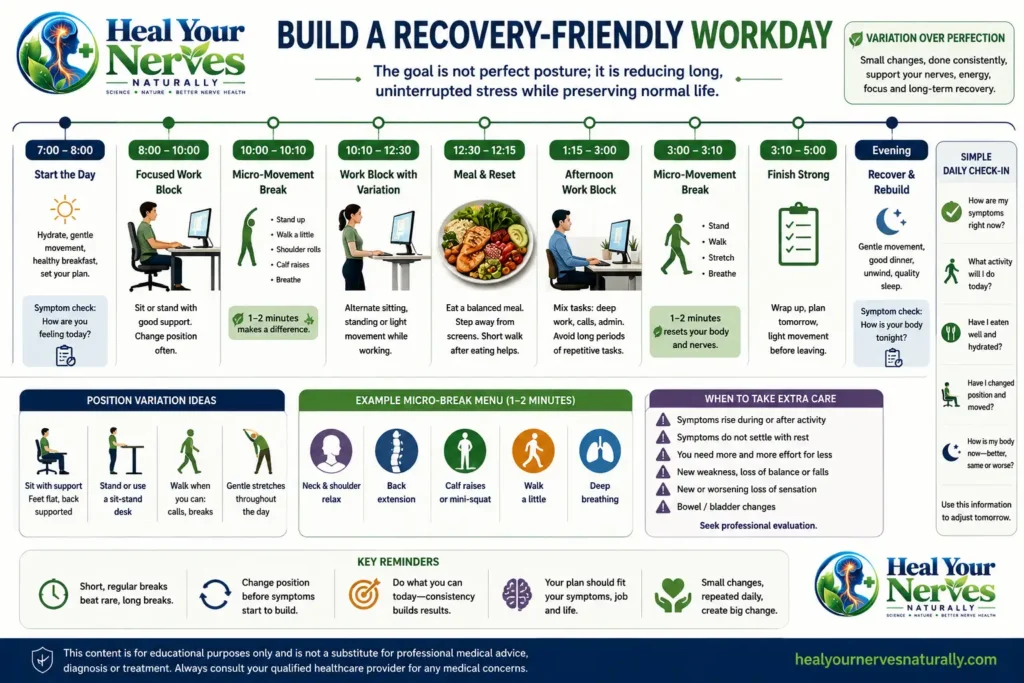
Build a Recovery-Friendly Workday
Most recovery advice fails if it assumes you can stop working, stop caring for family and spend the day optimizing your nervous system.
Real life has deadlines, commutes, keyboards, standing shifts and household responsibilities.
So design around them.
If You Work at a Desk
Nerve Recovery Guides workday tip: Aim for position changes, not perfect posture for eight straight hours.
Try this framework:
Before work: note baseline symptoms.
First work block: do not wait for a major flare before moving.
Position change: stand, walk briefly or change task when appropriate.
Midday: eat a real meal rather than relying on caffeine and snack foods.
Afternoon: compare symptoms with the morning. If they are climbing steadily every day, your current work pattern may need adjustment.
After work: notice whether symptoms settle or remain elevated into the evening.
In addition, the goal is not a perfect ergonomic pose. It is fewer long, uninterrupted exposures.
If You Type or Use Your Hands Repetitively
Task variation matters.
Alternate activities where possible. Avoid prolonged compression at the wrist or elbow. If a diagnosed compression neuropathy is present, follow condition-specific advice.
If You Stand Most of the Day
However, standing is not always better than sitting. A static standing position can also become a problem if it is the only position available.
Use movement and task variation.
If You Drive
Notice whether seat position, hip angle, vibration or prolonged sitting changes symptoms. For major numbness or weakness affecting safe vehicle control, seek individual medical advice rather than relying on a website rule.
If You Cannot Modify Your Job Easily
Start with the smallest change you can control: micro-break timing, position variation, tool placement, footwear, task sequencing or discussing temporary adjustments with an employer when medically appropriate.
Therefore, this is where daily patterns for nervous-system stability and managing recovery load become practical rather than theoretical.
Make Home Life Safer and Easier
In other words, recovery is not only exercise and appointments. It is showering, cooking, sleeping, walking across the house and doing chores.
If Your Feet Are Numb
Nerve Recovery Guides home-safety tip: Protect skin you cannot fully feel. Small injuries can be easy to miss.
- inspect them regularly,
- wear appropriate footwear,
- check inside shoes,
- be careful with temperature,
- address blisters or sores promptly,
- avoid long periods of pressure on one area.
These recommendations are especially important when diabetes is present. The CDC highlights foot care because numbness can allow cuts and sores to go unnoticed.
When Balance Is Reduced
Make the environment easier:
- improve lighting,
- remove obvious trip hazards,
- use rails where appropriate,
- avoid carrying awkward loads on stairs,
- consider rehab assessment if falls or near-falls are occurring.
Protect Your Hands When They Are Numb
Use extra care with knives, hot pans and water temperature.
Make Chores Easier When Fatigue or Pain Is High
Break tasks into shorter blocks. Sit for tasks that do not require standing. Put often used items within easy reach.
Adaptation is not “giving in.” It can help preserve independence while your capacity changes.
For the broader nervous-system adaptation process, see neuroplastic adaptation.
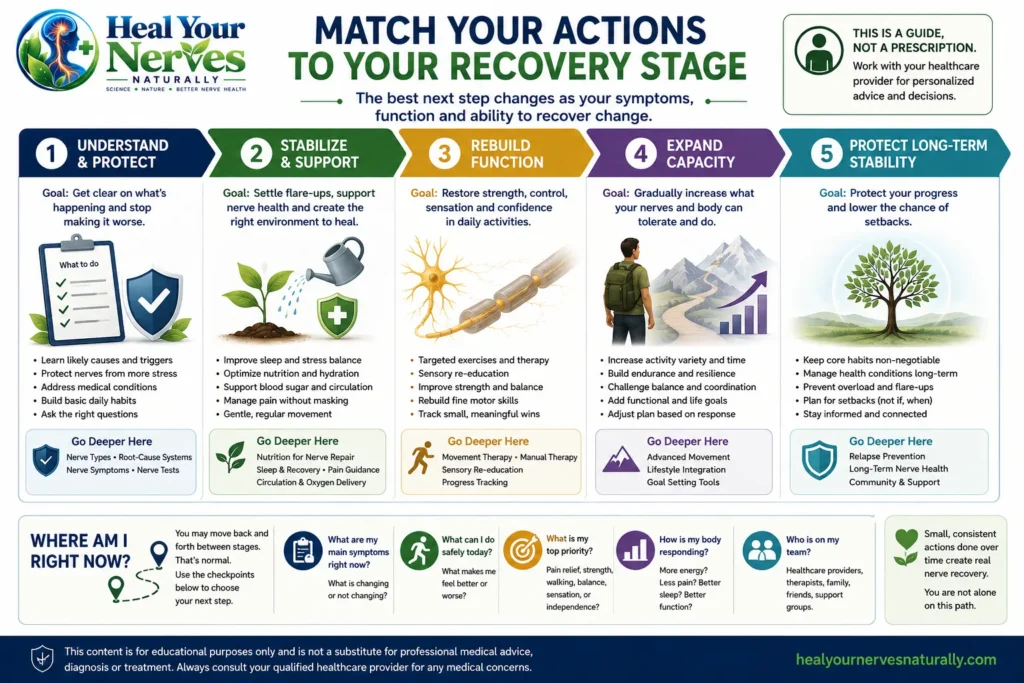
Understand Your Recovery Stage
There is no universal five-stage clock that every injured nerve follows. But a practical stage model can help you decide what deserves attention now.
Stage 1: Something Has Changed
Your priority is not optimization. It is understanding and protection.
Questions:
- What happened?
- Is there weakness?
- Is sensation changing quickly?
- Was there trauma?
- Is there a medical cause that needs review?
- Is ongoing pressure still present?
Explore root causes of nerve damage.
Stage 2: The Situation Is Stable but Symptoms Remain
Now the focus becomes:
- remove avoidable aggravators,
- address the root cause,
- protect numb areas,
- maintain safe movement,
- improve sleep and nutrition,
- establish a baseline.
Explore healing environment for nerve recovery.
Stage 3: Function Needs Rebuilding
Nerve Recovery Guides stage check: At this point, the goal often shifts from protection toward graded function.
Also, you may be medically stable but weaker, less mobile or less confident.
Therefore, this is where rehab, gradual loading, balance work and task-specific practice may matter.
Explore movement therapy and neuroplastic adaptation.
Stage 4: You Are Improving but Not Back to Normal
This is where people often overdo it.
You feel better, so you suddenly return to the movement level you had before the problem.
Instead, use gradual progression and feedback.
Explore recovery phasing and personalizing the recovery process.
Stage 5: Long-Term Stability
The goal changes from “How do I survive this flare?” to “How do I protect function and reduce avoidable recurrence?”
Explore long-term nerve health protection and recovery stability.
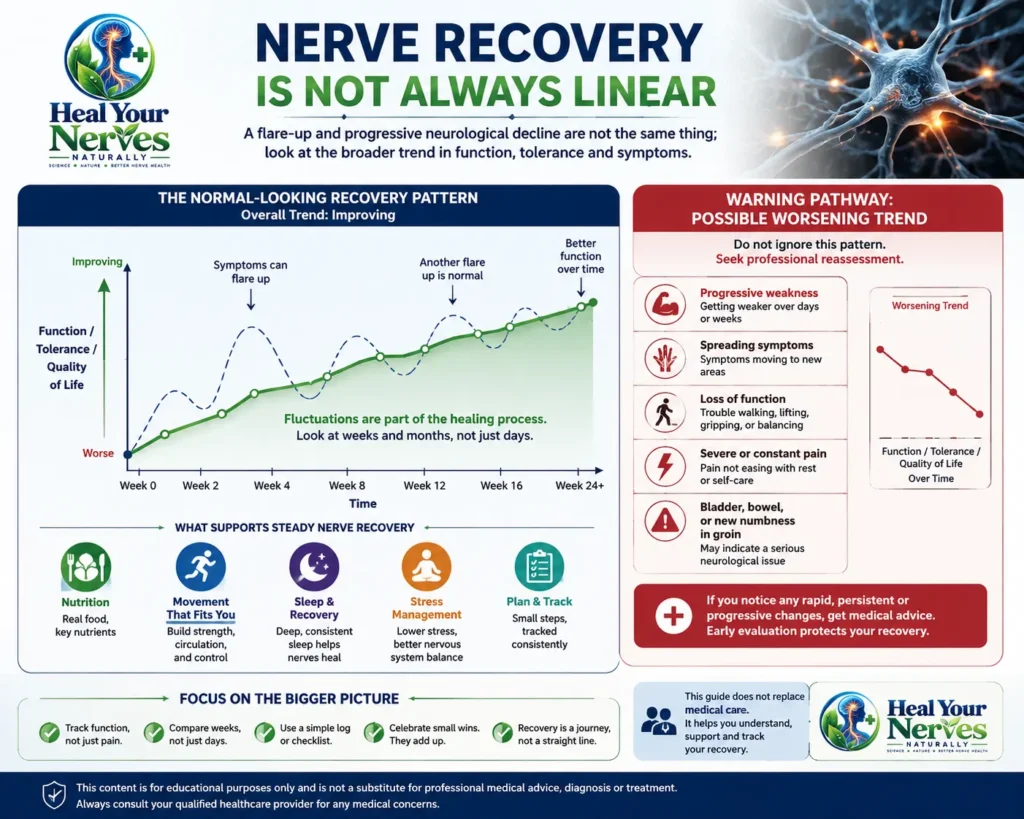
Good Days, Bad Days and Flare-Ups
For example, a bad day can be emotionally powerful. If yesterday felt better and today burns, tingles or aches more, it is easy to conclude that recovery has failed.
But one day is a data point, not the entire trend.
A Common Real-Life Pattern
Nerve Recovery Guides flare-up check: Compare the whole trend, not one difficult evening.
Monday: You feel better.
Tuesday: You sit longer, walk farther, do more chores and skip your usual breaks.
Tuesday night: Symptoms increase.
Wednesday: You panic and wonder whether you damaged the nerve again.
Before deciding, ask:
- Was there a clear jump in activity?
- Have you added a new movement?
- Was sleep worse than usual?
- After rest and normal routines, did symptoms move back toward baseline?
- Have you developed new weakness?
- Has numbness spread?
- Over several days, is the overall trend getting worse rather than moving around a baseline?
Flare-Up Does Not Mean “Ignore It”
In addition, the goal is not to reassure yourself out of the right medical care.
A flare that follows unusual activity and settles may call for load adjustment.
A progressive deficit, new weakness or major sensory loss calls for reassessment.
Use a Recovery-Cycle Mindset
Your limit today may not equal your capacity next month.
Observe, adjust and retest gradually.
Explore nerve recovery cycles and feedback systems.
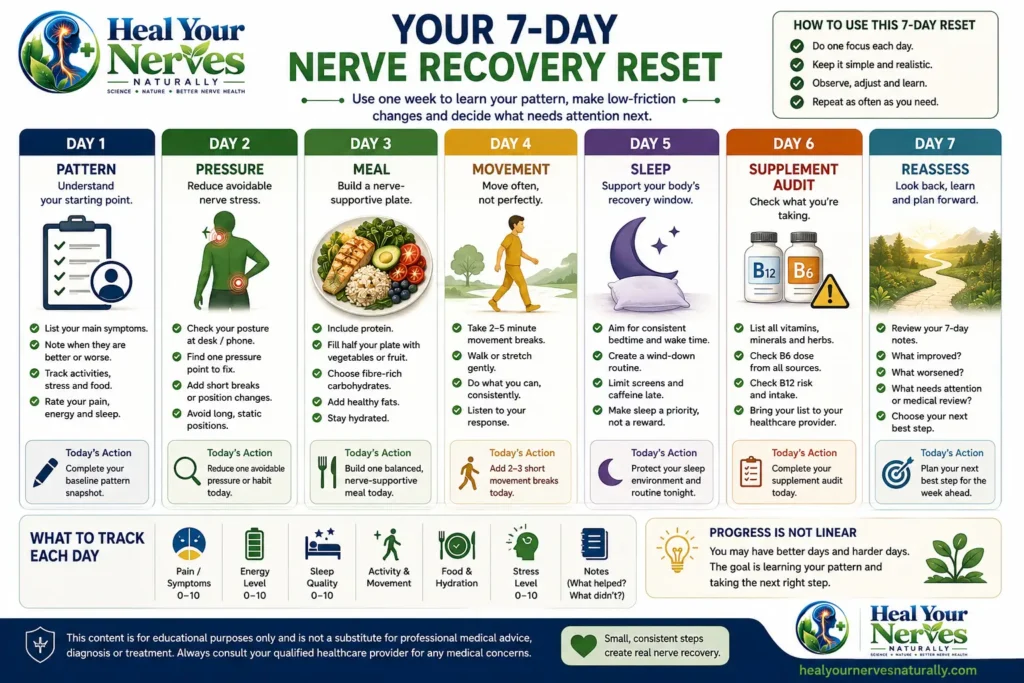
Nerve Recovery Guides: Your 7-Day Practical Reset
Therefore, this is not a treatment protocol. It is a one-week organization tool to help you stop guessing and start observing.
Day 1: Map the Symptom
Nerve Recovery Guides 7-day reset: Begin with one clear baseline that you can compare later.
Write down:
- exact location,
- main sensation,
- what brings it on,
- what relieves it,
- one functional difficulty,
- whether weakness is present.
Do not change ten things today. Establish your starting point.
Day 2: Remove One Repeated Stressor
Look for:
- prolonged elbow pressure,
- bent wrist position,
- long uninterrupted sitting,
- tight footwear,
- one repetitive movement,
- an movement spike that reliably produces a long flare.
Change one.
Day 3: Fix One Meal
Choose the meal you most often skip or improvise.
Make it more complete and repeatable.
If you suspect B12 deficiency or have a restrictive diet, this is the day to plan appropriate medical/nutritional review rather than buying random “nerve vitamins.”
Day 4: Find Your Tolerable Movement Dose
Choose a safe activity appropriate to your condition.
It might be a short walk, clinician-prescribed rehab exercise or gentle mobility.
Record:
- symptoms before,
- symptoms during,
- symptoms afterward,
- how you feel the next morning.
Day 5: Improve the Night
Pick one sleep variable:
- regular bedtime,
- pressure-free position,
- pillow/support adjustment,
- reduced late-night stimulation,
- pain-management discussion if symptoms often wake you.
Track awakenings.
Day 6: Audit Medications and Supplements
Do not stop prescription medication on your own.
Create one list containing:
- prescriptions,
- over-the-counter medication,
- vitamins,
- B-complex products,
- energy products,
- herbal products,
- “nerve support” supplements.
Look especially for duplicate ingredients.
Day 7: Reassess
Ask:
Symptoms: better, same, worse or different?
Function: what became easier?
Movement tolerance: longer, shorter or unchanged?
Sleep: fewer awakenings or the same?
New weakness: yes or no?
New numb area: yes or no?
Most predictable trigger: what is it?
Then choose your next path.
Do not ask only, “Did I heal in seven days?” Ask, “What did I learn about the pattern, and what decision is clearer now?”
Nerve Recovery Guides: How to Tell Whether Your Plan Is Helping
Many people track pain obsessively and miss functional progress.
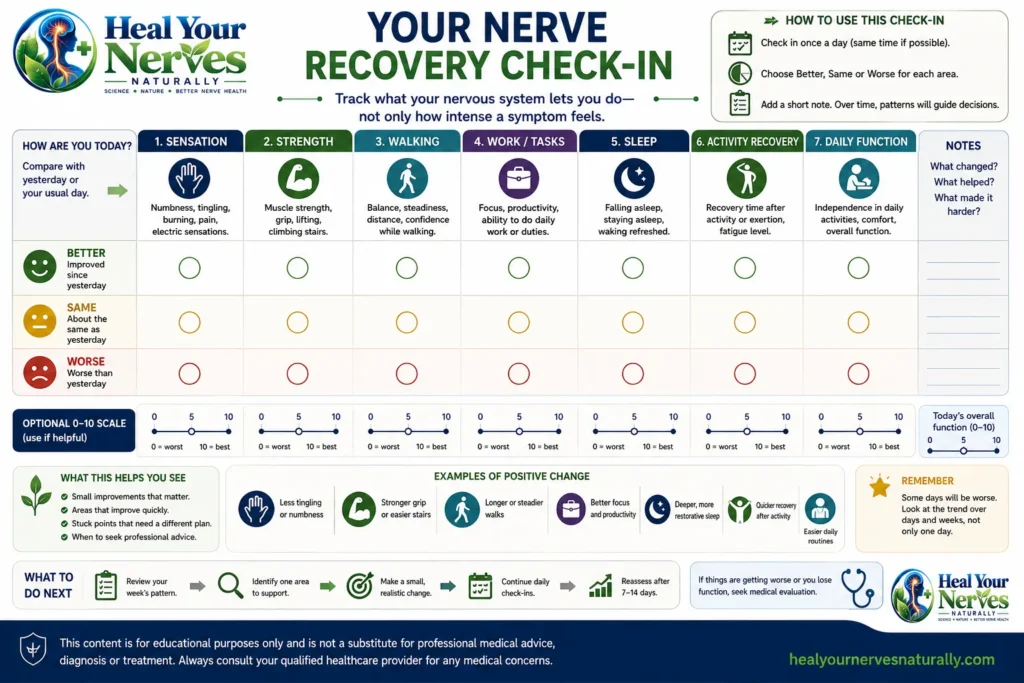
Use a broader scorecard.
Sensation
- Is numbness smaller, larger or unchanged?
- Is tingling less constant?
- Is touch tolerance changing?
Strength
- Are you dropping fewer objects?
- Can you perform a movement more reliably?
- Is there any new weakness?
Walking and Balance
- How long can you walk comfortably?
- Are you tripping?
- Do you need more or less support?
Work Tolerance
Nerve Recovery Guides progress check: Improvement may show up as longer tolerance before symptoms start.
- How long can you work before changing position?
- Are you losing fewer work hours to symptoms?
Sleep
- How many times did symptoms wake you?
- Are you getting back to sleep more easily?
Recovery after movement
- Do symptoms settle within a predictable period?
- Does a normal day create a multi-day setback?
Participation in Normal Life
Therefore, this may be the most important question:
What part of your real life can you do now that was harder two weeks ago?
Cook a meal? Walk to a shop? Hold your child? Drive safely? Type? Sleep? Stand in the shower? Attend work?
That is recovery clues.
Your Nerve Recovery Guides Repeat Check-In
Save or bookmark this page and revisit the same questions after a meaningful interval.
Do not compare hour to hour. Compare patterns over time.
Nerve Recovery Guides FAQ: Real-Life Questions People Ask
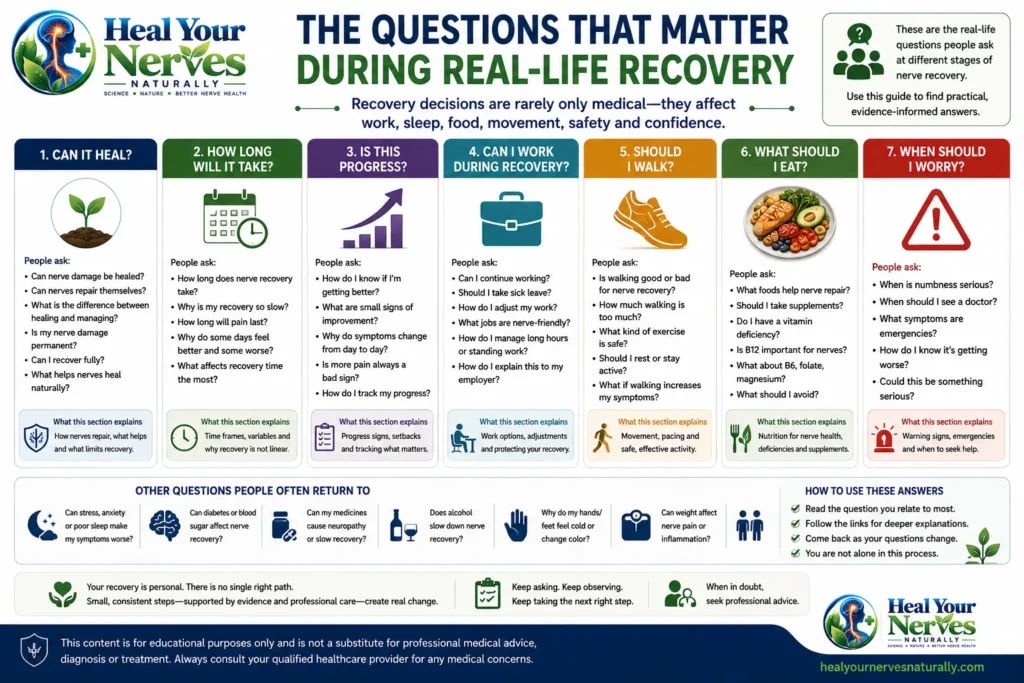
These are the questions people tend to ask after the first medical explanation is over—when they are back at home, at work, in bed at night or trying to decide whether a symptom change matters.
Can Damaged Nerves Heal on Their Own?
Sometimes, but the answer depends on what “damaged” means.
For example, a mildly compressed peripheral nerve whose internal structure remains intact may recover once pressure is relieved and the nerve has time to restore normal signaling. A more substantial axonal injury may recover more slowly because the nerve must regrow over distance. A severely disrupted or completely divided nerve is a different problem and may need specialist or surgical management.
That is why the most useful first question is not “Can nerves heal?” but “What type of nerve problem do I appear to have?”
Mayo Clinic explains that peripheral nerve injury treatment depends on the extent and cause of injury and on whether the nerve is already healing. If your symptoms began after a major injury or surgery, use post-injury nerve damage rather than relying on a generic healing timeline.
Nerve Recovery Guides Question: How Long Does Recovery Take?
There is no single honest number.
Recovery may take days or weeks in some mild conduction problems, while axonal injuries can take months or longer because peripheral axons regrow slowly. Distance matters: a nerve supplying a nearby target does not face the same regrowth distance as a nerve that must reconnect with tissue much farther away. Severity, age, scarring, the health of the target muscle and whether the root cause remains active can all influence recovery.
In addition, the NCBI peripheral nerve injury review describes regeneration as a slow process and emphasizes that prognosis depends on injury severity and several biological and anatomical factors.
So if someone online says, “Nerves heal in exactly six weeks,” treat that as a personal story, not a universal clock.
A more useful approach is to set functional checkpoints: Is strength changing? Is the numb area changing? Can you tolerate more normal activity? Is the trend stable, improving or worsening?
Does Tingling Mean the Nerve Is Healing?
It can occur during recovery, but tingling is not a reliable proof of regeneration.
Tingling can also occur with compression, ongoing irritation, neuropathy and many other nerve conditions. The context matters more than the sensation alone.
If tingling appears while overall function is improving, the affected area is becoming smaller and no new weakness is appearing, that is a different pattern from tingling that is spreading, becoming constant and appearing with loss of strength.
Use tingling as one observation, not as a verdict.
If you keep checking your body every few minutes for “healing tingles,” you may generate more anxiety without gaining useful clues. Record the pattern once or twice a day and compare over a longer interval.
Is Burning a Sign of Nerve Healing—or a Sign Something Is Wrong?
Burning pain can occur in neuropathic conditions whether a nerve is recovering or still irritated. It does not carry a single biological meaning.
Instead of interpreting the word “burning,” look for the surrounding pattern:
- Is it new?
- Is it rapidly worsening?
- Is it limited to the original area?
- Does activity predictably trigger it?
- Does it interfere with sleep?
- Is sensation or strength changing at the same time?
If burning often wakes you, interferes with normal activity or is progressively worsening, discuss symptom management and cause with a clinician. For ongoing symptoms, see chronic nerve pain.
My Pain Is Better but Numbness Remains. Is That Normal?
Different nerve functions do not always recover at the same pace, and ongoing numbness can remain even when pain improves. But no website can tell from that pattern alone whether your numbness will fully resolve.
Track the territory of numbness and what it does to function. Can you feel temperature safely? Is balance affected? Is the numb area shrinking? Can you walk or use the hand more normally? Is there weakness?
Most importantly, protect the numb area from injury. A person who feels less pain may assume the problem is “over” while reduced protective sensation still creates risk.
If numbness is ongoing, spreading or functionally important, clinical reassessment may be more useful than searching often for a precise recovery date.
I Felt Better, Then Symptoms Came Back. Did I Reinjure the Nerve?
Not necessarily.
Symptoms can fluctuate with activity, pressure, sleep, posture, metabolic control and other factors. For example, a temporary increase after doing much more than usual is not always the same thing as a new structural injury.
But do not use that statement to ignore a major change.
Compare the event with your previous baseline. If symptoms settle and function remains stable, you may need to adjust the amount or timing of activity. If symptoms keep worsening, spread into a new area or are accompanied by weakness, seek reassessment.
This is why a recovery diary should include what you did before the change, not only how painful the change felt.
For a structured approach, use load management.
Nerve Recovery Guides Question: Should I Rest or Keep Moving?
The answer depends on the cause, stage and severity of your problem.
Complete inactivity can reduce strength and confidence, while aggressive exercise can be inappropriate in an acute injury, severe flare or postoperative period. For many stable peripheral neuropathies, appropriately tailored movement and rehab can support strength, balance and function. For an acute injury or surgical repair, restrictions may be very different.
Do not use discomfort as your only exercise prescription.
A practical approach is to choose an activity that is appropriate for your condition, begin below your maximum capacity, monitor symptoms and function afterward, and progress gradually if the response is acceptable.
If you have major weakness, balance problems, recurrent falls or major uncertainty, a physical or occupational therapist can help create a safer plan.
Can I Keep Working While a Nerve Is Recovering?
Many people can, but the work environment may need to change.
The useful question is not “work or no work?” It is which parts of the job often aggravate symptoms and which parts can be modified?
At a desk, that may mean changing position more often. For hand-intensive jobs, it may mean task rotation or reducing prolonged compression. If you stand most of the day, it may mean planned sitting or more position changes. For physically demanding work, temporary restrictions may need to come from the clinician managing the injury.
A return-to-work plan should protect safety and function without assuming that normal life must stop until every sensation disappears.
If symptoms affect driving, grip, balance or safe machinery use, individual professional advice is especially important.
Do I Need a Special “Nerve Repair” Supplement?
Not automatically.
If a deficiency exists, correcting it can be important. B12 is a clear example: deficiency can affect the nervous system and produce numbness or tingling. But supplements can also cause problems. Excessive B6 intake is a documented cause of sensory neuropathy.
That is why we prefer a deficiency-and-risk approach rather than a “more is better” approach.
Before buying another product, ask:
- Do I have a known deficiency?
- Is my diet putting me at risk?
- Could a medical condition affect absorption?
- Am I already getting the same ingredient from another product?
- Does this supplement interact with medication?
For food-first guidance, use Nerve Food Repair. For supplement review, see supplement intelligence.
How Do I Know When I Am Ready to Do More?
Look for consistency before ambition.
A single good morning does not prove that your capacity has doubled. A better sign is that your current activity level has become more predictable: you can complete it safely, symptoms do not escalate dramatically, and you recover without often losing the next day.
Then increase one variable at a time—duration, distance, repetitions, load or task complexity—not all of them together.
This approach makes it easier to identify the dose that your current system tolerates.
What If Recovery Is So Slow That I Stop Noticing Progress?
Use objective anchors from real life.
Do not rely on memory alone. Write down today’s sitting tolerance, walking tolerance, sleep interruptions, grip task, numb area and one meaningful activity. Repeat the same check later.
Therefore, people often notice day-to-day noise and miss month-to-month change.
If nothing is improving, that clue is still valuable. It tells you that the plan or diagnosis may need reassessment.
When Can I Say I Am “Recovered”?
However, there is no universal finish line.
For one person, recovery may mean the pain is gone. Someone else may still have a small numb patch but can work, sleep, exercise and take part in normal life. With chronic neuropathy, the goal may be stability, fewer symptoms, safer movement and slower progression rather than full return of sensation.
Therefore, define recovery in terms that matter to your life:
- function,
- independence,
- safety,
- participation,
- symptom burden,
- confidence,
- and long-term stability.
That definition can evolve as your condition changes.
Nerve Recovery Guides by Condition: Choose the Right Path
For example, a general recovery guide cannot replace condition-specific clues.
Use these routes when they fit your situation.
Peripheral Neuropathy
If symptoms are bilateral, length-dependent, especially in the feet, or linked with metabolic, nutritional, toxic or systemic causes, start with peripheral neuropathy.
Nerve Compression
If posture, repetitive use or pressure reliably changes symptoms, explore nerve compression.
Diabetic Neuropathy
If diabetes is part of your medical history, use diabetic neuropathy and make glucose and foot safety part of the plan.
Post-Injury Nerve Damage
If symptoms began after trauma, surgery, fracture, dislocation, cut or stretch injury, use post-injury nerve damage.
Sciatic Nerve Pain
For back, buttock and leg symptoms that fit a sciatic pattern, use sciatic nerve pain.
Chronic Nerve Pain
If ongoing neuropathic pain has become a central problem even after the original trigger has been addressed, use chronic nerve pain and explore pain processing.
When Self-Care Is Not Enough
A practical recovery page also needs a clear boundary.
Seek Emergency Help for Sudden Stroke-Like Symptoms
The CDC lists sudden numbness or weakness—especially on one side—along with facial droop, speech difficulty, sudden vision trouble, loss of balance or a sudden severe unexplained headache as possible stroke signs. These require emergency action.
Do not use a nerve-recovery guide to watch and wait on sudden stroke-like symptoms.
Back/Leg Symptoms Plus New Bladder, Bowel or Saddle-Sensation Changes Need Urgent Assessment
Acute compression of the cauda equina is rare but serious. The North Bristol NHS Trust describes urgent warning signs including new changes in bladder or bowel function, new altered sensation around the buttocks/genitals/inner thighs and severe or worsening leg symptoms.
Seek emergency assessment rather than trying stretches or home remedies.
Arrange Prompt medical review for New or Progressive Weakness
Examples include:
- a foot beginning to drop,
- increasing trouble walking,
- new hand weakness,
- repeated falls,
- steadily spreading numbness,
- visible muscle wasting,
- symptoms rapidly worsening over days.
Do Not Ignore Injuries You Cannot Feel
If numbness prevents you from sensing a burn, blister, cut or pressure injury—especially with diabetes—address the injury promptly.
ongoing Symptoms Still Deserve an Explanation
Nerve Recovery Guides safety note: If the pattern stays unexplained, practical support should not replace a medical review.
Even without an emergency sign, ongoing unexplained numbness, burning, tingling or weakness deserves review.
Use nerve dysfunction diagnosis to understand the kinds of clues clinicians may use.
Nerve Recovery Guides: Where Should You Go Next?
Also, you do not need every page on this site today.
Choose the question that matches your next decision.
“I want to understand how nerves heal.”
Read the Nerve Healing Guide.
“I want a structured view of the recovery process.”
Explore Nerve Recovery Protocols.
“I want to understand the cause.”
Start with Root Causes of Nerve Damage.
“I want to improve the environment around recovery.”
Use Healing Environment for Nerve Recovery.
“I want practical food help.”
Go to Nerve Food Repair.
“I want movement help.”
Explore Movement Therapy.
“I want to understand sleep.”
Go to Sleep Recovery.
“I keep overdoing it and flaring.”
Use Load Management and Recovery Phasing.
“I am improving and want to protect long-term nerve health.”
Use Long-Term Nerve Health Protection.
Nerve Recovery Guides: Your Next Check-In
Before you leave this page, answer six questions.
- What is the one symptom that matters most today?
- What daily activity is hardest because of it?
- What reliably makes it worse?
- What seems to make it easier?
- What is one realistic change you can make this week?
- What would tell you that you need medical reassessment rather than more self-management?
Write the answers somewhere you can find them.
Then return after your chosen check-in period and ask:
- What improved?
- Which things stayed the same?
- Did anything become harder?
- Have I noticed a new pattern?
- Did my walking, work, sleep or daily function change?
- Is my next question about symptoms, cause, movement, food, sleep, recovery stage or a specific condition?
Finally, your question may be different next week. That is why these Nerve Recovery Guides are designed for repeat visits.
When it is, start here again.
Selected Clinical and Research Sources
This guide is educational and is designed to help you organize questions and practical next steps. It does not diagnose the cause of nerve symptoms or replace care from a qualified health professional.
- National Institute of Neurological Disorders and Stroke — Peripheral Neuropathy
- Mayo Clinic — Peripheral Nerve Injuries: Diagnosis and Treatment
- NCBI Bookshelf / StatPearls — Peripheral Nerve Injury
- MedlinePlus — Peripheral Neuropathy
- NIH Office of Dietary Supplements — Vitamin B12
- NIH Office of Dietary Supplements — Vitamin B6
- CDC — Diabetes and Nerve Damage
- CDC — Signs and Symptoms of Stroke
- North Bristol NHS Trust — Cauda Equina Syndrome