
Exercises: Movement, Learning, and Everyday Function
Exercises are purposeful movements. People use exercises to move, learn, practice, and handle daily life better. Exercise does not only happen in a gym. It can include walking, stretching, balance practice, light activity, sports, gardening, stairs, or simple daily movement.
Many people think exercises are only for fitness. However, exercises can also support learning, coordination, confidence, and daily function. For example, a person may practice a movement many times. Over time, the movement may feel easier. The body learns the pattern. The nervous system also becomes more familiar with the action.
Because movement is part of daily life, exercises can help people understand how the body and brain work together. A simple walk, a stretch, or a balance activity may involve attention, timing, strength, and control. Therefore, exercises are not only about muscles. They also involve learning, awareness, and adaptation.
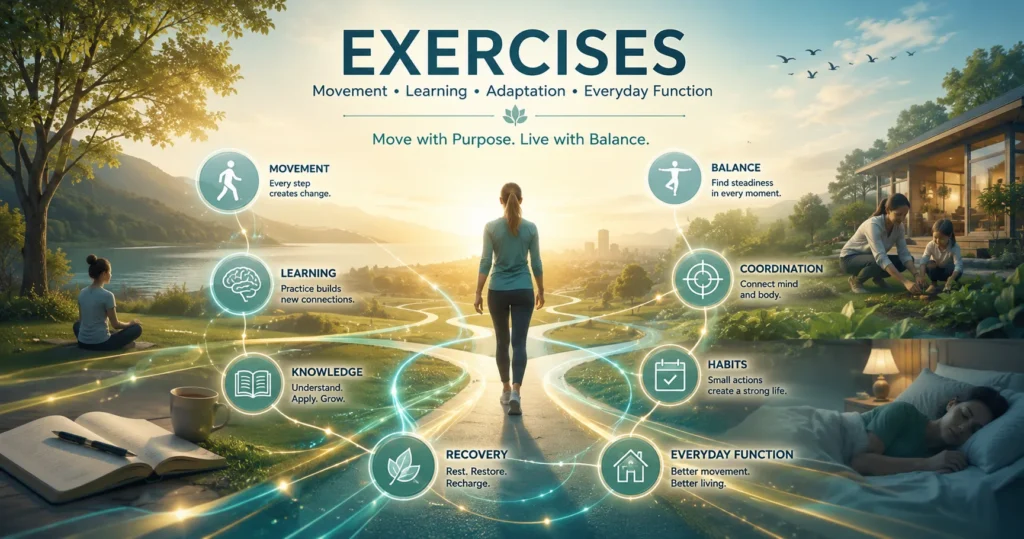
Exercises in Everyday Life
People experience exercises in different ways. Some people enjoy structured workouts. Others prefer walking, housework, gardening, dancing, or outdoor activities. These activities may look different, but they all involve movement.
Exercise should not be viewed as one fixed activity. Instead, it can include many forms of movement. A person may choose simple movement, gentle practice, or skill-based activity. The best way to understand exercises is to see them as movement experiences that can fit different needs, interests, and daily routines.
Exercises and Learning
Exercises often involve learning. When a person practices a movement, the body gathers information. The brain and nervous system use that information to improve the next attempt.
For example, learning to ride a bicycle may feel hard at first. Balance may feel uncertain. Steering may need full attention. However, practice helps the body learn. Later, the same activity may feel smoother and easier.
This same idea applies to many movements. Stretching, walking, balance work, or learning a new activity can all improve through practice. As a result, exercises can support movement learning over time.
Exercises and the Mind-Body Connection
Exercises involve both the body and the mind. Attention helps people notice movement. Motivation helps people continue. Planning helps people choose when and how to move. At the same time, movement can affect confidence, energy, and daily awareness.
Because of this two-way connection, exercises can fit well within nervous system education. Movement gives the body information. Then the nervous system uses that information to adjust. Over time, repeated movement may help people become more familiar with their own body patterns.
This page explains exercises as an educational topic. It does not provide treatment, diagnosis, or medical advice. Instead, it helps readers understand how movement, learning, recovery, behavior, and daily function can work together.
Quick Navigation
Real-Life Symptom Language Bridge
Common Misunderstandings About Exercises
How Exercises Connect With Other Nerve Health Pages
Plain Meaning / Glossary Box
Plain Meaning
Exercises are planned or purposeful movements. They help people practice skills, move better, build habits, and take part in daily life. Some exercises are simple. Others need more focus or coordination. However, all exercises involve movement.
Exercise is not only for athletes. Every person moves throughout the day. Walking across a room, standing from a chair, reaching for an object, and carrying a bag all involve movement skills. Because of this, exercises can be seen as a way to practice and understand movement.
Simple Definition
Exercises are purposeful movement activities that help people practice, learn, adapt, and support daily function.
Simple Example
Imagine learning to ride a bicycle. At first, balance may feel difficult. Steering may also feel awkward. However, practice helps the body learn the movement.
After some time, the same activity may feel easier. The bicycle did not change. Instead, the person learned through movement, practice, and experience. This is a simple example of how exercises can support learning and adaptation.
Quick Glossary
Exercise – Purposeful movement for practice, activity, learning, or function.
Movement – Any action made by the body.
Coordination – The ability to move body parts together in an organized way.
Adaptation – Adjusting to new experiences, movements, or demands over time.
Balance – The ability to stay steady while moving or standing still.
Function – The ability to do daily tasks and activities.
Physical Activity – Any body movement that uses energy.
Practice – Repeating an action to become more familiar with it.
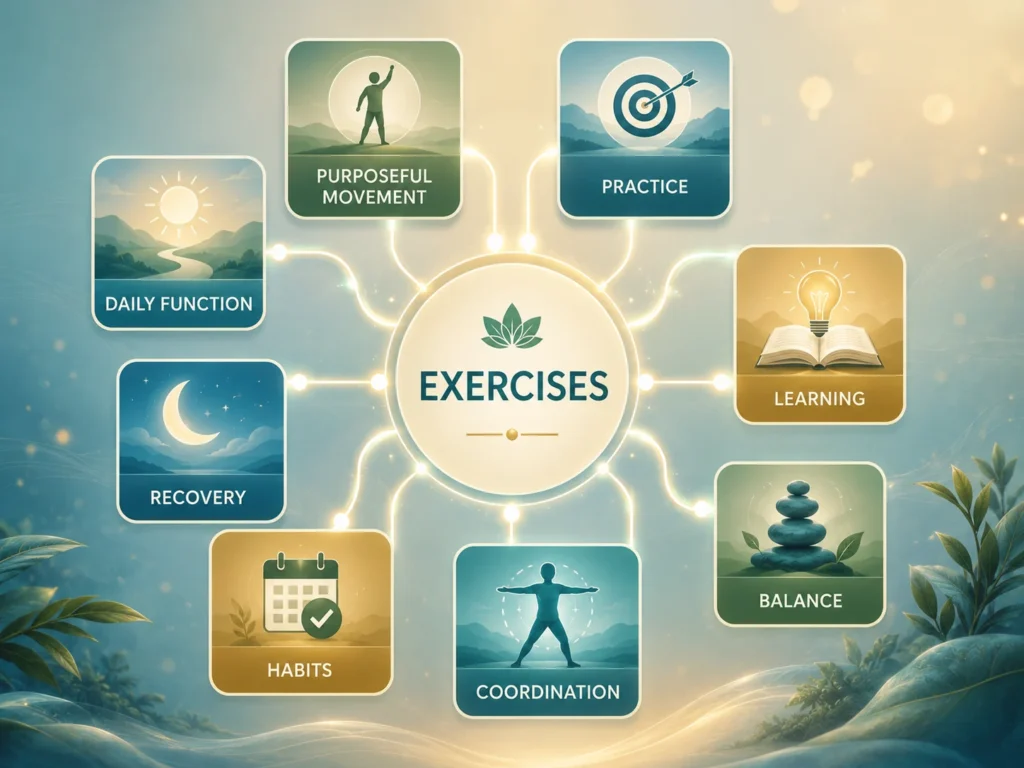
What Are Exercises?
Exercises are purposeful movements. People use exercises to move, practice, learn, and take part in daily life. Some exercises feel easy. Others need more focus, balance, strength, or control. However, all exercises involve movement in some way.
Exercise does not only mean going to a gym. It can include walking, stretching, light activity, balance practice, dancing, gardening, sports, or simple movement at home. For example, standing from a chair, climbing stairs, carrying groceries, or reaching for an object all use movement skills.
The main idea is simple. Exercise is movement with purpose. A person may move to build a habit, learn a skill, improve coordination, support daily function, or feel more connected to the body.
Exercises can also help the body and nervous system learn. When a person repeats a movement, the body gathers information. Then the nervous system uses that information to adjust. As a result, the movement may feel easier over time.
Therefore, exercises should not be viewed only as workouts. Instead, they can be understood as movement experiences. These experiences help people practice skills, notice body signals, build confidence, and adapt to everyday life.
How Exercises Work
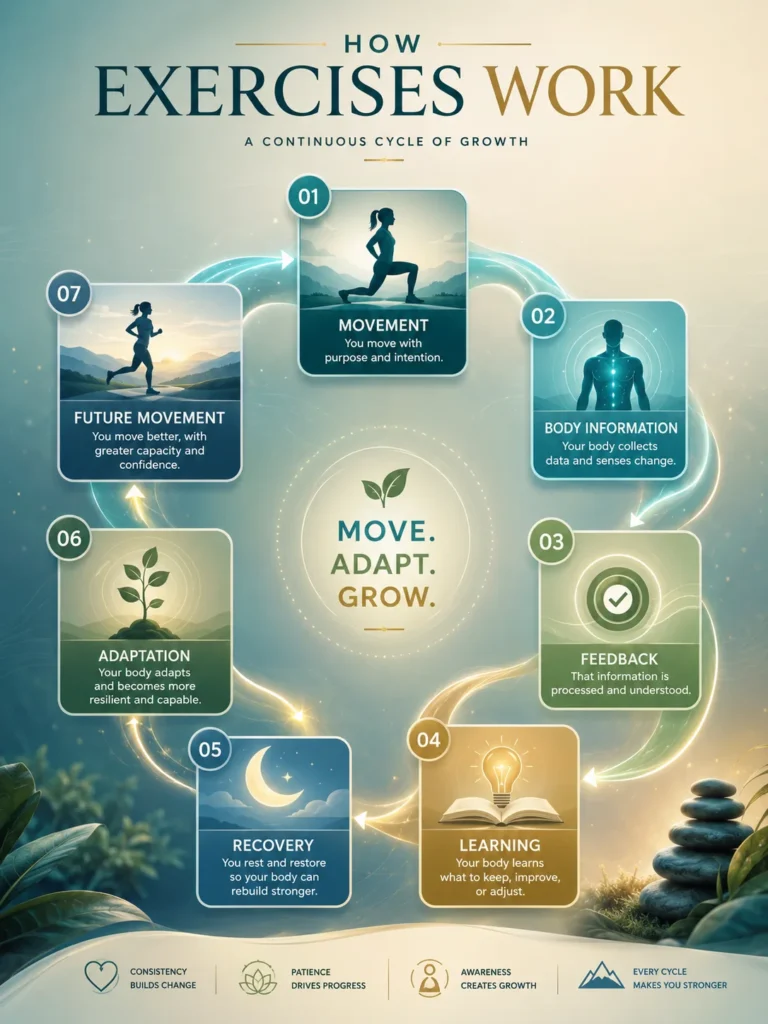
Exercises work through movement, practice, feedback, and learning. First, a person performs a movement. Then the body sends information to the nervous system. The nervous system uses that information to understand balance, position, effort, timing, and control.
For example, when someone practices standing on one foot, the body learns how to stay steady. The eyes, muscles, joints, and nervous system all provide information. As a result, balance may slowly improve with practice.
This process often takes time. A movement may feel difficult at first. However, repeated practice can make it feel more familiar. Therefore, exercises often support learning through repetition and experience.
Movement Creates Information
Movement gives the body useful information. When a person walks, stretches, bends, reaches, or turns, the nervous system receives signals from the body. These signals help the brain understand where the body is and how it is moving.
This information matters because movement requires awareness. For example, walking across uneven ground needs more attention than walking on a flat floor. Because the surface changes, the body must adjust.
In this way, exercise helps the body and nervous system communicate. The movement creates information. Then the nervous system uses that information to guide the next response.
Practice Builds Familiarity
Practice helps the body become familiar with movement. At first, a new exercise may feel awkward. A person may need to think carefully about each step. However, repeated practice often makes the movement smoother.
For example, a person learning a stretch may not know how far to move at first. Later, the same stretch may feel more natural. This happens because the body has learned the pattern.
As a result, practice can make movement easier to understand. It can also help people feel more confident with daily movement.
Feedback Helps Adjustment
Feedback helps people adjust movement. Feedback can come from the body, the environment, or the result of the action. For example, if a movement feels unstable, the person may slow down. If a task feels too hard, they may reduce effort or choose a simpler version.
This feedback is useful. It helps people learn what feels steady, safe, and manageable. Therefore, feedback is an important part of exercise learning.
Over time, repeated feedback can guide better movement choices. This is one reason exercises often improve through practice.
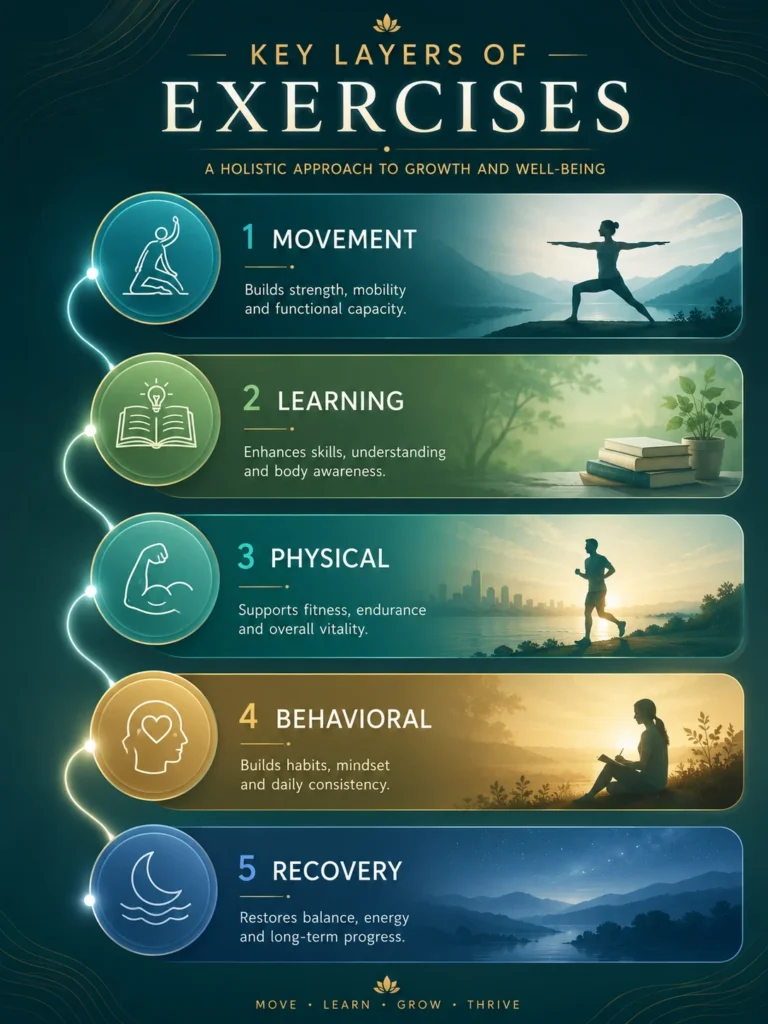
Key Layers of Exercises
Exercises have several simple layers. These layers work together whenever a person moves. One layer helps the body move. Another layer helps the brain learn the movement. Other layers involve effort, habits, motivation, and recovery. Because these layers work together, exercise is more than one body action.
The first layer is movement. This includes walking, stretching, bending, reaching, lifting, turning, and balancing. These actions may look simple. However, the body uses many parts at the same time. Muscles, joints, balance, attention, and timing all work together.
Next, the learning layer helps the body understand the movement. For example, a new stretch may feel strange at first. A balance activity may feel difficult. However, practice gives the body more information. Over time, the movement may feel easier and more familiar.
The physical layer includes energy, effort, strength, balance, and coordination. Some exercises need light effort. Others need more control or focus. Because people have different bodies and routines, exercise can feel different from person to person.
The behavioral layer includes habits and consistency. A person may want to move more often, but regular movement usually needs planning and repetition. Therefore, small routines can help movement become part of daily life.
Finally, the recovery layer gives the body time to rest and restore. Movement creates demand. Recovery helps the body prepare for the next activity. As a result, exercise works best when movement, learning, behavior, and recovery stay connected.
Overall, exercises should not be viewed only as workouts. Instead, they can be understood as a learning process. Through movement, people practice skills, notice body signals, build habits, and adapt to daily life.
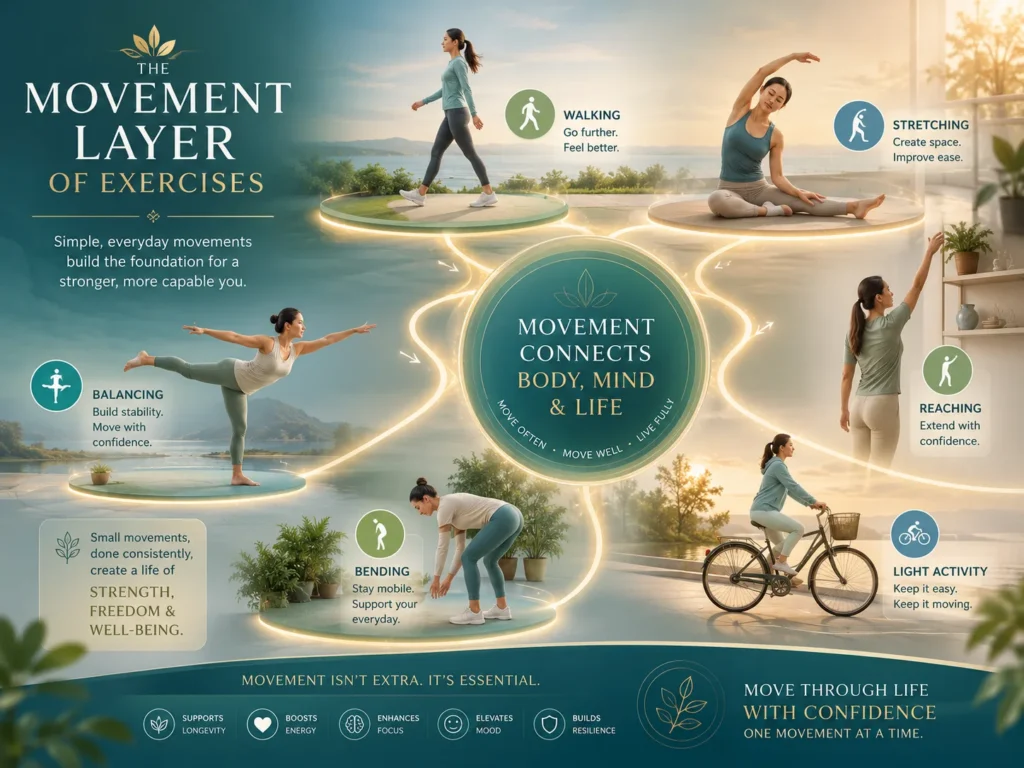
Movement Layer of Exercises
The movement layer is the most visible part of exercise. It includes walking, stretching, bending, lifting, reaching, turning, balancing, and many other actions. These movements help people interact with daily life.
Movement requires coordination. The body must use muscles, joints, senses, and timing together. Even simple movements involve many small steps. For example, standing from a chair requires leg strength, balance, posture, and control.
Because movement happens throughout the day, this layer is central to exercise. It helps people practice body awareness and daily function.
Simple Movement Skills
Simple movement skills include actions that people use often. Walking, standing, sitting, turning, reaching, and carrying objects all belong to daily movement.
These actions may seem ordinary. However, they require coordination and control. When people practice movement, they often improve familiarity with these patterns.
Therefore, exercise can support everyday function by helping people better understand movement skills.
Movement and Daily Function
Daily function depends on movement. People move to work, cook, clean, travel, communicate, and care for themselves. Because movement supports so many tasks, exercise can connect closely with independence and daily routines.
For example, balance practice may help someone feel more aware while walking. Gentle stretching may help someone feel more comfortable during daily tasks. However, exercise should always fit the person’s needs and situation.
This page explains the concept only. It does not give personal exercise plans or treatment advice.
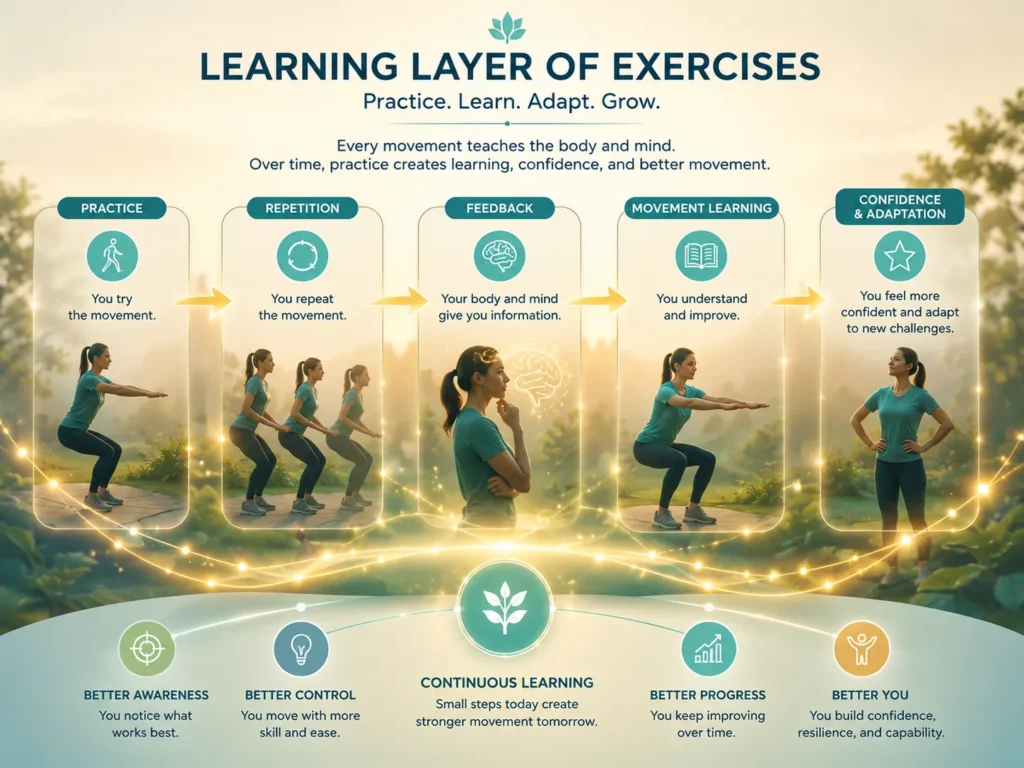
Learning Layer of Exercises
Exercises are not only about movement. They are also about learning. Every time a person practices a movement, the body and nervous system gather information. Then they use that information to improve future performance.
Learning often begins with awareness. A person notices how a movement feels. Next, they learn what works well and what feels less effective. After that, they make small adjustments. As a result, movement may become smoother and more familiar over time.
This process explains why practice is important. Most people do not master a new movement immediately. Instead, learning usually happens step by step through repetition and experience.
Learning Through Repetition
Repetition gives the body more opportunities to learn. Each attempt provides information. The nervous system compares that information with previous experiences. Then it adjusts future responses.
For example, someone learning a balance exercise may wobble during the first few attempts. However, repeated practice can improve familiarity with the movement. Over time, the person may feel more stable and confident.
Therefore, repetition is often one of the most important parts of movement learning.
Building Confidence Through Learning
Learning can also influence confidence. When people become more familiar with a movement, they often feel more comfortable performing it.
For example, a person who practices a new activity regularly may feel uncertain at first. Later, the same activity may feel easier because experience has reduced uncertainty.
As a result, learning and confidence often grow together.
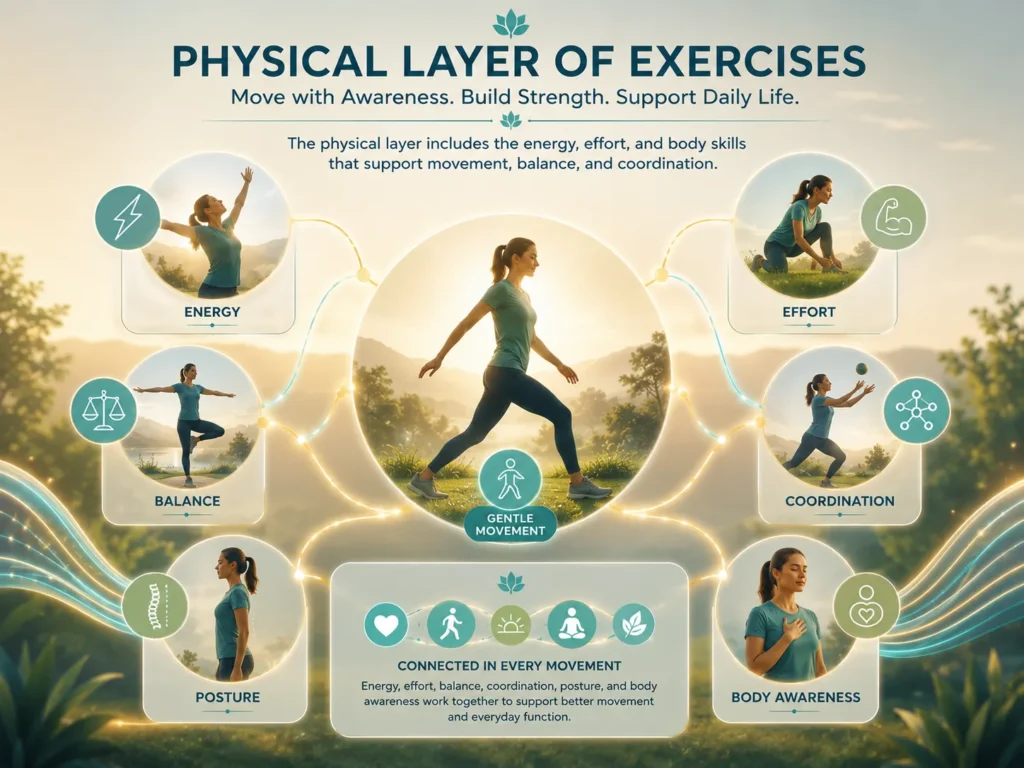
Physical Layer of Exercises
The physical layer focuses on how the body performs movement. Muscles, joints, balance systems, coordination, posture, and energy all contribute to physical activity.
Every movement requires physical effort. Some activities require very little effort. Others require more. However, all exercises involve some level of physical participation.
Because the body performs movement, physical function remains an important part of exercise education.
Energy and Effort
Different exercises require different amounts of energy. Walking slowly uses energy differently than running. Likewise, stretching feels different from carrying a heavy object.
The amount of effort may change depending on the activity, the environment, and the individual. Therefore, exercises can vary widely from person to person.
Balance and Coordination
Balance helps people stay steady. Coordination helps body parts work together efficiently. These skills support many daily activities.
For example, walking requires coordination between the legs, arms, eyes, and nervous system. Standing on one foot requires balance and body awareness. Because of this, many everyday movements involve both balance and coordination.
Physical Awareness
Physical awareness means noticing how the body feels during movement. People may notice posture, balance, comfort, effort, or movement quality.
This awareness can help people better understand their movement patterns. Therefore, physical awareness is an important part of exercise learning.
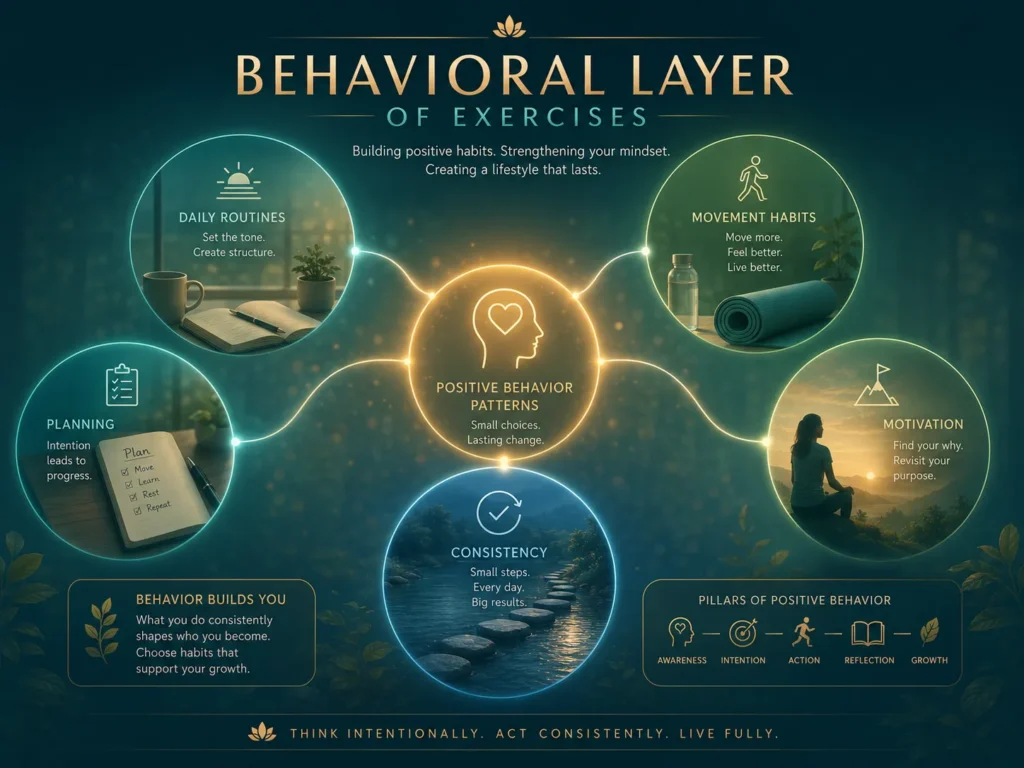
Behavioral Layer of Exercises
The behavioral layer focuses on habits and routines. While movement is important, consistency often matters just as much.
Many people know that movement is beneficial. However, turning movement into a regular habit may require planning, motivation, and repetition. Because of this, behavior plays a major role in exercise participation.
Building Movement Habits
Habits develop through repeated actions. A person who walks every morning may gradually create a regular movement routine. Likewise, someone who stretches each evening may build a consistent habit over time.
These habits do not appear instantly. Instead, they usually develop through repetition and practice.
Small Actions Add Up
Many people focus on large goals. However, small actions can also matter. A short walk, a few minutes of stretching, or a simple movement practice may seem minor on a single day.
However, repeated actions can accumulate over time. Therefore, small steps often contribute to long-term progress.
Consistency Over Perfection
Many people believe they must perform exercises perfectly. However, consistency is often more important than perfection.
Regular participation allows people to continue learning and adapting. As a result, long-term habits often develop through steady effort rather than flawless performance.
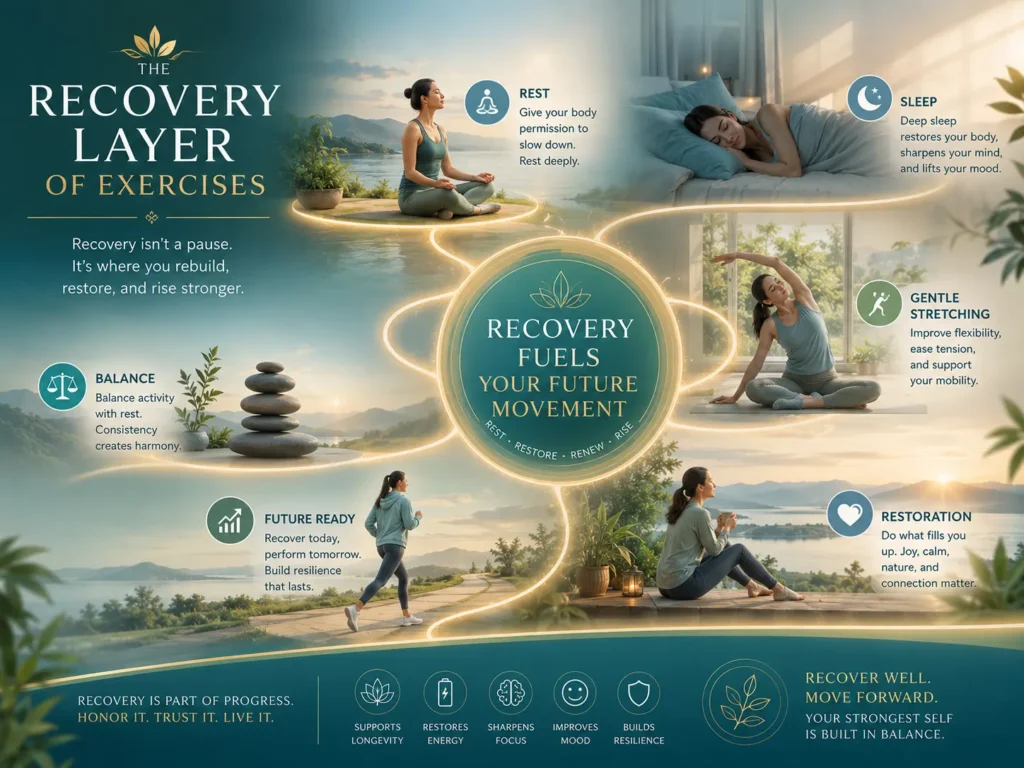
Recovery Layer of Exercises
Recovery is an important part of exercise. Movement creates demand. Recovery provides time for restoration and adjustment afterward.
Without recovery, people may find it harder to maintain performance, energy, or consistency. Therefore, exercise and recovery work together.
Why Recovery Matters
Recovery gives the body time to restore energy and prepare for future activity. It also allows people to reflect on experiences and learning.
For example, after practicing a new movement, recovery provides time before the next practice session. This balance helps support long-term participation.
Recovery and Adaptation
Adaptation often develops through a combination of movement and recovery. Movement creates experience. Recovery provides time for adjustment. Together, these processes support learning over time.
Because of this relationship, recovery remains an essential layer of exercise education.
Recovery in Everyday Life
Recovery does not always mean complete inactivity. Rest, sleep, relaxation, and balanced routines may all contribute to recovery.
As a result, recovery should be viewed as an active part of the overall movement process rather than something separate from exercise.
Real-Life Symptom Language Bridge
Many readers arrive at exercise-related topics because they notice changes in how they feel during daily life. Some people report feeling stiff after sitting for long periods. Others describe feeling less steady, less flexible, or less confident with certain movements.
Some readers may search for information because they experience tingling, numbness, burning sensations, nerve sensitivity, weakness, balance difficulties, fatigue, or changes in movement comfort. These experiences can have many different causes. Therefore, exercise should never be viewed as the only explanation.
Instead, this topic helps explain one possible layer of movement, learning, and adaptation. It focuses on how movement experiences may influence body awareness, coordination, confidence, and daily function. However, sudden, severe, unusual, or worsening symptoms require evaluation by qualified healthcare professionals.
Everyday Examples People Often Describe
People use many different words to describe movement-related experiences. For example:
- “I feel stiff when I get up in the morning.”
- “I feel less steady than I used to.”
- “My movements feel awkward sometimes.”
- “I lose confidence when trying new activities.”
- “I feel tired after physical activity.”
- “Certain movements feel unfamiliar.”
These descriptions do not automatically point to one specific cause. Instead, they show how people often describe changes in movement experiences.
Understanding the Bigger Picture
Movement experiences involve many systems working together. Muscles, joints, senses, balance systems, learning processes, habits, recovery, and the nervous system all contribute to daily function.
Because these systems interact, movement experiences can feel different from person to person. Therefore, understanding exercise requires looking at the whole picture rather than focusing on a single factor.
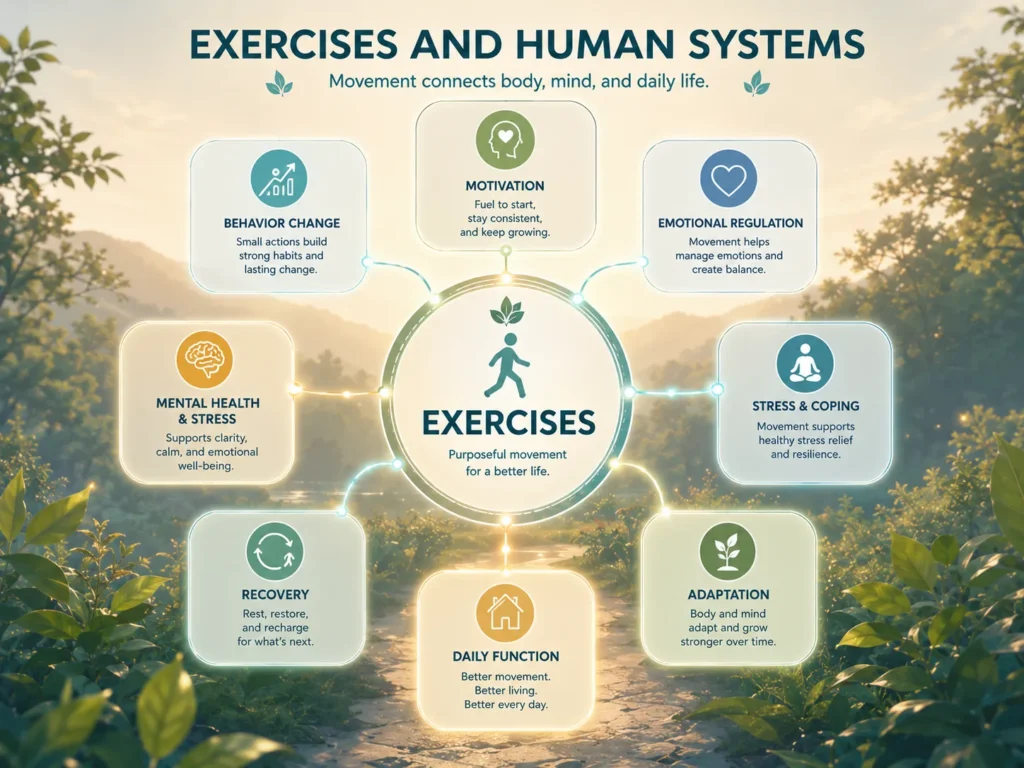
Exercises and Human Systems
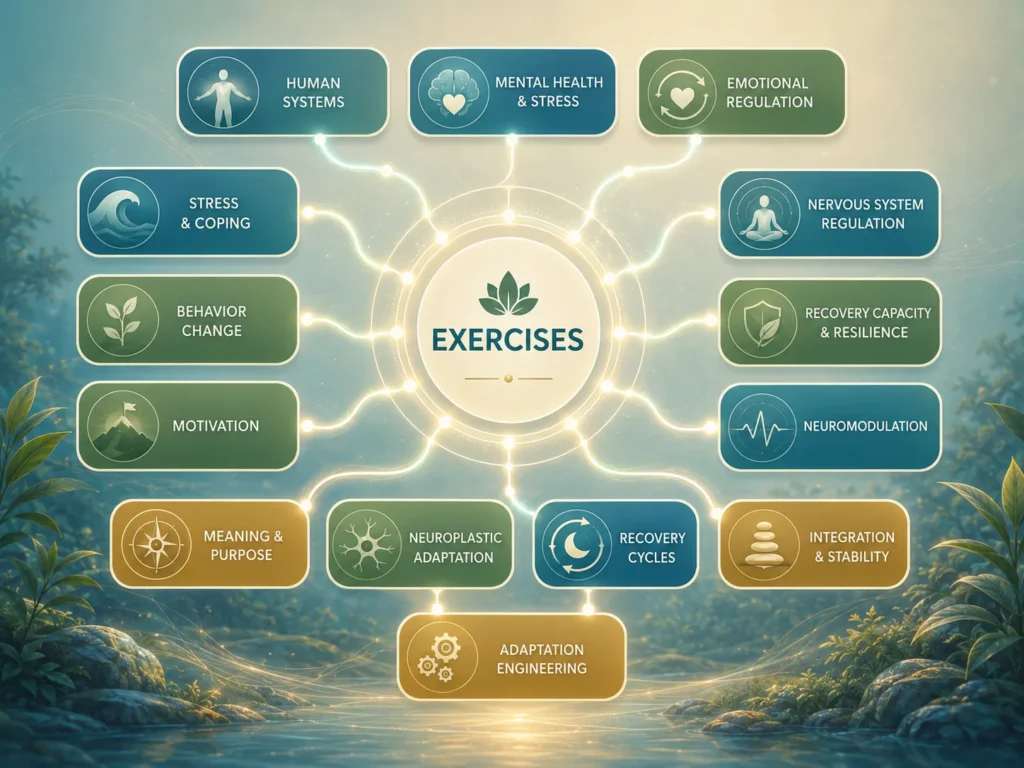
Exercises connect with many Human Systems topics throughout the Heal Your Nerves Naturally educational framework. This is because movement influences learning, emotions, habits, motivation, resilience, and adaptation.
People do not move in isolation. Instead, movement often interacts with thoughts, feelings, goals, routines, and daily experiences. As a result, exercises connect naturally with several educational topics across the site.
Connection With Motivation
Motivation often influences movement participation. A person may feel motivated to start a new activity, continue practicing a skill, or work toward a personal goal.
However, motivation can change from day to day. Therefore, understanding motivation can help explain why exercise habits sometimes feel easy and other times feel challenging.
Connection With Behavior Change
Exercise habits often involve behavior change. People may decide to add more movement to their routine, develop new habits, or practice new skills.
Because habits develop through repetition, behavior change and exercise frequently work together.
Connection With Emotional Regulation
Movement experiences can influence emotions. Likewise, emotions can influence movement choices. For example, confidence, enjoyment, frustration, excitement, or uncertainty may affect participation in different activities.
Therefore, Emotional Regulation and Exercises share important connections.
Connection With Stress & Coping
Stress can influence how people approach movement. Likewise, movement often becomes part of broader coping and lifestyle routines.
Because both topics involve adaptation and daily experiences, they connect closely within the Human Systems framework.
Exercises Interactions
Exercises interact with many other systems throughout the body and nervous system. Movement rarely affects only one area. Instead, it often involves multiple layers working together at the same time.
For example, balance activities involve physical movement, attention, learning, and coordination. Walking may involve posture, awareness, energy, and environmental information. Therefore, exercises often create interactions between many different systems.
Movement and Learning
Movement and learning frequently occur together. Every movement creates information. Then the nervous system uses that information to guide future actions.
Because of this relationship, movement often becomes a practical way to explore learning and adaptation.
Movement and Recovery
Recovery supports ongoing participation. Movement creates demand. Recovery provides time for restoration afterward.
As a result, movement and recovery often work as a connected cycle rather than separate processes.
Movement and Adaptation
Adaptation develops through repeated experiences. Exercises provide opportunities for those experiences to occur.
Over time, people may become more familiar with movements, environments, and activities. Therefore, adaptation remains an important concept within exercise education.
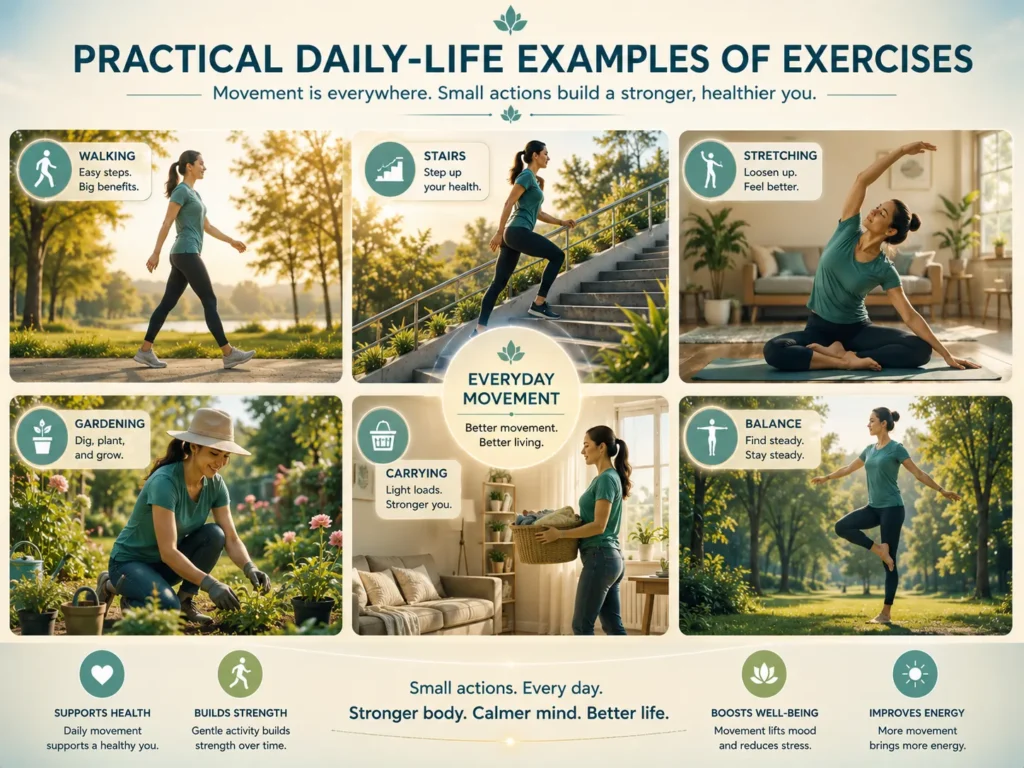
Practical Daily-Life Examples
Exercises appear in many everyday situations. Most people perform movement activities without thinking about them as formal exercise.
For example:
- Walking through a grocery store
- Carrying household items
- Climbing stairs
- Gardening
- Playing with children
- Practicing balance while reaching for an object
- Learning a recreational activity
- Participating in sports or hobbies
These examples show that movement exists throughout daily life. Therefore, exercises should be viewed as part of normal human experience rather than something limited to structured workouts.
Exercises Visual Flow
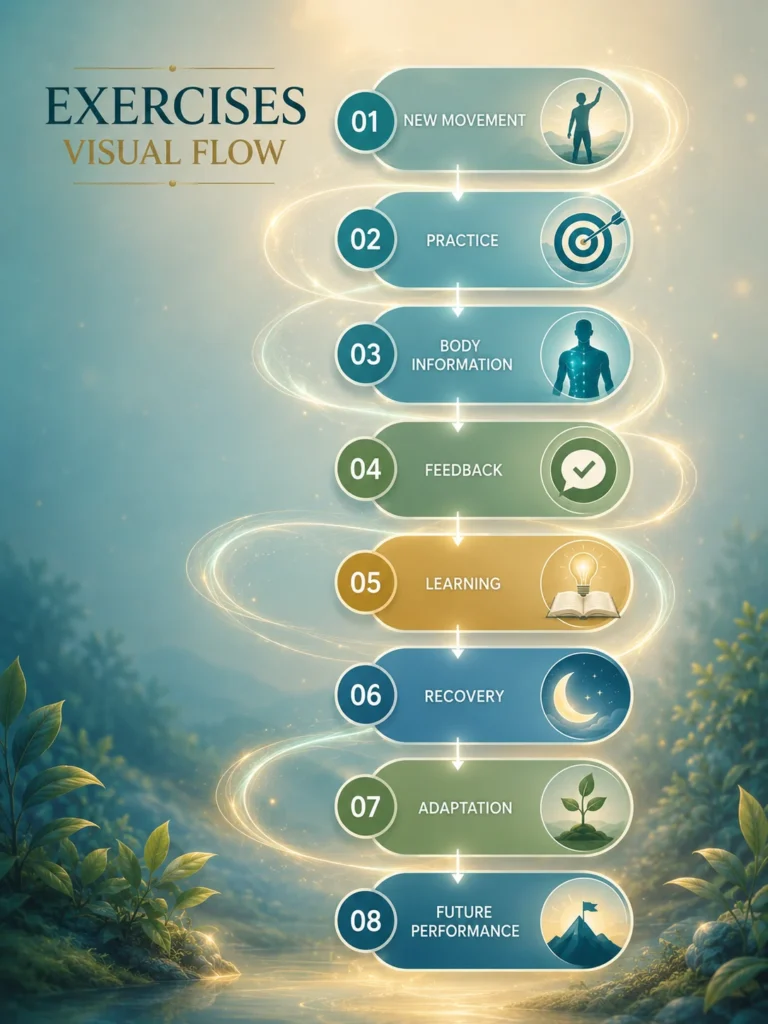
Exercises often follow a simple learning and adaptation process. While every person has unique experiences, many movement activities follow similar patterns. First, a person performs a movement. Next, the body gathers information. Then the nervous system processes that information. Finally, learning and adaptation may develop through repeated practice.
This process does not happen instantly. Instead, it usually develops through repetition, feedback, recovery, and experience. Because of this, exercise can be viewed as a continuous learning cycle rather than a one-time event.
A Simple Exercise Flow
New Movement → Practice → Body Information → Feedback → Learning → Recovery → Adaptation → Future Performance
Each step provides information for the next step. Therefore, learning often becomes stronger when movement experiences occur consistently over time.
Why Visual Flow Matters
Understanding the exercise process can help people see movement differently. Rather than focusing only on physical activity, they can recognize how learning, awareness, recovery, and adaptation contribute to progress.
As a result, exercise becomes more than movement alone. It becomes a process of gathering information, learning from experience, and improving familiarity with different activities.
Why Exercises Matter
Exercises matter because movement is part of everyday life. People move to work, learn, communicate, travel, play, and complete daily responsibilities. Therefore, understanding movement can help people better understand many aspects of human function.
Exercise also helps explain how learning develops through practice. New skills rarely appear immediately. Instead, people often improve through repetition and experience. Because of this, exercise provides a useful example of adaptation in action.
Supporting Daily Function
Many daily activities depend on movement. Walking, standing, reaching, lifting, turning, and balancing all require coordination and control.
Exercises help people explore these movement patterns. As a result, they can better understand how movement supports everyday life.
Supporting Learning and Adaptation
Exercises provide opportunities to learn. Every movement creates information. Then the nervous system uses that information to guide future responses.
Because this process repeats over time, exercise often becomes a practical example of learning and adaptation.
Supporting Long-Term Participation
People often participate in movement activities throughout life. Walking, recreation, hobbies, sports, and daily tasks all involve movement.
Therefore, understanding exercises can help readers appreciate how movement contributes to lifelong learning and participation.
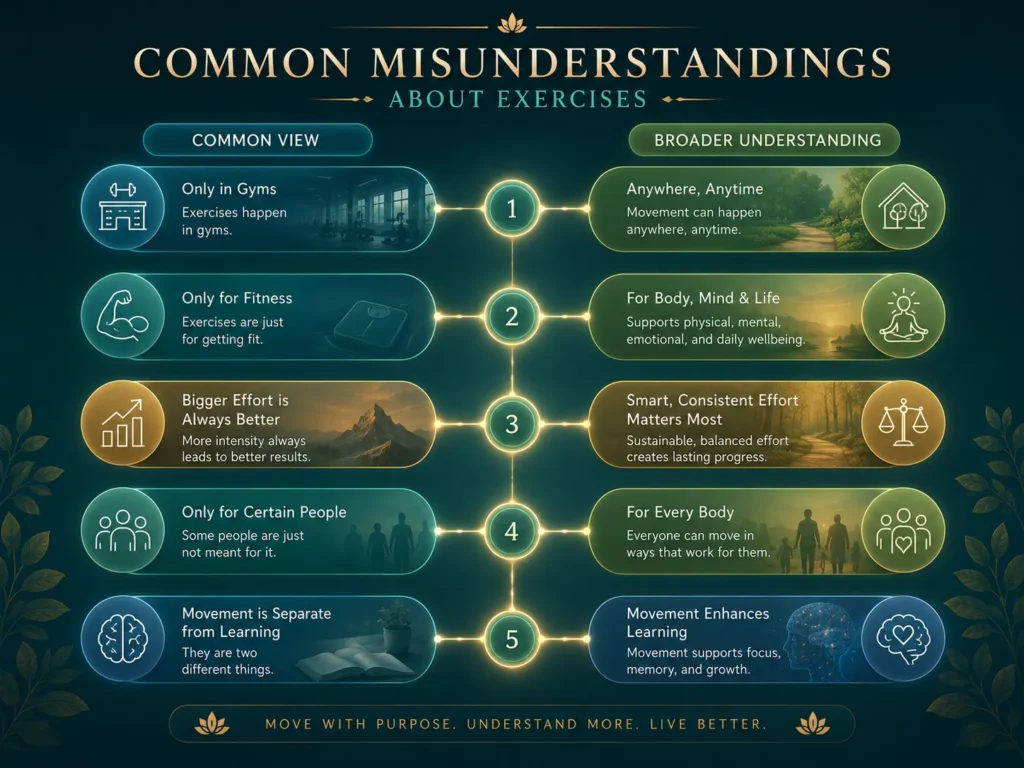
Common Misunderstandings About Exercises
Many misconceptions exist about exercise. These misunderstandings can make movement seem more complicated or less accessible than it actually is.
Misunderstanding: Exercise Only Happens in a Gym
Many people associate exercise with gyms and fitness centers. However, exercise can occur almost anywhere.
Walking, gardening, stretching, recreational activities, and daily movement all involve exercise in different ways.
Misunderstanding: Exercise Is Only About Fitness
Fitness is one part of exercise. However, movement also involves learning, adaptation, coordination, habits, confidence, and daily function.
Because of this, exercise should be viewed as a broader educational topic.
Misunderstanding: Bigger Effort Always Means Better Results
People sometimes believe that more effort always leads to better outcomes. However, learning often develops gradually.
Consistent practice, recovery, and repetition frequently play important roles in movement development.
Misunderstanding: Exercise Is Only for Certain People
Exercise is not limited to athletes or highly active individuals. Movement is a normal part of human life.
Therefore, exercise can be relevant to people with different interests, abilities, and activity levels.
Related Condition Connections
Some readers explore exercise topics because they are interested in movement-related conditions or changes in physical function. While exercise does not explain every situation, it can help people understand one layer of movement and adaptation.
Related educational condition pages include:
These conditions involve different experiences and causes. Therefore, exercises should not be viewed as the sole explanation for symptoms or movement changes.
How Exercises Connect With Other Nerve Health Pages
Exercises connect with many topics throughout the Heal Your Nerves Naturally educational framework. This is because movement influences learning, adaptation, behavior, resilience, recovery, and daily function.
For example, Neuromodulation explores how the nervous system adjusts to information and experience. Neuroplastic Adaptation explains how learning influences future responses. Recovery Capacity and Nervous System Resilience focuses on adaptation after periods of demand.
Together, these topics help create a broader understanding of how movement and learning interact across daily life.
Connections With Human Systems
Exercises connect closely with Human Systems topics.
For example:
These topics influence participation, habits, consistency, and learning. Therefore, they play important roles in exercise experiences.
Connections With Recovery Systems
Exercises also connect with recovery-related topics.
Examples include:
• Recovery Capacity and Nervous System Resilience
These topics help explain how recovery supports future participation and adaptation.
Topic Cluster Placement
Within the Heal Your Nerves Naturally educational framework, Exercises belong primarily within the Human Systems cluster.
This topic acts as a bridge between movement, learning, habits, adaptation, recovery, and everyday function. Because of this role, Exercises connect naturally with many educational topics across the site.
Movement is rarely an isolated activity. Instead, it often involves attention, motivation, emotions, behavior, recovery, and adaptation. Therefore, Exercises help connect multiple learning pathways into one practical topic.
Primary Cluster
Direct Connections
• Recovery Capacity and Nervous System Resilience
Supporting Connections
As a result, Exercises serve as one of the practical application topics within the Human Systems cluster.
Exercises FAQ
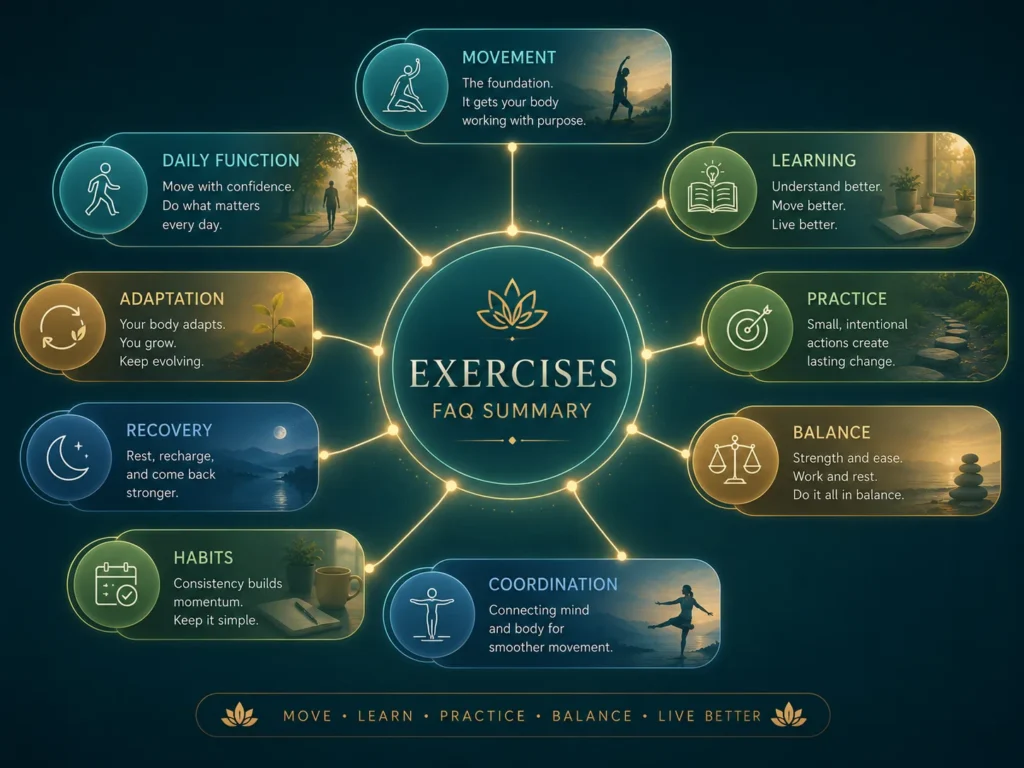
What are exercises?
Exercises are purposeful movements that help people practice skills, learn movement patterns, improve function, and participate in daily activities.
Do exercises always require a gym?
No. Exercises can happen almost anywhere. Walking, stretching, gardening, balance activities, recreational sports, and many daily tasks involve movement.
Why are exercises important?
Exercises help explain how movement, learning, adaptation, habits, and daily function work together. They are an important part of everyday life.
Are exercises only about fitness?
No. Fitness is one part of exercise. However, exercises also involve learning, coordination, confidence, awareness, habits, and adaptation.
How do exercises support learning?
Every movement creates information. The body and nervous system use that information to improve future responses. Therefore, practice often supports learning.
Why does practice matter?
Practice creates repeated experiences. Over time, these experiences can help movements feel more familiar and easier to perform.
What role does recovery play?
Recovery gives the body time to restore and prepare for future activity. Because of this, recovery remains an important part of the exercise process.
Can exercises become habits?
Yes. Repeated participation can help people build movement routines and long-term habits.
Do exercises influence adaptation?
Exercises provide opportunities for learning and experience. Therefore, they often contribute to adaptation over time.
Are exercises the same for everyone?
No. People choose different types of movement based on interests, goals, abilities, and daily circumstances.
Is this page providing exercise programs?
No. This page explains exercises as an educational topic. It does not provide personal exercise plans, treatment recommendations, or medical advice.
Do exercises guarantee specific outcomes?
No. Individual experiences vary. Many factors influence movement, learning, recovery, and participation.
Continue Learning
Exercises connect with many other topics throughout the Heal Your Nerves Naturally educational framework. Exploring related pages can help readers build a broader understanding of movement, learning, adaptation, recovery, resilience, and daily function.
To continue learning, consider exploring:
• Recovery Capacity and Nervous System Resilience
Together, these topics help explain how movement, learning, habits, recovery, adaptation, and everyday experiences interact across human life.
Sources / References
The following educational resources provide reliable information about physical activity, movement, learning, health, and nervous system function. Readers who want to explore these topics in greater depth may find these sources helpful.
• Centers for Disease Control and Prevention (CDC)
• National Institutes of Health (NIH)
• National Institute of Neurological Disorders and Stroke (NINDS)
• National Center for Biotechnology Information (NCBI)
These organizations offer educational information about exercise, movement, physical activity, recovery, health, and human function.
Author / Editorial Trust Note
This page was created as part of the Heal Your Nerves Naturally educational platform. The goal is to explain complex topics in a clear, practical, and user-friendly way.
Exercises are often discussed from many different perspectives. Therefore, this page focuses on helping readers understand movement, learning, adaptation, recovery, and daily function using simple language whenever possible.
Technical concepts are simplified to improve understanding while maintaining educational accuracy. In addition, real-life examples and practical explanations are included to help connect information with everyday experiences.
The purpose of this page is education and awareness. It is designed to help readers better understand how movement fits within broader discussions about learning, adaptation, resilience, recovery, and human function.
Educational Trust Note
Exercise is studied across many fields, including movement science, rehabilitation, neuroscience, education, psychology, human performance, and public health.
As research continues to grow, understanding also continues to develop. Therefore, this page focuses on broad educational principles rather than specific exercise methods or programs.
The goal is to help readers understand how movement, learning, adaptation, and recovery interact within everyday life.
Safety & Education Notice
This page is for educational purposes only. It does not diagnose, treat, cure, or prevent any disease or medical condition.
Symptoms such as severe pain, sudden weakness, loss of function, major balance problems, unusual sensory changes, worsening symptoms, or other concerning health issues should be evaluated by qualified healthcare professionals.
Exercises should be viewed as an educational topic that helps explain movement, learning, adaptation, habits, recovery, and daily function. It should not replace professional medical advice, diagnosis, or treatment.