
Nerve Food Repair: What to Eat to Support Nerve Health and Recovery

This Nerve Food Repair guide is for the person who wakes up with tingling feet, notices numb fingers while working, feels burning in the legs at night, or has been told that a nerve has been injured or damaged.
In those moments, the question often feels simple:
“What should I eat to help my nerves?”
Food does matter. However, it rarely works in the way internet headlines suggest.
Your nerves need energy, protein, vitamins, minerals and a healthy blood supply. Nutrition becomes especially important when poor intake, malabsorption or a true nutrient deficiency is contributing to nerve problems.
Yet no single food has been shown to repair every damaged nerve.
Peripheral neuropathy can have many causes. NINDS lists diabetes, injury, compression, vascular problems, autoimmune conditions, nutritional imbalance, toxins and other medical problems among them. Vitamin B12 deficiency and excess vitamin B6 are two of the best-known vitamin-related causes of neuropathy.
So a useful Nerve Food Repair plan has to do more than give you a list of salmon, spinach and berries.
It should help you answer four practical questions:
Could nutrition be part of my problem?
What should I eat in normal life?
What should I avoid doing?
When do my symptoms need more than food?
That is what this guide is designed to do.
QUICK ANSWER
A practical nerve-supportive eating pattern usually includes enough protein, reliable vitamin B12 sources when needed, whole grains and legumes, vegetables and fruit, nuts and seeds, and other minimally processed foods that fit your health needs.
WHO describes adequacy, balance, moderation and dietary diversity as core features of a healthy diet.
There is, however, no scientifically established universal “nerve repair diet.”
Think of food as one part of the recovery environment.
Find your situation below ↓
Why Nerve Food Repair Starts With the Cause
Imagine two people.
The first eats a strict vegan diet, has not used fortified foods or B12 supplements for years, and recently developed numbness.
The second eats a balanced diet but develops hand tingling after a repetitive wrist injury.
Both people may search:
“What food repairs nerves?”
Yet they do not have the same problem.
For the first person, nutritional status may be central.
For the second, mechanical pressure or injury may matter much more.
That is why Nerve Food Repair should begin with the cause rather than the food.
If You Have Tingling or Numbness
Tingling can occur with nutritional deficiency. However, it can also happen with diabetes, nerve compression, injury and many other conditions.
NINDS describes numbness, tingling, pain and weakness among common peripheral neuropathy features and lists a wide range of possible causes.
Therefore, do not use a food list as a self-diagnosis tool.
If you are unsure where your symptoms fit, start with the HYN symptoms of nerve dysfunction guide.
For a deeper condition overview, read peripheral neuropathy causes and symptoms.
When Nutrition Deserves Closer Attention
Nutrition moves higher on the list when you eat a very restricted diet, have known B12 deficiency, have a gastrointestinal absorption problem, have undergone stomach or intestinal surgery, drink heavily, eat very little overall, or use several supplements containing high doses of B vitamins.
Some medicines can also affect B12 status.
NIH notes that gastric-acid inhibitors can interfere with B12 absorption from food. Metformin may also reduce B12 absorption and blood concentrations.
That does not mean the medicine should be stopped.
Instead, it gives you a useful question to discuss with your healthcare professional:
“Should my B12 status be checked?”
Start With a Three-Day Reality Check
Before changing everything you eat, look at three normal days.
Not your healthiest days.
Not the days when you knew someone was watching.
Look at your actual routine.
Did breakfast disappear because you were busy?
Was lunch mostly coffee and a pastry?
Did dinner contain a protein source?
Did you eat any reliable B12 source?
Did vegetables or fruit appear more than once?
Are you taking three different products that all contain B6?
This is often more useful than immediately buying another supplement.

What Foods Belong in a Nerve Food Repair Plan?
A useful Nerve Food Repair diet is not built around one “best” food.
Instead, think about the nutritional job each food group performs.
| Nutritional goal | Everyday foods | Why it matters |
|---|---|---|
| Support B12 intake | Fish, shellfish, eggs, dairy, meat, fortified foods | B12 is needed for normal nervous-system function |
| Provide thiamin | Whole grains, beans, fortified grains, pork, fish, seeds | Severe deficiency can affect peripheral nerves |
| Meet protein needs | Fish, eggs, poultry, dairy, beans, lentils, tofu | Provides amino acids needed across normal tissue maintenance |
| Improve dietary variety | Vegetables, fruit, legumes, whole grains | Helps provide a wider mix of nutrients and fibre |
| Include unsaturated fats | Fish, nuts, seeds, avocado, plant oils | Supports an overall cardiometabolic eating pattern |
| Support metabolic health | Whole grains, legumes, vegetables, fruit | Especially relevant for diabetes and prediabetes |
The important word here is pattern.
One healthy dinner does not cancel weeks of poor intake.
Likewise, one doughnut does not destroy your nerves.
Instead, the pattern repeated across months is what matters most for general nutrition.
For a deeper explanation of why nutrition matters biologically, continue to how nutrition supports nerve repair.
Vitamin B12: The Nutrient Every Nerve Food Repair Guide Should Explain Properly
Vitamin B12 is one nutrient where the connection to neurological health is not simply marketing.
B12 is involved in normal nervous-system function and myelination. Deficiency can produce neurological problems, including numbness and tingling. Some people can develop neurological symptoms even without obvious anemia.
NIH also notes that certain medicines and absorption problems can affect B12 status.
NIH Vitamin B12 Fact Sheet for Health Professionals
Which Foods Contain Vitamin B12?
Common natural B12 sources include fish, shellfish, meat, poultry, eggs, milk, yogurt and other dairy products.
Fortified foods can also provide B12.
For many omnivores, ordinary meals can supply sufficient B12.
However, the situation changes for people who avoid animal-derived foods.
What If You Eat Vegan?
If you eat vegan, B12 deserves a deliberate plan.
A diet can contain plenty of vegetables, legumes, whole grains, nuts and seeds and still lack reliable natural B12.
Therefore, fortified foods and/or an appropriate supplement are often part of a vegan B12 strategy.
Do not rely on the idea that a diet is automatically nutritionally complete because it is “natural” or plant-based.
Can Vegetarians Also Become B12 Deficient?
Yes.
Some vegetarians consume dairy and eggs, which can provide B12. However, actual intake differs greatly from person to person.
A vegetarian who eats eggs and dairy regularly is in a different situation from someone who eats them once a month.
Therefore, the label “vegetarian” tells us less than the actual food pattern.
Can I Fix Low B12 Just by Eating More Eggs?
Not necessarily.
If low intake is the main problem, better dietary intake may help.
However, if the problem is poor absorption, simply eating more B12-rich food may not be enough.
NIH notes that gastric-acid inhibitors and metformin can affect B12 status, and absorption disorders can also matter.
If B12 deficiency has already been confirmed, the key question is:
Why am I deficient?
That determines whether food alone is a realistic solution.
Are B12 Injections Better Than Food?
They solve a different problem.
Food is part of ordinary nutritional intake.
Injections are a clinical treatment option used in some situations where deficiency needs treatment or absorption is impaired.
Therefore, do not compare them as if they are competing foods.
If you have a diagnosed deficiency, use the treatment plan recommended for the cause of that deficiency.
Vitamin B6: The “Nerve Vitamin” That Can Become a Nerve Problem
Vitamin B6 appears in many products marketed for energy, nerves and general wellness.
That makes it easy to assume that more must be better.
It is not.
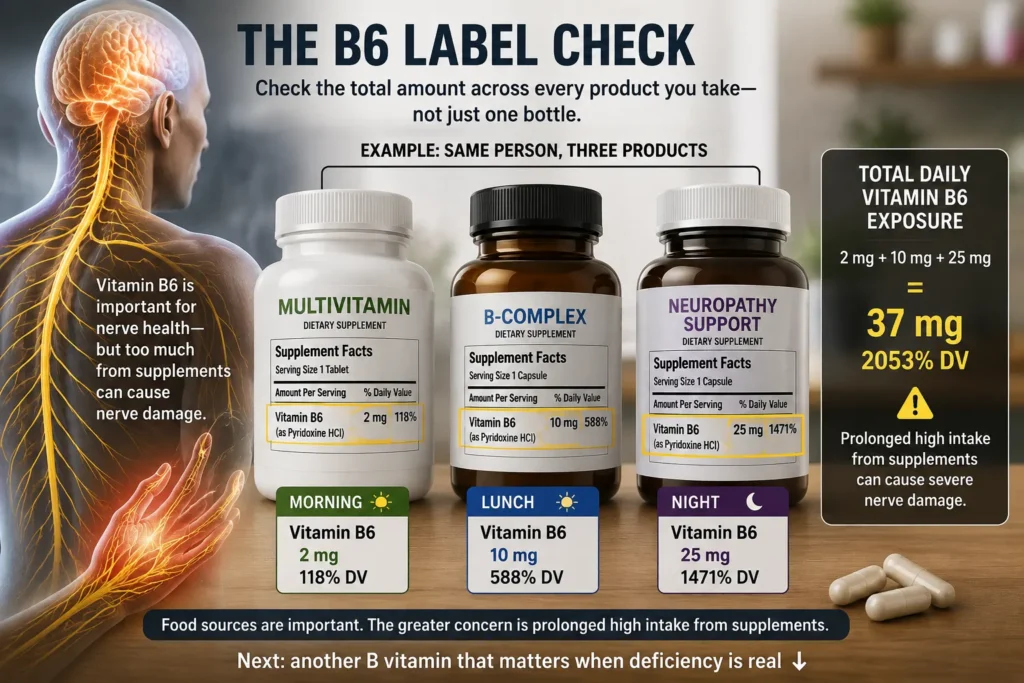
NIH states that high amounts of supplemental B6 taken for a long time can cause severe nerve damage. Excess B6 from ordinary food, in contrast, is uncommon.
NIH Vitamin B6 Consumer Fact Sheet
The Real-Life Supplement Problem
Imagine someone takes:
a multivitamin in the morning,
a B-complex at lunch,
and a “neuropathy support” capsule at night.
Each product may contain B6.
The person may never think of themselves as taking a high-dose B6 supplement because the B6 is spread across three bottles.
That is why label checking matters.
Does B6 From Food Need the Same Concern?
Usually no.
NIH notes that people almost never consume harmful amounts from food alone. The greater concern is prolonged high intake from supplements.
So bananas, potatoes, poultry and other B6-containing foods do not need to be feared because B6 supplements can cause toxicity.
Does a Higher Percentage on the Label Mean a Better Nerve Supplement?
No.
A huge percentage of the Daily Value is not evidence that a product repairs nerves.
It simply tells you the dose is high relative to daily requirements.
That is an important distinction in any responsible Nerve Food Repair plan.
Thiamin, or Vitamin B1: Important When Deficiency Is the Problem
Thiamin helps cells use energy.
NIH explains that severe thiamin deficiency can cause beriberi. Peripheral neuropathy and impaired sensory, motor and reflex function are major features of the condition.
Good food sources include whole and fortified grains, pork, trout, beans and other foods.
NIH Thiamin Fact Sheet for Health Professionals
Does That Mean More Thiamin Repairs Nerves?
No.
It means something more specific:
If thiamin deficiency is causing nerve problems, correcting the deficiency matters.
That is very different from saying everyone with nerve pain should take high-dose thiamin.
The first statement follows the evidence.
The second does not.
Who Is More at Risk?
NIH notes that thiamin deficiency can be associated with inadequate intake, reduced absorption, increased losses and certain conditions. Alcohol dependence is one recognized risk factor.
That makes alcohol an important real-life topic, which we will return to later.
Does Magnesium Matter for Nerves?
Magnesium is needed for many normal body processes, including nerve and muscle function.
However, magnesium is another nutrient that is often oversold online.
Severe magnesium deficiency can cause symptoms including numbness, tingling, muscle contractions and cramps. Yet symptomatic magnesium deficiency from low dietary intake alone is uncommon in otherwise healthy people. Certain illnesses, medications and chronic alcohol use can raise risk.
NIH Magnesium Fact Sheet for Health Professionals
Should Everyone With Tingling Take Magnesium?
No.
Tingling has many possible causes.
If someone with normal magnesium status takes extra magnesium, that does not automatically treat the actual cause of the tingling.
This is another example of a core Nerve Food Repair principle:
Treat a real deficiency when it exists. Do not assume every nerve symptom is a deficiency.
Which Foods Provide Magnesium?
Common sources include nuts, seeds, legumes, whole grains and leafy vegetables.
Those foods fit naturally into a healthy dietary pattern even when magnesium deficiency is not present.
Protein: The Part of Nerve Food Repair People Often Overlook
When people think about nerves and nutrition, they usually think about vitamins.
Protein receives less attention.
Yet if a person is eating too little overall, skipping meals or consistently eating very little protein, another vitamin capsule may not solve the bigger nutritional problem.
Protein provides amino acids used throughout the body for tissue maintenance, enzymes, immune function and many recovery processes.
Useful protein sources include fish, eggs, poultry, dairy, beans, lentils, tofu, soy foods, nuts and seeds.
For a deeper look at this part of your site’s nutrition architecture, see protein and amino acids in recovery nutrition.
Does Eating Extra Protein Make Nerves Grow Faster?
There is no good basis for promising that.
The goal is adequacy.
If someone is already meeting their protein needs, doubling intake does not mean nerve recovery will double.
Likewise, if a person has kidney disease or another condition affecting protein needs, “eat more protein” can be overly simplistic.
Use protein as part of a balanced plan, not as a regeneration hack.
Omega-3 Foods: Useful Foods, Not a Proven Nerve-Regeneration Treatment
Omega-3 fats are another popular topic.
Fatty fish such as salmon, sardines, herring and mackerel provide EPA and DHA. Walnuts, chia and flax provide ALA.
NIH Omega-3 Fatty Acids Fact Sheet
Omega-3 fats have important roles in cell membranes and broader cardiovascular and physiological health.
However, that is not the same as evidence that eating salmon directly regenerates an injured human nerve.
Should Fish Be Part of a Nerve Food Repair Diet?
It can be.
Fish can provide protein, B12 and omega-3 fats.
That makes it nutritionally useful for many people.
Still, think of it as a nutrient-dense food rather than medicine.
What If I Do Not Eat Fish?
You can still build a balanced diet.
Plant sources such as walnuts, chia, flaxseed, soybean oil and canola oil provide ALA.
Depending on your diet, fortified foods may also contribute certain omega-3 fats.
Vegetables and Fruit: Valuable Without Calling Them “Nerve-Healing Superfoods”
Search results often promote individual foods:
blueberries for nerves,
spinach for nerves,
avocado for nerves,
broccoli for nerves.
The problem is not that those foods are unhealthy.
The problem is the leap from “nutritious food” to “clinically proven nerve repair.”
A diverse diet supplies a broader range of vitamins, minerals, fibre and other dietary compounds.
WHO emphasizes dietary diversity and minimally processed foods, including vegetables, fruit, pulses and whole grains, as part of healthy eating.
Are Berries Good for Nerves?
Berries can be part of a nutritious diet.
They provide fibre and various plant compounds.
However, there is no need to tell a reader that blueberries will regenerate damaged nerves.
Enjoy them because they are useful foods, not because they are a cure.
Is Spinach a Nerve Repair Food?
Spinach contains several nutrients and can fit well into a healthy diet.
However, “contains nutrients” does not mean “repairs nerve damage.”
This difference between nutrition and treatment runs throughout Nerve Food Repair.
What About Bananas?
Bananas are ordinary nutritious foods.
They provide carbohydrate, potassium and some B6.
They are not a proven treatment for neuropathy.
Importantly, the B6 toxicity concern discussed earlier relates mainly to high supplemental intake, not ordinary food intake.
Are Eggs Good for Nerve Health?
Eggs provide protein and B12.
Therefore, they can be useful in a balanced diet for people who eat them.
Still, an egg does not work like a nerve-repair drug.
Whether eggs fit your daily diet also depends on your wider eating pattern and individual health needs.
What About Milk and Yogurt?
Milk, yogurt and other dairy foods can provide protein and B12.
For someone who tolerates dairy, these foods can be convenient.
For example, yogurt paired with oats, fruit and nuts can turn a rushed breakfast into a more balanced meal.
However, dairy is not mandatory for nerve health.
Someone who does not consume dairy can meet nutritional needs through other foods and appropriate fortified products.
Again, Nerve Food Repair is a framework, not a list of compulsory foods.
Can Food Actually Repair or Regenerate Damaged Nerves?
This is the most emotionally important question on the page.
A person with numb toes is rarely searching “nerve regeneration foods” out of casual curiosity.
Usually, they want to know:
“Can I get better?”
The answer depends heavily on why the nerve is damaged.
NINDS notes that when the underlying cause of some neuropathies can be corrected, nerves may recover and regrow. However, treatment and outcome depend on the type, location and cause of the nerve damage.
That means food can be very important in one person and relatively minor in another.
A More Useful Model of Nerve Recovery
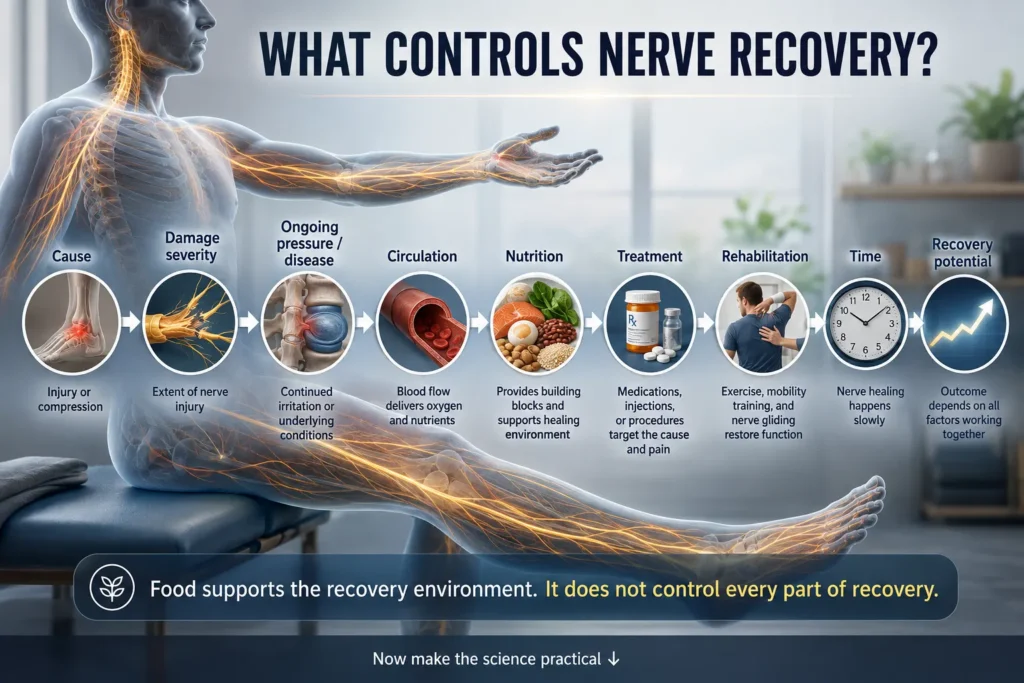
Think of recovery as a chain:
Cause of damage
→ Severity of damage
→ Whether the damage continues
→ Blood supply
→ Metabolic health
→ Nutritional adequacy
→ Treatment
→ Rehabilitation
→ Time
Nutrition sits inside that chain.
It does not replace the rest of it.
Why Myelin Matters
Many nerve fibers are wrapped in myelin, which helps support efficient nerve signaling.
If you want the biology rather than the food advice, continue to how myelin supports nerve function.
For the next layer, explore how neural signaling works.
Why “Regeneration” Needs Careful Language
A food may contain a nutrient used in normal biology.
A laboratory study may show an effect on nerve cells.
An animal study may show improved regeneration.
None of those automatically prove that eating the food repairs established human neuropathy.
That translation step matters.
Therefore, this page will use words such as support, adequacy and recovery environment when those are what the evidence supports.
Build a Nerve Food Repair Plate for Real Life
There is no universal medically recognized “nerve repair diet.”
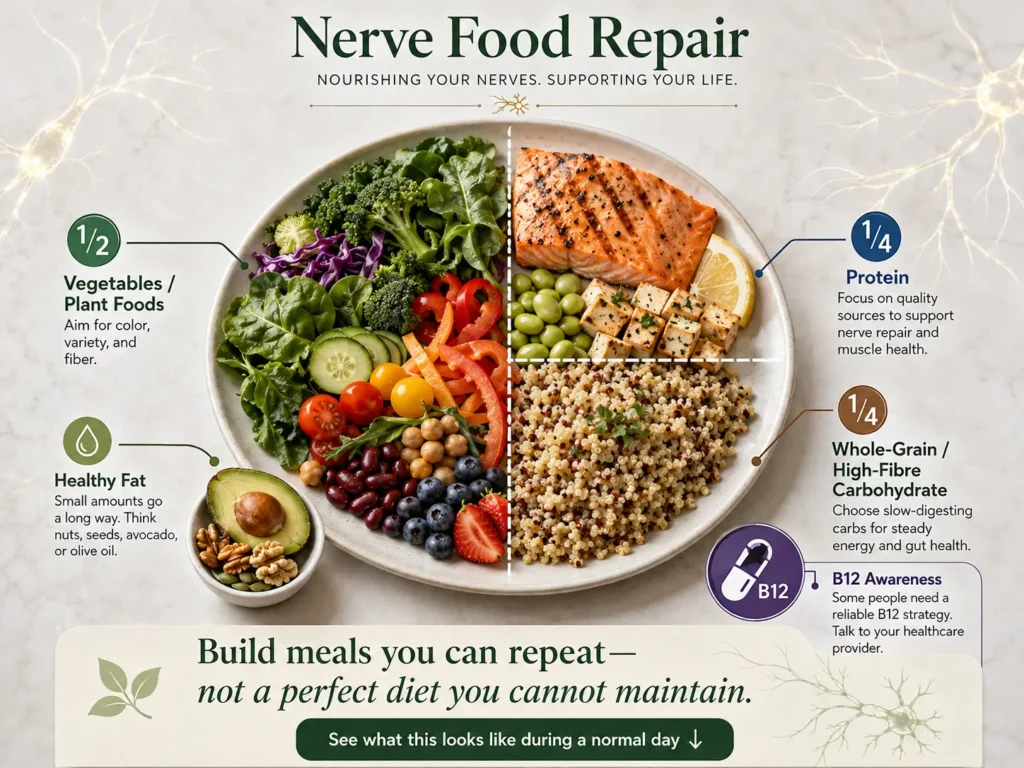
Therefore, it makes more sense to build meals around basic nutritional jobs.
Start With a Protein Source
Examples include fish, eggs, poultry, yogurt, beans, lentils, tofu or other protein foods that fit your diet.
Add Vegetables or Fruit
Use variety.
You do not need spinach at every meal.
You do not need berries every morning.
You need a pattern that includes a range of plant foods.
Add a Fibre-Rich Carbohydrate
Useful choices may include oats, whole grains, beans, lentils, brown rice or other minimally processed starches.
Add an Appropriate Unsaturated-Fat Source
Nuts, seeds, fish, avocado or suitable plant oils can fill this role.
Add B12 Awareness Where Needed
If your dietary pattern provides little natural B12, make sure there is a reliable strategy.
A useful Nerve Food Repair plate should look like normal food.
If your plan requires twelve supplements, three powders and rare imported berries at every meal, it is probably more complicated than necessary.
What Could You Eat During a Normal Day?
The point of a nutrition guide is lost if the reader finishes it still wondering:
“Fine—but what do I eat tomorrow?”
Here are simple examples.
Breakfast When You Have Time
Oats with yogurt or a fortified alternative, fruit and nuts or seeds.
Or eggs with whole-grain toast, vegetables and fruit.
Breakfast When You Are Rushing
Yogurt plus fruit and nuts.
Or a fortified cereal with milk or an appropriate alternative.
The perfect breakfast is less important than avoiding a routine where breakfast becomes nothing but coffee every day.
Lunch at Home
Lentils or beans with rice or another whole grain, plus vegetables.
Or fish, chicken or tofu with vegetables and a fibre-rich carbohydrate.
Lunch at Work
Look for the same structure:
protein,
vegetable or fruit,
fibre-rich carbohydrate.
It does not need to look like a health magazine.
A sandwich with a meaningful protein filling, salad and fruit may fit better into real life than a complicated “healing bowl.”
Dinner
Use a protein source, vegetables and a whole-food carbohydrate.
Then add an appropriate unsaturated-fat source if the meal does not already provide one.
Snacks
Fruit with yogurt.
Fruit with nuts.
Whole-grain crackers with hummus.
The snack does not need a “nerve health” label.
A Budget-Friendly Nerve Food Repair Plan
Healthy eating becomes useless advice if it assumes an unlimited food budget.
Fortunately, many nutritious foods are relatively inexpensive.
Beans, lentils, oats, eggs, frozen vegetables, canned fish, brown rice, peanut butter, seasonal fruit and fortified cereals can all fit into a practical diet.
Fresh Is Not Always Better Than Frozen
Frozen vegetables can be useful when fresh produce is expensive or spoils before you use it.
The same applies to frozen fruit.
A bag you actually eat is more useful than fresh produce you throw away every week.
Canned Foods Can Be Practical
Canned beans, lentils and fish can save time.
Depending on your health needs, look at sodium and other label information.
Rinsing canned beans can also reduce some of the sodium.
Do I Need Expensive “Superfoods”?
No.
You do not need goji berries, exotic powders or rare oils to build a good Nerve Food Repair diet.
Start with ordinary food.
What If You Hate Cooking?
This is a common real-life barrier.
A diet plan that assumes everyone enjoys cooking from scratch will fail many people.
Use convenience strategically.
Prewashed salad, frozen vegetables, canned beans, canned fish, cooked lentils, plain yogurt, eggs, whole-grain bread and prepared fruit can all reduce effort.
If you buy prepared meals, try to add something rather than thinking only about removing foods.
For example:
prepared soup + beans + fruit,
frozen meal + extra vegetables,
sandwich + yogurt + fruit.
Small upgrades are often easier to sustain.
Nerve Food Repair for Diabetes and Prediabetes
When diabetes or prediabetes is involved, food has a different job.
Now the goal is not simply nutrient adequacy.
It is also metabolic management.
NINDS identifies diabetes as a major cause of peripheral neuropathy.
The ADA Standards of Care in Diabetes—2026 emphasizes comprehensive risk reduction rather than treating diabetes as a glucose number alone.
What Does That Mean at the Dinner Table?
It means your Nerve Food Repair plan should fit your diabetes plan.
Meal composition, carbohydrate amount, medication timing and individual glucose response can matter.
Therefore, avoid copying a generic high-carbohydrate or very-low-carbohydrate “nerve diet” without considering your diabetes treatment.
Does Eating Sugar Cause Neuropathy?
One sugary food does not suddenly create neuropathy.
However, chronic hyperglycemia is central to diabetic complications.
So for someone with diabetes, repeated glucose exposure and overall diabetes management matter far more than labeling sugar as a direct “nerve toxin.”
Do I Need to Avoid All Carbohydrates?
Not necessarily.
ADA care is individualized.
Whole grains, legumes, vegetables and fruit can fit healthy dietary patterns.
Your carbohydrate plan should reflect your type of diabetes, medications, glucose response and other health needs.
Can Lifestyle Changes Help Diabetic Neuropathy?
Evidence is promising, although it should not be exaggerated.
A systematic review found encouraging data for physical activity and dietary interventions, but studies were generally small and more randomized trials were needed.
A randomized clinical trial involving 74 people with diabetic peripheral neuropathy found improvement in neuropathy severity after a 12-week lifestyle intervention that included diet, physical activity, weight-related guidance and foot care.
More recent meta-analyses also support exercise as useful for several metabolic and functional outcomes in diabetic peripheral neuropathy.
The correct takeaway is:
Lifestyle management matters.
It is not:
“One diet regenerates diabetic nerves.”
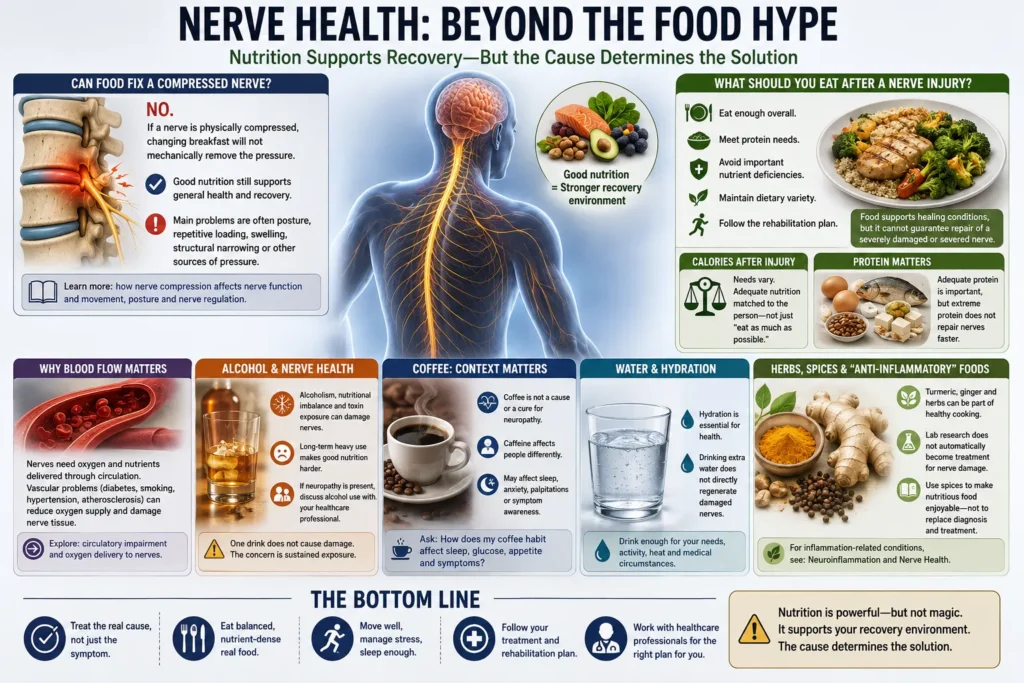
Can Food Fix a Compressed Nerve?
No.
If a nerve is physically compressed, changing breakfast will not mechanically remove the pressure.
That does not make nutrition irrelevant.
Good nutrition still supports general health and recovery.
However, the main problem may be posture, repetitive loading, swelling, structural narrowing or another source of pressure.
If compression is a realistic possibility, read how nerve compression affects nerve function.
You can also explore movement, posture and nerve regulation when movement patterns are relevant.
Why This Matters
Someone can spend months buying supplements while continuing the activity that irritates the nerve every day.
That is not a failure of nutrition.
It is a mismatch between the solution and the cause.
What Should You Eat After a Nerve Injury?
After trauma or surgery, the nutritional goals remain simple.
Eat enough overall.
Meet protein needs.
Avoid important nutrient deficiencies.
Maintain dietary variety.
Follow the rehabilitation plan.
Food can support healing conditions, but it cannot guarantee repair of a severely damaged or severed nerve.
For the condition-specific pathway, continue to post-injury nerve damage and recovery.
Should I Eat More Calories After an Injury?
Sometimes recovery raises nutritional demands. However, needs vary widely.
An immobilized person may also be moving far less than usual.
Therefore, “eat as much as possible to heal” is not useful universal advice.
The better goal is adequate nutrition matched to the person.
Is Protein More Important After Injury?
Adequate protein can be especially important during recovery.
Still, there is no reason to assume that extreme protein intake will repair nerves faster.
Why Blood Flow Matters to Nerve Health
Nerves need oxygen and nutrients delivered through the circulation.
NINDS notes that vascular problems that reduce oxygen supply to peripheral nerves can cause nerve tissue damage. Diabetes, smoking, hypertension-related vascular disease and atherosclerosis can contribute.
For the system-level explanation, explore how circulatory impairment can affect nerve health.
You can also continue to oxygen delivery and nerve function.
Are There Foods That “Increase Blood Flow to the Nerves”?
Be careful with this type of claim.
A heart-healthy eating pattern can support vascular health.
However, saying one food directly increases blood flow to damaged nerves and repairs them goes beyond what we can confidently promise.
Think systemically.
Does Alcohol Affect Nerve Health?
Yes, alcohol deserves attention.
NINDS lists alcoholism, nutritional imbalance and toxin exposure among factors that can damage nerves and contribute to neuropathy.
Long-term heavy alcohol use can also make good nutrition harder.
If I Already Have Neuropathy, Should I Stop Drinking?
That depends on your situation, but alcohol is worth discussing with your healthcare professional if neuropathy is present.
This becomes particularly important if alcohol use is heavy, frequent or associated with poor food intake.
Does One Drink Cause Nerve Damage?
That is not how alcohol-related neuropathy usually develops.
The concern is more about sustained exposure and the wider nutritional and health context.
Avoid turning the issue into a single-drink fear message.
Does Coffee Make Neuropathy Worse?
Coffee is not established as a universal cause of neuropathy.
Nor is it a nerve-repair treatment.
However, caffeine affects people differently.
If coffee worsens anxiety, sleep, palpitations or how strongly you notice symptoms, reducing it may make daily life easier.
Also pay attention to what comes with the coffee.
A sweetened coffee drink consumed several times a day can matter metabolically in a way that plain coffee does not.
The practical question is not:
“Is coffee good or bad for nerves?”
It is:
“How does my coffee habit affect my sleep, glucose, appetite and symptoms?”
Does Water Help Repair Nerves?
Hydration is essential for health.
However, drinking extra water does not directly regenerate damaged nerves.
This is another place where simple wellness advice can become overpromising.
Drink enough to meet normal needs and account for heat, activity and medical circumstances.
But do not expect water itself to reverse neuropathy.
What About Turmeric, Ginger and “Anti-Inflammatory Foods”?
Turmeric, ginger, herbs and spices can fit into healthy cooking.
However, calling them proven nerve-repair treatments is a much stronger claim.
Human neuropathy is complex.
An ingredient showing antioxidant or anti-inflammatory activity in laboratory research does not automatically become a treatment for established nerve damage.
If inflammation is part of the condition you are trying to understand, read HYN’s guide to neuroinflammation and nerve health.
Use herbs because they make nutritious food enjoyable.
Do not rely on them to replace diagnosis.
Should I Try an “Anti-Inflammatory Diet” for Nerve Pain?
This depends on what is causing the pain.
A whole-food dietary pattern may support overall metabolic and cardiovascular health.
However, “inflammation” is not one single disease.
Burning nerve pain can come from several mechanisms.
Therefore, avoid assuming every case of neuropathic pain is a food-driven inflammation problem.
For the deeper nervous-system pathway, see how the nervous system processes pain.
Why Sleep Belongs in a Nerve Food Repair Page
A nutrition page should not pretend food exists in isolation.
Poor sleep can make healthy eating harder.
It can increase reliance on convenience foods.
It can also make pain and fatigue harder to cope with.
Therefore, a person may be spending money on supplements while consistently sleeping five hours a night.
That does not mean sleep “regenerates nerves.”
It means recovery behavior works as a system.
For the broader HYN pathway, explore Sleep Regeneration.
What Should I Eat Before Bed for Nerve Pain?
There is no proven bedtime food that switches nerve pain off.
If a late heavy meal disrupts sleep, adjust timing.
If diabetes medication or glucose patterns require a specific meal strategy, follow individualized guidance.
Otherwise, focus less on a magic nighttime snack and more on the whole day.
Stress, Eating and Nerve Symptoms
Stress does not mean nerve symptoms are imaginary.
However, high stress can change eating patterns, sleep, muscle tension and how the nervous system processes discomfort.
A person under sustained stress may skip meals all day, overeat at night and sleep poorly.
That can make a Nerve Food Repair plan difficult to follow even if the nutrition advice is sound.
For the wider system, see the HYN Stress System.
The solution is not to blame stress for every symptom.
It is to recognize that nutrition works inside real life.
Should I Fast to “Reset” or Regenerate My Nerves?
There is no established human clinical evidence that a fasting routine universally regenerates damaged peripheral nerves.
Therefore, avoid using fasting as a substitute for diagnosis or treatment.
Fasting can also create practical problems for people using diabetes medicines or people who struggle to meet nutritional needs.
If your goal is weight or metabolic management, use an approach that fits your medical situation.
A dramatic fasting protocol is not automatically more therapeutic than consistent healthy meals.
What If I Am Overweight?
Weight is only one part of metabolic health.
For some people with type 2 diabetes, prediabetes or other metabolic risk factors, weight loss can improve insulin resistance and broader health.
However, crash dieting can create other problems.
A Nerve Food Repair plan should protect nutrient adequacy while addressing weight goals.
That means enough protein, enough micronutrients and a realistic calorie strategy rather than extreme restriction.
Can a Very Low-Calorie Diet Hurt Nerve Health?
Severe or poorly planned restriction can increase the risk of nutritional inadequacy.
If a person loses weight quickly while consuming a narrow range of foods, nutrient gaps become more plausible.
People who have had bariatric surgery also require special nutritional follow-up because absorption can change.
If new neurological symptoms appear during or after major weight loss, medical and nutritional evaluation may be appropriate.
Do not assume the answer is simply “eat more.”
Find out what is happening.
Nerve Food Repair After Bariatric or Gastrointestinal Surgery
This group deserves special attention.
Even a nutrient-dense diet may not guarantee normal absorption after some gastrointestinal procedures.
Vitamin B12 is one important example.
Therefore, a reader with a history of bariatric or GI surgery should not rely solely on generic food advice if neurological symptoms develop.
The practical step is to discuss nutritional monitoring with the clinical team responsible for follow-up.
Can Acid-Reflux Medicines Affect B12?
Some can.
NIH notes that gastric-acid inhibitors can reduce the release and absorption of food-bound B12 and may contribute to deficiency.
This does not mean you should stop a prescribed acid-suppressing medicine.
Instead, if you use one long term and also have unexplained neurological symptoms, B12 status may be worth discussing.
What About Metformin and B12?
NIH reports that metformin may reduce B12 absorption and significantly lower serum B12 concentrations.
Again, this is not a reason to stop metformin.
Metformin can be an important diabetes treatment.
The useful message is:
Medication benefit and nutrient monitoring can exist at the same time.
That is a far safer approach than telling readers to choose one or the other.
Are “Nerve Support” Supplements Worth It?
The label alone tells you very little.
A product may contain B1, B6, B12, alpha-lipoic acid, magnesium, herbs and several other ingredients.
That does not prove the combination repairs nerves.
Before Buying, Ask Four Questions
What specific problem am I trying to correct?
Do I actually have a deficiency?
Is the dose reasonable?
Could this overlap with another product I already take?
For B6 in particular, dose matters because high supplemental exposure can itself cause nerve injury.
Why “Natural” Does Not Mean Risk-Free
Supplements are biologically active.
They can interact with medicines.
They can provide unexpectedly high doses.
They can also distract from the underlying diagnosis.
A responsible Nerve Food Repair plan uses supplements for a clear reason rather than because the label shows a glowing nerve.
What About Alpha-Lipoic Acid?
Alpha-lipoic acid is commonly marketed for neuropathy.
The research has mostly focused on diabetic neuropathy, and results depend on formulation, route, dose and study design.
That makes it inappropriate to describe alpha-lipoic acid as a universal nerve-repair supplement.
If you are considering it, especially while taking diabetes medicines or other treatments, discuss the choice with your clinician rather than treating it as ordinary food.
Should I Take a Multivitamin “Just in Case”?
A multivitamin can be useful in some situations.
However, it is not a substitute for a varied diet.
It is also not a diagnostic test.
If you have symptoms that might reflect B12 deficiency, taking random supplements before evaluation can sometimes make the situation harder to interpret.
At minimum, review the ingredient list and doses.
Pay particular attention to B6.
Does Nerve Food Repair Mean Cutting Out Processed Food Completely?
No.
An all-or-nothing rule often fails in normal life.
A better goal is to make minimally processed, nutrient-dense foods the base of the diet while leaving room for convenience and enjoyment.
WHO recommends limiting highly processed foods high in free sugars, sodium and unhealthy fats as part of a healthy dietary pattern.
That does not mean one packaged snack damages nerves.
The overall pattern matters.
Is Sugar “Poison” for Nerves?
The word “poison” is not useful here.
For people with diabetes, chronic hyperglycemia is highly relevant to neuropathy risk and management.
For someone without diabetes, eating a dessert is not the same as chemically poisoning a nerve.
Use accurate language.
If you have diabetes or prediabetes, work on glucose management as part of comprehensive care.
If you do not, focus on the overall quality of your diet rather than fearing individual foods.
Do Artificial Sweeteners Damage Nerves?
There is no good basis for telling general readers that approved non-nutritive sweeteners are established causes of peripheral neuropathy.
That does not mean everyone needs to use them.
It simply means a Nerve Food Repair page should not turn speculation into medical fact.
If a particular product seems to trigger symptoms for you, record what happens and discuss persistent symptoms appropriately.
Are Gluten-Free Foods Better for Nerves?
Not automatically.
Someone with celiac disease or another medical reason to avoid gluten has a specific situation.
For everyone else, removing gluten does not create a universal nerve-repair diet.
Unnecessary restriction can also make a diet more expensive and complicated.
Do not remove whole food groups unless there is a useful reason.
Can Spicy Food Make Nerve Pain Worse?
Some people notice that certain foods change how they experience symptoms.
That does not prove the food is damaging the nerve.
If a food consistently seems to worsen symptoms, keeping a short food-and-symptom diary can help you see whether the pattern repeats.
However, do not create an enormous avoidance list based on one uncomfortable evening.
Why a Food-and-Symptom Diary Can Be Useful
A diary does not diagnose neuropathy.
However, it can help organize information.
For seven days, record:
meals,
supplements,
alcohol,
caffeine,
sleep,
symptom timing,
activity.
You may notice patterns worth discussing.
For example:
symptoms worsen after long sitting,
not after a particular food.
Or:
you regularly skip lunch and feel weak by late afternoon.
That information can shift the next question in a useful direction.
How Long Does Nerve Food Repair Take to Work?
There is no universal timeline.
That is because Nerve Food Repair is not one treatment.
If a true nutritional deficiency is corrected, the nutritional problem may improve on one timeline while neurological recovery follows another.
If the nerve is compressed, food may not change symptoms until the pressure is addressed.
If diabetes is the cause, long-term metabolic management matters.
If injury is severe, recovery may take much longer.
Some nerve damage can also be incomplete or permanent.
Therefore, avoid promises such as:
“Eat these foods for 30 days and your nerves will regenerate.”
No responsible evidence-based page should guarantee that.
Can Old Nerve Damage Still Recover?
Sometimes recovery can occur, but age of the injury alone does not answer the question.
Cause, severity, nerve structure, ongoing damage and treatment all matter.
If you have long-standing symptoms, the useful next step is to understand the diagnosis and current status rather than assume food will reverse years of damage.
Why Do My Nerve Symptoms Feel Worse at Night?
Many people report noticing symptoms more when resting or trying to sleep.
However, that does not automatically point to a food deficiency.
The quiet of nighttime can simply make symptoms harder to ignore, while sleep position, glucose patterns, pain sensitivity or other factors may also matter.
If nighttime symptoms are persistent, treat them as useful diagnostic information.
Do not assume you need a special bedtime food.
What Should I Eat When My Appetite Is Poor?
Poor appetite can make nutrient adequacy harder.
Instead of forcing large meals, smaller nutrient-dense meals may be easier.
Examples include yogurt with fruit, eggs with toast, soup with beans, smoothies built from ordinary foods, or small portions of fish, lentils or tofu with rice.
If appetite loss is persistent or unexplained, it deserves its own evaluation.
Do not let a nutrition article hide another medical problem.
What If Chewing or Cooking Is Difficult?
Real-life limitations matter.
Older adults, people recovering from illness and people living with disability may struggle with food preparation.
Soft foods such as yogurt, eggs, cooked lentils, soups, soft fish, oatmeal and cooked vegetables can help maintain nutrient intake.
Prepared foods and assistance may also be appropriate.
The best diet is one the person can actually eat.
Nerve Food Repair for Older Adults
Older adults can face several nutrition-related challenges:
lower appetite,
less dietary variety,
medication burden,
GI changes,
difficulty shopping or cooking.
B12 also deserves particular attention because absorption from food can become more difficult in some people.
Therefore, avoid assuming that an older person eating “normally” automatically has adequate nutritional status.
At the same time, avoid self-diagnosing every tingling symptom as B12 deficiency.
Testing and clinical context matter.
Nerve Food Repair for Vegans and Vegetarians
Plant-based diets can provide excellent nutrition when planned well.
The biggest nerve-specific issue to keep visible is B12.
Build Around Reliable Protein
Use beans, lentils, tofu, tempeh, soy foods, nuts, seeds and other suitable protein sources.
Use Fortified Foods Strategically
Fortified foods can help fill certain nutrient gaps, including B12.
Do Not Assume “Plant-Based” Means “Complete”
A person can eat a very healthy plant-based diet and still require a B12 strategy.
That is not a criticism of vegan eating.
It is basic nutrition planning.
Can I Follow Nerve Food Repair With Kidney Disease?
Generic high-protein or high-potassium advice may not be appropriate for some people with kidney disease.
Kidney disease can also itself be associated with peripheral neuropathy. NINDS includes kidney disorders among conditions that can contribute to nerve damage.
Therefore, if you have chronic kidney disease, use individualized renal nutrition guidance rather than copying a generic meal plan.
This is another example of why the underlying condition comes first.
What If I Have Food Allergies?
A good Nerve Food Repair plan should adapt.
If you cannot eat dairy, use other protein and B12 options.
If you cannot eat fish, use other protein sources and consider plant omega-3 foods.
If nuts are unsafe, use seeds or other foods where appropriate.
There is no single required ingredient.
The goal is nutrient coverage.
How Much Food Do I Need?
There is no single calorie number for nerve recovery.
Needs vary with age, sex, body size, activity, illness, injury and goals.
Therefore, this guide does not prescribe a universal calorie target.
Instead, watch for signs that you may be consistently under-eating:
unintended weight loss,
frequent skipped meals,
very low energy,
limited protein,
extremely narrow food choices.
If those are present, a registered dietitian or appropriate clinician can help build a more individualized plan.
A One-Day Omnivore Nerve Food Repair Example
Breakfast could be oats, yogurt, berries and walnuts.
Lunch could be lentil soup, whole-grain bread and salad.
Dinner could be salmon, vegetables and brown rice.
A snack could be fruit with yogurt or nuts.
Notice what is missing:
no special nerve powder,
no exotic supplement stack,
no miracle drink.
Just ordinary food covering several nutritional needs.
A One-Day Vegetarian Example
Breakfast could be eggs, whole-grain toast and fruit.
Lunch could be chickpeas, vegetables and rice.
Dinner could be tofu with vegetables and a whole grain.
Yogurt or a fortified alternative may work as a snack depending on the person’s diet.
Again, the plan should reflect actual B12 intake.
A One-Day Vegan Example
Breakfast could be oats with fortified plant milk, fruit and seeds.
Lunch could be lentils, vegetables and brown rice.
Dinner could be tofu or tempeh with vegetables and a whole grain.
Snacks could include fruit, hummus or nuts.
The important difference is the reliable B12 plan.
Do not leave that part to chance.
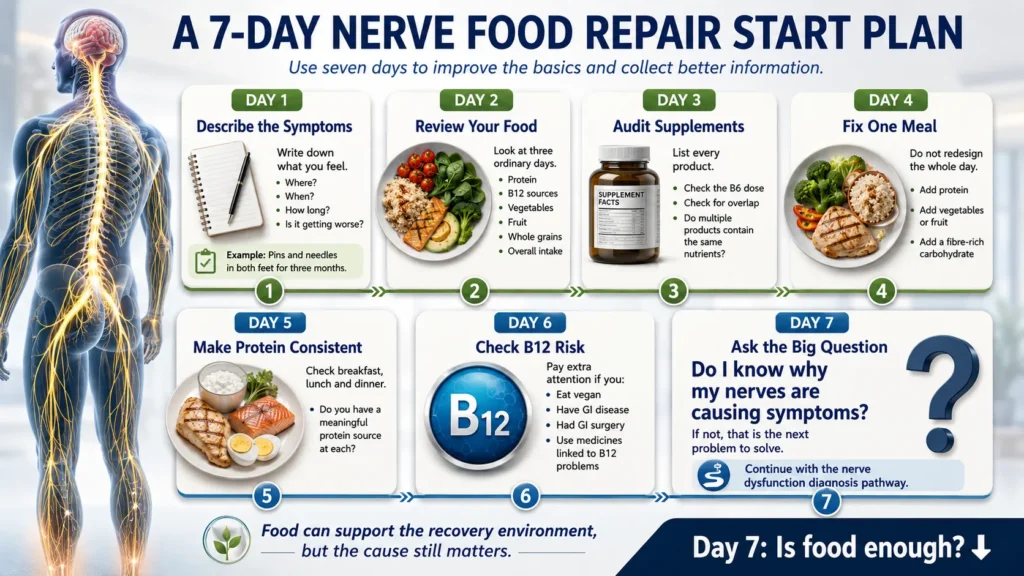
A 7-Day Nerve Food Repair Start Plan
You do not need to rebuild your entire diet tonight.
Use seven days to gather useful information.
Day 1 — Describe the Symptoms
Write down what you feel.
Where?
When?
How long?
Is it getting worse?
“Pins and needles in both feet for three months” is more useful than “bad nerves.”
Day 2 — Review Your Food
Look at three ordinary days.
Check protein, B12 sources, vegetables, fruit, whole grains and overall intake.
Day 3 — Audit Supplements
List every product.
Check the B6 dose.
Check whether multiple products contain the same nutrients.
Day 4 — Fix One Meal
Do not redesign the whole day.
Choose one meal and add:
protein,
vegetables or fruit,
fibre-rich carbohydrate.
Day 5 — Make Protein Consistent
Look at breakfast, lunch and dinner.
Do you have a meaningful protein source at each?
Day 6 — Check B12 Risk
Pay extra attention if you eat vegan, have GI disease, have had GI surgery or use medicines linked to B12 problems.
Day 7 — Ask the Big Question
Do I know why my nerves are causing symptoms?
If not, that is the next problem to solve.
Continue with the HYN nerve dysfunction diagnosis pathway.
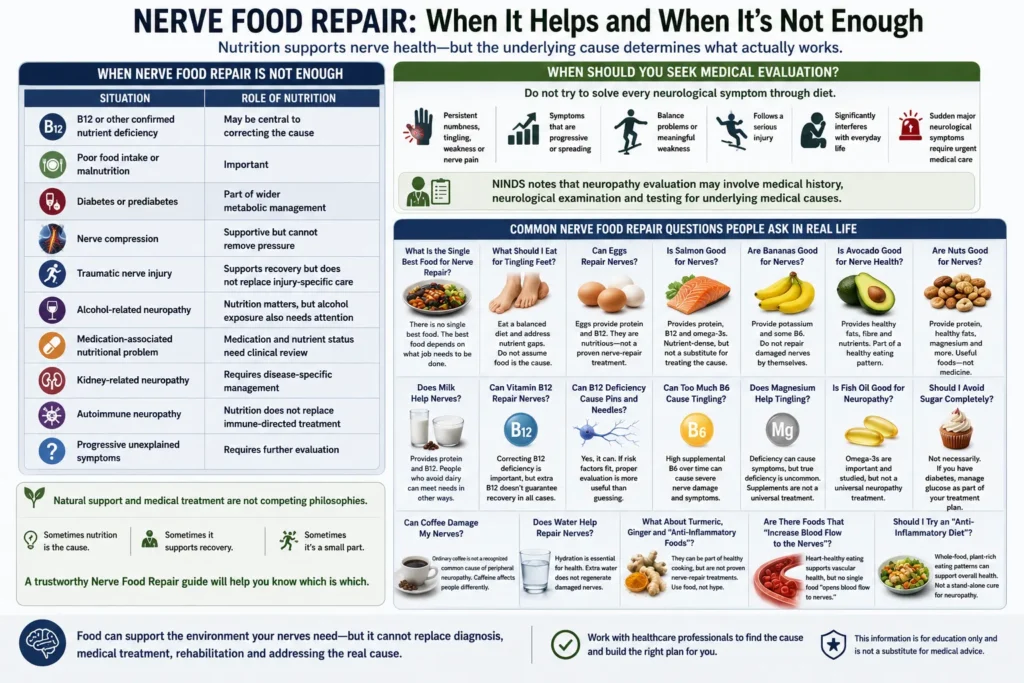
When Nerve Food Repair Is Not Enough
This may be the most important table on the page.
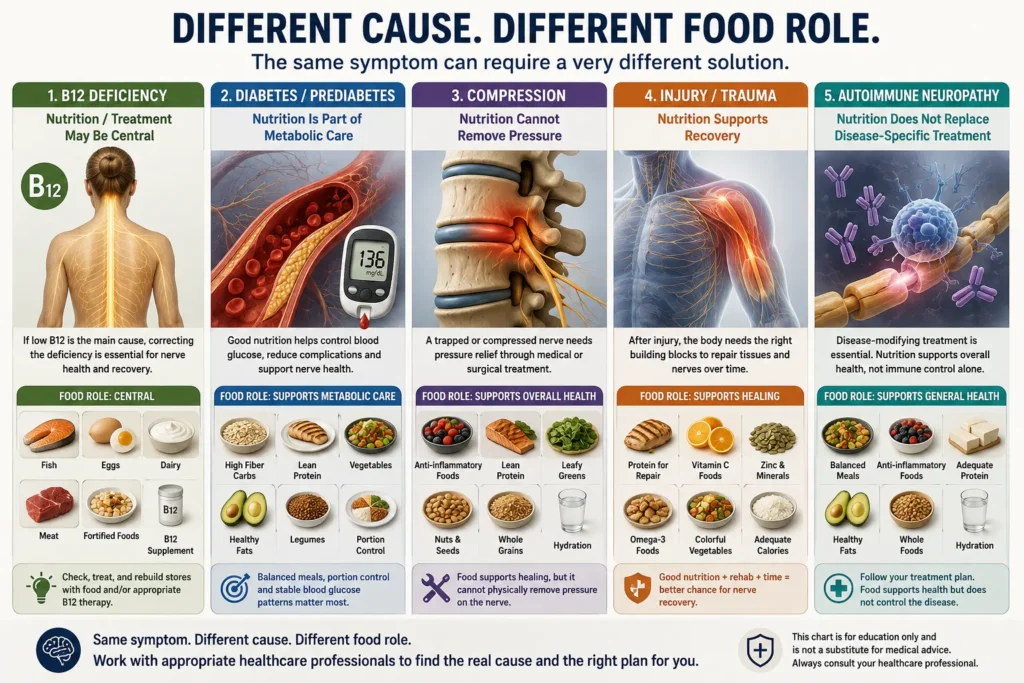
| Situation | Role of nutrition |
|---|---|
| B12 or other confirmed nutrient deficiency | May be central to correcting the cause |
| Poor food intake or malnutrition | Important |
| Diabetes or prediabetes | Part of wider metabolic management |
| Nerve compression | Supportive but cannot remove pressure |
| Traumatic nerve injury | Supports recovery but does not replace injury-specific care |
| Alcohol-related neuropathy | Nutrition matters, but alcohol exposure also needs attention |
| Medication-associated nutritional problem | Medication and nutrient status need clinical review |
| Kidney-related neuropathy | Requires disease-specific management |
| Autoimmune neuropathy | Nutrition does not replace immune-directed treatment |
| Progressive unexplained symptoms | Requires further evaluation |
Natural support and medical treatment are not competing philosophies.
Sometimes a nutrition problem is the cause.
Sometimes nutrition supports recovery while another treatment addresses the cause.
Sometimes food is only a small part of the picture.
A trustworthy Nerve Food Repair page should tell you which is which.
When Should You Seek Medical Evaluation?
Do not try to solve every neurological symptom through diet.
Medical evaluation is especially important if numbness, tingling, weakness or nerve pain is persistent, progressive, spreading, associated with balance problems, associated with meaningful weakness, follows a serious injury, or significantly interferes with everyday life.
Sudden major neurological symptoms require urgent medical attention rather than a nutrition experiment.
NINDS notes that neuropathy evaluation may involve medical history, neurological examination and testing for underlying medical causes.
Common Nerve Food Repair Questions People Ask in Real Life
What Is the Single Best Food for Nerve Repair?
There is no single best food.
If B12 deficiency is the problem, B12 adequacy matters greatly.
If diabetes is the problem, metabolic management matters.
If compression is the problem, food cannot remove the compression.
The “best” food depends on what nutritional job actually needs to be done.
What Should I Eat for Tingling Feet?
Eat a balanced diet and make sure obvious nutrient gaps are addressed.
However, do not assume food is the cause of the tingling.
B12 deficiency is one possible explanation, but diabetes, compression, injury and many other conditions can cause similar symptoms.
Can Eggs Repair Nerves?
Eggs provide protein and B12.
They can fit well into a nutritious diet.
They are not a proven nerve-regeneration treatment.
Is Salmon Good for Nerves?
Salmon provides protein, B12 and EPA/DHA omega-3 fats.
That makes it a nutrient-dense food.
However, eating salmon is not a substitute for treating the cause of neuropathy.
Are Bananas Good for Nerves?
Bananas are normal nutritious foods that provide potassium and some B6.
They do not repair damaged nerves by themselves.
Is Avocado Good for Nerve Health?
Avocado can contribute unsaturated fats, fibre and other nutrients.
It fits a healthy eating pattern.
There is no need to label it a nerve-healing treatment.
Are Nuts Good for Nerves?
Nuts can provide protein, unsaturated fats, magnesium and other nutrients.
They are useful foods when tolerated.
They are not medicine.
Does Milk Help Nerves?
Milk can provide protein and B12.
Therefore, it can contribute to nutrient adequacy.
People who avoid dairy can meet those needs in other ways.
Can Vitamin B12 Repair Nerves?
B12 deficiency can damage the nervous system, so correcting deficiency is important.
However, taking extra B12 does not guarantee recovery from every type of nerve damage.
Can B12 Deficiency Cause Pins and Needles?
Yes, neurological symptoms can occur with B12 deficiency.
If symptoms and risk factors fit, proper evaluation is more useful than guessing.
Can Too Much B6 Cause Tingling?
High supplemental B6 over time can cause severe nerve damage and neurological symptoms.
That is why supplement labels deserve attention.
Does Magnesium Help Tingling?
Magnesium deficiency can cause numbness and tingling in severe cases.
However, symptomatic deficiency is uncommon in otherwise healthy people eating a normal diet.
Magnesium supplements are not a universal treatment for neuropathy.
Is Fish Oil Good for Neuropathy?
Omega-3 fats are important nutrients and fish oil has been studied for several health conditions.
However, that does not establish fish oil as a universal neuropathy treatment.
Food sources such as fatty fish can fit into a balanced diet.
Should I Avoid Sugar Completely?
Not necessarily.
If you have diabetes or prediabetes, glucose management is important.
That does not require calling every carbohydrate or sweet food “toxic.”
Use a diabetes plan that fits your treatment.
Can Coffee Damage My Nerves?
Ordinary coffee is not a recognized common cause of peripheral neuropathy.
However, caffeine can affect sleep and how some people experience symptoms.
Pay attention to your own pattern.
Does Alcohol Cause Neuropathy?
Long-term heavy alcohol use can contribute to neuropathy and nutritional problems. NINDS includes alcoholism and nutritional imbalance among neuropathy causes.
Should I Stop Gluten?
Only when there is a medical or practical reason.
A gluten-free diet is not a universal nerve-repair treatment.
Is Fasting Good for Nerve Repair?
There is no established human evidence that fasting universally regenerates peripheral nerves.
It may also complicate nutrition or diabetes management in some people.
Should I Drink More Water for Nerve Damage?
Stay adequately hydrated.
However, extra water does not regenerate damaged nerves.
Do I Need a Nerve Supplement?
Not automatically.
First identify the problem you are trying to solve.
If there is a real deficiency, targeted treatment makes sense.
If there is no deficiency, a supplement may simply add cost—or, in the case of excessive B6, risk.
Can Nerves Grow Back?
Some nerves can recover under certain conditions.
Outcome depends on the type, severity and cause of injury and whether the underlying problem is corrected.
How Long Does Nerve Recovery Take?
There is no universal timeline.
Different causes have different recovery patterns.
Avoid anyone promising a guaranteed number of days from a diet or supplement.
Why Is My Tingling Worse at Night?
Symptoms may become more noticeable during rest, but nighttime symptoms do not point to one nutritional cause.
Use timing as information, not as proof of a deficiency.
What If My Feet Are Numb but Do Not Hurt?
Loss of sensation can still matter.
If sensation is reduced, injury can go unnoticed.
Persistent numbness deserves evaluation even when it is painless.
Can Diet Help With Burning Feet?
It can help when nutritional or metabolic problems are contributing.
However, burning feet can have several causes.
Food alone does not identify which one is present.
What Is a Nerve Repair Diet?
There is no universally established medical diet by that name.
A practical Nerve Food Repair diet is simply a nutrient-adequate, balanced pattern adjusted to the cause of the nerve problem.
Should I Take B Vitamins Together?
There is no rule that everyone with nerve symptoms needs a high-dose B-complex.
Check the actual need and the actual doses.
B6 deserves particular caution.
Are Natural Supplements Safer Than Medicines?
“Natural” does not automatically mean safe.
Supplements can contain biologically active doses and interact with medications.
The right comparison is not natural versus medical.
It is appropriate versus inappropriate for the problem.
Can Diet Replace Neuropathy Medicine?
Sometimes diet addresses an underlying contributor, especially when metabolic or nutritional factors matter.
However, neuropathic pain, autoimmune neuropathy, compression and other conditions may require treatments beyond nutrition.
Do not stop prescribed treatment based on a food article.
How Strong Is the Evidence Behind Nerve Food Repair?
A good health page should tell you what we know confidently and what remains uncertain.
| Claim | Evidence confidence |
|---|---|
| B12 deficiency can produce neurological problems | Strong |
| Severe thiamin deficiency can cause peripheral neuropathy | Strong |
| Excess supplemental B6 can cause nerve damage | Strong |
| Severe magnesium deficiency can include numbness and tingling | Strong, but deficiency is not common in healthy people |
| Dietary variety supports nutrient adequacy | Strong |
| Diabetes management matters in diabetic neuropathy | Strong |
| Lifestyle intervention may improve some diabetic neuropathy outcomes | Promising / condition-specific |
| Fatty fish is nutritionally useful | Strong as nutrition, not proven universal nerve regeneration |
| One food regenerates damaged human nerves | Not established |
| High-dose B vitamins repair every neuropathy | Not established |
| Turmeric universally treats neuropathic pain | Not established |
| Fasting regenerates peripheral nerves in humans | Not established |
| Food removes mechanical nerve compression | No |
The strongest evidence usually involves correcting a real problem.
That is less exciting than a miracle-food headline.
It is also far more useful.
What We Want You to Remember About Nerve Food Repair
If you remember nothing else from this page, remember this:
Nerve Food Repair is not a search for one miracle ingredient.
It is a way of asking better questions.
Do I have a nutritional deficiency?
Am I eating enough?
Am I getting reliable B12?
Am I taking too much B6?
Is diabetes affecting my nerves?
Is a nerve compressed?
Did symptoms start after injury?
Could alcohol, medication or another medical condition be part of the problem?
Once the cause is clearer, nutrition becomes much more useful.
Sometimes food is central.
Sometimes it supports treatment.
Sometimes it is not the main solution at all.
And that distinction may be the most important nutrition advice on this entire page.
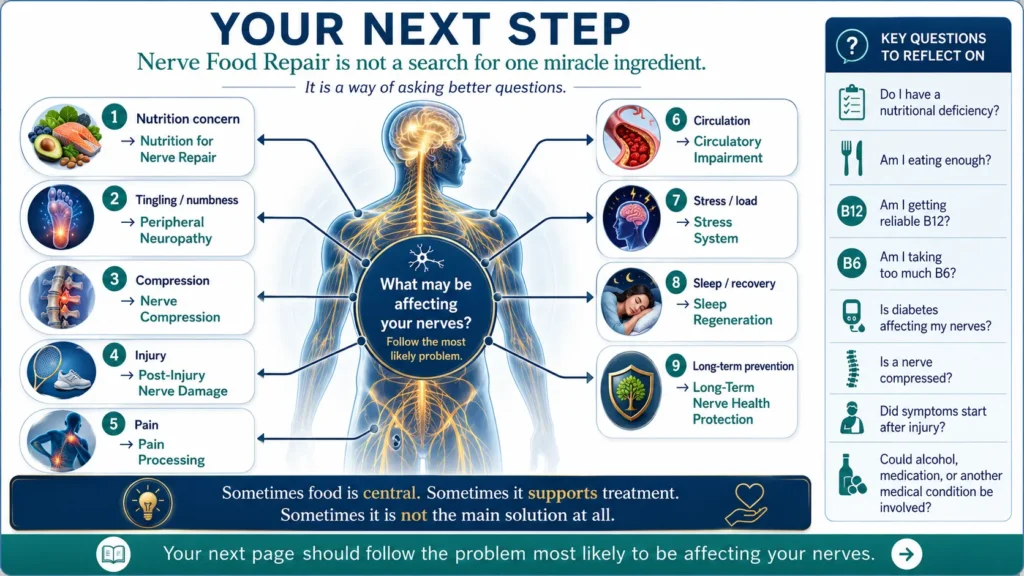
Continue With the Part of the System That Matches Your Problem
If nutrition is still your main question, continue with how nutrition supports nerve repair.
For the full nutrition cluster, explore Nutrition for Nerve Repair.
If numbness and tingling are your main concerns, continue to Peripheral Neuropathy.
If pressure may be involved, read Nerve Compression.
If symptoms followed trauma or surgery, continue to Post-Injury Nerve Damage.
For the biology of nerve insulation, explore Myelin System.
For electrical communication, continue to Neural Signaling.
For pain mechanisms, read Pain Processing.
For circulation, continue to Circulatory Impairment System.
For movement-related support, explore Movement, Posture & Nerve Regulation.
For sleep and recovery, continue to Sleep Regeneration.
For longer-term prevention, continue to Long-Term Nerve Health Protection.
Medical Sources and Further Reading
National Institute of Neurological Disorders and Stroke — Peripheral Neuropathy
Used for causes of peripheral neuropathy, nutritional imbalance, B12/B6 relevance, vascular factors and recovery after correction of some underlying causes.
Read the NINDS Peripheral Neuropathy resource
NIH Office of Dietary Supplements — Vitamin B12
Used for B12 physiology, medication interactions, metformin and gastric-acid inhibitor considerations.
Read the NIH Vitamin B12 fact sheet
NIH Office of Dietary Supplements — Vitamin B6
Used for food sources and the risk of nerve damage from prolonged high supplemental B6 intake.
Read the NIH Vitamin B6 fact sheet
NIH Office of Dietary Supplements — Thiamin
Used for thiamin’s metabolic role, food sources and neuropathy associated with severe deficiency/beriberi.
Read the NIH Thiamin fact sheet
NIH Office of Dietary Supplements — Magnesium
Used for magnesium’s role in nerve and muscle function and symptoms associated with severe deficiency.
Read the NIH Magnesium fact sheet
NIH Office of Dietary Supplements — Omega-3 Fatty Acids
Used for omega-3 food sources and physiological roles.
Read the NIH Omega-3 fact sheet
World Health Organization — Healthy Diet
Used for the broader principles of dietary adequacy, balance, moderation and diversity.
Read WHO Healthy Diet guidance
American Diabetes Association — Standards of Care in Diabetes—2026
Used for contemporary diabetes-management context and complication care.
Zilliox et al. — Physical Activity and Dietary Interventions in Diabetic Neuropathy
Systematic review showing promising but still limited evidence for lifestyle interventions in diabetic neuropathy.
View the systematic review on PubMed
Ghavami et al. — Lifestyle Intervention in Diabetic Peripheral Neuropathy
Randomized trial assessing combined lifestyle education and neuropathy severity.
View the clinical trial on PubMed