
Nerve Recovery Protocols: What a Safe, Coordinated Recovery Plan Should Include
Nerve Recovery Protocols work best when they are built around the cause of the nerve problem, the function that has changed, the person’s daily life, and clear rules for review—not around a random list of supplements, exercises, diets, or therapies.
Nerve Recovery Protocols: The Quick Answer
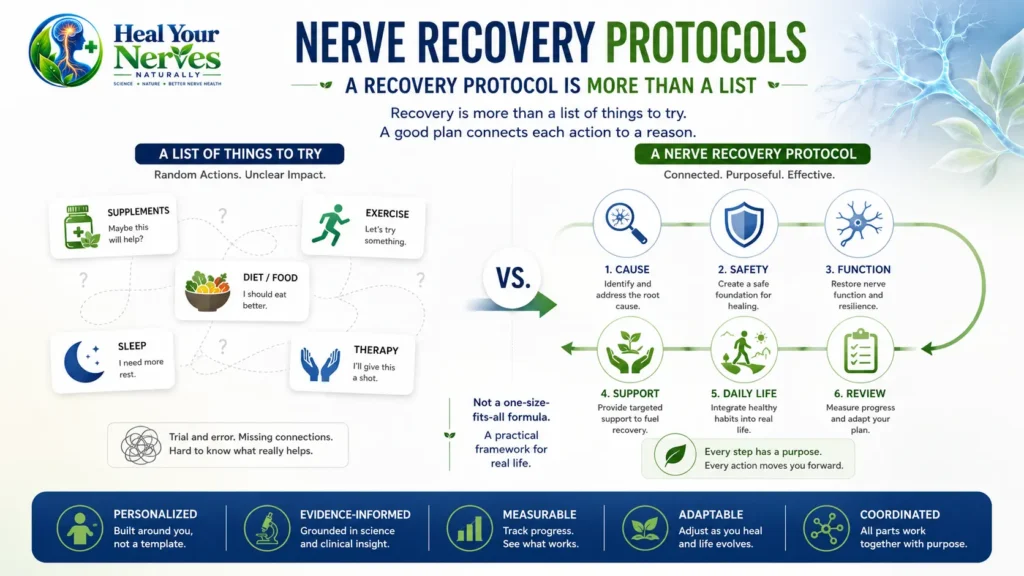
You may already be trying several things. Perhaps you are walking more carefully, changing your meals, improving sleep, taking a supplement, doing physical therapy, stretching, reducing alcohol, changing your workstation, or simply trying not to trigger another flare. Some of those actions may be useful. However, a useful nerve recovery protocol does more than collect helpful ideas. It connects each action to a reason.
That distinction matters because nerve problems outside the brain and spinal cord are not one disease. The National Institute of Neurological Disorders and Stroke describes more than 100 types of peripheral neuropathy. Different patterns can affect sensory, motor, or autonomic nerves, and the causes can be very different. NINDS explains these patterns and causes in its peripheral neuropathy overview.
Therefore, this page is not a universal treatment recipe. Instead, it is a practical guide to what Nerve Recovery Protocols should consider: the likely cause, safety, lost function, rehab needs, supportive health factors, real-life fit, progress, and review.
If you are still trying to understand what your symptoms might mean, start with the Nerve Recovery Guides hub. If you already understand the broad recovery picture and want to learn how goals, focus areas, load, measurements and change rules are used to build a plan, continue later to Nerve Recovery Protocol Design.
What Are People Usually Trying to Solve With Nerve Recovery Protocols?
A search for Nerve Recovery Protocols often hides a more personal question.
You may be asking:
- Can this nerve problem improve?
- How long could recovery take?
- Are tingling or electrical sensations signs of healing?
- Should I rest, walk, stretch, exercise, or protect the area?
- Does physical therapy help nerve damage?
- Is nutrition part of the plan?
- Should I be taking vitamins or supplements?
- How do I know whether I am improving if numbness is still present?
- Why was yesterday good and today worse?
- When should I stop self-managing and seek review?
Those questions are related, but they are not identical. As a result, the best answer is not a single “nerve healing routine.” A useful framework first identifies what problem you are trying to solve.
Start with what you want back
“I want my nerves to heal” is understandable, but it is too broad for practical planning.
One person may want burning in the feet to settle enough to sleep. Another may want enough ankle control to walk safely. Someone recovering from a hand injury may care most about grip and dexterity. A person with diabetic neuropathy may be worried about reduced protective sensation and foot safety. Meanwhile, another person may already be back at work but need two days to recover after a normal shift.
These are different recovery problems.
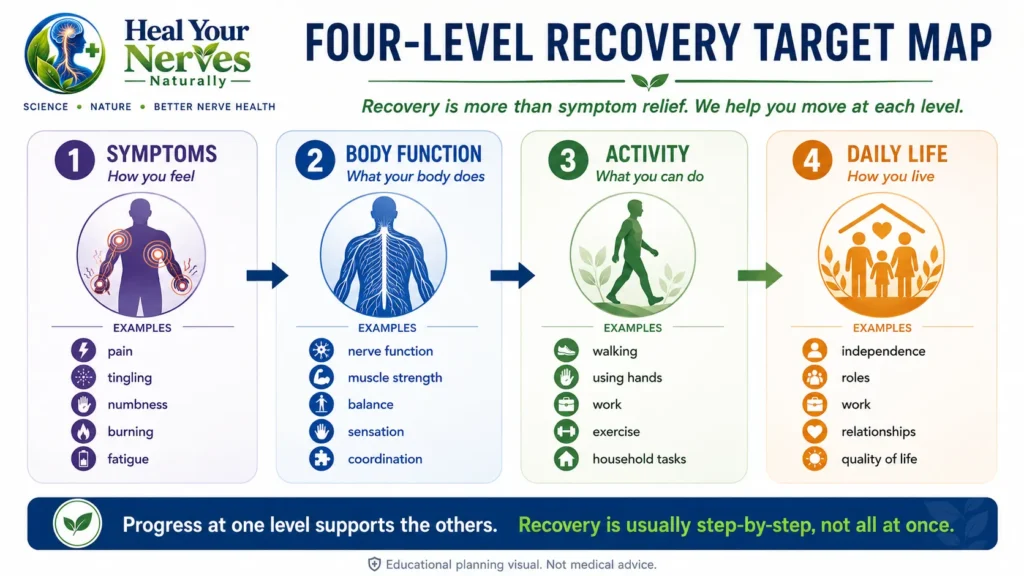
A practical framework separates at least four levels.
What are you feeling?
Symptoms can include pain, burning, tingling, numbness, electric sensations, hypersensitivity, cramping, or unusual temperature sensations.
Symptoms matter because they can disrupt sleep, concentration, movement, confidence, and mood. However, symptom level alone does not tell you the whole story of nerve-related function.
What body function has changed?
Ask what the nerve problem is changing physically.
Can you generate the same strength? Can you feel temperature safely? Is balance different? Can you control the foot, hand, or fingers normally? Has coordination changed? Is protective sensation reduced?
NINDS notes that this kind of nerve damage can affect sensory, motor, and autonomic fibers in different ways. Therefore, the same label can create very different real-life problems.
What task has become harder?
Next, move from anatomy to daily function.
Can you walk to the kitchen without holding furniture? Button a shirt? Type for an hour? Stand through a shower? Carry a shopping bag? Drive safely? Cook without dropping hot objects? Use stairs confidently?
This is where nerve health becomes everyday life.
What part of life are you trying to return to?
Work. Parenting. Exercise. Hobbies. Independence. Sleep. Travel. Social life. Caring for another person. Using your hands confidently. Walking outside without planning every step.
The World Health Organization’s International Classification of Functioning, Disability and Health looks at functioning in context, including daily tasks, daily life, and surroundings. That perspective fits nerve recovery well: what you can do matters alongside what you feel.
Return tool: “What Recovery Means to Me”
Write down four answers:
- My most disruptive symptom: ______
- Body function I am most worried about: ______
- Task I most want back: ______
- Part of life that would improve if that task returned: ______
Then revisit those answers later. If the answers change, your recovery focus areas may need to change too.
What Are Nerve Recovery Protocols—and What Are They Not?
For this guide, Nerve Recovery Protocols are organized recovery frameworks that connect:
the problem → the clinical context → safety → meaningful goals → needed support → rehab needs → daily-life fit → tracking → review
That is deliberately broader than a supplement stack, a stretching routine, or a calendar of exercises.
The 2025 NICE guideline on rehab for chronic nerve-related disorders includes acquired peripheral nerve disorders within its scope in relevant rehab contexts. It recommends holistic assessment, personally meaningful goals, coordinated planning, and review. NICE’s public guidance describes this person-centered approach. The guideline also makes an important distinction: some isolated peripheral nerve injuries may fall outside that guideline when management is mainly non-rehab. In other words, the exact clinical context still matters.
A nerve recovery protocol is not always a treatment
A protocol is not always:
- a supplement stack.
- a 30-day challenge.
- an exercise calendar.
- “detox” program.
- long list of every therapy that has ever been proposed for nerves.
- guarantee that damaged nerves will regrow.
- substitute for diagnosis.
- reason to delay disease-specific treatment.
- copy of someone else’s recovery story.
If the root problem is compression, diabetes, vitamin deficiency, immune-related neuropathy, a medicine effect, toxic exposure, traumatic injury, nerve transection, or another medical condition, that context changes what should happen next.
Why an organized plan can still be wrong
A routine can look impressive and still target the wrong problem.
For example, a better diet cannot remove a nerve compression. Regular exercise can also coexist with an unrecognized deficiency. Several “nerve support” products may duplicate vitamin B6 without you noticing. Meanwhile, medicine may reduce pain even while weakness gets worse.
Therefore, Nerve Recovery Protocols are useful only when they stay connected to the problem they are meant to address.
Why Nerve Recovery Protocols Start With the Cause, Not the Remedy
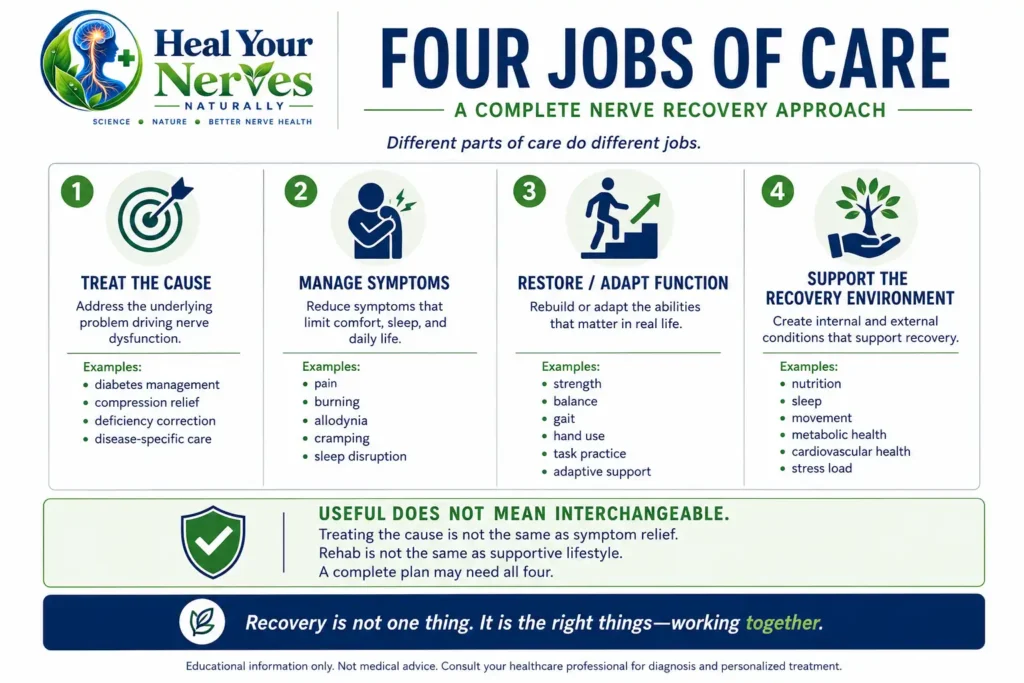
A major source of confusion is that several actions can be useful for very different jobs.
Pain treatment may help sleep without restoring lost sensation. A brace may make walking safer while a nerve is still recovering. Correcting a confirmed deficiency can address an actual cause. Physical rehab may maintain movement, rebuild function, or reduce secondary problems even when it does not directly prove nerve regrowth.
Because these jobs are different, they should not be mixed together.
Job 1 — Treat or control the cause
Cause-directed care aims at the condition that is producing, continuing, or worsening nerve damage.
Depending on the cause, that may involve diabetes management, relief of a clinically significant compression, treatment of an immune-related neuropathy, correction of a confirmed deficiency, review of a neurotoxic medicine, management of toxic exposure, or surgical repair when indicated.
MedlinePlus says that treatment of peripheral nerve disorders depends on the type and cause. In some situations, treating the root condition can allow recovery over time. See the MedlinePlus overview of peripheral nerve disorders.
Job 2 — Manage symptoms
Symptom management focuses on what you feel: pain, burning, allodynia, itching, cramping, or other distressing sensations.
This job can be very important. Better symptom control may improve sleep, movement, mood, and daily life. However, symptom relief does not prove that the root nerve damage has reversed.
Job 3 — Restore, maintain, or adapt function
Functional rehab asks what the body needs to do more safely or effectively.
Depending on the problem, this may involve strength, balance, range of motion, gait, hand use, task practice, orthoses, adaptive equipment, energy management, or safer ways to do daily tasks.
NICE recommends rehab planning around function and daily life, including everyday tasks, work, and social life. Its rehab-planning recommendations emphasize personalized goals and coordinated delivery.
Job 4 — Support the recovery environment
Supportive measures address the wider conditions in which medical care and rehab take place.
That can include adequate nutrition, sleep, movement, metabolic health, cardiovascular health, smoking, alcohol, stress load, and daily routines.
The word supportive matters. These measures may be valuable without becoming universal cures.
For the practical food layer, use Nerve Food Repair. For the deeper explanation of why nutrition can matter without becoming a “nerve cure,” see Nutrition for Nerve Repair.
Why the Same Tingling or Numbness Can Need Different Nerve Recovery Protocols
“Tingling” sounds specific until you ask what is causing it.
Nerve symptoms can come from compression or injury, diabetes, immune disease, nutrient problems, toxins, medicines, poor blood flow, infections, and many other causes. NINDS lists a wide range of acquired causes and explains that different nerve fibers can be affected in different ways.
As a result, the same symptom can sit inside very different recovery realities.
Nerve compression: the problem may be ongoing pressure
If repeated positioning, narrowed anatomy, scar tissue, or another mechanical factor is irritating a nerve, the framework may need to address the source of pressure first.
Useful questions include:
- What position or task often brings on the symptoms?
- Is weakness present?
- Is the pattern stable or getting worse?
- Does the person need medical assessment before increasing demand?
- Is work setup part of the problem?
- Would a brace, task change, therapy, injection, or surgery be relevant in this specific case?
In that case, nutrition may still support general health. However, nutrition alone cannot remove a clinically significant compression.
Start deeper with Nerve Compression and the Mechanical Damage System.
Diabetes: the framework must include metabolic and safety questions
If neuropathy is related to diabetes, the plan is not simply “stretch more” or “take a nerve vitamin.”
Blood-sugar management, foot safety, physical function, the right amount of movement, symptom management, footwear, skin checks, and the person’s wider health may all matter.
Therefore, Nerve Recovery Protocols for diabetic neuropathy should not be copied from a post-injury nerve plan.
See Diabetic Neuropathy and the Metabolic Damage System.
Post-injury nerve damage: the type and severity of injury change the plan
After trauma or surgery, the degree of nerve injury matters.
Mayo Clinic notes that treatment depends on the extent and cause of the injury and on how well the nerve is healing. Some nerves that remain in continuity may recover slowly. By contrast, a nerve that is fully cut is much harder to treat and may need repair or reconstruction. Recovery can take many months or even years. Mayo Clinic explains the variability in peripheral nerve injury treatment and recovery.
That means a post-injury framework may need to coordinate surgical follow-up, protection, range of motion, motor or sensory re-education, strength, task practice, and realistic expectations.
For this pathway, see Post-Injury Nerve Damage.
Nutritional problems: deficiency and excess are different risks
A confirmed nutrient deficiency can matter. However, “more vitamins” is not the same as correcting a deficiency.
Vitamin B12 deficiency is one possible cause of neuropathy. At the same time, excessive supplemental vitamin B6 can itself cause sensory neuropathy. The NIH Office of Dietary Supplements reviews this risk in its Vitamin B6 fact sheet.
Therefore, some Nerve Recovery Protocols need a supplement audit, not another supplement.
The rule to remember
Same symptom does not always mean the same recovery plan.
If you are still working out the “why,” use Root Causes of Nerve Damage before you add more recovery actions.
What If the Cause Is Still Unclear?
This is common, and it can be frustrating.
You may have symptoms without a clear cause. You may have several plausible contributors. A test may explain part of the picture but not all of it. One clinician may focus on the spine while another focuses on blood-sugar or metabolic risk. You may even have a label such as “idiopathic neuropathy,” which means the cause has not been found.
The answer is not to pretend that uncertainty has disappeared.
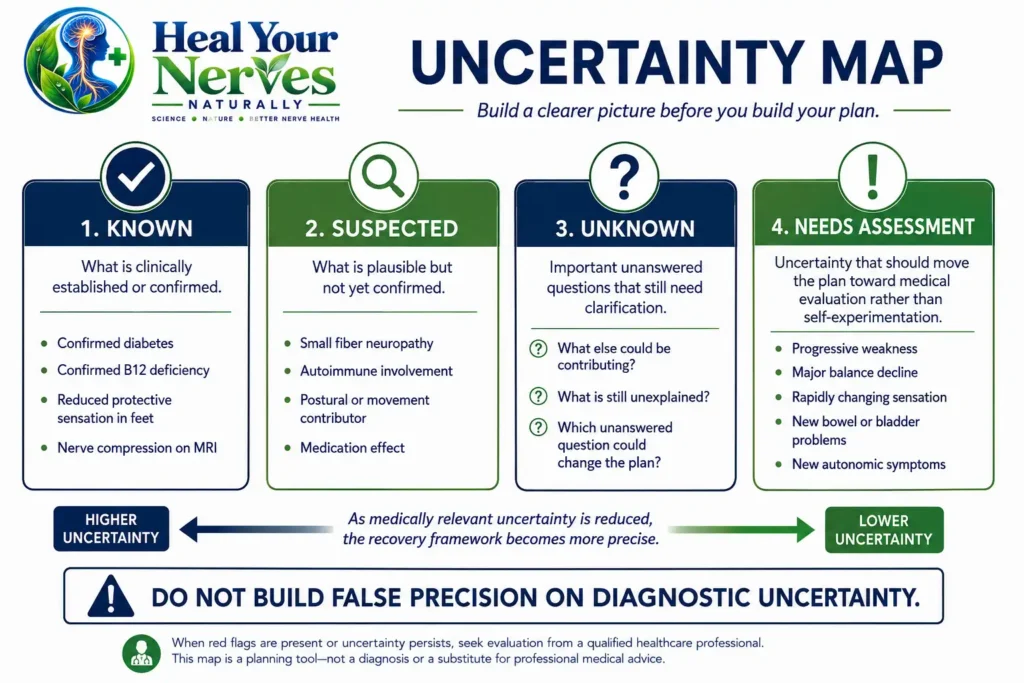
Instead, Nerve Recovery Protocols should become more precise only as the clinical picture becomes more precise.
Known
What has really been established?
Examples may include a confirmed cause, imaging that shows compression, abnormal nerve-test findings, a confirmed nutrient deficiency, a known medicine exposure, or a diagnosed health condition.
Likely or suspected
What is plausible but not yet established?
This may come from symptom pattern, history, examination, or an incomplete workup.
Unknown
What important question remains unanswered?
The cause of numbness may still be unclear. Weakness may not be fully explained. Symptoms may also be changing faster than expected.
Needs assessment
Which uncertainty is important enough that self-directed experimentation should not be the next step?
Progressive weakness, major balance decline, rapidly changing sensation, new bowel or bladder problems, new autonomic symptoms, or another major nerve-related change should move the plan toward medical assessment.
A practical boundary
Do not build false precision on diagnostic uncertainty.
A plan can look reassuring because it gives exact supplement doses, exact exercise targets, and exact timelines. However, precision is not the same as accuracy.
If the main cause remains unclear, start with Nerve Dysfunction Diagnosis before making the recovery framework more complex.
What Should Nerve Recovery Protocols Include?
A useful framework does not need to include every possible treatment. However, it should ask enough questions to avoid obvious blind spots.
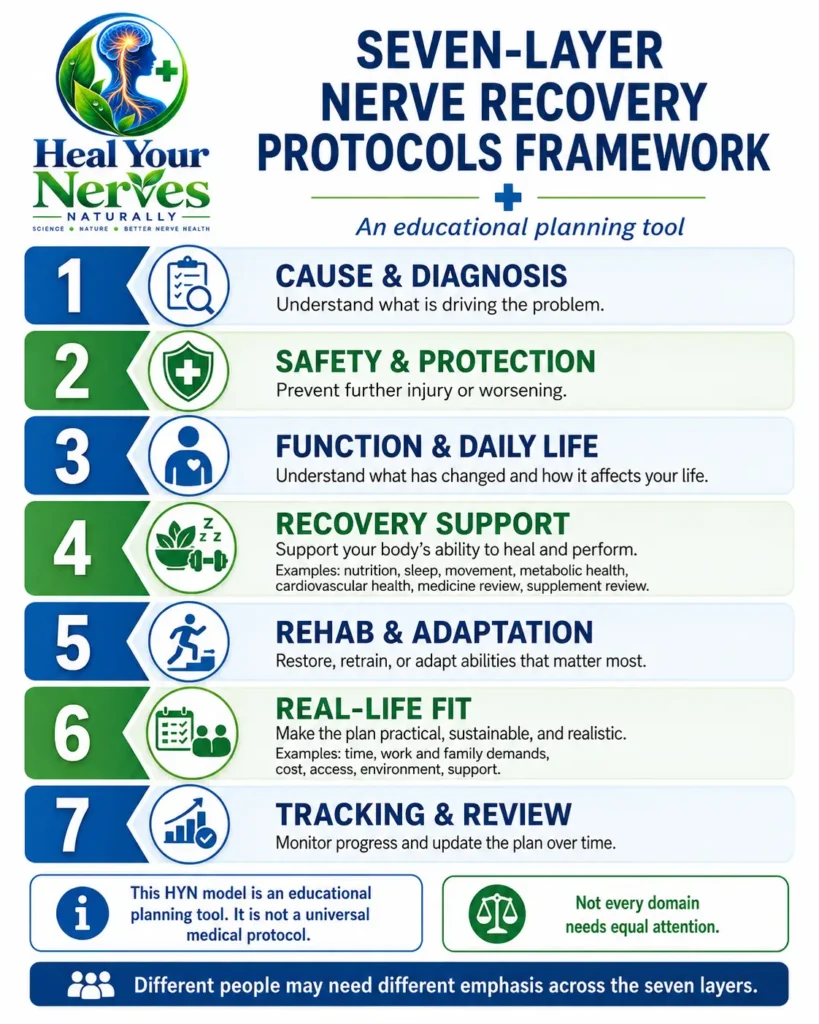
The following HYN seven-layer model is an educational planning tool. It is not a universal medical protocol.
Layer 1 — Cause and diagnosis
What is driving the problem?
This is where the cause, disease-specific treatment, injury type, and important unknowns belong.
If this layer is wrong, everything downstream can be beautifully organized around the wrong target.
Questions to ask:
- Do we know the cause?
- Is the nerve still being injured?
- Could a treatable medical cause be active?
- Does the current explanation fit the symptom and function pattern?
- Has anything changed enough to require review?
Layer 2 — Safety and protection
Is anything increasing the risk of further harm?
Examples include fall risk, loss of protective sensation, continued compression, unsafe work exposure, post-surgical restrictions, foot injury risk, or progressive nerve-related change.
Safety is not a final paragraph. It is part of the protocol from the beginning.
For people with reduced sensation, MedlinePlus stresses practical injury prevention and home safety because numbness can make injuries easier to miss. See MedlinePlus guidance on peripheral neuropathy and home safety.
Layer 3 — Function and daily life
What can you no longer do—or no longer do well?
This includes walking, balance, hand use, self-care, work, exercise, driving, sleep, and community daily life.
A pain score is useful. However, it cannot tell you whether you can feel the brake pedal, carry a pan safely, walk to the shop, or complete a workday.
Therefore, Nerve Recovery Protocols should track function alongside symptoms.
Layer 4 — Recovery-support needs
Which supportive domains are genuinely relevant?
Possibilities include:
- adequate nutrition.
- blood-sugar and metabolic health.
- sleep.
- movement.
- blood flow, heart, and blood-vessel health.
- stress and coping.
- reduction of harmful exposures.
- medicine review.
- supplement review.
Not every domain needs equal attention.
For deeper system-specific reading, use Circulation and Oxygenation, Movement Therapy, Mental Recovery, and Nutrition for Nerve Repair.
Layer 5 — Rehab and adaptation
What do you need to keep, regain, retrain, or adapt?
Depending on the injury and recovery stage, rehab can involve protection, range of motion, motor retraining, sensory re-education, strength, gait, balance, task practice, or compensatory strategies.
A peer-reviewed review of traumatic peripheral nerve injury rehab describes focus areas changing with nerve status, reinnervation, and function rather than following one fixed exercise routine. Read the review on assessment and rehab of traumatic peripheral nerve injuries.
If you want the biological layer behind those changes, continue to Axonal Regrowth, Myelin Regrowth, and Neuroplastic Adaptation.
Layer 6 — Real-life real-life fit
Can the plan really live inside your life?
A theoretically excellent plan can fail if it requires more time, money, energy, equipment, transport, or support than the person has.
For example, a two-hour daily routine may be unrealistic for someone working two jobs. A specialist-food plan may be unaffordable. A walking program may need to account for caregiving, heat, unsafe roads, transport, or access to a stable surface.
NICE recommends that nerve-related rehab goals reflect what matters to the person and consider daily tasks, work, education, relationships, and meaningful daily life. See NICE guidance on rehab needs and goal setting.
Layer 7 — Tracking and review
How will you know whether the framework is still right?
A plan should not become permanent simply because it once made sense.
Relevant changes can include:
- new weakness.
- a shrinking or expanding numb area.
- better or worse walking tolerance.
- improved hand control.
- a change in balance.
- different sleep patterns.
- shorter or longer recovery after demand.
- updated medical finding.
- medicine change.
- return to work.
- plateau.
- meaningful return of function.
The detailed “how” of turning those observations into decisions belongs in Feedback Systems and Nerve Recovery Protocol Design.
What Can Block Recovery Even When You Are “Doing Everything Right”?
Many people respond to slow progress by asking what else they can add.
Sometimes that is the wrong question.
A better question is: What is still getting in the way?
Ongoing pressure or movement stress
Could a position, repetitive task, work exposure, poorly fitting equipment, prolonged pressure, or anatomical compression still be irritating the nerve?
If so, adding more supportive therapies may not solve the central problem.
For a broader systems view, see Lifestyle Healing and Movement, Posture and Nerve Regulation.
An untreated or incompletely controlled medical cause
Supportive care cannot replace management of a condition that is still damaging nerves.
For example, a diet change does not substitute for diabetes care. Relaxation does not treat an immune-related neuropathy. A supplement does not decompress a severely trapped nerve.
Therefore, cause-directed care remains central even when supportive habits are strong.
Too much total load
Work, exercise, rehab, errands, caregiving, poor sleep, and stress can accumulate.
A single task may look modest on its own. However, the total daily demand can exceed what you currently tolerate.
That does not always mean the movement is harmful. Instead, it means the dose, timing, or combination may need review.
This topic belongs more deeply in Load Management.
Too little movement
Fear can push in the opposite direction.
Pain, numbness, and uncertainty can lead to prolonged avoidance. Depending on the cause and medical advice, too little movement may contribute to stiffness, deconditioning, reduced confidence, and loss of function.
The answer is not “push through.” The answer is to match movement to the condition, current limits, and clinical guidance.
Poor sleep and reduced recovery opportunity
If nerve symptoms often disrupt sleep, daytime function often suffers too.
You may tolerate less movement. Pain may feel harder to manage. Concentration can fall. Rehab can become harder to follow.
Therefore, sleep can be a genuine part of Nerve Recovery Protocols, even though sleep alone is not a treatment for every nerve disorder.
Use Sleep Recovery for the practical layer.
A nutrition gap—or risky supplement use
The question is not “Which vitamin heals nerves?”
A better question is: Is there a real deficiency, absorption problem, food gap, or supplement-related risk that changes the plan?
That distinction matters because a needed nutrient can still be misused. For example, high supplemental vitamin B6 can cause sensory neuropathy. Meanwhile, a true B12 deficiency may need specific correction.
Daily routines that recreate the same problem
Sometimes the problem is not a missing treatment. It is a repeated daily exposure.
Examples include:
- long uninterrupted sitting.
- repeated wrist or elbow pressure.
- vibration exposure.
- poor foot protection when sensation is reduced.
- repeated “boom-and-bust” effort.
- irregular sleep.
- heavy alcohol use.
- work demands that often provoke the same pattern.
In those cases, Nerve Recovery Protocols may improve when the environment stops recreating the problem.
Do Nerve Recovery Protocols Need Every Possible Recovery Tool?
No.
This is where the word comprehensive is often misunderstood.
A comprehensive framework does not mean doing everything. Instead, it means asking enough questions that you do not overlook something important.
More actions can create more confusion
Imagine starting all of these on the same Monday:
- a B-complex.
- magnesium.
- a new “anti-inflammatory” diet.
- longer walks.
- nerve-gliding exercises.
- massage.
- a standing desk.
- a new sleep supplement.
By Friday, the tingling changes.
What caused the change?
Was it improvement? Irritation? Normal fluctuation? A delayed response to exertion? Better sleep? Worse sleep? A supplement effect? Something unrelated?
You may not know.
Complexity is not coordination
A coordinated plan gives each action a job.
For example:
- “This change is intended to reduce a known pressure or movement trigger.”
- “This therapy is intended to improve balance.”
- “This diet change is intended to correct a known gap.”
- “This medicine is for symptom control.”
- “This brace is for safety while motor function is limited.”
- “This sleep change is intended to improve daytime function and recovery tolerance.”
Now later review becomes possible.
Ask one question about every action
What problem is this supposed to address?
If you cannot answer that question, the action may be decorative rather than purposeful.
This is one of the key differences between Nerve Recovery Protocols and random “nerve healing” routines.
When “Trying Everything” Becomes Part of the Problem
Persistent nerve symptoms can create an exhausting cycle:
new symptom → new search → new product → new hope → unclear result → next product
That cycle can be expensive. It can also make the recovery picture harder to interpret.
Duplicate supplements
A multivitamin, B-complex, magnesium product, energy formula, and “nerve support” product may contain overlapping ingredients.
Vitamin B6 deserves particular attention because excessive supplemental intake can cause sensory neuropathy. This does not mean normal food sources are dangerous. It means “more” is not always safer. NIH ODS summarizes vitamin B6 safety information.
Too many variables
If everything changes at once, it becomes hard to tell what caused the result.
This is especially important when the response is delayed. A flare the next morning may be hard to interpret if the previous day also included a new supplement, harder exercise, less sleep, and a long drive.
Too much burden
A plan can become so complex that following it becomes another source of stress.
The burden itself matters. If the plan requires constant tracking, many products, several appointments, and hours of daily tasks, adherence may fall.
Marketing language can imitate medical precision
Phrases such as “nerve repair,” “neuro-regrowth,” “detox,” “nerve restore,” and “cellular repair” can sound precise while saying very little about the actual evidence.
Before you trust a claim, ask what condition was studied, what outcome changed, and whether the claim applies to humans with your type of nerve problem.
The biggest risk: delaying needed care
Wasted money is frustrating. Delayed assessment can be more serious.
A supportive routine should never become a reason to ignore progressive weakness, spreading numbness, major gait change, falls, bowel or bladder symptoms, or another important nerve-related change.
How Should Nerve Recovery Protocols Evaluate “Nerve Healing” Claims?
You do not need to become a research scientist to ask better questions.
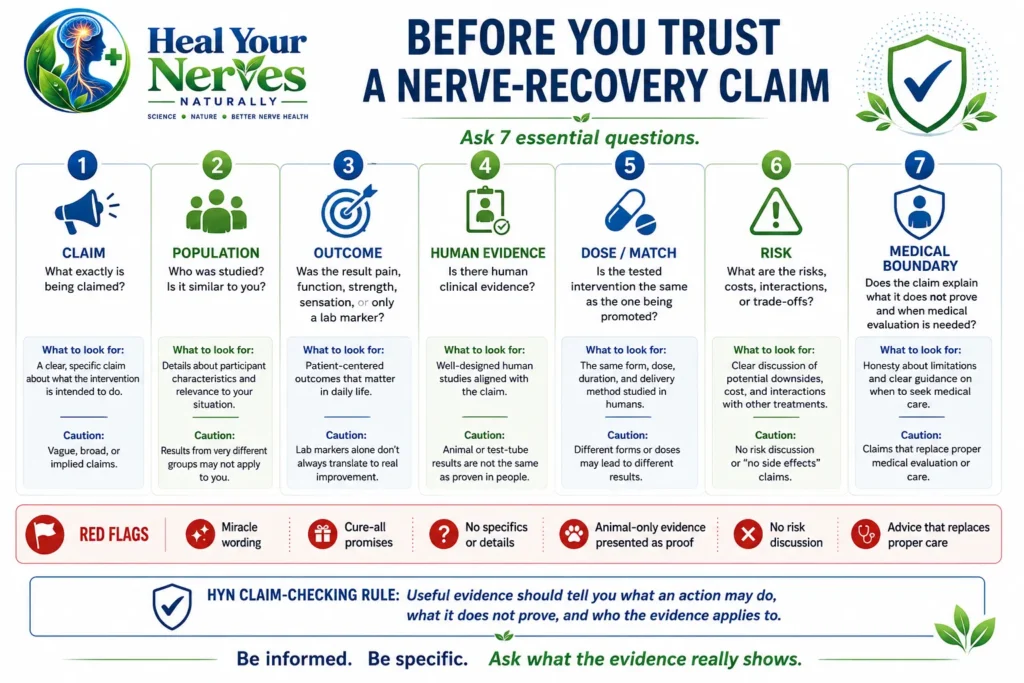
Use this claim checker.
1. What exactly is being claimed?
Is the claim about:
- less pain?
- better sleep?
- improved walking?
- improved strength?
- corrected deficiency?
- nerve regrowth?
- restored sensation?
- reduced inflammation?
- “detoxification”?
A vague claim is hard to evaluate.
2. Who was studied?
People with diabetic neuropathy? People after a specific nerve surgery? Healthy adults? Rats with a surgically injured sciatic nerve?
Evidence from one group does not always apply to every neuropathy.
3. What outcome was measured?
A biochemical marker is not the same as restored daily function.
A lower pain score is not the same as regrown axons. Better balance can be very meaningful even if it does not prove structural nerve repair.
4. Was the action tested in humans?
Preclinical research can be scientifically important. However, animal or laboratory findings may not be ready to guide a person’s treatment decisions.
5. Does the product match the evidence?
A nutrient being needed for normal physiology does not prove that taking more improves nerve recovery.
Likewise, a study of one device, dose, or treatment protocol does not prove that a different product with similar marketing works.
6. What are the downsides?
Cost, interactions, excessive dosing, overexertion, delayed care, and false reassurance all count.
7. Does the source explain medical boundaries?
A credible resource should not imply that every worsening nerve-related symptom can be handled with lifestyle changes.
The HYN claim-checking rule
Useful evidence should tell you what an action may do, what it does not prove, and who the evidence applies to.
How Nerve Recovery Protocols Change Across Recovery Stages
People often want a clean timeline.
Week 1. Then week 4. Later, week 8. “Regrowth phase.” “Strength phase.”
Real nerve recovery is usually less tidy.
A surgically repaired nerve, a mild compression injury, diabetic polyneuropathy, and an immune-related neuropathy do not follow one shared biological calendar. Mayo Clinic notes that nerve recovery can take many months or years, depending on the injury and how well the nerve is healing.
Still, broad planning states can help organize decisions.
Protect
The priority is to reduce ongoing harm and maintain safety.
Questions may include:
- Does the area need protection?
- Could pressure still be occurring?
- Are there post-surgical restrictions?
- Does loss of sensation create injury risk?
- Is weakness affecting walking or hand safety?
Stabilize
The goal is to make the pattern more predictable.
This may involve managing the cause, preventing secondary problems, improving basic tolerance, establishing a baseline, and learning what tends to worsen or improve function.
Restore
When the time is right, the focus shifts toward recovering or retraining function.
That may include range of motion, motor control, sensory retraining, strength, gait, balance, or meaningful task practice.
Build tolerance
Next, the goal becomes doing more without often triggering long setbacks.
This stage often raises questions about dose, progression, pacing, work, exercise, and recovery time after exertion.
Maintain
The final job is not “never think about it again.”
Maintenance means protecting gains, integrating recovery into ordinary life, reducing preventable risk, and noticing meaningful change early.
This five-state model is an HYN planning model. It is not a claim that every nerve follows five universal biological stages.
For the dedicated page about how focus areas change over time, use Recovery Phasing.
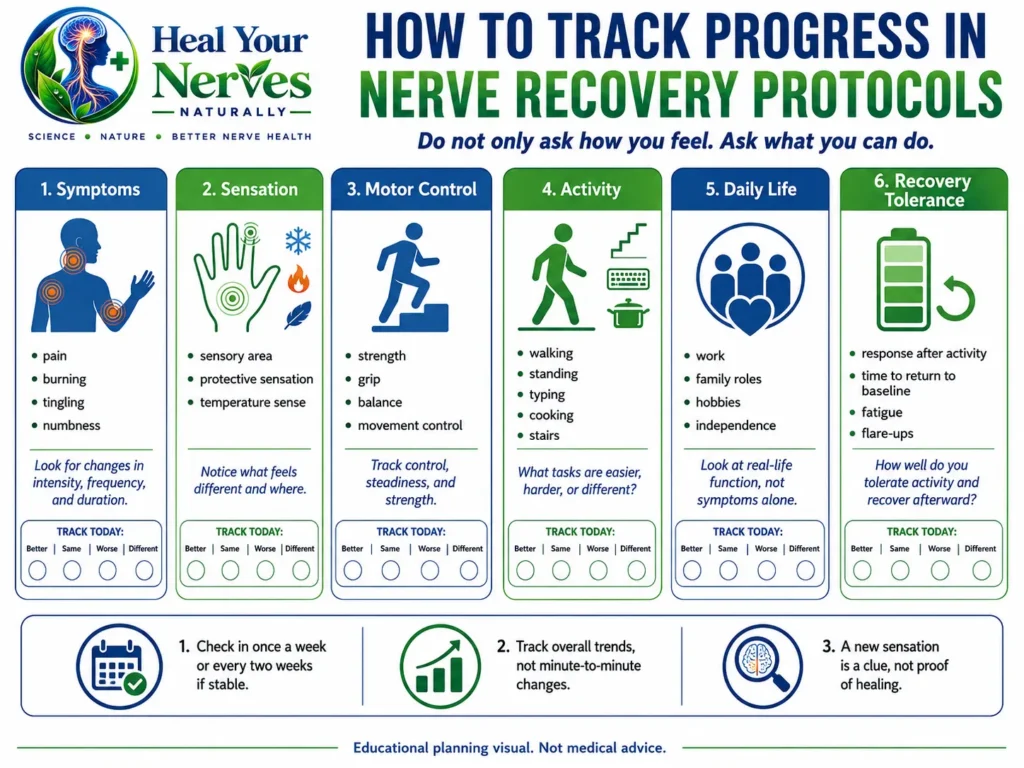
How to Track Progress in Nerve Recovery Protocols
One of the hardest questions is: How do I know whether I am improving?
Symptoms can be noisy.
Pain may fall because medicine is working while weakness remains. Walking may improve even though numbness persists. A tingling pattern may change without revealing why. Meanwhile, a person may report less pain simply because they have stopped doing the tasks that used to provoke it.
Therefore, Nerve Recovery Protocols should use more than one metric.
Track symptoms
What do you feel?
Examples include pain, burning, tingling, numbness, allodynia, cramping, or unusual temperature sensations.
Record the pattern, not every minute.
Track sensory function
Has the numb area changed? Protective sensation may be reduced. Temperature sense may also be different. Ask whether the pattern is stable, shrinking, or spreading.
Do not often test painful or numb skin in ways that could cause injury.
Track motor function
Can you lift, grip, push, balance, or control movement better, worse, or the same?
New or progressive weakness usually deserves more attention than a small change in tingling level.
Track daily tasks
How long can you walk, stand, type, cook, shower, drive, exercise, or use stairs?
Use tasks that matter in your life.
Track daily life
Are you returning to work, family roles, hobbies, social life, exercise, or independent living?
This is where recovery becomes meaningful beyond the clinic.
Track recovery tolerance
What happens after demand?
Do you return to baseline later that day? By the next morning? Does an ordinary task now trigger a two-day setback?
Recovery tolerance is one of the most useful bridges between daily life and the plan.
The signature question
Do not only ask how you feel. Ask what you can do.
Are Tingling, Burning, or Electrical Sensations Signs of Nerve Healing?
This question appears often in search results because people want a visible sign that recovery is happening.
A numb area may begin to tingle. Burning may replace deadness. Sensations may move, fluctuate, or become easier to trigger. After some nerve injuries, changing sensations can occur during recovery. However, a sensation by itself does not prove the mechanism.
That is why Nerve Recovery Protocols should treat a new sensation as a clue rather than as a verdict.
A safer interpretation
A new sensation is a clue, not proof of healing.
Instead of labeling it immediately, look at the larger pattern.
Where is the change?
Is the affected area shrinking, expanding, or moving?
A smaller area of altered sensation may mean something different from rapidly spreading numbness.
What is happening to function?
Is strength improving? Walking may be better or worse. Hand control may be returning. Balance may still be stable—or it may have changed.
A functional trend can provide context that a single sensation cannot.
What triggers the sensation?
Does it appear after a certain position, task, pressure, temperature, or time of day?
Trigger patterns can help distinguish a repeatable mechanical or load-related response from a change with no obvious trigger.
What is the time trend?
One evening is not the same as a repeated pattern over several weeks.
For that reason, avoid turning every hour into a recovery test.
Are there warning changes?
Progressive weakness, rapidly increasing sensory loss, new gait difficulty, or major nerve-related changes should not be interpreted as reassuring simply because the symptoms feel “different.”
If you want a broader guide to interpreting changes during recovery, return to Nerve Recovery Guides.
Why Can a Good Day Be Followed by a Bad Day?
A good day can be misleading.
You wake up with less pain. Walking feels easier. You catch up on errands, clean the house, stand longer, and decide to make the most of the improvement.
Then symptoms rise later that evening or the next day.
Did you damage the nerve again?
Sometimes symptoms alone cannot answer that question.
The flare may reflect total daily load, a pressure or movement trigger, poor sleep, medicine timing, illness, normal variation, or a clinical change that deserves review.
Do not judge a flare only by symptom level
Ask:
- What did I do differently?
- Did strength change?
- Was balance different?
- Did the symptom area spread?
- How long did it take to settle?
- Has the same trigger produced the same response before?
- Is the overall weekly trend improving, stable, or worsening?
This gives the flare context.
A good day is data—not permission to double everything
When people feel better, they often increase several tasks at once.
However, if demand rises sharply, the next response becomes harder to interpret. Progress is easier to understand when increases are deliberate enough that you can observe what happens afterward.
The detailed dose-and-response logic belongs in Load Management and Nerve Recovery Protocol Design.
A Bad Day Can Mislead You Too
One difficult day can produce the opposite reaction.
You may want to stop all movement, cancel rehab, and protect the body from every sensation.
That reaction is understandable, especially after a frightening injury. Still, not every fluctuation means the same thing.
A recovery framework helps you avoid making permanent decisions from one temporary data point.
Ask what kind of bad day this is
Is it:
- a predictable short-lived response.
- repeated pattern after the same demand.
- clear worsening of function.
- new nerve-related change.
- problem with total daily load.
- sign that the root condition needs review?
The answer changes what “rest” or “continue” should mean.
Therefore, Nerve Recovery Protocols need both patience and safety boundaries.
How Do Walking, Work, Driving, Exercise, and Sleep Fit Into Nerve Recovery Protocols?
For many people, these questions matter more than the anatomy lesson.
The answer is rarely a universal yes or no because safety depends on the cause, sensation, strength, balance, medicine effects, recovery stage, and the specific task.
Walking
Walking may support rehab or general health for some people. However, reduced sensation, foot drop, weakness, balance problems, wounds, or post-surgical restrictions can change what is safe.
If walking is a major part of your plan, use Movement Therapy and Nerve Recovery Exercises rather than copying someone else’s step count.
A more useful question is:
What amount of walking lets me practice function without creating a pattern of worsening that I cannot recover from?
That question still needs to fit the condition and any medical restrictions.
Work
Desk work can create long periods of static posture. Physical work may involve lifting, repeated pressure, vibration, prolonged standing, or awkward positions. Shift work can also affect sleep and meal timing.
Instead of asking only, “Can I work?” ask:
Which part of my work currently exceeds what I can safely do or recover from, and what can be modified safely?
Possible changes may involve task rotation, breaks, workstation setup, footwear, lifting demands, scheduling, or a graded return. However, the right change depends on the job and the condition.
Driving
Driving requires reliable sensation, strength, reaction time, motor control, vision, cognition, and alertness.
If you cannot clearly feel a pedal, control the limb, react quickly, or remain alert because of medicine or pain, driving becomes a safety question. Generic internet reassurance is not enough.
Exercise
Exercise is not one action.
Walking, cycling, resistance training, balance work, stretching, nerve-gliding exercises, and sport create different demands.
Therefore, ask:
What is the job of this exercise in my recovery framework?
Is it for conditioning? Balance? Strength? Range of motion? Motor retraining? Confidence? Work preparation?
Once the job is clear, it becomes easier to judge whether the exercise is helping.
Sleep
Neuropathic pain can be worse at night and can disrupt sleep. When sleep is poor, daytime function and rehab tolerance may also suffer.
If sleep is limiting recovery daily life, treat it as part of the framework rather than as a side issue.
Use Sleep Recovery and Regrowth Processes During Sleep for deeper reading.
Family and caregiving
Recovery rarely happens in isolation.
A partner may be doing more household work. A parent may still need to care for children while symptoms fluctuate. An older adult may live alone. Someone may rely on family for transport or shopping.
A practical framework therefore asks:
- Who is helping?
- Which tasks create the most strain?
- Which support is temporary?
- What independence is the person trying to regain?
- How could unnecessary dependence be reduced without creating unsafe pressure?
Real-life fit is one reason Nerve Recovery Protocols should be tailored rather than copied.
What If Nerve Recovery Is Real but Incomplete?
Meaningful recovery does not always mean “back to exactly how I was before.”
Some people regain walking but continue to have numbness. Some regain hand function but notice fatigue. Some return to work but need task change. Others reduce pain while protective sensation remains limited.
Improvement and loss can exist at the same time.
Recovery can mean restoration
Function returns toward the previous level.
For example, grip improves enough to cook again or foot control improves enough to walk more safely.
Recovery can mean adaptation
A person learns a different way to perform a task.
That can reduce risk while still allowing daily life.
Recovery can mean compensation
Braces, assistive devices, pacing, or changes to the environment can help bridge a lasting impairment.
Compensation is not “giving up.” It can be a practical way to protect function.
Recovery can mean protection
The root disease is stabilized and further loss is reduced even if older damage does not fully reverse.
That is still medically meaningful.
Recovery can mean daily life
A person returns to work, family life, hobbies, social activity, or independence while some symptoms remain.
NICE rehab guidance focuses on meaningful function and daily life. That is a more useful definition of recovery than requiring every symptom to disappear.
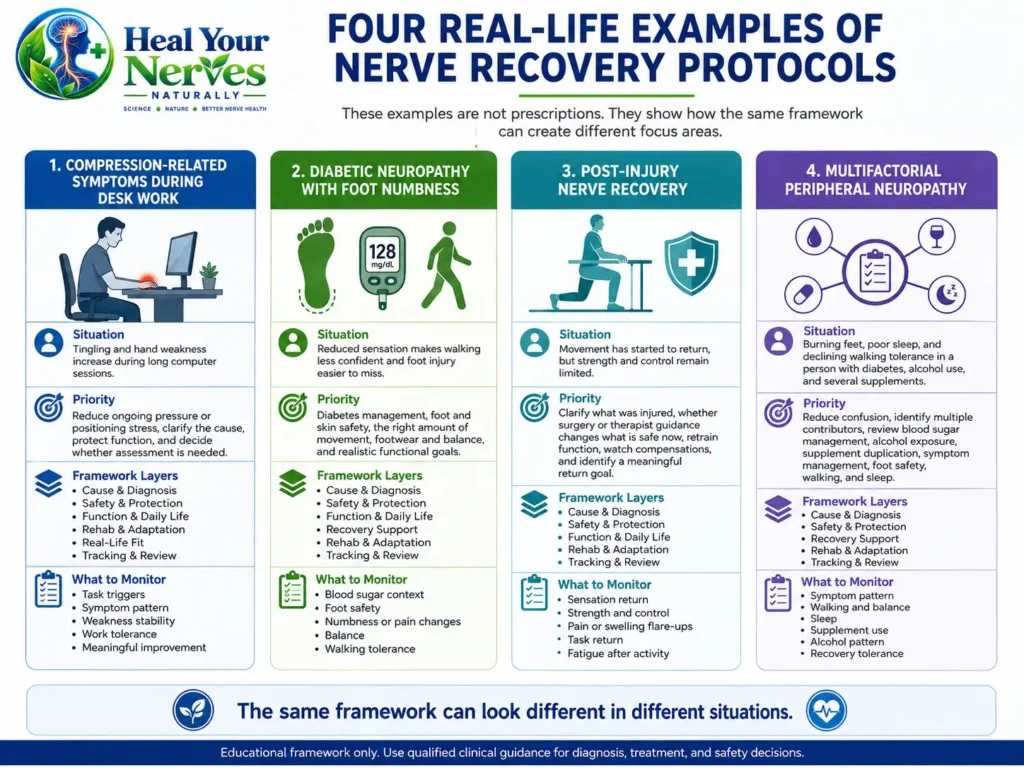
Four Real-Life Examples of Nerve Recovery Protocols
These examples are not prescriptions. Instead, they show how the same framework can create different focus areas.
Example 1 — Compression-related symptoms during desk work
Life problem: Tingling and hand weakness increase during long computer sessions.
Known or suspected context: Nerve compression is possible, but the cause is still being clarified.
Main questions:
- Is there ongoing pressure or positioning that should change?
- Is weakness stable or progressive?
- Which work tasks trigger symptoms?
- Is diagnostic assessment needed before demand increases?
- Would therapy, work change, splinting, or another action have a clear job?
- What change would count as meaningful improvement?
Useful site pathway: Nerve Compression → Movement, Posture and Nerve Regulation → Load Management.
Example 2 — Diabetic neuropathy with foot numbness
Life problem: Reduced sensation makes walking less confident and foot injury easier to miss.
Possible framework focus areas:
- diabetes management with the healthcare team.
- foot and skin safety.
- sensory and motor tracking.
- the right amount of movement.
- footwear and balance considerations.
- symptom management.
- realistic functional goals.
The important point is not that everyone needs the same seven actions. The point is that the metabolic cause and safety risk change the framework.
Useful site pathway: Diabetic Neuropathy → Metabolic Damage System → Movement Therapy.
Example 3 — Post-injury nerve recovery
Life problem: Movement has started to return, but strength and control remain limited.
Main questions:
- What exactly was injured?
- Was the nerve repaired surgically?
- What has the surgeon or therapist found as safe now?
- Is there clinical or electrodiagnostic evidence of recovery?
- Which function needs retraining?
- Is strengthening safe at this stage?
- Have compensatory movement patterns developed?
- Which task would represent a meaningful return?
Useful site pathway: Post-Injury Nerve Damage → Axonal Regrowth → Neuroplastic Adaptation → Recovery Phasing.
Example 4 — Multifactorial peripheral neuropathy
Life problem: Burning feet, poor sleep, and declining walking tolerance in a person with diabetes, alcohol use, and several supplements.
Why one-cause thinking may fail: More than one contributor may matter.
A coordinated framework may need to consider:
- clinical review of the neuropathy.
- blood-sugar management.
- alcohol exposure.
- supplement duplication.
- symptom management.
- foot safety.
- walking and balance.
- sleep.
In this case, Nerve Recovery Protocols should reduce confusion rather than add another product.
Useful site pathway: Peripheral Neuropathy → Root Causes of Nerve Damage → Nerve Recovery Protocol Design.
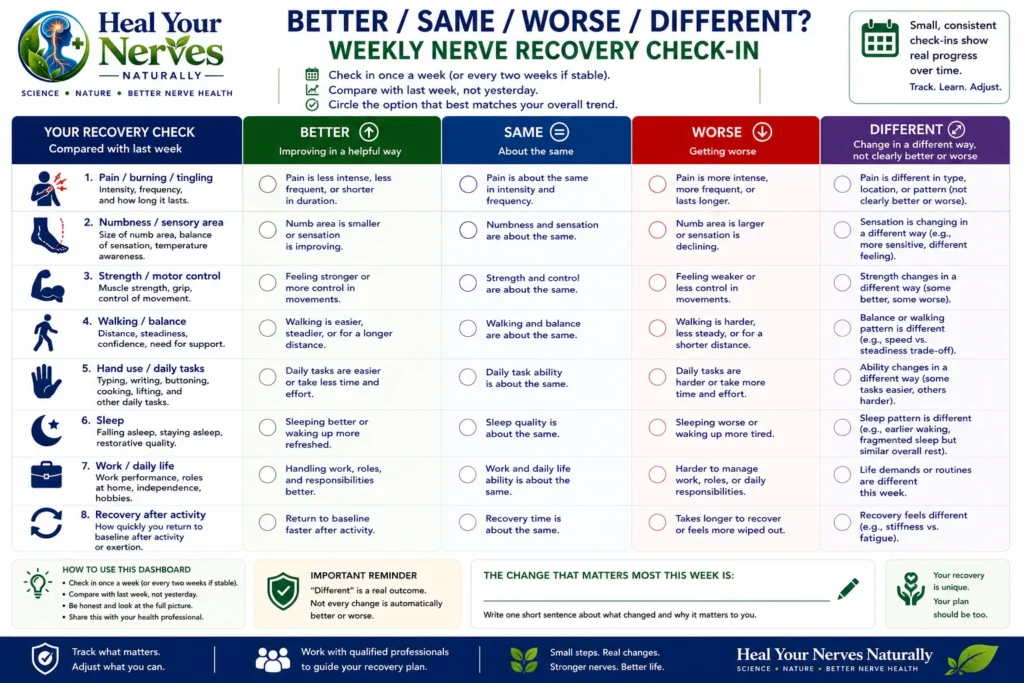
Better, Same, Worse, or Different? A Simple Nerve Recovery Protocols Check-In
A complex recovery picture needs a simple review tool.
Choose a regular check-in point. For many stable situations, weekly review is easier to interpret than reacting to every hour. However, clinician-directed follow-up or changing nerve-related symptoms may require a different schedule.
Use the same domains each time.
| Domain | Better | Same | Worse | Different |
|---|---|---|---|---|
| Pain / burning / tingling | ||||
| Numbness / sensory area | ||||
| Strength / motor control | ||||
| Walking / balance | ||||
| Hand use / daily tasks | ||||
| Sleep | ||||
| Work / daily life | ||||
| Recovery after activity |
Then add one sentence:
The change that matters most this week is: __________.
This helps prevent one symptom from dominating the entire interpretation.
Why “different” deserves its own column
Not every change is clearly better or worse.
A numb area may become smaller but more sensitive. Pain may fall while fatigue increases. Walking may improve while sleep gets worse.
Therefore, “different” gives you permission to investigate the pattern instead of forcing it into a positive or negative label.
How Often Should Nerve Recovery Protocols Be Reviewed?
There is no universal review interval.
A person after surgery may have clinician-defined follow-up. Someone with a stable chronic neuropathy may review practical goals less often. By contrast, someone with rapidly changing symptoms may need clinical review rather than a self-tracking schedule.
NICE recommends tailoring review to the person’s condition, circumstances, and goals.
Review sooner when the picture changes
Examples include:
- new weakness.
- a new numbness pattern.
- major change in walking.
- a new fall.
- a new wound when sensation is reduced.
- return to work.
- new medicine.
- treatment change.
- updated medical finding.
- large change in movement.
- persistent worsening of sleep or function.
These changes may alter the job of the plan.
Review routinely when the picture is stable
For self-observation, weekly or biweekly review can sometimes reveal trends more clearly than constant symptom checking.
However, this is not a medical follow-up schedule. Follow the timing recommended for your condition, surgery, or rehab plan.
Review the goal when the goal stops mattering
You may begin recovery focused on pain. Later, you may care more about endurance, hand use, balance, or returning to work.
That is not failure. It means the recovery problem has changed.
Good Nerve Recovery Protocols change when the meaningful goal changes.
When Do Nerve Recovery Protocols Need Full Review?
Sometimes the right move is not to tweak an exercise or swap a supplement.
Sometimes the whole picture needs to be reconsidered.
The diagnosis changes
A new test, specialist assessment, or clinical finding can change the assumed cause.
When the cause changes, the framework may need to change with it.
Function worsens even though symptoms feel better
Pain can improve while motor function deteriorates.
That mismatch matters. Symptom relief should not hide declining strength, balance, or control.
Weakness is new or progressive
Do not interpret progressive weakness as a normal “healing sensation.”
This is a reason to seek clinical assessment.
Sensory loss spreads significantly
A rapidly expanding or substantially different sensory pattern can change the clinical picture.
It deserves more attention than a familiar stable symptom.
The plan has become impossible to follow
A routine that worked during time off may collapse after returning to work, caregiving, or travel.
Instead of calling that lack of discipline, review the design.
A plan that cannot live inside your real life is not functioning as a plan.
Recovery plateaus
A plateau does not always mean permanent damage.
Possible explanations include slow biology, an unresolved cause, the wrong priority, too much load, too little useful stimulus, poor adherence, an unrealistic goal, the wrong measure, or a need for medical review.
The job is to investigate rather than guess.
A new health condition or medicine changes the context
The recovery framework should evolve with the person.
That is why Nerve Recovery Protocols should be treated as living frameworks rather than fixed documents.
When Recovery Support Is Not Enough
Lifestyle support, rehab, and self-tracking should never become reasons to delay urgent medical care.
Seek prompt medical assessment for major new or worsening nerve-related changes such as:
- new or progressive weakness.
- major decline in walking or balance.
- repeated falls associated with nerve-related change.
- rapidly spreading or sudden sensory loss.
- new bowel or bladder dysfunction.
- saddle or groin-area numbness.
- severe nerve-related symptoms after major trauma.
- symptoms that could suggest stroke or another emergency.
- rapidly emerging autonomic symptoms such as fainting or major blood-pressure problems.
This list is not exhaustive.
If symptoms are sudden, severe, or potentially life-threatening, emergency care is more appropriate than self-tracking.
For stable but unexplained symptoms, use Nerve Dysfunction Diagnosis as an educational next step and discuss the pattern with an appropriate healthcare professional.
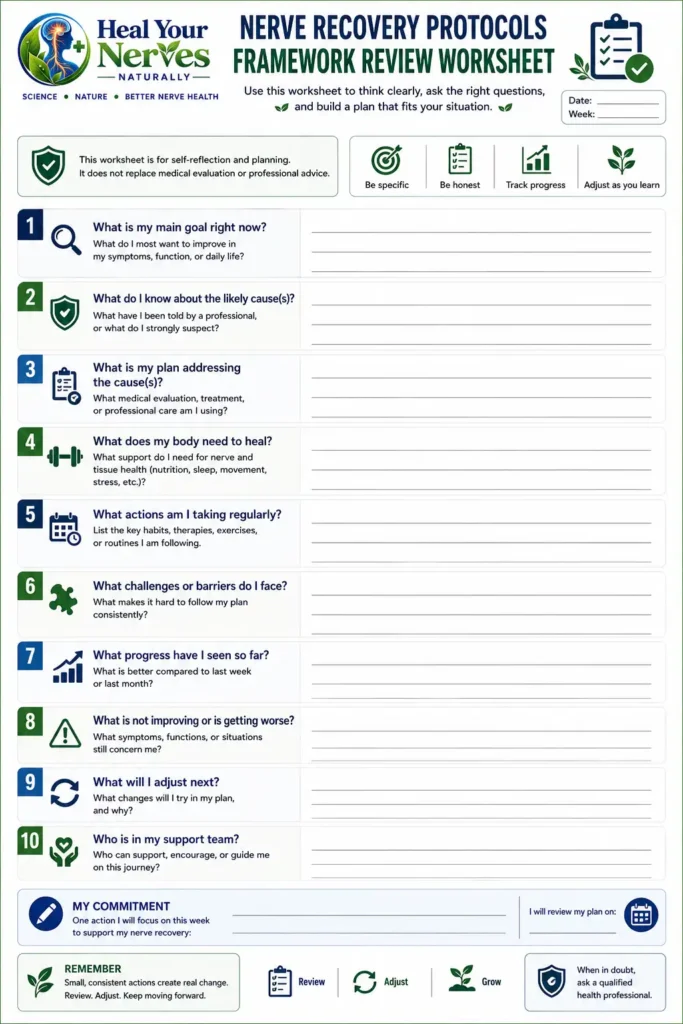
Your 10-Question Nerve Recovery Protocols Review
Use this return tool whenever the picture changes.
1. What matters most right now?
Which symptom, functional problem, or life limitation is currently driving your decisions?
2. What do you really know about the cause?
List what has been diagnosed, measured, or confirmed.
3. What remains uncertain?
Identify the unanswered question that could materially change the plan.
4. Is anything still causing harm or increasing risk?
Think about pressure or movement stress, uncontrolled disease, toxic exposure, medicine issues, falls, wounds, or another ongoing problem.
5. What function are you trying to protect or regain?
Walking? Hand use? Balance? Sleep? Work? Driving? Independence?
6. Which supportive domains are genuinely relevant?
Nutrition? Movement? Sleep? Circulation? Mental recovery? Changes at home or work? Metabolic health?
7. What are you doing now—and what job does each action have?
If an action has no clear job, ask why it is in the plan.
8. What changed since the last review?
Better, same, worse, or different?
9. What would make you seek review?
Define the boundary before you are in the middle of a flare.
10. What is the next useful question?
Do you need to understand the cause, recovery stage, load, feedback, nutrition, movement, or a specific condition?
This final question stops random browsing. Instead, it turns the site into a learning path.
What Should You Bring to a Recovery Conversation With a Clinician or Therapist?
A useful framework can make appointments more productive.
Instead of bringing a long list of disconnected sensations and products, bring a short pattern summary.
What changed first?
When did the problem begin?
Was there an injury, surgery, illness, medicine change, new work demand, new medical finding, or gradual onset?
What is changing now?
Describe the trend, not only today’s symptom.
For example:
- numbness has stayed in the same area for six weeks.
- grip has become weaker over the last month.
- walking tolerance has improved from five to fifteen minutes.
- pain is lower, but balance is worse.
- symptoms rise after long sitting and settle after position changes.
Trends give the clinician more useful detail than “today is bad.”
What have you really tried?
List the action, why you tried it, how long you used it, and what changed.
If supplements are relevant, bring the labels. Doses are easy to misremember, especially when several products overlap.
What function matters most to you?
“I have tingling” is medically useful.
However, “I cannot feel the brake pedal well,” “I keep dropping pans,” or “I can no longer walk to the shop without holding onto something” shows the functional consequence immediately.
What are you most uncertain about?
Ask the question directly.
Examples include:
- Do we know the cause?
- Is this weakness expected for this condition?
- What would count as meaningful improvement?
- What should make me seek review sooner?
- Is this exercise right at this stage?
- Could any medicine or supplement be relevant?
- Is there a function I should protect while we wait for recovery?
Good Nerve Recovery Protocols do not make professional care less needed. Instead, they help you arrive with clearer observations and better questions.
What Should a Good Nerve Recovery Protocol Help You Stop Doing?
A strong framework is not only additive.
It can remove confusion.
Stop chasing every sensation
Not every new tingle needs a new remedy.
Observe the pattern before you assign meaning.
Do not treat every bad day as failure
Look at function, triggers, recovery time, and the wider trend.
Avoid treating every good day as permission to double what you do
Your limits are better judged from repeated response than from one unusually good morning.
Do not copy another person’s timeline
Cause, severity, nerve involved, treatment, age, health, and daily demands may all differ.
Separate symptom relief from nerve repair
Symptom management can be valuable without proving structural regrowth.
Do not equate residual symptoms with zero recovery
Function can improve even when sensation is not fully normal.
Give every action a clear job
If you cannot explain why something is in the plan, review whether it belongs.
Never use supportive care to postpone needed assessment
A recovery routine should create clarity, not hide a worsening nerve-related picture.
These “stops” are important. Once noise falls, it becomes easier to see what the recovery picture is really telling you.
Common Questions About Nerve Recovery Protocols
How long do nerve injuries take to heal?
There is no single recovery time.
Mayo Clinic notes that these nerves recover slowly and that maximal recovery may take many months or years. The timeline depends on the type, location, severity, cause, and treatment of the injury, as well as how well recovery is progressing. See Mayo Clinic’s peripheral nerve injury guidance.
Therefore, Nerve Recovery Protocols should not promise a universal 30-, 60-, or 90-day timeline.
What are common signs that a nerve may be changing during recovery?
Changes can include altered sensation, changing numbness, tingling, return of motor response, better function, or improved tolerance for tasks.
However, no single sensation proves regrowth. Functional change, clinical examination, and sometimes electrodiagnostic or other testing may be needed to interpret recovery.
Can damaged nerves repair naturally?
Some nerve injuries outside the brain and spinal cord can recover without surgery, especially when the nerve remains in continuity and the cause is removed or controlled. Other injuries are more severe and may need surgery or other specialized care.
Therefore, the useful question is not simply “Can nerves heal naturally?” It is what type of nerve problem is present, and what does that problem require?
Does physiotherapy help nerve damage?
Physical or occupational therapy can help restore or maintain function in many nerve-related problems. Depending on the condition, therapy may address range of motion, strength, gait, balance, motor control, sensory re-education, task practice, or prevention of secondary complications.
However, therapy should match the injury, stage, and clinical restrictions. It is not one generic set of “nerve exercises.”
Are supplements part of Nerve Recovery Protocols?
Sometimes, but not by default.
A supplement may have a clear job when there is a confirmed deficiency, a known food gap, or another evidence-based indication. On the other hand, unnecessary stacking can add cost, duplicate ingredients, and create risk.
The purpose of a protocol is not to maximize the number of products. It is to maximize relevance.
Should pain reduction be the main measure of recovery?
No single measure should dominate the whole picture.
Pain matters. However, strength, sensation, balance, daily tasks, daily life, and recovery after demand can reveal changes that a pain score misses.
What if my symptoms improve but my function does not?
That mismatch deserves attention.
Symptom relief can be meaningful, but the plan may still need to address strength, gait, hand use, sensory safety, or another functional problem.
What if nothing changes for several weeks?
A stable period may mean different things depending on the condition.
It may reflect slow biological recovery, a plateau, an unresolved cause, the wrong action, the wrong dose, poor adherence, or simply that the metric you are watching is not the best one.
Instead of simply adding more, review the problem.
Where to Go Next
If you are still asking “What is happening to me?”, return to the Nerve Recovery Guides and choose the symptom, cause, or condition pathway that fits your current question.
For “How does nerve healing work biologically?”, continue to the Nerve Healing Guide and the relevant regrowth pages.
To explore “What might be driving the damage?”, use Root Causes of Nerve Damage.
For “What should I eat?”, use Nerve Food Repair.
When the question is “How should movement fit into recovery?”, use Movement Therapy and Nerve Recovery Exercises.
To understand “Why does the plan need to change over time?”, continue to Recovery Phasing.
And if your question has become:
“I understand the recovery picture. How do I decide what comes first, how much to do, what to measure, and when to change course?”
continue to Nerve Recovery Protocol Design: how goals, focus areas, load and feedback shape the plan.
That is where the broad framework becomes a decision system.
Evidence and Further Reading
The following sources support the evidence boundaries, rehab concepts, functioning framework, safety points, and nerve-injury context used in this guide:
- NINDS — Peripheral Neuropathy
- Mayo Clinic — Peripheral nerve injuries: diagnosis and treatment
- NICE — Rehabilitation for chronic neurological disorders including acquired brain injury
- NICE — Assessing rehabilitation needs and goal setting
- NICE — Rehabilitation planning and delivery
- WHO — International Classification of Functioning, Disability and Health
- MedlinePlus — Peripheral Nerve Disorders
- MedlinePlus — Peripheral neuropathy and home safety
- NIH Office of Dietary Supplements — Vitamin B6
- Traumatic peripheral nerve injury assessment and rehabilitation review
Editorial note: This page explains how coordinated recovery frameworks can be organized. It does not diagnose nerve damage or provide a universal treatment plan. Treatment and rehab should be matched to the cause, severity, functional loss, medical findings, and individual circumstances.