Integration: Connecting Learning, Adaptation, and Recovery Systems
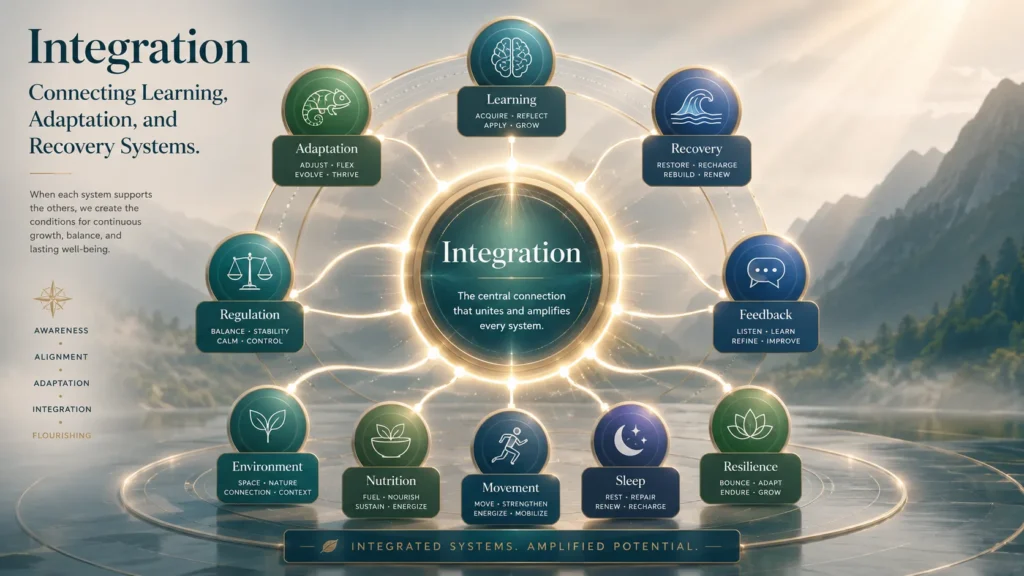
Understanding Integration in Everyday Life
Integration is the process of bringing different parts of learning, adaptation, regulation, and recovery together into one understandable system. Many people learn about sleep, stress, movement, emotional regulation, nutrition, resilience, and nervous system function as separate topics. However, real life does not work in separate categories. Instead, these systems often influence one another every day.
For example, poor sleep may affect stress tolerance. Increased stress may influence emotional regulation. Emotional strain may affect daily behavior and recovery capacity. Meanwhile, physical load, mental demand, social pressure, and environmental factors may all interact at the same time. Because of these connections, it can be difficult to understand why recovery sometimes feels clear and manageable and other times feels confusing or inconsistent.
This is where integration becomes valuable. Rather than focusing on one factor alone, integration helps readers understand how different systems may interact across the body and daily life. Therefore, the goal is not to find a single explanation. Instead, the goal is to build a clearer picture of how learning, adaptation, recovery support, and long-term stability may connect.
Throughout this page, readers will explore how integration relates to nervous system regulation, adaptation, resilience, recovery engineering, behavior change, emotional regulation, and daily-life decision-making. As a result, they can develop a more organized understanding of how multiple recovery-related systems may work together over time.
Quick Navigation
- Understanding Integration in Everyday Life
- What Is Integration?
- Plain Meaning / Glossary Box
- How Integration Works
- Key Layers of Integration
- Integration and Stability
- Integration and Adaptation
- Integration and Learning Systems
- Human Systems and Integration
- Recovery Engineering Connections
- Integration and Feedback Systems
- Integration and Load Management
- Integration and Healing Sequencing
- Integration and Neuromodulation
- Real-Life Symptom Language Bridge
- Practical Daily-Life Examples
- Integration Visual Flow
- Why Integration Matters for Long-Term Recovery
- Common Misunderstandings About Integration
- Related Condition Connections
- Topic Cluster Placement
- Integration FAQ
- Continue Learning
- Sources / References
- Author / Editorial Trust Note
- Educational Trust Notice
- Safety Notice
What Is Integration?
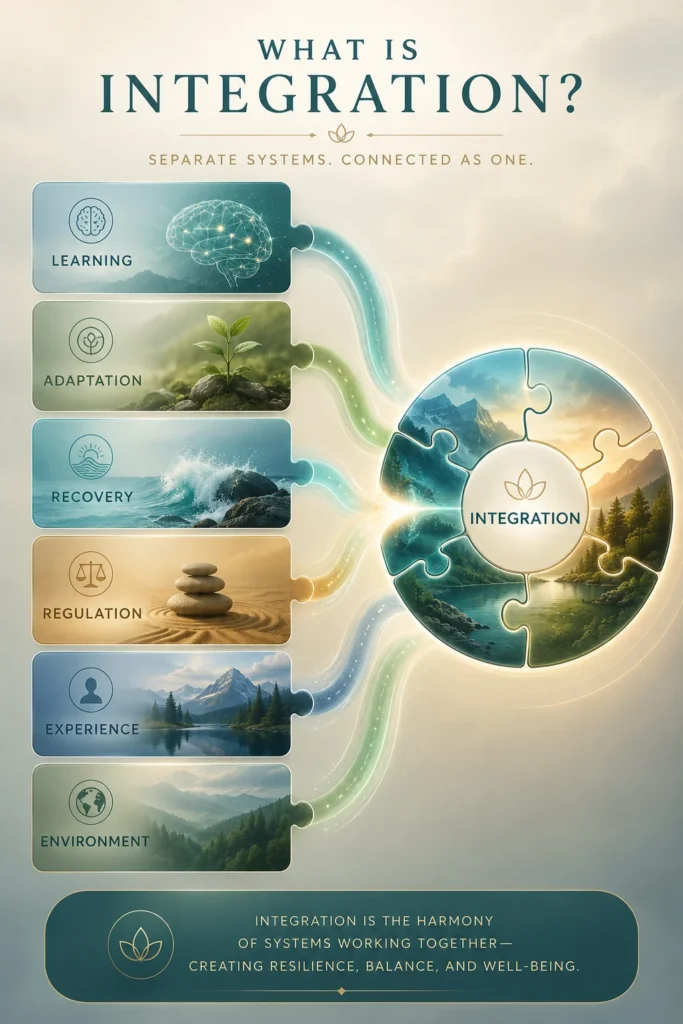
Integration Is About Connecting the Bigger Picture
Integration is the process of bringing different parts of learning, adaptation, regulation, and recovery support together into one clearer picture. In nerve health education, integration does not mean a cure, treatment, or special recovery method. Instead, it helps explain how different systems, experiences, and daily habits may connect and influence one another over time.
Many people look at recovery through only one lens. For example, they may focus on sleep, stress, nutrition, exercise, circulation, inflammation, or emotional well-being separately. However, the body rarely works in separate compartments. Instead, these systems constantly interact with one another. Because of that, understanding only one piece of the puzzle may not provide the full picture.
Therefore, integration helps readers step back and see how multiple factors may work together. Rather than focusing on a single symptom or one possible influence, it encourages a broader understanding of how different systems may contribute to overall function, adaptation, and recovery support.
Why This Concept Helps Readers
Many people become frustrated when they learn about one topic after another but still struggle to understand how everything fits together. For example, someone may read about stress management one day, sleep quality the next day, and nervous system regulation the following week. Although each topic may be valuable, the information can feel disconnected when there is no framework linking everything together.
This is where integration becomes useful. Instead of treating each topic as a separate lesson, integration helps organize information into a connected learning system. As a result, readers can better understand how different influences may interact throughout everyday life.
For example, poor sleep may affect energy levels and stress tolerance. Increased stress may influence emotional regulation and daily behavior. Likewise, physical overload may affect recovery capacity, while emotional strain may change how the body responds to challenges. Therefore, integration helps readers understand these relationships rather than viewing each factor in isolation.
Integration Helps Make Sense of Complex Recovery Topics
Recovery-related education can sometimes feel overwhelming because many topics seem important at the same time. Sleep, movement, stress, resilience, emotional balance, daily routines, nutrition, and recovery cycles may all appear connected. Consequently, readers may wonder where to start or which topic matters most.
Integration helps answer that question by showing that many recovery-related systems work together rather than independently. Instead of searching for one perfect explanation, readers can begin exploring how different influences may interact across the body and daily life.
Moreover, integration encourages patience. Recovery-related learning is often not about finding one missing piece. Rather, it is about understanding patterns, recognizing connections, and developing a clearer picture over time. Because of this, integration supports a more realistic and less overwhelming approach to nervous system education.
How Integration Connects With Other HYN Topics
Integration acts as a bridge between many important topics across Heal Your Nerves Naturally. For example, it naturally connects with Nervous System Regulation, which explores how the nervous system responds to internal and external demands. It also connects with Recovery Capacity and Resilience, which focuses on how the body responds to stress, challenge, and recovery needs.
In addition, integration supports understanding of Neuroplastic Adaptation, which explains how the nervous system may change through learning and repeated experiences. Likewise, it connects with Load Management, which helps readers understand how physical, emotional, mental, and lifestyle demands can influence overall capacity.
As readers continue exploring these related topics, integration helps create a clearer framework that connects them together. Therefore, instead of learning isolated concepts, readers can build a more complete understanding of how learning, adaptation, regulation, and recovery support may interact throughout daily life.
A Simple Way to Think About Integration
A helpful way to think about integration is to imagine a large map. Each topic—such as sleep, stress, movement, nutrition, emotional regulation, resilience, and recovery—represents a different location on that map. Individually, each location may be useful. However, the map only becomes truly helpful when the connections between those locations are visible.
Similarly, integration helps reveal the connections between different aspects of health education. It does not claim that one factor causes everything. Instead, it helps readers understand how multiple systems may influence one another over time.
Because of this broader perspective, integration serves as an important foundation for learning, adaptation, recovery awareness, and long-term nervous system education.
Plain Meaning / Glossary Box
Integration Means Putting the Pieces Together
Integration simply means “putting the pieces together.” On this page, it means understanding how body signals, daily habits, learning, emotional regulation, and recovery demand may connect with one another. Instead of looking at each part separately, integration helps readers see the bigger picture.
For example, sleep may affect how well a person handles stress. Stress may affect muscle tension, energy, mood, and focus. In the same way, movement may influence circulation, body comfort, and daily confidence. Meanwhile, nutrition may support energy rhythm and general body function. Therefore, integration helps readers understand that these areas are not isolated. They often work together as part of one connected system.
Integration Does Not Mean Doing Everything at Once
A common mistake is thinking that integration means adding more and more actions. However, integration is not about doing everything at the same time. Instead, it is about understanding which pieces may be connected and how they may influence daily life.
For example, a person may feel tired and tense after several nights of poor sleep. Another person may notice that emotional stress makes daily routines harder to follow. In both cases, integration helps connect the pattern without blaming one single factor. As a result, readers can think more clearly and avoid feeling overwhelmed by too many separate ideas.
Adaptation Means the Body Can Adjust Over Time
Adaptation means the body’s ability to adjust to repeated signals. These signals may come from movement, sleep rhythm, stress, emotions, routines, environment, or learning. Over time, the nervous system and body may respond differently depending on the kinds of signals they receive again and again.
For example, a consistent sleep routine may help the body expect rest more easily. Gentle movement may help the body become more familiar with activity. However, high stress or repeated overload may also affect how the body responds. Therefore, adaptation is not always about improvement only. It is about how the body changes in response to repeated patterns.
Stability Means Having Enough Consistency
Stability means having enough consistency for learning and recovery support to happen. It does not mean life must be perfect, strict, or completely controlled. Rather, it means the body and mind have enough predictability to notice patterns more clearly.
For example, if sleep time, meals, activity, stress, and routines change every day, it may be harder to understand what is helping or what is increasing load. However, when some parts of daily life become more stable, feedback becomes easier to read. Because of that, stability can support clearer learning, calmer observation, and better understanding of recovery-related patterns.
Load Means the Total Demand on the Body
Load means the total demand placed on the body and nervous system. This demand can be physical, emotional, mental, sensory, social, or lifestyle-related. For example, long work hours, poor sleep, intense worry, screen overload, difficult emotions, physical strain, and noisy environments can all add to total load.
Because load comes from many directions, it can sometimes build quietly. A person may not feel one single big cause. Instead, many small pressures may combine. Therefore, integration helps readers understand that the body may respond to the total pattern, not just one event. This makes load management an important part of recovery education.
Feedback Means Noticing Patterns Over Time
Feedback means noticing patterns over time. It is the information a person gathers from daily experience. For example, someone may notice that they feel more sensitive after poor sleep. Another person may notice that gentle movement feels better when stress is lower. These observations do not prove a diagnosis. However, they may help the reader understand possible connections.
Feedback is useful because it turns daily experience into learning. Instead of guessing, readers can begin to observe patterns more calmly. Over time, this may help them ask better questions, understand their limits, and recognize when professional guidance is needed.
A Simple Summary of the Glossary
In simple terms, integration means connecting the dots. Adaptation means the body can adjust to repeated patterns. Stability means having enough consistency to learn from those patterns. Load means the total pressure placed on the body. Feedback means noticing what changes over time.
Together, these ideas help readers understand recovery education in a safer and more organized way. Therefore, integration is not about forcing progress or doing more. Instead, it is about seeing how the right pieces may connect in a clearer, calmer, and more realistic way.
How Integration Works
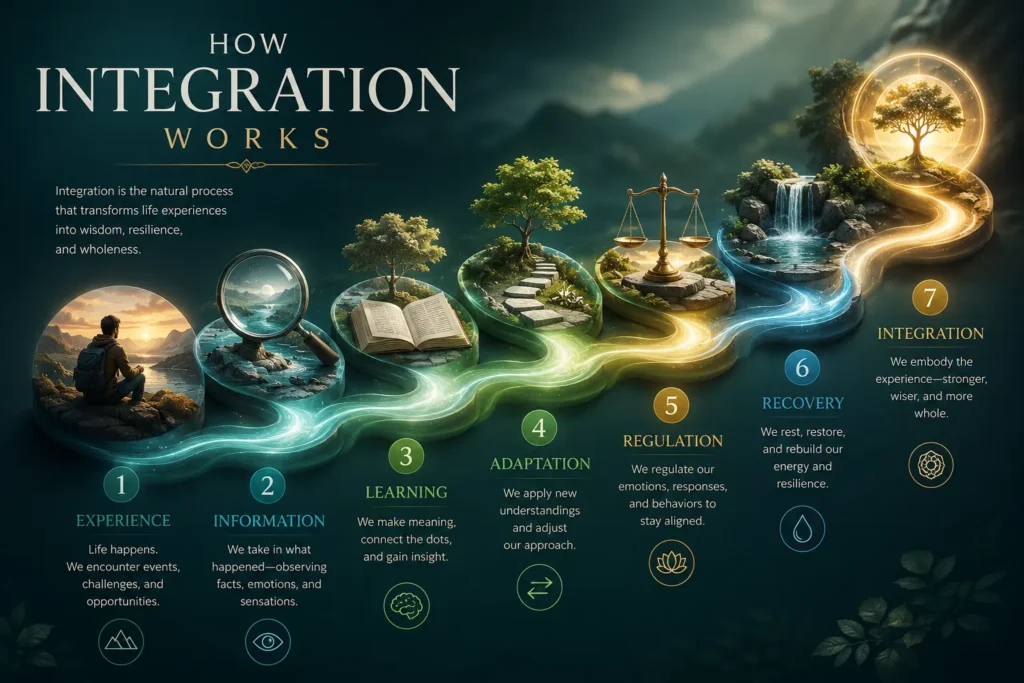
Integration Turns Separate Ideas Into One Clear System
Integration works by organizing separate recovery-related ideas into one connected learning system. At first, a person may only notice discomfort, fatigue, stress, sensitivity, tension, or confusion. These experiences may feel random because the larger pattern is not clear yet. However, as the person learns more about body systems, nervous system regulation, emotional patterns, daily load, and recovery capacity, the pieces may begin to connect.
For example, sleep may affect stress tolerance. Stress may affect muscle tension. Mental overload may affect focus and energy. Meanwhile, daily routines may influence how much recovery space the body has. Therefore, integration helps readers move from scattered information toward a more organized understanding of how different influences may work together.
Integration Helps Readers See Patterns More Clearly
Many people try to understand recovery by focusing on one thing at a time. For instance, they may ask whether poor sleep, stress, food, movement, or posture is the main issue. However, the body often responds to combined patterns rather than one isolated factor. Because of that, integration helps readers look at the full picture with more balance.
For example, a rushed routine may make it harder to notice helpful feedback. In addition, high mental load may increase body tension. Poor sleep may make stress feel harder to manage. When these patterns are seen together, the reader can understand why one area may influence another. As a result, learning becomes less confusing and more practical.
Integration Does Not Prove One Single Cause
Integration does not mean that one factor explains everything. It also does not diagnose symptoms or prove cause and effect. Instead, it helps organize possible influences so readers can understand their experiences in a safer and more realistic way.
For example, fatigue may be connected with poor sleep, emotional stress, heavy workload, low recovery space, or a medical issue. Similarly, nerve sensitivity may be influenced by many different factors. Therefore, integration helps readers avoid quick conclusions. It encourages careful observation, better questions, and professional support when symptoms are sudden, severe, worsening, or unusual.
Integration Makes Learning More Useful
Recovery-related learning becomes more useful when the information is connected. A reader may learn about nervous system regulation on one page, recovery capacity on another page, and load management somewhere else. However, those ideas become easier to understand when integration explains how they may work together.
Because of this, integration acts like a learning bridge. It helps readers connect daily habits, body signals, emotional regulation, feedback, and recovery support. Over time, this broader view may help them understand why recovery education needs order, patience, and context. Instead of feeling overwhelmed by many separate topics, readers can follow a clearer path.
Key Layers of Integration
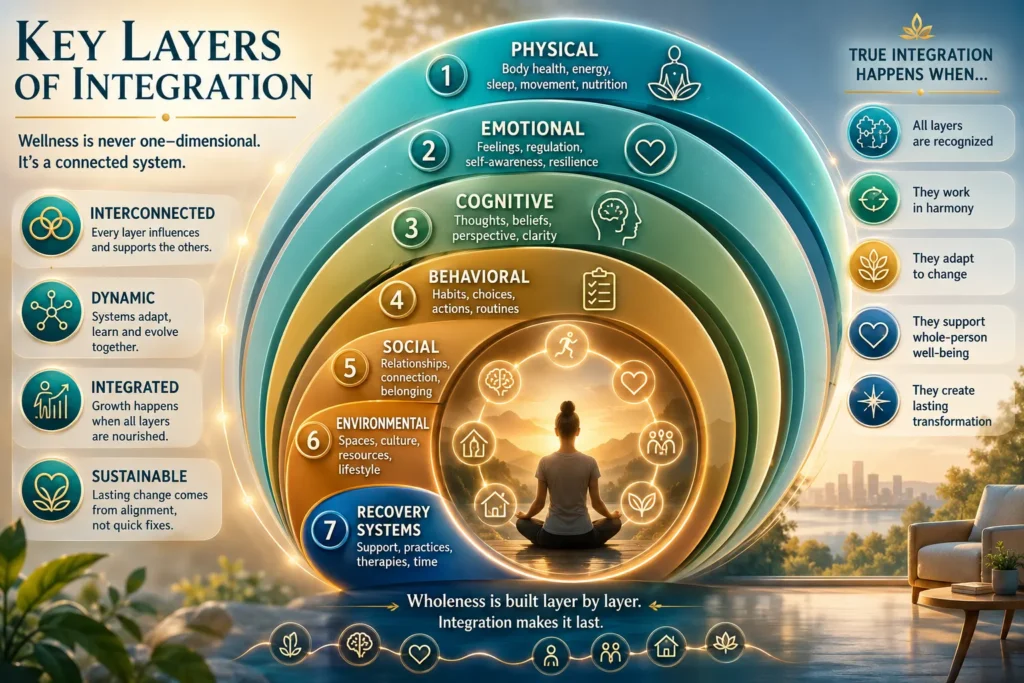
Integration Has More Than One Layer
Integration is not only one idea. Instead, it has several layers that work together. Each layer helps readers understand a different part of the recovery education process. For example, one layer helps with learning. Another layer helps with awareness. Other layers connect regulation, adaptation, behavior, and meaning.
This is important because recovery-related learning can feel confusing when everything is mixed together. A person may notice symptoms, stress, fatigue, sleep changes, emotional pressure, and daily overload at the same time. Therefore, these layers help organize the experience. Rather than seeing everything as random, readers can begin to understand how different parts of life may connect.
The Learning Layer: Understanding Body Signals
The learning layer helps readers understand body signals in a calmer way. Many people feel worried when they notice discomfort, sensitivity, fatigue, tension, or changes in energy. However, fear can make learning harder. Therefore, this layer focuses on clear education instead of panic.
For example, a reader may learn how the nervous system responds to stress, sleep, movement, and recovery demand. They may also learn that body signals can have many possible causes. As a result, learning helps them ask better questions without jumping to conclusions. This layer does not replace medical care. Instead, it gives readers a safer foundation for understanding related topics.
The Awareness Layer: Noticing Daily Patterns
The awareness layer helps readers notice patterns in daily life. These patterns may include sleep quality, stress level, activity load, emotional pressure, screen time, food timing, rest, and daily rhythm. At first, these patterns may seem unrelated. However, over time, some connections may become easier to see.
For example, a person may notice that poor sleep makes stress feel heavier the next day. Another person may notice that long sitting increases tension or discomfort. Meanwhile, emotional stress may make routines harder to follow. Therefore, awareness helps readers observe their experience more clearly. It is not about constant checking. Instead, it is about gentle, realistic noticing.
The Regulation Layer: Supporting Balance and Flexibility
The regulation layer connects stress response, emotional balance, attention, rest, and recovery space. A regulated system is not calm all the time. Instead, it can move between activity and rest with more flexibility. Because of this, regulation is an important part of integration.
For example, stress may increase alertness, muscle tension, and mental pressure. However, rest, sleep, supportive routines, and emotional regulation may help the system shift toward recovery. Therefore, this layer helps readers understand why nervous system regulation is not only about relaxation. It is also about flexibility, timing, and the ability to return to balance after demand.
The Adaptation Layer: How Repeated Signals Shape Responses
The adaptation layer explains how repeated signals may shape body and nervous system responses over time. These signals may come from sleep habits, movement patterns, emotional stress, workload, environment, learning, and daily routines. Because the body responds to repetition, patterns matter.
For example, repeated overload may make the system feel more reactive. On the other hand, repeated supportive routines may help create a clearer foundation for recovery education. However, adaptation is not always quick or straight. Some days may feel easier, while other days may feel more difficult. Therefore, this layer helps readers stay patient and avoid expecting instant change.
The Behavior Layer: Turning Knowledge Into Real Life
The behavior layer is important because knowledge only becomes useful when it connects with real life. A person may understand stress, sleep, movement, and load management very well. However, if the ideas are too difficult to apply, they may not create practical change.
Therefore, behavior should be realistic, gentle, and matched to daily capacity. For example, a small routine change may be more useful than a large plan that feels impossible to follow. In addition, behavior change often needs motivation, feedback, and patience. This layer helps readers understand that integration is not only about knowing more. It is also about applying knowledge in a manageable way.
The Meaning Layer: Staying Patient and Connected
The meaning layer helps readers stay connected to purpose, patience, and self-understanding. Recovery-related learning can sometimes feel slow, confusing, or emotionally heavy. Because of that, meaning can help readers continue learning without feeling lost or discouraged.
For example, a person may remind themselves that small steps still matter. Another person may connect their learning with family, work, independence, or long-term well-being. Meanwhile, meaning can reduce the pressure to find quick answers. Therefore, this layer supports emotional strength and long-term engagement. It helps readers see integration as a learning journey, not a race.
How These Layers Work Together
These layers work best when they support one another. Learning gives the reader information. Awareness helps them notice patterns. Regulation supports balance and flexibility. Adaptation explains how repeated signals may shape responses. Behavior turns knowledge into daily action. Finally, meaning helps the reader stay patient and connected.
Together, these layers show why integration is a bridge between education and daily-life recovery support. It does not promise a cure or a single solution. Instead, it helps readers understand how different parts of learning, behavior, regulation, and recovery awareness may connect over time.
Integration and Stability
Stability Gives Integration a Stronger Foundation
Integration and stability work closely together. Integration helps readers connect different parts of learning, adaptation, regulation, and recovery support. Meanwhile, stability gives those connections a clearer foundation. Without some level of stability, too many things may change at the same time. As a result, it becomes harder to understand what is helping, what is increasing pressure, and what needs more attention.
For example, a person may change sleep habits, food choices, movement routines, stress coping, and work rhythm all at once. Although the intention may be positive, the body may receive too many new signals at the same time. Therefore, feedback can become confusing. Stability helps reduce that confusion by creating a calmer base for learning.
Stability Does Not Mean Perfect Control
Stability does not mean life must be perfect, strict, or fully controlled. In real life, routines change, stress happens, sleep may vary, and daily responsibilities can shift. Therefore, stability should not be understood as perfection. Instead, it means having enough consistency to notice patterns more clearly.
For example, a person may keep a regular bedtime most nights, take breaks during long sitting, or follow a simple daily rhythm. These small stable points can make the body’s feedback easier to understand. Because of that, stability is not about forcing life into a rigid plan. Rather, it is about creating enough predictability for better awareness and calmer learning.
Why Too Many Changes Can Create Confusion
When many habits change at once, it becomes difficult to know which change created which effect. For example, if someone changes sleep timing, adds new exercise, changes meals, increases work hours, and starts a new stress routine in the same week, the feedback may become unclear. If they feel better or worse, it may be hard to understand why.
Therefore, stability helps readers slow down and observe more carefully. Instead of changing everything at once, a more stable approach allows the person to notice how one area may influence another. This does not mean avoiding change. Instead, it means making change easier to understand.
Stability Helps the Body Read Patterns
The body often responds to patterns, not just single events. For example, one poor night of sleep may not explain everything. However, repeated poor sleep may affect energy, stress tolerance, mood, focus, and recovery capacity. In the same way, repeated overload may make the system feel more reactive over time.
Because of this, stability helps readers see repeated patterns more clearly. A stable routine gives the body and mind a better chance to compare one day with another. As a result, the reader may better understand what supports comfort, what increases load, and what may need professional attention.
Stability Supports Safer Learning
Stability also supports safer learning. When the body and mind feel less chaotic, it becomes easier to learn without panic. A reader can observe symptoms, routines, emotions, and recovery patterns with more balance. In addition, they may be less likely to jump to extreme conclusions.
For example, if a person has a stable sleep rhythm and a steady movement routine, they may notice more clearly when stress, workload, or emotional pressure changes their comfort level. Therefore, stability helps integration become more practical. It gives readers a calmer space to connect information, feedback, and daily experience.
A Simple Way to Understand Stability
A simple way to understand stability is to imagine trying to read a book while someone keeps shaking the table. The words may be there, but they are harder to follow. In a similar way, when daily life changes too much too quickly, the body’s feedback becomes harder to read.
Stability makes the “table” steadier. It does not remove every challenge. However, it creates enough calm structure for learning, observation, and adaptation to become clearer. Because of that, stability is one of the most important foundations for integration.
Integration and Adaptation
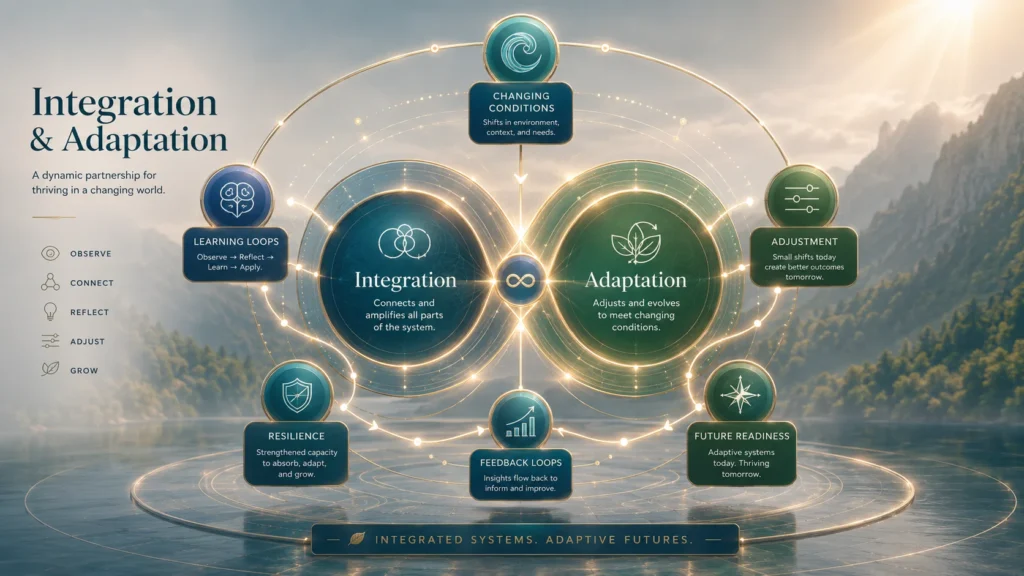
Adaptation Means the Body Learns From Repeated Signals
Integration supports adaptation because the body and nervous system learn from repeated experiences. These experiences may come from sleep rhythm, movement, stress, emotional load, daily routines, rest, work demand, and environment. Over time, the body may adjust to these repeated signals.
However, adaptation is not always quick or smooth. Sometimes the body responds well to small changes. At other times, it may feel more sensitive because sleep, stress, illness, overload, or recovery demand has changed. Therefore, integration helps readers understand adaptation as a gradual process. It also helps them avoid thinking that one difficult day means failure.
Adaptation Is Not Always a Straight Line
Many people expect progress to move in a straight line. For example, they may think that if a routine helps once, it should help every time. However, the body does not always work that way. Energy, stress tolerance, nervous system sensitivity, and recovery capacity can change from day to day.
Because of that, adaptation often happens in waves. A person may feel better for several days, then feel more tired or sensitive during a stressful week. This does not always mean something is wrong. Instead, it may mean the total demand on the body has changed. Integration helps readers see this bigger context more clearly.
Why the Same Routine May Feel Different
The same routine can feel different depending on the body’s condition. For example, a gentle walking routine may feel helpful when sleep is stable and stress is low. However, the same walk may feel harder during illness, poor rest, emotional pressure, or a busy work period.
Therefore, integration helps readers avoid quick conclusions. A routine that feels harder one day is not automatically bad. Instead, the body may be responding to a different total load. Sleep, stress, nutrition, emotional state, weather, posture, workload, and recovery space may all influence the experience. Because of this, adaptation needs context.
Integration Helps Readers Understand Total Load
Adaptation depends on total load. Load means the full amount of demand placed on the body and nervous system. This can include physical effort, emotional stress, mental work, sensory input, social pressure, and lifestyle strain. When total load is high, even a small activity may feel more difficult.
For example, a person may handle movement well on a calm day. However, after poor sleep and high stress, the same movement may feel heavier. Integration helps connect these pieces. As a result, readers can understand that adaptation is not only about one action. It is also about the full condition of the system.
Adaptation Engineering and Integration Work Together
Adaptation Engineering and integration belong together because they explain two sides of the same process. Adaptation Engineering focuses on adjustment. It helps readers understand how the body may respond to repeated signals, pacing, feedback, and capacity. Meanwhile, integration connects the wider context around those adjustments.
For example, adaptation may involve movement, sleep rhythm, stress regulation, and recovery timing. Integration helps readers see how these parts may interact. Therefore, Adaptation Engineering explains how adjustment may happen, while integration explains how the surrounding systems may support or challenge that adjustment.
A Simple Way to Understand Adaptation
A simple way to understand adaptation is to think about learning a new skill. At first, the skill may feel difficult. With repeated practice, the body and mind may become more familiar with it. However, practice feels easier when the person is rested, calm, and not overloaded.
In the same way, the nervous system may adapt better when repeated signals are steady, realistic, and matched to capacity. Therefore, integration helps readers understand that adaptation needs time, context, and patience. It is not about forcing progress. Instead, it is about creating clearer conditions for learning and adjustment.
Integration and Learning Systems
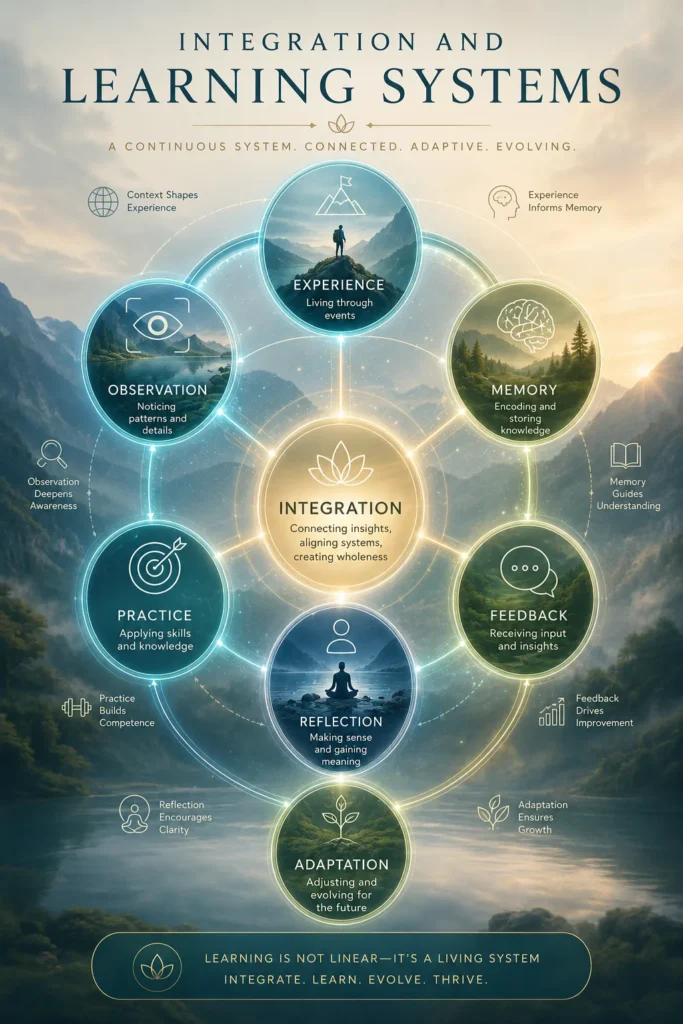
Learning Is the Foundation of Integration
Learning systems are at the heart of integration. Before people can connect different parts of recovery-related education, they first need information. However, information alone is not always enough. Many readers collect ideas from articles, videos, books, healthcare professionals, social media, personal experiences, and daily observations. Although each source may offer useful insights, the information can quickly become overwhelming when there is no clear structure.
As a result, people often feel confused rather than informed. They may learn about sleep one day, stress the next day, and nervous system regulation the following week. However, they may still struggle to understand how these topics fit together. Therefore, integration helps organize learning into a clearer path. Instead of seeing separate pieces of information, readers can begin to see how different topics may connect.
Why Too Much Information Can Become Confusing
Today, information is everywhere. A person can read dozens of articles, watch hours of videos, and follow countless health-related discussions online. While access to information can be helpful, it can also create confusion. Sometimes one source says one thing, while another source appears to say the opposite.
Because of that, many people experience information overload. They may jump from one idea to another without understanding the bigger picture. For example, someone may focus heavily on nutrition one week and then switch all attention to stress management the next week. Meanwhile, they may overlook how those topics interact.
Integration helps solve this problem by creating a learning framework. Rather than collecting random information, readers can organize ideas into a connected system. As a result, learning becomes easier to understand and apply.
Learning Becomes Stronger Through Connection
Learning is often more effective when ideas connect with one another. Reading about a topic once may create awareness, but deeper understanding usually happens when that information links to real-life experiences and related concepts.
For example, a reader may learn about stress regulation. At first, it may seem like a separate topic. However, over time they may notice that stress also affects sleep quality, emotional balance, recovery capacity, attention, and daily habits. Therefore, the original lesson becomes more meaningful because it is connected to other parts of life.
Similarly, learning about movement becomes more useful when connected with circulation, posture, recovery demand, and energy management. Because of these connections, integration helps transform isolated information into practical understanding.
Repetition Helps Learning Become More Useful
Most people do not fully understand a complex idea after seeing it once. Instead, learning often grows through repetition. The same concept may appear in different situations, examples, and experiences. Each time, understanding becomes a little stronger.
For example, a person may read about recovery capacity several times before fully understanding how it applies to daily life. Likewise, they may learn about nervous system regulation through articles, personal observation, and conversations. Over time, those repeated experiences help the concept become clearer.
Therefore, integration values repetition. Instead of constantly searching for new information, readers can benefit from revisiting important ideas from different angles. As a result, learning becomes deeper, more stable, and easier to remember.
Learning Should Feel Safer, Not More Frightening
Good learning should reduce confusion rather than increase fear. Unfortunately, some health information can make people feel overwhelmed, worried, or pressured to find immediate answers. As a result, they may focus more on fear than understanding.
Integration takes a different approach. Instead of promoting extreme claims or quick solutions, it encourages balanced learning. Readers are invited to explore possibilities, understand patterns, and ask thoughtful questions. Therefore, learning becomes a process of understanding rather than worrying.
This approach is especially important when discussing nervous system topics. Many symptoms, experiences, and body responses can have multiple influences. Because of that, careful learning helps readers stay curious without becoming alarmed.
Learning Helps Readers Ask Better Questions
One of the most valuable outcomes of learning is the ability to ask better questions. At first, a person may ask, “What is wrong with me?” However, as understanding grows, the questions often become more useful.
For example, they may begin asking:
- What patterns am I noticing?
- How does sleep affect my stress tolerance?
- What happens when my daily load increases?
- How does recovery space influence my energy?
- Which habits seem to support stability?
These questions encourage observation and learning. Instead of searching for one simple explanation, readers begin exploring how different systems may interact. Therefore, integration supports curiosity, awareness, and a broader understanding of recovery-related topics.
Learning Connects Knowledge With Real Life
Learning becomes most valuable when it connects with everyday life. Information that stays only on a page may be interesting, but it may not change understanding. However, when readers connect what they learn with their own experiences, the information often becomes more meaningful.
For example, a person may learn about stress and later notice how a busy work week affects sleep and recovery. Another reader may learn about load management and then recognize how emotional pressure influences daily energy. These real-life connections help transform information into understanding.
Because of this, integration encourages readers to connect learning with observation, reflection, and daily experience. Over time, this process can create a more organized and realistic view of recovery-related education.
Integration Creates a Clearer Learning Path
Ultimately, integration helps turn scattered information into a connected learning journey. Instead of viewing sleep, stress, movement, emotional regulation, recovery capacity, and nervous system function as separate topics, readers can begin to understand how these areas may influence one another.
Therefore, integration acts like a map. It helps organize information, reduce confusion, support awareness, and encourage deeper learning. As a result, readers can move beyond isolated facts and develop a more complete understanding of how learning, adaptation, regulation, and recovery support may connect in everyday life.
Human Systems and Integration
Integration Is Not Only Physical
Integration connects deeply with Human Systems because recovery-related learning is not only physical. A person is not just a body with symptoms. They also think, feel, worry, hope, avoid, decide, learn, and sometimes become discouraged. Therefore, integration must include the human side of recovery education.
For example, someone may understand a helpful idea but still feel too overwhelmed to apply it. Another person may know that small routines matter, yet stress, fear, or low motivation may make consistency difficult. Because of this, Human Systems help explain why information alone is not always enough. Integration becomes more useful when emotional regulation, coping, behavior, motivation, meaning, and trauma awareness are included.
Emotional Regulation Supports Integration
Emotional Regulation helps readers understand how emotions can influence learning, decision-making, and daily routines. When emotions feel intense, it may become harder to think clearly or apply helpful ideas. For example, worry may make a person search for quick answers. Frustration may make them give up too early. Meanwhile, fear may make normal body signals feel more alarming.
Therefore, emotional regulation supports integration by creating more space between feeling and reacting. It does not mean a person must stay calm all the time. Instead, it helps them respond with more awareness. As a result, learning becomes safer, slower, and more balanced.
Stress and Coping Shape Daily Capacity
Stress & Coping is also important because stress can affect how much a person can handle in daily life. When stress is high, even small tasks may feel heavier. In addition, stress may influence sleep, muscle tension, focus, emotional balance, and recovery space. Therefore, integration needs to include stress as part of the wider picture.
Coping means how a person responds to pressure. Some coping patterns may reduce overload, while others may add more strain over time. Because of that, integration helps readers notice how stress and coping connect with body signals, behavior, and recovery capacity. This makes the page more practical and human.
Behavior Change Turns Learning Into Action
Behavior Change matters because knowledge only becomes useful when it can fit into real life. A reader may understand nervous system regulation, load management, and recovery capacity. However, if the next step feels too hard, too large, or too confusing, the knowledge may not lead to action.
Therefore, integration supports small, realistic behavior changes. For example, a person may begin with a simple sleep rhythm, short breaks during work, gentle pacing, or better awareness of overload. These steps are not cures or treatments. Instead, they are examples of how learning may become more practical. As a result, integration becomes easier to apply.
Motivation Helps Readers Continue Gently
Motivation helps readers continue when progress feels slow or uneven. Many people start with strong effort but become discouraged when change does not happen quickly. However, integration teaches that learning and adaptation often happen gradually. Because of that, motivation should not depend only on fast results.
A more stable form of motivation comes from small progress, clear purpose, and realistic expectations. For example, a reader may feel encouraged when they understand one pattern better than before. Another person may feel motivated by keeping one supportive habit for a few days. Therefore, motivation helps integration stay gentle and sustainable.
Meaning and Purpose Reduce Discouragement
Meaning & Purpose can make integration feel more personal and grounded. When people connect learning with something meaningful, they may feel less lost. For example, someone may want to stay active for family life, work, independence, creativity, or daily confidence. This sense of purpose can support patience during slow learning periods.
However, meaning does not mean ignoring difficulty. Instead, it gives the reader a reason to keep learning without forcing progress. Because of this, meaning and purpose help integration become more compassionate. They remind readers that recovery education is not only about symptoms. It is also about life, identity, hope, and long-term understanding.
Trauma Integration Adds Context and Safety
Trauma Integration may also connect with this page because past stress, fear, or overwhelming experiences can shape how people respond to body signals. Some readers may feel alarmed by symptoms because previous experiences made uncertainty feel unsafe. Others may avoid learning because the topic feels emotionally heavy.
Therefore, trauma-aware integration should be gentle, clear, and non-alarming. It should not push readers into fear-based conclusions. Instead, it should help them understand that emotional safety, pacing, and careful learning matter. This does not replace therapy or medical care. However, it makes the educational experience more respectful and supportive.
Human Systems Make Integration More Realistic
Human Systems make integration more realistic because people do not live inside perfect plans. They live with stress, responsibilities, habits, emotions, relationships, work pressure, hope, and uncertainty. Because of that, recovery-related education must consider the whole person, not only the physical system.
Together, Emotional Regulation, Stress & Coping, Behavior Change, Motivation, Meaning & Purpose, and Trauma Integration help integration become more practical, compassionate, and human. As a result, readers can understand not only what they are learning, but also how to stay connected to the learning process over time.
Recovery Engineering Connections
Integration Is the Bridge That Connects the Recovery Engineering System
Integration is one of the most important pages in the Recovery Engineering cluster because it helps connect many related concepts into one organized learning system. Instead of treating each topic as a separate lesson, integration helps readers understand how different parts may work together.
For example, a reader may learn about stability on one page, feedback systems on another page, and load management somewhere else. Although each topic is valuable on its own, the bigger picture can be difficult to see when those topics remain separate. Therefore, integration acts like a bridge. It helps connect structure, learning, observation, adjustment, and recovery-related understanding into one clearer framework.
Because of that, integration helps readers move through the Recovery Engineering cluster in a more organized way. Rather than collecting isolated ideas, they can begin to see how different concepts may support one another.
Recovery Engineering Is About Organization, Not Treatment
The term “Recovery Engineering” may sound technical at first. However, on Heal Your Nerves Naturally, it should be understood as an educational framework rather than a medical system. It does not provide treatment plans, medical protocols, diagnoses, or personalized instructions.
Instead, Recovery Engineering focuses on how learning can be organized. It helps readers understand how people observe patterns, manage demand, adjust habits, learn from feedback, and build a clearer understanding of recovery-related topics.
Therefore, the goal is not to tell readers exactly what to do. Rather, the goal is to help them understand how different educational concepts connect. This makes learning more structured, practical, and easier to follow over time.
How Integration Connects With Stability
One of the strongest Recovery Engineering connections is Stability. Stability creates a foundation that makes learning easier. Without some level of consistency, it can become difficult to understand what is helping, what is increasing load, and what may need attention.
For example, if sleep patterns, daily routines, activity levels, and stress habits are constantly changing, feedback may become difficult to interpret. However, when some parts of life become more stable, patterns often become easier to notice. Therefore, integration and stability support one another. Stability creates the foundation, while integration helps explain the connections.
How Integration Connects With Feedback Systems
Feedback Systems help readers learn from daily experiences. Every day, the body provides information through energy levels, sleep quality, emotional responses, attention, stress tolerance, and other signals. However, these signals can feel confusing when they are viewed separately.
This is where integration becomes important. It helps organize those observations into a larger picture. For example, a person may notice that poor sleep often comes before a stressful day. Another person may observe that high workload affects recovery capacity. Therefore, integration helps readers connect individual observations into meaningful patterns.
As a result, feedback becomes more useful because it is understood within a broader context rather than as isolated events.
How Integration Connects With Load Management
Load Management explains the total demand placed on the body and nervous system. This demand can come from physical effort, emotional stress, mental workload, social pressure, environmental stimulation, and daily responsibilities.
Because load can come from many directions, people often focus on one factor while missing the bigger picture. For example, someone may focus on exercise while overlooking poor sleep and emotional strain. Meanwhile, another person may focus on stress while ignoring physical overload.
Therefore, integration helps readers understand how different forms of load may combine. Instead of looking at one pressure at a time, they can learn to view total demand more clearly. This broader perspective makes load management easier to understand.
How Integration Connects With Healing Sequencing
Healing Sequencing explains why order can matter when learning about recovery-related topics. Not every concept needs attention at the same time. In many situations, some foundations may need to be understood before other ideas become useful.
For example, awareness may need to develop before meaningful feedback can be recognized. Likewise, understanding load may help readers make more sense of adaptation. In addition, stability may make learning easier by reducing confusion.
Therefore, integration helps organize these ideas into a logical flow. It does not create a treatment plan. Instead, it helps readers understand how different concepts may build upon one another.
How Integration Connects With Adaptation Engineering
Adaptation Engineering focuses on how the body and nervous system may respond to repeated signals over time. This includes learning, adjustment, repetition, pacing, and feedback. However, adaptation rarely happens in isolation.
For example, sleep quality, stress level, emotional state, workload, and recovery space may all influence how adaptation unfolds. Because of that, integration helps explain the wider context around adaptation. One topic focuses on adjustment itself, while the other explains the surrounding conditions that may influence that adjustment.
Together, these pages help readers develop a more complete understanding of how learning and adaptation may interact.
How Integration Connects With Automation and Systems Thinking
Automation may sound like a technology term, yet it can also describe routines and habits that happen with less conscious effort over time. For example, a person may automatically follow a bedtime routine, take regular movement breaks, or notice overload patterns more quickly than before.
Integration helps explain how these patterns develop. First, learning creates awareness. Next, awareness supports behavior change. Then, repetition helps certain actions become more familiar. Over time, some supportive habits may require less effort to maintain.
Therefore, integration helps readers understand how learning can gradually become part of everyday life rather than remaining only theoretical knowledge.
Why Integration Holds the Recovery Engineering Cluster Together
Ultimately, integration acts as the connecting page that brings the Recovery Engineering cluster together. Stability, feedback systems, load management, healing sequencing, adaptation engineering, and automation each explain an important part of the picture. However, integration helps readers understand how those pieces relate to one another.
Without integration, these topics may feel disconnected. With integration, readers can see how structure, feedback, learning, adaptation, and daily-life experience may fit together. Therefore, this page serves as the central bridge that connects the entire Recovery Engineering framework into one organized and easier-to-understand learning system.
Integration and Feedback Systems
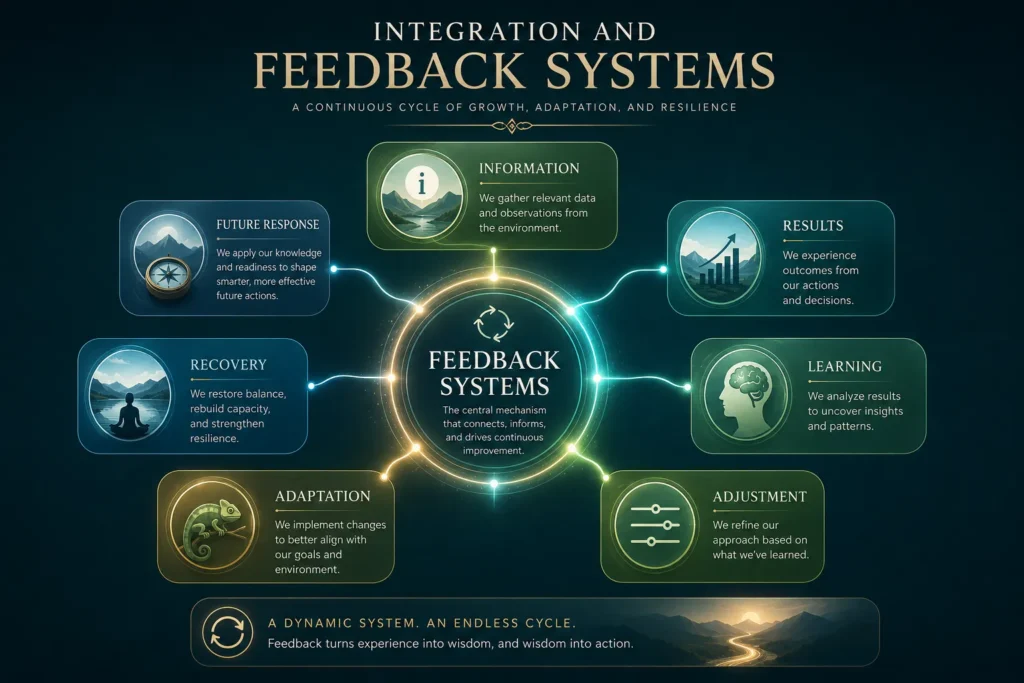
Feedback Helps Integration Become Practical
Feedback systems help integration become more useful in real life. Without feedback, a person may only guess what helps, what increases pressure, or what needs more attention. However, when someone observes patterns carefully, the picture can become clearer over time.
For example, a reader may notice that poor sleep often comes before higher sensitivity. Another person may notice that long screen time, emotional stress, intense activity, or a rushed routine changes daily comfort. These patterns do not prove a diagnosis. Still, they can help the reader understand how daily life and body signals may connect. Therefore, feedback makes integration more practical, organized, and easier to apply.
Feedback Is Not About Constant Checking
Feedback does not mean watching every body signal all day. That can become stressful and overwhelming. Instead, healthy feedback means noticing useful patterns in a calm and balanced way. The goal is not to create fear. Rather, the goal is to understand what may be happening more clearly.
For example, a person may gently notice sleep quality, energy level, stress level, movement load, mood, or recovery space. Over time, these simple observations may show repeated patterns. Because of that, feedback should feel like learning, not pressure. It helps readers stay curious without becoming alarmed by every small change.
Feedback Turns Daily Experience Into Learning
Daily life gives many small signals. Some signals may come from the body, such as tiredness, tension, sensitivity, or energy changes. Other signals may come from routines, such as sleep timing, activity level, work pressure, or emotional load. When these signals are ignored, the reader may feel confused. However, when they are observed gently, they can become useful information.
For example, someone may notice that a busy workday affects sleep. Another person may notice that poor rest makes emotional regulation harder. Therefore, feedback helps turn daily experience into learning. It allows the reader to connect real-life patterns with the bigger integration system.
Feedback Helps Avoid Quick Conclusions
One important benefit of feedback is that it helps readers avoid quick conclusions. A single difficult day does not always mean a routine is wrong. Likewise, one good day does not prove that one habit fixed everything. The body often responds to patterns over time, not one event only.
Therefore, feedback should be viewed across repeated experiences. For example, if sensitivity increases after several nights of poor sleep, that pattern may be worth noticing. However, it still does not prove one cause. Instead, it gives the reader a better question to explore. This makes learning safer, calmer, and more realistic.
Feedback Shows When Timing May Matter
Sometimes a routine may not be wrong, but the timing may not fit the person’s current capacity. For example, gentle movement may feel helpful in the morning but harder after a long stressful day. Similarly, screen time may be manageable for a short period but more tiring when sleep is poor.
Because of this, feedback helps readers understand timing. It may show whether a routine is too much, too little, too late, too rushed, or affected by another factor. As a result, integration becomes more connected to real life. The reader can see that context matters.
Feedback Systems Connect With Recovery Engineering
Feedback Systems are a key part of Recovery Engineering because they help organize learning. Integration connects feedback with stability, load management, adaptation, and healing sequencing. Without feedback, these topics may remain theoretical. However, with feedback, they become easier to understand.
For example, feedback may show how total load changes during stressful weeks. It may also show whether a routine feels more stable over time. Therefore, feedback systems help integration move from general education into practical awareness. They do not replace medical advice, but they can help readers ask better questions and understand patterns more clearly.
A Simple Way to Understand Feedback
A simple way to understand feedback is to think of it as a mirror. A mirror does not diagnose or fix anything. However, it helps a person see what is there more clearly. In the same way, feedback does not prove the cause of symptoms. Still, it can reflect patterns that may deserve attention.
Therefore, feedback systems help readers become better observers of their daily experience. They make integration less abstract and more human. Over time, feedback can support clearer learning, safer questions, and a more organized understanding of recovery-related patterns.
Integration and Load Management
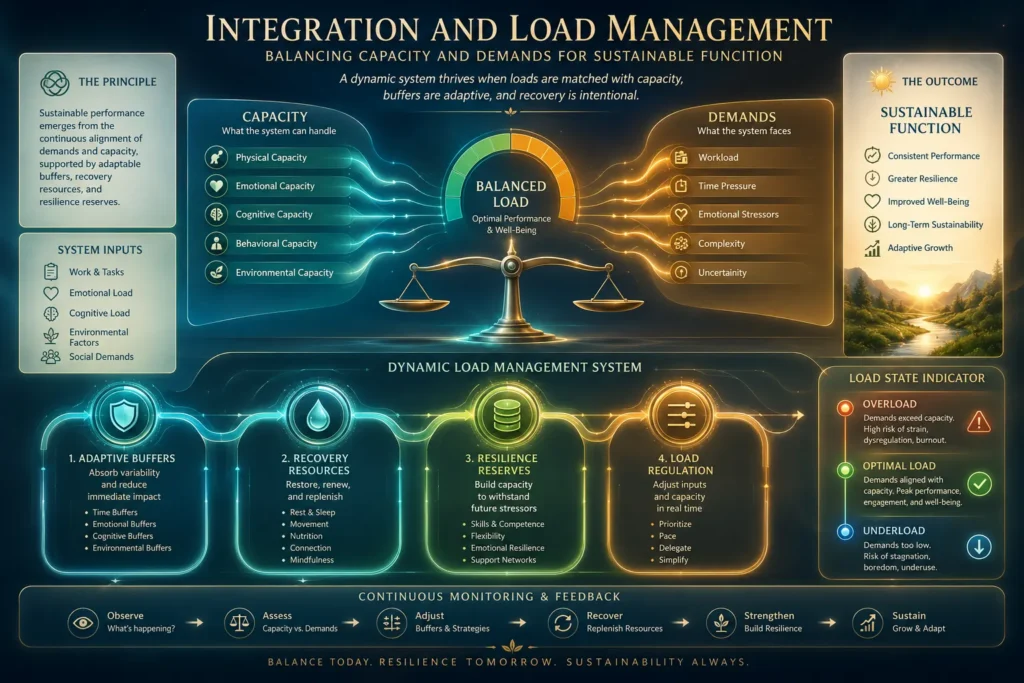
Load Management Helps Readers See the Full Pressure on the Body
Load management is one of the strongest parts of integration because the body does not respond to one type of pressure only. Every person has a different capacity for physical, emotional, mental, sensory, social, and lifestyle demand. When the total load becomes too high, the body may feel more tired, tense, sensitive, restless, or reactive.
For example, someone may focus only on movement while ignoring poor sleep, emotional stress, or long work hours. Another person may focus only on nutrition while daily pressure remains very high. Therefore, Load Management helps readers see the bigger picture. It encourages them to understand total demand, not just one habit.
Load Can Come From Many Directions
Load does not always come from heavy exercise or physical work. It can also come from worry, screen time, poor sleep, emotional pressure, noisy environments, rushing, family responsibilities, financial stress, or constant decision-making. Because of that, a person may feel overloaded even when they have not done much physical activity.
For example, a quiet day may still feel exhausting if the person has been mentally stressed, emotionally strained, or exposed to too much sensory input. Meanwhile, a physically active day may feel manageable if sleep, mood, and recovery space are better. As a result, integration looks at the whole pattern instead of one isolated source of demand.
Total Load Can Affect Recovery Capacity
Recovery capacity means how much demand the body can handle before it feels more strained. When total load stays within a manageable range, the body may have more room for learning, adaptation, and recovery support. However, when demand becomes too high for too long, the system may feel more reactive.
For example, a person may handle a short walk well on a rested day. However, after poor sleep, emotional stress, and a long work shift, the same walk may feel harder. This does not automatically mean the walk is harmful. Instead, it may mean the total load is higher than usual. Therefore, integration helps readers understand capacity with more context.
Load Management Is Not About Avoiding All Challenge
Load management does not mean avoiding every challenge, activity, or responsibility. Life still includes work, movement, relationships, emotions, and stress. Instead, load management means understanding how much demand the body can handle at a given time.
For example, a person may still move, work, learn, and participate in daily life. However, they may also need pacing, rest, breaks, simpler routines, or better timing. Because of this, load management is not about fear or avoidance. Rather, it is about matching demand with capacity, recovery space, and feedback.
Integration Helps Connect Load With Daily Patterns
Integration makes load management more useful because it connects load with other daily patterns. Sleep, stress, activity, emotion, nutrition, environment, and recovery rhythm may all influence how much load a person can handle. Therefore, one habit should not be judged alone.
For example, movement may feel better when sleep is stable and stress is lower. In contrast, the same movement may feel harder when the person is rushed, under-rested, or emotionally overloaded. As a result, integration helps readers understand why context matters. It shows that daily capacity can change based on the whole system.
Feedback Helps Readers Understand Their Load
Feedback is important because people cannot always guess their load accurately. Sometimes overload builds slowly. A person may not notice the pressure until they feel tired, tense, irritated, sensitive, or mentally drained. Therefore, feedback helps readers recognize patterns before they become too confusing.
For example, a reader may notice that symptoms feel stronger after several days of poor sleep and high stress. Another person may notice that they recover better when they take short breaks during long tasks. These observations do not diagnose anything. However, they can help readers understand how load may be affecting daily experience.
A Simple Way to Understand Load Management
A simple way to understand load management is to imagine carrying a backpack. One book may not feel heavy. However, if more books, a laptop, water bottles, and other items are added, the backpack becomes harder to carry. The body can work in a similar way.
One demand may be manageable. Yet many small demands together may feel heavy. Therefore, integration helps readers notice the full “backpack,” not only one item inside it. This makes load management more realistic, human, and easier to understand.
Integration and Healing Sequencing

Why Order Matters in Learning and Recovery Education
Healing sequencing is the idea that some things are easier to understand, learn, or apply after a foundation has been built. In everyday life, most people do not learn everything at once. Instead, they often move through a series of steps. One lesson creates the foundation for the next lesson. Because of that, order can make learning clearer and less overwhelming.
For example, it may be difficult to focus on behavior change when a person feels constantly stressed, exhausted, or overloaded. Likewise, it may be harder to understand feedback when daily routines change every day. Therefore, healing sequencing helps readers understand that some concepts naturally support other concepts. It creates structure and makes learning easier to follow.
Healing Sequencing Is About Understanding, Not Treatment
The word “healing” can sometimes create confusion. However, on this page, healing sequencing is not a medical treatment plan, therapy program, or personal recovery instruction. Instead, it is an educational framework that explains how different learning topics may fit together.
For example, a reader may first learn about awareness, then understand feedback, then explore load management, and later study adaptation. This order does not mean everyone must follow the same path. Instead, it shows how some ideas may become easier to understand when certain foundations are already in place.
Therefore, healing sequencing should be viewed as a learning map rather than a set of rules. It helps organize information so readers can see how topics connect.
Strong Foundations Make Later Steps Easier
Most complex systems work better when a foundation exists first. A house needs a foundation before walls and a roof are added. Similarly, learning often becomes easier when the basics are understood before moving into more advanced topics.
For example, a person may benefit from understanding daily load before trying to interpret adaptation. Likewise, learning about sleep, stress, and recovery capacity may help make feedback patterns easier to understand. Therefore, healing sequencing encourages readers to build understanding step by step rather than trying to learn everything at once.
As a result, learning becomes more organized and less confusing. Readers can focus on one layer while still understanding how it connects to the larger picture.
Why Changing Everything at Once Can Create Confusion
Many people feel motivated to improve several areas of life at the same time. They may change sleep habits, movement routines, stress management, work schedules, and nutrition all within a short period. Although the intention is positive, the results can become difficult to understand.
For example, if a person feels better, they may not know which change helped most. If they feel worse, they may not know which factor increased the pressure. Therefore, healing sequencing encourages a more organized approach to learning and observation.
This does not mean avoiding change. Instead, it means understanding that too many changes at once can make feedback harder to interpret. Consequently, a structured sequence often makes learning clearer.
Integration Connects One Step to the Next
Integration plays an important role because it connects different learning steps together. Without integration, topics such as stability, load management, feedback systems, and adaptation may feel like separate ideas. However, integration helps readers understand how one concept may support another.
For example, stability can create a better foundation for feedback. Feedback can help readers understand load. Load awareness can support adaptation. Meanwhile, adaptation may become easier to understand when patterns are observed over time. Therefore, integration acts like a bridge between each stage of learning.
As a result, readers can move through topics more naturally instead of feeling overwhelmed by disconnected information.
A Common Example of Healing Sequencing
A simple example can help explain the concept. Imagine a person who wants to understand why they feel tired and overloaded. At first, they may focus only on symptoms. However, after learning more, they begin noticing sleep patterns, daily stress, work pressure, and recovery habits.
Next, they start paying attention to feedback and repeated patterns. After that, they learn about load management and how different demands combine. Eventually, they begin understanding adaptation and recovery capacity more clearly.
In this example, each stage builds upon the previous one. Therefore, healing sequencing helps create a smoother learning journey rather than a collection of unrelated facts.
Healing Sequencing Supports Patience
One of the biggest benefits of healing sequencing is that it encourages patience. Many people want immediate answers, yet learning often takes time. Understanding complex systems usually happens gradually as knowledge, awareness, and experience grow.
Therefore, healing sequencing reminds readers that it is normal to learn step by step. Not every concept needs to be mastered immediately. Instead, each layer can support the next layer. This approach reduces pressure and creates a more realistic learning experience.
Because of that, healing sequencing works well with integration. Together, they help readers see that learning, awareness, stability, feedback, load management, and adaptation often connect in a meaningful order.
A Simple Way to Understand Healing Sequencing
A simple way to understand healing sequencing is to think about learning to read. Most people learn letters before words, words before sentences, and sentences before books. Each stage makes the next stage easier.
In the same way, recovery-related education often becomes clearer when concepts are learned in a logical order. Therefore, healing sequencing is not about strict rules or perfect steps. Instead, it is about creating enough structure for learning to feel more organized, practical, and easier to understand.
As a result, readers can connect information more effectively and build a stronger understanding of how different recovery-related systems may fit together.
Integration and Neuromodulation
Understanding the Connection Between Integration and Neuromodulation
Integration and neuromodulation connect because both topics focus on how the nervous system responds to different signals over time. However, these concepts should be understood in a broad and educational way. On Heal Your Nerves Naturally, neuromodulation is not limited to medical devices, clinical procedures, or specialized treatments. Instead, it can be viewed as a way of understanding how the nervous system may respond to learning, experience, environment, behavior, emotion, and daily routines.
Therefore, integration helps readers see the bigger picture. Rather than focusing on one signal alone, it encourages them to understand how many different influences may shape nervous system responses. As a result, neuromodulation becomes easier to understand as part of a larger learning system.
The Nervous System Is Always Receiving Signals
Every day, the nervous system receives information from many sources. Some signals come from the body, while others come from the environment. In addition, thoughts, emotions, habits, relationships, workload, sleep patterns, and daily experiences may all influence how the nervous system responds.
For example, a quiet evening routine may feel very different from a stressful and rushed day. Likewise, a person who feels rested may respond differently to challenges than someone who is exhausted. Therefore, the nervous system is constantly processing information and adjusting to changing conditions.
Because of this, neuromodulation can be understood as the ongoing influence of repeated signals on nervous system activity. Integration helps readers understand how those signals may connect and interact.
Small Daily Signals Can Matter
Many people think only major events influence the nervous system. However, small daily experiences can also be important. For example, sleep rhythm, work pressure, emotional stress, movement habits, social interaction, and recovery time may all contribute to the overall pattern of nervous system activity.
A single event may not seem significant on its own. However, repeated experiences can gradually shape how the body responds to demand. Therefore, integration encourages readers to look at patterns rather than isolated moments.
For instance, a person who consistently experiences poor sleep may notice different responses compared with someone who maintains a more stable sleep rhythm. Similarly, repeated overload may influence how manageable daily demands feel. Because of that, integration helps readers understand how many small signals can combine over time.
Emotional Regulation and Neuromodulation
Emotions are another important source of nervous system input. Every person experiences emotions throughout the day. However, emotional experiences do not stay separate from the body. Instead, they often influence attention, energy, tension, stress response, and daily behavior.
Therefore, emotional regulation connects naturally with neuromodulation. When people develop healthier ways to understand and respond to emotions, they may create different patterns of nervous system input over time. This does not mean emotions should be controlled perfectly. Instead, it means emotional awareness can become part of the larger integration process.
As a result, readers can better understand why emotional regulation is included alongside other topics such as sleep, stress, adaptation, and recovery capacity.
Learning and Neuromodulation Work Together
Learning is also connected to neuromodulation because the nervous system changes through experience. Every new skill, idea, habit, or pattern of understanding creates opportunities for learning. Over time, repeated learning experiences may influence how people think, respond, and make decisions.
For example, a reader may learn about stress patterns and begin noticing them more clearly. Later, they may learn about load management and start recognizing how daily demands affect their energy. Eventually, these insights may become part of their normal awareness.
Therefore, learning is not simply collecting information. It also becomes part of how people interact with their environment. Integration helps organize this learning process so it feels more structured and easier to understand.
Why Sleep, Routines, and Recovery Space Matter
Sleep rhythm, daily routines, and recovery space may also influence nervous system activity. When routines are highly unpredictable, it can be more difficult to recognize patterns. In contrast, some consistency may make feedback easier to understand.
For example, stable sleep timing may help a person notice how stress affects energy. Likewise, regular breaks may help reveal how workload influences focus and comfort. Therefore, routines can provide a clearer background for learning and observation.
However, this does not mean routines must be perfect. Instead, integration encourages readers to understand how consistency may support awareness and learning. As a result, they can better appreciate how different influences interact over time.
Neuromodulation Is Not the Same as Treatment
It is important to understand that neuromodulation, as discussed on HYN, is an educational concept. It is not presented as a treatment, cure, therapy, or medical recommendation. Likewise, calm routines, sleep habits, emotional regulation, and learning patterns should not be viewed as disease treatments.
Instead, these examples help explain how the nervous system may respond to different kinds of input. Therefore, the goal is education rather than intervention. Readers can use this information to better understand how daily experiences may influence nervous system activity without making assumptions about medical outcomes.
Integration Helps Readers Understand the Bigger Picture
Without integration, topics such as sleep, stress, emotions, learning, adaptation, and routines may appear unrelated. However, integration helps connect these ideas into a larger framework. It shows how different signals may influence one another and how those influences may shape daily experiences.
For example, sleep may affect stress tolerance. Stress may influence emotional regulation. Emotional regulation may affect behavior. Meanwhile, behavior may influence recovery space and daily load. Therefore, integration helps readers see connections rather than isolated events.
As a result, neuromodulation becomes easier to understand. Instead of focusing on one factor, readers can appreciate how many different influences may contribute to the overall picture.
A Simple Way to Understand Integration and Neuromodulation
A simple way to think about integration and neuromodulation is to imagine an orchestra. Each instrument produces its own sound. However, the overall experience depends on how all the instruments work together. If one section becomes louder or quieter, the whole performance changes.
In a similar way, the nervous system receives many different signals every day. Sleep, stress, emotions, learning, movement, environment, and daily routines all contribute their own input. Integration helps readers understand how those signals connect, while neuromodulation helps explain how the nervous system may respond to them over time.
Together, these concepts provide a broader and more realistic way to understand nervous system learning, adaptation, and regulation.
Real-Life Symptom Language Bridge
Why Readers May Search for Integration
Many readers do not arrive at this page because they are searching for the word “integration.” Instead, they often arrive because they are trying to understand confusing experiences in everyday life. For example, they may feel tired even after resting, overwhelmed by stress, sensitive to daily demands, or frustrated because symptoms seem to change from day to day.
Some readers may notice tingling, burning sensations, numbness, weakness, nerve sensitivity, muscle tightness, fatigue, sleep problems, mental exhaustion, or periods when symptoms feel worse than usual. Others may simply feel that their body does not respond the same way it used to. Therefore, they begin looking for explanations that help them understand the bigger picture.
This is where integration can be useful. It helps organize learning about different influences without assuming there is one simple answer.
Symptoms Can Have Many Possible Influences
One of the most important ideas to understand is that symptoms can have many possible causes and contributing factors. Because of that, integration should never be used as the only explanation for a symptom or health concern.
For example, fatigue may be influenced by sleep quality, emotional stress, workload, illness, recovery demand, or another health condition. Likewise, muscle tension may be connected with posture, stress, activity level, or other factors. In the same way, tingling, numbness, burning sensations, or weakness can have many possible explanations that require proper medical evaluation.
Therefore, integration is not about identifying the cause of symptoms. Instead, it helps readers understand that many systems may interact at the same time.
Why Symptoms Sometimes Feel Inconsistent
Many people become confused when symptoms seem to change without a clear reason. One day they may feel relatively comfortable, while another day they may feel more tired, sensitive, tense, or overwhelmed. As a result, they may wonder why the experience feels so unpredictable.
In some situations, daily factors such as poor sleep, emotional pressure, mental overload, physical demand, illness, or reduced recovery space may influence how the body feels. However, that does not mean those factors are the only explanation. Instead, they may be part of a larger picture.
Therefore, integration helps readers step back and look at broader patterns rather than focusing only on one moment. This approach encourages observation and learning instead of quick conclusions.
Integration Helps Organize Possible Influences
Integration acts like a map for understanding different influences that may affect daily experience. Rather than focusing on a single factor, it encourages readers to consider how multiple systems may interact.
For example, daily comfort may be influenced by:
- Sleep quality
- Stress level
- Emotional load
- Physical activity
- Recovery space
- Work pressure
- Movement patterns
- Circulation
- Nutrition
- Environmental factors
- Existing medical conditions
Because these influences may overlap, it can be difficult to understand them when viewed separately. Therefore, integration helps organize them into a clearer framework. As a result, readers can better understand how different areas of life may connect.
Integration Is About Understanding, Not Diagnosing
A common misunderstanding is believing that integration explains the cause of symptoms. However, this page does not diagnose conditions, identify medical problems, or determine why symptoms occur.
Instead, integration helps readers explore how different factors may interact. For example, poor sleep may affect stress tolerance. Stress may influence emotional regulation. Emotional strain may affect daily routines. Meanwhile, reduced recovery space may increase overall demand on the body.
These connections can be useful for learning. However, they should never be viewed as proof of a medical explanation. Therefore, integration should be used as an educational tool rather than a diagnostic tool.
When Medical Attention Is Important
Although learning about integration can be helpful, some symptoms require professional medical evaluation. Sudden, severe, spreading, worsening, or unusual symptoms should never be ignored.
For example, significant weakness, loss of balance, sudden numbness, major changes in sensation, loss of bladder or bowel control, severe pain, chest pain, confusion, or other concerning symptoms require medical attention. Therefore, readers should always seek appropriate care when symptoms appear serious or unexpected.
Integration can help organize learning, but it should never replace professional medical advice, diagnosis, or treatment.
Looking Beyond One Symptom
Many people focus on one symptom because it is the most noticeable part of their experience. However, symptoms often exist within a larger context. Sleep habits, stress level, workload, emotional pressure, activity patterns, and recovery capacity may all influence how daily life feels.
Therefore, integration encourages readers to look beyond a single symptom and consider the broader picture. This does not mean the symptom is unimportant. Instead, it means understanding the wider environment in which that symptom occurs.
As a result, readers may gain a more balanced and realistic perspective on their experiences.
A Simple Way to Understand the Symptom Bridge
A simple way to think about this section is to imagine a dashboard in a car. When a warning light appears, the light itself is not the entire story. Instead, it signals that something deserves attention. The warning light helps direct attention, but it does not automatically explain every detail.
Similarly, symptoms can act as signals. They may point toward areas that deserve further understanding or professional evaluation. However, they do not always reveal the complete picture by themselves.
Therefore, integration helps readers organize possible influences, recognize patterns, and understand connections more clearly. At the same time, it reminds them that symptoms can have many causes and that professional care remains important when concerns arise.
Practical Daily-Life Examples

Integration Becomes Easier to Understand in Real Life
Integration can sometimes sound like a complex concept. However, it becomes much easier to understand when we look at everyday situations. Most people do not experience life through separate categories such as sleep, stress, movement, emotions, and recovery. Instead, these influences often happen at the same time.
Because of that, integration helps readers understand how different parts of daily life may interact. Rather than focusing on one factor alone, it encourages a broader view of how multiple demands may affect energy, comfort, focus, and recovery capacity. The following examples show how integration may help organize real-life experiences without making medical claims.
Example 1: The Desk Worker
Many office workers spend long hours sitting, looking at screens, attending meetings, and concentrating on tasks. At first, the person may believe that muscle tension or discomfort comes only from sitting. However, the bigger picture may be more complex.
For example, long sitting may combine with mental fatigue, work pressure, poor breaks, reduced movement, and limited recovery time. In addition, stress from deadlines may increase tension and make the workday feel more demanding. Therefore, integration helps the reader understand that posture, attention, stress, activity level, and recovery space may all interact.
Instead of blaming one factor alone, the person can begin looking at the overall pattern. As a result, daily experiences may become easier to understand.
Example 2: The Family Caregiver
A caregiver often supports children, parents, partners, or other family members while managing many responsibilities at once. Although caregiving can be meaningful, it can also create emotional, physical, and mental demands.
For example, a caregiver may experience interrupted sleep, emotional pressure, physical work, and limited personal time. Because these demands occur together, recovery capacity may sometimes feel lower even when there is no single obvious reason. Therefore, integration helps explain how several small pressures may combine.
Rather than viewing tiredness as one isolated problem, the caregiver can understand how sleep disruption, emotional load, daily responsibility, and recovery space may all influence the experience. Consequently, the situation becomes easier to view within a larger context.
Example 3: The Student
Students often balance classes, assignments, exams, social expectations, and future goals. During busy periods, stress can increase while sleep and routines become less consistent. As a result, many students notice changes in energy, focus, motivation, or emotional balance.
For example, late nights may reduce sleep quality. Poor sleep may affect concentration. At the same time, academic pressure may increase mental load. Meanwhile, inconsistent meals and reduced recovery time may add additional strain.
Therefore, integration helps students understand how these influences may connect. Rather than assuming one factor explains everything, they can begin to see how multiple demands may shape their daily experience.
Example 4: The Shift Worker
Shift work often requires people to be active at times when the body would normally expect rest. Because of that, sleep timing, daily rhythm, and recovery patterns may become more challenging.
For example, a shift worker may sleep during daylight hours, work overnight, and change schedules frequently. As a result, sleep quality, energy rhythm, meal timing, and daily routines may feel less predictable. In addition, family responsibilities and social activities may add further pressure.
Therefore, integration helps explain why shift work can feel demanding even when a person is trying to take care of themselves. It highlights how circadian rhythm, sleep timing, workload, and recovery space may interact.
Example 5: The Busy Parent
Parents often manage work, household responsibilities, family schedules, and caregiving tasks at the same time. Because of these overlapping demands, daily life may feel full from morning until night.
For example, a parent may experience interrupted sleep, limited quiet time, emotional responsibilities, and constant decision-making. Meanwhile, work demands and household tasks continue in the background. Therefore, even small additional pressures may feel more noticeable.
Integration helps organize these experiences by showing how many demands may exist simultaneously. As a result, parents can better understand why recovery space sometimes feels limited despite their best efforts.
Example 6: The Person Recovering From Overload
Sometimes a person reaches a point where daily life simply feels too demanding. They may feel mentally exhausted, emotionally drained, physically tired, or overwhelmed by responsibilities. In these situations, it can be tempting to search for one simple explanation.
However, integration encourages a broader view. For example, the overload may involve stress, poor sleep, workload, emotional pressure, lack of recovery time, and reduced stability all happening together. Therefore, understanding the full picture becomes more helpful than focusing on one factor alone.
As a result, the person may gain a clearer understanding of how different demands have combined over time.
What These Examples Have in Common
Although each situation is different, they all share one important theme. Multiple influences are often happening at the same time. Sleep, stress, emotional pressure, movement, workload, environment, recovery space, and daily routines rarely operate independently.
Therefore, integration helps readers connect these influences into a clearer map. It does not diagnose symptoms or explain every experience. Instead, it helps organize learning and encourage a broader understanding of how daily-life factors may interact.
Because of that, integration can make recovery-related education feel more practical, realistic, and relevant to everyday life.
Integration Visual Flow
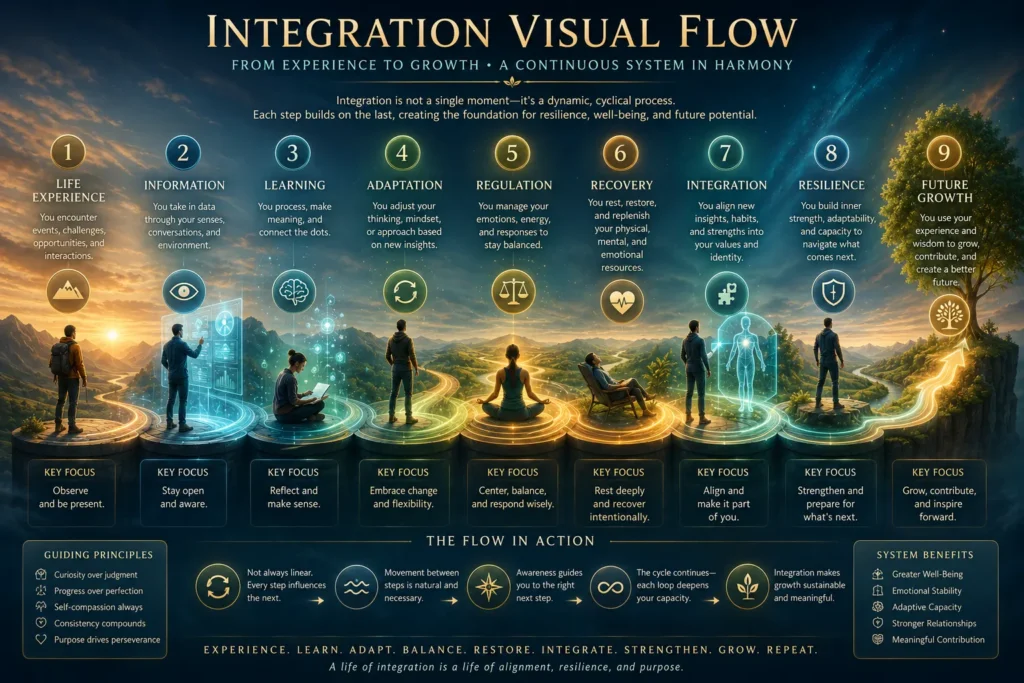
A Simple View of How Integration Develops Over Time
Learning → Awareness → Regulation → Load Adjustment → Feedback → Recovery Support → Adaptation → Stability → Long-Term Integration
At first glance, integration may seem like a complex idea. However, in practice, it often develops through a series of connected steps. These steps are not strict rules, and they do not happen perfectly for everyone. Instead, they provide a simple way to understand how learning, awareness, and adaptation may gradually work together over time.
Therefore, this visual flow should be viewed as an educational guide rather than a recovery formula. It helps readers understand how different parts of the integration process may connect. As a result, the journey becomes easier to follow and less overwhelming.
Step 1: Learning Creates the Starting Point
Every integration journey begins with learning. Before people can understand patterns, they first need information. For example, they may learn about sleep, stress, nervous system regulation, recovery capacity, movement, emotional regulation, or load management.
At this stage, the goal is not to solve every problem immediately. Instead, it is to build understanding. Learning helps readers replace confusion with knowledge and uncertainty with curiosity. Therefore, it creates the foundation for everything that follows.
Without learning, it can be difficult to recognize what may be influencing daily experiences. Because of that, learning is the first step in the integration process.
Step 2: Awareness Helps Readers Notice Patterns
After learning comes awareness. Once readers understand basic concepts, they often begin noticing patterns in everyday life. For example, they may see how poor sleep affects stress tolerance or how emotional pressure changes daily energy.
However, awareness is not about constantly monitoring the body. Instead, it is about gently observing recurring patterns without fear or panic. Therefore, awareness helps readers move beyond isolated events and begin seeing broader connections.
As a result, everyday experiences become valuable sources of information rather than sources of confusion.
Step 3: Regulation Supports Better Balance
As awareness grows, regulation becomes more important. Regulation refers to how people respond to stress, emotions, sensory input, workload, and daily challenges. Rather than aiming for perfect calmness, regulation supports flexibility and balance.
For example, a person may learn how stress affects them and then develop healthier ways to respond. Likewise, they may begin creating more recovery space within their routine. Therefore, regulation helps readers work with their experiences instead of feeling controlled by them.
Because of that, regulation creates a stronger foundation for long-term learning and adaptation.
Step 4: Load Adjustment Reduces Unnecessary Pressure
Once patterns become clearer, readers may begin adjusting load. Load includes physical effort, emotional stress, mental work, sensory stimulation, and daily responsibilities. Sometimes people discover that the total demand on their system is higher than they realized.
Therefore, load adjustment involves understanding where pressure is coming from and whether some demands can be reduced, paced, or managed differently. This does not mean avoiding all challenges. Instead, it means creating a better balance between demand and capacity.
As a result, the system may have more room for learning, recovery support, and adaptation.
Step 5: Feedback Provides Valuable Information
After load adjustment, feedback becomes even more useful. Feedback helps readers understand what may be changing and which patterns continue to repeat over time.
For example, they may notice improvements in sleep consistency, better stress awareness, or more stable routines. On the other hand, they may discover that certain pressures continue to increase their overall load.
Therefore, feedback acts like a guide. It helps readers understand what they are learning from their daily experiences. Because of that, integration becomes more practical and less theoretical.
Step 6: Recovery Support Creates More Space
Recovery support includes rest, sleep, pacing, nourishment, downtime, and opportunities for restoration. Without recovery space, it can be difficult for learning and adaptation to develop effectively.
For example, a person who is constantly rushing may have little opportunity to notice patterns or process experiences. In contrast, someone who has adequate recovery space may find it easier to observe changes and learn from feedback.
Therefore, recovery support is not about doing nothing. Instead, it is about creating enough space for the body and mind to respond to daily demands more effectively.
Step 7: Adaptation Happens Through Repetition
As supportive patterns repeat, adaptation may begin to occur. Adaptation refers to the body’s ability to adjust to repeated experiences, routines, and signals over time.
However, adaptation is rarely instant. Some changes may happen slowly, while others may depend on context, timing, and overall capacity. Therefore, readers should not expect a perfectly straight path.
Instead, adaptation is best understood as a gradual process that develops through repeated learning, awareness, feedback, and recovery support.
Step 8: Stability Provides a Stronger Foundation
As adaptation develops, stability often becomes easier to build. Stability means having enough consistency to understand patterns more clearly. It does not mean perfection. Rather, it means there is enough predictability for learning and observation to become more meaningful.
For example, stable routines may make it easier to notice how stress, sleep, or workload affects daily life. Therefore, stability helps reduce confusion and supports clearer understanding.
Because of that, stability becomes one of the most important outcomes of the integration process.
Step 9: Long-Term Integration Connects Everything Together
Eventually, all of these steps begin to work together. Learning, awareness, regulation, load adjustment, feedback, recovery support, adaptation, and stability become part of one connected system.
At this stage, the goal is not perfect control. Life will still include challenges, stress, change, and uncertainty. However, readers may develop a clearer understanding of how different influences interact.
Therefore, long-term integration is about connection rather than perfection. It helps people see the bigger picture and understand how multiple systems may work together over time.
Why Integration Matters for Long-Term Recovery

Recovery Is Usually Bigger Than One Factor
One of the most important reasons integration matters is that long-term recovery support is rarely based on a single factor. Instead, many different influences often work together. Sleep, stress response, emotional regulation, movement, daily habits, recovery space, learning, and nervous system regulation may all play a role.
Because of that, focusing on only one area can sometimes create an incomplete picture. For example, improving one habit may be helpful, but other demands may still affect the overall experience. Therefore, integration helps readers understand how different parts of life may interact rather than viewing each topic separately.
Integration Creates a Clearer Learning Path
Many people jump from one idea to another while searching for answers. They may focus on sleep one week, stress the next week, and nutrition the week after. Although each topic may be valuable, the overall picture can become confusing.
Therefore, integration helps organize information into a clearer learning path. Instead of collecting disconnected facts, readers can begin understanding how different concepts fit together. As a result, learning feels more structured, practical, and easier to apply.
Integration Supports Realistic Expectations
Another benefit of integration is that it encourages realistic expectations. Many people hope for quick answers or immediate changes. However, learning and adaptation often take time.
Some improvements may happen gradually. Other changes may depend on sleep quality, stress level, recovery space, daily capacity, and many other factors. Therefore, integration helps readers understand that progress is not always fast or predictable.
Because of this, readers can develop more patience and avoid becoming discouraged when experiences change over time.
Integration Helps Reduce Overwhelm
When people feel overwhelmed, they often focus on isolated problems. However, looking at one issue without context can make learning more difficult. Integration helps reduce this overwhelm by creating a more organized view.
For example, instead of seeing sleep, stress, movement, and emotional regulation as separate challenges, readers can understand how these areas may connect. Therefore, integration creates a sense of structure and clarity.
As a result, learning feels more manageable and less intimidating.
Integration Encourages a Long-Term Perspective
Long-term learning is often more valuable than short-term reactions. Therefore, integration encourages readers to think beyond today’s challenges and consider broader patterns over time.
Rather than searching for one perfect solution, readers can explore how different systems interact. This approach supports curiosity, patience, and ongoing learning. Consequently, integration becomes an important part of building a deeper understanding of recovery-related education.
Common Misunderstandings About Integration
Misunderstanding #1: Integration Means a Cure
One of the most common misunderstandings is believing that integration is a cure, treatment, or recovery method. However, integration is none of those things.
Instead, integration is a way of organizing learning. It helps readers understand how different systems, habits, experiences, and influences may connect. Therefore, it should be viewed as an educational framework rather than a medical solution.
Misunderstanding #2: More Information Always Helps
Many people assume that learning more information automatically creates better understanding. However, too much information without structure can actually increase confusion.
For example, a reader may consume articles, videos, and advice from many different sources. While each source may contain useful information, the overall picture may become harder to understand. Therefore, integration focuses on organization rather than information overload.
As a result, readers can learn more effectively without feeling overwhelmed.
Misunderstanding #3: Progress Should Always Be Linear
Another common belief is that progress should move in a straight line. People often expect improvement to happen steadily without setbacks or changes. However, real life rarely works that way.
Stress, sleep, workload, illness, emotional pressure, and daily demands can all influence how a person feels. Therefore, adaptation often happens in cycles rather than straight lines. Some periods may feel easier, while others may feel more challenging.
Because of that, integration encourages patience and a broader perspective.
Misunderstanding #4: One Tool Should Fix Everything
It is natural to search for one answer that explains everything. However, recovery-related learning is usually more complex than that. Sleep, stress, movement, emotional regulation, recovery space, learning, and daily load may all interact.
Therefore, integration encourages readers to move beyond one-factor explanations. Instead, it promotes a wider understanding of how different influences may work together.
As a result, readers can develop more realistic expectations and avoid oversimplified thinking.
Misunderstanding #5: Integration Replaces Professional Care
Some readers may mistakenly believe that understanding integration removes the need for professional medical support. However, this is not true.
Integration helps organize learning and improve understanding. It does not diagnose symptoms, provide treatment, or replace professional care. Therefore, medical concerns should always be discussed with qualified healthcare professionals when appropriate.
A Better Way to Think About Integration
A better way to think about integration is as a map rather than an answer. A map helps people understand where different paths connect, but it does not decide where they must go.
Similarly, integration helps readers understand how learning, awareness, regulation, adaptation, and recovery-related concepts may fit together. Therefore, it supports understanding rather than certainty.
As a result, readers can approach recovery-related education with more curiosity, balance, and realistic expectations.
Related Condition Connections
Why Condition Connections Matter
One of the goals of integration is to help readers understand how different health education topics may connect. Many people arrive at a condition page looking for information about symptoms, causes, or daily challenges. However, they often discover that the condition itself is only one part of a larger picture.
For example, sleep quality, stress response, emotional load, recovery capacity, movement patterns, and daily habits may all influence how a person experiences life with a condition. Therefore, integration helps readers move beyond isolated information and explore how different systems may interact.
It is important to remember that these connections are educational only. They do not diagnose, explain, treat, or cure any condition. Instead, they help readers understand related topics more clearly and encourage a broader perspective.
Integration and Peripheral Neuropathy
Readers exploring Peripheral Neuropathy may also benefit from understanding topics such as stress, sleep, circulation, nervous system regulation, and recovery capacity. Although peripheral neuropathy involves nerve-related symptoms, daily experiences are often influenced by more than one factor.
For example, poor sleep may affect energy and stress tolerance. Emotional pressure may increase feelings of overwhelm. Likewise, reduced recovery space may make daily demands feel more difficult. Therefore, integration helps readers understand how these additional influences may fit into the bigger picture.
However, this does not mean stress, sleep, or recovery factors cause peripheral neuropathy. Rather, integration helps readers explore related educational topics that may improve understanding.
Integration and Diabetic Neuropathy
Readers studying Diabetic Neuropathy often learn about blood sugar management, nerve health, and long-term metabolic influences. However, they may also benefit from understanding how lifestyle patterns, daily load, recovery demand, and nervous system regulation connect with broader health education.
For example, sleep quality, emotional stress, activity patterns, and daily routines may all affect overall well-being. Therefore, integration helps readers understand how different educational topics can connect rather than viewing them separately.
As a result, the learning experience becomes more complete and easier to navigate.
Integration and Nerve Compression
People reading about Nerve Compression may naturally become interested in posture, movement patterns, daily physical demand, and recovery space. While nerve compression has its own medical considerations, daily habits and body mechanics are often discussed alongside the condition.
Therefore, integration helps readers understand how movement, posture awareness, physical load, and recovery-related education may fit together. Instead of focusing on one topic alone, they can explore how several areas may influence daily experience.
Because of that, integration serves as a useful bridge between condition education and broader nervous system learning.
Integration and Sciatic Nerve Pain
Readers learning about Sciatic Nerve Pain may encounter discussions about movement, posture, activity level, discomfort, and recovery support. However, these experiences do not exist in isolation. Stress, sleep quality, daily load, and emotional strain may also affect how a person experiences day-to-day challenges.
Therefore, integration helps organize these related topics into a clearer framework. It encourages readers to understand the broader context rather than focusing on one factor alone.
As a result, the information becomes easier to understand and more relevant to everyday life.
Looking Beyond the Condition
A condition page often answers questions about a specific diagnosis or symptom pattern. However, integration encourages readers to also explore the surrounding factors that may influence daily life.
For example, understanding nervous system regulation, emotional regulation, load management, recovery capacity, and sleep patterns may provide valuable context. Therefore, integration acts as a connecting point between condition-specific learning and broader recovery-related education.
Because of this, readers can develop a more balanced understanding without making assumptions about causes, treatments, or outcomes.
topic cluster placement
Where Integration Fits Within HYN
Integration is designed to function as a bridge page across multiple learning areas within Heal Your Nerves Naturally. Rather than belonging to only one topic, it connects Recovery Engineering, Human Systems, Neurobiology, and recovery-related education.
Because of that, this page helps readers move between different clusters while maintaining a clear understanding of how the topics relate to one another. As a result, learning becomes more connected and less fragmented.
Primary Cluster: Recovery Engineering
The primary home for Integration is the Recovery Engineering cluster. This cluster focuses on how learning, organization, feedback, adjustment, and structure can help readers understand recovery-related topics more clearly.
Integration supports this cluster by bringing together many related concepts into one educational framework. Therefore, it acts as a central connection point rather than a standalone topic.
Direct Recovery Engineering Connections
Integration connects directly with:
- Stability
- Protocol Design
- Automation
- Feedback Systems
- Healing Sequencing
- Load Management
- Adaptation Engineering
- Neuromodulation
Each of these topics explains a different part of the larger learning process. However, integration helps readers understand how they fit together. Therefore, these pages work best when explored as a connected system rather than isolated lessons.
Supporting Nervous System Connections
Integration also supports several nervous system education pages, including:
- Neuroplastic Adaptation
- Autonomic Regulation
- Neural Signaling
- Recovery Cycles
- Recovery Capacity and Resilience
- Nervous System Regulation
These topics help readers understand how the nervous system responds, adapts, learns, and regulates itself. Therefore, integration provides a broader framework that helps organize these concepts.
Human Systems Connections
Human Systems play a major role in integration because people learn, think, feel, decide, and adapt through daily experiences.
For that reason, integration connects strongly with:
- Emotional Regulation
- Stress & Coping
- Behavior Change
- Motivation
- Meaning & Purpose
- Trauma Integration
Together, these topics help readers understand the human side of learning and adaptation. As a result, integration becomes more practical, realistic, and compassionate.
Why This Placement Is Important
Without a bridge page, readers may view Recovery Engineering, Human Systems, and Neurobiology as separate educational areas. However, integration helps connect them into one larger learning framework.
Therefore, this placement allows readers to move naturally between topics while maintaining a clearer understanding of how the pieces fit together. As a result, learning becomes more organized and easier to follow.
integration faq
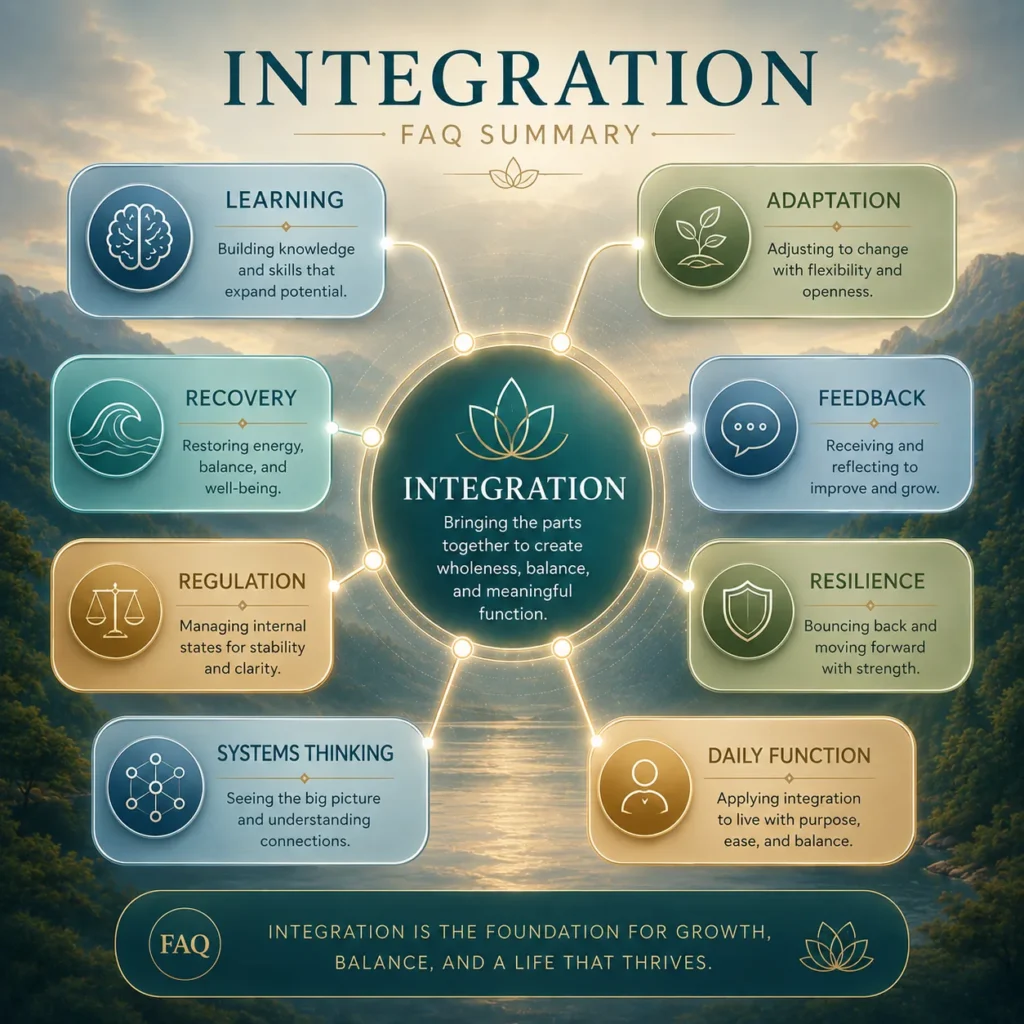
What does integration mean in recovery education?
Integration means bringing together learning, awareness, regulation, adaptation, feedback, and recovery-related concepts into one understandable system. Instead of focusing on one factor alone, it helps readers see how different influences may connect.
Is integration the same as healing?
No. Integration and healing are not the same thing. Integration is an educational concept that helps organize information and understanding. Healing is a biological process that may involve many medical, personal, and environmental factors.
Why does integration matter for nervous system regulation?
Nervous system regulation is influenced by many signals, including sleep, stress, emotions, daily habits, movement, recovery space, and workload. Therefore, integration helps readers understand how these influences may work together.
Does integration happen quickly?
Usually not. Integration often develops gradually. Learning, awareness, behavior change, and adaptation typically require repetition, experience, and time. Therefore, integration is best viewed as an ongoing process.
How does integration connect with neuroplastic adaptation?
Neuroplastic adaptation refers to the nervous system’s ability to change through experience and repeated signals. Integration helps organize the learning, feedback, and behavior patterns that may support understanding of those changes.
What role does behavior change play in integration?
Behavior change helps turn knowledge into practical action. Without behavior change, information may remain theoretical. Therefore, it is an important part of making integration useful in daily life.
Why does integration connect with stability?
Stability creates a more predictable foundation for learning and observation. Meanwhile, integration helps connect those observations into a larger framework. Because of that, the two concepts naturally support one another.
Can integration reduce symptom confusion?
Integration may help readers organize their thoughts about symptoms and patterns more clearly. However, it does not diagnose symptoms or determine causes. Medical evaluation remains important for concerning symptoms.
Is integration a protocol?
No. Integration is not a protocol, treatment plan, or medical recommendation. Instead, it is an educational framework that helps readers understand how different concepts may connect.
What should readers learn after this page?
Readers may continue exploring Stability, Feedback Systems, Load Management, Healing Sequencing, Neuromodulation, Neuroplastic Adaptation, Emotional Regulation, Stress & Coping, Recovery Capacity and Resilience, and other connected topics.
Continue learning

Continue Exploring Recovery Engineering
If you would like to continue learning within the Recovery Engineering cluster, consider exploring:
- Stability
- Protocol Design
- Feedback Systems
- Load Management
- Healing Sequencing
- Automation
- Adaptation Engineering
These pages explain how learning, organization, feedback, and adjustment can be understood within a broader educational framework.
Continue Exploring Nervous System Education
To learn more about nervous system function and adaptation, continue with:
- Nervous System Regulation
- Neuroplastic Adaptation
- Autonomic Regulation
- Neural Signaling
- Recovery Cycles
- Recovery Capacity and Resilience
Together, these pages provide a deeper understanding of how the nervous system learns, responds, and adapts.
Continue Exploring Human Systems
For readers interested in behavior, emotions, motivation, and personal growth, the following Human Systems pages are recommended:
- Emotional Regulation
- Stress & Coping
- Behavior Change
- Motivation
- Meaning & Purpose
- Trauma Integration
These topics help explain how human experiences connect with learning, adaptation, and recovery-related education.
Sources / References
Educational Sources Used for This Topic
The concepts discussed throughout this page are supported by educational resources related to stress, nervous system function, neuroplasticity, recovery-related learning, and health education.
Key reference sources include:
- MedlinePlus — Stress
- National Institute of Neurological Disorders and Stroke (NINDS) — Peripheral Neuropathy
- NCBI Bookshelf — Neuroplasticity
- Centers for Disease Control and Prevention (CDC) — Mental Health and Stress Management
- Cleveland Clinic — Peripheral Neuropathy
- Mayo Clinic — Peripheral Neuropathy Symptoms and Causes
These sources provide general educational information about nervous system health, adaptation, stress, and related topics. They are included to support learning and should not replace professional medical advice, diagnosis, or treatment.
Author / Editorial Trust Note
This page is written by Heal Your Nerves Naturally as an educational guide to help readers understand integration, adaptation, regulation, and recovery-related learning. The goal is to make complex nervous system topics easier to understand without fear, confusion, or overpromising.
The content follows the HYN educational framework. It avoids diagnosis, treatment claims, cure claims, personal medical instructions, supplement promotion, and protocol promises. In addition, the page connects readers to related internal learning pages so they can continue exploring the topic safely.
Educational Trust Notice
This page is for education only. It explains integration as a learning and organization concept inside Recovery Engineering. It does not provide medical advice, diagnosis, treatment, cure, prescription, or personal recovery instructions.
Readers should use this page to understand how learning, adaptation, feedback, regulation, and daily load may connect. However, individual symptoms and health conditions need professional evaluation. Therefore, this page should support better understanding, not replace medical care.
Safety Notice
Seek medical help if symptoms are sudden, severe, worsening, spreading, unusual, or connected with weakness, loss of balance, loss of bladder or bowel control, chest pain, severe headache, confusion, fever, injury, or major changes in sensation.
Nerve-related symptoms can have many causes. Some causes require urgent care. Therefore, do not use this page to self-diagnose or delay medical support. Instead, use it as a safe educational guide for understanding related body systems more clearly.