
How Nutrition Supports Nerve Repair in Everyday Life

How Nutrition Supports Nerve Repair becomes much easier to understand when we stop thinking about “healing foods” and start thinking about what nerve cells and the tissues around them need every day.
Food provides energy. It provides amino acids from protein. It supplies vitamins and minerals. It also forms part of the larger system that influences blood sugar, cardiovascular health, body weight and overall nutritional status.
Those things matter.
But they do not mean that a bowl of lentils, an egg, a vitamin tablet or a piece of fish directly “repairs” an injured nerve.
That distinction is the foundation of this page.
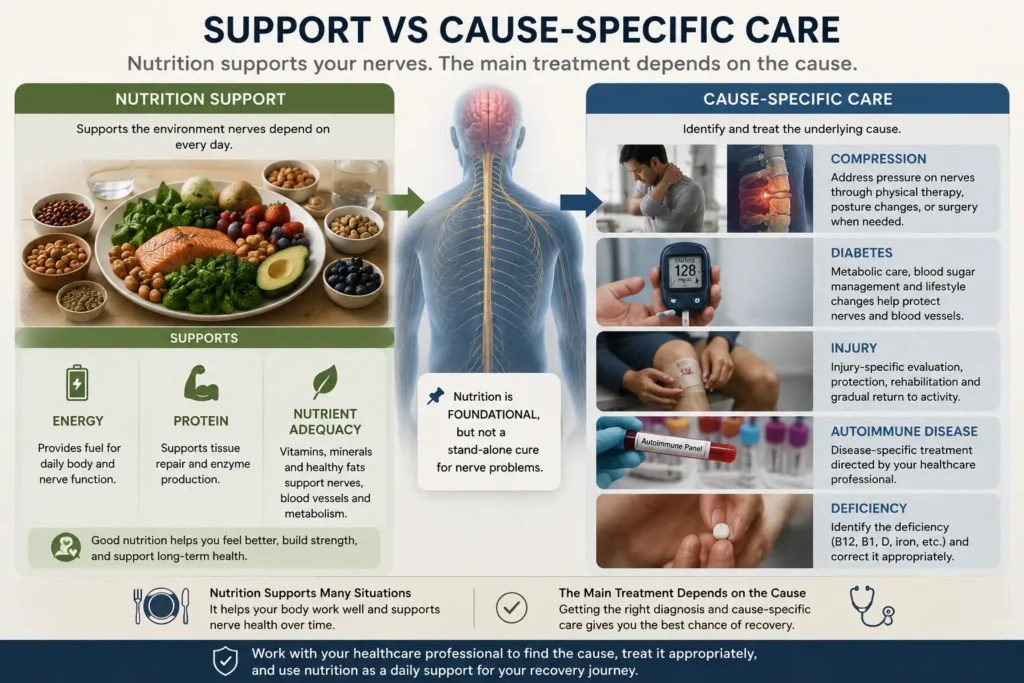
Nerve problems can arise for very different reasons. NINDS lists diabetes, physical injury, compression, vascular problems, immune-related conditions, nutritional imbalance, alcohol-related problems, toxins and medications among possible contributors to peripheral neuropathy. Vitamin B12 deficiency and excess vitamin B6 are among the best-known vitamin-related causes.
So when we talk about how nutrition supports nerve repair, we mean something practical:
Does the body have enough energy and nutrients to function normally?
Is a deficiency interfering with nerve health?
Is metabolic health creating additional stress?
Can the body absorb the nutrients being eaten?
Is nutrition helping—or is the real problem something food cannot fix, such as mechanical compression?
Those are the questions we will answer here.
If your main question is “Which foods should I eat?”, use the more food-specific Nerve Food Repair guide.
If your question is “How do I organize family meals and everyday household nutrition?”, use the broader Nutrition for Nerve Repair family guide.
This page has a different job:
to explain why nutrition matters inside the nerve-recovery environment.

What Does “Nutrition Supports Nerve Repair” Actually Mean?
Does Food Literally Repair a Damaged Nerve?
Not in the simple way that phrase may suggest.
A damaged nerve is not like a cut that can be repaired by adding one ingredient.
Nerve recovery depends on the type of nerve involved, how severe the damage is, whether the damaging factor is still present and what caused the problem in the first place.
Nutrition contributes to the environment in which that recovery has to happen.
In other words, food supplies fuel and raw materials.
It does not control every part of repair.
What Does “Support” Mean, Then?
In this context, support means helping the body meet normal biological needs.
MedlinePlus describes proteins, carbohydrates, fats, vitamins, minerals and water as essential parts of nutrition and notes that healthy eating should also reflect preferences, cultural traditions and budget.
That matters because nerves do not live separately from the rest of the body.
They depend on cells, blood vessels, connective tissue, muscles and metabolic processes.
Nutrition therefore supports the whole environment around nerve function.
Why Does This Page Avoid Saying “Food Heals Nerves”?
Because the phrase is too broad.
A person with B12 deficiency and a person with a compressed nerve may both have tingling.
Nutrition may be central to one case and only supportive in the other.
If we tell both people that food “heals nerves,” we hide the most important information: the cause matters.
Is Nutrition Still Worth Paying Attention to If It Is Not a Cure?
Absolutely.
Correcting a real nutritional deficiency can be medically important.
Maintaining adequate protein and energy matters.
Managing diabetes and broader metabolic risk matters.
Avoiding excessive supplemental B6 matters.
The goal is not to make nutrition less important.
The goal is to make its role accurate.
How Does Food Give Nerves the Energy They Need?
Do Nerves Really Need Much Energy?
Yes. Nerve cells are active cells.
They maintain electrical gradients, transmit signals and participate in continuous communication with other cells.
That work depends on energy metabolism.
However, feeling tired, numb or tingly does not prove that your nerves simply “need more calories.”
The same symptoms can come from many different problems.
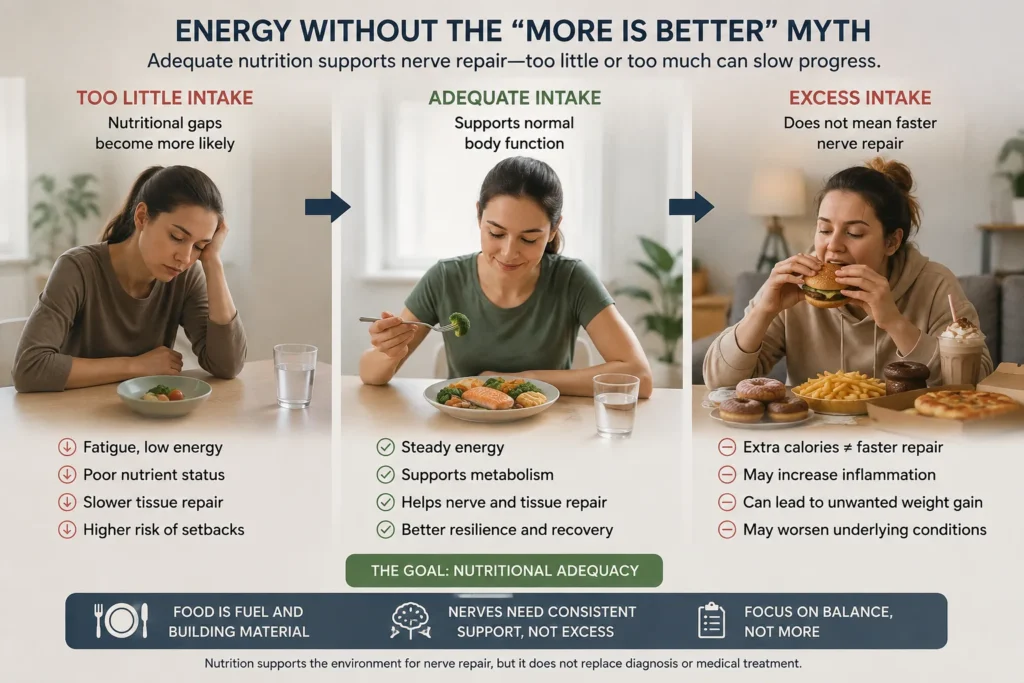
Does This Mean I Should Eat More Food to Help My Nerves?
Not automatically.
Enough energy is important.
More than enough is not necessarily better.
A person who is under-eating because of illness, low appetite or an extremely restrictive diet has a different nutritional problem from someone already eating more energy than their body requires.
So the useful question is:
“Am I meeting my nutritional needs?”
not:
“How much extra should I eat for nerve repair?”
What Happens If I Regularly Skip Meals?
Skipping one meal does not damage your nerves.
However, a pattern of regularly missing meals can make it harder to meet energy, protein and micronutrient needs.
That is especially relevant if the rest of the diet is already limited.
For example, someone who drinks coffee in the morning, skips lunch and eats one small evening meal may be getting much less nutrition than they realize.
Is Tea and Biscuits Enough for Breakfast?
Usually, that is a very limited breakfast.
It may supply energy, but often little protein and limited micronutrient variety.
A practical improvement might be:
tea + egg + fruit,
or
tea + yogurt + oats,
rather than trying to find a special “nerve breakfast.”
Does Breakfast Have to Be Perfect?
No.
Consistency is more useful than perfection.
If breakfast is difficult, start with one addition.
Add yogurt.
Add an egg.
Add fruit.
Add a protein source that fits your diet.
Small changes can make an ordinary routine more nutritionally complete.
Can Fasting Help Nerves Regenerate?
There is not established human evidence that a particular fasting routine universally regenerates damaged peripheral nerves.
For some people, fasting also makes it harder to meet nutritional needs.
For others—especially people using diabetes medications—it can affect glucose management.
Therefore, fasting should not be treated as a general nerve-repair protocol.
How Does Protein Support the Nerve-Recovery Environment?
Why Is Protein Mentioned So Often in Recovery?
Protein provides amino acids.
The body uses amino acids in structural proteins, enzymes, immune processes and many other functions.
So if someone is eating very little protein, correcting that gap can help improve overall nutritional adequacy.
Does Protein Directly Rebuild an Axon?
That would be too strong a claim.
The body uses amino acids throughout normal biology, but eating extra protein does not mean the body automatically sends those amino acids to a damaged nerve and rebuilds it faster.
Think of protein as necessary building material, not a nerve-specific drug.
How Do I Know If a Meal Contains Protein?
You do not need complex calculations for every meal.
Look for a clear protein source:
eggs,
fish,
chicken,
milk or yogurt,
beans,
lentils,
tofu,
soy foods,
nuts or seeds.
For deeper site-level coverage, see Protein & Aminos.
Is Dal Enough to Count as Protein?
Yes, lentils contribute protein.
They also contribute fibre and micronutrients.
A meal such as rice + dal + vegetables is nutritionally stronger than rice alone.
Adding another protein source may further increase protein, but whether it is necessary depends on the whole diet.
Are Eggs Good Because of Protein or B12?
Both.
Eggs contribute protein and vitamin B12.
That makes them useful foods for many people.
Still, an egg is not a treatment for neuropathy.
Is Fish Better Because It Contains Omega-3?
Some fish provide protein, B12 and EPA/DHA omega-3 fats.
NIH lists fatty fish such as salmon, mackerel, tuna, herring and sardines among important omega-3 sources. Walnuts, chia and flax provide the plant omega-3 ALA.
This makes fish nutritionally useful.
It does not prove that fish directly regenerates damaged nerves.
Do I Need Protein Powder?
Most people do not automatically need it.
If ordinary food can meet nutritional needs, protein powder may add little.
There are situations where supplemental protein can be useful, but that is different from calling it a nerve-repair treatment.
Can Too Much Protein Be a Problem?
It can be inappropriate for some people, particularly when certain medical conditions affect protein needs.
Someone with kidney disease, for example, should not simply follow generic “high-protein recovery” advice.
Individual medical nutrition guidance takes priority.
How Does Vitamin B12 Support Nerve Health?
Why Is B12 So Important in This Discussion?
Because this is one area where nutritional status and neurological health are clearly connected.
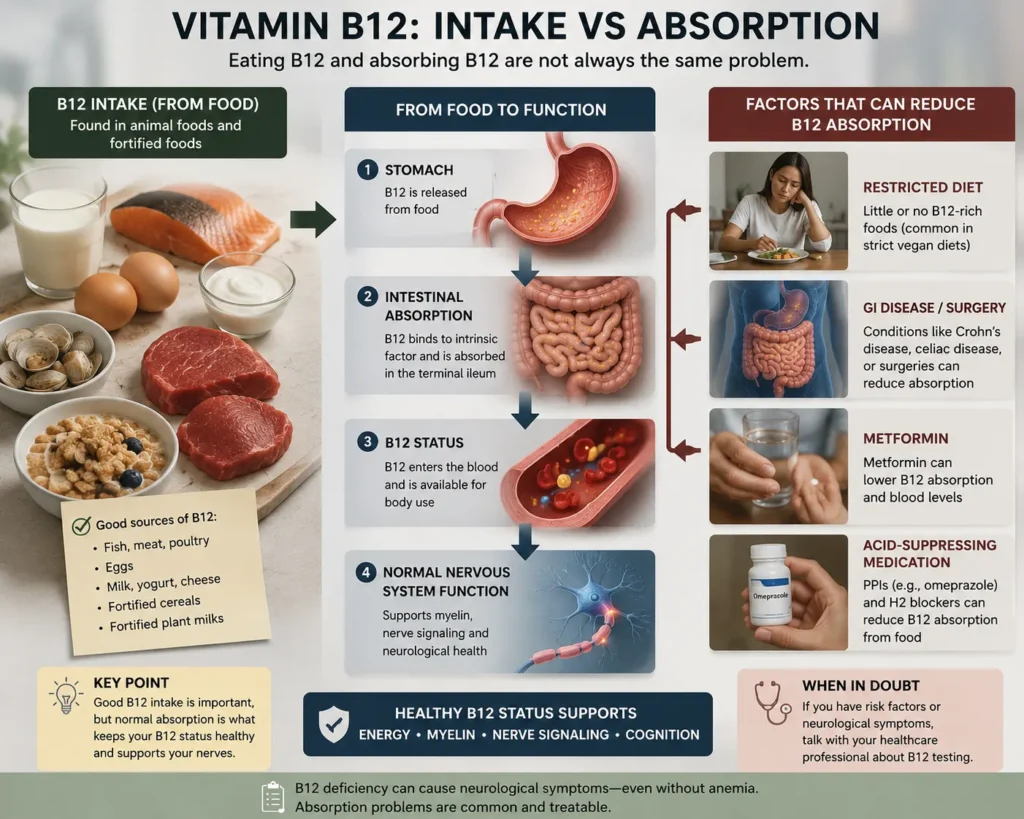
Vitamin B12 deficiency can cause neurological changes including numbness and tingling in the hands and feet. Importantly, those neurological symptoms can occur even without anemia.
That makes B12 deficiency very different from an internet claim such as “berries are good for nerves.”
One is a documented deficiency-related neurological issue.
The other may simply describe a nutritious food.
Does B12 Build Myelin?
Vitamin B12 is involved in normal nervous-system function and myelination.
That helps explain why deficiency can become neurologically important.
For a broader explanation of nerve insulation, continue to Myelin System.
Can Low B12 Cause Tingling Even If I Am Not Anemic?
Yes.
NIH explicitly notes that neurological symptoms can occur without anemia.
That is one reason persistent unexplained numbness or tingling should not be dismissed simply because a standard blood count appears normal.
Does Everyone With Tingling Need B12?
No.
Tingling has many possible causes.
B12 deficiency is one.
Diabetes, compression, injury, autoimmune disease and other conditions are others.
So B12 should be considered when the history and risk factors fit—not assumed in everyone.
Who Should Think More Carefully About B12?
Examples include people who eat little or no reliable B12 source, people with certain gastrointestinal problems, people who have undergone some GI surgeries and people using medications that may affect B12.
Older adults may also have difficulty absorbing food-bound B12.
Can Metformin Affect B12?
Yes.
NIH states that metformin may reduce B12 absorption and significantly reduce serum B12 concentrations.
That does not mean metformin is a bad medicine or should be stopped.
It means medication use and nutritional monitoring can coexist.
Can Omeprazole or Similar Acid Medicines Affect B12?
Yes.
NIH notes that gastric-acid inhibitors, including proton-pump inhibitors, can interfere with B12 absorption from food.
Again, do not stop prescribed medication on your own.
If long-term use and neurological symptoms occur together, it may be reasonable to discuss B12 status with the treating professional.
My Parent Eats Fish and Eggs. Could B12 Still Be Low?
Yes.
Food intake is only one part of B12 status.
Absorption matters too.
This is one of the clearest examples of why how nutrition supports nerve repair cannot be understood simply by making a food list.
If B12 Is Low, Will Eating More Eggs Fix It?
It depends on why the level is low.
If low intake is the main issue, better dietary intake may help.
If absorption is impaired, food may not be enough.
Does More B12 Mean Faster Nerve Repair?
No.
Correcting deficiency is different from taking extra B12 when status is already adequate.
Do not turn a deficiency-treatment principle into a “more is better” rule.
Why Can Vitamin B6 Be Helpful in Normal Nutrition but Harmful in Excess?
Isn’t B6 Supposed to Be Good for Nerves?
Vitamin B6 is essential.
But essential does not mean unlimited.
High supplemental intake over a long period can cause severe nerve damage. NIH notes that excessive intake from ordinary food is uncommon; the main concern is high-dose supplementation.
Can Bananas Cause B6 Toxicity?
Normal food intake is not the usual concern.
The safety issue is much more relevant to supplements.
So there is no reason to fear ordinary B6-containing foods because high-dose B6 supplements can be harmful.
How Does Someone Accidentally Take Too Much B6?
This is common in real life.
A person may take:
a multivitamin,
a B-complex,
a magnesium product with B6,
and a “nerve support” supplement.
Each bottle may look different.
Yet B6 can appear in all of them.
What Should I Do With My Supplements?
Read the labels.
Write down how much B6 each product contains.
Look for duplication.
If doses are high or you are unsure why you are taking them, discuss the combination with a pharmacist, dietitian or appropriate clinician.
Does a Higher B6 Percentage Mean the Supplement Works Better?
No.
The percentage tells you how much of the reference daily value the product contains.
It does not prove effectiveness for neuropathy.
How Do Thiamin and Magnesium Fit Into Nerve Nutrition?
Why Is Thiamin Mentioned in Neuropathy?
Thiamin, or vitamin B1, is involved in energy metabolism.
Severe thiamin deficiency can cause neurological problems, including peripheral neuropathy.
This is another example where deficiency matters.
It is not proof that high-dose thiamin improves every nerve disorder.
Which Foods Provide Thiamin?
Whole grains, fortified grains, legumes, seeds, pork and some fish can provide thiamin.
Again, food variety helps reduce the chance that one narrow eating pattern leaves important gaps.
Does Alcohol Affect Thiamin Status?
Long-term heavy alcohol use can contribute to nutritional problems and is a recognized neuropathy risk factor. NINDS includes alcoholism and nutritional imbalance among causes of neuropathy.
That means the solution may need to address both food intake and alcohol exposure.
Why Is Magnesium Relevant?
Magnesium participates in hundreds of biochemical processes, including muscle and nerve function, glucose control and energy production. It also participates in ion transport involved in nerve impulse conduction.
Can Low Magnesium Cause Tingling?
Severe magnesium deficiency can cause numbness and tingling, along with muscle cramps and other symptoms. However, symptomatic magnesium deficiency from low dietary intake alone is uncommon in otherwise healthy people.
Should Everyone With Tingling Take Magnesium?
No.
The fact that severe deficiency can cause tingling does not mean every episode of tingling reflects magnesium deficiency.
This is exactly the kind of reasoning this page is designed to prevent.
How Does Blood Sugar Affect the Nerve-Recovery Environment?
Why Is Diabetes So Important on a Nutrition Page?
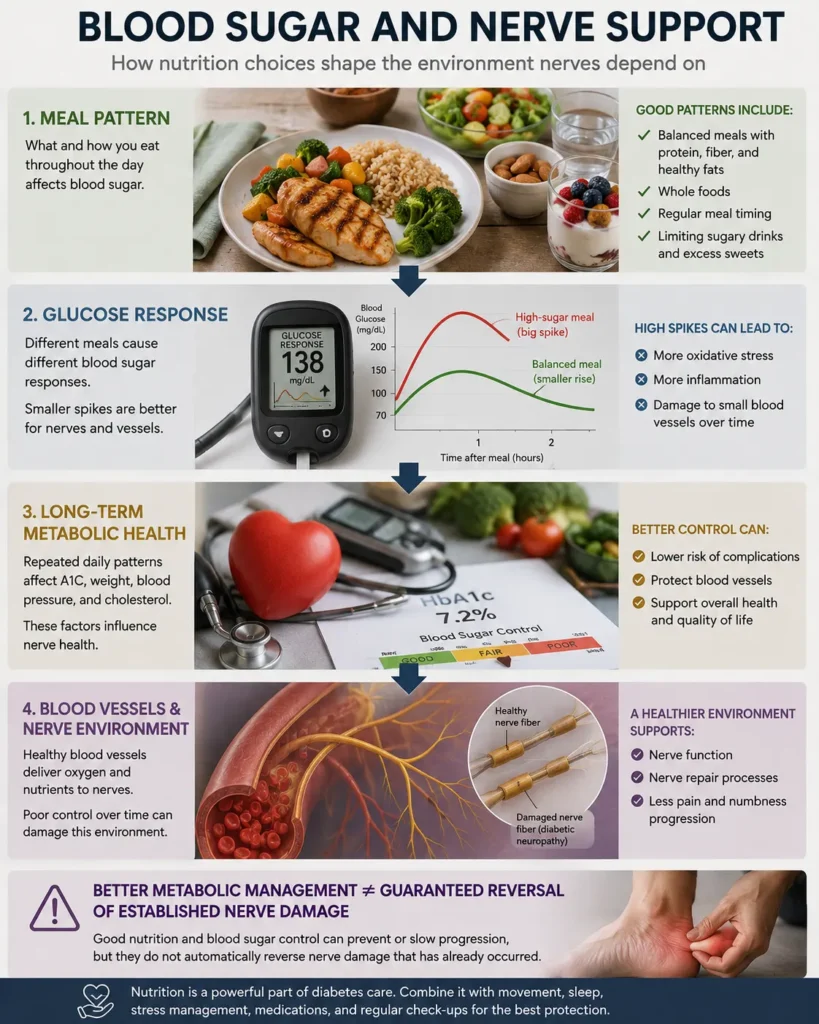
Because chronic hyperglycemia is strongly linked with diabetic neuropathy.
The American Diabetes Association’s 2026 Standards identify chronic hyperglycemia as a key risk factor for microvascular complications, including neuropathy.
In diabetes, nutrition is therefore not simply about vitamins.
It becomes part of broader metabolic care.
Can Better Eating Reverse Diabetic Nerve Damage?
That is too strong.
ADA’s 2026 guidance states that optimizing glucose management can prevent or delay neuropathy in type 1 diabetes and may modestly slow progression in type 2 diabetes, but it does not reverse neuronal loss.
That is a crucial distinction.
So What Does Food Do in Diabetes?
Food influences glucose patterns, energy intake, weight and cardiovascular risk.
ADA recommends individualized nutrition and notes that carbohydrate, fat and protein education should reflect individual needs and treatment. It also encourages legumes, nuts, seeds and other diverse food patterns as appropriate.
Is Rice Bad for Nerves If I Have Diabetes?
Rice itself is not a nerve toxin.
The useful questions are:
How much are you eating?
What is eaten with it?
How does the meal affect glucose?
What medication or insulin plan are you using?
For example, a meal of rice alone is metabolically different from rice with vegetables, lentils and protein.
Should I Stop All Carbohydrates?
Not automatically.
Diabetes nutrition should be individualized.
Carbohydrate type, amount, timing and treatment plan matter.
Does Sugar “Poison” the Nerves?
That wording oversimplifies the problem.
Chronic hyperglycemia matters in diabetic neuropathy.
One sweet food is not the same as instantly poisoning a nerve.
Better health decisions come from accurate explanations, not fear.
Can Fruit Be Part of the Diet?
Often, yes.
Whole fruit can fit balanced dietary patterns.
People with diabetes may need to consider portion size and individual glucose response.
Does Sweet Tea Matter?
It can.
If someone drinks several cups of heavily sweetened tea every day, the added sugar may become meaningful.
A small everyday habit repeated five times daily can matter more than an occasional dessert.
How Does Circulation Connect Nutrition and Nerve Health?
Why Do Nerves Need Blood Flow?
Blood vessels deliver oxygen and nutrients to tissues.
Peripheral nerves are no exception.
Vascular problems that reduce oxygen supply can contribute to nerve damage. NINDS includes blood and vascular disorders among possible neuropathy contributors.
Can One Food “Increase Blood Flow to the Nerves”?
That claim is usually too simplistic.
Cardiovascular health is built over time through multiple factors:
diet,
movement,
blood pressure,
lipids,
smoking exposure,
diabetes control,
and other health conditions.
One ingredient does not suddenly fix the entire delivery system.
Do Omega-3 Foods Help Because of Circulation?
Omega-3-containing foods can be part of heart-healthy eating.
Fatty fish, walnuts, chia and flax are established sources.
However, that does not establish them as direct treatments for nerve regeneration.
Is Water Part of Nerve Circulation?
Adequate hydration is part of normal health.
But drinking extra water beyond normal needs does not regenerate damaged nerves.
What If My Nerve Problem Is Related to Circulation?
Then the broader vascular problem deserves attention.
Use the HYN Circulatory Impairment System and Oxygen Delivery and Nerve Function for the next layer.
Why Does Nutrient Absorption Matter as Much as the Food You Eat?
If My Diet Looks Healthy, Can I Still Have a Nutrient Problem?
Yes.
A healthy-looking plate tells us what goes into the digestive system.
It does not always tell us what gets absorbed.
B12 is the clearest everyday example.
What Can Interfere With Absorption?
Depending on the nutrient, gastrointestinal disease, surgery, medication and other health conditions may matter.
This is why dietary advice cannot always solve a laboratory-confirmed deficiency.
Does Stomach Surgery Change the Nutrition Question?
It can.
Some gastrointestinal and bariatric procedures can alter normal absorption.
Therefore, neurological symptoms after significant GI surgery deserve more than generic advice to “eat healthier.”
What If I Have Celiac Disease or Crohn’s Disease?
Gastrointestinal disease can affect nutrient absorption.
Magnesium inadequacy, for example, is more likely in people with certain GI diseases.
Different diseases can affect different nutrients, so targeted assessment is more useful than taking a random multivitamin.
Can More Food Overcome Poor Absorption?
Not always.
If absorption is the bottleneck, simply increasing food quantity may not fix the deficiency.
This is one reason supplements, fortified foods or clinical treatment sometimes have a legitimate role.
How Does Everyday Meal Variety Support Nerve Health?
Why Does Variety Matter?
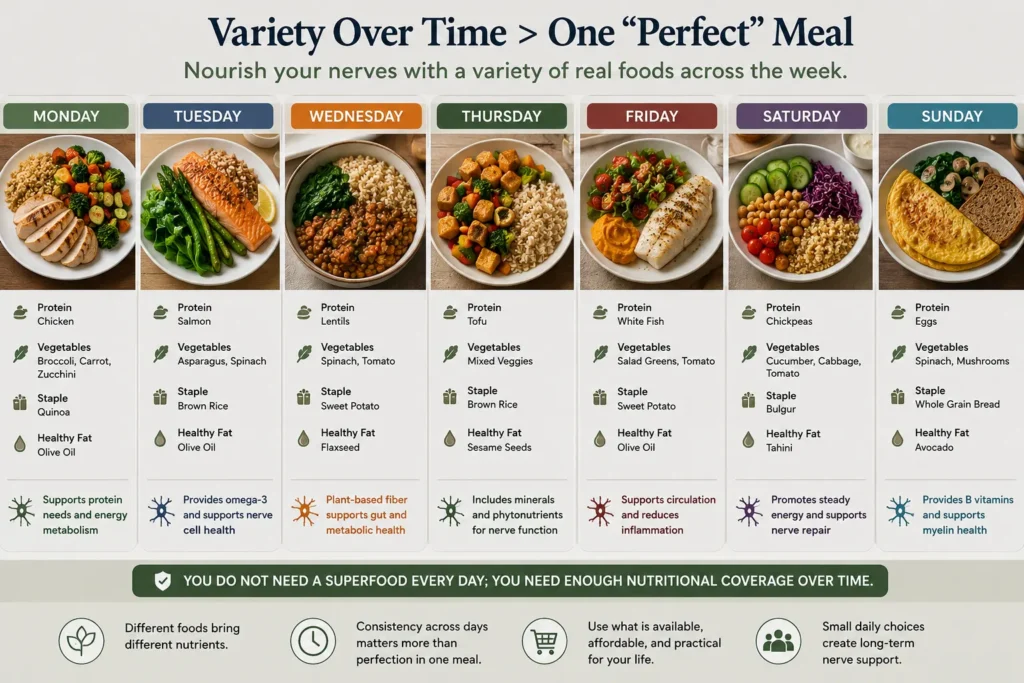
Different foods provide different combinations of nutrients.
A very narrow diet can make nutritional gaps more likely.
WHO describes dietary adequacy, balance, moderation and diversity as core aspects of diet quality.
Do I Need to Eat Twenty Different Foods Every Day?
No.
Think across the week rather than trying to turn every meal into a nutritional checklist.
Different vegetables.
Different protein sources.
Fruit.
Legumes.
Grains.
Suitable fats.
The pattern matters.
Is Eating the Same Breakfast Every Day Bad?
Not necessarily.
A balanced repeat breakfast can be perfectly practical.
For example, oats + yogurt + fruit + nuts may cover several nutritional roles.
Repetition becomes more concerning when the entire diet consists of only a few foods.
Does Fresh Food Always Beat Frozen?
No.
Frozen vegetables and fruits can make a varied diet more realistic.
MedlinePlus also emphasizes that healthy eating should reflect preference, culture and budget rather than requiring a rigid diet.
Is Expensive Food More Nutritious?
Not automatically.
Lentils, beans, eggs, oats, local vegetables and other ordinary foods can make important contributions.
Nutritional value is not determined by marketing price.
How Do Sleep and Stress Change the Way Nutrition Works in Real Life?
Why Talk About Sleep on a Nutrition Page?
Because humans do not eat in laboratory conditions.
Poor sleep can change appetite, energy, cravings and the likelihood that someone cooks or skips meals.
A person who sleeps poorly may rely on caffeine all morning and convenience food all evening.
So sleep can influence whether a good nutrition plan is actually followed.
Does Sleep Repair Nerves?
Sleep is an important biological process, but it should not be marketed as a guaranteed neuropathy cure.
The useful point is that recovery is multi-system.
For deeper HYN coverage, use Sleep & Recovery.
Can Stress Cause Me to Eat Too Little?
Yes.
Some people lose appetite under stress.
Others snack continuously.
Others skip meals all day and overeat at night.
The nutritional problem is therefore partly behavioral.
Does Stress Mean My Symptoms Are Psychological?
No.
Recognizing stress does not mean dismissing neurological symptoms.
Stress, sleep and eating behavior can interact with a real physical condition.
Use Stress System for the broader relationship.
Does Coffee Make Nerve Repair Harder?
Coffee is not a universal neuropathy cause.
However, if caffeine disrupts your sleep, that can affect the rest of your daily recovery routine.
So rather than asking:
“Is coffee bad for nerves?”
ask:
“Is my coffee habit helping or disrupting my normal sleep, meals and glucose control?”
Why Can Nutrition Support Recovery but Not Fix Nerve Compression?
If I Eat Perfectly, Can a Compressed Nerve Recover?
Nutrition cannot mechanically remove pressure from a nerve.
If the nerve is compressed because of anatomy, swelling, repetitive loading or another structural issue, that problem still needs to be addressed.
Does Nutrition Have Any Role in Compression?
It can support overall health and nutritional adequacy during recovery.
But that is different from fixing the compression itself.
How Do I Know If Compression Might Be the Problem?
Symptoms may follow specific positions, repetitive movements or mechanical patterns, but diagnosis requires proper clinical evaluation.
Use Nerve Compression for deeper education.
Can Posture Matter More Than Food?
Sometimes.
If a mechanical pattern is repeatedly irritating a nerve, changing the meal plan while leaving the mechanical load unchanged may miss the main cause.
For the broader movement connection, explore Movement, Posture & Nerve Regulation.
How Does Nutrition Support Recovery After a Nerve Injury?
Does Injury Increase Nutritional Needs?
Recovery requires adequate nutrition, but exact needs depend on the person and the injury.
A person healing after surgery may need sufficient protein and energy.
Yet someone who is immobilized may also be less physically active.
Therefore, “eat as much as possible” is not appropriate general advice.
Does Protein Become More Important After Injury?
Meeting protein needs may become particularly relevant to general tissue recovery.
That still does not mean extreme protein intake makes a damaged axon reconnect.
Are Vitamins More Important After Injury?
Meeting normal micronutrient needs matters.
If a deficiency exists, correcting it can be important.
But taking huge vitamin doses “just in case” is not evidence-based nerve repair.
Can Food Fix a Severely Severed Nerve?
No food can be promised to reconnect a severely severed nerve.
That requires injury-specific medical and surgical assessment.
For the next layer, read Post-Injury Nerve Damage.
How Do I Know Whether Supplements Are Helping or Just Adding Complexity?
Are Supplements Part of Nutrition?
They can be.
Supplements are useful in certain circumstances, particularly when a nutrient cannot be obtained or absorbed adequately from food alone.
NIH notes that nutritional needs should generally be met primarily through food, while fortified foods and supplements may be useful when needs cannot otherwise be met.
Should I Take a Multivitamin for Tingling?
Not simply because you have tingling.
The symptom does not tell you which nutrient—if any—is low.
Is a B-Complex a Good “Insurance Policy”?
Not necessarily.
A B-complex may contain nutrients you do not need in doses much higher than normal requirements.
B6 deserves special caution because chronic high supplemental exposure can cause neuropathy.
What Should I Check Before Buying a Nerve Supplement?
Ask:
What problem am I trying to solve?
Do I have evidence of a deficiency?
Which ingredients are included?
How much of each ingredient is present?
Am I already getting the same ingredients from another product?
Could it interact with medication?
Why Are “Nerve Support” Labels Not Enough?
A marketing label is not clinical evidence.
A glowing nerve graphic does not prove that the formula treats neuropathy.
Always read the ingredient panel.
What About Alpha-Lipoic Acid?
Alpha-lipoic acid has been studied in diabetic neuropathy, but evidence, formulation and treatment context are more complicated than the simple statement “ALA repairs nerves.”
It should not be presented as a universal household supplement.
What About Fish Oil Capsules?
Fish oil can provide omega-3 fatty acids.
But omega-3 intake and nerve regeneration are not the same question.
If you eat fatty fish regularly, you may already be getting EPA and DHA from food.
Is Food Always Better Than Supplements?
Not always.
If a confirmed B12 deficiency exists because absorption is impaired, ordinary food may not provide adequate treatment.
The correct principle is:
food first when appropriate; targeted supplementation or treatment when needed.
How Does Nutrition Support Nerve Signaling?
Do Vitamins Make Nerves “Fire” Better?
That is too simplistic.
Normal nerve signaling depends on a complex system involving cell membranes, ion gradients, myelin and metabolic energy.
Many nutrients participate indirectly in these processes.
However, taking extra vitamins does not automatically make nerve signals stronger or healthier.
What Does Magnesium Do?
Magnesium participates in transport of calcium and potassium ions across cell membranes, which is relevant to nerve impulse conduction and muscle contraction.
But once again, normal physiology does not mean supplementing above need improves nerve function.
Why Does Myelin Matter?
Myelin helps many nerve fibers conduct signals efficiently.
Nutritional deficiency can affect myelin-related nervous-system health in some contexts, particularly B12 deficiency.
For the deeper mechanism, read Myelin System.
Where Can I Learn About the Electrical Side?
Continue to Neural Signaling.
That page should own the electrical-signaling explanation, while this page keeps nutrition in its proper support role.
How Does Nutrition Interact With Inflammation?
Are All Nerve Problems Caused by Inflammation?
No.
Neuropathy is not one single inflammatory condition.
Compression, metabolic disease, deficiency, trauma, autoimmune disease and other processes can all lead to nerve symptoms.
Do “Anti-Inflammatory Foods” Cure Nerve Pain?
There is no good basis for promising that.
A healthy dietary pattern may support broader cardiometabolic health, but that is not the same as treating every neuropathic pain mechanism.
What About Turmeric?
Turmeric is a normal culinary ingredient.
You can use it because you enjoy it.
That does not make ordinary turmeric intake a proven treatment for damaged nerves.
What About Ginger or Garlic?
The same principle applies.
Nutritious or flavorful foods do not automatically become neurological therapies.
Why Does This Matter?
Because a person with worsening weakness could waste time experimenting with turmeric drinks when medical evaluation is what they really need.
For the deeper inflammatory-system explanation, use Neuroinflammation and Nerve Health.
What Does a Supportive Day Look Like Without Turning Food Into Medicine?
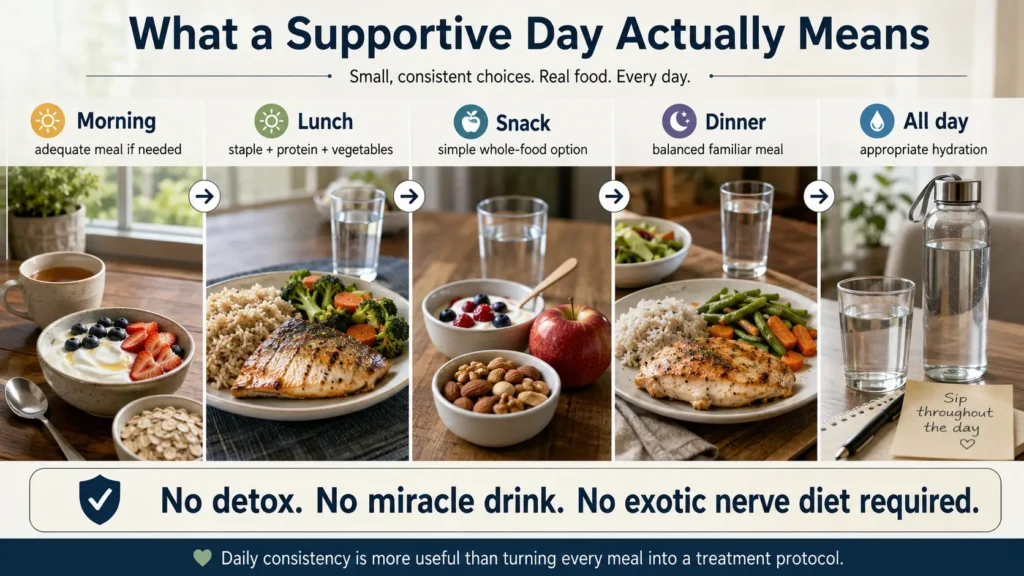
What Should I Do First Thing in the Morning?
You do not need a special nerve drink.
Ask whether breakfast fits your actual needs.
If you routinely skip it but eat adequately later, that may be fine for you.
If skipping breakfast leads to coffee, biscuits and no real food until evening, consider a more complete option.
What Should Lunch Do?
Lunch should help meet the day’s energy, protein and nutrient needs.
It does not have to be photogenic.
Rice + lentils + vegetables + egg can perform several useful nutritional jobs.
What Should Dinner Do?
The same thing.
Provide a reasonable balance of food groups that fits your health needs.
Do I Need a Special Nerve Snack?
No.
Fruit, yogurt, nuts, seeds or another ordinary snack can work.
No “nerve” label is necessary.
What About Water?
Stay adequately hydrated.
Do not expect extra litres of water to regenerate nerves.
What About Dessert?
A healthy diet can include enjoyable foods.
MedlinePlus explicitly notes that healthy eating does not require eliminating every favourite food; balance and frequency matter.
What If the Family Diet Is Cultural and Rice-Based?
Keep the cultural pattern.
Improve balance inside it.
MedlinePlus specifically notes that healthy nutrition should consider culture, preferences and budget.
That is a much more sustainable approach than replacing familiar meals with imported “health foods.”
What Happens When the Diet Is Too Restrictive?
Can “Healthy Eating” Become Too Restrictive?
Yes.
Someone may eliminate:
gluten,
dairy,
grains,
fruit,
legumes,
and several other foods
without a clear medical reason.
Eventually, the diet may become so narrow that meeting nutrient needs becomes harder.
Is Cutting More Foods Always Better?
No.
Restriction should solve a clear problem.
Removing foods simply because social media calls them inflammatory can create unnecessary nutritional gaps.
What If I Have a Real Food Allergy?
That is different.
Avoid the allergen and replace the nutritional role where needed.
For example, someone avoiding dairy can use other sources of protein, B12 or calcium as appropriate.
What About Celiac Disease?
Celiac disease requires gluten avoidance.
That is a disease-specific reason.
It should not be generalized to everyone with neuropathy.
Can Crash Dieting Affect Nutrition?
Yes.
Very-low-calorie or highly restrictive diets can make nutrient inadequacy more likely.
This becomes more important if rapid weight loss, poor appetite or neurological symptoms occur together.
What If I Recently Had Bariatric Surgery?
Then general nutrition advice may be insufficient.
Bariatric procedures can change nutrient intake and absorption.
Long-term monitoring and individualized nutritional guidance become more important.
How Does How Nutrition Supports Nerve Repair Change With Age?
Does an Older Adult Need a Different Approach?
Often, yes.
Older adults may eat less, cook less, have dental problems, use more medications or have greater difficulty absorbing certain nutrients.
Why Is B12 Particularly Relevant?
Absorption of food-bound B12 can become more difficult in some older adults.
So a person may eat apparently adequate B12-containing food yet still need assessment.
What If My Parent Eats Very Little?
Focus first on nutritional density and practicality.
Smaller meals may work better than forcing large portions.
Eggs, yogurt, oatmeal, cooked lentils, soups, soft fish and other easy-to-eat foods can be useful.
What If My Parent Has Diabetes Too?
Then both nutritional adequacy and glucose management matter.
A meal plan that increases intake without considering diabetes may solve one problem while worsening another.
What If Their Feet Are Numb?
Do not simply buy vitamins.
Numbness in older adults can have many causes.
If diabetes is present, foot safety is particularly important. ADA recommends regular neuropathy assessment and foot-risk screening in diabetes.
How Does Nutrition Support a Vegan or Vegetarian Nervous System?
Can a Plant-Based Diet Support Nerve Health?
Yes, when nutritional needs are adequately covered.
The concern is not whether the diet is plant-based.
It is whether nutrients such as B12 are reliably supplied.
Do Lentils Provide B12?
No meaningful natural B12.
Lentils provide protein, fibre and other nutrients, but they do not perform the same nutritional job as B12-rich or fortified foods.
Is Fortified Food “Bad” Because It Is Not Natural?
No.
Fortification can be an important nutritional tool.
The relevant question is whether it helps meet a genuine nutrient need.
Does a Vegan Need B12?
A reliable B12 strategy is essential because natural dependable B12 sources are largely animal-derived.
Fortified foods and appropriate supplements are common ways to address this.
Does a Vegetarian Automatically Get Enough From Eggs and Milk?
Not automatically.
It depends on how often and how much is eaten, as well as absorption.
Look at the real diet rather than the dietary label.
What Common Household Habits Can Quietly Reduce Nutritional Quality?
Is Tea and Biscuits Several Times a Day a Problem?
It can become one.
Not because tea damages nerves.
The issue is that biscuits and sweet tea may repeatedly replace more complete food.
What About Skipping Lunch at Work?
If dinner later makes up the nutritional needs, it may not be a problem.
If it contributes to chronically low protein, low variety and poor overall intake, then it matters.
Is Eating Only Rice at Dinner Enough?
It supplies energy but little nutritional diversity.
Add lentils, vegetables and a protein source to make the meal more complete.
What About Living on Takeaway Food?
Takeaway food varies widely.
Instead of labeling it all “bad,” ask:
Where is the protein?
Where are the vegetables?
How much is heavily processed?
How often is it eaten?
Could you add fruit or a simple side?
What About Sugary Drinks?
Repeated sugary beverages can contribute to total sugar intake and metabolic burden.
This becomes particularly relevant in diabetes or prediabetes.
Does Alcohol Replace Nutrition?
It can in real life.
Heavy alcohol use may replace meals and contribute to nutritional problems while also being a neuropathy risk factor itself.
What Are the Most Common Misunderstandings About How Nutrition Supports Nerve Repair?
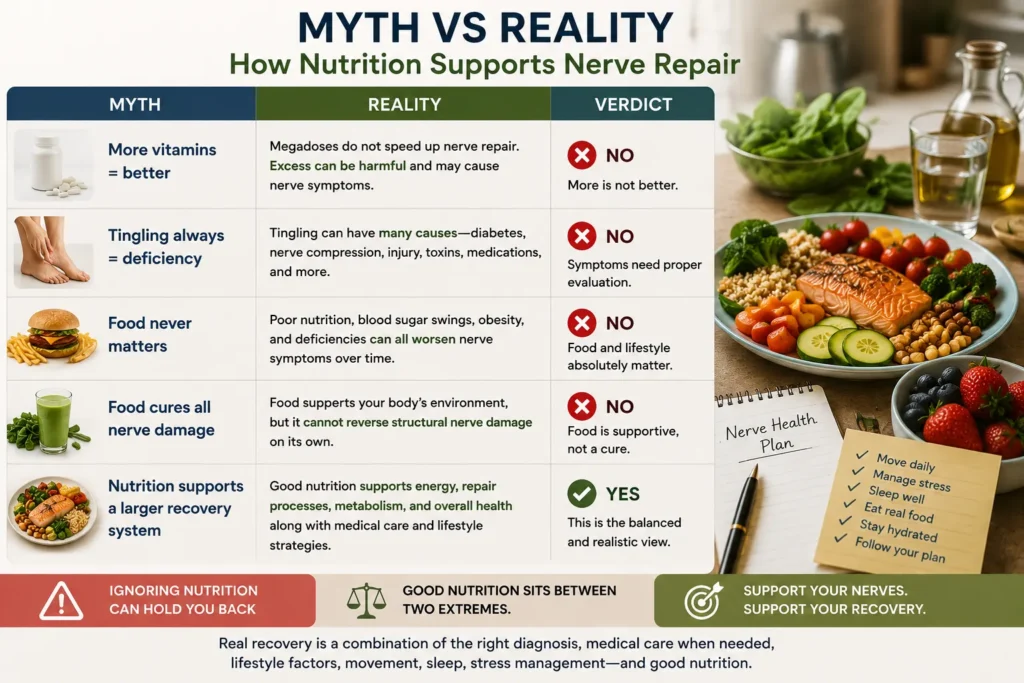
“If a Nutrient Is Good for Nerves, More Must Be Better.”
No.
B6 demonstrates why that rule can be dangerous.
Adequate and excessive are not the same thing.
“If My Diet Is Healthy, My Tingling Cannot Be Nutritional.”
Not necessarily.
Absorption problems can occur even with apparently adequate food intake.
“If I Take Supplements, I Do Not Need to Improve My Diet.”
Supplements cannot provide everything food does.
They do not replace protein, fibre, normal meals or broader dietary quality.
“If My Nerves Are Damaged, I Need a High-Protein Diet.”
You need appropriate protein.
Not automatically an extreme intake.
“If I Have Neuropathy, Carbohydrates Are Bad.”
That is an oversimplification.
In diabetes, carbohydrate management matters.
That is not the same as declaring all carbohydrate harmful to nerves.
“If My Feet Tingle, I Need B12.”
Maybe.
But tingling has many possible causes.
“If B12 Is Good, High-Dose B-Complex Must Be Better.”
No.
A B-complex can contain high B6 doses, and excessive B6 can itself damage nerves.
“Fish Oil Regenerates Nerves.”
Not established.
Omega-3 fats are nutrients; a universal nerve-regeneration claim goes far beyond that.
“Turmeric Heals Inflammation, So It Must Heal Nerves.”
Not established.
“If Food Cannot Cure Neuropathy, Nutrition Does Not Matter.”
Also wrong.
Nutrient deficiencies, metabolic health and nutritional adequacy can be highly relevant.
The accurate position sits between the two extremes.
How Can I Tell Whether Nutrition Is Actually a Weak Point in My Life?
Question 1: Am I Eating Enough?
Look for patterns such as frequent skipped meals, unintended weight loss or persistently poor appetite.
Question 2: Is Protein Present Regularly?
Look at normal meals—not ideal meals.
Does breakfast contain protein?
Lunch?
Dinner?
Question 3: Is My Diet Very Narrow?
Do you eat only a few foods?
Have entire food groups been removed without replacements?
Question 4: Do I Have a Reliable B12 Strategy?
Especially important for vegan diets and people with B12 risk factors.
Question 5: Am I Taking Multiple Supplements?
Write them all down.
Look for overlapping B6.
Question 6: Is Diabetes or Prediabetes Part of the Picture?
If yes, nutrition is also part of metabolic care.
Question 7: Could Absorption Be a Problem?
GI disease, surgery and medication history can matter.
Question 8: Is Alcohol Replacing Meals?
If so, both nutritional intake and alcohol exposure deserve attention.
Question 9: Am I Expecting Food to Fix a Mechanical Problem?
If symptoms follow posture, repetitive activity or injury, food may not be the main answer.
Question 10: Do I Know the Cause of My Symptoms?
This is the most important question.
If the answer is no, nutritional improvement is reasonable—but it should not become a substitute for evaluation.
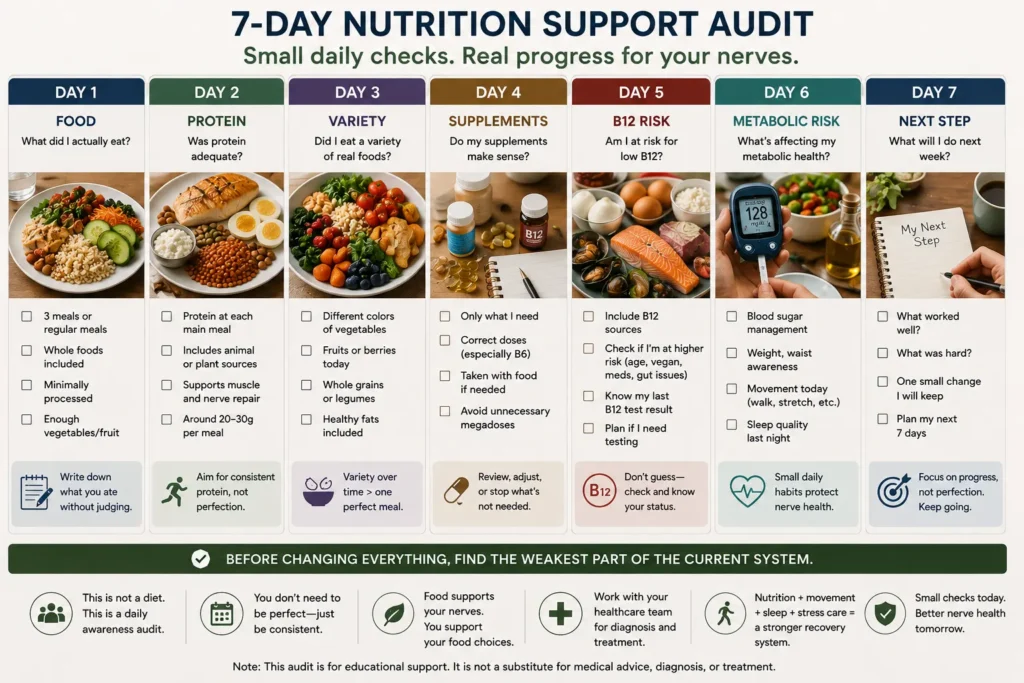
A 7-Day “How Nutrition Supports Nerve Repair” Reality Check
This is not a meal plan.
It is a way to understand your current recovery environment.
Day 1 — Observe, Do Not Change Anything
Write down normal meals and drinks.
The goal is to see reality.
Day 2 — Check Energy and Meal Gaps
Are there long periods where coffee or tea replaces actual food?
Day 3 — Check Protein
Mark each main meal that contains a real protein source.
Day 4 — Check Nutritional Variety
Count how many different vegetables, fruits, legumes, grains and protein sources appear across several days.
Day 5 — Audit Supplements
Write down every vitamin and supplement.
Check B6 duplication.
Day 6 — Review Risk Factors
B12 risk?
Diabetes?
GI surgery?
Long-term metformin?
Acid-suppressing medication?
Alcohol?
Highly restrictive diet?
Day 7 — Identify the Real Question
At the end of the week, decide which statement best fits:
My food quality needs improvement.
I may have a nutrient-risk factor that deserves testing.
My metabolic health needs more attention.
My symptoms may be more mechanical than nutritional.
I still do not know what is causing the problem.
That answer tells you where to go next.
When Does Nutrition Need Professional Help?
When Should I Consider a Dietitian?
A registered dietitian can be particularly useful when there is:
a highly restricted diet;
unintended weight loss;
diabetes;
kidney disease;
GI disease;
bariatric surgery;
difficulty meeting protein or energy needs;
multiple food allergies;
or a diagnosed nutrient deficiency.
When Should a Doctor Be Involved?
When nerve symptoms are persistent, progressive, unexplained or associated with other neurological changes.
What If Tingling Keeps Getting Worse Even Though I Improved My Diet?
Do not keep adding supplements.
The persistence of symptoms is information.
Find out what is causing them.
What If Weakness Appears?
Weakness deserves more attention than simply adjusting nutrition.
New or progressive neurological weakness requires medical evaluation.
What If Balance Is Getting Worse?
That is another reason to seek assessment.
What If the Symptoms Started After Injury?
Use injury-specific evaluation and the HYN Post-Injury Nerve Damage guide.
What If the Symptoms Seem Related to Diabetes?
Use comprehensive diabetes care rather than a food-only strategy. ADA emphasizes screening and management of neuropathy and broader glucose, weight, blood pressure and lipid risk.
When Is Nutrition Not Enough?
Nutrition is not enough when the main problem requires something else.
| Situation | What nutrition can do | What nutrition cannot do |
|---|---|---|
| B12 deficiency | Support intake; targeted correction may be central | Explain the cause without assessment |
| Poor overall intake | Improve energy, protein and nutrient adequacy | Treat unrelated neurological disease |
| Diabetes | Support metabolic management | Reverse established neuronal loss by itself |
| Nerve compression | Support general health | Remove mechanical pressure |
| Significant nerve injury | Support recovery nutrition | Reconnect every damaged nerve |
| Autoimmune neuropathy | Support general nutrition | Replace disease-specific therapy |
| Medication-related problem | Help correct relevant deficiencies | Replace medication review |
| Alcohol-related neuropathy | Improve nutritional intake | Remove ongoing alcohol-related harm |
| Progressive unexplained symptoms | Prevent nutritional neglect | Replace diagnosis |
This is where the three nutrition pages on the site should work together instead of competing.
Nerve Food Repair answers:
“What foods can I eat?”
Nutrition for Nerve Repair answers:
“How can I make everyday family nutrition work?”
And How Nutrition Supports Nerve Repair answers:
“Why does any of this matter biologically, and where are the limits?”
Common Practical Questions About How Nutrition Supports Nerve Repair
Can Nutrition Help Tingling Feet?
It may help if poor nutrition, B12 deficiency or another nutritional problem contributes.
But tingling can also result from diabetes, compression, injury and many other causes.
Can Nutrition Help Numb Hands?
The same principle applies.
Nutrition supports normal function, but numb hands do not tell you the cause.
Can Better Food Reduce Burning Nerve Pain?
It may improve an underlying nutritional or metabolic factor in some people.
There is no guarantee that diet alone will reduce neuropathic pain.
Can I Repair Nerves With Eggs?
Eggs provide protein and B12.
They do not function as a nerve-repair treatment.
Can Fish Repair Nerves?
Fish provides useful nutrients.
No fish has been established as a universal treatment for damaged human nerves.
Can Lentils Help?
Lentils provide protein, fibre and micronutrients.
They contribute to nutritional adequacy but are not a nerve medication.
Does Milk Support Nerves?
Milk can provide protein and B12.
People who do not use dairy can meet those needs in other ways.
Does Fruit Support Nerve Repair?
Fruit contributes to a varied healthy diet.
There is no single “nerve fruit.”
Should I Eat Blueberries Every Day?
Only if you enjoy them.
They are not required.
Are Nuts Helpful?
They can provide protein, unsaturated fats, magnesium and other nutrients.
They are one useful option, not a treatment requirement.
Is Salmon Better Than Local Fish?
Not automatically.
Different fish provide different nutrient profiles.
A sustainable local option you regularly eat may make more sense than expensive imported fish.
Is Brown Rice Required?
No.
Whole grains can provide fibre and nutrients, but your entire meal pattern matters.
Can White Rice Fit?
Yes.
Particularly when balanced with protein, legumes and vegetables.
People with diabetes should consider portion and glucose response.
Can Tea Damage Nerves?
Tea itself is not a common neuropathy cause.
Watch what you add and how it affects sleep.
Does Coffee Block Nerve Repair?
No established evidence says ordinary coffee blocks nerve regeneration.
But excess caffeine may disrupt sleep in some people.
Can Sugar Cause Nerve Damage?
Chronic hyperglycemia is important in diabetic neuropathy.
One sugary food is not equivalent to instantly damaging a nerve.
Is Honey Better for Nerves Than Sugar?
Honey is still a source of sugar.
It should not be promoted as nerve medicine.
Does Lemon Water Help?
It can be a pleasant way to drink water.
It does not regenerate nerves.
Does Coconut Water Help?
It is a beverage that contains nutrients.
It is not a neuropathy treatment.
Is Turmeric Useful?
Use turmeric as food or seasoning.
Do not depend on it as a proven nerve-repair therapy.
Does Ginger Help?
Similar answer.
Useful food does not automatically equal neurological treatment.
Does Bone Broth Repair Nerves?
There is no strong evidence supporting that claim.
Can Intermittent Fasting Help?
There is no universal fasting protocol proven to regenerate peripheral nerves.
Can Losing Weight Help?
For people with overweight and metabolic disease, weight management can support broader health.
Extreme dieting, however, may create nutritional problems.
Can Exercise and Nutrition Work Together?
Yes, as part of broader metabolic and physical health.
The appropriate movement plan depends on the condition.
Does Sleep Affect Nutrition?
Yes.
Poor sleep can affect appetite, food choices and routine.
Does Stress Affect Nutrition?
Yes.
Stress can alter appetite, meals and sleep.
That does not mean neurological symptoms are “just stress.”
Can Nutrition Prevent Every Neuropathy?
No.
Nutrition can reduce some nutritional risks and support broader health.
Many neuropathies arise for reasons nutrition alone cannot prevent.
Can Nerves Recover?
Some peripheral nerves can recover under certain circumstances, but outcome depends on cause, severity and continued injury.
How Long Does Nutrition Take to Work?
There is no universal timeline.
Correcting a nutritional deficiency and recovering neurological function are not necessarily the same timeline.
Should I Notice Improvement in a Week?
Do not use a one-week symptom change as proof that nutrition repaired the nerve.
The seven-day plan above is for understanding habits—not testing a cure.
How Strong Is the Evidence Behind These Ideas?
| Statement | Confidence |
|---|---|
| The body needs adequate energy, protein, vitamins and minerals | Strong |
| B12 deficiency can cause neurological symptoms | Strong |
| Excess supplemental B6 can cause nerve damage | Strong |
| Severe magnesium deficiency can cause numbness/tingling | Strong, but symptomatic deficiency is uncommon in healthy people |
| Diabetes management matters for diabetic neuropathy | Strong |
| Dietary variety supports nutrient adequacy | Strong general nutrition evidence |
| Omega-3 foods are nutritious | Strong |
| Omega-3 foods directly regenerate damaged nerves | Not established |
| Extra protein accelerates nerve regeneration | Not established |
| One special food heals nerves | Not established |
| Food removes mechanical compression | No |
| Nutrition replaces treatment for autoimmune neuropathy | No |
| High-dose vitamins are always better | No |
The strongest nutrition advice is often very ordinary:
eat adequately,
avoid true deficiencies,
do not overdose supplements,
manage metabolic disease,
and treat the actual cause of the neurological problem.
That may not sound as exciting as a “7 foods that regrow nerves” headline.
It is much more useful.
What We Want You to Remember
How Nutrition Supports Nerve Repair is not a story about one food.
It is a story about the environment in which nerves have to function.
Food supplies energy.
Protein supplies amino acids.
Vitamins and minerals support normal biochemical processes.
B12 deficiency can directly affect neurological health.
Too much supplemental B6 can harm nerves.
Blood sugar and metabolic health matter, especially in diabetes.
Absorption can matter as much as intake.
Circulation helps deliver oxygen and nutrients.
Sleep, stress and daily routine affect how consistently people can meet their nutritional needs.
At the same time:
food cannot remove mechanical compression;
food cannot reconnect every severe nerve injury;
food cannot replace immune-directed treatment;
and a supplement cannot diagnose why your hands or feet are numb.
So rather than asking:
“Which food repairs nerves?”
this page encourages a better question:
“Is my body getting and using the nutritional support it needs—and is nutrition actually the limiting factor in my situation?”
Once you answer that, the role of food becomes much clearer.

Continue With the Question That Matters Most to You
If your next question is “What should I eat?”, continue to the Nerve Food Repair practical food guide.
If you need to organize everyday household eating, use the Nutrition for Nerve Repair family nutrition guide.
For the deeper micronutrient layer, continue to Micronutrients and Nerve Function.
For numbness, tingling and peripheral nerve symptoms, continue to Peripheral Neuropathy.
If diabetes is involved, continue to Diabetic Neuropathy.
For mechanical causes, continue to Nerve Compression.
For symptoms after trauma or surgery, continue to Post-Injury Nerve Damage.
To understand nutrient and oxygen delivery, continue to Oxygen Delivery and Nerve Function and Microcirculation and Nerve Sensitivity.
For the daily recovery pattern, continue to Daily Patterns and Nervous System Stability.
For longer-term recovery timing and adaptation, continue to Recovery Cycles.
Medical Sources and Further Reading
National Institute of Neurological Disorders and Stroke — Peripheral Neuropathy
Used for the broader causes of neuropathy, including diabetes, nutritional imbalance, alcohol, toxins, vascular problems and vitamin-related causes.
Read the NINDS Peripheral Neuropathy resource
NIH Office of Dietary Supplements — Vitamin B12
Used for neurological effects of B12 deficiency, B12 absorption and medication interactions involving metformin and gastric-acid inhibitors.
Read the NIH Vitamin B12 Fact Sheet
NIH Office of Dietary Supplements — Vitamin B6
Used for the safety distinction between normal food intake and prolonged high supplemental B6 exposure.
Read the NIH Vitamin B6 Fact Sheet
NIH Office of Dietary Supplements — Magnesium
Used for magnesium’s role in nerve and muscle function, ion transport and symptoms of severe deficiency.
Read the NIH Magnesium Fact Sheet
NIH Office of Dietary Supplements — Omega-3 Fatty Acids
Used for established food sources of ALA, EPA and DHA.
Read the NIH Omega-3 Fact Sheet
American Diabetes Association — Standards of Care in Diabetes—2026
Used for current diabetic-neuropathy guidance, the role of chronic hyperglycemia and current recommendations around glucose, weight, blood-pressure and lipid management.
Read the ADA 2026 Neuropathy Standards
MedlinePlus — Nutrition
Used for the practical framework of proteins, carbohydrates, fats, vitamins, minerals and water, and for the principle that healthy eating should account for culture, preferences and budget.