
Inflammation Control
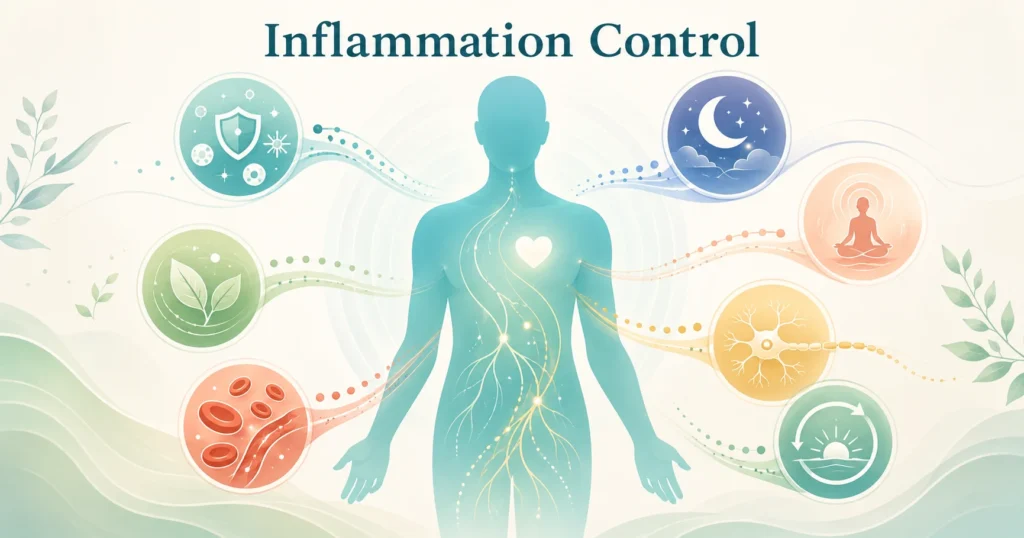
Inflammation Control means how the body manages inflammation in a balanced way. Inflammation is part of the immune system. It can help the body respond to injury, irritation, infection, and tissue stress.
Because of this, inflammation is not always bad. In many cases, it is a normal protective response. However, when inflammatory signals stay active for too long, they may add stress to tissues and increase recovery demand.
For nerve health education, this topic matters because nerves do not work alone. They sit inside tissues that can be affected by immune signals, swelling, stress load, sleep quality, blood flow, and metabolic health.
In simple terms, this page explains how Inflammation Control may connect with nerve sensitivity and recovery capacity. It is not a diagnosis. It is not a treatment plan. Rather, it is a calm learning guide.
The goal is to help readers understand how immune signals, tissue comfort, stress, sleep, and recovery may work together.
Quick Navigation
What Is Inflammation Control?
Inflammation Control is a simple way to describe how the body manages immune activity. Inflammation can begin when the body notices injury, germs, irritation, or tissue stress.
At first, this response may be useful. It can help protect the body and start repair. For example, acute inflammation is usually short-term and can happen after injury or infection. Chronic inflammation, however, may last much longer and can continue for months or years.
This difference matters. Short-term inflammation can be part of normal healing. Long-term inflammation may place more demand on the body. Therefore, Inflammation Control should be understood as balance, not as “turning off” the immune system.
For nerve health education, this matters because nerves are surrounded by living tissue. When that tissue is irritated, swollen, stressed, or under-recovered, nerves may become more sensitive.
However, this does not mean inflammation explains every nerve symptom. Tingling, numbness, burning, weakness, and pain can have many causes. NINDS explains that peripheral neuropathy includes many conditions that involve damage to the peripheral nervous system.
Because of this, Inflammation Control should be used only as an educational lens. It should not be used for self-diagnosis or treatment decisions.
How Inflammation Control Works
First, the body notices a possible threat or stress. This may include injury, infection, irritation, poor sleep, metabolic strain, toxins, tissue overload, or autoimmune activity.
Next, the immune system sends signals. These signals may increase blood flow, attract immune cells, and change the local tissue environment. In many cases, this is useful.
After that, the body needs to resolve the response. In other words, the inflammatory process should calm when the original stress is handled. This helps tissues return toward a more stable state.
However, if the stress continues, the response may last longer. As a result, tissues may stay more reactive. Over time, this may affect comfort, energy demand, and recovery capacity.
For this reason, Inflammation Control is not about forcing inflammation down. Instead, it is about understanding how the body manages immune signals, tissue stress, cleanup, and recovery timing.
Key Layers of Inflammation Control
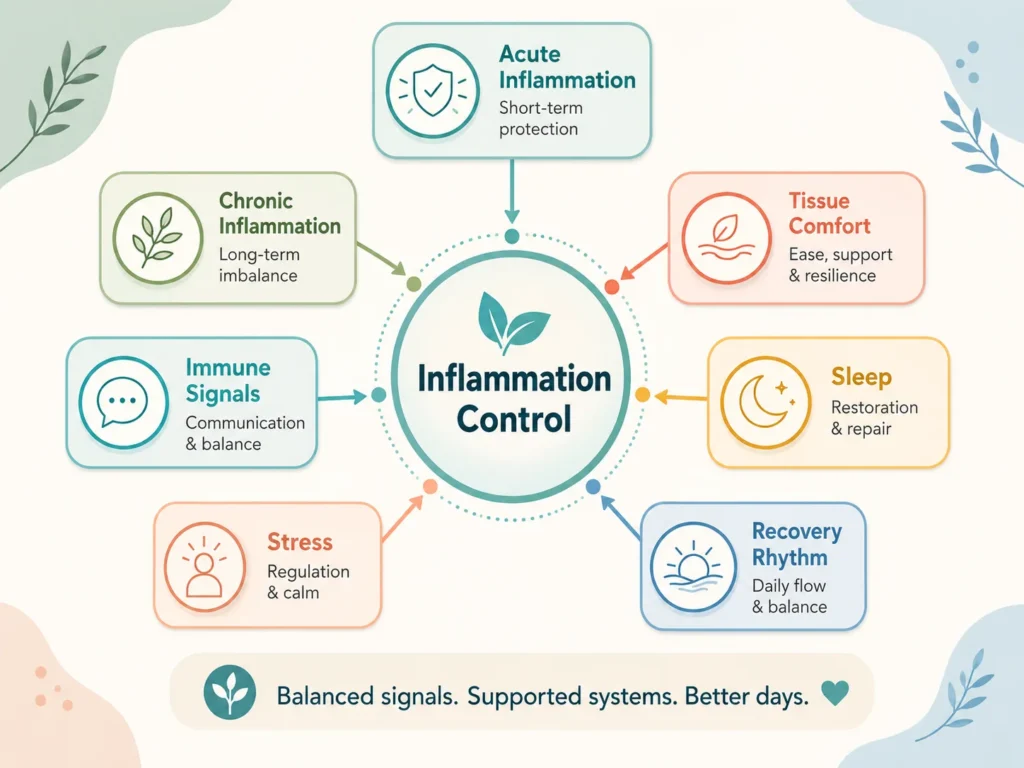
Acute Inflammation and Inflammation Control
Acute inflammation is a short-term response. It may happen after injury, irritation, or infection. In many cases, this response is helpful.
For example, the body may increase blood flow and immune activity in the affected area. This can support protection and early repair.
However, acute inflammation should not be confused with chronic inflammation. Acute inflammation is usually temporary. Chronic inflammation lasts longer and may involve ongoing tissue stress.
Because of this, Inflammation Control should be understood with timing and context.
Chronic Inflammation and Inflammation Control
Chronic inflammation is longer-lasting inflammation. It may continue for months or years. Its effects can vary based on the cause, the tissue involved, and the body’s ability to repair.
This matters because long-term inflammatory signals may increase body load. They may also affect comfort, energy use, and recovery demand.
However, chronic inflammation is a medical topic. Readers should not assume they have it based only on symptoms.
Instead, this section helps explain why ongoing inflammation should be handled with care and proper medical guidance.
Immune Signals and Inflammation Control
The immune system uses signals to communicate. These signals help the body respond to stress, injury, and possible threats.
In many cases, immune signals are helpful. They guide protection, cleanup, and repair. However, too much or too long of a signal may keep tissues more reactive.
For nerve health education, this matters because nerves respond to the tissue environment around them. If the local area is irritated, the nervous system may notice more signals.
Therefore, immune signaling is one key layer of Inflammation Control.
Tissue Comfort and Inflammation Control
Inflammation can affect tissue comfort. For example, a tissue area may feel sore, warm, tight, swollen, or sensitive. These signs can vary by person and by cause.
When tissue comfort changes, the nervous system may pay more attention to that area. As a result, signals from the area may feel stronger.
This does not mean the symptom is “only inflammation.” Instead, it means tissue comfort and nerve sensitivity may interact.
Because of this, Inflammation Control belongs in a larger nerve health map.
Sleep and Inflammation Control
Sleep and inflammation can influence each other. Poor sleep may increase stress load. It may also affect immune signaling and recovery timing.
At the same time, discomfort or inflammation may make sleep harder. As a result, a cycle may form.
For this reason, sleep rhythm is an important part of Inflammation Control education. Still, sleep should not be presented as a cure.
It is one support layer in a larger system.
Stress and Inflammation Control
Stress can affect the immune system. It may also influence sleep, blood sugar, muscle tension, breathing rhythm, and recovery capacity.
In the short term, stress responses can be useful. However, repeated stress may increase system load. Over time, this may affect how the body manages inflammatory signals.
Therefore, Inflammation Control should be discussed together with stress regulation. This should remain educational, not a treatment claim.
Recovery Rhythm and Inflammation Control
The body needs rhythm to recover. Inflammation can start, rise, and then resolve. Recovery depends on timing, cleanup, energy, and tissue support.
If recovery windows are too short, the body may stay under pressure. For example, poor sleep, high stress, low movement, or repeated strain may reduce recovery space.
Because of this, Inflammation Control is also about rhythm. It is not only about immune activity.
Inflammation Control Interactions
Inflammation Control and the Nervous System
The immune system and nervous system communicate closely. Inflammation can affect how tissues feel. Meanwhile, the nervous system can influence stress response and body regulation.
This two-way link matters because nerve sensitivity may involve more than nerve structure. It may also involve immune signals, tissue load, sleep, stress, and recovery capacity.
Therefore, Inflammation Control may be one useful layer in nervous system education.
Inflammation Control and Pain Processing
Pain processing involves the brain, nerves, tissues, and body context. Inflammatory signals can affect tissue sensitivity. They may also increase attention toward a body area.
However, pain should not be reduced to inflammation alone. Pain can involve many layers, including nerve compression, injury, stress, sleep, mood, and medical conditions.
For this reason, Inflammation Control should stay part of a wider system view.
Inflammation Control and Circulation
Circulation helps move oxygen, nutrients, immune signals, and waste products. During inflammation, blood flow and immune activity may change in local tissues.
This can be helpful during protection and repair. However, ongoing tissue stress may increase recovery demand.
Because of this, Inflammation Control connects naturally with Circulation & Oxygenation.
Inflammation Control and Hormonal Balance
Hormones and immune signals can interact. Stress hormones, sleep rhythm, blood sugar, and reproductive hormones may all shape body load.
At the same time, inflammation may influence energy, mood, and tissue comfort. Therefore, Hormonal Balance and Inflammation Control should be viewed together.
Still, this connection should not be used for self-diagnosis. It is only a learning model.
Inflammation Control and Sleep
Sleep is a major recovery window. It gives the body time to organize energy, repair, and regulation.
When sleep is poor, the body may have a harder time managing stress and recovery demand. In addition, discomfort may make sleep less restful.
Because of this, Inflammation Control and Sleep & Recovery are closely connected.
Patterns That Influence Inflammation Control
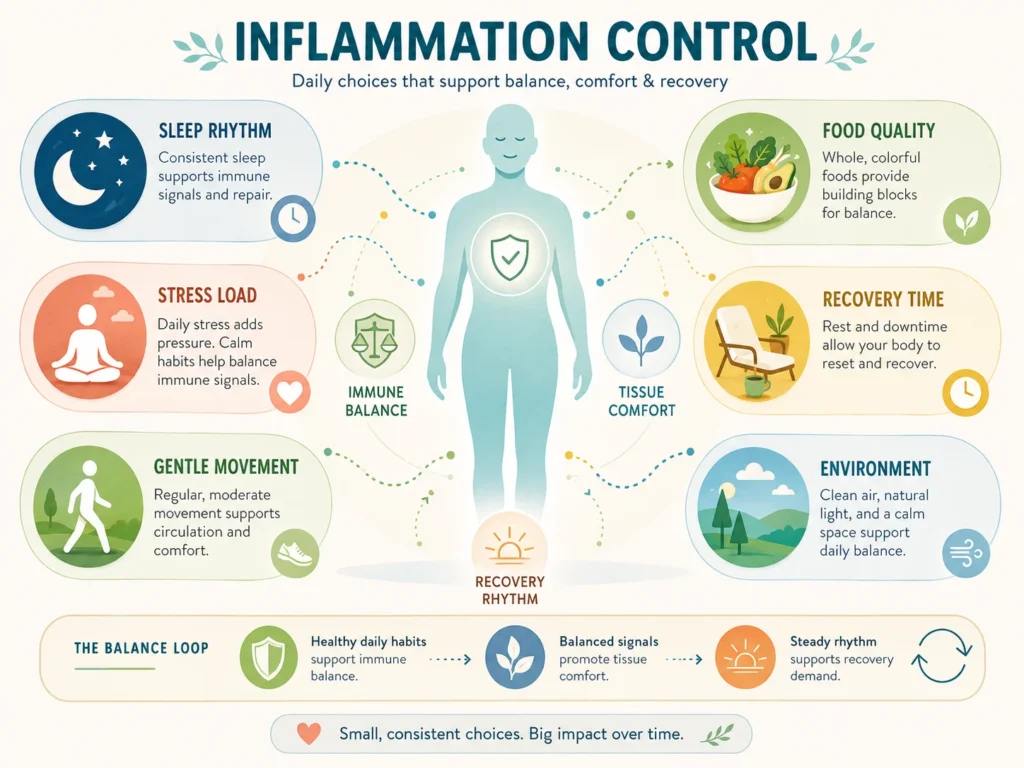
Daily patterns may shape how the body handles inflammatory load. These patterns do not diagnose disease. They also do not replace medical care.
However, they can help readers understand how system demand may build over time.
Sleep rhythm is one pattern. Poor sleep may affect stress response, immune signaling, and recovery timing. Because of this, sleep can influence the body’s background load.
Stress load is another pattern. Worry, pain, work pressure, conflict, and constant alerts may keep the body more active. Over time, this may affect recovery.
Food quality may also play a role in overall health. However, this page does not give diet rules, anti-inflammatory protocols, supplement plans, or detox advice.
Movement can also influence tissue comfort, circulation, and energy use. Still, too much effort without enough recovery may add load.
Environmental factors may matter as well. Air quality, smoke, chemicals, noise, heat, cold, and screen load may affect body stress in some people.
Because of this, Inflammation Control should be viewed as a body-wide pattern, not a single action.
Inflammation Control and Nerve Function
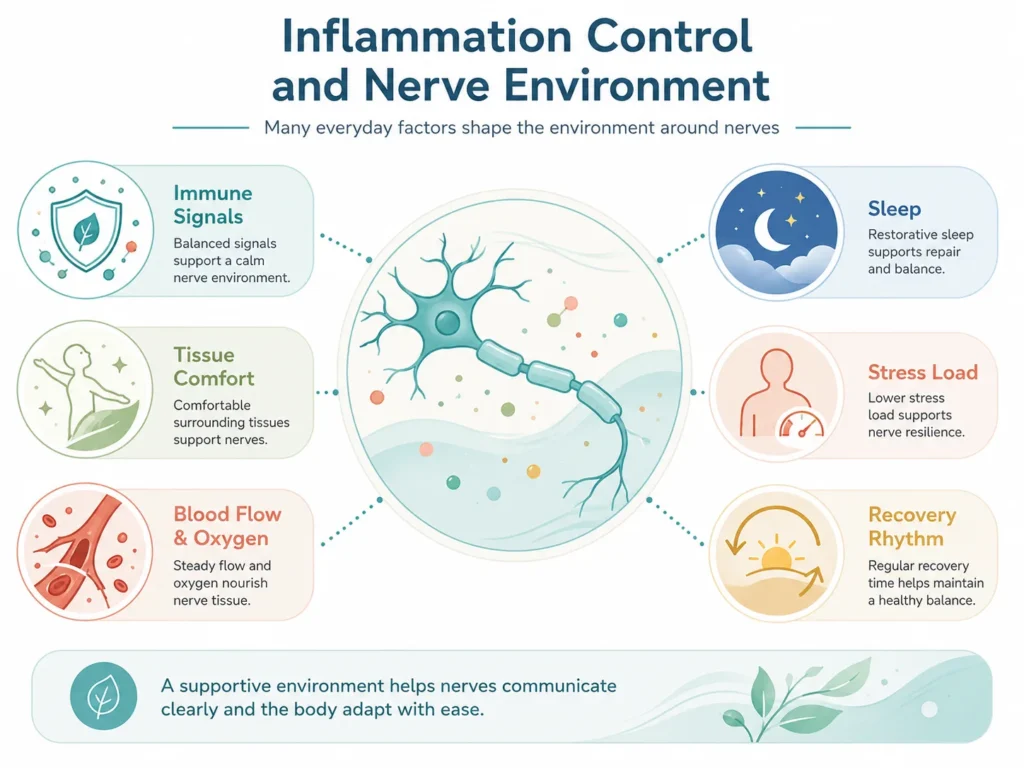
Inflammation Control may connect with nerve function through immune signals, tissue comfort, blood flow, stress load, and recovery capacity. Nerves need a stable environment to send clear signals.
For example, tissue irritation may make a local area feel more sensitive. Poor sleep may make signals feel louder. Stress may increase muscle tension and alertness. In addition, metabolic strain may affect energy and tissue comfort.
Together, these layers may influence how the nervous system feels and responds. However, nerve symptoms should not be explained by inflammation alone.
Tingling, burning, numbness, weakness, pain, or fatigue can have many causes. These may include nerve pressure, injury, metabolic issues, vitamin problems, medication effects, autoimmune activity, or other medical conditions.
For this reason, Inflammation Control should be used only as an educational lens. It can help readers understand one possible layer, but it should not be used for self-diagnosis.
In simple terms, nerves work inside a tissue environment. When that environment is under high demand, the body may need more coordination and recovery capacity.
Inflammation Control Visual Flow
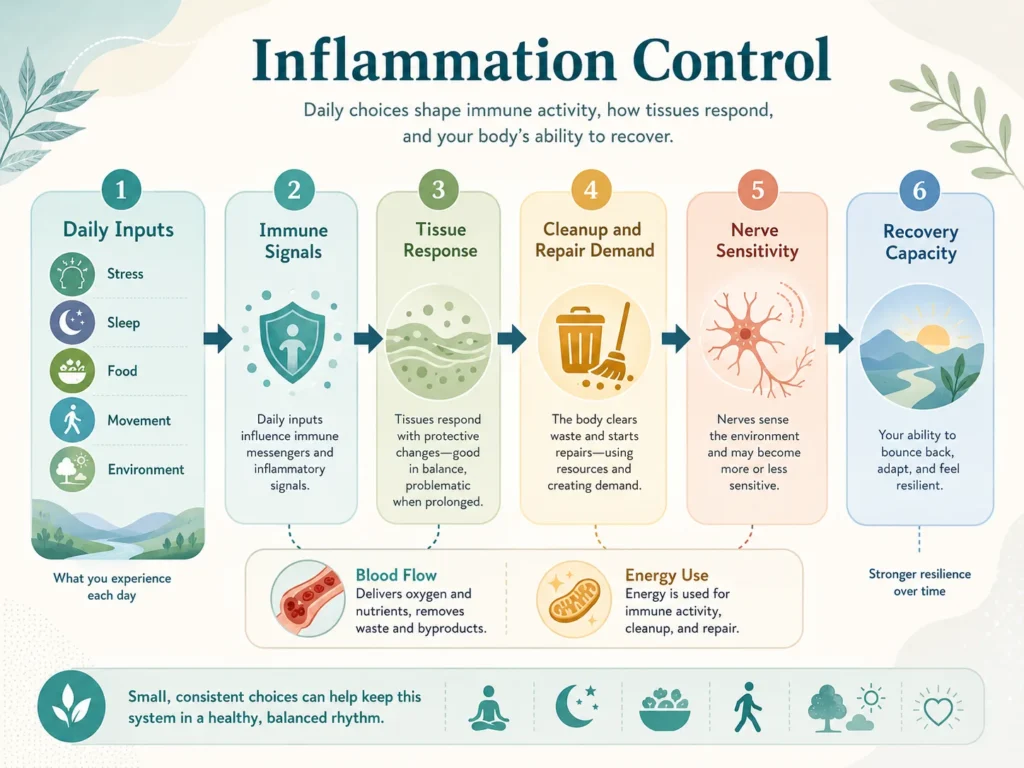
Simple Educational Flow:
Daily Stress, Sleep, Food, Movement, and Environment
↓
Immune Signals and Tissue Response
↓
Inflammation, Cleanup, and Repair Demand
↓
Blood Flow, Energy Use, and Tissue Comfort
↓
Nerve Sensitivity and Recovery Demand
↓
Recovery Capacity or Ongoing System Load
This flow is not always straight. In many cases, it works like a cycle. For example, poor sleep may affect stress response. Then stress may affect immune signals. After that, tissue discomfort may make sleep harder again.
Different people may notice different patterns. One person may feel sore. Another may feel tired, tense, sensitive, foggy, or less resilient.
This model is for education only. It is not a diagnosis, inflammation test, treatment plan, supplement plan, diet plan, or recovery promise.
Why Inflammation Control Matters for Recovery
Inflammation Control Requires System Coordination
Recovery depends on many systems working together. Immune signals, sleep, stress response, circulation, hormones, movement, and energy all play roles.
When the body is under repeated load, this teamwork may feel harder. Still, that does not mean a person should assume they have chronic inflammation.
Instead, Inflammation Control can help explain why recovery is body-wide.
Inflammation Control Requires Sleep Rhythm
Sleep gives the body time to reset. It also helps the body organize energy, repair, and regulation.
If sleep is poor, the body may have less recovery space. Because of this, sleep is one major layer in Inflammation Control.
However, sleep is not a cure claim. It is one part of a larger recovery system.
Inflammation Control Requires Energy Stability
The body needs energy to manage immune activity and repair. When energy demand is high, the body may feel more tired or reactive.
This may happen with stress, poor sleep, pain, under-recovery, or heavy workload. Therefore, Inflammation Control may matter because energy stability supports recovery capacity.
Inflammation Control Requires Lower Stress Overload
Stress signals are useful when the body needs action. However, repeated stress may keep the body more alert.
Over time, this may affect sleep, breathing, muscle tension, appetite, and sensory sensitivity. Because of this, stress overload may raise recovery demand.
This does not mean stress is the only issue. Rather, stress is one important layer in Inflammation Control.
Inflammation Control May Increase Recovery Demand
When inflammatory systems are under strain, recovery demand may rise. This may happen through poor sleep, stress activation, tissue discomfort, energy swings, or body tension.
However, this should not be used for self-diagnosis. Inflammation concerns need proper medical evaluation.
Instead, this page helps readers understand how Inflammation Control may fit into a larger recovery map.
Common Misunderstandings About Inflammation Control
Misunderstanding 1: All inflammation is bad.
Clarification:
Inflammation is not always bad. Short-term inflammation can help protect the body and support repair. The concern is when inflammatory signals stay active too long or happen in the wrong context.
Misunderstanding 2: Inflammation Control means suppressing the immune system.
Clarification:
Inflammation Control does not mean forcing the immune system down. A safer view is balance, timing, cleanup, and recovery coordination.
Misunderstanding 3: Every nerve symptom is caused by inflammation.
Clarification:
Nerve symptoms can have many causes. They may involve nerve pressure, injury, blood sugar, vitamin problems, medications, autoimmune activity, or other medical issues.
Misunderstanding 4: Anti-inflammatory means a guaranteed cure.
Clarification:
No food, habit, supplement, or routine should be presented as a cure. Inflammation Control is a learning framework, not a treatment promise.
Misunderstanding 5: One change can control inflammation.
Clarification:
Inflammation is complex. Sleep, stress, movement, metabolism, immune activity, environment, and medical history may all matter.
Inflammation Control Comparison Table
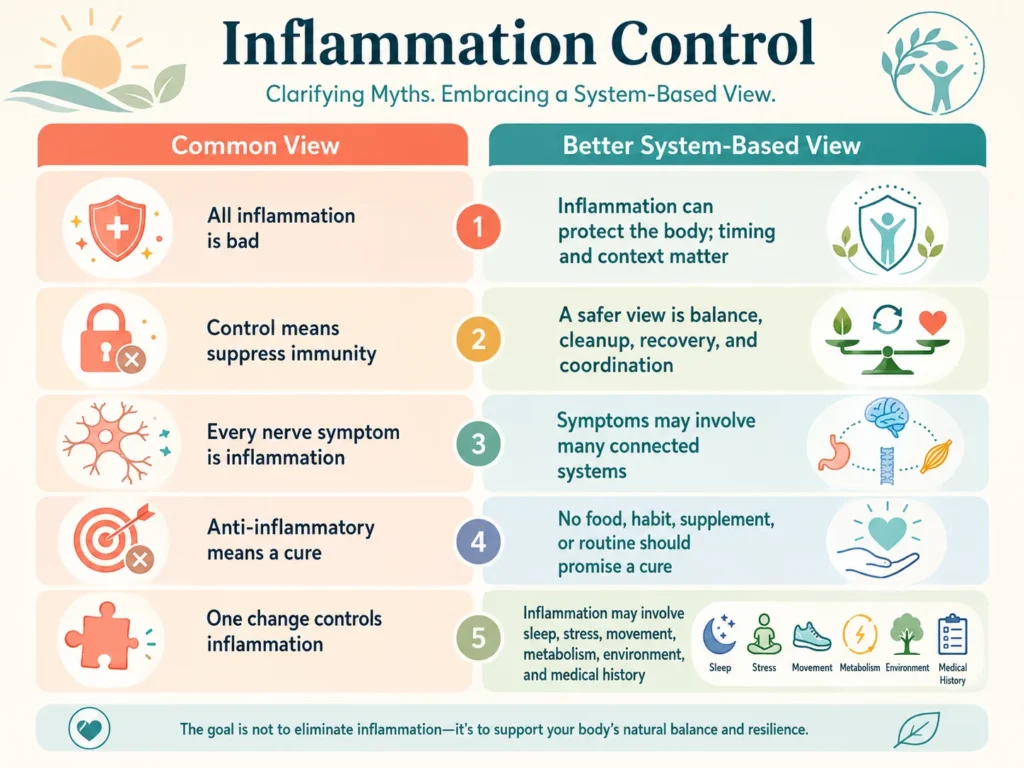
This table shows a simple system-based way to understand common misunderstandings about Inflammation Control. The goal is not to blame every symptom on inflammation. Instead, it helps readers see how immune signals, tissue comfort, sleep, stress, and recovery capacity may work together.
| Common View | Better System-Based View |
|---|---|
| All inflammation is bad | Inflammation can protect the body, but timing and context matter |
| Inflammation Control means suppressing immunity | A safer view is balance, cleanup, recovery, and coordination |
| Every nerve symptom is inflammation | Symptoms may involve many connected systems |
| Anti-inflammatory means a cure | No food, habit, supplement, or routine should promise a cure |
| One change controls inflammation | Inflammation may involve sleep, stress, movement, metabolism, environment, and medical history |
This system-based view helps readers avoid fear-based thinking. It also reminds them that Inflammation Control should be used for education, not self-diagnosis or treatment planning.
Inflammation Control FAQs
Can Inflammation Control affect nerve sensitivity?
Inflammation Control may influence tissue comfort, immune signals, sleep, stress, and recovery demand. These layers may affect how the nervous system feels. However, nerve sensitivity can have many causes and should not be self-diagnosed.
Is Inflammation Control a medical treatment?
No. Inflammation Control is used here as an educational phrase. Medical inflammation problems need proper evaluation, testing, and care from qualified healthcare professionals.
Is all inflammation harmful?
No. Short-term inflammation can be useful. It helps the body respond to injury or infection. However, long-term inflammation may place more demand on tissues and should be discussed with a healthcare professional when suspected.
Can stress affect inflammation?
Stress may affect immune signaling, sleep, blood sugar, muscle tension, and recovery. However, stress is not the only factor. Illness, injury, medications, autoimmune activity, and medical conditions may also matter.
Should readers follow anti-inflammatory diets or supplements?
This page does not recommend anti-inflammatory diets, supplements, detox plans, or treatment protocols. Readers should discuss medical or nutrition concerns with qualified professionals.
When should someone seek medical care?
Seek medical care for severe, sudden, unusual, or worsening symptoms. This includes sudden weakness, severe numbness, chest pain, trouble breathing, fever with severe illness, confusion, severe pain, or fast-changing nerve symptoms.
Continue Learning
Inflammation Resolution — learn how the body may move from immune activity toward cleanup, repair, and calmer tissue signaling.
Immune Repair — explore how immune signals may connect with repair timing, tissue comfort, and recovery capacity.
Hormonal Balance — understand how hormone signals may interact with stress, sleep, energy, and inflammation.
Sleep & Recovery — learn how sleep rhythm may support nervous system repair, energy, and recovery capacity.
Circulation & Oxygenation — explore how blood flow, oxygen delivery, and energy may connect with tissue comfort and nerve function.
Environmental Factors and Nerve Health — learn how air quality, light, noise, temperature, and screens may shape body load and recovery demand.
Learning Path — follow a step-by-step education path through nerve function, sensitivity, root causes, and recovery capacity.
Related Systems
Inflammation Resolution — connects with cleanup, immune settling, tissue comfort, and recovery demand.
Immune Repair — explains how immune signals may support protection, repair, and recovery timing.
Neuroinflammation — connects with nervous system immune signaling and sensitivity.
Pain Processing — helps explain how the brain and nervous system interpret body signals.
Stress System — connects with alertness, muscle tension, stress hormones, and immune load.
Metabolic Damage System — connects with blood sugar, energy use, tissue stress, and inflammatory load.
Circulation & Oxygenation — connects with blood flow, oxygen delivery, immune signaling, and tissue support.
Sources / References
NCBI Bookshelf — Chronic Inflammation. NCBI explains that chronic inflammation is slow, long-term inflammation that may last for months to years. It also notes that the effects vary based on the cause and the body’s ability to repair.
Cleveland Clinic — Inflammation. Cleveland Clinic explains that acute inflammation is sudden and temporary, while chronic inflammation may continue for months or years.
NINDS — Peripheral Neuropathy. NINDS explains that peripheral neuropathy includes many conditions involving the peripheral nervous system and may involve symptoms such as tingling, numbness, and pain.
NCBI / PMC — Inflammatory responses. Peer-reviewed research describes inflammation as a biological immune response that can be triggered by pathogens, damaged cells, and toxic compounds.
NCBI / PMC — Inflammation and pain. Peer-reviewed research discusses how inflammatory and neuroinflammatory processes may interact with pain pathways.
These sources are used for educational context only. This page does not diagnose, treat, cure, or prevent disease.
Educational Trust Note
This page is part of the Heal Your Nerves Naturally education system. Its purpose is to help readers understand how immune signals, tissue comfort, stress response, sleep rhythm, energy use, and recovery capacity may connect with nerve health education.
However, this page is not medical advice. It does not diagnose, treat, cure, or prevent disease. Instead, it offers a calm and system-based learning view.
Also, readers should remember that inflammation-related symptoms can have many possible causes. Inflammation Control may be one layer, but it should not be used as the only explanation.
For more context, readers can also review the About page, Health Disclaimer, and Contact page. These pages explain the educational purpose of the website and the limits of the information shared here.
Safety & Education Notice
This page is for education only. It does not diagnose, treat, cure, or prevent disease. Also, it is not a substitute for medical advice, diagnosis, or treatment.
Inflammation topics can be medically sensitive. For example, immune disorders, infections, autoimmune disease, medication effects, chronic pain, swelling, fever, and nerve symptoms may need proper medical review. Because of this, readers should speak with qualified healthcare professionals when symptoms are unclear, ongoing, severe, or changing.
Seek urgent medical care for severe, sudden, unusual, or worsening symptoms. These may include sudden weakness, loss of bladder or bowel control, chest pain, trouble breathing, severe numbness, severe pain, high fever, confusion, fainting, or fast-changing nerve symptoms.
In addition, readers should use extra caution because this topic may involve inflammation, immune activity, medications, infections, autoimmune concerns, pain, and nervous system symptoms. They should not use this page to self-diagnose, stop medicine, start supplements, begin detox or anti-inflammatory protocols, delay care, or replace medical evaluation.
Instead, this page should be used as a safe educational guide. Its goal is to help readers understand how Inflammation Control may connect with body load, tissue comfort, immune signals, sleep rhythm, stress response, and recovery capacity.
In simple terms, this page supports a bigger nervous system picture. It helps readers learn how different body systems may work together, while still keeping medical safety and professional care in the right place.