
Fatty Acids for Nerve Health: Omega-3s, Membranes and Myelin
Fatty acids for nerve health are the focus of this Nutritional Intelligence page. It owns fatty-acid and lipid nutrition for nerve membranes and myelin context, while practical meals, full myelin biology, regeneration and diagnosis remain with their specialist HYN pages.
If you searched for fatty acids for nerve health, omega-3 for nerves, fish oil for neuropathy, or “Can omega-3 repair nerve damage?”, you have probably already seen two very different kinds of advice.
The biology is more interesting—and more practical—than either extreme.
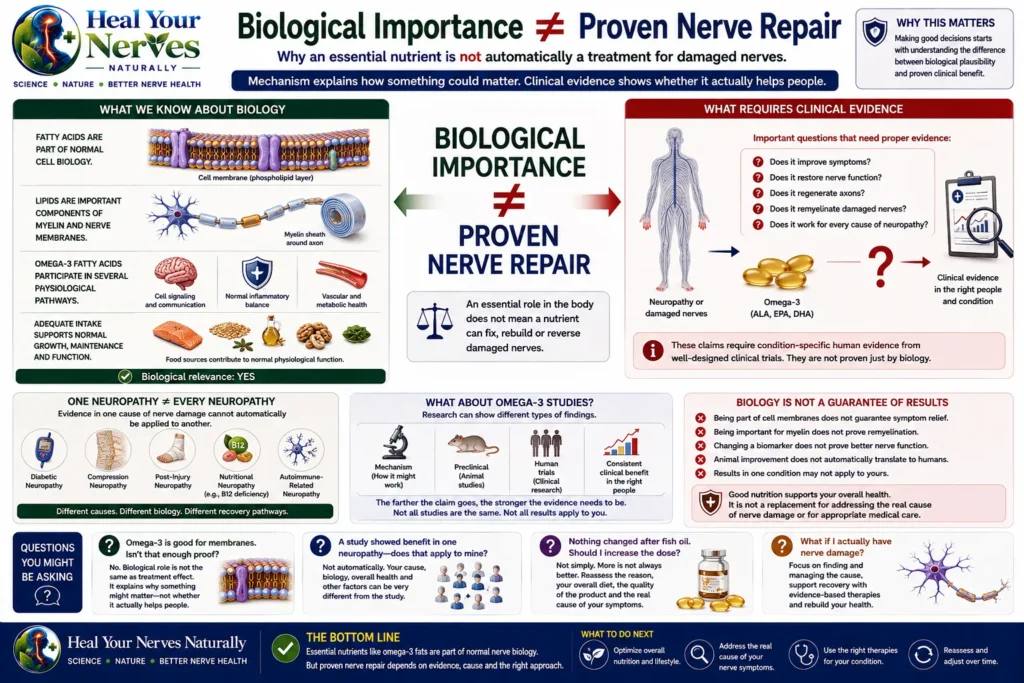
Fatty acids really do matter. Cell membranes contain lipids. Myelin is a highly specialized lipid-rich membrane. Alpha-linolenic acid (ALA) and linoleic acid are essential fatty acids that must be obtained from the diet. EPA and DHA have additional physiological roles. But biological importance is not the same as proof that a high-dose supplement repairs every damaged peripheral nerve.
The central rule of this page: fatty acids are building materials and signaling substrates inside a regulated biological system. More does not automatically mean more nerve repair.
However, This page will help you understand the biology without losing the practical questions: what foods provide useful fats, whether plant omega-3 is the same as fish omega-3, how to read a fish-oil label, what omega-6 really means, whether an omega-3:omega-6 ratio is useful, when supplements make sense, what evidence exists for neuropathy, and what should make you stop experimenting and look for another cause of nerve symptoms.
Safety boundary: New or worsening numbness, weakness, loss of coordination, rapidly spreading symptoms, severe pain after injury, or other significant neurological changes need appropriate assessment. Do not use fish oil, seed oils, flaxseed, or another dietary fat as a substitute for diagnosing a nerve problem.

Why Does the Nervous System Need Fat?
Fat is often discussed only in terms of calories, body weight or cholesterol. In nervous-system biology, lipids have a structural role as well.
When we discuss fatty acids for nerve health, the useful question is not whether fat is “good” or “bad,” but which fatty acid, which source, and what biological or practical problem you are trying to solve.
Every nerve cell is surrounded by a membrane built around a lipid bilayer. That membrane contains proteins, receptors, channels and transport systems. Its lipid environment influences how many of those systems function.
Myelin is even more obviously lipid-rich. A 2023 review describes myelin as a specialized cell membrane whose high lipid abundance is central to electrical insulation and nerve conduction, while a 2020 review of myelin fatty-acid metabolism notes that myelin formation requires substantial fatty-acid and lipid synthesis as well as uptake of extracellular fatty acids.
PubMed: Myelin Lipid Metabolism and Its Role in Myelination and Myelin Maintenance
PubMed: Myelin Fat Facts—Lipids and Fatty Acid Metabolism
One side says omega-3 is almost a nerve-repair treatment: take fish oil, rebuild myelin, reduce inflammation, repair damaged nerves. The other side reacts by saying supplements are useless or that the whole topic is marketing.
What this does—and does not—prove
It proves that lipid metabolism and fatty-acid biology belong in a serious discussion of nervous-system structure.
It does not prove that a person with numb feet needs fish oil, that a larger fish-oil dose regenerates axons, or that dietary fat can reverse demyelination caused by an autoimmune disorder.
Fatty acids for nerve health: the practical question
Instead of asking “Does fat help nerves?”, ask:
- Which fatty acid are we discussing?
- Is it essential?
- What food pattern supplies it?
- Is the claim about normal biology or treatment of disease?
- Does the evidence apply to my type of nerve problem?
- Am I choosing food, a supplement, or a therapeutic dose—and why?
If you need the broader integration of protein, fat, micronutrients and energy, the sibling owner is Neuro Nutrition.
What Are Fatty Acids?
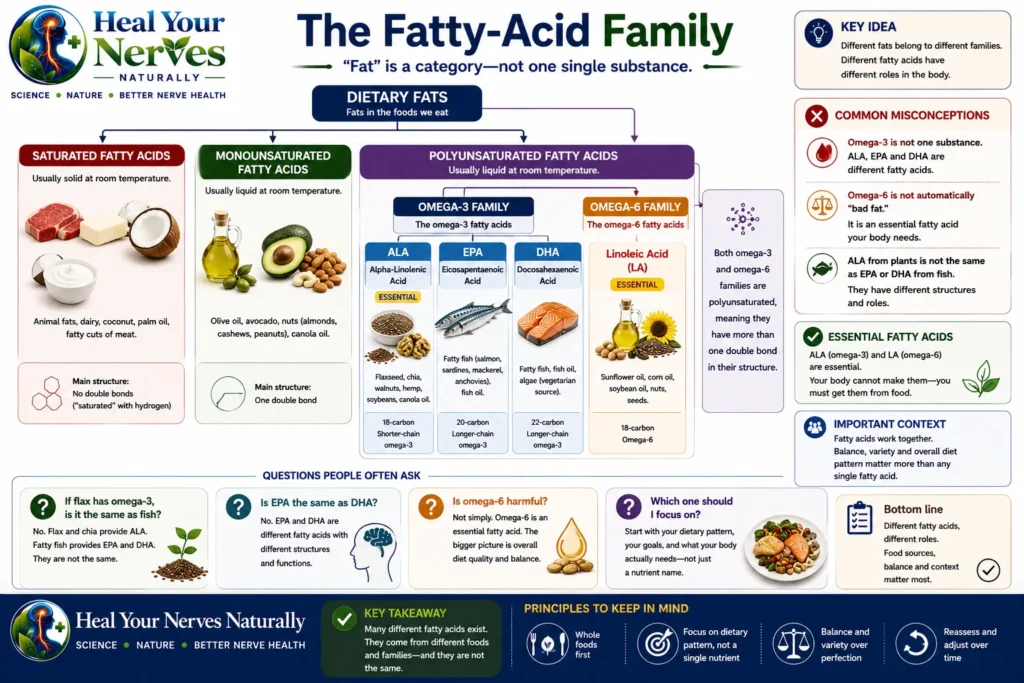
Fatty acids are components of many dietary fats and biological lipids. They differ in chain length, number and position of double bonds, and the biological pathways they enter.
When we discuss fatty acids for nerve health, the useful question is not whether fat is “good” or “bad,” but which fatty acid, which source, and what biological or practical problem you are trying to solve.
The major families you will see
- Saturated fatty acids contain no carbon-carbon double bonds.
- Monounsaturated fatty acids contain one double bond.
- Polyunsaturated fatty acids (PUFAs) contain two or more double bonds.
- Omega-3 fatty acids and omega-6 fatty acids are PUFA families defined by the position of a double bond relative to one end of the molecule.
Essential fatty acids
The word essential has a precise nutritional meaning: the body cannot synthesize enough and therefore needs a dietary source.
ALA, an omega-3 fatty acid, is essential.
Linoleic acid, an omega-6 fatty acid, is also essential.
NIH ODS identifies both ALA and linoleic acid as essential fatty acids. That fact alone should make you suspicious of simplistic claims that “omega-6 is poison.”
NIH Office of Dietary Supplements: Omega-3 Fatty Acids
From Dietary Fat to Nerve-Cell Membranes
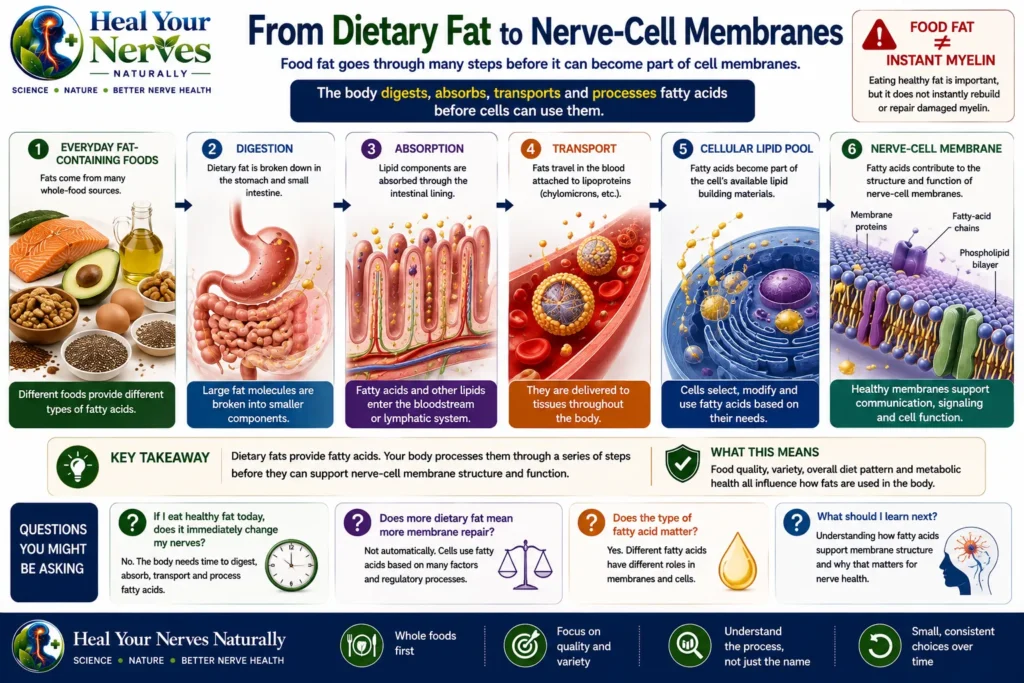
One of the biggest problems in supplement advertising is that it removes all the biological steps between eating a nutrient and changing a tissue.
You eat salmon, walnuts, flaxseed, eggs, oil or another fat-containing food. The fat is digested. Fatty acids and related molecules are absorbed. They are packaged, transported, stored, oxidized, remodeled and incorporated into different lipid pools under cellular control.
There is no straight arrow:
fish oil capsule → injured nerve → repaired membrane.
Why the missing middle matters
For example, Cells regulate fatty-acid uptake and lipid synthesis. Myelinating glial cells synthesize and handle lipids in specialized ways. Different tissues have different compositions and demands.
That means availability can matter without availability being the only limiting factor.
Real-life example: “I eat almost no fat because I want to be healthy”
A very-low-fat restrictive diet can make essential-fatty-acid adequacy more relevant. But the correct response is not to jump to a high-dose fish-oil product. First review whether ordinary dietary sources of essential fatty acids are present.
Real-life example: “I eat plenty of fat, so my myelin must be fine”
Total fat intake does not diagnose myelin status. A person can eat a high-fat diet and still have a demyelinating disease, metabolic disorder or nerve injury. Myelin health cannot be inferred from how much fat is on the plate.
Why Fatty Acids Matter for Cell Membranes
A cell membrane is a flexible, organized environment rather than a static wall. Phospholipids form much of the bilayer. Cholesterol and other lipids contribute to membrane properties. Proteins embedded in the membrane function as receptors, channels and transporters.
When we discuss fatty acids for nerve health, the useful question is not whether fat is “good” or “bad,” but which fatty acid, which source, and what biological or practical problem you are trying to solve.
Fatty-acid composition affects membrane properties
The fatty acids attached to membrane lipids can influence fluidity and the physical environment surrounding membrane proteins. Omega-3 and omega-6 fatty acids also serve as precursors for signaling molecules.
NIH ODS notes that omega-3 fatty acids are important components of cell membranes and that omega-3 and omega-6 fatty acids are used to form eicosanoids involved in cardiovascular, immune, endocrine and other functions.
What fatty acids for nerve health mean in practice
It gives a biological reason to care about overall essential-fatty-acid adequacy and dietary fat quality.
It does not give a biological reason to maximize one fatty acid without limit.
What if you already eat fish regularly?
If you already eat seafood and have a varied diet, the next question should not automatically be “Which omega-3 supplement should I add?” Your existing intake, health goals, medication context and evidence for the desired outcome matter.
What if you never eat fish?
Then your sources of ALA and your reason for considering EPA/DHA deserve review. Not eating fish is a dietary fact, not a diagnosis of nerve deficiency.

Where Fatty Acids Fit Into Myelin Biology
Myelin is one of the strongest reasons users become interested in fatty acids. Search results often make the argument sound simple:
When we discuss fatty acids for nerve health, the useful question is not whether fat is “good” or “bad,” but which fatty acid, which source, and what biological or practical problem you are trying to solve.
Myelin contains fat → eat more fat or take DHA → rebuild myelin.
The first statement is biologically relevant. The final step is not established by that fact alone.
Myelin is a specialized membrane
In the peripheral nervous system, Schwann cells form myelin around axons. In the central nervous system, oligodendrocytes perform that role. Myelin contains high proportions of lipids and has a composition distinct from many ordinary cell membranes.
Myelin maintenance is an active metabolic process
In addition, Cells synthesize, recycle and regulate myelin lipids. Genetic and metabolic disturbances in lipid pathways can disrupt myelin biology. This is much more complex than “dietary fat sticks to the sheath.”
Do omega-3s rebuild myelin?
You cannot answer that question simply by pointing out that myelin contains fatty acids. Remyelination depends on glial-cell biology, injury context, disease mechanisms, signaling and multiple metabolic processes.
If your question is “What is myelin?”, use Myelin System. If your question is “How does remyelination happen?”, use Myelin Regeneration. This Fatty Acids page owns the nutritional lipid contribution, not the entire regeneration mechanism.

Omega-3 Fatty Acids: ALA, EPA and DHA
“Omega-3” is a family name. The three forms users encounter most often are ALA, EPA and DHA.
When we discuss fatty acids for nerve health, the useful question is not whether fat is “good” or “bad,” but which fatty acid, which source, and what biological or practical problem you are trying to solve.
ALA: alpha-linolenic acid
ALA is essential, so dietary intake is required. Common sources include flaxseed, chia seeds, walnuts, canola oil, soybean oil and other foods.
EPA: eicosapentaenoic acid
EPA is a long-chain omega-3 found in fish and seafood and in fish-oil products. Some algal products also provide EPA.
DHA: docosahexaenoic acid
DHA is another long-chain omega-3. It is present in fish and seafood and is available in fish-oil and algal-oil products. NIH ODS notes that DHA is an important component of cell membranes and is especially abundant in certain tissues including the brain and retina.
Do you need to memorize the chemistry?
No. For real-life decisions, remember:
- ALA is mainly the plant omega-3 users encounter.
- EPA and DHA are long-chain omega-3s commonly obtained from seafood or supplements.
- The body can convert ALA to EPA and DHA, but conversion is limited.
- Therefore, “contains omega-3” does not tell you which omega-3 or how much.
Why ALA, EPA and DHA Are Not Interchangeable
This is the single most important omega-3 literacy skill on the page.
NIH ODS states that ALA can be converted to EPA and then DHA, but conversion is very limited. Consuming ALA-rich foods is therefore not numerically equivalent to directly consuming EPA or DHA.
“I eat chia every day, so I get DHA”
Chia is a useful ALA source. But the statement confuses dietary ALA with direct DHA intake.
“Flax oil is the same as fish oil”
No. Flaxseed oil mainly provides ALA. Fish oil generally provides EPA and DHA. Both can belong in a diet or supplement decision, but they are not identical products.
“Algal oil is fake fish oil”
No. Microalgae are the original biological source of marine-chain omega-3s in the food web. NCCIH notes that algal oils are vegetarian sources of DHA and some also provide EPA.
NCCIH: Omega-3 Supplements—What You Need to Know
Vegan or vegetarian user: what is the practical decision?
First review ALA-rich foods. Then ask why you are considering EPA/DHA. Pregnancy/lactation, clinician advice, dietary preference and other health goals may change the decision. If a supplement is appropriate, algal oil can fit a vegetarian or vegan dietary identity.

What About Omega-6 Fatty Acids?
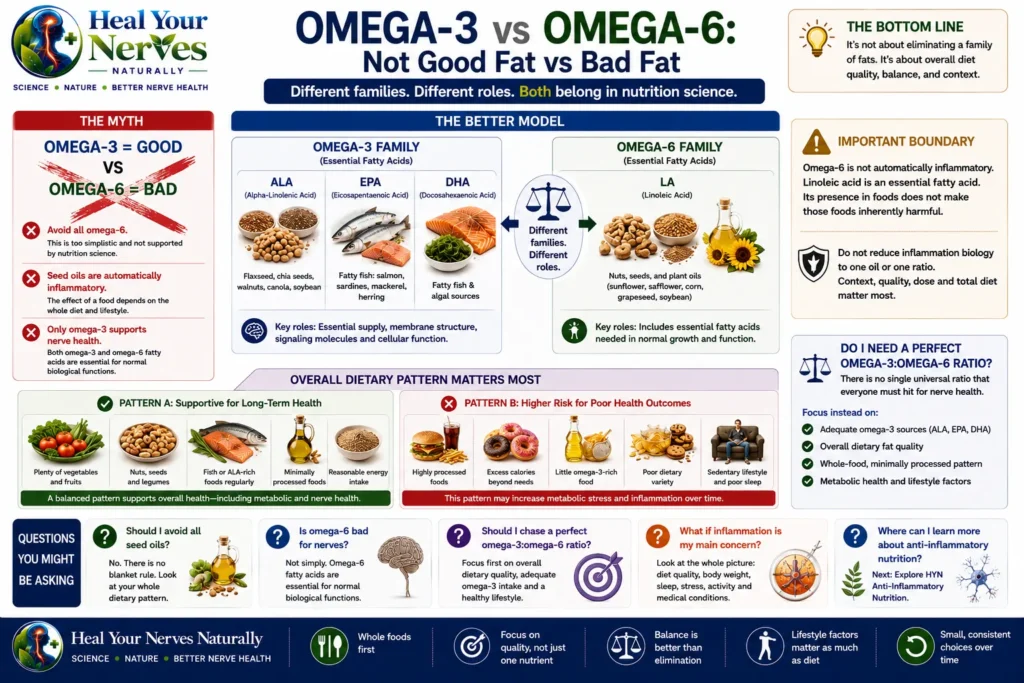
Omega-6 is often presented online as the villain opposite “good omega-3.” That binary is scientifically and practically weak.
Linoleic acid is essential
Your body cannot make enough linoleic acid, so you need a dietary source. An entire essential fatty-acid family cannot be dismissed as “toxic” simply because some omega-6-derived signaling molecules can participate in inflammatory pathways.
Why “omega-6 equals inflammation” is too simple
Fatty-acid metabolism produces multiple signaling molecules, and their effects depend on the specific fatty acid, pathway, tissue and context. Dietary inflammation is also influenced by overall dietary pattern, energy balance, body composition, smoking, metabolic disease and many other factors.
What about seed oils?
Users often ask whether seed oils “damage nerves.” There is no general clinical basis for treating ordinary seed-oil consumption as a direct cause of neuropathy. A cooking oil should be judged within the overall diet, preparation method, quantity and cardiovascular/metabolic context.
Therefore, WHO’s current healthy-diet guidance emphasizes replacing saturated and trans fats with unsaturated fats and recognizes both ALA and linoleic acid as essential.
World Health Organization: Healthy Diet
Practical habit change
Instead of trying to drive omega-6 intake toward zero, ask whether your fat pattern is dominated by highly processed foods and whether you have room for more minimally processed sources of unsaturated fats and omega-3-rich foods.
Do You Need a Specific Omega-3-to-Omega-6 Ratio?
You will see exact targets such as 1:1, 2:1 or 4:1 presented as if they were diagnostic numbers. NIH ODS notes that researchers have debated the importance of the omega-6:omega-3 ratio, but an optimal ratio has not been defined and some experts consider ratios too nonspecific because they hide the actual amounts of individual fatty acids.
Why ratios can distract users
Imagine two diets with the same ratio. One may contain very low amounts of both omega-3 and omega-6. Another may contain much higher amounts. The ratio alone does not tell you what the person is actually eating.
A practical fatty acids for nerve health audit
- Do you regularly eat ALA-rich plant foods?
- Do you eat seafood or another direct EPA/DHA source?
- What are your main cooking fats?
- How much of your diet comes from highly processed snack and fast foods?
- Are you improving the whole dietary pattern or obsessing over a calculator?
If a ratio makes you eat more varied minimally processed foods and useful omega-3 sources, the behaviour may help. If it makes you fear normal foods and buy expensive testing, the ratio may be creating more confusion than value.
What About Monounsaturated and Saturated Fats?
Not every fat choice needs to be evaluated through omega-3.
Monounsaturated fats
Olive oil, avocados, peanuts and many nuts contain monounsaturated fatty acids. They can fit within heart-healthy dietary patterns.
Saturated fats
Saturated fats are found in many animal foods and some tropical oils. WHO recommends limiting saturated fat and prioritizing unsaturated fats as part of overall healthy-diet guidance.
What does this have to do with nerves?
Indirectly, cardiovascular and metabolic health matter because peripheral nerves need adequate blood supply and oxygen. That does not justify saying “olive oil heals nerves” or “butter causes neuropathy.”
If circulation is the primary concern, continue to Circulatory Impairment System or Oxygen Delivery and Nerve Function.
Which Foods Provide Useful Fatty Acids?
You do not need an expensive “neuro lipid” product to improve dietary fat quality. Ordinary foods supply essential fatty acids and, depending on the food, EPA and DHA.
When we discuss fatty acids for nerve health, the useful question is not whether fat is “good” or “bad,” but which fatty acid, which source, and what biological or practical problem you are trying to solve.
Foods that provide ALA
- ground flaxseed;
- chia seeds;
- walnuts;
- canola oil;
- soybean oil and soy foods;
- some other nuts and seeds.
Foods that provide EPA and DHA
Fatty fish and other seafood are the main direct dietary sources. Examples include salmon, sardines, herring, trout and mackerel. Availability, price and local food habits matter, so the “best” source is often the one you can obtain and eat regularly.
What if fish is too expensive?
Do not assume nerve health requires premium fresh salmon. Depending on location, canned sardines, canned salmon, frozen fish or locally available oily fish may be more affordable. ALA-rich foods such as flax, chia or walnuts can also contribute to the overall pattern.
What if you dislike fish?
You can still build a reasonable dietary-fat pattern using plant ALA sources and other unsaturated fats. If direct EPA/DHA intake is a specific goal, an algal product may be an option for some users, but that decision belongs in a food-versus-supplement context rather than being assumed necessary.
What about eggs?
Eggs provide fat and protein; omega-3 content varies depending on the feed and product. They can be part of a varied diet, but they are not a substitute for understanding which fatty acids you are trying to obtain.
What about nuts and seeds?
Nuts and seeds contribute unsaturated fats and other nutrients. Flax, chia and walnuts are especially useful when the goal is dietary ALA. Portion size still matters because these foods are energy-dense.
What about cooking oils?
Choose oils within the context of the overall diet, cooking method, cost and cardiovascular goals. There is no single “nerve-healing oil.” The useful shift is from a highly processed, trans-fat- or saturated-fat-heavy pattern toward a more balanced pattern of unsaturated fats.
At the same time, For actual meal structure rather than fatty-acid biology, move to the Action Layer: Nerve Food Repair.
Plant vs Marine Sources
This comparison matters because users often assume all omega-3 sources are interchangeable.
Plant sources mainly give you ALA
Flaxseed, chia, walnuts and some plant oils provide ALA. ALA is essential and valuable in its own right.
Marine sources give you EPA and DHA directly
Fish and seafood provide EPA and DHA without relying on the body’s limited conversion from ALA.
Algae bridges the dietary-identity gap
Algal oils provide a vegetarian source of DHA, and some formulations also include EPA. NCCIH specifically lists algal oils as vegetarian omega-3 products.
Does every vegan need algal DHA?
No universal statement like that is appropriate. The decision depends on life stage, diet, health goals, professional guidance and personal preference. The point is to understand the difference between ALA intake and direct EPA/DHA intake so the decision is informed rather than accidental.
Does eating fish mean you should avoid fish oil?
Not automatically. It means you should account for the EPA and DHA already coming from food when deciding whether a supplement is necessary. “More” should not be the default goal.

Do Omega-3s Repair Damaged Nerves?
This is the highest-risk claim on the page because a biologically plausible story can sound like proven treatment even when clinical evidence is limited or condition-specific.
When we discuss fatty acids for nerve health, the useful question is not whether fat is “good” or “bad,” but which fatty acid, which source, and what biological or practical problem you are trying to solve.
Direct answer
Omega-3 fatty acids participate in normal membrane, signaling and lipid biology, but omega-3 supplementation is not established as a universal treatment that repairs all damaged peripheral nerves.
What about experimental studies?
Animal and laboratory studies can help researchers understand mechanisms and generate hypotheses about nerve regeneration, inflammation and membrane biology. They are valuable science. But a positive result in a rodent nerve-injury model is not the same as demonstrating that a fish-oil supplement restores function in humans with a specific neuropathy.
What about human neuropathy studies?
A 2025 Cochrane review evaluated oral omega-3 supplementation in adults with diabetic distal symmetrical peripheral neuropathy and found the evidence uncertain regarding benefits and harms. That is an important boundary because diabetic neuropathy is one specific condition, not a proxy for every kind of nerve injury.
Cochrane Review via PubMed: Omega-3 Supplementation for Diabetic Peripheral Neuropathy
Evidence transferability matters
Even if a future trial showed benefit in diabetic neuropathy, you could not automatically apply the result to:
- carpal tunnel syndrome;
- post-injury nerve damage;
- chemotherapy-induced neuropathy;
- B12-deficiency neuropathy;
- autoimmune neuropathy;
- hereditary neuropathy;
- idiopathic neuropathy.
The cause changes the biology and the treatment question.
What does “supports nerve repair” actually mean?
Sometimes writers use “support” to mean the nutrient participates in normal cellular biology. That is not the same as demonstrating faster axonal regrowth, restored sensation or remyelination in clinical trials.
What if you feel better after starting fish oil?
Record the improvement, but define it. Less pain? Better sleep? Less stiffness? Improved mood? A subjective change can be real without proving structural nerve regeneration.
What if nothing changes after several weeks?
Do not automatically double the dose. Reassess whether omega-3 inadequacy was ever the limiting factor. If the main problem is compression, diabetes, trauma, medication toxicity or another cause, escalating fish oil can distract from the real issue.
For instance, For actual nerve-regeneration biology, move to Regeneration Biology. For remyelination, use Myelin Regeneration.
Who Might Need More Attention to Fatty-Acid Intake?
This is not a deficiency diagnosis list. It is a list of situations where review of dietary fat becomes more useful.
Very-low-fat restrictive diets
If someone has removed most dietary-fat sources for weight loss, digestive fears or internet health rules, essential-fatty-acid adequacy may deserve attention.
Little seafood plus few ALA-rich foods
If the diet contains neither seafood nor regular flax, chia, walnuts, canola/soy-based sources or other useful fat foods, the pattern is worth reviewing. That does not automatically diagnose a neurological problem.
Vegetarian or vegan diets
These patterns can provide ALA well when planned, but direct EPA/DHA intake is a separate question. Algal options may be relevant depending on the person’s goals.
Fat malabsorption
People with conditions that impair fat digestion or absorption require a different conversation from someone simply choosing between salmon and walnuts. A clinician or dietitian may need to address the underlying condition and broader fat-soluble nutrient issues.
Pregnancy and lactation
DHA receives particular attention during pregnancy and lactation because of fetal and infant development. This is a life-stage-specific context and should not be turned into a general neuropathy dose recommendation.
People already using several supplements
Fish oil can be hidden inside multinutrient, prenatal, heart-health or brain-health products. Count the actual EPA and DHA from every product before adding another.
People taking anticoagulant or antiplatelet medication
High-dose EPA/DHA can affect platelet-related physiology and may interact with medications. NIH ODS discusses potential medication interactions and safety at higher intakes. Do not use a general “omega-3 is natural” message as a substitute for medication review.
Fish allergy or dietary restrictions
Fish oil may not be appropriate for everyone. Algal sources can offer a non-fish alternative for some people, but allergy and product-safety questions still deserve individual attention.
Real-life question: “I never eat fish. Does that mean my nerves are missing omega-3?”
No. Not eating fish tells us that direct dietary EPA and DHA intake is probably low; it does not diagnose a nerve problem or prove omega-3 inadequacy. ALA from plant foods is still an essential omega-3 source, and the body can convert some ALA to longer-chain forms, although conversion is limited.
The practical next step is to review the whole pattern: do flax, chia, walnuts, canola/soy foods or other ALA sources appear? Why are you considering EPA/DHA—general dietary adequacy, pregnancy, a clinician recommendation, cardiovascular guidance, or an attempt to treat neuropathy? Different goals need different evidence.
Real-life question: “I am vegan. Is algal DHA something I must take?”
Vegan dietary identity changes the source options, not the basic evidence rule. Algal oil can provide DHA and sometimes EPA without fish. Whether you need a product depends on life stage, diet, health goals and professional guidance. The locked HYN principle is not “every vegan needs DHA capsules”; it is “ALA, EPA and DHA are not interchangeable, so know which one you are discussing.”
Before buying, read the label. Some algal products supply mostly DHA, some include EPA, and serving sizes vary. The word “algae” does not tell you the dose.
Real-life question: “Is fish oil better than algal oil for nerves?”
There is no general evidence-based ranking that makes fish oil a superior nerve treatment. The products can differ in EPA/DHA amounts, formulation, price and dietary suitability. If the question is simply “Which gives me DHA/EPA?”, the Supplement Facts panel is more useful than the source story on the front.
If the question is “Which treats my neuropathy better?”, you now need condition-specific clinical evidence—not a generic supplement comparison.
Real-life question: “Is krill oil better absorbed, so is it better for neuropathy?”
As a result, Krill oil contains omega-3s largely in phospholipid form. Some studies have examined differences in bioavailability, but “higher bioavailability” is not equivalent to “better clinical outcome for neuropathy.” A product can raise blood EPA/DHA efficiently without proving that it repairs a damaged nerve.
Separate three questions: absorption, change in biomarker, and improvement in the clinical outcome you care about. They are not interchangeable.
Real-life question: “Which oil is best for nerves?”
There is no single nerve-healing oil. Olive oil, canola oil, soybean oil, nut/seed oils and other unsaturated-fat sources can fit healthy dietary patterns. Some oils provide ALA; others provide mainly monounsaturated or omega-6 fatty acids. The choice should reflect cooking method, total diet, cardiovascular/metabolic goals, availability and cost.
If a website names one oil as the answer to neuropathy, ask what clinical evidence links that oil to the specific condition rather than to general nutrition.
Real-life question: “Are seed oils causing my tingling?”
A temporal association may feel convincing, especially after reading strong online claims. But ordinary dietary seed oils are not a recognized general cause of peripheral neuropathy. If tingling is persistent, do not delay assessment while repeatedly changing cooking oils.
You can still improve overall diet quality—fewer highly processed foods, more minimally processed foods, a sensible mix of unsaturated fats—without turning a single ingredient into the diagnosis.
Real-life question: “Should I try to make my omega-6 intake as low as possible?”
No. Linoleic acid is essential. The goal is not omega-6 elimination. If your diet is dominated by ultra-processed foods, improving the pattern can change many things at once: sodium, refined carbohydrate, total energy, fibre, fat quality and food variety. That is different from blaming the essential fatty acid itself.
Real-life question: “I found a calculator that says my omega-3:omega-6 ratio is bad”
A ratio can be interesting, but do not let it become a diagnosis. The ratio may hide the absolute intake of both families, and an “optimal” universal target has not been established. A food diary that shows no seafood and no ALA-rich foods may be more actionable than a precise-looking ratio from incomplete data.
Real-life question: “My bottle says 1,000 mg. Is that a high dose?”
You cannot answer until you know what the 1,000 mg describes. It may be total fish oil, not EPA+DHA. Turn the bottle around and read the Supplement Facts panel. Find the serving size first—two capsules may count as one serving—then find EPA and DHA separately.
This is why front-label numbers are poor dose-comparison tools. Two “1,000 mg fish oil” products can deliver very different EPA+DHA amounts.
Real-life question: “How much omega-3 should I take for neuropathy?”
This search query is common, but it jumps over the most important question: is omega-3 supplementation an established treatment for your specific neuropathy?
There is no universal HYN “neuropathy dose” because different neuropathies have different causes and the clinical evidence for omega-3 treatment is not universal. A dose used in one trial cannot automatically be generalized to another condition or used as a personal prescription.
Real-life question: “Can I take more because omega-3 is natural?”
Natural origin does not remove dose, interaction or side-effect questions. NIH ODS discusses safety at high EPA/DHA intakes and potential interactions with anticoagulant medication. More capsules can also increase gastrointestinal side effects and cost without proving additional benefit.
The correct target is the amount justified by the reason for use—not the largest number the product allows.
Real-life question: “Can fish oil cause neuropathy?”
Fish oil is not a standard recognized cause of peripheral neuropathy in the way excess vitamin B6 can be. But if tingling or another neurological symptom begins after a new product, do not dismiss it or label it a “healing response.” Review the product, other ingredients, timing and other simultaneous changes, and seek assessment when symptoms are significant.
Combination products matter: a “brain omega” supplement may contain vitamins or other ingredients in addition to fish oil.
Real-life question: “I get fishy burps. Does that mean the oil is bad?”
On the other hand, Fishy aftertaste or burping can occur with omega-3 supplements and does not automatically prove rancidity. Storage, formulation, taking the product with food and individual tolerance can influence symptoms. A strong unpleasant odor, expired product, damaged packaging or poor storage raises a different quality question.
If a product repeatedly causes gastrointestinal discomfort, that is a legitimate reason to reconsider whether it is worth using.
Real-life question: “How can I tell if fish oil is rancid?”
Consumers cannot reliably perform laboratory oxidation testing at home. Practical quality steps are simpler: buy from a reputable manufacturer, check expiry and storage instructions, avoid products with damaged seals, store as directed, and do not assume a marketing term such as “ultra pure” proves oxidation status.
Third-party quality testing can help with identity or contaminants, but it still does not prove clinical benefit for nerve symptoms.
Real-life question: “Should I freeze fish-oil capsules?”
Follow the manufacturer’s storage instructions. Some products are designed for room-temperature storage away from heat and light; others may recommend refrigeration. Freezing is not a universal quality test and should not replace expiry, seal and storage guidance.
Real-life question: “Do I need a third-party certified product?”
Independent testing can provide useful information about ingredient identity, contaminants or manufacturing quality. It is a quality signal, not a treatment-efficacy signal. A perfectly manufactured product can still be unnecessary for your goal.
Real-life question: “What about mercury in fish oil?”
Mercury exposure is a legitimate seafood concern, but purified fish-oil supplements and whole fish are not identical exposure questions. Reputable supplement manufacturers use purification and quality controls. For food choices, species and public-health seafood guidance matter. Do not let fear of one contaminant lead you to conclude that all seafood or all fish oil is unsafe.
Real-life question: “I have a fish allergy. Can I take fish oil?”
Do not assume it is safe just because the product is an oil. Allergy severity and product composition matter, and medical advice may be appropriate. Algal oil can provide a non-fish EPA/DHA option for some people, but that does not mean every algal product is automatically suitable for every allergy or condition.
Real-life question: “I am pregnant or breastfeeding. Should I use DHA?”
Pregnancy and lactation are specific life-stage contexts where DHA receives attention because of fetal and infant development. This should be handled through pregnancy-specific dietary guidance and, when appropriate, clinician advice—not through neuropathy-oriented dosing advice.
Also check whether a prenatal supplement already contains DHA before adding another product.
Real-life question: “I take a blood thinner. Can I take fish oil?”
Medication context can change the safety decision, particularly at higher EPA/DHA doses. Do not stop prescribed medication or add a high-dose supplement based on a website. Bring the exact product and dose to the clinician or pharmacist who manages the medication.
Real-life question: “Is cod-liver oil better because it has vitamins too?”
More ingredients do not automatically make a product better. Cod-liver oil can contain vitamins A and D in addition to EPA and DHA. NCCIH specifically notes that those vitamins can be harmful in excessive amounts. If you already take a multivitamin or vitamin D, product stacking becomes even more relevant.
Real-life question: “Should I take omega-3 with food?”
Many omega-3 products are taken with meals for practical tolerance and absorption reasons, but follow the product instructions and individual clinical guidance. The larger decision remains whether you need the supplement at all.
Real-life question: “How long should I take fish oil before deciding it did not help?”
There is no universal neuropathy trial period because there is no universal omega-3 neuropathy treatment protocol. Define the outcome and the evidence before starting. If you are using the product for general intake adequacy, the outcome is different from trying to reduce neuropathic pain.
A stop/reassessment point should be established before indefinite use becomes habit.
Real-life question: “My pain improved. Did the nerve regenerate?”
Not necessarily. Pain intensity can change because of many factors without structural regrowth. Regeneration is a biological process that cannot be inferred from one subjective symptom alone. Improvement is still meaningful—just describe it accurately.
Real-life question: “My omega-3 blood level is low. Is that why my feet burn?”
A low or relatively low fatty-acid biomarker can inform nutritional status, but it does not automatically identify the cause of neuropathic symptoms. Burning feet have many possible explanations. Treat the lab result and the neurological symptom as two pieces of information that need to be integrated, not as proof of causation.
Real-life question: “My omega-3 index is high. Does that mean my nerves are protected?”
Meanwhile, No single omega-3 index proves protection from nerve injury or excludes neuropathy. It describes fatty-acid composition in the tested sample. It does not tell you whether a nerve is compressed, whether diabetes is damaging small fibers, or whether a medication is neurotoxic.
Real-life question: “Should I keep increasing the dose until symptoms improve?”
No. This is the dose-escalation trap. Lack of benefit can mean the intervention is ineffective for the problem, the cause is different, the outcome requires other treatment, or the expectation was unrealistic. It does not automatically mean the dose was insufficient.
Cost and sustainability: do you need the premium bottle?
High-cost omega-3 products often emphasize molecular form, purity, concentration or branding. Some differences can be real, but a more expensive bottle is not automatically a better nerve-health decision. If your goal can be met through affordable foods, that may be more sustainable. If a supplement is justified, choose based on transparent active amounts, safety, quality and fit—not prestige.
Food vs Fish Oil or Algal Supplements
Before comparing brands, ask one step earlier: What problem are you trying to solve?
When we discuss fatty acids for nerve health, the useful question is not whether fat is “good” or “bad,” but which fatty acid, which source, and what biological or practical problem you are trying to solve.
If your goal is a better dietary pattern
Start with food. NCCIH notes that for some health outcomes the evidence for eating seafood is stronger than the evidence for omega-3 supplements, and foods bring nutrients beyond isolated EPA/DHA.
If your goal is direct EPA/DHA intake without fish
An algal product may be a practical option, especially for vegetarian or vegan users. The label still needs to show how much DHA and EPA are actually present.
If your goal is to treat neuropathy
Now you are no longer asking a general nutrition question. You are asking whether a specific intervention treats a specific condition. That requires condition-specific evidence and often clinician involvement.
Fish oil, krill oil and algal oil are product forms—not nerve diagnoses
Fish oil usually contains EPA and DHA. Krill oil contains omega-3s largely in phospholipid form. Algal oil commonly supplies DHA and sometimes EPA. Differences in form and bioavailability may matter for some outcomes, but “better absorbed” does not automatically mean “better for neuropathy.”
The label problem: 1,000 mg fish oil is not 1,000 mg EPA+DHA
This is the most practical skill on the page.
A bottle may say:
Fish Oil 1,000 mg
Then the Supplement Facts panel may list smaller amounts of EPA and DHA. The front number can describe total oil, not the combined long-chain omega-3 amount.
Your action:
- Turn the bottle over.
- Find the serving size.
- Next, find EPA.
- Then find DHA.
- Add them if you need the combined amount.
- Check whether you take more than one product containing them.
FDA requires the Supplement Facts label to list dietary ingredients and amounts per serving.
U.S. FDA: Dietary Supplements 101
The HYN 7-Point Supplement Audit for omega-3
- What exactly are you taking? Fish oil, krill oil, algal oil, cod-liver oil?
- How much active omega-3? Record EPA and DHA, not just “fish oil.”
- Why? General diet, pregnancy, triglycerides, neuropathy, another goal?
- Are you already getting it elsewhere?
- Is there evidence of too little intake or a justified indication?
- Could medication or a condition change safety?
- What is your stop/reassessment point?
Cod-liver oil is not just fish oil
Cod-liver oil can contain vitamins A and D as well as EPA/DHA. NCCIH notes that those vitamins can be harmful in excessive amounts. Treat the whole product as a formulation, not simply an omega-3 source.
How should you judge product quality?
Look for transparent labeling, identifiable EPA/DHA amounts, sensible storage instructions, an unexpired product, and reputable quality controls. Third-party quality marks can help with identity or contaminants, but a quality seal does not prove that a supplement treats neuropathy.
Detailed product-quality methodology belongs to Supplement Intelligence.
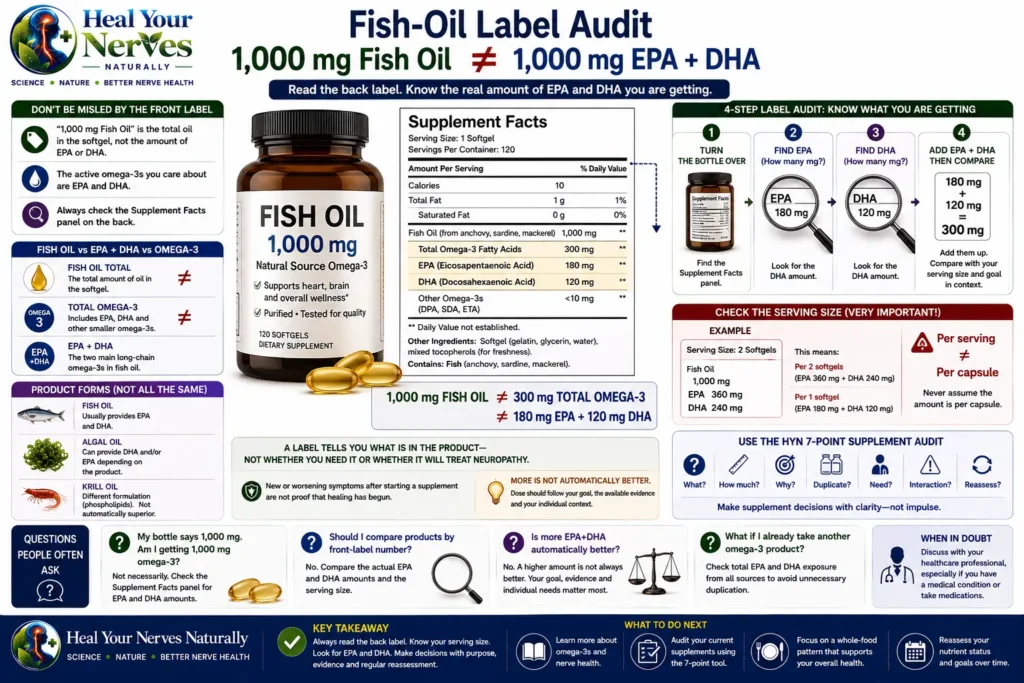
How to compare two omega-3 labels without getting lost
When users compare products, they often compare the biggest number on the front. A better comparison uses the same serving basis.
For each product, write:
- capsules per serving;
- total fish/algal/krill oil per serving;
- EPA per serving;
- DHA per serving;
- other omega-3s if listed;
- additional vitamins or active ingredients;
- cost per serving rather than cost per bottle.
Now compare the ingredient you actually care about. A cheap bottle with many capsules and low EPA/DHA per serving may not be cheaper in practice. A concentrated product may contain fewer capsules but cost more. The correct choice depends on the reason for use, not simply concentration.
“Triglyceride form” vs “ethyl ester”: what should a normal user do with that information?
Because of this, NIH ODS notes that omega-3 supplements come in several chemical forms and that some forms have somewhat different bioavailability. However, all common forms can raise plasma EPA/DHA. For a normal user, this is usually a second-order product question after the basics: Do you need the supplement? What are the EPA/DHA amounts? Can you tolerate it? Does it interact with your situation? Is the product transparent and reputable?
Do not allow a formulation detail to become a marketing shortcut to “therefore this brand heals nerves better.”
What about enteric-coated fish oil?
Enteric coating is sometimes used to reduce fishy aftertaste or change where the capsule dissolves. That can affect user experience. It does not create stronger evidence for neuropathy treatment.
Should you choose a high-EPA or high-DHA product?
That question only makes sense when the goal is defined. Different clinical research areas use different EPA/DHA profiles. There is no general rule that a high-DHA product is “for nerves” while high-EPA is “for inflammation.” Nervous-system biology is more complex than that product segmentation.
Can a supplement replace fish or other food?
A capsule can provide selected fatty acids, but it does not reproduce the whole food matrix, protein, minerals and other nutrients in seafood. NCCIH specifically notes that evidence for benefits from seafood can be stronger than evidence for omega-3 supplements for some health outcomes.
That does not mean food is always possible or appropriate. It means food and supplement are different tools.
What if you cannot tolerate fish but tolerate fish oil—or vice versa?
Tolerance can differ because a supplement is not a whole fish meal. Gastrointestinal symptoms, allergy and dietary preferences should be evaluated individually. If allergy is part of the question, do not self-test a concentrated product after a serious reaction history.
What about “omega-3 gummies” or fortified foods?
They can provide omega-3s, but again the label must specify which fatty acid and how much. A gummy that advertises “omega-3” may supply a small ALA amount or a particular EPA/DHA dose. Fortified eggs, milk or other foods also vary.
Use the same label-literacy rule everywhere: family name is not enough; identify the actual fatty acid and amount.
Can you get too little total fat even if omega-3 intake looks adequate?
Yes. ALA adequacy does not describe total dietary-fat adequacy, energy intake or absorption of fat-soluble nutrients. Extremely low-fat diets can create broader nutritional issues. If a restrictive diet is intentional because of a medical condition, personalized guidance may be important.
Can you get plenty of total fat but still have a poor fat pattern?
Yes. Total grams do not tell you the distribution of saturated, monounsaturated and polyunsaturated fats or whether the diet is dominated by highly processed foods. This is why the page focuses on fat quality rather than total fat alone.
How do diabetes and metabolic health change the fatty-acid conversation?
If the user has diabetes and neuropathy, the metabolic disease is a major part of the causal pathway. Fat quality can contribute to overall cardiovascular and metabolic dietary quality, but fish oil should not become a substitute for glucose, blood-pressure, lipid, foot-care and other condition-specific management.
Use Diabetic Neuropathy for the condition owner and Metabolic Support for dietary metabolic context.
How does nerve compression change the answer?
If numbness is coming from carpal tunnel syndrome, cubital tunnel syndrome or another entrapment, dietary fatty acids do not remove mechanical pressure. A good diet still matters for general health, but the limiting factor is different.
Use Nerve Compression and the Mechanical Damage System when that pattern is plausible.
How does a post-injury nerve problem change the answer?
Traumatic nerve damage depends on injury type, location and severity. Supplying normal dietary fats cannot be equated with repairing a stretched, crushed or severed axon. Nutrition can support the recovery environment while the injury itself remains the primary owner.
In contrast, Continue to Post-Injury Nerve Damage when symptoms began after trauma.
What if the user has an autoimmune or demyelinating disorder?
A nutrient that participates in myelin biology cannot replace disease-specific treatment of an autoimmune condition. If immune attack is ongoing, providing more fatty-acid substrate does not switch off the immune mechanism.
This is a critical YMYL boundary: supportive nutrition and disease-directed therapy are different tracks.
What if you are taking omega-3 because a clinician recommended it for a non-nerve reason?
Then keep the goals separate. A clinician may recommend an omega-3 strategy in a cardiovascular, lipid or pregnancy context. The fact that the supplement is justified for that reason does not mean it should be marketed to you as nerve-repair therapy.
How to define an outcome before you start
Write the intended outcome in one sentence:
- “I want a reliable direct DHA source because I do not eat fish.”
- “I am using this under clinician guidance for a triglyceride-related indication.”
- “I am testing whether this reduces neuropathic pain.”
The third statement requires a different evidence standard from the first two. Outcome definition prevents biological plausibility from masquerading as clinical proof.
What counts as a meaningful reassessment?
At reassessment, do not ask only whether you “feel different.” Review:
- Did the dietary gap you identified actually close?
- Did you tolerate the product?
- If a biomarker was clinically relevant, did it change?
- Next, did the specific symptom outcome change?
- Finally, did any new medication, illness or lifestyle change confound the result?
- Does the original reason for use still exist?
A supplement should not become permanent simply because nobody remembered to reconsider it.
What about cooking fish—does heat destroy all omega-3?
No. Cooking does not turn fish into an omega-3-free food. Preparation method, temperature, storage and the fish itself can influence fatty-acid composition, but the practical takeaway is not to fear normal cooking. Baking, grilling, steaming, curries and other ordinary methods can all fit. Avoid turning nutrient preservation into a reason to eat foods in ways you dislike or cannot sustain.
Does canned or frozen fish “count”?
Yes. Canned and frozen seafood can provide useful nutrients and may be more affordable and accessible than fresh fish. Check sodium, preparation and species as relevant to your health goals, but “fresh only” is not a nerve-health requirement. A sustainable household pattern matters more than an aspirational food list.
What about eating fish and taking a supplement on the same day?
There is no general rule that they can never occur together. The useful question is total exposure and why the supplement exists. If the product was recommended for a specific indication, follow that guidance. If it is optional, account for regular seafood intake before assuming the capsule adds meaningful value.
Should you avoid omega-3 supplements before surgery?
Perioperative advice can depend on the procedure, dose, medication list and clinician’s protocol. Do not rely on a generic internet rule. Tell the surgical team about fish oil, krill oil, algal oil and all other supplements so they can give procedure-specific instructions.
What if the label lists “omega-3 fatty acids” but not EPA and DHA separately?
If EPA/DHA amount matters to your goal, a vague label makes comparison difficult. Choose transparent labeling rather than guessing. This is especially important when products combine several oils or when the front label emphasizes a large total-oil number.
Should You Test Omega-3 Status?
Fatty-acid tests exist, including plasma/serum measures and red-blood-cell fatty-acid analysis. NIH ODS notes that omega-3 status can be assessed in different biological samples, but experts have not established universal normal ranges for every purpose.
When we discuss fatty acids for nerve health, the useful question is not whether fat is “good” or “bad,” but which fatty acid, which source, and what biological or practical problem you are trying to solve.
What a test may tell you
It may provide information about the proportion of EPA, DHA or other fatty acids in the measured sample, depending on the method.
What it does not tell you
- whether you have neuropathy;
- what caused a damaged nerve;
- whether myelin is regenerating;
- whether fish oil will reduce your symptoms;
- whether a higher omega-3 index will repair an injured axon.
There is no “nerve fat deficiency test”
A company may market an omega-3 index as an optimization tool. That can be a legitimate fatty-acid measurement, but do not transform it into a diagnostic test for nerve damage.
When testing can become a distraction
If the real problem is persistent burning feet, unexplained weakness or numbness, repeated omega-3 testing may delay a broader neurological assessment. In that situation the Safety/Differential Layer is Nerve Dysfunction Diagnosis.
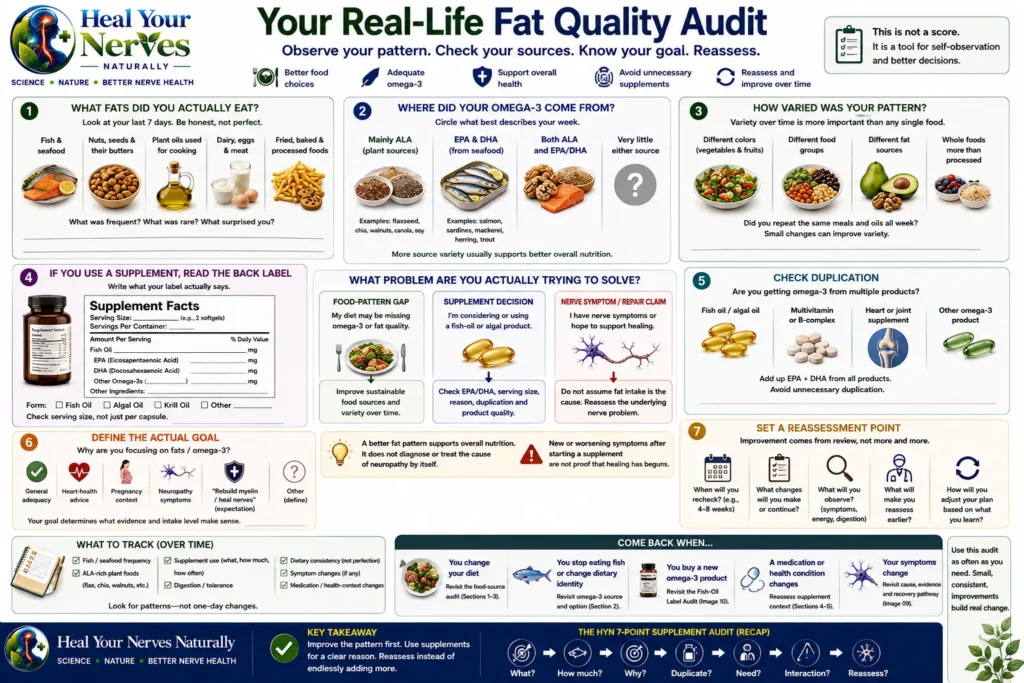
A Real-Life Fat Quality Audit
Use this for seven ordinary days. The goal is not to score your diet. It is to replace assumptions with information.
When we discuss fatty acids for nerve health, the useful question is not whether fat is “good” or “bad,” but which fatty acid, which source, and what biological or practical problem you are trying to solve.
Day 1: List your main fat sources
Write down the foods and oils that actually provide most of your dietary fat. Include cooking oil, fish, eggs, dairy, meat, nuts, seeds, fried foods, packaged snacks, spreads and supplements.
Day 2: Find your ALA sources
Do flaxseed, chia, walnuts, canola/soy foods or another meaningful ALA source appear regularly? If yes, note frequency rather than forcing a perfect daily target.
Day 3: Find direct EPA/DHA sources
Do you eat fish or seafood? How often? If not, that is simply information for the next decision.
Day 4: Audit cooking and processed-food patterns
Are most fats coming from home cooking and whole/minimally processed foods, or from fried takeaway foods, pastries and highly processed snacks? This matters more for overall diet quality than obsessing over one fatty-acid ratio.
Day 5: Turn every omega-3 bottle over
Record serving size, EPA, DHA and any vitamins or other active ingredients. If the product says “proprietary blend,” note what information is missing.
Day 6: Write down the reason for each product
“My doctor recommended it for a specific reason” is different from “I saw a video saying it heals nerves.” The evidence standard should match the goal.
Day 7: Choose the smallest useful change
Examples:
- add an ALA-rich food several times a week;
- include an affordable seafood option if you eat fish;
- replace part of a saturated-fat-heavy pattern with unsaturated-fat foods;
- stop duplicating two omega-3 products after reviewing the labels;
- seek condition-specific assessment instead of escalating fish oil for unexplained neuropathy.
What to observe
Observe dietary consistency, supplement tolerance and the specific outcome you were trying to change. Do not use a daily symptom diary to convince yourself that every fluctuation comes from one fatty acid.
When to reassess
Reassess when the seven-day audit is complete, when you change a product, when medication changes, or when symptoms change. A return date is not a reason to wait if significant neurological symptoms are worsening.
Reassessment scenario: “I improved my fat quality but my nerve symptoms did not change”
That result is not a failure of healthy eating. It may mean the dietary pattern improved an important general-health factor without changing the limiting cause of the nerve symptom. Do not undo a sensible food change simply because it did not cure neuropathy. Instead, separate the outcomes.
Ask whether the goal was overall dietary adequacy, cardiovascular/metabolic health, or treatment of a neurological symptom. A change can succeed at the first goal while doing little for the third.
Reassessment scenario: “My fish-oil dose is high but my omega-3 index did not rise as much as expected”
Product adherence, serving size, test method, timing, biological variability and formulation can all influence biomarker changes. This becomes a testing/formulation question—not proof that the nerves require an even higher dose. Review the product and clinical reason with an appropriate professional before escalating.
Reassessment scenario: “I stopped fish oil and the symptoms came back”
A repeated on/off pattern can be useful information, but it still does not tell you the mechanism. Symptoms can fluctuate for many reasons. If the effect is meaningful and reproducible, document it carefully and discuss it in the context of diagnosis, medication and other interventions rather than concluding structural regeneration occurred.
Reassessment scenario: “I switched from fish oil to algae and feel different”
Compare the active amounts. The two products may not provide equivalent EPA and DHA doses. They may also differ in excipients, capsule size, oxidation, timing or other ingredients. Do not attribute the difference to “fish vs algae” before comparing the labels.
Credibility filter: how to judge a viral omega-3 claim
When a video or product page says “DHA repairs myelin” or “omega-3 reverses neuropathy,” run this five-part check:
- Is the evidence about normal biology or a treatment outcome? Showing that DHA exists in membranes does not prove symptom reversal.
- What type of study is being cited? Cell, animal, observational and randomized human evidence answer different questions.
- What condition was studied? Diabetic neuropathy evidence cannot automatically be transferred to nerve compression or chemotherapy neuropathy.
- What outcome changed? A blood fatty-acid level is not the same as restored nerve conduction or function.
- Is a product being sold immediately after the claim? Commercial interest does not make evidence false, but it raises the need for independent verification.
What if a study uses a dose much higher than your food intake?
Do not convert a research dose into a personal prescription. Clinical studies use specific populations, formulations and monitoring. The dose may have been chosen to test a hypothesis rather than to define a safe general recommendation. The trial’s result and adverse-event profile matter as much as the number.
What if you prefer food but worry you cannot eat fish often enough?
Build the diet you can actually maintain. An ALA-rich food pattern plus occasional seafood may be realistic for one household. Another may use more frequent seafood. Another may prefer an algal supplement for ethical or dietary reasons. There is no moral hierarchy between those choices; the important thing is knowing what each source provides.
What if your family cooks with one oil and you cannot change it?
Diet quality is not determined by a single oil. You can often improve the pattern around the existing household routine—add nuts or seeds, include fish where appropriate, increase vegetables and legumes, reduce heavily fried/processed foods, and control overall portions—without turning family cooking into a conflict.
What if you have a limited budget?
Prioritize the highest-value changes. An expensive concentrated supplement may not be the first need if the diet lacks basic food variety. Affordable local fish, canned fish where suitable, flax or chia used in small amounts, peanuts/nuts/seeds, and ordinary unsaturated cooking oils can all contribute. The exact best value depends on local prices.
Observation without obsession: what should you actually track?
If you make a dietary-fat change, track the variable you can reasonably observe. For food-pattern work, that may be frequency of fish intake, use of ALA-rich foods, or reduction in heavily processed sources. For a clinician-directed supplement, it may be adherence, tolerance and a specific laboratory or clinical outcome.
Avoid checking your hands and feet every hour after taking a capsule. Neurological symptoms fluctuate with posture, activity, sleep, stress, temperature and many other factors. Hyper-monitoring can make normal fluctuation feel like a supplement effect.
How to avoid changing too many variables at once
Suppose you begin fish oil, stop seed oils, remove gluten, start B12, increase exercise and improve sleep in the same week. If symptoms change, you have created a story but not much usable evidence.
When it is safe to do so, make the smallest number of changes needed to answer your question. This is especially important when supplements are optional rather than medically necessary.
What if the internet says you need “therapeutic” omega-3 rather than food?
The word “therapeutic” should trigger a higher evidence standard. A therapeutic dose is not simply a larger nutritional dose. Ask which condition, which formulation, which outcome, what trial evidence and what safety monitoring support the recommendation.
If the answer is only “omega-3 reduces inflammation,” the claim is still too broad to justify a neuropathy protocol.
Could omega-3 improve pain without repairing the nerve?
In principle, symptom change and structural repair are different outcomes. A therapy could affect inflammation, pain processing or another pathway without reversing the underlying lesion. That is why studies must be read by their actual outcome measures rather than by the headline “nerve healing.”
What if your doctor says your neuropathy is idiopathic?
Idiopathic means no cause has been identified, not “therefore omega-3 deficiency.” It is understandable to look for modifiable factors, but a lack of diagnosis should not lower the evidence standard for every supplement claim.
Use dietary adequacy as supportive care while continuing appropriate reassessment when symptoms change or new clinical information appears.
When does fatty-acid optimization stop being useful?
Optimization stops being useful when it begins to consume more attention, money and restriction than the likely benefit justifies. If you already have a varied diet with appropriate unsaturated-fat sources and no specific indication for supplementation, continually chasing higher omega-3 biomarkers may add complexity without solving the nerve problem.
The return trigger should therefore include a possible stopping decision: “I have enough information now; I do not need to keep optimizing this variable.”
A final misconception check before you leave this page
If you remember only four things, make them these: first, ALA, EPA and DHA are related but not interchangeable. Second, omega-6 is not automatically harmful; linoleic acid is essential. Third, the amount on the front of a fish-oil bottle may not equal its EPA+DHA content. Fourth, a biological role in membranes or myelin does not establish a supplement as a general nerve-repair treatment.
Those four ideas protect against most of the misinformation users encounter before they ever reach a product comparison.
Return tool: three questions to ask before every new omega-3 purchase
- What is my goal? Dietary adequacy, a clinician-directed indication, or an unproven nerve-repair hope?
- What does this serving actually provide? EPA, DHA, ALA, vitamins or other ingredients?
- What will make me reassess? A date, symptom, laboratory result, medication change or lack of benefit?
If you cannot answer those three questions, wait before buying. That pause is often more useful than another product comparison.
One last practical rule: do not let fatty-acid literacy become food fear
The purpose of understanding omega-3, omega-6, ALA, EPA and DHA is to make calmer decisions, not to make every restaurant meal or cooking oil feel dangerous. If the diet is varied, essential-fat sources are present and no specific clinical indication exists, you may not need to keep optimizing. Good nutrition should eventually reduce decision burden.
Travel, restaurants and real life: you do not need perfect fat ratios
A fatty-acid plan has to survive days when you are not cooking at home. At a restaurant or during travel, you may not know the exact oil or omega-6 content of a meal. That does not make the meal a neurological threat. Focus on the broader pattern across the week: include useful unsaturated-fat foods when available, eat seafood if it fits your diet, keep ALA-rich foods in the routine, and avoid letting highly processed/fried foods dominate every day.
If a plan makes you anxious because you cannot calculate the omega-3:omega-6 ratio of restaurant food, the plan has become less useful. Nutritional literacy should help you make reasonable choices under uncertainty, not require laboratory-level control of every meal.
Five common fatty-acid mistakes to catch before you move on
- Treating “omega-3” as one substance. ALA, EPA and DHA are related but not interchangeable.
- Calling omega-6 inherently harmful. Linoleic acid is essential; overall diet quality matters more than a good-fat/bad-fat slogan.
- Reading the front label instead of the Supplement Facts panel. Total fish oil is not automatically EPA+DHA.
- Turning myelin composition into a treatment claim. Lipid-rich myelin does not prove that more fish oil remyelinates damaged nerves.
- Escalating dose when the problem is unchanged. Lack of benefit can mean omega-3 was never the limiting factor.
These five mistakes explain why a simple bottle comparison often becomes confusing. Correcting them usually gives you a clearer next action than searching for a stronger product.
Where to Go Next
The next page should match the question that remains.
I want the bigger nutrition-and-nervous-system picture
Use the direct sibling Neuro Nutrition.
I want to understand the protein side of nerve biology
Continue through the direct sibling loop to Protein and Amino Acids for Nerve Health.
I want practical food choices rather than more lipid biology
Move to the Action Layer: Nerve Food Repair or Nutrition for Nerve Repair.
I want to understand myelin
Use the Deep Biology Layer: Myelin System.
I want to understand how myelin regenerates
Use Myelin Regeneration. This is intentionally separate from dietary-fat ownership.
I am comparing fish oil, krill oil or algal oil
Use Supplement Intelligence for formulation, quality, dose logic and interaction review.
I have neuropathy symptoms and do not know the cause
Do not keep changing oils. Use Peripheral Neuropathy and Nerve Dysfunction Diagnosis.
Your return trigger
Come back to the Real-Life Fat Quality Audit:
- before buying a new omega-3 product;
- when you stop or start eating seafood;
- when you switch to a vegan/vegetarian diet;
- when pregnancy/lactation changes your nutrition questions;
- when a medication changes;
- when you receive a fatty-acid test result;
- when a fish-oil product causes a new symptom;
- or when the expected benefit does not happen.
When you return, ask a more precise question than “Do I need more omega-3?”
Which fatty acid am I trying to change, why am I trying to change it, what evidence applies to my goal, and what other explanation for my nerve problem still needs attention?
That is the practical purpose of this page: to make fatty-acid biology useful without turning it into a promise that oil can repair every nerve.