
Micronutrients for Nerve Health: What Matters, What Your Status Means, and How to Use Supplements Safely
If you are reading this because your hands or feet tingle, your lab report looks “borderline,” you are taking several supplements, or you simply want to understand micronutrients for nerve health, start with one important idea:
A nutrient can be too low, adequate, or too high—and those are three different situations.
That distinction matters because nerve-health questions are rarely solved by asking, “Which vitamin is best?” A person can eat a reasonably healthy diet and still have an absorption problem. Someone can take a supplement and still have an unclear lab result. Another person may combine several products that each look harmless on their own but together provide more of the same nutrient than expected.
So when we talk about micronutrients for nerve health, the useful question is not simply which vitamin or mineral matters. It is whether your intake, absorption, nutrient status and total exposure fit the problem you are actually trying to solve.
That sounds simple, but it changes how we think about micronutrients for nerve health.
A person can eat a reasonably healthy diet and still have a problem with absorption. Someone can take a supplement and still have an unclear lab result. Another person can take several products that each look harmless on their own but together provide more of the same nutrient than expected.
So the useful question is not:
“Which vitamin is best for nerves?”
A better set of questions is:
- Am I getting enough of the nutrient?
- Is my body absorbing and using it?
- Does my test result actually tell the whole story?
- Could I be taking more than I realize?
- Does this nutrient plausibly fit my symptoms and risk factors?
- What is the safest next decision?
This page is designed to help you work through those questions without turning every symptom into a vitamin deficiency—or every supplement into a treatment.
Important: Tingling, numbness, burning, weakness, balance changes and other neurological symptoms can have many causes. Nutrition is one possible part of the picture, not a diagnosis by itself. New, progressive, severe, one-sided or function-limiting neurological symptoms deserve medical assessment.
This page is part of the Nutritional Intelligence system. Its job is to help you identify and interpret micronutrient status before you decide what to do next.
What this page helps you do: identify the micronutrients most relevant to nerve-health questions; distinguish deficiency, adequacy and excess; make sense of B12 testing context; review supplement duplication and interactions; and decide whether food, testing, supplement review or a deeper clinical conversation is the more sensible next step.
What this page does not do: diagnose neuropathy, prescribe a personalized supplement dose, recommend brands or treatment protocols, promise nerve regeneration, or provide a full root-cause diagnosis. For mechanism, use Micronutrients and Nerve Function. For deficiency causes, use Nutritional Deficiency and Nerve Damage.
Find Your Situation
Use the situation that sounds most like you:
- “My B12 result says normal or borderline, but I still have symptoms.” → Go to B12 result interpretation
- “I started B12 before testing.” → Go to supplement-before-test guidance
- “I take several supplements, or symptoms worsened after one.” → Go to B6 and supplement-safety review
- “I want to know which nutrients deserve the most attention.” → Go to the micronutrient priority map
- “I eat reasonably well but still tested low—or I cannot afford every test and supplement.” → Go to Food, Supplement or Testing
- “I am not sure nutrition is the right explanation.” → Go to when nutrition should not be your only explanation

Start Here: Micronutrient Status Is More Useful Than “Good Vitamin” or “Bad Vitamin”
Micronutrients are vitamins and minerals that the body needs in relatively small amounts, but “small amount” does not mean “small importance.” They participate in normal metabolism, enzyme reactions, blood formation, energy production, nerve signaling and many other processes. The World Health Organization’s healthy-diet guidance emphasizes adequacy, balance, moderation and diversity rather than chasing one “perfect” food or nutrient.
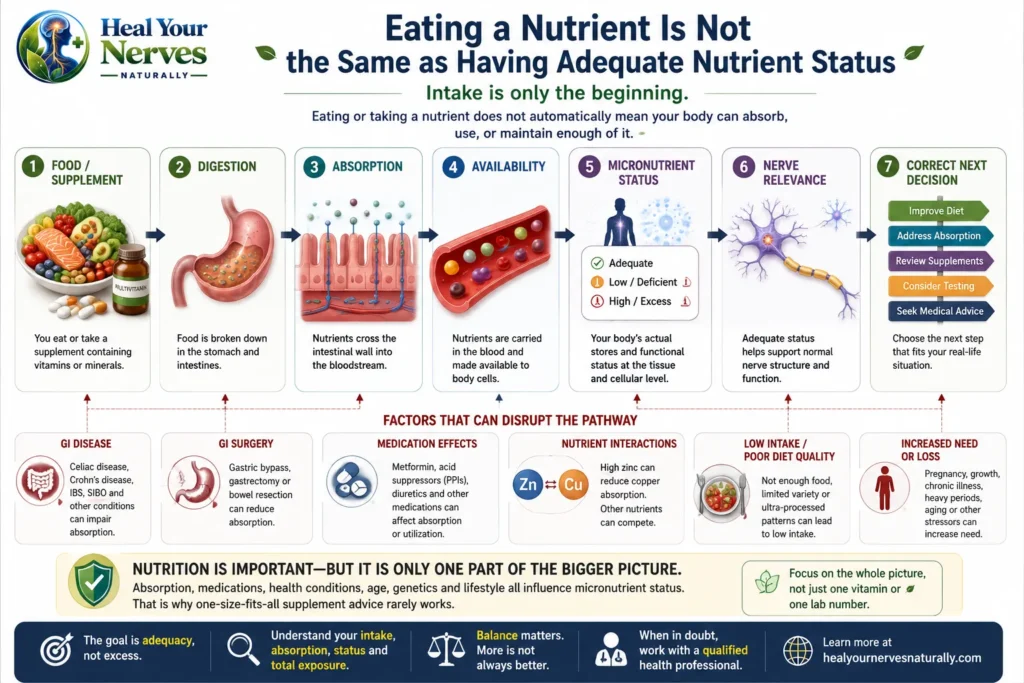
For nerve-related questions, we use a simple pathway:
Intake → Absorption / Availability → Micronutrient Status → Deficient / Adequate / Excessive → Nerve Relevance → Correct Next Decision
This pathway helps prevent a common mistake: assuming that eating a nutrient, swallowing a supplement or seeing a single lab number automatically tells us whether the nervous system has what it needs.
What does “micronutrient status” mean in everyday language?
Think of it as the bigger picture of whether your body has enough of a nutrient available for normal function.
It can be influenced by:
- what you eat;
- how much you eat;
- whether the nutrient is fortified in foods;
- digestion and absorption;
- gastrointestinal disease or surgery;
- medicines that affect absorption or metabolism;
- alcohol exposure;
- interactions between nutrients;
- age and individual health conditions;
- supplements you already take;
- and, for some nutrients, how accurately available tests reflect body status.
This is why two people who eat similar foods can have different nutrient situations.
Eating enough is not always the same as absorbing enough
Imagine two people eating the same breakfast: eggs, yogurt and fortified cereal.
One person digests and absorbs nutrients normally.
The other has a condition affecting the stomach or small intestine, has had gastrointestinal surgery, or takes a medicine that interferes with the availability of a particular nutrient.
The meal may look identical. The biological outcome may not be.
That distinction becomes especially important for vitamin B12.
What this means for you
Before adding another supplement, ask:
- What am I already getting from food?
- What am I already getting from supplements?
- Do I have a reason to suspect poor absorption or increased risk?
- Do symptoms or test results justify clinical interpretation?
- Could I already be getting too much of something?
That five-question check is more useful than searching for “the best nerve vitamin.”
Which Micronutrients Deserve the Most Attention for Nerve Health?
There is no scientifically honest list of seven vitamins that “repair nerve damage” for everyone.
Different nutrients matter for different reasons, and the strength of the nerve-related evidence is not equal for every vitamin or mineral.
For this page, the most important micronutrients to understand are:
- Vitamin B12 (cobalamin) — because deficiency can cause neurological problems and may occur even without obvious anemia;
- Vitamin B1 (thiamin/thiamine) — because severe deficiency can affect peripheral nerves and energy metabolism;
- Vitamin B6 (pyridoxine and related forms) — because both inadequate status and excessive supplemental exposure matter, with excess being a well-recognized neuropathy risk;
- Copper — because deficiency can affect the nervous system, and high zinc intake can interfere with copper absorption;
- Vitamin E — particularly in the context of fat malabsorption;
- Folate (vitamin B9) — important in one-carbon metabolism and relevant to interpretation of B12-related problems;
- Magnesium — involved in many enzyme systems and normal nerve and muscle function, but not a universal explanation for tingling;
- Zinc — important biologically, but especially relevant here because high supplemental zinc can create a copper problem;
- Vitamin D — important for overall health, but it should not be presented as a proven treatment for neuropathy simply because observational associations exist.

If your main question is how these nutrients participate in myelin, signaling and cellular energy, read Micronutrients and Nerve Function.
Vitamin B12: The Nutrient Most People Mean When They Ask About Nerves
Vitamin B12 deserves special attention because it is involved in normal blood and nervous-system function, and deficiency can cause neurological symptoms. The NIH Office of Dietary Supplements vitamin B12 fact sheet is one of the most useful primary references for intake, status, deficiency and medication interactions.
Can B12 deficiency cause tingling or numbness?
Yes, B12 deficiency can be associated with neurological symptoms including altered sensation.
But this is where careful interpretation matters:
Tingling does not prove B12 deficiency.
Tingling can also occur with diabetes, nerve compression, injury, medication or toxin exposure, autoimmune disease, other nutritional problems and many other neurological conditions.
If your question is “Could my symptoms be part of a nutritional-deficiency pathway?” move next to Nutritional Deficiency and Nerve Damage.
“My blood count is normal. Does that rule out B12 deficiency?”
No.
The NICE guideline on vitamin B12 deficiency specifically advises not to rule out B12 deficiency solely because anemia or macrocytosis is absent.
This matters in real life because people often hear:
“Your blood count looks fine, so B12 cannot be the issue.”
That conclusion can be too simple.
Neurological context, symptoms, risk factors and appropriate testing still matter.
“My B12 result is technically normal, but I still have symptoms.”
This is one of the most common areas of confusion.
A lab report usually provides a reference range, but a reference range is not the same thing as a personalized diagnosis.
The NIH notes that serum or plasma B12 is commonly used to assess status, while methylmalonic acid (MMA) can be useful as a more sensitive marker in certain borderline ranges. NICE also uses an “indeterminate” category in its diagnostic guidance and recommends considering additional assessment in appropriate symptomatic people.
That does not mean everyone with a low-normal number needs treatment.
It means the number should be interpreted in context.
A practical “normal lab but symptoms” checklist
If you have symptoms and an unclear B12 result, useful questions include:
- What exact test was used—total B12 or active B12?
- What is the laboratory’s reference range?
- Was the result clearly low, clearly adequate, or indeterminate/borderline?
- Were you already taking B12 before the blood test?
- Do you have kidney problems that might complicate MMA interpretation?
- Do you have diet, GI, medication or surgery-related risk factors?
- Are your symptoms progressive or affecting balance, strength or daily function?
- Has another cause been investigated?
NICE also cautions that B12-containing over-the-counter products can raise measured B12 concentrations without necessarily resolving the underlying problem, which is another reason to tell the clinician what you were taking before the test.

“I started B12 before the blood test. Did I ruin the test?”
Not necessarily—but you have changed the context in which the result needs to be interpreted.
This happens in real life all the time. Someone develops tingling, reads about B12, starts a tablet or injection, and only later arranges testing.
The important response is not to hide the supplement use or panic that the test is now useless.
NICE guidance on vitamin B12 deficiency recommends taking diagnostic blood samples before B12 replacement when possible. It also advises asking exactly what over-the-counter B12 products a person has already used, because tablets, injections and even transdermal products can raise total or active B12 concentrations and make interpretation more difficult.
What you can do now
Write down:
- the exact B12 product or injection you used;
- the form if it is listed on the label;
- the dose;
- the date you started;
- how often you used it;
- whether symptoms changed before or after starting it;
- and the date of the blood test.
Bring that information to the clinician interpreting the result.
Do not stop prescribed B12 replacement simply to create a “cleaner” blood test without medical advice. NICE also makes an important safety exception: when serious B12 deficiency with neurological or severe haematological features is suspected, necessary treatment should not be delayed just to wait for testing.
The practical lesson is:
If supplementation came first, the next step is better documentation and interpretation—not pretending the supplementation never happened.
Can metformin or acid-suppressing medicines affect B12?
They can be relevant.
The NIH notes that metformin can reduce B12 absorption and serum concentrations, while gastric-acid inhibitors such as proton-pump inhibitors can interfere with release and absorption of food-bound B12. NICE also lists metformin, H2-receptor antagonists and proton-pump inhibitors among common medication-related risk factors.
This does not mean you should stop a prescribed medicine.
It means:
If you use one of these medicines long term and have relevant symptoms or risk factors, B12 status is worth discussing with your healthcare team.
Never stop metformin, a PPI or another prescribed medicine simply because you read that it can influence a nutrient.
Pregnancy, breastfeeding or postpartum: does B12 need different context?
Yes. These are situations where a generic “normal range” mindset can be especially unhelpful.
During pregnancy, NICE recommends active B12 rather than total B12 as the initial B12 test because total B12 concentrations can fall during pregnancy even when there is no true deficiency. NICE also treats pregnancy and breastfeeding as situations where an indeterminate result may deserve more active clinical consideration rather than casual watch-and-wait.
The NIH Office of Dietary Supplements pregnancy fact sheet also notes that B12 matters to both maternal and infant health and that requirements and clinical decisions need to be considered in the life-stage context.
A practical caution is important here:
Fatigue, weakness, tingling or “not feeling like yourself” during pregnancy or after birth should not automatically be blamed on B12—or dismissed as “just pregnancy” or “just postpartum.”
If you are pregnant, breastfeeding or recently postpartum and have neurological symptoms, bring the symptom timeline, diet pattern, supplement list and actual lab result to your healthcare team. Do not self-escalate high-dose supplements based only on an internet reference range.
Vitamin B1 (Thiamin): Why Severe Deficiency Matters to Nerves
Thiamin helps the body convert food into usable energy. The NIH thiamin fact sheet provides the core evidence on intake, deficiency and risk groups.
Severe thiamin deficiency can affect both the cardiovascular and nervous systems and can include peripheral neuropathy.
Who deserves more attention for thiamin risk?
Real-life contexts can include:
- very poor or highly restricted intake;
- prolonged vomiting;
- alcohol dependence or heavy alcohol exposure;
- bariatric surgery;
- severe malnutrition;
- conditions causing substantial gastrointestinal problems.
This is not a nutrient where a person with new neurological symptoms should simply guess and self-treat while delaying assessment—especially if there is confusion, severe weakness, walking difficulty, vomiting or a high-risk medical context.
“I eat rice. Does that mean I get enough B1?”
Not necessarily, and the answer depends on the type of rice, fortification, the rest of the diet and overall intake.
Rather than building a nerve-health plan around one staple food, look at the total dietary pattern. Whole or enriched grains, legumes, seeds, pork and some fish can contribute thiamin.
For practical meal-level guidance, see Nerve Food Repair.
Vitamin B6: The Best Example of Why “More” Is Not “Better”
Vitamin B6 is necessary for normal metabolism and many enzyme reactions.
But B6 is also the nutrient that most clearly shows why our framework must include deficiency, adequacy and excess.
The NIH vitamin B6 fact sheet describes neuropathy as a risk of excessive chronic oral pyridoxine exposure. It also notes that upper-intake guidance differs between authorities: the older U.S. Food and Nutrition Board adult UL is 100 mg/day, while the European Food Safety Authority re-evaluated the neurotoxicity evidence in 2023 and established an adult UL of 12 mg/day for total vitamin B6 intake. Neither number is a treatment target. The practical lesson for users is to avoid assuming that a high-dose product is harmless simply because B6 is a vitamin.
This does not mean every person above or below one number will develop symptoms. It does mean B6 deserves serious attention when people combine supplements.
The real-life problem: hidden B6
Consider someone taking:
- one multivitamin;
- one B-complex;
- one magnesium formula;
- one “nerve support” product.
They may think they are taking four different supplements.
But the labels may show:
- B6;
- more B6;
- more B6;
- more B6.
That is why total exposure matters more than the front label.

[Vitamin B6 supplement label cross-check showing duplicate B6 across multivitamin B complex magnesium and nerve support products]
Different products can contain the same nutrient. Check the Supplement Facts panel across all products you use and look for duplicate B6 exposure.
The FDA’s dietary supplement safety guidance warns that problems can occur when supplements are combined, mixed with medicines or taken in excessive amounts.
For the full label-reading and duplication method, use Supplement Label Cross-Check.
“My tingling got worse after I started a nerve or magnesium supplement. Is that a healing reaction?”
Do not assume that it is.
This is an important real-life safety problem because the symptom a person is trying to treat—tingling, burning or numbness—can also be a sign of excessive B6 exposure.
The Therapeutic Goods Administration (TGA) safety update on vitamin B6 reports peripheral neuropathy in people using B6-containing products, including cases involving multiple products and supplements marketed mainly as magnesium or zinc products. Its safety advice specifically tells users to take new tingling, burning or numbness seriously rather than continue exposure without review.
What to do with that information
If symptoms began or clearly worsened after you added a new supplement:
- Check the full label, not just the product name.
- Look for B6 under names such as pyridoxine or pyridoxal-5-phosphate / P-5-P.
- Check every other supplement, fortified powder or energy product you use.
- Write down the timing: when the product started and when the symptoms changed.
- Contact a clinician or pharmacist promptly for review.
- Do not keep increasing the product because someone online calls worsening symptoms a “healing reaction.”
For non-prescribed B6-containing products, TGA consumer guidance advises stopping the product if tingling, burning or numbness occurs and seeking medical advice. If the product was prescribed for a diagnosed condition, contact the prescriber promptly before changing the treatment plan.
Worsening neurological symptoms are a reason to reassess the supplement—not proof that it is working.
Supplement Label Cross-Check: How to Read a Label Without Getting Lost
A supplement label can look scientific while still making the practical decision difficult.
The front may say:
- “nerve support”;
- “energy”;
- “stress support”;
- “brain and nerve formula”;
- “high potency”;
- “methylated B vitamins.”
None of those phrases tells you the total daily exposure.
The part that matters most is the Supplement Facts panel.
Start with serving size, not the ingredient list
If a bottle says:
Serving size: 2 capsules
and you take four capsules, you are taking two servings.
That sounds obvious, but it is one of the easiest ways to underestimate intake.
Then look for the same nutrient under different products
For B6, a label may use terms such as:
- vitamin B6;
- pyridoxine hydrochloride;
- pyridoxal-5-phosphate;
- P-5-P.
For B12, you may see:
- cyanocobalamin;
- methylcobalamin;
- adenosylcobalamin.
Different forms do not mean they should be ignored when you calculate total exposure.
Do not compare only percentages
Percent Daily Value can help orient you, but for supplement-stacking questions it is often more useful to write down the actual amount per serving.
Example:
Multivitamin: B6 5 mg
B-complex: B6 10 mg
Magnesium product: B6 5 mg
Nerve formula: B6 8 mg
A user looking at four separate bottles may not immediately recognize that the same nutrient is appearing four times.
This is exactly the kind of situation the FDA supplement safety guidance warns about when it advises caution with combining supplements and taking excessive amounts.
“High potency” is not a medical indication
A larger number can look more powerful.
But nutrient adequacy is not a competition.
The better question is:
What problem is this dose meant to solve, and do I actually have that problem?
If there is no clear answer, adding another high-dose product may create complexity without improving the decision.
Copper and Zinc: A Nutrient Interaction That Is Easy to Miss
Copper is an essential mineral and a cofactor for enzymes involved in energy production, iron metabolism, neuropeptide activation, connective-tissue synthesis and neurotransmitter synthesis. See the NIH copper fact sheet for the primary reference.
The important real-life point is this:
High zinc intake can interfere with copper absorption.
That means a person can create a nutrient problem not because they are eating poorly, but because they are taking a high-dose supplement without recognizing the interaction.
“I take zinc for immunity. Should I worry about copper?”
Do not panic over normal food intake or a standard supplement without checking the amount.
Instead:
- read the zinc dose on the label;
- check whether more than one product contains zinc;
- note how long you have been taking it;
- do not add copper automatically to “balance” zinc without a reason;
- discuss prolonged high-dose zinc use with a clinician when relevant.
Adding another supplement to fix a supplement interaction can turn into an endless stack.
The better approach is to understand the total exposure first.

Vitamin E: Think About Absorption, Not Just Intake
Vitamin E deficiency is uncommon in healthy people eating ordinary diets, but it becomes more relevant when fat absorption is impaired.
The NIH vitamin E fact sheet notes that people with fat-malabsorption disorders are more likely to become deficient, and neurological manifestations can include peripheral neuropathy and ataxia.
This is a useful example because it reminds us:
Sometimes the problem is not “What am I eating?” but “What can my body absorb?”
If you have chronic diarrhea, known fat malabsorption, Crohn’s disease, cystic fibrosis, significant pancreatic or biliary disease, or another GI condition, nutrient questions should be connected to the underlying condition rather than treated as an isolated supplement problem.
Read more about digestion, absorption and nutrient bioavailability.
Folate (Vitamin B9): Important, but Do Not Let It Hide the B12 Question
Folate is essential, and deficiency matters.
But there is a particular B12-related safety issue: large amounts of folate can correct the megaloblastic anemia caused by B12 deficiency without correcting the neurological damage. The NIH folate fact sheet discusses this long-standing concern.
In practical terms:
If someone has neurological symptoms and possible B12 deficiency, a “better blood count” after folic acid is not proof that the neurological issue has been solved.
That is another reason to interpret symptoms and nutrient status as a system, not one lab marker at a time.
Magnesium: Important for Normal Nerve Function, but Not a Universal Tingling Explanation
Magnesium participates in hundreds of enzyme systems and is involved in normal muscle and nerve function, glucose regulation, energy production and ion transport. The NIH magnesium fact sheet is a useful primary source.
But online discussions often move from:
“Magnesium is involved in nerve function”
to:
“My tingling must be magnesium deficiency.”
Those statements are not equivalent.
If you eat a varied diet and have persistent neurological symptoms, magnesium should not become a reason to delay investigation of more likely causes.
Also remember that magnesium itself appears in many combination products—sometimes alongside B6—so label checking still matters.
Vitamin D: Important for Health, but Be Careful With Neuropathy Claims
Vitamin D is important for bone, muscle, immune and overall health.
Associations between low vitamin D status and some neuropathic or metabolic conditions exist in the literature, but association does not prove that vitamin D deficiency is the cause of a person’s neuropathy or that high-dose vitamin D will repair damaged nerves.
Our practical rule is:
Correct a confirmed deficiency for appropriate health reasons, but do not turn vitamin D into a universal nerve treatment.
Deficient, Adequate or Excessive: Use the Three-Zone Model
Most internet content focuses on deficiency.
For real-life supplement safety, we need three zones.
Zone 1: Too little
The body may not have enough of a nutrient for normal physiological function.
Possible reasons include:
- low intake;
- restricted diet;
- malabsorption;
- GI surgery;
- medication effects;
- alcohol-related nutritional problems;
- increased requirements or losses in selected situations;
- nutrient interactions.
Zone 2: Adequate
Needs are reasonably met.
This is the zone people often skip because supplement marketing encourages the idea that more is automatically better.
But once adequacy is achieved, increasing intake does not necessarily create better nerve function.
Zone 3: Too much
Excess can create risk for selected nutrients.
B6 is the clearest nerve-related example in this page. Zinc is another important safety example because excessive zinc can impair copper absorption.

Food, Supplement or Testing: Which Comes First?
This is where the page becomes practical.
There is no single answer for everyone.
Situation 1: Your diet is obviously limited, but you have no neurological red flags
Example:
You have been skipping meals, eating a very narrow range of foods or following a restrictive diet without planning for key nutrients.
A practical first step may include improving diet quality and reviewing whether fortified foods or appropriate supplementation are needed.
For food-level action, use Nerve Food Repair.
For a broader eating pattern, use Nutrition for Nerve Repair.
Situation 2: You have persistent tingling, numbness, weakness or balance problems
Do not assume food changes alone are enough.
The first question becomes:
Do these symptoms need clinical evaluation and targeted testing?
If symptoms are new, progressive, severe or affecting function, the answer may be yes.
Situation 3: You already take several supplements
Do not add another product before you inventory what you already take.
Check:
- B6;
- zinc;
- B12;
- folate;
- magnesium;
- vitamin D;
- any proprietary blends.
Then use Supplement Intelligence to review duplication, dose and interaction logic.
Situation 4: You eat well but still have a confirmed deficiency
Think beyond intake.
Ask about:
- absorption;
- GI disease;
- GI surgery;
- medicines;
- alcohol exposure;
- nutrient interactions;
- other medical causes.
Continue with Nutritional Deficiency and Nerve Damage.
Situation 5: You cannot afford every test, supplement or specialist visit at once
This is a real constraint, and pretending otherwise does not help.
The safest response is not to buy the largest supplement stack you can afford. Start by reducing uncertainty.
A practical order of questions is:
- Are there neurological red flags or rapidly worsening symptoms? If yes, safety comes before nutrition optimization.
- What information do you already have? Gather actual lab reports, medicine names and supplement labels before paying to repeat things blindly.
- Is there an obvious exposure problem? Removing accidental duplication may cost nothing.
- Is there an obvious food gap? Some practical diet improvements can be made with ordinary foods rather than specialty products.
- Is there a clear risk factor—such as bariatric surgery, significant GI disease, metformin use or a very restrictive diet—that changes what deserves clinical attention first?
- Which unanswered question would actually change the next decision? That is the question worth taking to a clinician.
Do not spend first. Clarify first.
This page cannot tell you which medical test personally deserves priority, but it can help you avoid paying for duplicate supplements or random testing that does not answer the decision you are facing.

A 7-Day Micronutrient Reality Check
This is not a treatment plan.
It is a simple information-gathering exercise to organize what you already know before making a bigger decision.
Day 1 — Put every supplement in one place
Include:
- multivitamins;
- B-complex;
- magnesium;
- “nerve support” products;
- energy powders;
- protein powders with added vitamins;
- fortified drink mixes;
- gummies;
- herbal blends with added nutrients.
Write down how many servings you actually take.
Day 2 — Check B6
Look for:
- vitamin B6;
- pyridoxine;
- pyridoxal-5-phosphate / P-5-P.
Add the amounts across products.
If your total looks high or you have unexplained sensory symptoms, discuss it rather than guessing.
Day 3 — Review your B12 risk
Ask:
- Do I eat animal-source foods or reliably fortified foods?
- Am I vegan or highly restrictive?
- Do I take metformin?
- Do I use long-term acid-suppressing medication?
- Have I had bariatric or GI surgery?
- Do I have a condition affecting absorption?
- Was my B12 tested before or after supplements?
Day 4 — Look for zinc duplication
Check immune products, lozenges and multivitamins.
If zinc appears in several products, calculate the total.
Day 5 — Review your actual food week
Not your “ideal diet.”
What did you really eat during the last seven days?
Look for:
- repeated skipped meals;
- tea/coffee replacing meals;
- very low variety;
- very little protein;
- little or no fortified food when relevant;
- heavy reliance on supplements to compensate.
Day 6 — Write down symptoms without diagnosing them
Note:
- where symptoms occur;
- when they started;
- whether they are getting worse;
- whether they are symmetrical;
- whether balance, walking, grip or strength are affected;
- whether symptoms change with position or movement;
- whether new medicines or supplements came before symptoms.
Day 7 — Decide what deserves follow-up
Your next step may be:
- improve food variety;
- stop unnecessary duplication after discussing it appropriately;
- bring supplement labels to a clinician or pharmacist;
- ask whether testing is appropriate;
- investigate absorption;
- look beyond nutrition.

When Nutrition Should Not Be Your Only Explanation
Micronutrients matter. But good content should also tell you when to stop forcing symptoms into a nutritional explanation.
The National Institute of Neurological Disorders and Stroke overview of peripheral neuropathy lists many possible causes, including metabolic disease, vascular problems, autoimmune disease, toxins, injury and nutritional or vitamin imbalance.
That is why persistent neurological symptoms should not be reduced to “Which vitamin am I missing?”
Seek prompt medical attention for symptoms such as
- sudden weakness or numbness, especially on one side;
- new facial droop or speech difficulty;
- rapidly progressive weakness;
- major new walking or balance difficulty;
- loss of bladder or bowel control with neurological symptoms;
- severe symptoms after toxic exposure;
- confusion, marked eye-movement problems or severe unsteadiness in a high-risk malnutrition/alcohol context;
- new neurological symptoms that are quickly worsening.
This page cannot determine the cause of those symptoms.
For broader condition context, see Peripheral Neuropathy.
For broader evaluation context, see Nerve Dysfunction Diagnosis.
Who Should Pay Extra Attention to Micronutrient Status?
Not everyone needs extensive nutrient testing.
But certain real-life situations make checking or interpreting nutrient status more relevant.
People with restrictive or highly repetitive diets
Examples include:
- vegan diets without reliable B12 planning;
- very limited food variety;
- eating disorders;
- extreme elimination diets;
- prolonged low-calorie intake;
- difficulty buying or preparing food.
The issue is not that a particular diet is automatically “bad.”
The issue is whether the diet reliably supplies the nutrients the person needs.
People with gastrointestinal disease or surgery
Examples can include:
- coeliac disease;
- inflammatory bowel disease;
- bariatric surgery;
- gastrectomy;
- terminal ileal surgery;
- significant fat malabsorption.
The pattern matters because the question can shift from intake to availability.
People taking medicines that can affect nutrient status
For B12, metformin and acid-suppressing drugs are important examples in NIH and NICE guidance.
Again, the correct action is not “stop the medicine.”
It is:
Recognize the interaction as part of the clinical context.
People who already take several supplements
This group deserves attention for the opposite reason.
The concern may be excess or interaction rather than deficiency.
People with persistent neurological symptoms
If tingling, numbness, burning, weakness or balance problems persist, do not keep adding nutrients one after another.
A structured assessment is more useful than a supplement trial-and-error cycle.
What Do Ordinary Foods Contribute?
Food should not be reduced to a list of “nerve-healing foods.”
But knowing where nutrients commonly come from can help you identify obvious gaps.
| Nutrient | Everyday food examples | What to notice |
|---|---|---|
| Vitamin B12 | fish, meat, eggs, dairy, fortified foods | vegan/restricted patterns need reliable planning |
| Thiamin (B1) | whole or enriched grains, legumes, seeds, pork, some fish | very restricted intake and alcohol-related malnutrition matter |
| Vitamin B6 | fish, poultry, potatoes, some fruits, fortified foods | food is rarely the main excess problem; supplements deserve review |
| Copper | shellfish, nuts, seeds, whole grains, organ meats | high supplemental zinc can impair copper absorption |
| Folate | leafy vegetables, legumes, fortified grains | high supplemental folic acid can complicate the B12 picture |
| Vitamin E | nuts, seeds, vegetable oils and other foods | fat malabsorption changes risk |
| Magnesium | legumes, nuts, seeds, whole grains, leafy vegetables | important biologically, but not a default tingling diagnosis |
| Zinc | meat, shellfish, dairy, legumes, nuts and fortified foods | high-dose supplements deserve interaction awareness |
The point is not to create a perfect menu.
It is to ask:
Does my normal week contain reliable sources of the nutrients I am worried about?
If you want meal-level help, use Nerve Food Repair.
Common Micronutrient Mistakes We Want You to Avoid
Mistake 1: Treating every neurological symptom as a deficiency
Tingling is not a vitamin test.
Symptoms can tell you something is worth investigating. They cannot tell you the cause by themselves.
Mistake 2: Treating a lab reference range as the whole diagnosis
A number matters, but so do:
- the test used;
- the reference range;
- symptoms;
- risk factors;
- kidney function for some markers;
- prior supplementation;
- other possible causes.
Mistake 3: Starting several supplements at once
Multiple new products make it harder to know what changed—and increase duplication risk.
Mistake 4: Assuming water-soluble means harmless
B6 is water-soluble, yet excessive exposure can cause neuropathy.
“Water-soluble” is not the same as “unlimited safety.”
Mistake 5: Trying to correct every interaction with another pill
High zinc? Add copper.
High folate? Add B12.
Low magnesium? Add a magnesium-B6 blend.
This can turn one unclear problem into a complicated stack.
The safer sequence is:
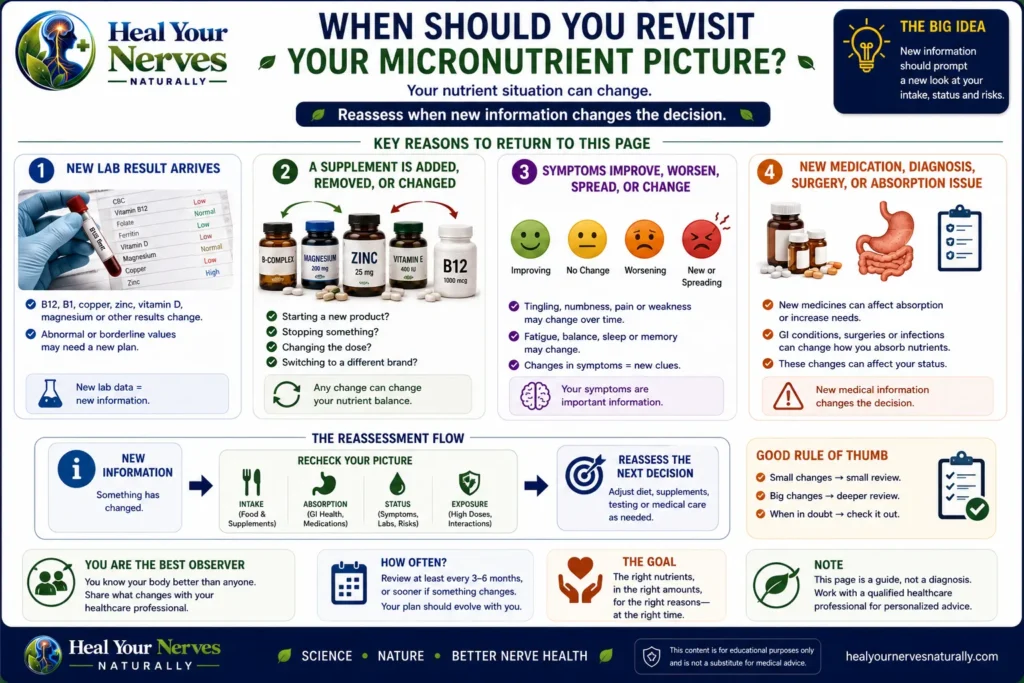
Identify → Interpret → Decide → Act → Reassess.
Mistake 6: Ignoring why a deficiency developed
If malabsorption, medication or GI surgery caused the problem, correcting intake alone may not answer the full question.
Mistake 7: Assuming symptom improvement should match the lab immediately
A blood value and a neurological symptom do not necessarily change on the same timeline.
That is why follow-up should include both the biochemical result and the person’s real-life function.
Common Questions About Micronutrients for Nerve Health
What vitamin is best for nerve health?
There is no single “best” vitamin for every person.
B12, B1, B6, copper and other micronutrients have different roles and different deficiency or toxicity risks. The most relevant nutrient is the one that fits your actual intake, status, risk factors and clinical context.
What vitamins repair nerve damage?
That wording is too strong.
Micronutrients are necessary for normal nerve biology, and correcting a real deficiency can be medically important. But taking extra vitamins does not automatically regenerate an injured axon, remove nerve compression or reverse every neuropathy.
For the biological distinction, read Micronutrients and Nerve Function and Regeneration Biology.
Can B12 deficiency cause nerve symptoms without anemia?
Yes. NICE specifically advises not to exclude B12 deficiency solely because anemia or macrocytosis is absent.
Can a normal B12 result still need interpretation?
Yes. Context matters, including the result, test method, symptoms, risk factors and prior B12 use. See the B12 interpretation section above for the full explanation.
Should I take B12 if I have tingling?
Not automatically.
Not automatically. Tingling has many possible causes. Use the B12 section above to review when testing and clinical evaluation may be appropriate.
Can too much vitamin B6 cause neuropathy?
Yes. Excess supplemental B6 is a recognized cause of sensory neuropathy. This is why total exposure from multiple products matters.
Can zinc cause copper deficiency?
High zinc intake, particularly from supplements, can interfere with copper absorption and contribute to copper deficiency.
Does magnesium fix tingling?
Magnesium is important for normal nerve and muscle function, but persistent tingling should not automatically be attributed to magnesium deficiency.
Is food always better than supplements?
Food provides nutrients within a broader dietary pattern and should usually form the foundation of nutrition. But food alone is not always sufficient—for example, when there is a clinically significant deficiency, malabsorption, a high-risk dietary pattern or a condition requiring replacement.
The key is to use supplements for a clear reason, not because “more nutrition” sounds safer.
Should I stop supplements before a blood test?
Do not make that decision on your own if the supplement was prescribed or is being used to treat a known deficiency. But tell the clinician exactly what you take. NICE notes that B12-containing over-the-counter products can alter B12 test results.
My nutrient level improved but symptoms remain. Does that mean treatment failed?
Not necessarily.
Nutrient status and neurological recovery are not the same timeline. Symptoms can also have more than one cause. If symptoms persist, worsen or change, reassessment matters.
Read Nutritional Deficiency and Nerve Damage for the cause pathway.
What We Want You to Remember
If you remember only six things from this page, remember these:
- Micronutrients for nerve health are about status—not simply supplement use.
- Intake and absorption are different questions.
- B12 deserves careful interpretation, especially when symptoms and risk factors are present.
- B6 proves that more is not always better.
- Nutrients can interact; high zinc and copper status are a good example.
- Persistent neurological symptoms deserve a broader view than nutrition alone.
Choose Your Next Step
If your main question is:
“What do these nutrients actually do inside a nerve?”
→ Read Micronutrients and Nerve Function.
“Why did I become deficient, and could that contribute to my symptoms?”
→ Read Nutritional Deficiency and Nerve Damage.
“What should I eat in normal daily life?”
→ Use Nerve Food Repair.
“How do I evaluate my supplement labels, doses and duplication?”
→ Use Supplement Intelligence.
“Could absorption be the real problem?”
→ Explore Gut Axis: Digestion, Absorption and Nutrient Bioavailability.
“Do my symptoms fit peripheral neuropathy?”
→ Read Peripheral Neuropathy.
References and Evidence
- NIH Office of Dietary Supplements — Vitamin B12: Fact Sheet for Health Professionals
- NICE — Vitamin B12 Deficiency in Over 16s: Diagnosis and Management
- NIH Office of Dietary Supplements — Vitamin B6: Fact Sheet for Health Professionals
- EFSA Journal — Scientific Opinion on the Tolerable Upper Intake Level for Vitamin B6
- NIH Office of Dietary Supplements — Thiamin: Fact Sheet for Health Professionals
- NIH Office of Dietary Supplements — Copper: Fact Sheet for Health Professionals
- NIH Office of Dietary Supplements — Folate: Fact Sheet for Health Professionals
- NIH Office of Dietary Supplements — Vitamin E: Fact Sheet for Health Professionals
- NIH Office of Dietary Supplements — Magnesium: Fact Sheet for Health Professionals
- FDA — FDA 101: Dietary Supplements
- Therapeutic Goods Administration — Peripheral Neuropathy With Supplementary Vitamin B6
- NIH Office of Dietary Supplements — Dietary Supplements and Life Stages: Pregnancy
- NINDS — Peripheral Neuropathy
- WHO — Healthy Diet
Medical disclaimer: This page is for general education and does not diagnose nutrient deficiency, neuropathy or another medical condition. Do not start, stop or substantially change prescribed medicines or high-dose supplements based only on this page. Seek professional medical care for persistent, progressive or severe neurological symptoms.