
Circadian Rhythm: A Clear Guide to Body Timing
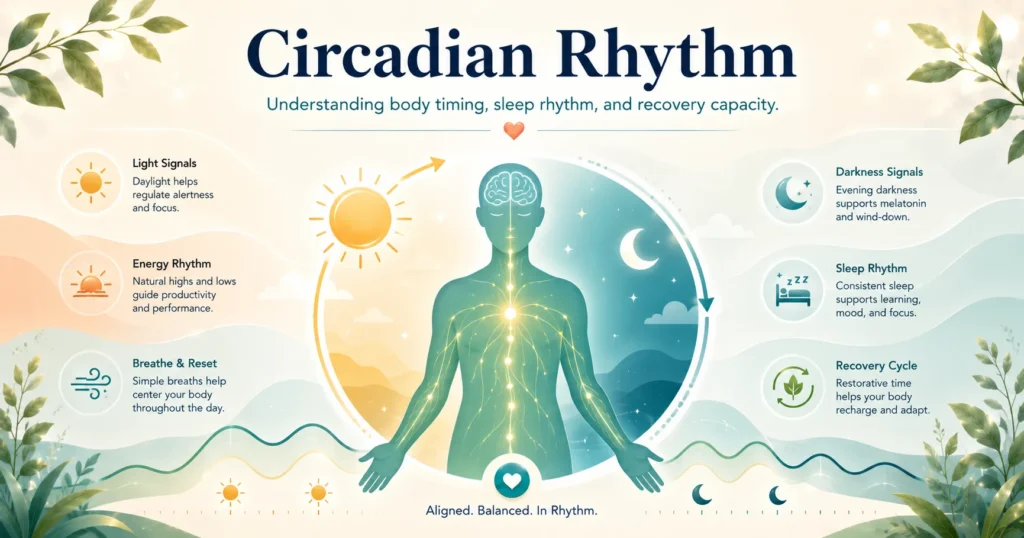
Circadian Rhythm is the body’s internal timing system. It helps organize sleep, wakefulness, alertness, hormone timing, body temperature, digestion, metabolism, immune rhythm, and recovery patterns across a roughly 24-hour cycle. It is not a treatment plan. Instead, it is an educational way to understand how body timing may influence nerve sensitivity, stress response, energy rhythm, and recovery capacity.
From a nerve health perspective, the Circadian Rhythm matters because nerves do not function in isolation from the rest of the body. They respond to sleep quality, light exposure, stress signals, circulation, inflammation, metabolic rhythm, and recovery windows. Therefore, when body timing becomes irregular, the nervous system may feel more reactive, tired, sensitive, or less settled.
NINDS explains that circadian rhythm and sleep homeostasis work together to regulate when a person is awake and when a person sleeps. NCBI Bookshelf also describes Circadian Rhythm as a 24-hour internal clock that regulates alertness and sleepiness, responding strongly to light changes in the environment.
Quick Navigation
What Is Circadian Rhythm?
Circadian Rhythm is the body’s natural daily timing pattern. In simple terms, it helps the body know when to feel awake, when to feel sleepy, when to release certain hormones, when digestion may be more active, and when recovery processes may be better organized.
A simple way to understand Circadian Rhythm is to imagine an internal clock. This clock does not control every detail by itself, but it helps different body systems stay coordinated. For example, sleep, body temperature, hunger, alertness, stress response, and repair timing all work better when they have a predictable rhythm.
This rhythm is strongly influenced by light. Morning light, evening darkness, sleep timing, meal timing, movement, stress, screen exposure, and daily routine may all send timing signals to the body. Because of this, Circadian Rhythm should not be understood as only a sleep topic. It is a body-wide timing system.
For nerve health education, this matters because the nervous system depends on rhythm. When timing becomes irregular, the body may have fewer predictable recovery windows. As a result, sensitivity, fatigue, pain perception, stress load, and emotional regulation may feel harder to manage.
How the Circadian Rhythm Works
First, the body receives timing signals from the environment. Light is one of the strongest signals. When light enters the eyes, it helps communicate time-of-day information to the brain’s central clock.
Next, the brain helps coordinate body timing. NCBI Bookshelf describes the suprachiasmatic nucleus, or SCN, as the central pacemaker of the circadian timing system. This small region helps regulate many circadian rhythms in the body.
As a result, different systems begin to follow daily patterns. Sleepiness, alertness, hormone rhythm, digestion, body temperature, and energy use may rise and fall across the day. In a healthy rhythm, the body usually becomes more alert during the day and more prepared for sleep and recovery at night.
However, when timing signals become inconsistent, the rhythm may become less clear. For example, late-night screen use, irregular sleep, shift work, stress, late meals, and inconsistent wake times may confuse the body’s timing system. Over time, this may affect sleep quality, energy rhythm, mood stability, stress response, and recovery capacity.
For this reason, Circadian Rhythm is best understood as a coordination system. It does not work alone. Instead, it interacts with the nervous system, stress system, metabolic system, sleep rhythm, hormone signals, and recovery cycles.
Key Layers of the Circadian Rhythm
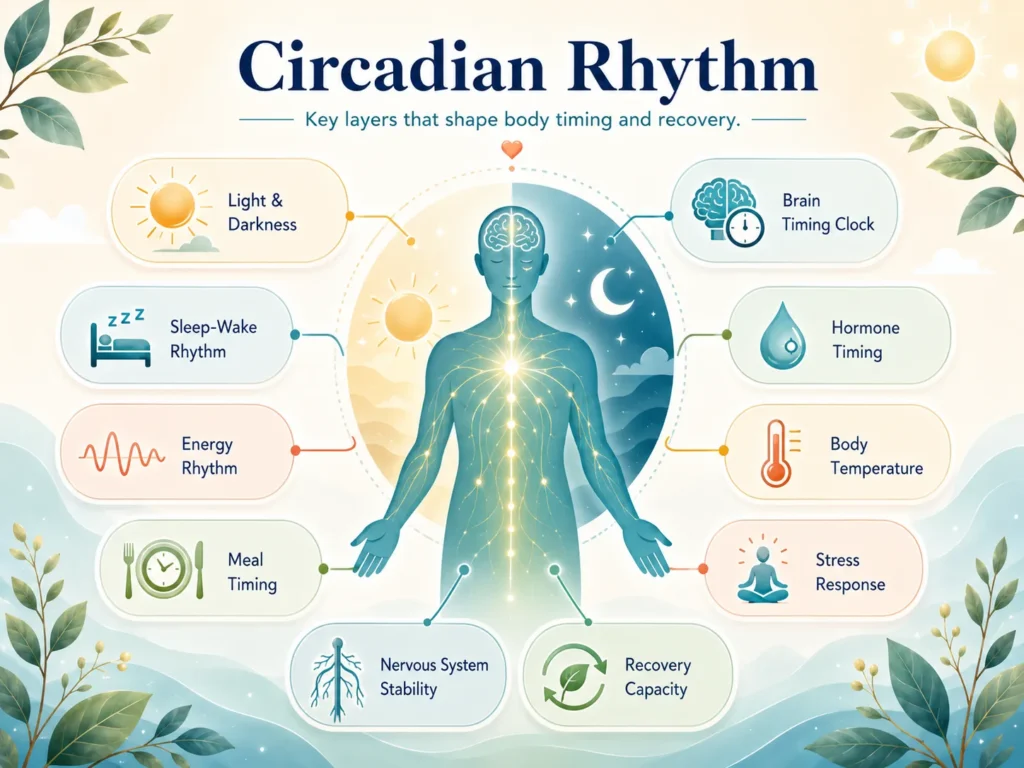
Light and Darkness Layer
Light and darkness are major timing cues for Circadian Rhythm. Morning light can help signal daytime alertness, while evening darkness helps the body prepare for sleep. In simple terms, light tells the body when to be active, and darkness helps signal when to wind down.
For example, bright light late at night may make it harder for the body to recognize that it is time to settle. Meanwhile, very little natural light during the day may make the rhythm less clear.
This layer matters because sleep timing affects recovery. When light and darkness signals are irregular, the nervous system may have a harder time moving between alertness and rest.
Sleep-Wake Timing Layer
The sleep-wake layer helps organize when the body feels awake and when it feels sleepy. NINDS explains that Circadian Rhythm works with sleep homeostasis to regulate wakefulness and sleep. Sleep homeostasis tracks sleep pressure, while Circadian Rhythm helps organize timing.
For example, a person may feel tired but still unable to sleep if their circadian timing is shifted. Another person may sleep enough hours but still feel unrefreshed if sleep happens at inconsistent times.
For nerve health education, this layer is important because sleep is a major recovery window. Poor timing may affect energy, sensitivity, emotional control, and recovery capacity.
Hormone Timing Layer
Circadian Rhythm helps organize hormone patterns across the day. For example, stress-related alertness signals, sleep-related signals, appetite-related signals, and metabolic signals often follow daily rhythms.
This does not mean hormones are good or bad by themselves. Instead, the key idea is timing. The body usually works better when alertness signals rise at helpful times and sleep-related signals appear when the body is ready to rest.
When the rhythm becomes irregular, hormone timing may feel less steady. As a result, a person may feel wired at night, tired in the morning, hungry at unusual times, or less stable during the day.
Body Temperature and Energy Layer
Body temperature and energy rhythm also follow daily patterns. Many people feel more alert during certain parts of the day and naturally slower during others. This is part of body timing.
For example, a person may feel a normal afternoon dip in energy. However, if sleep is irregular or stress is high, this dip may feel stronger. In some cases, the person may feel tired during the day and restless at night.
This layer matters because recovery requires energy organization. When body timing is inconsistent, the body may use energy less efficiently and may have fewer clear recovery windows.
Metabolic and Meal Timing Layer
Meal timing can also influence Circadian Rhythm. Digestion, blood sugar rhythm, appetite, and energy use often follow daily timing patterns. Therefore, irregular eating patterns may add another layer of timing stress.
For example, eating very late at night may send a “daytime activity” signal to the body. Meanwhile, skipping meals during the day may affect energy rhythm and stress demand.
This is not a diet instruction. Instead, it is a system-based explanation of how food timing may interact with body timing, energy rhythm, and nervous system stability.
Stress Response Layer
Stress can influence Circadian Rhythm, and Circadian Rhythm can influence stress response. When stress stays high at night, the body may have difficulty settling. At the same time, poor sleep timing may make the stress system more reactive the next day.
For example, a person under pressure may stay mentally active late into the night. Then, poor sleep may increase next-day fatigue, tension, and sensitivity. This can create a repeated stress-and-sleep loop.
This layer is important because chronic stress and circadian disruption often interact. The nervous system may need rhythm, not only rest, to feel more settled.
Recovery Timing Layer
Recovery does not happen randomly. Many recovery-related processes depend on timing, sleep, energy availability, circulation, immune rhythm, and nervous system state. Circadian Rhythm helps create predictable windows for these processes.
For example, deeper rest at night may support signal organization, tissue recovery, emotional processing, and energy restoration. If the rhythm is disrupted, these recovery windows may become less stable.
This does not mean the body cannot recover without a perfect schedule. However, rhythm may help the body coordinate recovery more clearly.
Circadian Rhythm Interactions
Sleep & Recovery Interaction
Circadian Rhythm is closely connected with sleep and recovery. Sleep is not only a pause from the day. It is an active state where the brain and body continue important functions. MedlinePlus explains that sleep helps the body restore energy and supports learning and memory.
When Circadian Rhythm is stable, sleep may become more predictable. However, when timing is irregular, sleep may become lighter, shorter, or harder to maintain.
Explore related page: Sleep & Recovery
Chronic Stress and Nervous System Dysregulation Interaction
Circadian Rhythm interacts strongly with chronic stress. Stress may delay sleep, increase nighttime alertness, and make the body feel less settled. Meanwhile, irregular sleep timing may increase next-day stress sensitivity.
This creates a loop. Stress disrupts rhythm, and disrupted rhythm increases stress demand. Because of this, Circadian Rhythm is a natural next step after Chronic Stress and Nervous System Dysregulation.
Explore related page: Chronic Stress and Nervous System Dysregulation
Autonomic Regulation Interaction
Autonomic Regulation explains how the body shifts between activation and recovery. Circadian Rhythm may influence this shift by helping the body know when to be alert and when to settle.
For example, heart rate, breathing rhythm, digestion, and body temperature may follow daily timing patterns. When this rhythm is disrupted, the autonomic system may feel less flexible.
Explore related page: Autonomic Regulation
Recovery Cycles Interaction
Recovery Cycles explain how the body moves between effort, rest, repair, and adaptation. Circadian Rhythm gives those cycles a daily timing structure.
For example, effort may be easier during the day, while deeper recovery may be more likely at night. When the schedule becomes irregular, the body may have difficulty organizing these cycles.
Explore related page: Recovery Cycles
Metabolic Support Interaction
Circadian Rhythm also connects with metabolism. Sleep quality and circadian timing may influence glucose rhythm, appetite timing, and energy use. Research reviews describe links between sleep, Circadian Rhythms, hormones, and metabolic processes.
This does not mean timing alone explains metabolic health. Instead, it shows that body timing may be one important layer in energy regulation.
Explore related page: Metabolic Support
Pain Processing Interaction
Pain Processing may be influenced by sleep timing, stress rhythm, fatigue, and nervous system alertness. When the body is underslept or out of rhythm, sensations may feel stronger or harder to ignore.
This does not mean pain is only a rhythm problem. Pain can involve many systems. However, Circadian Rhythm may shape the internal context in which pain signals are processed.
Explore related page: Pain Processing
Patterns That Influence Circadian Rhythm
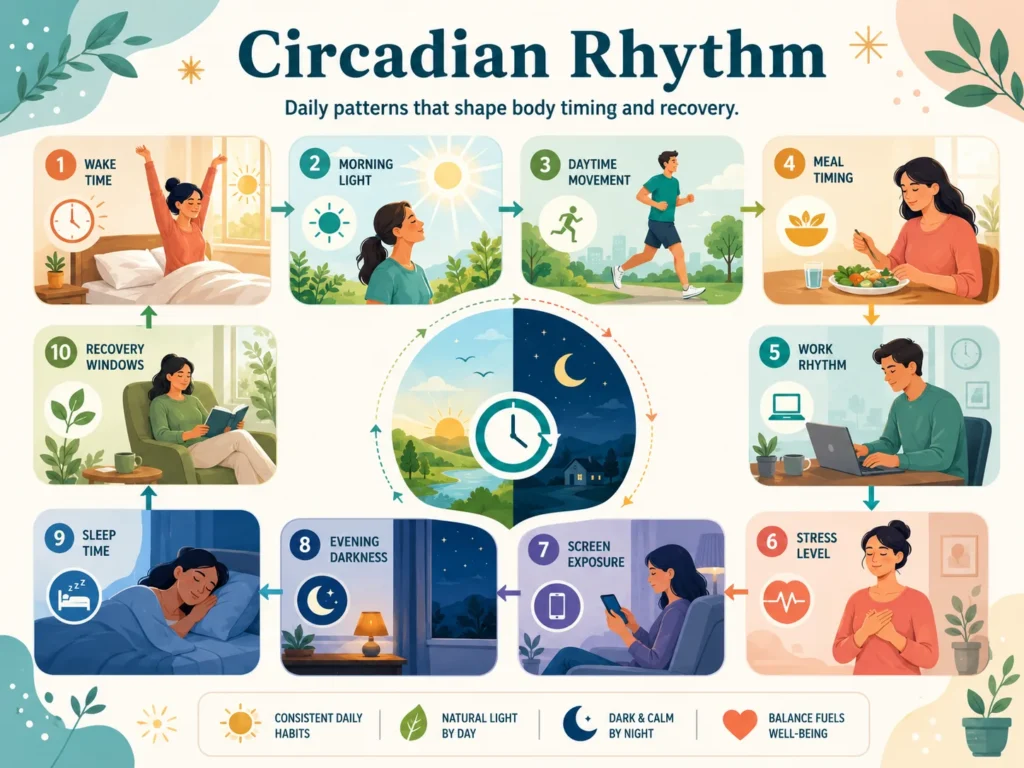
Daily patterns can strongly influence Circadian Rhythm. Often, the body responds not only to what happens, but also to when it happens.
For example, wake time, sleep time, light exposure, meal timing, movement, stress level, screen exposure, caffeine timing, and evening routine may all send timing signals. When these signals are consistent, the rhythm may become clearer. When they are inconsistent, the body may feel less settled.
This section is not a treatment plan. Instead, it helps readers understand how everyday patterns may shape body timing and nervous system stability.
| Daily Pattern | Possible System-Based View |
|---|---|
| Irregular sleep time | May make body timing less predictable |
| Late-night screen exposure | May delay sleep readiness for some people |
| Low morning light | May weaken daytime timing signals |
| Late heavy meals | May send an activity signal close to sleep time |
| High evening stress | May keep alertness systems active |
| Long daytime inactivity | May reduce natural energy rhythm |
| Shift work | May misalign sleep timing and internal body timing |
| Inconsistent wake time | May make the rhythm harder to stabilize |
In simple terms, Circadian Rhythm often responds to repeated timing patterns. Therefore, daily routine can be understood as a timing message to the body.
Circadian Rhythm and Nerve Function
Circadian Rhythm may connect with nerve function through sleep, stress response, energy rhythm, pain processing, inflammation, circulation, and autonomic regulation. When timing is steady, the nervous system may have clearer windows for alertness and recovery.
For example, poor sleep timing may make nerve sensations feel more noticeable the next day. A person may feel more burning, tingling, fatigue, or body-wide sensitivity during periods of poor sleep, high stress, or irregular routine. This does not mean Circadian Rhythm is the only cause. It means timing may be one layer that changes nervous system sensitivity.
Nerve symptoms should always be taken seriously, especially when they are sudden, severe, worsening, or linked with weakness, balance changes, bladder or bowel changes, chest pain, fainting, confusion, or difficulty breathing. This page is for education only.
From a system perspective, the key idea is simple: nerves live inside a timed body. When the body’s timing becomes disrupted, the nervous system may have more difficulty organizing signals, energy, and recovery.
Circadian Rhythm Visual Flow
Simple Educational Flow:
Light / Dark Signals
↓
Brain Timing System
↓
Sleep-Wake Rhythm
↓
Hormone, Temperature, Digestion, and Energy Timing
↓
Nervous System Alertness and Recovery Windows
↓
Nerve Sensitivity and Recovery Capacity
↓
Daily Rhythm Feedback Loop
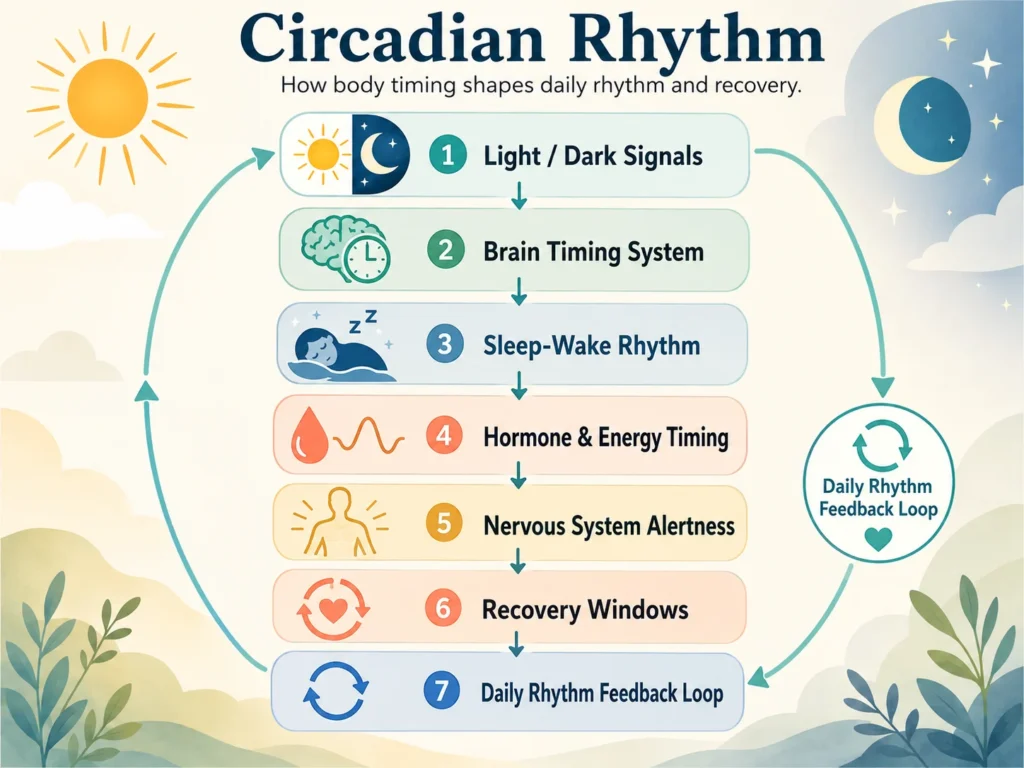
This flow is not always perfect or linear. In many cases, Circadian Rhythm works like a daily loop. Morning light, daytime activity, meal timing, stress level, evening routine, and sleep timing all feed back into the next day’s rhythm.
Different people may experience different patterns. One person may feel tired in the morning and wired at night. Another may feel sleepy during the day but restless at bedtime. Another may notice more nerve sensitivity after several nights of poor timing.
This is an educational model only. It does not diagnose sleep disorders, neurological conditions, hormone issues, or medical causes of fatigue.
Why the Circadian Rhythm Matters for Recovery
1. Recovery Requires Timing
Recovery is not only about what the body does. It is also about when the body does it. Circadian Rhythm helps organize sleep, energy, digestion, hormone signals, and recovery windows.
When timing becomes irregular, recovery may feel less efficient. The body may still work, but it may need more effort to organize repair and regulation.
2. Recovery Requires Sleep Rhythm
Sleep is one of the body’s most important recovery states. When the sleep-wake rhythm is stable, the body may have more predictable time for restoration, signal processing, and energy renewal.
However, when sleep timing changes often, the nervous system may feel less settled. As a result, fatigue, sensitivity, and stress reactivity may become more noticeable.
3. Recovery Requires Energy Rhythm
Energy is not the same throughout the day. Circadian Rhythm helps coordinate when the body feels more alert and when it is more ready to slow down.
When energy rhythm becomes irregular, the person may feel tired at the wrong time and alert at the wrong time. This can increase stress demand and reduce recovery quality.
4. Recovery Requires Nervous System Flexibility
A flexible nervous system can move between alertness and rest. Circadian Rhythm gives this flexibility a daily structure.
For example, the body may need activation during the day and deeper recovery at night. If timing is disrupted, the nervous system may feel stuck in alertness, fatigue, or mixed signals.
5. Recovery May Be Influenced by Repeated Timing Stress
Repeated timing stress may come from irregular sleep, late-night light, shift work, inconsistent meals, or high evening stress. Over time, these patterns may increase system demand.
Because of this, Circadian Rhythm matters for recovery capacity. It helps explain why rhythm, consistency, and timing may be just as important as effort.
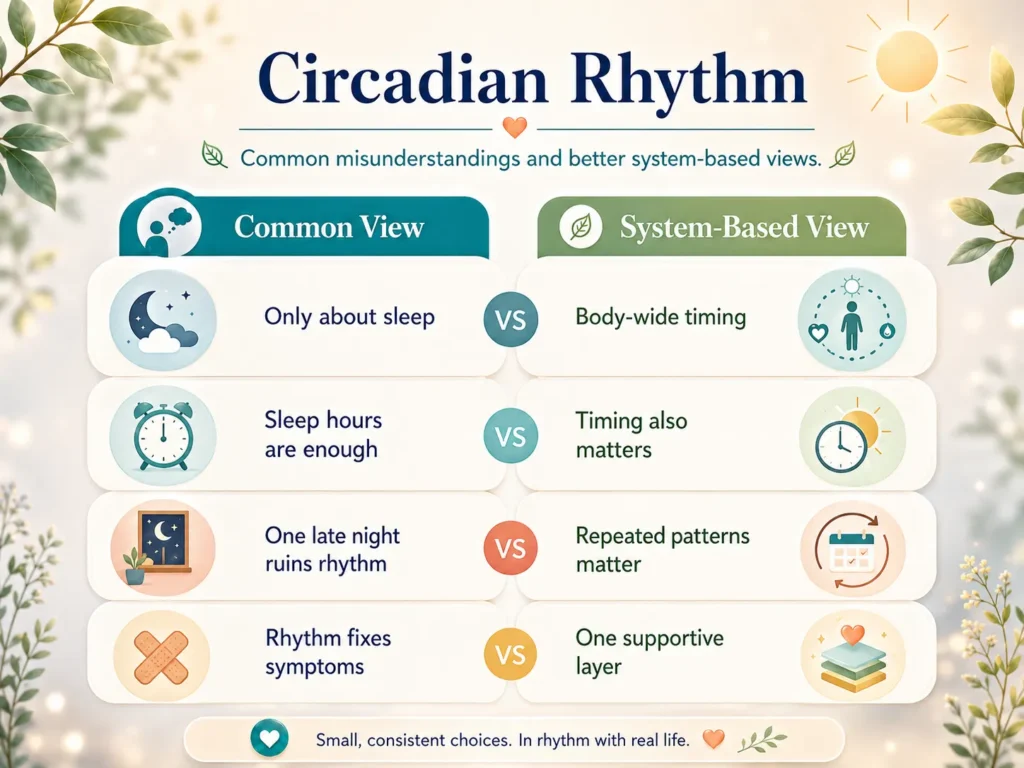
Common Misunderstandings About the Circadian Rhythm
| Common View | Better System-Based View |
|---|---|
| Circadian Rhythm is only about sleep | It also relates to hormones, energy, digestion, temperature, and stress response |
| Sleeping enough hours is always enough | Timing and consistency may also matter |
| Night owls are simply lazy | Body timing can be influenced by biology, light, routine, stress, and environment |
| One late night does permanent harm | The body can adapt, but repeated disruption may increase system demand |
| Circadian Rhythm fixes nerve symptoms | It may be one supportive layer, not a cure or treatment |
Misunderstanding 1: Circadian Rhythm is only a sleep topic.
Clarification:
Sleep is important, but Circadian Rhythm is broader. It may influence alertness, digestion, temperature, hormone timing, energy rhythm, mood, and recovery patterns.
Misunderstanding 2: More sleep always solves rhythm problems.
Clarification:
Sleep amount matters, but timing also matters. A person may sleep many hours and still feel unrefreshed if the rhythm is irregular.
Misunderstanding 3: A disrupted rhythm means the body is damaged.
Clarification:
A disrupted rhythm does not automatically mean damage. It may mean the body’s timing signals are inconsistent or overloaded.
Misunderstanding 4: Circadian Rhythm is a treatment plan.
Clarification:
This page does not provide treatment instructions. It explains body timing from an educational system perspective.
Misunderstanding 5: Circadian Rhythm explains every nerve symptom.
Clarification:
Nerve symptoms may involve many factors. Circadian Rhythm may be one layer, but symptoms still need proper medical evaluation when concerning.
FAQs About Circadian Rhythm
Can the circadian rhythm affect nerve sensitivity?
Circadian Rhythm may influence nerve sensitivity indirectly through sleep, stress response, energy rhythm, pain processing, and recovery capacity. However, it should not be assumed to be the only cause of symptoms.
Is the circadian rhythm the same as sleep?
No. Sleep is one part of the circadian rhythm. Circadian Rhythm also helps organize alertness, hormone timing, body temperature, digestion, energy, and recovery patterns.
Can irregular sleep timing affect stress?
Yes, irregular sleep timing may increase stress demand for some people. Poor timing may make the nervous system more reactive, especially when combined with emotional pressure, pain, or fatigue.
Does light affect Circadian Rhythm?
Yes. Light is one of the strongest timing signals for the body’s internal clock. Morning light and evening darkness may help the body understand day and night timing.
Can Circadian Rhythm affect recovery capacity?
Circadian Rhythm may influence recovery capacity by organizing sleep, energy rhythm, immune timing, autonomic regulation, and stress response. It is one possible layer in a larger recovery system.
When should someone seek medical care?
Seek medical care for severe insomnia, sudden neurological symptoms, worsening nerve symptoms, severe fatigue, fainting, confusion, chest pain, difficulty breathing, or symptoms that interfere with daily life.
Continue Learning
After understanding Circadian Rhythm, readers can continue exploring how sleep timing, stress response, recovery rhythm, and nervous system stability connect inside the larger Heal Your Nerves Naturally learning system.
Sleep & Recovery — learn how sleep may influence recovery capacity, nervous system settling, energy rhythm, and daily function.
Recovery Cycles — understand how the body moves between effort, rest, repair, and adaptation.
Chronic Stress and Nervous System Dysregulation — explore how repeated stress patterns may interact with nervous system activation and sleep rhythm.
Autonomic Regulation — learn how the body shifts between activation and recovery states through automatic nervous system patterns.
Pain Processing — understand how fatigue, stress, and poor sleep may shape signal interpretation and sensitivity.
Learning Path — follow a structured education journey from symptoms to systems, then from systems to recovery concepts.
Health Disclaimer — Review important safety guidance for educational health content.
Related Systems
Sleep & Recovery
Sleep & Recovery is closely connected with Circadian Rhythm because sleep is one of the main ways the body expresses its daily timing pattern. This page helps readers understand why sleep is not only rest, but also a recovery state.
Recovery Cycles
Recovery Cycles explains how the body moves between effort, rest, repair, and adaptation. Circadian Rhythm gives these cycles a daily structure.
Chronic Stress and Nervous System Dysregulation
Chronic Stress and Nervous System Dysregulation connects with Circadian Rhythm because repeated stress may disrupt sleep timing and keep the nervous system more activated.
Autonomic Regulation
Autonomic Regulation helps explain how the body shifts between activation and recovery. Circadian Rhythm may support this shift by organizing alertness during the day and settling at night.
Pain Processing
Pain Processing may connect with Circadian Rhythm because poor sleep timing, fatigue, and stress can influence how strongly the nervous system interprets signals.
Metabolic Support
Metabolic Support connects with Circadian Rhythm because meal timing, energy rhythm, sleep, and glucose patterns may interact across the day.
Regeneration Processes During Sleep
Regeneration Processes During Sleep can help readers understand how sleep-related timing may connect with repair, recovery, and body-wide regulation.
Sources / References
NINDS explains that circadian rhythm and sleep homeostasis work together to regulate when a person is awake and when a person sleeps. This supports the educational view that body timing and sleep pressure both shape sleep-wake rhythm.
NCBI Bookshelf describes Circadian Rhythm as a 24-hour internal clock that regulates alertness and sleepiness by responding to light changes in the environment.
NCBI Bookshelf describes the suprachiasmatic nucleus, or SCN, as the central pacemaker of the circadian timing system. This helps explain how the brain coordinates body timing.
MedlinePlus explains that sleep helps the body restore energy and supports learning and memory. This supports the role of sleep as an active recovery process, not only a passive rest state.
Research reviews also describe links between sleep quality, circadian rhythms, hormones, and metabolic processes. This supports the system-based view that Circadian Rhythm may connect with energy rhythm and metabolic regulation.
Educational Trust Note
This page is part of the Heal Your Nerves Naturally educational library. Its purpose is to help readers understand Circadian Rhythm as one possible body-wide timing system that may influence sleep, stress response, nerve sensitivity, energy rhythm, and recovery capacity.
This content does not diagnose, treat, cure, or prevent disease. It does not replace professional medical advice, diagnosis, testing, or treatment. For more context, readers may review the About page, Health Disclaimer, and Contact page.
Safety & Education Notice
This page is for educational purposes only. It is designed to help readers understand Circadian Rhythm from a calm, system-based perspective. However, it does not diagnose, treat, cure, or prevent any disease. It is also not a substitute for professional medical advice, diagnosis, or treatment.
In addition, sleep problems, nerve-related symptoms, fatigue, or sudden neurological changes may sometimes need professional evaluation. Therefore, readers should seek urgent medical care for severe, sudden, unusual, or worsening symptoms. These may include sudden weakness, loss of bladder or bowel control, chest pain, difficulty breathing, severe numbness, severe pain, fainting, confusion, or rapidly changing neurological symptoms.
Because this topic may involve medically sensitive body systems, readers should use this information for education only. For this reason, they should not use it to self-diagnose, stop medication, begin supplements, follow extreme sleep routines, or delay professional care. When symptoms feel concerning or unclear, it is always safer to speak with a qualified healthcare professional.