
Meaning & Purpose: A Simple Guide to Direction and Growth

Meaning & Purpose helps explain why people keep moving forward, even when life feels difficult. Every day, people make choices, build habits, solve problems, and respond to stress. However, not every action comes from the same reason. Some actions meet short-term needs, while others connect with deeper values, goals, relationships, or life direction. Therefore, understanding meaning and purpose can help readers better understand motivation, resilience, personal growth, and long-term behavior.
Many people search for questions such as “what does purpose mean,” “purpose meaning,” or “what is life meaning and purpose.” These questions often appear during stress, change, recovery, grief, or personal reflection. As a result, meaning and purpose are not only philosophical ideas. Instead, they may shape daily choices, priorities, emotional strength, relationships, and long-term growth.
Some people believe purpose must be one big life mission. However, purpose can appear in many simple and personal ways. For example, family, faith, learning, service, creativity, community, work, or personal growth may all provide meaning. In addition, purpose can change as life changes. Therefore, this page explains Meaning & Purpose as a flexible Human Systems topic, not as a rule everyone must follow.
This page does not diagnose mental health conditions, provide counseling, or offer treatment advice. Instead, it gives simple educational information about how values, goals, direction, and personal meaning may influence behavior, motivation, resilience, recovery-related learning, and long-term adaptation.
Quick Navigation
What Is Meaning & Purpose?
Plain Meaning / Glossary Box
How Meaning & Purpose Works
Key Layers of Meaning & Purpose
Real-Life Symptom Language Bridge
Meaning & Purpose and Human Systems
Meaning & Purpose Interactions
Practical Daily-Life Examples
Meaning & Purpose Visual Flow
Why Meaning & Purpose Matters for Recovery
Common Misunderstandings About Meaning & Purpose
Related Condition Connections
Topic Cluster Placement
Meaning & Purpose FAQ
Continue Learning
Sources / References
Author / Editorial Trust Note
Educational Trust Note
Safety & Education Notice
What Is Meaning & Purpose?
Meaning & Purpose refers to the values, goals, beliefs, relationships, and directions that help people understand why their actions matter. In simple terms, meaning helps answer, “What gives this value?” Purpose helps answer, “Why am I doing this?” These questions may sound simple. However, they often guide daily choices more than people realize. For example, a person may continue a hard project because it supports family, learning, service, faith, or personal growth.
Purpose does not need to be dramatic. In fact, many people find meaning through ordinary life. Caring for loved ones, helping others, learning new skills, building good habits, or living by personal values may all create direction. Therefore, Meaning & Purpose often shows up in daily actions, not only in major achievements. For a broader learning path, readers can explore Human Systems and Motivation as connected topics.
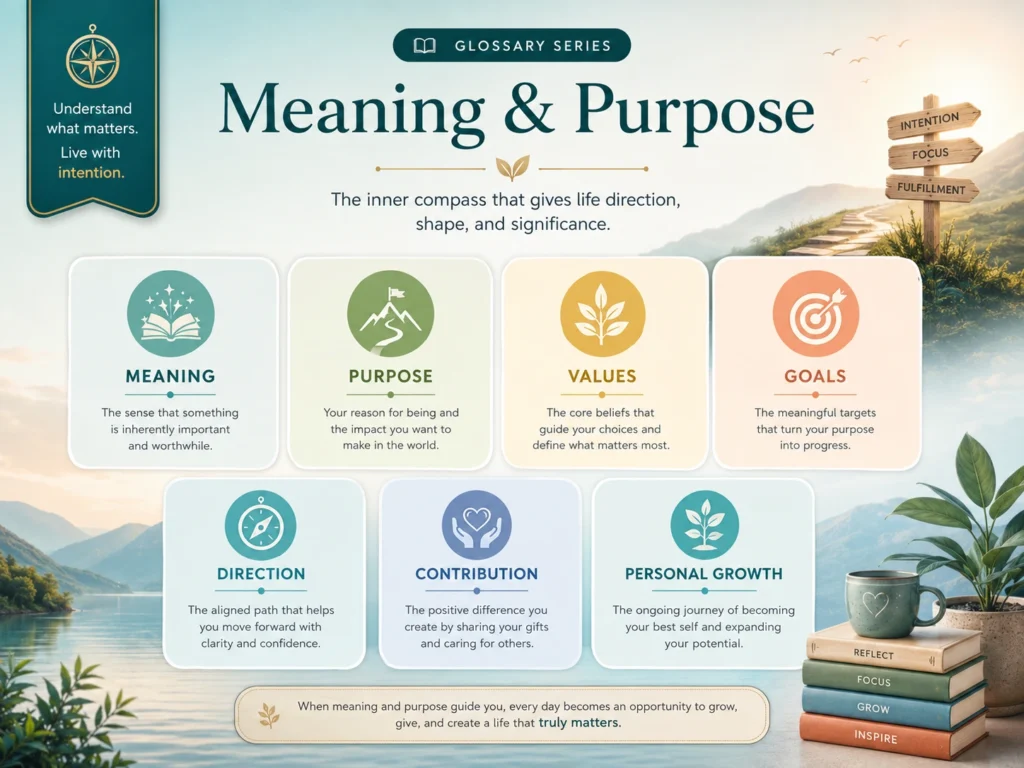
Plain Meaning / Glossary Box
Meaning
Meaning is the sense that an experience, relationship, action, or goal has value. For example, a simple daily responsibility may feel meaningful when it connects with love, service, growth, or personal values.
Purpose
Purpose is a reason, direction, or intention behind action. In simple words, purpose explains why something feels worth doing.
Meaning & Purpose
Meaning & Purpose combines value and direction. Together, they help explain why people choose certain goals and keep moving toward them over time.
Purpose Meaning
Purpose meaning simply means the reason or value behind an action, goal, responsibility, or direction.
What Does Purpose Mean?
Purpose means the reason behind something. It helps answer the question, “Why is this important?”
Life Purpose
Life purpose means a broader sense of direction that guides long-term choices, priorities, and growth.
Personal Values
Personal values are beliefs about what matters most. They often shape goals, habits, decisions, and relationships.
How Meaning & Purpose Works
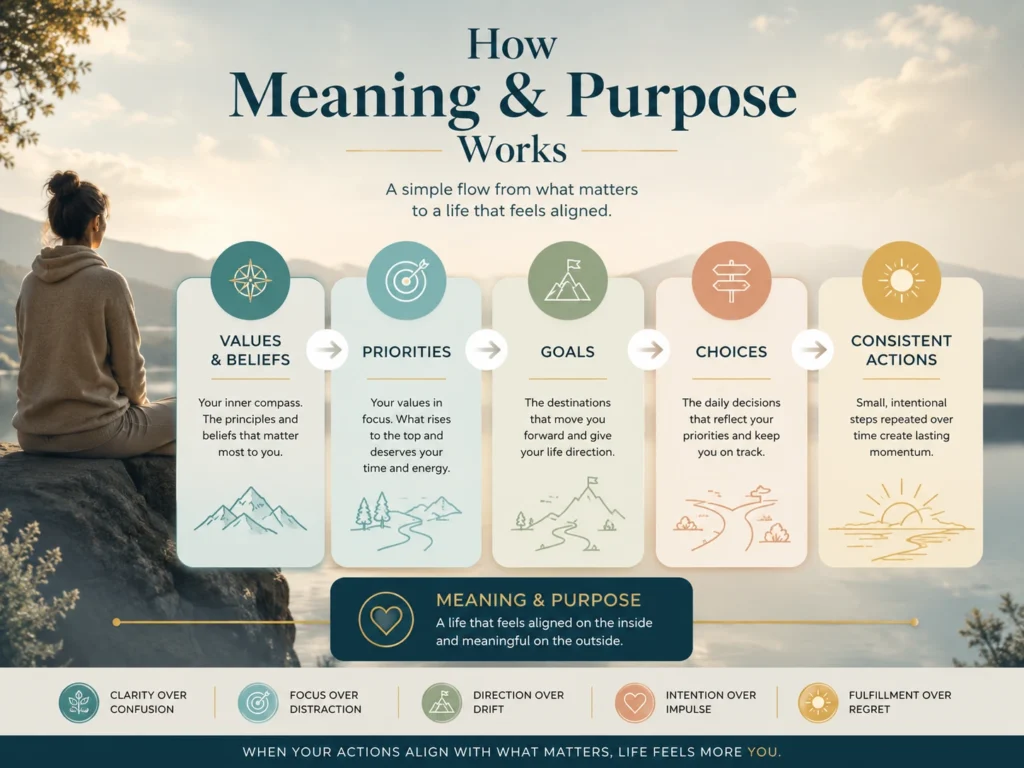
Meaning and purpose often begin when people notice what matters most to them. For example, family, health, learning, service, creativity, faith, independence, or relationships may become important priorities. Once these priorities become clearer, decisions may feel easier. As a result, people can compare daily actions with their deeper values and choose what deserves time, effort, and attention.
Purpose may also influence resilience. For example, two people may face the same challenge. One person may feel stuck because the challenge seems meaningless. Meanwhile, another person may continue because the effort connects with an important goal. Therefore, purpose can help people stay connected to direction during hard periods. However, purpose does not remove stress or solve every problem. Instead, it may provide a reason to continue learning, adapting, and making thoughtful choices.
Meaning & Purpose also affects attention. People often give more energy to activities they believe are important. Consequently, meaningful goals may receive more focus than goals that feel disconnected from personal values. In addition, purpose can support consistency when motivation rises and falls. This is why Meaning & Purpose connects naturally with Behavior Change, Stress & Coping, and Emotional Regulation.
Importantly, purpose is not fixed forever. It can change with age, family roles, education, work, health concerns, spiritual beliefs, loss, recovery, or personal growth. Therefore, people do not need to panic when their old goals no longer feel right. Instead, changing purpose may simply show that life is moving into a new stage. Because of this, Meaning & Purpose should be understood as an ongoing process, not a one-time discovery.
Key Layers of Meaning & Purpose
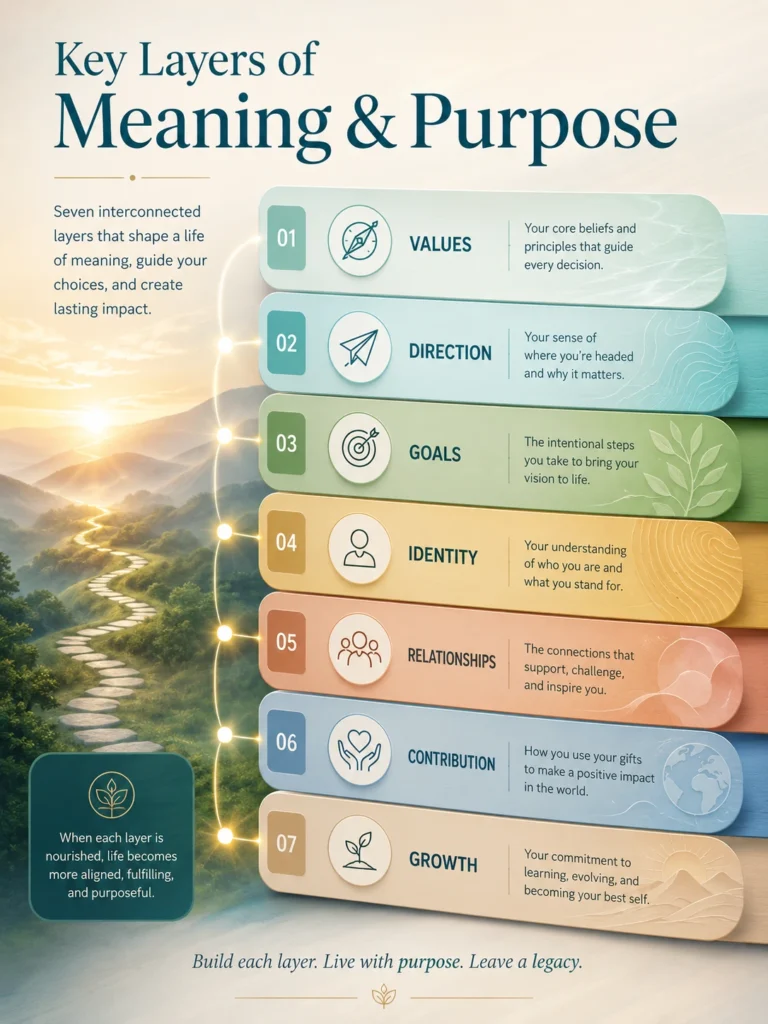
Meaning & Purpose Values Layer
Values form the foundation of Meaning & Purpose. They help people understand what feels important, worthwhile, and worth protecting. For example, honesty, learning, compassion, family, service, independence, responsibility, and growth may all function as values. When actions match these values, people may feel more settled and clear. However, when actions conflict with values, frustration or confusion may increase.
Meaning & Purpose Direction Layer
Direction gives people a sense of movement toward something that matters. It does not require knowing every future step. Instead, direction helps people understand where attention and effort should go next. For example, someone who values learning may choose education. Similarly, someone who values service may focus on helping others. Therefore, direction helps organize priorities in a practical way.
Meaning & Purpose Goal Layer
Goals turn purpose into action. Without goals, purpose can feel abstract. However, when goals are clear, purpose becomes easier to practice in daily life. These goals do not need to be large. Small goals, repeated over time, often create meaningful progress. As a result, purpose becomes visible through simple daily choices rather than only through big achievements.
Meaning & Purpose Identity Layer
Identity refers to how people understand themselves. Purpose often shapes identity because meaningful actions become part of a person’s life story. For example, someone may see themselves as a learner, caregiver, parent, helper, teacher, creator, friend, or community member. Consequently, this identity can guide choices, habits, and priorities over time.
Meaning & Purpose Relationship Layer
Relationships provide meaning for many people. Family, friendship, community, faith groups, partnerships, and support networks often influence direction and growth. Because humans are social beings, connection often supports resilience, belonging, and emotional strength. Therefore, meaning often grows through relationships, not only through individual goals.
Meaning & Purpose Contribution Layer
Contribution means making a positive difference. Some people find purpose through teaching, helping, mentoring, volunteering, creating, supporting others, or sharing knowledge. However, contribution does not need to be large. Small acts of care, service, and kindness may also create meaning. Consequently, purpose often grows through steady actions rather than extraordinary success.
Meaning & Purpose Growth Layer
Growth includes learning, adapting, improving, and becoming more aware. Many people feel purpose when they develop skills, understand themselves better, overcome challenges, or continue learning. Therefore, growth can support long-term meaning because it gives people a reason to keep developing across different stages of life.
Real-Life Symptom Language Bridge
Some readers arrive at a Meaning & Purpose page because they feel lost, stuck, disconnected, tired, uncertain, or unsure about life direction. Others may feel busy every day but still wonder whether their effort matters. In addition, some people continue working hard yet feel little satisfaction. Therefore, questions about meaning and purpose often appear during stress, change, recovery, grief, or personal growth.
Readers may also be exploring nerve health, recovery, stress management, emotional well-being, or Human Systems topics. They may notice fatigue, poor sleep, low motivation, emotional strain, worry, or reduced focus. However, these experiences can have many causes. Therefore, Meaning & Purpose should never be used to diagnose a medical condition, mental health condition, neurological disorder, or recovery issue.
Instead, Meaning & Purpose can help readers understand one human layer behind direction and persistence. For example, people who feel connected to important values may find it easier to keep going during hard times. However, purpose is not a cure for life problems. People can have strong purpose and still face stress, illness, grief, or uncertainty. Therefore, this topic should be viewed as one part of a larger Human Systems framework.

Meaning & Purpose and Human Systems
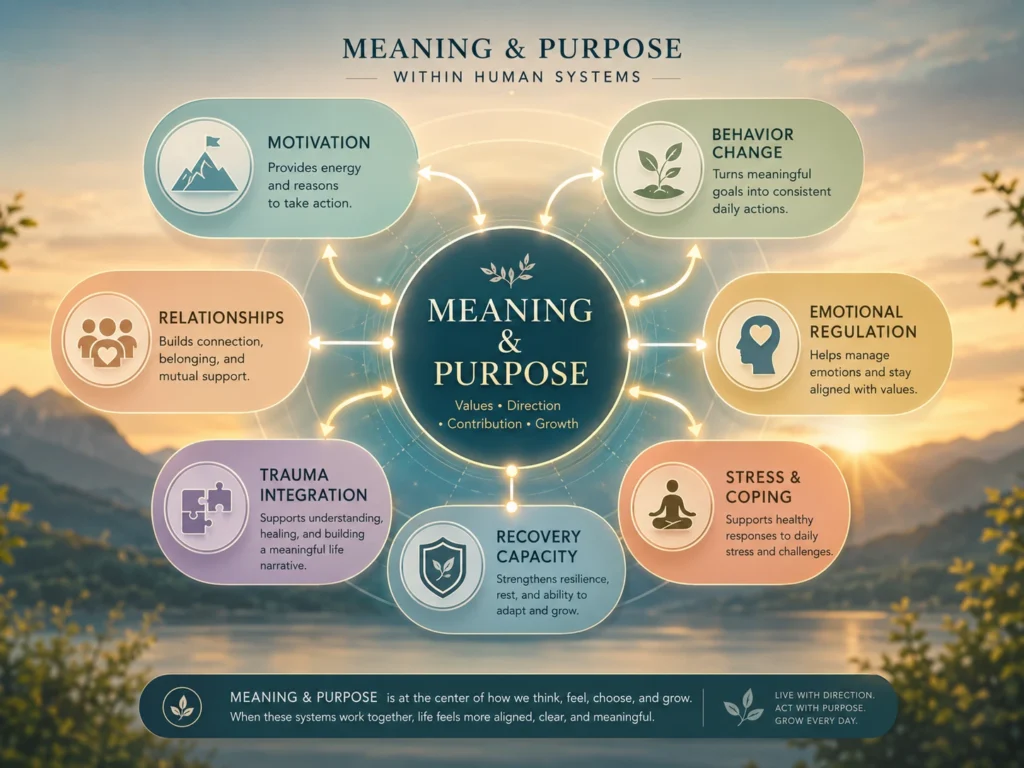
Meaning & Purpose belongs inside the Human Systems cluster because it explains how values, identity, direction, and long-term goals influence behavior. Emotions, stress responses, habits, motivation, relationships, and recovery capacity all affect daily decisions. However, purpose often provides the broader reason behind those decisions. Therefore, this topic helps connect daily action with deeper life direction.
For example, a person may feel motivated to start a new habit. However, long-term consistency often becomes easier when that habit connects with something meaningful. A sleep routine, learning goal, movement habit, or stress-management practice may feel more important when it supports family, independence, service, or personal growth. As a result, Meaning & Purpose can support behavior over time.
Meaning & Purpose also connects with emotional life. During stressful periods, people often reassess what matters most. In addition, strong emotions may narrow attention toward immediate problems. However, when people reconnect with values and direction, they may gain a broader view. Therefore, Meaning & Purpose works closely with Emotional Regulation, Stress & Coping, and Recovery Capacity and Nervous System Resilience.
Meaning & Purpose Interactions
Meaning & Purpose and Motivation
Motivation and Meaning & Purpose are closely connected. Motivation may provide the energy to begin action, while purpose explains why the action matters. For example, a person may want to improve sleep, movement, learning, or communication. However, when the deeper reason connects with family, growth, independence, or service, the action may feel more important. Therefore, purpose may support motivation over time.
Meaning & Purpose and Behavior Change
Behavior Change turns goals into repeated actions. Meaning & Purpose can support this process because meaningful goals often feel more worthwhile. For example, a person may want to build a better routine. If that routine only feels like a rule, it may be harder to continue. However, when it connects with values, recovery learning, family life, or personal growth, the routine may feel easier to maintain.
Meaning & Purpose and Emotional Regulation
Emotional Regulation and Meaning & Purpose often work together. Strong emotions can make problems feel bigger and narrow a person’s attention. However, purpose may help restore perspective by reminding the person what matters most. In addition, emotional awareness can help people respond thoughtfully instead of reacting quickly. As a result, decisions may stay more aligned with values and long-term direction.
Meaning & Purpose and Stress & Coping
Stress & Coping connects strongly with purpose because stress often forces people to choose where to spend limited time and energy. When purpose is clear, priorities may become easier to manage. For example, a person may decide which responsibilities deserve urgent attention and which can wait. Therefore, purpose can support coping by helping people focus on what matters most.
Meaning & Purpose and Recovery Capacity
Recovery Capacity and Nervous System Resilience may influence how easily people pursue meaningful goals. When sleep, energy, stress balance, and daily rhythm are poor, focus may become harder. As a result, direction may feel unclear. However, better recovery capacity may support clearer thinking and more stable action. Therefore, purpose and recovery often influence each other in indirect ways.
Meaning & Purpose and Trauma Integration
Trauma Integration may connect with Meaning & Purpose because difficult experiences can affect identity, direction, and life story. However, purpose should never be used to minimize pain or suggest that hardship is good. Instead, some people may slowly rebuild meaning through safety, support, learning, connection, and personal growth. Therefore, this connection must be explained with care.
Meaning & Purpose and Relationships
Relationships are one of the most common sources of meaning. Family, friendship, community, faith, support networks, and shared goals often shape purpose. For many people, purpose includes caring for others, helping a group, teaching, supporting loved ones, or creating something useful. Consequently, Meaning & Purpose often grows through connection rather than isolation.
Practical Daily-Life Examples
Finding Meaning Through Daily Responsibilities
Many people think purpose must involve a major achievement. However, meaning often appears through ordinary responsibilities. Caring for family, supporting friends, learning a skill, helping a community, or living by personal values may all create purpose. For example, a parent may find meaning through caring for children. Meanwhile, a teacher may find purpose through helping students learn. Therefore, purpose often grows through consistent actions.
Meaning During Life Transitions
Life transitions often make people think more deeply about purpose. Starting a new job, retiring, becoming a parent, moving, losing someone, recovering from illness, or entering a new stage of life may change priorities. During these times, old goals may feel less useful. However, new values, relationships, and responsibilities may become clearer. Therefore, uncertainty may be part of growth, not a sign of failure.
Meaning Through Learning and Growth
Learning provides meaning for many people because it supports curiosity, growth, and confidence. Some people find purpose through education, while others enjoy solving problems, building skills, exploring ideas, or sharing knowledge. In addition, growth can include emotional awareness, communication, creativity, spiritual reflection, or personal development. Therefore, learning may become a steady source of meaning throughout life.
Meaning Through Helping Others
Helping others is a common source of purpose. Contribution may include volunteering, teaching, mentoring, supporting family, encouraging friends, or sharing useful information. However, contribution does not need to be large. Small acts of care may also feel meaningful. As a result, purpose often grows through repeated acts of service, kindness, and connection.
Meaning During Difficult Times
People often ask about life meaning and purpose during difficult periods. Stress, grief, uncertainty, setbacks, and recovery challenges can make people question priorities. Purpose does not remove hardship. However, it may help people remember why continued effort matters. For example, a person may keep learning because education supports a future goal. Therefore, purpose can work as a guide during uncertainty.
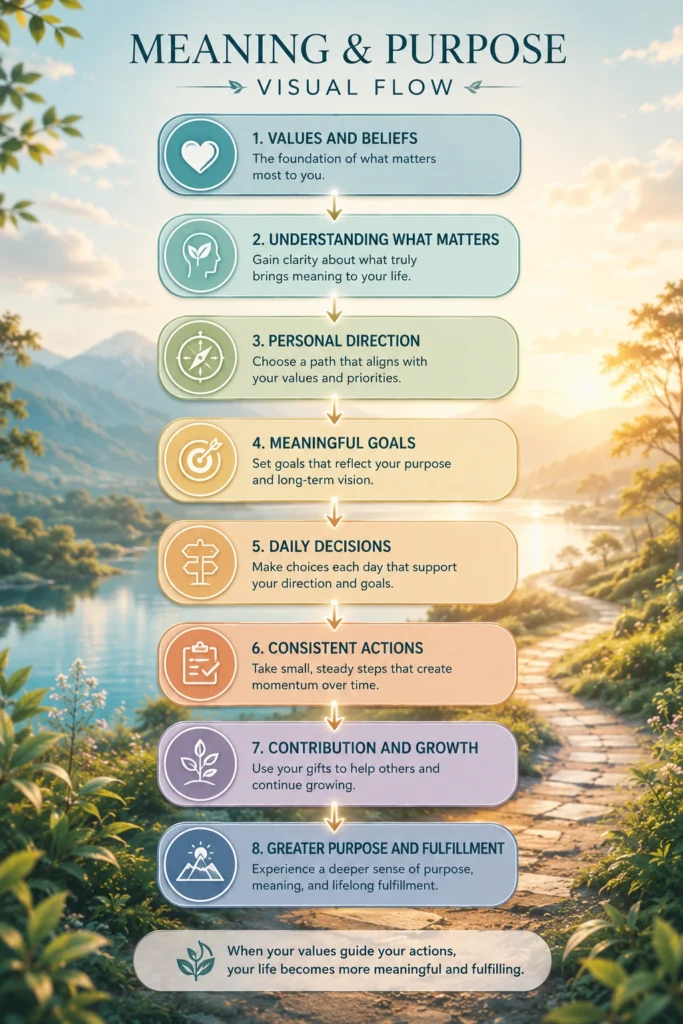
Meaning & Purpose Visual Flow
Values and Beliefs
↓
Understanding What Matters
↓
Personal Direction
↓
Meaningful Goals
↓
Daily Decisions
↓
Consistent Actions
↓
Contribution and Growth
↓
Greater Purpose and Fulfillment
This flow shows how Meaning & Purpose may develop over time. First, values help people understand what matters. Then, those values shape direction and goals. After that, goals guide daily choices. Over time, repeated actions may support contribution, learning, growth, relationships, and personal development. Therefore, purpose often becomes visible through behavior, not only through thought.
In addition, purpose is not always a final destination. Instead, it may work as an ongoing process of aligning actions with values. Because life changes, meaning may also change. Therefore, this visual flow should be understood as flexible, not fixed.
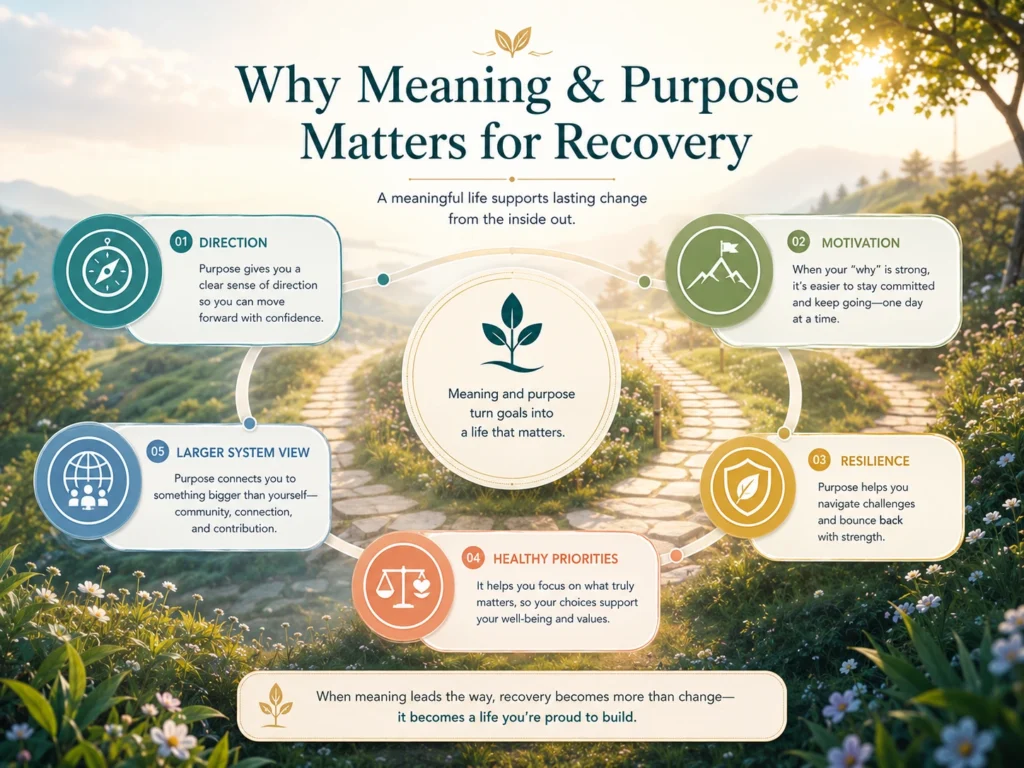
Why Meaning & Purpose Matters for Recovery
Meaning & Purpose Provides Direction
Recovery-related learning often includes uncertainty. People may face changing symptoms, stress, routines, responsibilities, or emotional pressure. During these times, purpose may help clarify what deserves attention. For example, a meaningful goal may encourage someone to keep learning, ask better questions, maintain supportive routines, or seek professional support when needed. Therefore, purpose can provide direction without pretending to solve everything.
Meaning & Purpose Supports Motivation
Purpose and motivation often work together. Motivation may help someone start, while purpose helps explain why the action matters. For example, a person may begin a habit because it seems useful. However, if that habit also supports family life, independence, learning, or long-term well-being, it may feel more meaningful. As a result, purpose may support long-term consistency.
Meaning & Purpose Encourages Resilience
Resilience means adapting to challenges while continuing forward. Meaningful goals may support resilience because they provide reasons to keep going during setbacks. For example, someone may continue education despite difficulty because learning matters. Similarly, another person may support loved ones during stress because relationships provide meaning. Therefore, purpose may help people maintain perspective during hard periods.
Meaning & Purpose Supports Healthy Priorities
Daily life includes many competing demands. Responsibilities, distractions, worries, and opportunities all compete for time and attention. However, clear purpose may help people decide what deserves priority. When values are clearer, choices often become simpler. Consequently, Meaning & Purpose can help organize work, relationships, learning, personal growth, and recovery-related education.
Meaning & Purpose Is Part of a Larger System
Meaning & Purpose is important, but it is not the whole story. Emotions, stress responses, habits, relationships, sleep, environment, health conditions, and support systems also influence behavior. Therefore, purpose should not be treated as a complete explanation for happiness, success, or recovery. Instead, it is one helpful layer inside a broader Human Systems framework.
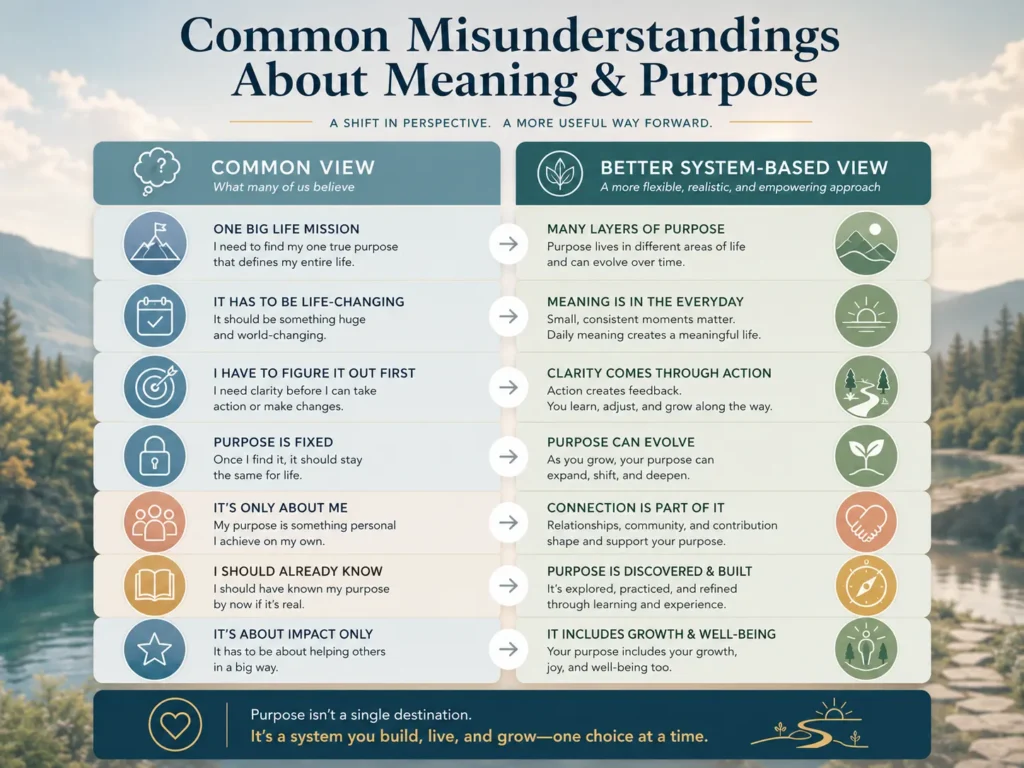
Common Misunderstandings About Meaning & Purpose
Many people misunderstand Meaning & Purpose because they think it must be one big life mission. However, real life is usually more flexible than that. Meaning can come from family, learning, faith, service, community, creativity, daily responsibility, and personal growth. Therefore, purpose does not have to be one perfect answer that a person must find quickly.
In many cases, purpose grows slowly. For example, a person may first find meaning through caring for family. Later, they may find meaning through learning, helping others, building skills, or supporting a community. As a result, purpose can change as life changes. This does not mean the earlier purpose was wrong. Instead, it may show that values, priorities, and life direction are developing over time.
| Common View | Better System-Based View |
|---|---|
| Everyone has one single life purpose. | Purpose may change and grow throughout life. |
| Purpose must be extraordinary. | Meaning often grows through simple daily actions. |
| Purpose removes stress. | Purpose may provide direction, but challenges can still exist. |
| Meaning only comes from work. | Relationships, learning, service, faith, creativity, and values may also create meaning. |
| No clear purpose means failure. | Many people explore, question, and refine purpose over time. |
| Purpose guarantees happiness. | Purpose may support fulfillment, but it does not remove difficulty. |
| Meaning is found only once. | Meaning often develops through ongoing life experience. |
One common misunderstanding is that purpose must be dramatic or impressive. In reality, many people experience deep meaning through ordinary parts of life. Family responsibilities, friendship, learning, faith, creativity, service, and helping others can all create purpose. Therefore, meaning is often built through repeated actions, not only through major achievements.
Another misunderstanding is that purpose never changes. However, life circumstances change over time. People grow, relationships change, responsibilities shift, and new experiences shape priorities. Consequently, values may become clearer or move in a new direction. Therefore, changing purpose does not mean a person failed. Instead, it may be part of healthy growth, reflection, and long-term personal development.
Related Condition Connections
Meaning & Purpose is a Human Systems topic, not a medical condition. However, some readers may find this page while exploring nerve health, emotional well-being, stress, recovery learning, or long-term adaptation. Therefore, this section helps connect the topic with broader education without suggesting that purpose explains symptoms.
For example, readers learning about Peripheral Neuropathy may also explore stress, habits, emotional resilience, daily routines, and personal direction. Similarly, readers exploring Diabetic Neuropathy, Nerve Compression, Sciatic Nerve Pain, or Post-Injury Nerve Damage may also think about long-term adjustment, learning, coping, and behavior change.
However, Meaning & Purpose should never be used to diagnose symptoms or predict medical outcomes. Nerve-related conditions can have many causes and may require professional evaluation. Therefore, this page should only support education about values, direction, motivation, and personal growth.
Topic Cluster Placement
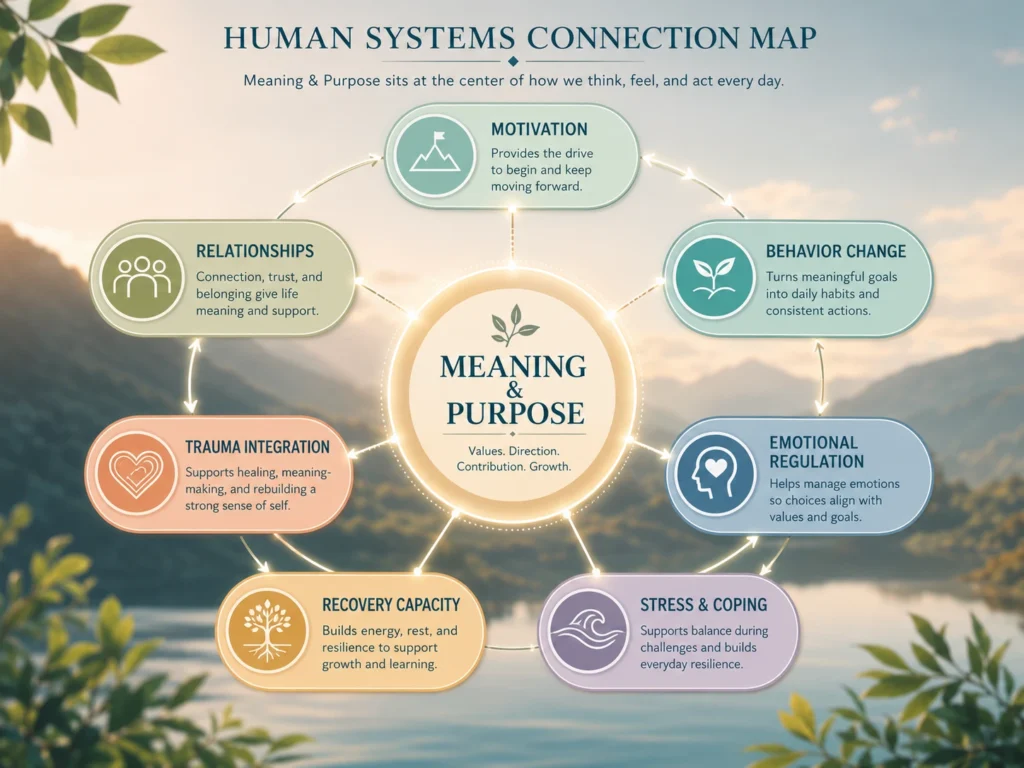
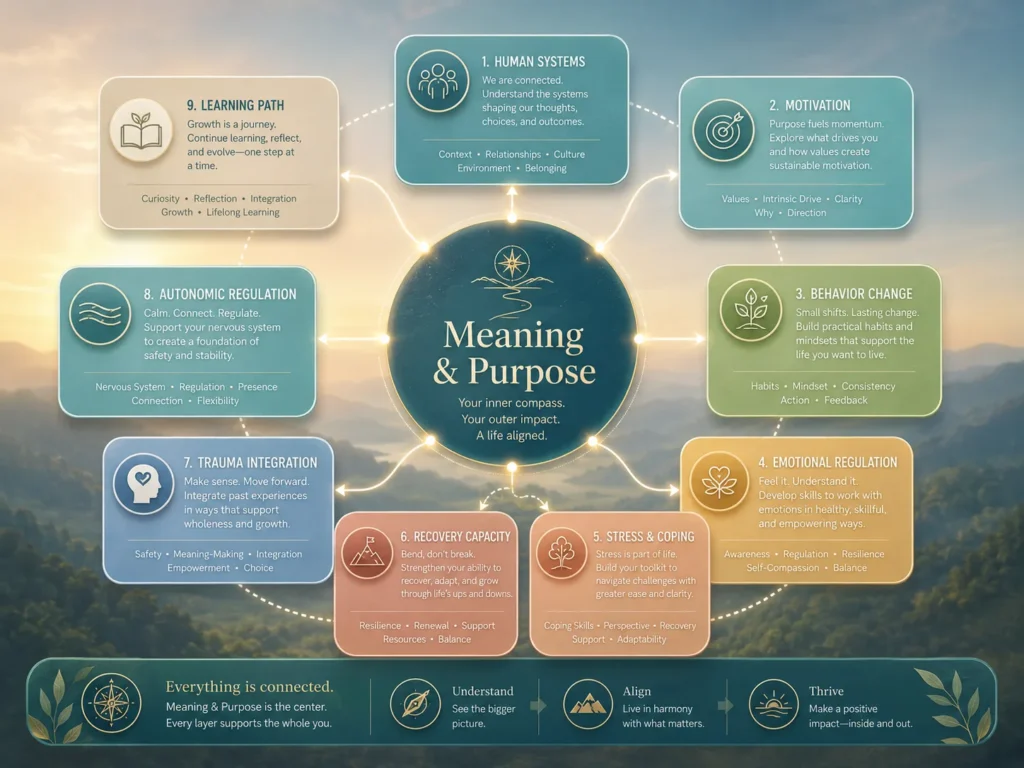
Meaning & Purpose belongs inside the Human Systems cluster because it explains how values, identity, direction, contribution, and long-term goals influence behavior. This page naturally connects with Motivation because purpose often gives motivation a deeper reason. It also connects with Behavior Change because meaningful goals may support repeated action over time.
In addition, Meaning & Purpose connects with Emotional Regulation because emotions can shape priorities and decisions. It also connects with Stress & Coping because stress often forces people to decide what matters most. Meanwhile, Recovery Capacity and Nervous System Resilience may affect the energy available for meaningful action. Finally, Trauma Integration may connect with purpose through identity, rebuilding, growth, and adaptation.
Recommended Human Systems learning path:
Emotional Regulation
↓
Stress & Coping
↓
Behavior Change
↓
Motivation
↓
Meaning & Purpose
↓
Trauma Integration
This path helps readers understand how emotions influence coping, coping influences behavior, behavior influences action, and action connects with meaning, identity, and long-term direction.
Meaning & Purpose FAQ
What is Meaning & Purpose?
Meaning & Purpose refers to the values, goals, priorities, and directions that help people understand why their actions matter. It helps explain what feels important, worthwhile, and worth continuing over time.
What does purpose mean?
Purpose means having a reason, direction, or intention behind actions and choices. In simple words, it answers the question, “Why is this important?”
What is purpose meaning?
Purpose meaning refers to the value, reason, or significance behind a goal, action, responsibility, or direction. It explains why something matters to a person.
What is life meaning and purpose?
Life meaning and purpose refers to the sense that life has value, direction, and worthwhile goals. Different people find meaning through different values, relationships, responsibilities, and contributions.
Can purpose change over time?
Yes. Purpose can change as life changes. New relationships, responsibilities, learning, work, health concerns, faith, loss, or growth may all influence what feels meaningful.
Do I need one single life purpose?
No. Many people find meaning through several parts of life at the same time. Family, learning, service, creativity, faith, community, and personal development may all contribute to purpose.
Does purpose guarantee happiness?
No. Purpose may support direction and fulfillment. However, it does not remove stress, grief, uncertainty, or hardship. Therefore, it should be viewed as one helpful influence, not a guarantee.
How does purpose connect with motivation?
Purpose can strengthen motivation because it explains why goals matter. While motivation may rise and fall, meaningful goals often provide more stable reasons for continued effort.
Continue Learning
Meaning & Purpose is only one part of the broader Human Systems cluster. Although it explains values, direction, and long-term priorities, it becomes more useful when viewed beside related topics. Therefore, readers can continue exploring connected pages to build a fuller understanding of behavior, resilience, and personal growth.
Readers who want to understand how goals begin can continue with Motivation. Motivation often provides the energy to start action, while meaning explains why that action matters. Those who want to turn goals into daily routines can continue with Behavior Change. This topic explains how meaningful goals can become repeated actions.
Readers who want to understand emotions can explore Emotional Regulation. Emotions often shape attention, choices, and priorities. Likewise, Stress & Coping explains how stress affects direction, resilience, and daily decisions. For deeper learning, readers can continue with Trauma Integration, Recovery Capacity and Nervous System Resilience, and Autonomic Regulation.
Finally, readers can explore the broader Learning Path to understand how Human Systems, nervous system education, recovery concepts, and personal growth topics fit together inside Heal Your Nerves Naturally.
Sources / References
The following sources were used to support this educational page. They help readers understand mental health, well-being, stress, behavior, personal growth, and human development in a safe and simple way.
MedlinePlus — Mental Health explains how mental health connects with emotions, thinking, stress, relationships, and daily choices.
NIMH — Caring for Your Mental Health provides helpful education about self-care, emotional well-being, healthy habits, and support-seeking.
CDC — Mental Health and Well-Being Resources explains how mental health is connected with overall health, families, communities, and public well-being.
World Health Organization — Mental Health and Well-Being explains mental well-being as part of health, daily function, learning, work, coping, and community contribution.
American Psychological Association — Human Behavior Resources provides broader psychology education about behavior, goals, values, motivation, and personal development.
NIH / NCBI — Human Behavior and Well-Being Research Resources provides access to research and educational material related to health, behavior, resilience, and well-being.
These sources are provided for education only. They should not be used for self-diagnosis, treatment decisions, or replacing professional care.
Author / Editorial Trust Note
This article was created by Heal Your Nerves Naturally as an educational resource. It uses a system-based approach to explain how Meaning & Purpose, values, direction, contribution, and growth may influence behavior and long-term adaptation.
The content is designed to help readers understand Human Systems topics in clear and practical language. However, it does not provide medical advice, mental health treatment, counseling, psychotherapy, diagnosis, or professional coaching. Readers should seek qualified professional support for personal medical, psychological, emotional, or behavioral concerns.
Educational Trust Note
Heal Your Nerves Naturally provides educational information about nerve health, nervous system learning, Human Systems, recovery capacity, personal development, and long-term adaptation.
The goal is to explain complex topics in a simple, structured, and evidence-informed way. Therefore, this page focuses on education rather than treatment. Readers can use this information for learning while seeking professional guidance when personal care is needed.
Safety & Education Notice
This page is for educational purposes only. It does not diagnose, treat, cure, or prevent any disease, medical condition, neurological disorder, psychological disorder, or mental health condition.
Questions about meaning and purpose often appear during stress, uncertainty, grief, recovery, or life transition. However, purpose should never replace professional care. If emotional distress becomes severe, persistent, or affects daily life, seek support from a qualified healthcare professional or mental health professional.
In addition, severe depression, thoughts of self-harm, panic, severe anxiety, or other concerning emotional experiences require appropriate support. Sudden neurological symptoms, severe weakness, loss of balance, severe numbness, bladder or bowel changes, severe pain, or rapidly worsening symptoms also need prompt medical evaluation.
This page is designed to support education about values, direction, meaning, and personal growth. It should be used as a learning resource, not as a substitute for professional care.