
Nutrition for Nerve Repair: Everyday Foods, Family Meals and Practical Answers

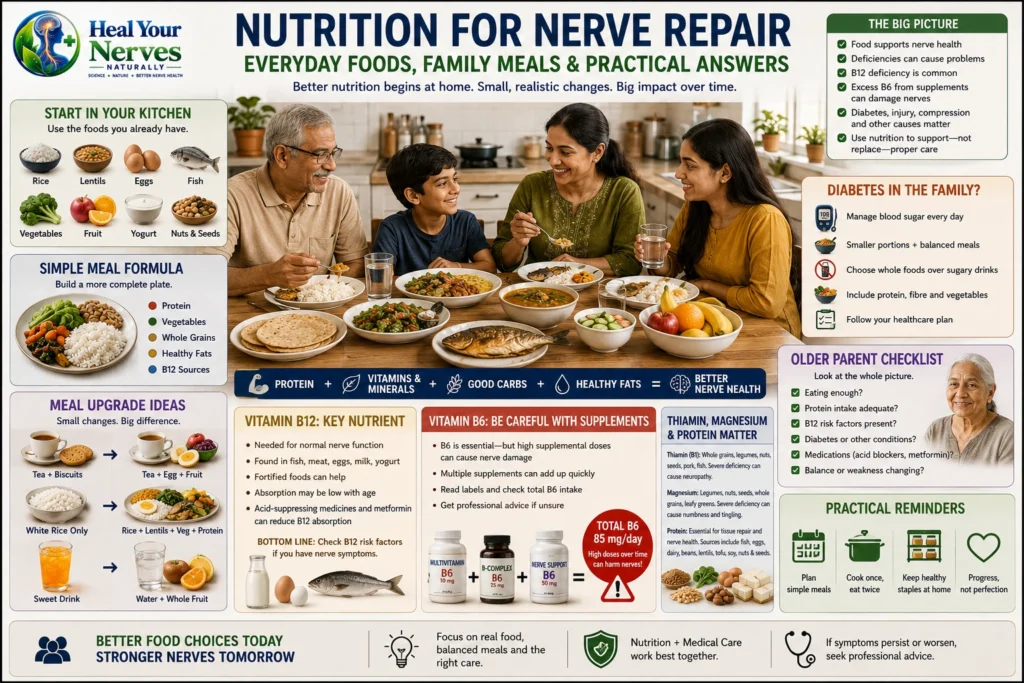
Nutrition for Nerve Repair does not have to begin with expensive supplements, unusual superfoods or a completely separate “healing diet.” For most families, the more useful starting point is much closer to home: the food already in the kitchen, the meals cooked every day, and the nutritional gaps that may actually matter.
Perhaps you eat rice and lentils most days.
Maybe there are eggs in the refrigerator, fish in the freezer and vegetables waiting to be cooked.
Perhaps breakfast is rushed, lunch happens at work, and dinner is the only meal the family eats together.
Or maybe an older parent has started eating less and is now complaining of numb feet.
These situations are much closer to real life than a list of twenty exotic “nerve regeneration foods.”
Nutrition matters because the nervous system requires adequate energy, protein, vitamins, minerals and healthy metabolic support. At the same time, food cannot correct every cause of nerve dysfunction.
Peripheral neuropathy can result from diabetes, physical injury, compression, vascular problems, autoimmune disorders, nutritional imbalance, alcohol-related problems, medications and other causes. Vitamin B12 deficiency and excess vitamin B6 are among the best-known vitamin-related causes.
Therefore, the purpose of this Nutrition for Nerve Repair guide is not to convince you that food can cure every nerve problem.
It is to help you make better decisions with the food, routines and family circumstances you already have.
If your main question is specifically “Which foods should I eat for nerve health?”, you can also use our more food-focused Nerve Food Repair guide.
Here, however, we will focus on everyday life:
What should I put on the family table?
Are rice and lentils okay?
Are eggs useful?
Does my elderly parent need B12?
Can I drink tea or coffee?
Do I need expensive fish?
What if I have diabetes?
Should I take a B-complex?
And when is food simply not enough?

What Can Nutrition for Nerve Repair Realistically Do?
A useful nutrition plan needs realistic expectations.
Can Food Actually Help Nerves?
Yes, but “help” can mean several different things.
Food can help you:
- meet normal energy requirements;
- obtain enough protein;
- prevent or correct some nutrient deficiencies;
- maintain adequate B12 intake;
- support metabolic health;
- support cardiovascular health;
- maintain a more stable overall recovery environment.
That is meaningful.
However, it is different from saying that one food can regrow every damaged nerve.
Can Poor Nutrition Actually Cause Nerve Problems?
In some situations, yes.
Nutritional and vitamin imbalances can contribute to peripheral neuropathy. B12 deficiency is particularly important, while severe thiamin deficiency can also produce tingling, numbness and other neurological symptoms.
This is why Nutrition for Nerve Repair should take true deficiencies seriously.
Does That Mean Every Person With Tingling Has a Vitamin Deficiency?
No.
That is one of the most important distinctions on this page.
Tingling can have many causes.
A vitamin deficiency is only one possibility.
If you have persistent numbness, tingling, burning or weakness and do not yet understand the cause, our Peripheral Neuropathy guide provides a broader starting point.
Nutrition for Nerve Repair in a Normal Family Kitchen
You do not need to replace everything in the house.
Instead, look at the foods already eaten by the family and ask what role they can play.
Is Rice Bad for Nerve Health?
No.
Rice does not “damage nerves” simply because it is rice.
For most people, the more useful question is what accompanies the rice.
A plate that contains a very large portion of refined rice and almost nothing else is nutritionally different from a meal containing:
rice + lentils + vegetables + fish or egg
The second meal adds protein, fibre, vitamins and minerals.
If you have diabetes or prediabetes, the amount and type of carbohydrate and your individual glucose response become more important.
Therefore, Nutrition for Nerve Repair should not teach people to fear rice.
It should teach them how to build a better meal around it.
Are Lentils or Dal Good for a Nerve-Supportive Diet?
Yes, lentils can be very useful.
They provide plant protein, fibre and several micronutrients.
They are also inexpensive and familiar in many households.
A bowl of lentils does not regenerate a damaged nerve by itself.
However, dal can make an everyday meal more nutritionally complete.
For example:
rice + dal + vegetables + egg
is far more useful nutritionally than:
rice + a small amount of sauce
This is the kind of practical difference that matters over time.
Are Eggs Good for Nerves?
Eggs are useful foods for many people.
They provide protein and vitamin B12, among other nutrients.
Therefore, eggs can be particularly practical when fish or meat is expensive or inconvenient.
However, an egg is not a nerve-repair medicine.
Think of eggs as one convenient way to contribute to nutritional adequacy.
Do I Need to Eat Eggs Every Day?
No.
There is no requirement to eat one particular food every day for nerve health.
If your diet includes other reliable protein and B12 sources, eggs are simply one option.
The whole pattern matters more than a single food.
Is Fish Better Than Chicken for Nerve Health?
Both can provide useful protein.
Fish may also provide B12 and, depending on the type, omega-3 fats.
Fatty fish such as salmon, sardines, herring and mackerel provide EPA and DHA omega-3 fatty acids. Nuts and seeds such as walnuts, chia and flax provide ALA.
However, this does not mean fish directly regenerates damaged nerves.
Use fish because it is a nutrient-dense food—not because it is a guaranteed neuropathy treatment.
What If Salmon Is Too Expensive?
Then do not build your diet around salmon.
Expensive imported foods are not required for Nutrition for Nerve Repair.
Use affordable local fish where available.
Eggs, lentils, beans, soy foods and dairy can also help meet protein needs.
A health plan should work financially as well as nutritionally.
Is Chicken Useful?
Yes.
Chicken can provide protein and several nutrients.
Again, the goal is not identifying whether chicken is a “nerve food.”
The goal is building adequate, balanced meals.
What About Beef or Other Meat?
Meat can provide protein and B12.
However, it should be considered within the overall diet, individual health needs and preferences.
A person does not need large amounts of red meat simply because B12 matters.
Several other B12 sources are available.

What About Milk, Yogurt, Fruit and Snacks?
These foods are often already in the home.
Is Milk Good for Nerves?
Milk can provide protein and vitamin B12.
For people who tolerate dairy, it can be an easy way to improve nutritional intake.
However, dairy is not essential for everyone.
Someone who avoids dairy can obtain protein and B12 through other foods or fortified products.
Is Yogurt Better Than Milk?
Not necessarily.
Both can fit a healthy diet.
Yogurt may be convenient as a snack or breakfast component.
For example:
plain yogurt + fruit + oats + nuts
creates a more substantial meal than tea and biscuits alone.
Is Cheese Good for Nerves?
Cheese can provide protein and B12.
However, some cheeses are also high in sodium and saturated fat.
Therefore, it is better treated as one food within the wider diet rather than a “nerve therapy.”
Which Fruit Is Best for Nerves?
There is no single best fruit.
That is good news because it means you do not need expensive berries.
Use what is affordable and available.
Bananas, oranges, apples, berries, guava, papaya and other fruits can all contribute to dietary variety.
WHO emphasizes fruit, vegetables, pulses and whole grains as part of a diverse healthy dietary pattern.
Are Bananas Good for Nerves?
Bananas provide carbohydrate, potassium and some vitamin B6.
They are a normal nutritious food.
They do not treat neuropathy by themselves.
Also, the concern about B6 toxicity applies mainly to high supplemental doses—not eating ordinary B6-containing foods such as bananas.
Are Berries Necessary?
No.
Berries can be nutritious.
However, you do not need blueberries every morning to support nerve health.
Use them if you enjoy and can afford them.
If not, choose other fruits.
Can I Drink Fruit Juice Instead?
Whole fruit generally offers fibre that juice lacks.
Juice can also make it easy to consume more sugar quickly.
For most people, whole fruit is the more useful everyday option.
If diabetes is involved, beverage choices deserve particular attention.
What Vegetables Should the Family Eat?
You do not need a special “nerve vegetable.”
Is Spinach a Nerve-Repair Food?
Spinach contains useful nutrients, including magnesium.
Magnesium is involved in normal nerve and muscle function. Green leafy vegetables, legumes, nuts, seeds and whole grains can all provide magnesium.
Still, spinach does not directly repair damaged nerves.
Are Potatoes Bad?
No.
Potatoes are ordinary foods and can contribute nutrients, including B6.
What matters is how they fit into the total meal and how they are prepared.
A boiled or roasted potato beside protein and vegetables is nutritionally different from a large portion of deep-fried potatoes eaten as the whole meal.
Do Carrots Help Nerves?
Carrots are nutritious vegetables.
However, they are not specific neuropathy treatments.
The practical advice is to eat a variety of vegetables rather than assign a medical effect to each one.
Fresh or Frozen Vegetables?
Either can work.
Frozen vegetables can be especially useful for busy families because they last longer and reduce waste.
A vegetable you actually cook is more valuable than fresh produce that repeatedly spoils in the refrigerator.
Is Canned Food Automatically Bad?
No.
Canned beans, lentils, fish and vegetables can make healthy meals easier.
Check labels where appropriate, particularly for sodium.
Convenience does not automatically mean poor nutrition.
Are Nuts and Seeds Worth Buying?
For many families, yes—but they are optional rather than essential.
Nuts and seeds can provide protein, unsaturated fats, magnesium and other nutrients.
Which Nuts Are Best?
There is no need to find one “best” nut.
Walnuts provide ALA omega-3 fats, while many nuts provide magnesium and unsaturated fats.
Use what fits your budget and preferences.
Are Peanuts Okay?
Yes.
Peanuts can be an affordable source of protein and unsaturated fats for people without peanut allergy.
You do not need expensive almonds to create a nutritious diet.
Are Chia Seeds Necessary?
No.
They can be useful, but they are not necessary.
If your family already uses inexpensive local seeds, nuts, legumes and fish, there may be no reason to buy trendy imported ingredients.
Does Cooking Oil Matter?
The overall amount and type of fat matters more than a single “nerve-healing oil.”
Is Olive Oil Required?
No.
Olive oil can be part of a healthy diet, but it is not compulsory.
Other unsaturated plant oils can also fit a healthy eating pattern.
The goal is not to purchase the most fashionable oil.
Is Coconut Oil Good for Nerve Repair?
There is no strong basis for describing coconut oil as a nerve-regeneration treatment.
Use cooking fats according to your overall health needs and normal culinary pattern.
Should I Stop Fried Food Completely?
Not necessarily.
An occasional fried food is not the same as a diet dominated by fried and highly processed foods.
The practical goal is moderation.
A pattern built mostly around minimally processed foods is more useful than an all-or-nothing rule that the family cannot maintain.
Tea, Coffee and Water: Common Family Questions
These are everyday habits, so they deserve straightforward answers.
Can I Drink Tea?
Tea does not need to be banned because you have nerve symptoms.
However, pay attention to what you add.
Several cups of heavily sweetened tea every day can contribute a meaningful amount of added sugar.
That becomes more relevant if diabetes or prediabetes is present.
Does Coffee Damage Nerves?
Ordinary coffee is not established as a common cause of peripheral neuropathy.
However, caffeine can affect sleep, anxiety or palpitations in some people.
If coffee makes you sleep poorly and poor sleep makes your symptoms harder to manage, reducing coffee may help indirectly.
The practical question is:
“How does my coffee habit affect the rest of my health?”
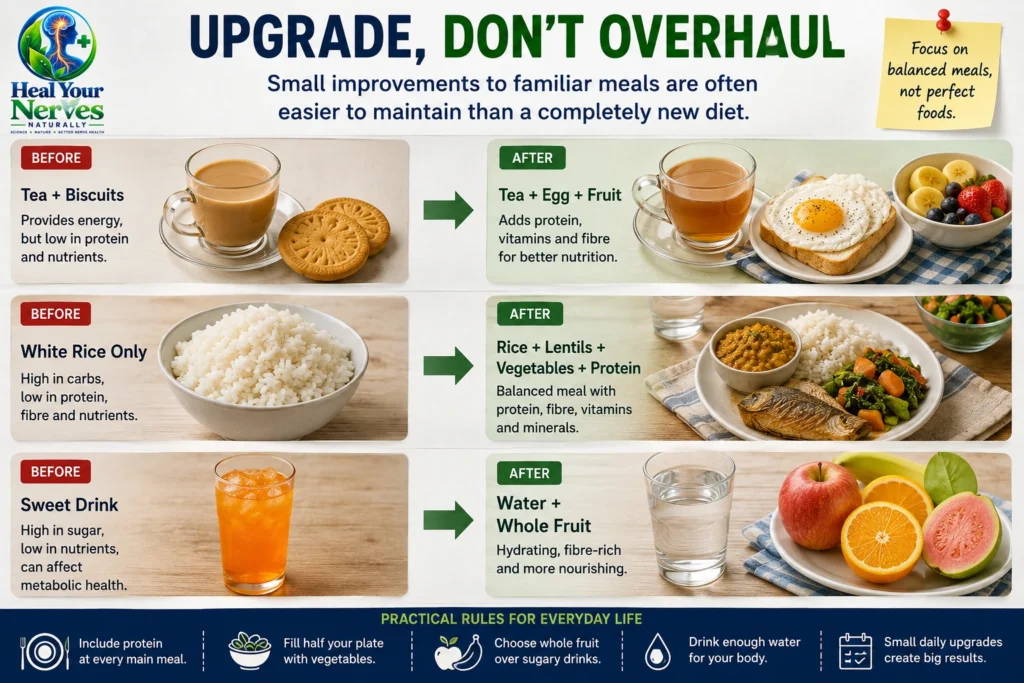
Is Tea and Biscuits a Good Breakfast?
For most people, it is nutritionally limited.
Tea and biscuits may provide energy but usually offer much less protein and micronutrient variety than a more complete breakfast.
A simple upgrade could be:
tea + egg + whole-grain toast + fruit
or
tea + yogurt + oats + banana
You do not have to eliminate tea.
Improve what surrounds it.
Does Drinking More Water Repair Nerves?
No.
Adequate hydration is important for normal health.
However, extra water does not regenerate injured nerves.
Drink enough for your circumstances without treating water as a neuropathy treatment.
Vitamin B12 and Nutrition for Nerve Repair
If there is one nutrient families should understand clearly, it is vitamin B12.
Why Does B12 Matter?
Vitamin B12 is required for normal nervous-system function.
Deficiency can lead to neurological problems.
It is possible for a person to have nerve-related B12 symptoms even when their diet appears generally healthy.
Which Everyday Foods Contain B12?
Natural sources include:
- fish;
- meat;
- poultry;
- eggs;
- milk;
- yogurt and other dairy products.
Fortified foods can also contain B12.
NIH notes that B12 is naturally found in animal foods and is also added to some fortified products.
My Father Eats Fish and Eggs. Can He Still Have Low B12?
Yes, it is possible.
Dietary intake is not the only issue.
Some people have difficulty absorbing B12 from food.
This becomes more common with certain gastrointestinal conditions and with age.
NIH also notes that some older adults may have difficulty absorbing naturally occurring food-bound B12.
Can Stomach Medicine Affect B12?
Some acid-suppressing medicines can interfere with B12 absorption from food.
NIH specifically notes that gastric-acid inhibitors can reduce absorption of food-bound B12.
Do not stop a prescribed medication because of this page.
Instead, if long-term acid-suppressing medication and unexplained neurological symptoms occur together, ask your clinician whether B12 status deserves evaluation.
What About Metformin?
Metformin may reduce B12 absorption and lower blood B12 concentrations.
Again, the correct action is not to stop metformin.
It is to recognize that useful diabetes treatment and nutrient monitoring can happen together.
If My B12 Is Low, Can I Fix It With Eggs and Milk?
Sometimes better food intake helps.
However, if absorption is impaired, food alone may not correct the problem.
That is why diagnosed B12 deficiency needs a cause-based approach.
Are B12 Injections Always Necessary?
No.
Treatment depends on the cause and individual situation.
Some people receive oral B12, while injections are used in other circumstances, especially when absorption is problematic. NIH notes that deficiency can occur despite adequate intake when absorption is impaired.
Vitamin B6: The Supplement Question Families Often Miss
B6 is an essential vitamin.
However, high-dose B6 supplementation can become a neurological problem.
Can Too Much B6 Cause Nerve Damage?
Yes.
NIH warns that high amounts of supplemental B6 taken for a prolonged period can cause severe nerve damage. By contrast, excessive B6 intake from ordinary food is uncommon.
This distinction is important.
You do not need to fear potatoes or bananas.
You should pay attention to supplement labels.
How Can Someone Accidentally Take Too Much?
Consider this routine:
morning multivitamin;
afternoon B-complex;
evening “nerve support” capsule.
All three may contain B6.
The person sees three different products.
The body sees the total intake.
Should I Throw Away My B-Complex?
Not automatically.
Instead:
- read the label;
- check the B6 amount;
- check whether other supplements also contain B6;
- discuss unnecessary high-dose use with an appropriate professional.
The point of Nutrition for Nerve Repair is not to create supplement fear.
It is to replace blind supplement use with informed decisions.

What About Thiamin, Magnesium and Protein?
These nutrients matter, but they should not be oversold.
Why Does Thiamin Matter?
Thiamin, or vitamin B1, helps the body turn food into usable energy.
Severe deficiency can cause beriberi, including tingling, numbness and impaired nerve function.
Food sources include whole and fortified grains, legumes, seeds, nuts, pork and fish.
Does Everyone With Neuropathy Need Extra Thiamin?
No.
Correcting a deficiency is important.
Taking extra thiamin when there is no deficiency is a different question.
Do not confuse the two.
Does Magnesium Help Nerves?
Magnesium is involved in normal nerve and muscle function.
Legumes, nuts, seeds, whole grains and green leafy vegetables are useful food sources.
Severe magnesium deficiency can produce numbness and tingling.
However, that does not mean every person with tingling needs magnesium supplements.
Why Does Protein Matter?
Protein provides amino acids used throughout the body.
If someone regularly skips meals or eats very little protein, simply adding vitamins may not solve the larger nutritional problem.
Useful protein sources include:
fish, eggs, poultry, dairy, beans, lentils, tofu, soy, nuts and seeds.
For the deeper biology, continue to Protein & Aminos.
Does More Protein Mean Faster Nerve Repair?
No.
The goal is adequate intake.
More is not automatically better.
Nutrition for Nerve Repair When Diabetes Is in the Family
This is where household food choices become particularly important.
Why Does Diabetes Change the Plan?
Diabetes is a major cause of peripheral neuropathy.
Therefore, for a person with diabetes, nutrition has two jobs:
support general nutrient adequacy and support diabetes management.
Current ADA Standards of Care continue to address neuropathy within comprehensive diabetes management.
Can Someone With Diabetes Eat Rice?
Often, yes.
However, portion size, meal composition, medication and individual glucose response matter.
A useful meal may contain:
smaller rice portion + lentils + vegetables + protein
rather than making rice the entire meal.
Should Someone With Diabetic Neuropathy Stop Eating Fruit?
Not automatically.
Whole fruit can fit diabetes meal plans.
The amount and timing may need to reflect individual glucose management.
Does Sugar Directly Poison the Nerves?
That wording is misleading.
The concern in diabetes is chronic hyperglycemia and broader metabolic disease—not one teaspoon of sugar acting like a nerve poison.
Use accurate language because fear does not create better diabetes care.
What About Sweet Tea?
This is where a household habit can add up.
If someone drinks four or five cups of tea with several teaspoons of sugar each day, the total intake may become meaningful.
Reducing sugar gradually may be easier than suddenly banning tea.
Should Someone With Diabetes Fast to Heal the Nerves?
Do not use fasting as a self-prescribed nerve treatment.
Fasting can interact with diabetes medications and glucose management.
There is no established universal fasting protocol that regenerates diabetic nerves.
What If an Older Parent Has Numb Feet?
This is a common family situation.
An older parent may say:
“My feet feel dead.”
Or:
“I cannot feel the floor properly.”
The family may respond by buying vitamins.
That may or may not address the actual problem.
What Should the Family Check First?
Look at the whole situation:
- How long have the symptoms been present?
- Is there diabetes?
- Is the person eating enough?
- Has weight been lost?
- Is B12 intake reliable?
- Are acid-suppressing medicines used?
- Is metformin used?
- Is walking or balance changing?
- Are several supplements already being taken?
Older adults may have more difficulty absorbing food-bound B12, making this nutrient particularly worth considering.
What If My Parent Has Little Appetite?
Do not force enormous meals.
Smaller nutrient-dense meals may work better.
For example:
egg + toast;
yogurt + fruit;
lentil soup;
soft fish + rice + vegetables;
oatmeal with milk or fortified alternative.
Persistent unexplained appetite loss or weight loss deserves medical attention.
What If Chewing Is Difficult?
Use softer foods.
Eggs, yogurt, oatmeal, cooked lentils, soups, soft fish, tofu and cooked vegetables can make eating easier.
Nutrition must fit the person’s actual abilities.

Nutrition for Nerve Repair for Vegetarians and Vegans
Plant-based eating can be nutritionally strong when it is planned well.
What Is the Main Nerve-Related Nutrient to Watch?
Vitamin B12.
Plant foods do not naturally provide dependable B12 in the same way animal-derived foods do.
Therefore, fortified foods and/or supplementation need deliberate attention.
Can Lentils Replace Meat?
For protein purposes, lentils can contribute significantly.
However, lentils do not naturally replace the B12 found in animal foods.
Protein and B12 are separate nutritional jobs.
What Can a Vegan Family Eat?
A practical pattern might include:
oats with fortified plant milk;
lentils and rice;
beans;
tofu or soy;
vegetables;
fruit;
nuts and seeds;
whole grains.
Then maintain a reliable B12 strategy.
Is a Vegan Diet Bad for Nerves?
No.
The issue is not whether the diet is vegan.
The issue is whether nutritional requirements are covered.
A well-planned vegan diet and a poorly planned omnivorous diet are not nutritionally equivalent simply because one contains meat.
What If the Family Budget Is Tight?
This matters because expensive advice is often unusable advice.
Which Affordable Foods Give the Most Value?
Depending on local prices:
- lentils;
- beans;
- eggs;
- oats;
- rice;
- seasonal vegetables;
- seasonal fruit;
- peanuts;
- canned fish;
- local fish;
- milk or yogurt;
- fortified cereals.
You do not need imported salmon, berries, avocado and almonds to build Nutrition for Nerve Repair into everyday life.
Is Frozen Food a Waste of Money?
Not if it prevents waste.
Frozen vegetables can be economical because you use only what you need.
Do We Need Supplements if the Family Cannot Afford Expensive Food?
Supplements do not replace adequate calories, protein and dietary variety.
When a specific deficiency or nutritional need exists, targeted supplementation may be appropriate.
But a cupboard full of supplements cannot compensate for consistently inadequate meals.
What If I Have No Time to Cook?
A realistic nutrition system must survive busy days.
Is Ready-Made Food Always Bad?
No.
Use convenience strategically.
For example:
prepared soup + beans;
whole-grain sandwich + egg or chicken + fruit;
frozen vegetables + rice + canned fish;
yogurt + oats + banana.
The goal is not culinary perfection.
What Can I Keep at Home for Busy Days?
Useful staples can include:
eggs;
oats;
lentils;
beans;
frozen vegetables;
whole-grain bread;
fruit;
yogurt;
canned fish;
nuts or peanuts.
A good Nutrition for Nerve Repair system works on Tuesday evening when everyone is tired—not only on Sunday when there is time to cook.
What About Family Meals Everyone Can Eat?
One person should not always need a completely separate “nerve diet.”
Can the Whole Family Eat the Same Basic Meal?
Often, yes.
A balanced family meal built around protein, vegetables, whole grains or another staple carbohydrate and suitable fats can work for many people.
Individual needs can then be adjusted.
For example, a family may eat:
rice;
dal;
fish;
mixed vegetables.
The person with diabetes may adjust the rice portion.
The vegetarian family member may take extra lentils or tofu instead of fish.
The older parent may need softer vegetables.
Same basic meal, different details.
That is far more sustainable than preparing four completely different “health diets.”
Are Spices Such as Turmeric, Ginger and Garlic Good for Nerves?
These foods are widely discussed online.
Does Turmeric Repair Nerves?
There is not enough human clinical evidence to describe ordinary turmeric consumption as a proven nerve-regeneration treatment.
Use turmeric because it contributes flavor and fits your cooking.
Do not use it as a replacement for neuropathy care.
What About Ginger?
Similar principle.
Ginger can be part of healthy cooking.
That does not make it a proven treatment for damaged nerves.
Is Garlic Good?
Garlic can be part of a healthy dietary pattern.
Again, “healthy food” and “clinically proven nerve repair” are different claims.
For deeper discussion of inflammatory mechanisms, explore how neuroinflammation affects nerve health.
Does Alcohol Matter?
Yes.
Long-term heavy alcohol use can contribute to peripheral neuropathy and nutritional problems. NINDS includes alcoholism and nutritional imbalance among recognized neuropathy factors.
Does One Drink Destroy Nerves?
That is not a useful way to think about alcohol-related neuropathy.
The concern is sustained exposure and the broader nutritional context.
Why Can Alcohol and Poor Nutrition Appear Together?
Heavy alcohol use can replace meals, reduce food quality and contribute to nutrient problems.
Thiamin deficiency is also more common in people with alcohol dependence.
If alcohol use and neuropathy occur together, food alone may not solve the problem.
Food or Supplements: What Should Come First?
For most people without a known deficiency, start by improving ordinary food.
When Might a Supplement Make Sense?
When:
a specific deficiency is identified;
dietary intake cannot realistically meet a need;
absorption is impaired;
a clinician has recommended supplementation;
a vegan B12 strategy requires it.
When Is a Supplement a Bad Substitute?
When someone has persistent weakness or numbness but uses supplements instead of finding out why.
Or when three different products all contain B6.
Are “Nerve Support” Products Reliable?
The words on the front of the bottle do not prove effectiveness.
Turn the bottle around.
Read the ingredient list.
Check the dose.
Ask whether the ingredients solve a problem you actually have.
Is “Natural” Automatically Safer?
No.
A supplement can be natural and still be biologically active.
It can interact with medicines or provide excessive doses.
B6 is a particularly useful reminder of this.
Does Nutrition for Nerve Repair Need a Strict Diet?
Usually not.
Should I Completely Stop Sugar?
Not necessarily.
People with diabetes need glucose-aware dietary management.
For everyone else, moderation is more practical than turning one food into an enemy.
Should I Stop Bread?
No universal reason exists.
Whole-grain breads can contribute fibre and thiamin.
Thiamin is found in whole grains and fortified grain products.
Do I Need to Stop Gluten?
Only if there is a medical or individual reason.
Gluten-free eating is not a universal nerve-repair strategy.
Should I Stop Dairy?
Again, not unless there is a reason.
Dairy can provide protein and B12.
Do I Need to Eat Organic Food?
Organic food is not required for Nutrition for Nerve Repair.
Nutrient adequacy and overall eating pattern matter far more than an organic label.
What About Fasting, Detoxes and Juice Cleanses?
These approaches often sound more therapeutic than ordinary meals.
Can Fasting Regenerate Nerves?
There is not established human evidence that a particular fasting protocol universally regenerates damaged peripheral nerves.
Therefore, fasting should not replace diagnosis or treatment.
Are Detox Juices Helpful?
The body does not need a special juice cleanse to “detox the nerves.”
Juice-only diets can also provide little protein.
For someone already eating inadequately, that may move nutrition in the wrong direction.
Is a Green Smoothie Good?
It can be a useful food.
For example, a smoothie containing yogurt or fortified plant milk, fruit and other ingredients can contribute nutrition.
However, it is still food—not a nerve cure.
What Role Do Sleep and Stress Play?
A page about nutrition should acknowledge how people actually live.
Why Does Sleep Matter to Eating?
When people sleep poorly, they may:
skip breakfast;
rely more on caffeine;
choose convenience foods;
feel less motivated to cook.
Therefore, nutrition and sleep routines affect each other.
Explore the broader recovery system in Sleep Regeneration.
Does Stress Cause Neuropathy?
Do not assume every nerve symptom comes from stress.
However, stress can affect sleep, appetite, muscle tension, eating behavior and pain perception.
For the wider relationship, see the Stress System.
Can Food Fix Stress-Related Symptoms?
Food can support normal nutrition.
It cannot solve every stress-related problem.
Again, think in systems rather than single solutions.
Why Movement Belongs Beside Nutrition
Imagine someone eating a perfect diet while a repetitive movement compresses a nerve eight hours each day.
Food cannot solve the mechanical problem.
For relevant movement and posture issues, continue to Movement, Posture & Nerve Regulation.
Can Food Fix a Compressed Nerve?
No.
Nutrition supports health.
It does not mechanically remove pressure from a nerve.
For more detail, see Nerve Compression.
What About Injury?
After injury, adequate food and protein can support recovery.
However, nutrition does not replace injury-specific treatment or rehabilitation.
Continue to Post-Injury Nerve Damage if symptoms began after trauma or surgery.
A Simple Nutrition for Nerve Repair Family Plate
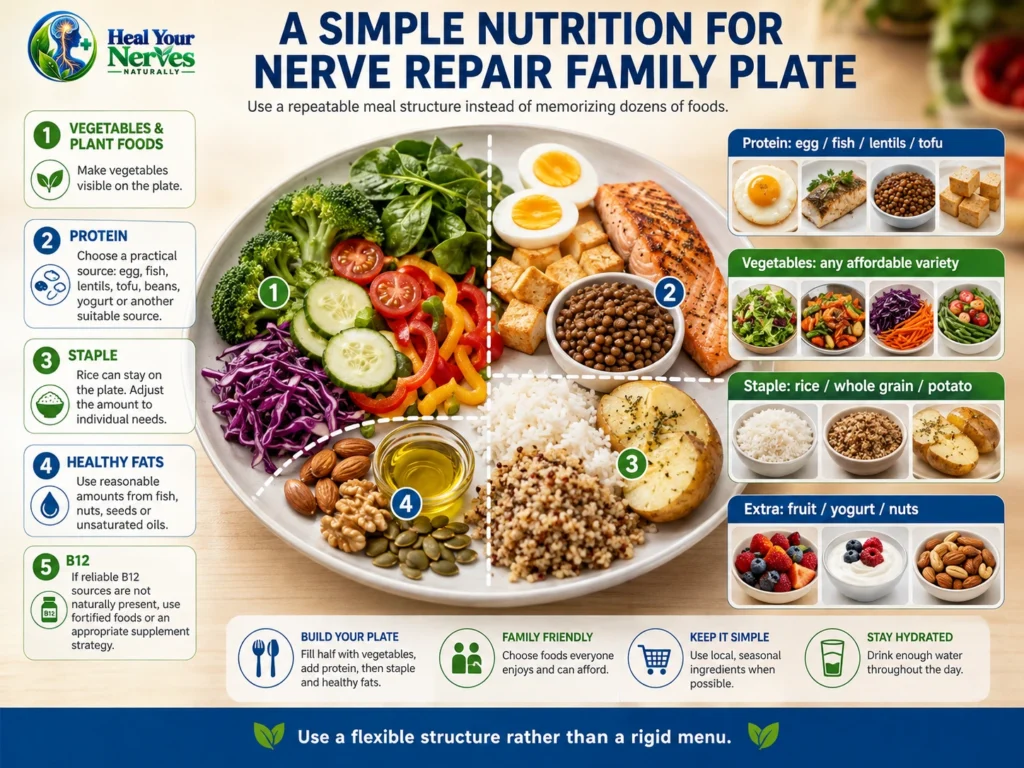
Instead of memorizing dozens of foods, use a repeatable meal structure.
What Should Half the Meal Look Like?
For many meals, vegetables and other plant foods can make up a substantial part.
You do not have to measure everything precisely.
Simply make vegetables visible on the plate.
What About Protein?
Include a practical protein source:
fish;
egg;
chicken;
lentils;
beans;
tofu;
yogurt;
another suitable source.
Can Rice Stay on the Plate?
Yes.
Adjust the amount to individual needs.
If diabetes is present, glucose response and treatment plan matter.
What About Fat?
Use reasonable amounts of appropriate fats from fish, nuts, seeds or unsaturated oils.
Where Does B12 Fit?
If the diet naturally contains reliable B12 sources, they may already be part of meals.
If not—particularly with vegan diets—a deliberate fortified-food or supplement strategy becomes important.
What Could a Normal Day Look Like?
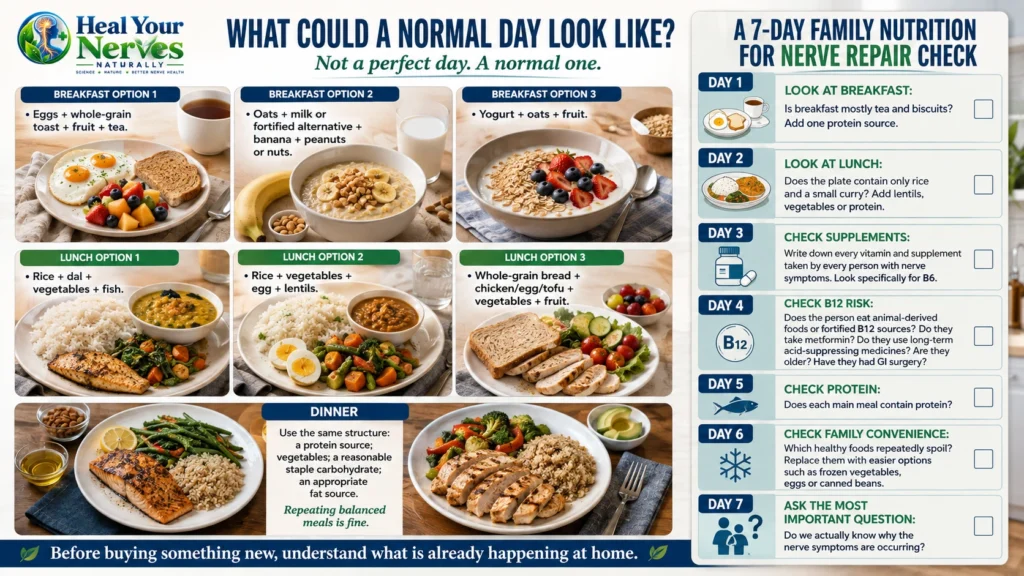
Not a perfect day.
A normal one.
Breakfast Option 1
Eggs + whole-grain toast + fruit + tea.
Breakfast Option 2
Oats + milk or fortified alternative + banana + peanuts or nuts.
Breakfast Option 3
Yogurt + oats + fruit.
Lunch Option 1
Rice + dal + vegetables + fish.
Lunch Option 2
Rice + vegetables + egg + lentils.
Lunch Option 3
Whole-grain bread + chicken/egg/tofu + vegetables + fruit.
Dinner
Use the same structure:
a protein source;
vegetables;
a reasonable staple carbohydrate;
an appropriate fat source.
You do not need seven completely different dinners every week.
Repeating balanced meals is fine.
A 7-Day Family Nutrition for Nerve Repair Check
This is not a detox.
It is a household audit.
Day 1 — Look at Breakfast
Is breakfast mostly tea and biscuits?
Add one protein source.
Day 2 — Look at Lunch
Does the plate contain only rice and a small curry?
Add lentils, vegetables or protein.
Day 3 — Check Supplements
Write down every vitamin and supplement taken by every person with nerve symptoms.
Look specifically for B6.
Day 4 — Check B12 Risk
Ask:
Does the person eat animal-derived foods or fortified B12 sources?
Do they take metformin?
Do they use long-term acid-suppressing medicines?
Are they older?
Have they had GI surgery?
Day 5 — Check Protein
Does each main meal contain protein?
Day 6 — Check Family Convenience
Which healthy foods repeatedly spoil?
Replace them with easier options such as frozen vegetables, eggs or canned beans.
Day 7 — Ask the Most Important Question
Do we actually know why the nerve symptoms are occurring?
If not, use our Nerve Dysfunction Diagnosis guide as the next step.
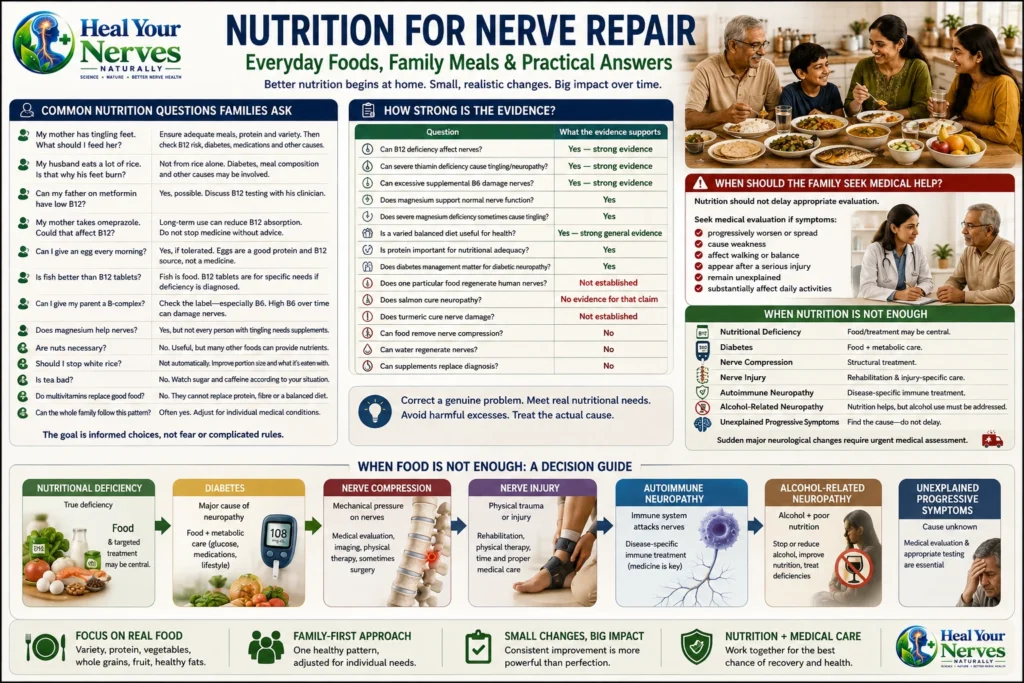
Common Nutrition for Nerve Repair Questions Families Ask
“My Mother Has Tingling Feet. What Should I Feed Her?”
Do not start with one special food.
First make sure she is eating adequate meals with protein and dietary variety.
Then consider whether B12 risk, diabetes, medications or other causes need evaluation.
“My Husband Eats a Lot of Rice. Is That Why His Feet Burn?”
You cannot make that diagnosis from rice intake.
If he has diabetes or prediabetes, meal composition and glucose management may matter.
Burning feet can also have other causes.
“My Father Takes Metformin and His Feet Are Numb. Should I Give Him B12?”
Do not diagnose or treat the problem solely from that combination.
Metformin can affect B12 status, so discussing B12 testing with his clinician is reasonable.
“My Mother Takes Omeprazole. Could That Affect B12?”
Long-term gastric-acid suppression can interfere with absorption of food-bound B12.
Again, do not stop prescribed medicine without medical advice.
“Can I Give an Egg Every Morning?”
For someone who eats eggs and has no reason to avoid them, eggs can be a practical protein and B12 source.
They do not need to be presented as medicine.
“Which Is Better: Fish or B12 Tablets?”
They are not directly comparable.
Fish is food.
A B12 supplement may be used to address a specific nutritional need.
If deficiency is confirmed, treatment depends on why the deficiency exists.
“Can I Give My Parent a B-Complex?”
First check the ingredients.
In particular, look at B6.
High supplemental B6 taken over time can cause nerve damage.
“Does My Parent Need Magnesium?”
Not simply because they have tingling.
Severe magnesium deficiency can cause tingling, but there are many other possible causes.
“Are Nuts Necessary?”
No.
They are useful, but other foods can provide protein, fats and minerals.
“Is Expensive Salmon Necessary?”
No.
Use affordable fish and other protein sources available locally.
“Does Chicken Help Nerves?”
Chicken provides protein and can contribute to a balanced diet.
It is not a direct nerve-regeneration treatment.
“Should I Stop White Rice?”
Not automatically.
Instead, improve portion size and what is eaten with it, especially when metabolic health matters.
“Are Brown Rice and Whole Grains Better?”
Whole grains generally provide more fibre and can also contribute nutrients such as thiamin.
They can be useful when affordable and acceptable to the family.
“Is Tea Bad?”
No.
Watch sugar and caffeine intake according to your circumstances.
“Should We Stop Biscuits?”
You do not need a dramatic household ban.
However, if biscuits repeatedly replace real meals, improve the meal routine.
“Can Fruit Raise Sugar?”
Fruit contains carbohydrate.
For diabetes, portion and individual glucose response matter.
That does not make whole fruit universally inappropriate.
“Can My Diabetic Parent Eat Banana?”
Often yes, but portion and overall carbohydrate management matter.
Individual diabetes guidance takes priority.
“Is Yogurt Helpful?”
It can provide protein and B12 when dairy is tolerated.
Choose according to the person’s broader dietary and metabolic needs.
“Do We Need Protein Powder?”
Most families do not automatically need protein powder.
Ordinary foods can often meet protein needs.
Supplemental protein may be useful in particular situations, but it is not a nerve treatment.
“Does Bone Broth Repair Nerves?”
There is no strong evidence that bone broth directly regenerates damaged nerves.
Use it as food if you enjoy it.
“Will Turmeric Milk Heal Nerves?”
No evidence supports treating turmeric milk as a proven nerve-regeneration therapy.
It can simply be a beverage within the diet.
“Is Honey Better Than Sugar?”
Honey is still a source of sugar.
It does not become a nerve-healing food simply because it is natural.
“Can Garlic Clean the Nerves?”
No.
Nerves are not pipes that need to be “cleaned.”
Garlic can be part of normal cooking.
“Can Drinking Lemon Water Repair Nerves?”
No.
It can contribute fluid and flavor.
It does not regenerate damaged nerves.
“What About Coconut Water?”
Coconut water can be a beverage, but it is not a neuropathy treatment.
People with kidney disease or other medical conditions may also need individualized advice about potassium-containing foods and drinks.
“Can I Use Multivitamins Instead of Improving Food?”
No.
A multivitamin cannot provide protein, fibre or the broader benefits of an adequate diet.
“Can the Whole Family Follow This Eating Pattern?”
In many cases, yes.
The basic pattern—varied foods, adequate protein, vegetables, fruit and sensible portions—is family-friendly.
Specific medical conditions still require individual adjustment.
How Strong Is the Evidence?
| Question | What the evidence supports |
|---|---|
| Can B12 deficiency affect nerves? | Yes — strong evidence |
| Can severe thiamin deficiency cause tingling/neuropathy? | Yes — strong evidence |
| Can excessive supplemental B6 damage nerves? | Yes — strong evidence |
| Does magnesium support normal nerve function? | Yes |
| Does severe magnesium deficiency sometimes cause tingling? | Yes |
| Is a varied balanced diet useful for health? | Yes — strong general evidence |
| Is protein important for nutritional adequacy? | Yes |
| Does diabetes management matter for diabetic neuropathy? | Yes |
| Does one particular food regenerate human nerves? | Not established |
| Does salmon cure neuropathy? | No evidence for that claim |
| Does turmeric cure nerve damage? | Not established |
| Can food remove nerve compression? | No |
| Can water regenerate nerves? | No |
| Can supplements replace diagnosis? | No |
The strongest Nutrition for Nerve Repair advice is often much less dramatic than social-media advice.
Correct a genuine problem.
Meet real nutritional needs.
Avoid harmful excesses.
Treat the actual cause.
When Nutrition Is Not Enough
Food can be central in one situation and supportive in another.
Nutritional Deficiency
Nutrition and targeted deficiency treatment may be central.
Diabetes
Nutrition is part of broader metabolic management.
Nerve Compression
Food supports health but cannot remove mechanical pressure.
Nerve Injury
Nutrition supports recovery but does not replace rehabilitation or injury-specific treatment.
Autoimmune Neuropathy
Food cannot replace disease-specific immune treatment.
Alcohol-Related Neuropathy
Improved nutrition can matter, but alcohol exposure itself also needs attention.
Unexplained Progressive Symptoms
Do not keep adding foods and supplements indefinitely.
Find the cause.
When Should the Family Seek Medical Help?
Nutrition should not delay appropriate evaluation.
Persistent or worsening numbness, tingling, weakness or nerve pain deserves attention.
In particular, seek appropriate medical evaluation if symptoms:
- progressively worsen;
- spread;
- cause meaningful weakness;
- affect walking or balance;
- appear after a serious injury;
- remain unexplained;
- substantially affect normal daily activities.
Sudden major neurological changes require urgent medical assessment rather than experimenting with diet.
NINDS emphasizes that peripheral neuropathy has many possible causes and that diagnosis can require medical history, examination and appropriate testing.
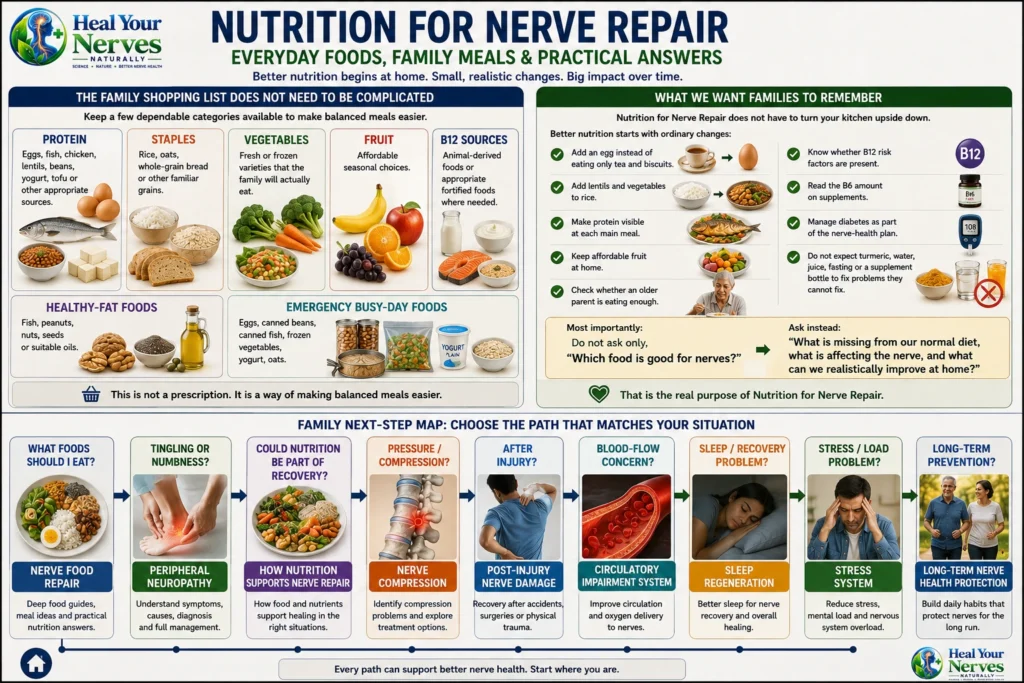
The Family Shopping List Does Not Need to Be Complicated
Instead of shopping for “nerve foods,” consider keeping a few dependable categories available.
Protein:
eggs, fish, chicken, lentils, beans, yogurt, tofu or other appropriate sources.
Staples:
rice, oats, whole-grain bread or other familiar grains.
Vegetables:
fresh or frozen varieties that the family will actually eat.
Fruit:
affordable seasonal choices.
B12 sources:
animal-derived foods or appropriate fortified foods where needed.
Healthy-fat foods:
fish, peanuts, nuts, seeds or suitable oils.
Emergency busy-day foods:
eggs, canned beans, canned fish, frozen vegetables, yogurt, oats.
This is not a prescription.
It is a way of making balanced meals easier.
What We Want Families to Remember
Nutrition for Nerve Repair does not have to turn your kitchen upside down.
For many families, better nutrition starts with ordinary changes:
Add an egg instead of eating only tea and biscuits.
Add lentils and vegetables to rice.
Make protein visible at each main meal.
Keep affordable fruit at home.
Check whether an older parent is eating enough.
Know whether B12 risk factors are present.
Read the B6 amount on supplements.
Manage diabetes as part of the nerve-health plan.
Do not expect turmeric, water, juice, fasting or a supplement bottle to correct a mechanical or medical problem they cannot fix.
Most importantly:
Do not ask only, “Which food is good for nerves?”
Ask:
“What is missing from our normal diet, what is affecting the nerve, and what can we realistically improve at home?”
That is the real purpose of Nutrition for Nerve Repair.
Continue Your Nerve Nutrition Journey
If you want a deeper food-by-food guide with meal examples, continue to Nerve Food Repair.
If you want to understand why nutrition matters biologically, read How Nutrition Supports Nerve Repair.
For numbness and tingling, continue to Peripheral Neuropathy.
For mechanical pressure, continue to Nerve Compression.
For symptoms after injury or surgery, continue to Post-Injury Nerve Damage.
For protein and recovery nutrition, explore Protein & Aminos.
For blood-flow and oxygen-related factors, continue to Circulatory Impairment System.
For movement-related factors, explore Movement, Posture & Nerve Regulation.
For sleep, continue to Sleep Regeneration.
For stress and nervous-system load, continue to Stress System.
For prevention after the immediate problem is understood, continue to Long-Term Nerve Health Protection.
Medical References and External Evidence
National Institute of Neurological Disorders and Stroke — Peripheral Neuropathy
Used for the causes of peripheral neuropathy, nutritional imbalance, B12/B6 relevance, vascular factors and the need for cause-specific management.
Read the NINDS Peripheral Neuropathy resource
NIH Office of Dietary Supplements — Vitamin B12
Used for B12 food sources, absorption issues, older-adult considerations, metformin and gastric-acid inhibitor interactions.
Read the NIH Vitamin B12 information
NIH Office of Dietary Supplements — Vitamin B6
Used for normal food sources and the neurological risk of excessive supplemental B6.
Read the NIH Vitamin B6 fact sheet
NIH Office of Dietary Supplements — Thiamin
Used for common food sources and neurological effects of severe thiamin deficiency.
Read the NIH Thiamin fact sheet
NIH Office of Dietary Supplements — Magnesium
Used for magnesium’s normal role in nerve and muscle function, food sources and symptoms of severe deficiency.
Read the NIH Magnesium fact sheet
NIH Office of Dietary Supplements — Omega-3 Fatty Acids
Used for established omega-3 food sources including fatty fish, walnuts, chia and flax.
Read the NIH Omega-3 information
American Diabetes Association — Standards of Care in Diabetes—2026
Used for current diabetic-neuropathy clinical context.