
Movement Posture Nerve Regulation
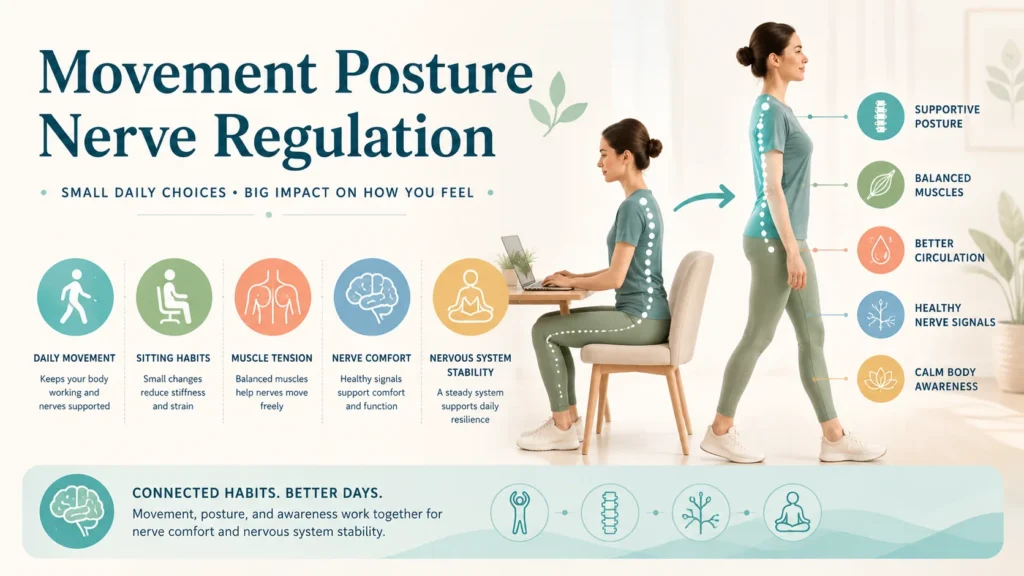
Movement Posture Nerve Regulation explains how daily body position, movement rhythm, sitting habits, muscle tension, and physical load may connect with nervous system comfort. This topic does not mean that posture alone explains nerve pain, tingling, numbness, burning feelings, weakness, or sensitive nerves. Instead, it gives readers one safe educational way to understand how the body may respond to repeated positions, long sitting, low movement variety, and daily physical demand.
A flexible body pattern can often make daily activity feel easier. In many cases, the nervous system works best when the body can move, rest, and shift positions with ease. However, long sitting, repeated strain, poor workstation setup, low activity, or tense movement habits may increase demand on muscles, joints, circulation, and nerve pathways. Because of this, the topic belongs inside the Lifestyle Healing cluster, where daily habits connect with nervous system load, body comfort, and recovery capacity.
This page is for education only. It does not diagnose, treat, cure, or prevent disease. For this reason, sudden, severe, worsening, or unusual symptoms need medical care, especially if weakness, bladder or bowel changes, severe numbness, chest pain, trouble breathing, or rapidly changing neurological symptoms appear.
Quick Navigation
What Is Movement Posture Nerve Regulation?
Movement Posture Nerve Regulation means the way body position and movement patterns may influence nervous system demand. In simple terms, the body is not built to stay fixed in one position for long periods. Joints, muscles, blood flow, breathing, attention, and sensory signals often work better when the body can shift throughout the day. As a result, movement and posture can become useful parts of nerve-health education.
Posture should not be understood as forcing the body into one perfect shape. Likewise, movement does not always mean intense exercise. A better view is flexibility. Someone may sit, stand, walk, rest, stretch lightly, or change position in ways that reduce repeated pressure on the same tissues. Over time, these daily patterns may affect muscle tension, circulation, sensory load, comfort, and recovery demand.
From an educational view, this page should not be used as a diagnosis. Nerve symptoms may come from many causes, including injury, metabolic issues, inflammation, compression, autoimmune activity, circulation problems, or other medical conditions. So, this topic explains only one possible lifestyle layer inside a wider nerve-health picture.
How Movement and Posture Work Together
The body receives signals from muscles, joints, skin, and nerves throughout the day. These signals help the brain understand position, pressure, movement, stretch, balance, and effort. After that, the nervous system adjusts muscle tone, breathing, attention, and movement control. When movement is varied, the body gets more chances to share load across different tissues instead of stressing the same areas again and again.
Long sitting, forward head posture, tense shoulders, crossed legs, repeated bending, or one-sided work habits may place extra demand on certain muscles and joints. In addition, low movement may reduce the natural pumping effect that helps circulation move through the body. This does not mean posture causes every nerve problem. Rather, daily position can become one layer that interacts with nerve comfort, body tension, and recovery need.
Repeated strain may also make the nervous system more alert, especially when poor sleep, stress, low activity, or pain is already present. Because of this, Movement Posture Nerve Regulation is best understood as a daily pattern topic. It connects naturally with Lifestyle Healing, Circulation and Oxygenation, Stress System, Sleep and Recovery, and Recovery Cycles.
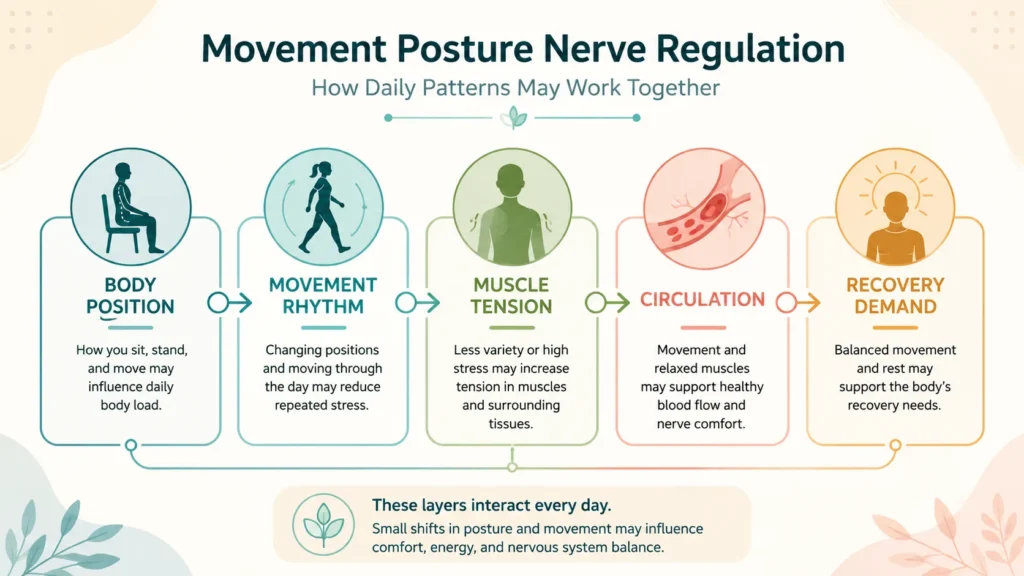
Key Layers of Movement Posture Nerve Regulation
Position Load Layer
Body position can change how load spreads across muscles, joints, and soft tissue. A rounded sitting position may increase demand around the neck, shoulders, upper back, arms, and breathing pattern. Standing in one fixed position for too long may create a different kind of load around the lower back, hips, legs, or feet. In both cases, the issue is often repeated pressure rather than one single “bad” position.
The goal is not perfect posture all day. A more useful goal is position variety. When the body changes position, pressure can shift from one area to another. As a result, tissues may get more chances to rest, move, and respond. This can matter because nerves often pass through areas surrounded by muscle, fascia, joints, and blood vessels.
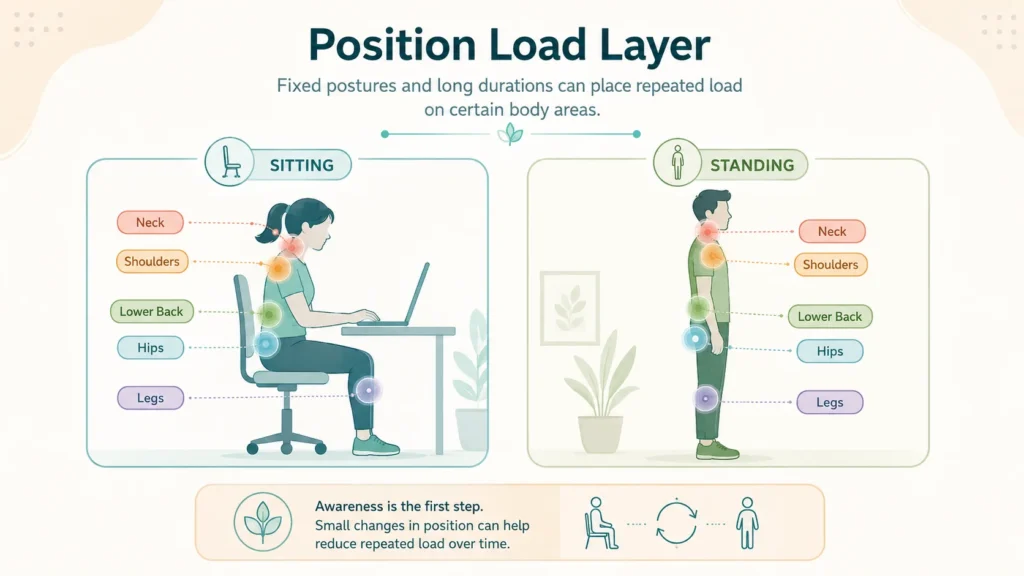
From a system perspective, repeated position load may interact with nerve sensitivity, circulation, and muscle tension. For this reason, posture should be seen as a flexible habit, not a rigid rule. The same section also reminds readers that symptoms need proper medical evaluation when they are severe, sudden, unusual, spreading, or worsening.
Movement Rhythm Layer
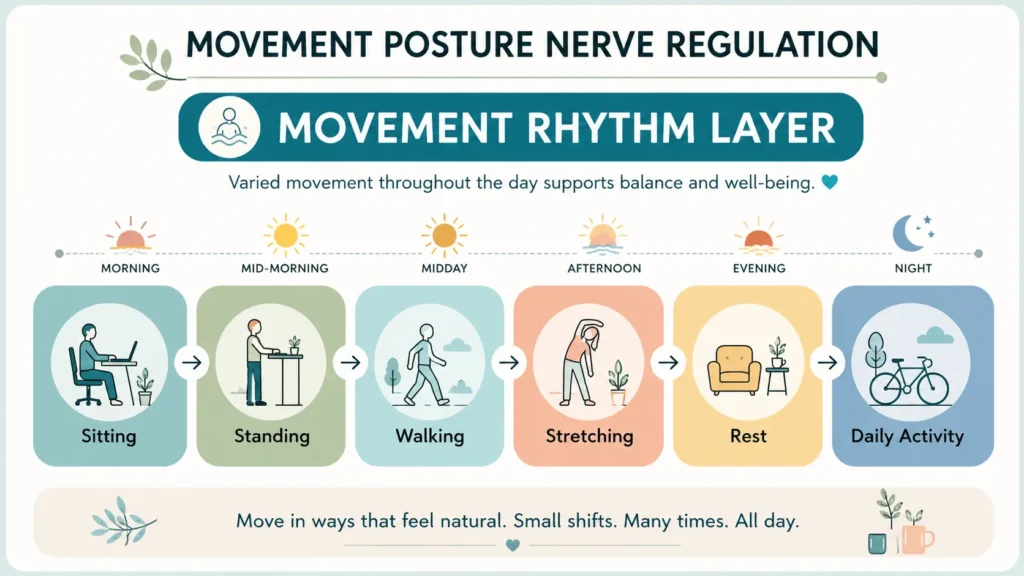
Movement rhythm refers to how often the body changes from stillness to motion. One person may sit for long hours and then suddenly do heavy activity. Another person may move gently throughout the day. These two patterns can create different levels of demand on muscles, joints, circulation, and the nervous system.
Daily motion also gives the body useful sensory input. The brain receives messages about stretch, pressure, balance, and position. Because of this, varied movement may help the nervous system stay connected with the body’s changing needs. Still, movement must be understood safely. It is not a cure, and it should not replace medical care.
Over time, poor movement rhythm may make the body feel stiff, tense, or less adaptable. This layer connects strongly with recovery capacity because a system facing less repeated physical load may have more space for rest, sleep, circulation, and repair-related processes. Even so, each person’s situation is different, so this page remains educational rather than prescriptive.
Muscle Tension Layer
Muscle tension can rise during stress, long screen use, poor posture, repeated tasks, or protective guarding after discomfort. At first, tension may be a normal response. When it stays high for long periods, the body may feel more tired, stiff, or sensitive. In some cases, tense areas may also affect nearby movement quality and make daily tasks feel harder.
Tight neck and shoulder muscles may change how a person holds the head, breathes, or uses the arms. Meanwhile, tight hips or back muscles may affect sitting comfort, walking pattern, or lower-body movement. As a result, muscle tension can become part of the wider body-load picture.
This does not mean muscle tension is always the cause of nerve symptoms. Instead, it may be one layer that adds demand to the system. Movement Posture Nerve Regulation explains how body tension, position habits, and movement patterns can work together while still avoiding treatment claims or simple one-cause explanations.
Circulation and Oxygen Layer
Movement and position may also affect circulation. When muscles move, they help push blood and fluid through the body. During long stillness, that natural movement effect may be lower. For this reason, circulation belongs inside this topic, especially when readers are learning how daily body position may connect with comfort and recovery demand.
Nerves need healthy tissue surroundings, oxygen delivery, and nutrient delivery. However, this connection should be explained carefully. Poor posture does not automatically mean poor nerve health. In the same way, movement does not guarantee symptom improvement. Circulation is only one system that may interact with nerve comfort, body load, and recovery capacity.
Simple body-position awareness can help readers understand why long sitting, repeated pressure, or low movement variety may feel uncomfortable. At the same time, symptoms should not be blamed on circulation or posture alone. This layer connects naturally with Circulation and Oxygenation, Vascular Regeneration, Microcirculation and Nerve Sensitivity, and Recovery Cycles.
Sensory Load Layer
The nervous system constantly reads signals from the body. It notices pressure, stretch, temperature, touch, balance, and pain-related messages. When posture is strained or movement is limited, sensory input may become repetitive. As a result, the nervous system may receive the same pressure or tension signals again and again.
A wrist resting against a hard edge, a leg crossed for a long time, or a neck held forward during screen use may create repeated sensory demand. Over time, some people may notice discomfort, tightness, heaviness, or sensitivity. Still, those feelings can have many causes and should not be explained by posture alone.
This layer helps readers think about sensory load in a calm way. The goal is awareness, not fear. Body position, movement breaks, workstation setup, sleep, stress, and recovery patterns may all interact with how the nervous system feels during daily life.
Recovery Demand Layer
Recovery demand means the amount of rest, repair, and system coordination the body may need after daily load. Poor sleep, high stress, low movement variety, and repeated posture strain may increase what the body has to manage. At the same time, recovery capacity may feel lower when the system is already tired or overloaded.
This page is not only about sitting straight. It is about the full pattern of how the body moves, rests, and adapts. A person’s daily routine may include work posture, phone posture, driving position, lifting habits, walking pattern, and rest quality. Together, these patterns can shape system demand.
From an educational view, recovery works best when body systems cooperate. Sleep, circulation, stress response, movement, nutrition, and nervous system stability all matter. That is why this page connects posture and movement with the wider Lifestyle Healing framework rather than presenting them as isolated fixes.
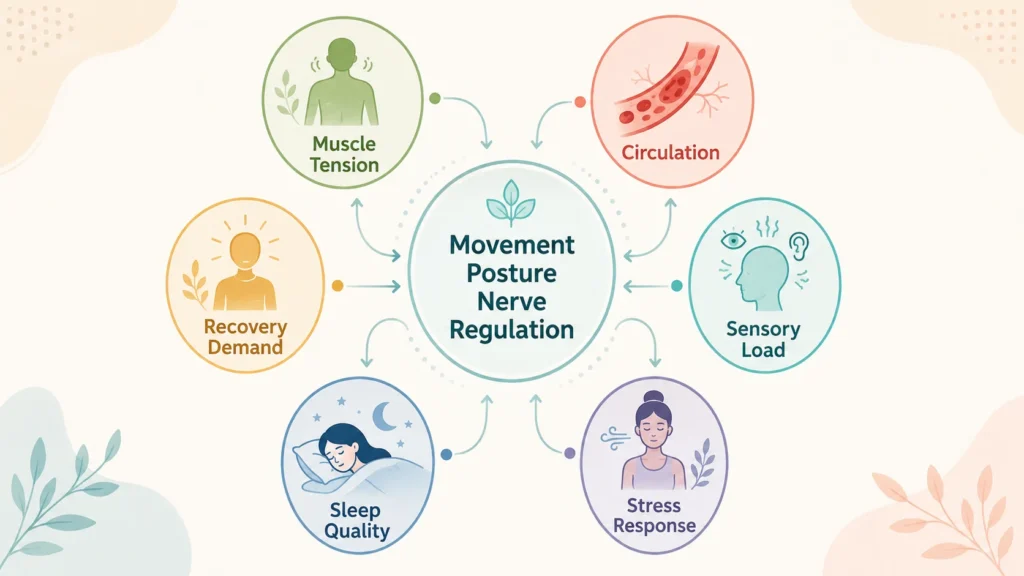
Plain Meaning / Glossary Box
Plain Meaning Box
Movement:
Any body action, such as walking, standing, stretching, changing position, or doing daily tasks. It does not always mean hard exercise.
Posture:
The way the body is positioned while sitting, standing, walking, working, sleeping, driving, or using a phone.
Nerve regulation:
The way the nervous system receives signals, responds to body demand, and helps the body settle after stress or activity.
Muscle tension:
Extra tightness or effort in the muscles. Stress, posture, discomfort, long sitting, or repeated work may influence it.
Recovery demand:
The amount of rest, energy, and body coordination that may be needed after physical, mental, or emotional load.
Sensory load:
The amount of pressure, touch, tension, pain, sound, light, or body signals the nervous system must process.
Real-Life Symptom Language Bridge
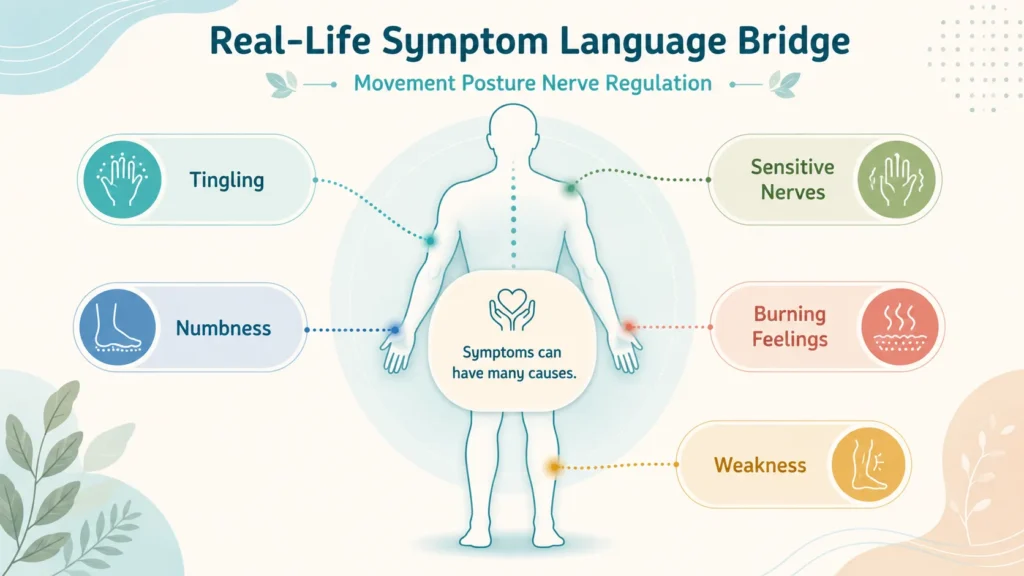
Some readers may search this topic because they notice nerve pain, tingling, numbness, burning feelings, sensitive nerves, tired nerves, muscle tightness, weakness, or changes in comfort. These symptoms can have many causes. For that reason, Movement Posture Nerve Regulation should never be used as the only explanation for symptoms.
Tingling in the hand may involve posture, nerve compression, circulation, metabolic issues, inflammation, injury, or another medical condition. Burning feelings in the feet may also have many possible explanations. Because of this, readers should avoid guessing or self-diagnosing from posture alone.
A safer view is to treat this page as one daily-life education layer. Movement, posture, sitting habits, and muscle tension may interact with nerve comfort and recovery demand. However, sudden weakness, severe numbness, spreading symptoms, loss of bladder or bowel control, chest pain, trouble breathing, or rapidly changing neurological symptoms need urgent medical care.
Movement Posture Nerve Regulation and Nerve Function
Movement Posture Nerve Regulation may connect with nerve function through several body-wide pathways. Posture can influence how pressure spreads through muscles, joints, and soft tissue. Daily motion can also change circulation, breathing rhythm, sensory input, and muscle tone. In addition, tension may affect how comfortable the body feels during ordinary tasks.
Nerve function is complex. Nerves send and receive signals, yet they also depend on healthy tissue surroundings, blood supply, metabolic health, immune activity, and nervous system processing. Therefore, posture and movement should be seen as part of a larger network. They may matter, but they are not the whole story.
Long sitting may increase stiffness and reduce movement variety. Stress may raise muscle tension at the same time. Poor sleep may also reduce recovery capacity. As these layers combine, the nervous system may feel more loaded. This does not prove one cause. It simply shows why system-based education can help readers understand patterns more safely.
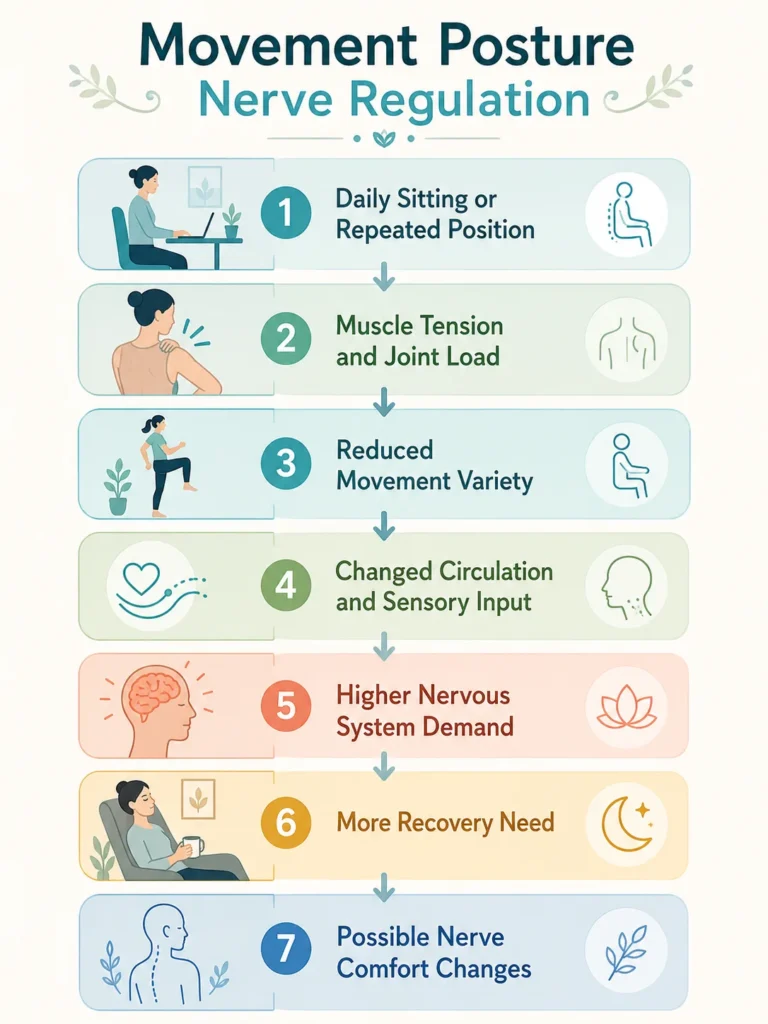
Movement Posture Nerve Regulation Visual Flow
Daily Sitting or Repeated Position
↓
Muscle Tension and Joint Load
↓
Reduced Movement Variety
↓
Changed Circulation and Sensory Input
↓
Higher Nervous System Demand
↓
More Recovery Need
↓
Possible Nerve Comfort Changes
This visual flow is educational, not diagnostic. In real life, the pattern is not always straight. Stress can increase muscle tension before posture changes. Poor sleep can make the nervous system more sensitive before a person notices body strain. Pain or discomfort may also lead people to guard the body, which can change movement quality.
Read this flow as a map, not a medical conclusion. It helps readers see how repeated position, movement rhythm, circulation, muscle tension, and nervous system demand may interact. At the same time, it does not say that posture causes nerve symptoms or that movement fixes them.
A helpful system view is circular. Daily load affects the body, and the body’s response affects the next day’s comfort and movement. Because of this, Movement Posture Nerve Regulation belongs with Daily Patterns and Nervous System Stability, Lifestyle Healing, Stress System, Sleep and Recovery, and Recovery Cycles.
Practical Daily-Life Examples
Long Screen Work
A person may sit at a desk for many hours with the head forward and shoulders raised. Over time, this pattern may add load to the neck, upper back, and arms. Low movement may also reduce position variety. This does not diagnose the cause of symptoms, but it may show one daily pattern worth understanding.
Phone Posture
Looking down at a phone for long periods may change neck and shoulder position. Hands and wrists may also stay in repeated positions. As a result, some people may notice tightness or discomfort. Symptoms such as numbness, weakness, or burning feelings still need proper medical attention when they are severe, worsening, or unusual.
Long Sitting With Crossed Legs
Crossed legs may place pressure on certain areas for some people. Long sitting may also reduce lower-body movement. Because of this, the nervous system may receive repeated pressure signals. Still, this pattern is only one possible layer, not a full explanation for nerve symptoms.
Sudden Heavy Activity After Stillness
A body that stays still for hours may feel less ready for sudden heavy movement. Muscles and joints may need time to adapt. From an educational view, steady daily variation may be easier for the system than long stillness followed by overload.
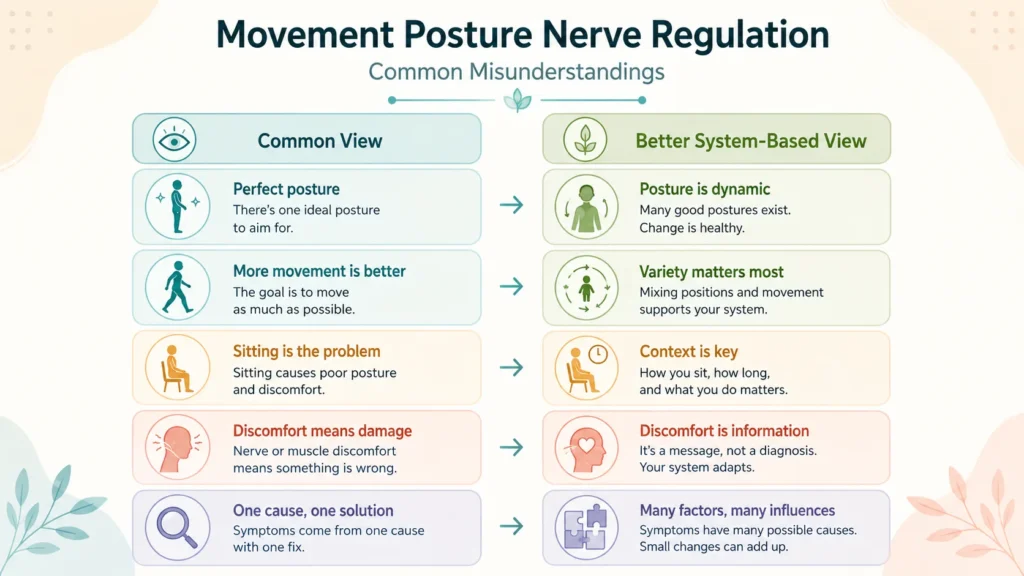
Common Misunderstandings About Movement Posture Nerve Regulation
Misunderstanding 1: Perfect posture fixes nerve problems
Clarification:
Perfect posture is not the goal. The body needs movement, rest, and position variety. In addition, nerve symptoms can come from many causes. Posture should not be treated as a cure, diagnosis, or guaranteed solution.
Misunderstanding 2: Movement always means exercise
Clarification:
Movement can include walking, standing, changing position, gentle stretching, daily chores, or light activity. People with pain, weakness, injury, or medical conditions may need professional guidance before changing activity.
Misunderstanding 3: Sitting is always harmful
Clarification:
Sitting is not automatically bad. Long sitting without movement variety may increase load for some people, but the better idea is not fear of sitting. A more balanced idea is body-position awareness and flexible movement.
Misunderstanding 4: Nerve symptoms are always from posture
Clarification:
Nerve pain, tingling, numbness, burning feelings, and weakness can have many causes. Symptoms should not be blamed on posture alone. Medical evaluation matters when symptoms are new, severe, spreading, or worsening.
Misunderstanding 5: More movement is always better
Clarification:
More is not always better. Some people may need pacing, rest, or professional advice. Movement should be understood as part of system awareness, not as a forced rule or treatment plan.
Better System-Based View
Common View:
Bad posture causes nerve problems.
Better System-Based View:
Posture may be one layer in a wider system that includes movement rhythm, muscle tension, circulation, stress, sleep, inflammation, and medical history.
Common View:
Exercise fixes nerve discomfort.
Better System-Based View:
Physical activity may support general health and body function, but nerve symptoms need careful evaluation and should not be treated with simple claims.
Common View:
Sitting is the enemy.
Better System-Based View:
Long stillness may increase demand for some people, but sitting can be part of a healthy day when balanced with position changes and recovery.
Common View:
Pain means damage.
Better System-Based View:
Pain is a nervous system signal that may involve many layers. It should be understood carefully, especially when symptoms are severe, unusual, or changing.
Topic Cluster Placement
Parent / Cornerstone Page:
Lifestyle Healing
Supporting Pages:
Daily Patterns and Nervous System Stability
Sleep and Recovery
Circulation and Oxygenation
Stress System
Recovery Cycles
Condition Bridge Pages:
Peripheral Neuropathy
Nerve Compression
Sciatic Nerve Pain
Post-Injury Nerve Damage
Diabetic Neuropathy
Definition / Glossary Page Idea:
Nervous System Regulation Explained
Nerve Sensitivity Explained
What Is Body Load?
Definition Page Strategy
This page should remain a full Therapeutic Systems page because the topic is system-level. It connects movement, posture, muscle tension, circulation, sensory load, recovery demand, stress, and nerve comfort. Because of that, the Master System Page Template is appropriate.
A shorter definition page can still be created later for early search intent. A possible glossary article could be titled “What Is Nerve Regulation?” or “Nervous System Regulation Explained.” That page should be shorter, simpler, and more direct. It can explain the term, give examples, list what it does not mean, and link back to this full page.
This strategy prevents the current page from becoming too basic. At the same time, it creates a future internal-link opportunity. A definition page can help readers who need a simple answer first, while this full page can serve readers who want deeper system education.
FAQ
Can posture affect nerve comfort?
Posture may affect comfort for some people because body position can influence muscle tension, joint load, pressure, and movement quality. Even so, posture does not explain every nerve symptom. Tingling, numbness, burning feelings, weakness, or severe pain should be evaluated carefully.
Is movement always good for nerve regulation?
Movement can support general health, body function, circulation, and well-being. The right type and amount can vary by person. Pain, injury, weakness, or medical conditions may require professional guidance. This page gives education, not an exercise plan.
Can sitting cause nerve pain?
Sitting itself does not always cause nerve pain. Long sitting, repeated pressure, low movement variety, or poor workstation setup may increase body load for some people. Since nerve symptoms can have many causes, sitting should not be treated as the only explanation.
Why do my nerves feel worse after long computer work?
Long computer work may involve stillness, forward head position, raised shoulders, eye strain, stress, and repeated hand use. As a result, the body may feel more tense or sensitive. Nerve symptoms that are severe, spreading, or worsening need medical attention.
Should I force myself into perfect posture?
No. Perfect posture is not realistic or necessary for most daily life. Body awareness and position variety are more useful ideas. A comfortable posture may change during the day, depending on activity, rest, fatigue, and body needs.
When should I seek medical care?
Seek medical care for severe, sudden, unusual, or worsening symptoms. Also seek urgent help for sudden weakness, loss of bladder or bowel control, severe numbness, chest pain, difficulty breathing, severe pain, or rapidly changing neurological symptoms.
Continue Learning
Lifestyle Healing
Continue with the main Lifestyle Healing page to understand how daily habits may connect with body rhythm, stress load, sleep, recovery demand, and nerve-health education.
Daily Patterns and Nervous System Stability
Explore how daily rhythm, sleep timing, movement, stress, and recovery windows may shape nervous system flexibility.
Circulation and Oxygenation
Learn how blood flow, oxygen delivery, and tissue support may connect with body-wide recovery capacity.
Stress System
Read how stress signals may influence muscle tension, alertness, sleep quality, and nervous system demand.
Recovery Cycles
Explore how rest, activity, adaptation, and repair may work together over time.
Peripheral Neuropathy
Use this condition page as an educational bridge for readers searching for tingling, numbness, burning feelings, or nerve discomfort.
Learning Path
Follow the structured learning path to move from symptoms and root causes toward system-based nerve-health education.
Related Systems
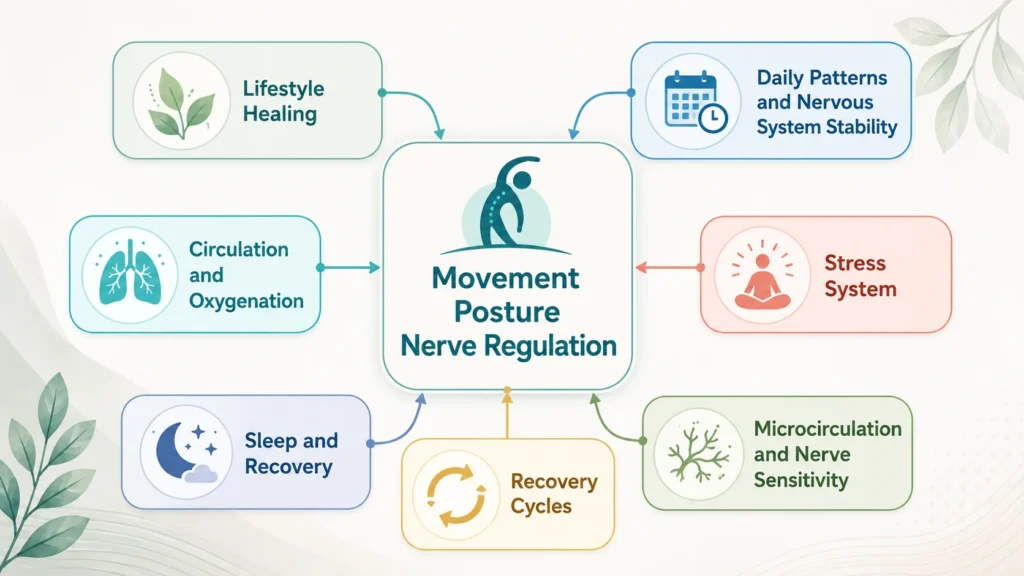
Movement Posture Nerve Regulation connects with several related systems because posture and movement do not work alone. Instead, they interact with stress load, circulation, sleep rhythm, recovery demand, muscle tension, and nervous system sensitivity. For this reason, this page should link to nearby system pages that help readers continue learning in a safe and structured way.
Lifestyle Healing
Lifestyle Healing is the parent system for this page. It explains how daily habits, sleep timing, movement rhythm, stress patterns, nutrition, and recovery windows may shape nervous system demand over time. Therefore, Movement Posture Nerve Regulation should link back to this page as the main cluster connection.
Daily Patterns and Nervous System Stability
Daily Patterns and Nervous System Stability connects closely with this topic because movement and posture are part of a daily rhythm. Sitting time, screen use, work habits, rest breaks, sleep timing, and stress load may all influence how stable or overloaded the nervous system feels.
Circulation and Oxygenation
Circulation and Oxygenation connects because movement may help the body move blood and fluid through tissues. In addition, long stillness or repeated pressure may influence comfort for some people. However, this should stay educational and should not be presented as a treatment claim.
Stress System
Stress System connects because stress may increase muscle tension, protective guarding, shallow breathing, and body alertness. As a result, posture and movement patterns may change when the body feels under pressure. This link helps readers understand the body-wide stress layer behind tension and nervous system demand.
Sleep and Recovery
Sleep and Recovery connects because poor sleep may reduce recovery capacity and make the body feel more sensitive to physical load. Meanwhile, pain, stiffness, or tension may also affect rest quality. Therefore, this related system helps readers understand why posture and movement should be viewed alongside sleep rhythm.
Recovery Cycles
Recovery Cycles connects because daily load and recovery work as a pattern. Movement, posture, rest, activity, stress, and sleep may all shape how much recovery demand the body has. This page can help readers understand why repeated strain and poor rest may matter over time.
Microcirculation and Nerve Sensitivity
Microcirculation and Nerve Sensitivity connects because small-vessel blood flow and tissue environment may matter for nerve comfort and sensory load. Movement and posture may interact with this topic through sitting habits, repeated pressure, and body-position awareness.
Related Condition Connections
Movement Posture Nerve Regulation may connect with several condition pages as an educational bridge. However, these links should be written carefully. This page should not say that posture causes these conditions. Instead, it can help readers understand how daily body position, repeated pressure, movement rhythm, muscle tension, and recovery demand may be one possible layer in a larger nerve-health picture.
Peripheral Neuropathy
Peripheral Neuropathy may connect because many readers search for nerve pain, tingling, numbness, burning feelings, sensitive nerves, or changes in comfort. However, peripheral neuropathy can have many possible causes. Therefore, posture and movement should not be used for self-diagnosis.
Nerve Compression
Nerve Compression may connect because repeated pressure, body position, posture strain, or mechanical load may matter in some cases. For example, long sitting, wrist pressure, neck position, or repeated bending may add demand around certain nerve pathways. Even so, symptoms that persist, spread, or include weakness need proper medical evaluation.
Sciatic Nerve Pain
Sciatic Nerve Pain may connect because sitting habits, hip position, lower-back load, muscle tension, and movement rhythm may influence comfort for some people. However, severe leg pain, sudden weakness, numbness in the groin area, or bladder and bowel changes need urgent medical care.
Post-Injury Nerve Damage
Post-Injury Nerve Damage may connect because movement and posture often change after injury. A person may guard the body, avoid certain movements, or hold tension around the injured area. As a result, recovery demand may increase. Still, this page should not give treatment instructions or replace medical care.
Diabetic Neuropathy
Diabetic Neuropathy may connect only as a safe educational bridge. Blood sugar, metabolic health, circulation, and nerve function are complex medical topics. Therefore, posture and movement should never be presented as the main explanation. Instead, this page can help readers understand one daily-life layer that may interact with comfort and body load.
Sources / References
MedlinePlus — Exercise and Physical Fitness
CDC — Benefits of Physical Activity
NINDS — Peripheral Neuropathy
Mayo Clinic — Office Ergonomics
Mayo Clinic — Peripheral Neuropathy Symptoms and Causes
Author / Editorial Trust Note
This article was created for Heal Your Nerves Naturally as an educational resource. The wording was checked for safety-focused language, non-diagnostic explanations, and source-based health education. It does not claim medical review unless a qualified reviewer is added by the site owner.
The goal of this page is to help readers understand Movement Posture Nerve Regulation as one possible lifestyle-related layer in nerve-health education. It does not tell readers what condition they have. It does not give a treatment plan, exercise prescription, supplement protocol, or cure claim.
Readers should use this page as a learning guide only. For personal symptoms, medical questions, diagnosis, or treatment decisions, they should speak with a qualified healthcare professional.
Educational Trust Note
Heal Your Nerves Naturally explains nerve health through safe, calm, system-based education. The site helps readers understand how nervous system function, root-cause patterns, daily habits, and recovery capacity may connect. This information is not a substitute for medical care.
This page is especially careful because movement, posture, and nerve symptoms can be misunderstood. Some discomfort may relate to body position or muscle tension. Other symptoms may involve medical conditions that need evaluation. Readers should avoid self-diagnosis and seek professional care when symptoms are severe, new, unusual, or worsening.
Safety & Education Notice
This page is for educational purposes only. It does not diagnose, treat, cure, or prevent disease. In addition, it should not be used as a substitute for professional medical advice, diagnosis, or treatment. Instead, readers should use this information as a calm learning guide and speak with a qualified healthcare professional when they have personal health concerns.
For this reason, urgent medical care is important for severe, sudden, unusual, or worsening symptoms. These may include sudden weakness, loss of bladder or bowel control, chest pain, difficulty breathing, severe numbness, severe pain, or rapidly changing neurological symptoms. When symptoms change quickly, it is safer to seek help early rather than guess the cause.
Because this topic may involve nerve symptoms, movement limits, pain, weakness, posture strain, and possible medical conditions, readers should be careful. Therefore, they should not use this page to self-diagnose, delay medical care, stop medication, or begin any exercise or therapy plan without appropriate professional guidance. In simple terms, this page can support understanding, but it cannot replace personal medical care.