
Micronutrients and Nerve Function: How Vitamins and Minerals Support Myelin, Signaling and Cellular Energy
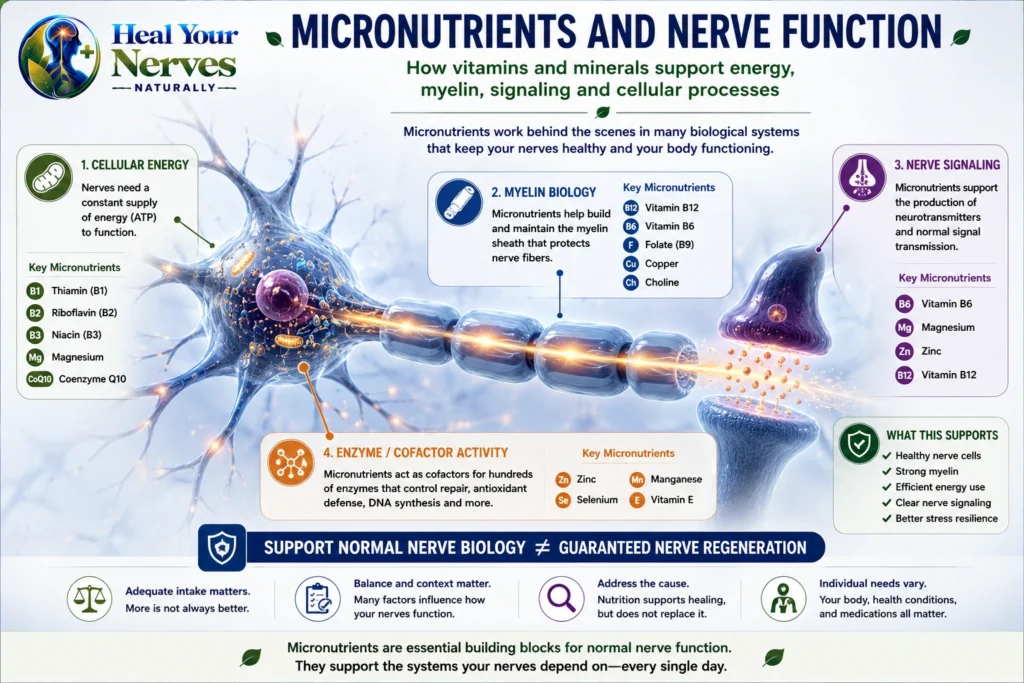
Micronutrients and nerve function are closely connected because nerves depend on vitamins and minerals for cellular energy, myelin-related biology, electrical signaling and enzyme activity. However, that does not mean that taking more vitamins automatically repairs a damaged nerve.
If you are here because you have tingling or numbness, you have seen claims that B12 “builds myelin,” or you simply want to understand what nutrients actually do inside nerves, this page will help separate normal biology from treatment claims.
The key idea is simple:
“This nutrient is necessary for normal nerve function”
is not the same as:
“Taking more of this nutrient will regenerate a damaged nerve.”
That distinction matters throughout this guide to micronutrients and nerve function. A true deficiency can disrupt normal nervous-system biology. At the same time, adequate intake does not guarantee that an injured axon will regrow, that compression will disappear, or that every neuropathy will reverse.
This page explains four main biological jobs: energy, myelin-related support, signaling, and enzyme/cofactor activity. It also shows where the evidence stops and when a different HYN page owns the next question.
This page is part of Nutrition for Nerve Repair. Its role is UNDERSTAND: explain how micronutrients participate in nerve biology without turning normal physiology into a supplement or regeneration promise.
What this page helps you do: understand micronutrients and nerve function through energy, myelin, signaling and enzyme/cofactor activity; see why B12, B1, B6, copper and other nutrients matter; and distinguish “supports normal nerve function” from “repairs nerve damage.”
What this page does not do: determine whether you personally are deficient, prescribe doses, choose supplement products, provide a complete food plan, diagnose neuropathy, or predict recovery time. For status and testing, use Micronutrients for Nerve Health. For deficiency causes, use Nutritional Deficiency and Nerve Damage.
Important: Tingling, numbness, burning, weakness and balance problems can have many causes. Micronutrient biology can explain part of nerve function, but it cannot diagnose the cause of your symptoms.
Find Your Situation
- “I want the simplest explanation of what micronutrients do inside nerves.” → Start with the four biological jobs
- “I keep hearing B12 ‘builds myelin.’ What is actually true?” → Go to B12 and myelin
- “How do vitamins and minerals fit into nerve impulses?” → Go to nerve signaling
- “Do vitamins repair nerve damage?” → Go to support versus regeneration
- “Would more vitamins make repair faster?” → Go to the adequacy-versus-excess explanation
- “My symptom could have several causes.” → Go to the real-life case comparison
The Simplest Way to Understand Micronutrients and Nerve Function
Think of a nerve as living tissue with several continuous jobs.
It must:
- produce and use energy;
- maintain cell membranes and internal structures;
- transmit information;
- maintain myelin where myelin is present;
- run thousands of enzyme-driven chemical reactions;
- respond to damage, inflammation and metabolic stress;
- communicate with muscles, skin, organs and other nerve cells.
Micronutrients participate in many of these processes, but they do not all perform the same job.
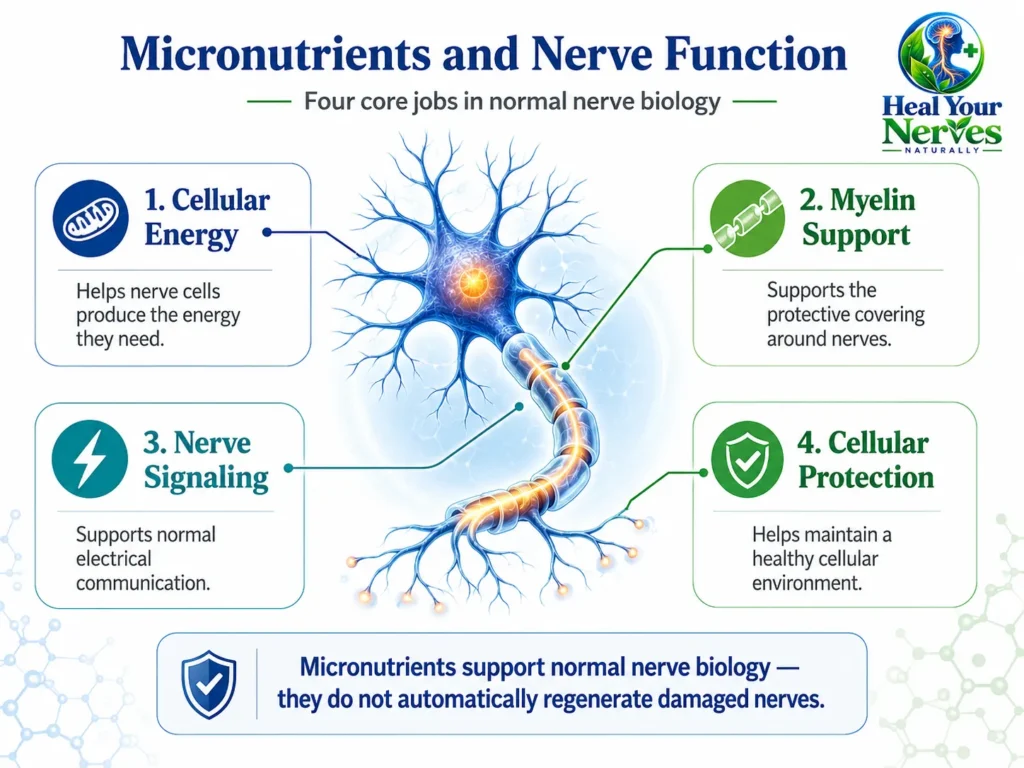
A four-part model for micronutrients and nerve function
For this page, we will group the science into four practical questions:
Energy — Can the nerve cell generate and use energy normally?
Myelin — Are the biological systems that maintain myelinated nerves supported?
Signaling — Can ions, membranes and neurotransmitter-related pathways work normally?
Cofactors and protection — Do essential enzyme systems have the micronutrients they require?
This is more useful than memorizing a list of vitamins.
Why Micronutrients Matter for Nerve Energy
Nerves are metabolically active cells.
Maintaining electrical gradients, transporting materials along long axons, releasing chemical messengers and preserving cell structures all require energy.
Therefore, energy metabolism is one of the clearest places to understand micronutrients and nerve function.
Vitamin B1 and nerve energy
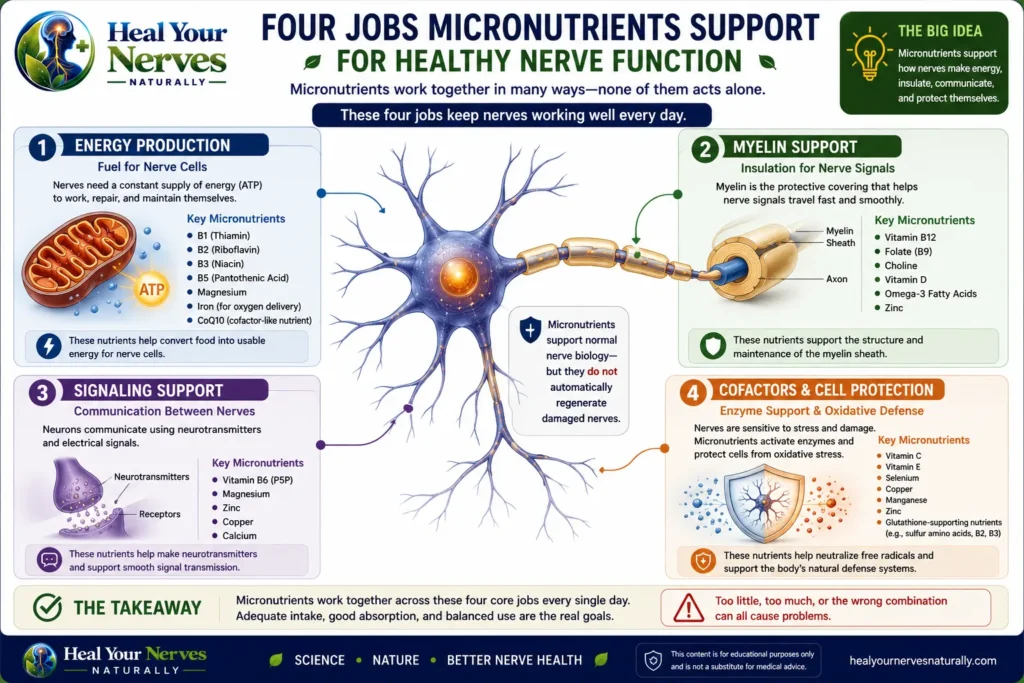
Thiamin, or vitamin B1, helps the body convert food into usable energy. The NIH Office of Dietary Supplements thiamin fact sheet describes thiamin’s role in metabolism and the neurological consequences of severe deficiency.
In simple terms:
Food contains energy, but cells need metabolic machinery to turn that energy into forms they can use. B1 participates in that machinery.
When thiamin deficiency becomes severe, the nervous system can be affected, including the peripheral nerves.
That does not mean extra thiamin makes a well-nourished nerve “supercharged.”
The meaningful biological distinction is:
- deficient → important metabolic processes can be impaired;
- adequate → normal requirements are supported;
- extra → not automatically better nerve performance.
Why B1 and nerve function depend on real-life context
A person with severe nutritional restriction, prolonged vomiting, alcohol dependence, bariatric surgery or major malnutrition has a very different risk profile from someone eating a varied diet.
So when B1 deficiency is plausible, the useful question is not:
“Which B1 supplement is best?”
It is:
“Why might thiamin status be inadequate, and does this clinical situation need prompt assessment?”
The causal question is different: it asks why thiamin status became inadequate and whether the clinical context makes deficiency plausible.
Vitamin B12, Myelin and Nerve Function
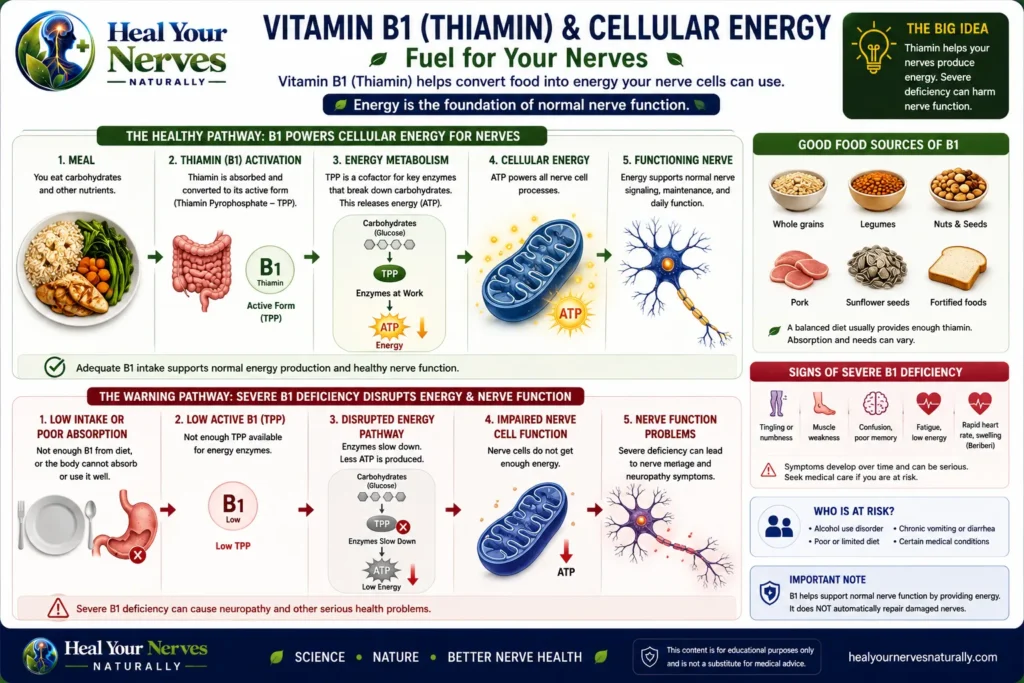
Myelin is a specialized insulating structure around many nerve fibers, and it helps signals travel efficiently.
To understand myelin itself—what it is, where it is found and why it matters—read The Myelin System.
Here, our question is narrower:
How do micronutrients fit into the biology that supports myelinated nerves?
Vitamin B12 and normal nerve function
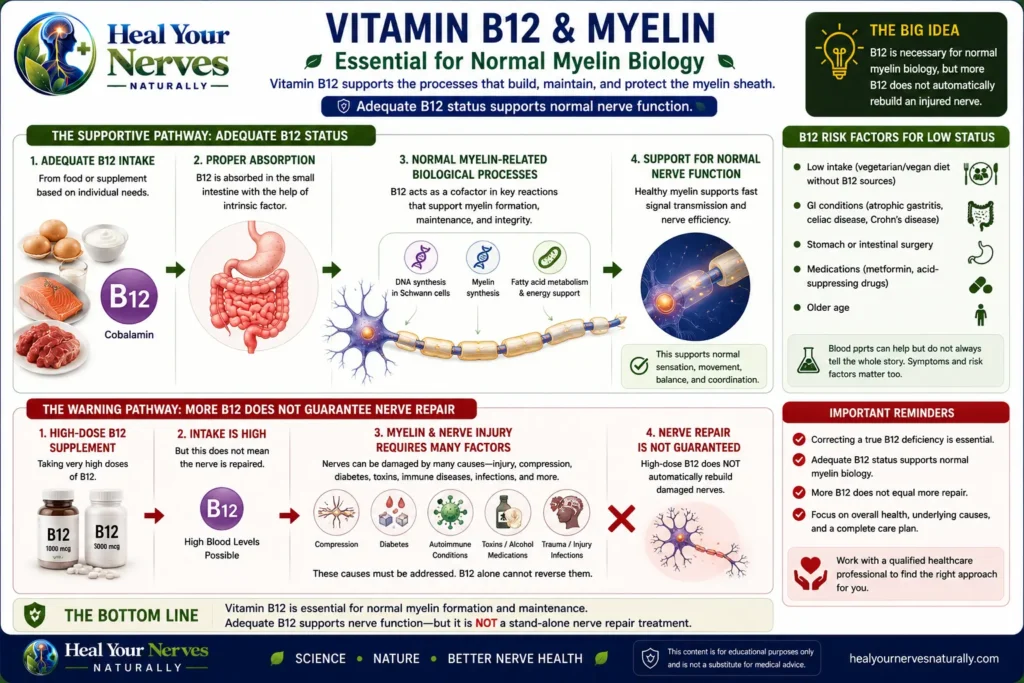
Vitamin B12 is necessary for normal neurological function. The NIH vitamin B12 fact sheet describes its importance to blood and nervous-system health, and deficiency can produce neurological problems.
Peer-reviewed reviews also discuss B12 in relation to myelination and neurological dysfunction when status is inadequate.
But we need to phrase this carefully.
What we can reasonably say
- B12 is required for normal nervous-system function.
- B12 deficiency can produce neurological injury.
- Myelin-related biology is one reason B12 deficiency matters.
- Correcting a true deficiency is medically important.
What we should not automatically say
- B12 supplements “rebuild any damaged myelin.”
- more B12 means faster nerve repair;
- a person with neuropathy should take high-dose B12 regardless of status or cause;
- B12 can remove nerve compression, reverse autoimmune disease or repair every injured axon.
That is the boundary between nutritional support and regeneration claims.
If B12 is low, does correcting it repair the nerve?
Sometimes neurological symptoms related to true B12 deficiency can improve after appropriate treatment, especially when the problem is recognized and addressed. But outcome depends on factors such as severity, duration, the underlying cause and whether another source of nerve injury is present.
That is why “B12 level corrected” and “nerve fully recovered” should not be treated as the same milestone.
If you are asking about deficiency, cause and persistent symptoms, continue to Nutritional Deficiency and Nerve Damage.
If you are asking how biological nerve repair works more broadly, continue to Regeneration Biology.
Micronutrients and Nerve Function in Signaling
A peripheral nerve carries information by tightly controlled electrical and chemical processes.
Cell membranes maintain ion gradients. Electrical impulses move along axons. At communication points, chemical signals may be released and received.
For the full mechanism, read Neural Signaling.
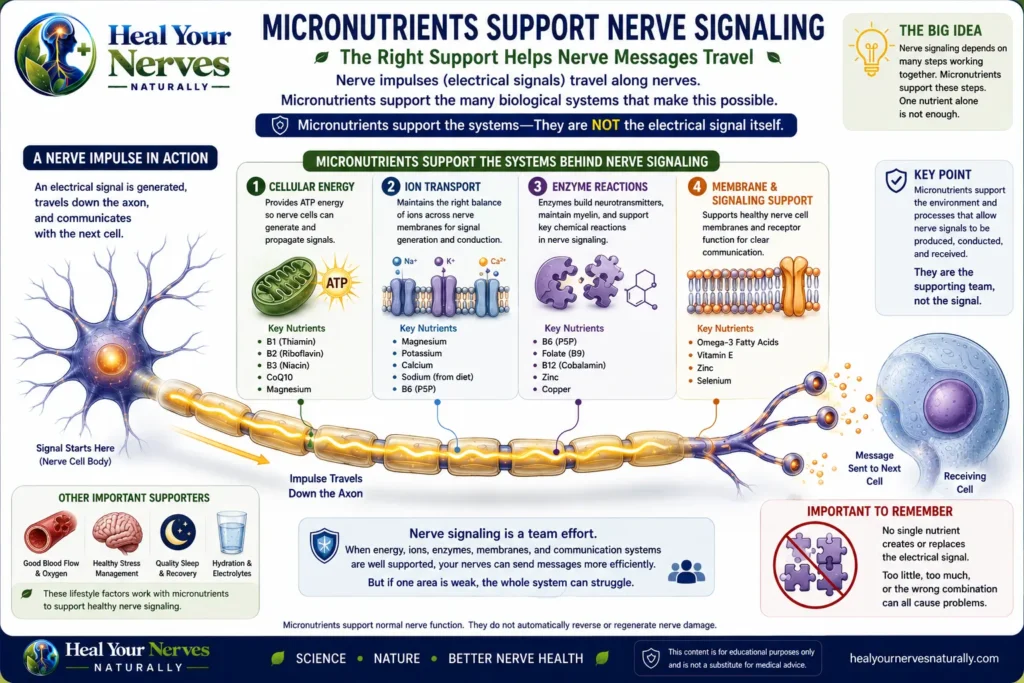
Micronutrients fit into this system indirectly and directly through:
- enzyme reactions;
- energy metabolism;
- ion transport;
- neurotransmitter-related pathways;
- membrane maintenance;
- cellular homeostasis.
Magnesium and normal nerve signaling
The NIH magnesium fact sheet notes that magnesium is a cofactor in hundreds of enzyme systems and is involved in muscle and nerve function, energy production and transport of ions such as calcium and potassium across cell membranes.
This role is important. However, the biological fact does not justify the treatment leap:
“Magnesium is involved in nerve conduction” does not mean “magnesium supplements treat every tingling sensation.”
The same reasoning applies across micronutrients and nerve function: a normal biological role does not automatically prove a treatment effect.
Vitamin B6, nerve function and the safety twist
Vitamin B6 participates in many enzyme reactions and is involved in nervous-system-related metabolism.
But excessive supplemental B6 can itself cause sensory neuropathy. The NIH vitamin B6 fact sheet and the EFSA scientific opinion on vitamin B6 both make the neurotoxicity issue clear. Upper-intake values differ by authority—the older U.S. Food and Nutrition Board UL is 100 mg/day for adults, while EFSA’s 2023 adult UL is 12 mg/day—so neither should be read as a personalized dose recommendation.
So B6 teaches us an important principle:
A nutrient can be essential at adequate intake and harmful at excessive exposure.
Worsening nerve symptoms are not proof a supplement is working
If tingling, burning or numbness becomes stronger after a new supplement, do not label the change a “healing reaction” simply because the ingredient has a biological role in nerves.
B6 is the clearest reason for caution: it is essential at appropriate intake, while excessive supplemental exposure can itself be neurotoxic. The mechanism lesson is therefore:
A symptom getting worse after a supplement is an observation to reassess—not evidence of detoxification, repair or regeneration.
For the practical label cross-check, exposure review and safety steps, use Micronutrients for Nerve Health.
Copper and Nerve Function: Small Amount, Several Jobs
Copper is a useful example of micronutrients and nerve function because the body needs only a small amount, yet copper supports several enzyme systems relevant to nerves.
According to the NIH copper fact sheet, copper is a cofactor for enzymes involved in processes including energy production, iron metabolism, neuropeptide activation and neurotransmitter synthesis.
Copper deficiency can affect the nervous system.
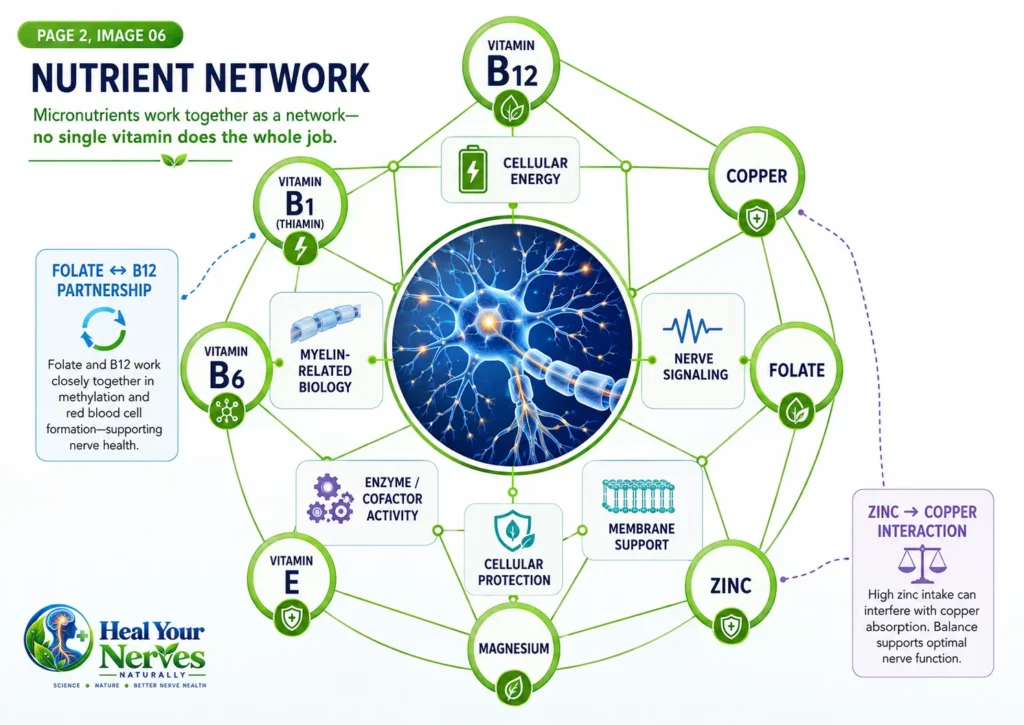
But copper is also an example of a network problem, because high zinc exposure can reduce copper absorption.
So the functional question is not simply:
“Does copper help nerves?”
It is:
“Is copper status adequate, and is anything interfering with it?”
The status-and-safety question is different from the mechanism question: it asks whether copper is adequate and whether zinc exposure or absorption could be changing that status.
Vitamin E and Nerve Function: Deficiency Matters Most
Vitamin E is a fat-soluble antioxidant. For example, the NIH vitamin E fact sheet notes that deficiency is particularly associated with fat-malabsorption disorders and can include neurological manifestations such as peripheral neuropathy and ataxia.
This is important. However, it is not an invitation to assume that large doses of vitamin E protect every nerve from damage.
The strongest clinical relevance is often the deficiency context:
Is there a reason this person may not be absorbing fat-soluble vitamins adequately?
That question belongs partly to nutrition and partly to the underlying GI or absorption problem.
For absorption biology, see Gut Axis.
Folate, B12 and Nerve Function
Folate participates in one-carbon metabolism and DNA-related processes. For nerve-health education, however, its relationship with B12 is especially important.
The NIH folate fact sheet explains that large folate intake can correct the megaloblastic anemia of B12 deficiency without correcting the neurological damage.
That is a valuable reminder:
One biological marker can improve while the neurological problem remains.
Therefore, micronutrients and nerve function should not be interpreted from one symptom, one lab number or one supplement alone.
Why Micronutrients Work as a Network
Online health content often encourages one-nutrient thinking:
- B12 for myelin;
- magnesium for nerves;
- B1 for energy;
- vitamin D for inflammation;
- zinc for immunity.
In practice, micronutrients and nerve function work through a network rather than a one-vitamin switch.
Cells use interconnected pathways. One nutrient can influence the metabolism or availability of another. A deficiency can coexist with another deficiency. A supplement can alter the balance of another mineral.
Three micronutrient interactions that matter
Zinc and copper: high zinc exposure can reduce copper absorption.
Folate and B12: folate can improve the blood picture while leaving B12-related neurological damage unresolved.
Multiple deficiencies: a person with malnutrition, bariatric surgery or significant malabsorption may not have a single isolated problem.
That is why we prefer:
“What is the nutritional pattern?”
over:
“Which one vitamin is the answer?”
Micronutrients, Nerve Function and the Limits of “Repair”
No.
This is one of the most important distinctions in micronutrients and nerve function.
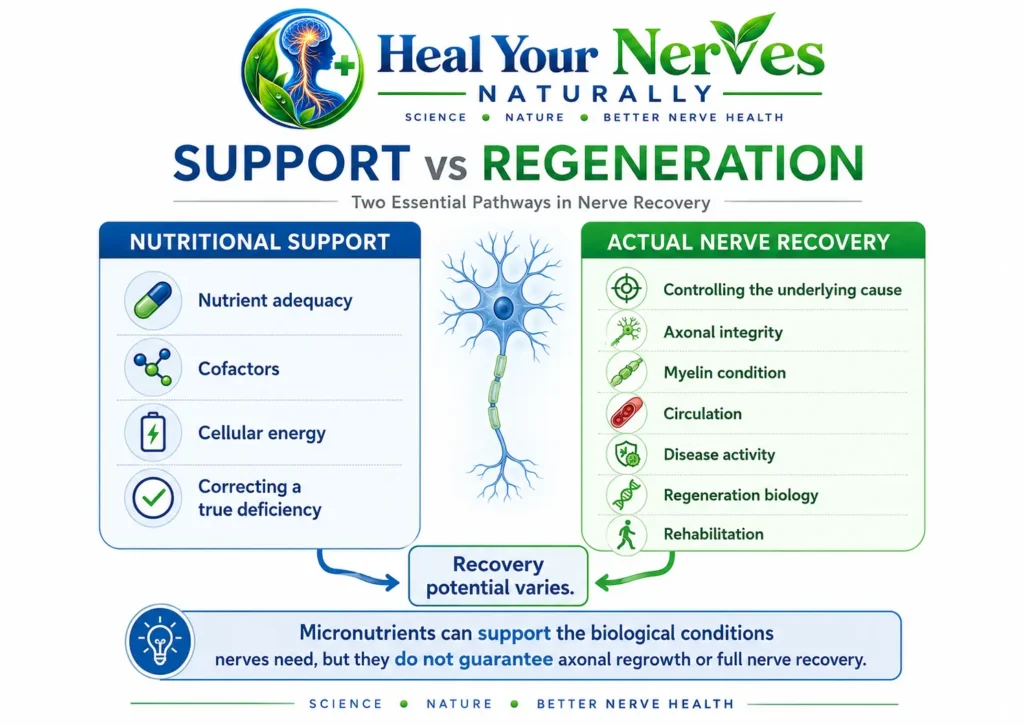
What nutritional support can mean for nerve function
- providing nutrients required for normal metabolism;
- correcting a confirmed deficiency;
- helping maintain adequate energy and enzyme function;
- supporting a nutritionally adequate tissue environment;
- reducing a preventable nutritional stressor.
Why nerve repair is a different biological question
Actual recovery can depend on:
- what caused the nerve injury;
- whether the axon is intact or damaged;
- whether myelin is affected;
- whether compression continues;
- whether blood supply is impaired;
- whether diabetes remains uncontrolled;
- whether immune disease is active;
- the location and severity of injury;
- time;
- regeneration capacity;
- rehabilitation and functional adaptation.
A nutrient cannot remove a mechanical compression.
A vitamin cannot switch off an active autoimmune attack by itself.
A supplement cannot guarantee axonal regrowth.
And a “perfect diet” cannot make every form of neuropathy reversible.
For deeper repair biology, see Regeneration Biology.
For myelin repair specifically, see Myelin Regeneration.
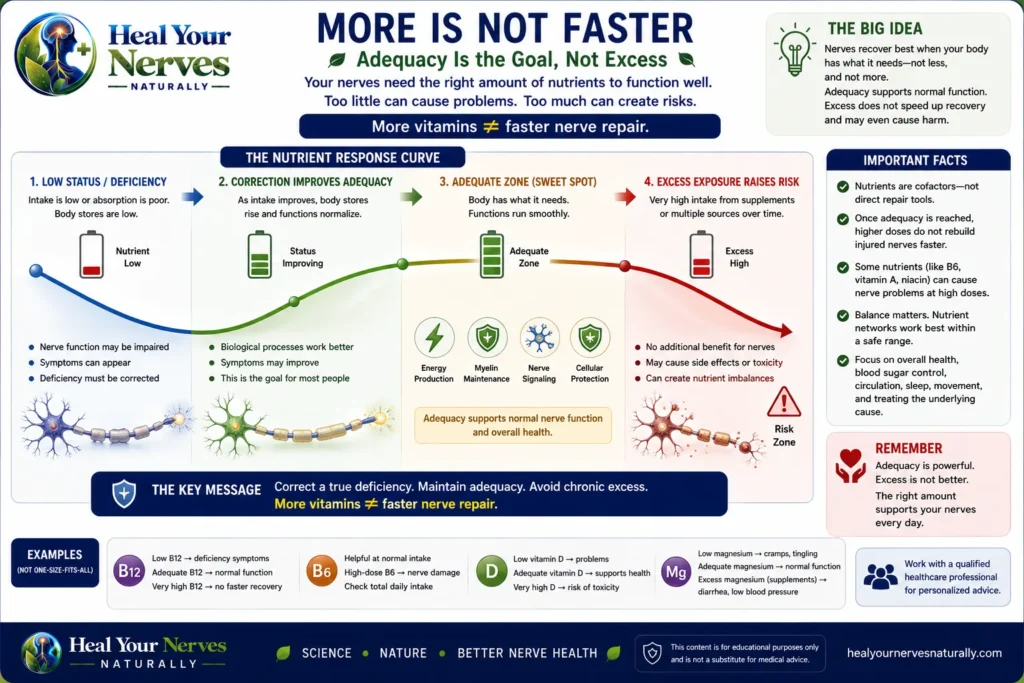
Why More Micronutrients Do Not Mean Faster Nerve Repair
If deficiency can hurt nerve function, it is tempting to assume the opposite:
“Then very high doses must make nerves work better.”
However, micronutrients and nerve function do not follow a “more is always better” rule.
Once a nutrient requirement is met, additional intake may offer no further benefit—and for some nutrients, excess creates risk.
B6 is the clearest example because excessive intake can itself cause neuropathy.
High zinc can create a copper problem.
High-dose supplements can also interact with medicines, interfere with tests or complicate interpretation. Detailed dose, duplication and label-review questions belong to Supplement Intelligence.
Nerve Function Is More Than Myelin: Axons and Signaling
When users say “nerve damage,” several very different biological problems can be hiding inside that phrase.
A nerve fiber can have:
- myelin dysfunction;
- axonal injury;
- altered membrane excitability;
- impaired metabolic support;
- disrupted blood supply;
- inflammatory damage;
- compression;
- degeneration at the nerve ending;
- or a combination of these.
That matters because micronutrients and nerve function interact differently depending on whether the main issue involves myelin, the axon, signaling, circulation, inflammation or compression.
If myelin is the main nerve problem
The biological question becomes:
What is happening to the insulation and to the cells that maintain it?
B12 status can be relevant because B12 deficiency is a well-established neurological problem with myelin-related consequences.
But if the myelin injury is caused by an autoimmune process, inherited disorder or other disease, B12 adequacy does not replace disease-specific treatment.
If the nerve axon itself is injured
The axon is the long conducting part of the nerve cell.
Recovery can depend on:
- whether the cell body remains viable;
- how severe the injury is;
- distance to the target tissue;
- local environment;
- ongoing compression or disease;
- regenerative capacity.
Adequate nutrition can support normal cellular metabolism, but it does not determine all of those factors.
For actual axonal-repair biology, see Axonal Regrowth.
If nerve signaling changes without major structural loss
Some symptoms can arise because nerve excitability or signaling is altered.
In that situation, the question may be less about “rebuilding the nerve” and more about what is disturbing normal signaling.
For the core mechanism, use Neural Signaling.
This distinction helps explain why two people can both describe “tingling” but have completely different underlying problems.
Cell Membranes, Fatty Acids and Nerve Function
Micronutrients and nerve function are only one part of the larger nutrition picture.
Nerve-cell membranes contain lipids, and myelin is especially lipid-rich.
That means fatty-acid biology also matters—but it belongs to a different nutrition question.
This page should not turn into an omega-3 or fat guide.
If your question is:
“How do fats fit into nerve membranes and myelin?”
continue to Fatty Acids.
This is an example of an important learning rule:
A page should explain enough to make the next question clear, then hand the deeper question to the correct owner.
Protein, Amino Acids and Nerve Function
Nerves are living tissue. Proteins supply amino acids used in enzymes, receptors, transporters and structural proteins. Therefore, protein biology matters to nerve cells even though it is not a micronutrient.
But the statement:
“Protein is important to tissue biology”
does not mean:
“More protein directly repairs neuropathy.”
For protein and amino-acid biology, continue to Protein and Amino Acids.
Micronutrients, Neurotransmitters and Misleading Claims
You may see claims such as:
“B6 makes neurotransmitters, therefore B6 improves nerve function.”
However, that claim skips several important steps.
Yes, vitamin B6 participates in enzyme reactions involved in neurotransmitter metabolism.
But the clinical effect of taking extra B6 depends on:
- baseline status;
- total dose;
- duration;
- other health conditions;
- the actual cause of symptoms.
And excessive B6 can itself be neurotoxic.
So a true mechanistic statement can still be used to sell an unjustified treatment claim.
Our rule is:
Mechanism tells us why adequacy matters. It does not automatically prove that supplementation treats a condition.
Why a Normal Nutrient Level Does Not Prove Normal Nerve Function
No.
A nutrient test and a nerve-function assessment answer different questions. This is a key boundary in micronutrients and nerve function.
A lab result may help estimate or confirm nutrient status.
It does not directly measure:
- nerve conduction;
- axonal integrity;
- myelin integrity;
- muscle response;
- sensory threshold;
- degree of compression;
- functional recovery.
The reverse is also true: a person can have neuropathic symptoms from a non-nutritional cause even when nutrition is adequate.
That is why this framework separates:
Nutrient status
from
Nerve function
from
Cause of dysfunction
from
Recovery.
Trying to collapse all four into one blood test creates confusion.
Five Real-Life Cases: Micronutrients and Nerve Function in Context
Mechanism helps us decide whether micronutrients and nerve function are biologically connected in a given pathway. However, mechanism does not prove that a nutrient caused a person’s symptom.
Case 1 — Borderline B12 and numb feet
A person has numbness in both feet and an indeterminate B12 result.
Mechanism tells us B12 is neurologically relevant. It does not prove causality. The next questions are whether there is a B12-risk pathway, whether supplements were used before testing, whether diabetes or another cause is present, and whether further clinical assessment is needed.
That is a status-interpretation question rather than a mechanism conclusion.
Case 2 — Normal B12, several B6-containing products
The user is focused on B12 because B12 is famous online, but the supplement list shows B6 in several products.
The better question becomes:
“What is my total B6 exposure?”
That is a status-and-safety question, not a reason to add more B12.
Case 3 — Diabetes, metformin and worsening distal numbness
Nutrition may still matter, especially because B12 belongs in the clinical context of long-term metformin use. But diabetic neuropathy and metabolic factors may also be central.
The point is not to choose one cause from a mechanism page. It is to recognize that more than one pathway can coexist. For condition-level context, read Diabetic Neuropathy.
Case 4 — Tingling after a back or compression injury
Symptoms began after a mechanical injury and change strongly with posture or movement.
The fact that B vitamins participate in nerve biology does not make a nutrient deficiency the first explanation to prioritize. Mechanism must return to the actual history.
Case 5 — Bariatric surgery, weakness and sensory change
Here the nutritional pathway deserves more attention because surgery can alter intake and absorption, and several deficiencies may coexist.
The useful question is not which single vitamin has the strongest marketing. It is:
Which deficiencies are plausible in this surgical context, and does the person need a broader clinical nutritional assessment?
That is a cause-tracing question rather than a mechanism conclusion.
Together these cases show the core rule:
Mechanism tells you what could matter biologically. Context and assessment determine what is actually causing the problem.
What Micronutrient Mechanisms Can—and Cannot—Tell You
Mechanism can help answer:
- Why does B1 deficiency affect energy-dependent tissue?
- Why does B12 matter to neurological function?
- Why can B6 be both essential and toxic?
- Why does copper status matter?
- Why can magnesium participate in normal signaling?
- Why can one nutrient interaction change another nutrient’s status?
Mechanism cannot tell you, by itself:
- whether you personally are deficient;
- whether a symptom is caused by that deficiency;
- which dose you need;
- whether a supplement will improve your symptoms;
- how long recovery will take;
- whether a nerve injury is reversible.
That boundary is not a weakness. Instead, it keeps information about micronutrients and nerve function clinically responsible.
Cellular Energy and Nerve Function: Why You May Not Feel an Immediate Boost
The word “energy” creates another common misunderstanding in discussions of micronutrients and nerve function.
When we say thiamin or magnesium participates in energy metabolism, we are describing cellular chemistry.
We are not saying:
“Take this nutrient and your nerves will immediately feel energized.”
Cells use metabolic pathways to convert nutrients into ATP and maintain normal function. A severe deficiency can impair those pathways. Correcting that deficiency can remove a biological problem.
But subjective fatigue, nerve pain, numbness and recovery are influenced by many systems.
This distinction matters because supplement marketing often turns a cellular mechanism into a promise you can feel within hours.
A better interpretation is:
Adequate micronutrient status helps normal metabolism run. It does not guarantee an immediate sensation or a specific clinical outcome.
Four Micronutrients, Four Lessons for Nerve Function
You do not need to memorize every biochemical reaction. Instead, these four examples capture the practical logic of micronutrients and nerve function.
B12: deficiency can disrupt nerve function
B12 matters because a true deficiency can affect nervous-system function and may occur without obvious anemia.
Practical lesson:
Do not dismiss neurological B12 questions only because the blood count looks normal.
B1: nerve function depends on metabolism
Severe thiamin deficiency can disrupt energy-dependent tissues, including the nervous system.
Practical lesson:
In severe malnutrition, prolonged vomiting, alcohol dependence or high-risk post-surgical situations, nutrient deficiency can become urgent—not merely a lifestyle optimization topic.
B6: normal nerve function does not mean unlimited intake
The body needs B6.
Excessive chronic exposure can also cause neuropathy.
Practical lesson:
A nutrient can be necessary at one level and harmful at another.
Copper: nerve function depends on nutrient balance
Copper contributes to several enzyme systems relevant to the nervous system, while high zinc exposure can reduce copper absorption.
Practical lesson:
You cannot always evaluate one supplement ingredient in isolation.
Together, these four examples explain why our model is:
status → function → cause → decision
not:
vitamin → benefit.
A Checklist for Reading Micronutrient and Nerve-Health Claims
When you see a statement such as:
“This nutrient repairs nerves”
run it through five questions.
1. Is the source talking about normal function or treatment?
“Required for normal function” is not the same as “treats disease.”
2. Is the evidence about deficiency correction?
A study or guideline showing benefit in deficient people does not prove the same benefit in people who are already adequate.
3. Is the mechanism being mistaken for an outcome?
A nutrient may participate in myelin-related biology without a clinical trial proving that a supplement remyelinates injured nerves.
4. Is the dose being ignored?
The fact that the body needs a nutrient does not justify very high doses.
5. Is the actual cause of nerve injury being ignored?
If compression, diabetes, autoimmune disease, trauma or another condition is driving the problem, nutrition may be supportive but not causal treatment.
This checklist helps separate biological plausibility from clinical evidence. It is especially useful when online claims about micronutrients and nerve function jump from “involved in biology” to “repairs damage.”
How Micronutrients and Nerve Function Should Change Your Next Decision
After reading about micronutrients and nerve function, you should not leave with a longer shopping list.
You should leave with a clearer question.
If you now think:
“I may actually be low in one of these nutrients.”
Go to Micronutrients for Nerve Health and review intake, status, testing and excess.
If you think:
“I have a real risk factor for deficiency.”
Go to Nutritional Deficiency and Nerve Damage and trace the cause.
If you think:
“My question is really about whether the nerve can regrow.”
Go to Regeneration Biology.
If you think:
“I only want practical food choices.”
Go to Nerve Food Repair.
That is the purpose of mechanism education:
not to give you more facts to memorize, but to help you ask the next question more accurately.
Common Questions About Micronutrients and Nerve Function
These questions bring micronutrients and nerve function back to the practical issues readers most often face.
Which nutrient is most important for nerve function?
There is no single winner.
B12 is particularly important because deficiency can produce neurological injury. B1 matters for energy metabolism and severe deficiency can cause neuropathy. B6 is necessary but excessive exposure can also cause neuropathy. Copper matters to several enzyme systems and deficiency can affect the nervous system.
The relevant nutrient depends on the biological and clinical problem. That is why micronutrients and nerve function should be understood as a system rather than a ranking of “best vitamins.”
Does B12 make myelin?
B12 is required for normal neurological and myelin-related biology, and deficiency can damage neurological function. But describing B12 as a simple “myelin builder” is too simplistic.
Can vitamins regenerate an axon?
Vitamins can support normal metabolism and correcting deficiency can remove a nutritional barrier. Actual axonal regeneration depends on the type and severity of nerve injury and many other biological factors.
Is magnesium important for nerve impulses?
Magnesium contributes to ion transport and normal nerve and muscle function. However, that role in micronutrients and nerve function does not make magnesium deficiency the default explanation for tingling, nor does it mean supplements treat every nerve symptom.
Why can B6 help normal biology but also damage nerves?
Because essentiality and toxicity are different parts of the dose-response relationship. The body requires B6 for normal function, while excessive chronic exposure—especially from supplements—can be neurotoxic.
Do nutrients work better together?
Normal physiology depends on many nutrients working in overlapping systems. But that is not a reason to take large “stacks.” Interactions matter, and unnecessary combinations can increase exposure without increasing benefit.
Does correcting deficiency guarantee recovery?
No. Although correcting a causal deficiency can be an essential part of care, neurological outcome still depends on duration, severity, tissue damage and other ongoing factors.
The Main Idea About Micronutrients and Nerve Function
The nervous system does not need “maximum vitamins.”
It needs adequate biological resources, functioning metabolic pathways and control of the actual cause of injury or dysfunction.
Micronutrients and nerve function are connected because nerves are living cells that depend on normal metabolism, signaling, membrane biology and enzyme activity.
They matter most when we ask the right question:
Is this nutrient necessary here, is the person actually deficient or overexposed, and what part of nerve biology does that change?
That question is more useful—and safer—than “What supplement repairs nerves?”
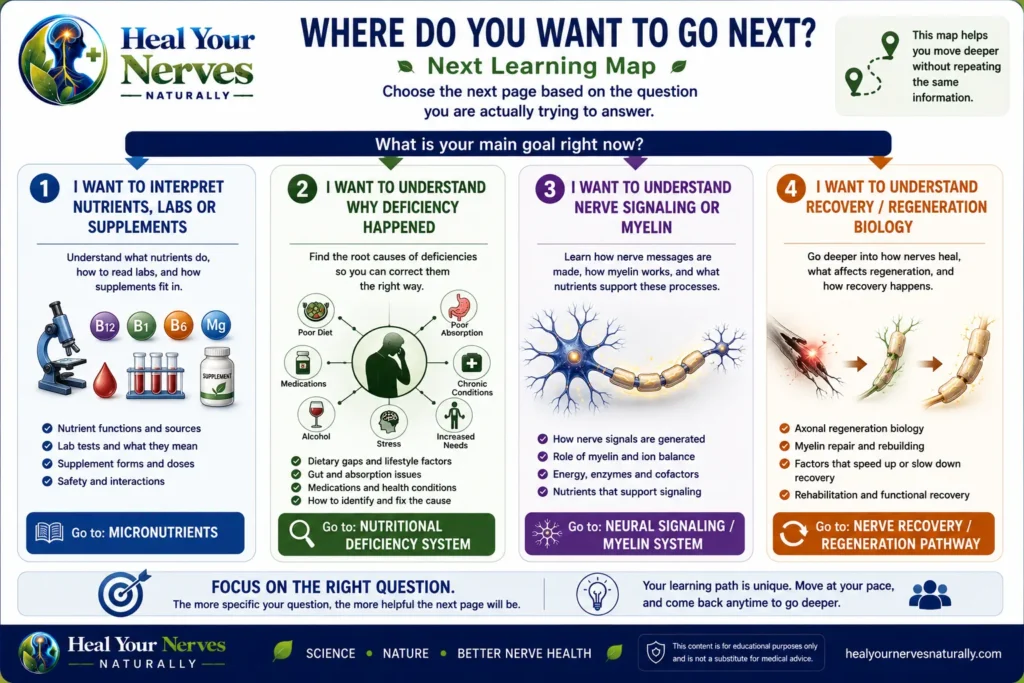
Choose Your Next Step
I want to understand my nutrient intake, lab result or supplement exposure.
→ Micronutrients for Nerve Health
I want to understand why a deficiency developed.
→ Nutritional Deficiency and Nerve Damage
I want practical food choices.
→ Nerve Food Repair
I want to understand nerve impulses.
→ Neural Signaling
I want to understand myelin itself.
→ Myelin System
I want to understand actual repair and regeneration.
→ Regeneration Biology
References and Evidence
Core micronutrient and nerve-function references
- NIH Office of Dietary Supplements — Vitamin B12: Fact Sheet for Health Professionals
- NIH Office of Dietary Supplements — Thiamin: Fact Sheet for Health Professionals
- NIH Office of Dietary Supplements — Copper: Fact Sheet for Health Professionals
- NIH Office of Dietary Supplements — Magnesium: Fact Sheet for Health Professionals
- NIH Office of Dietary Supplements — Vitamin E: Fact Sheet for Health Professionals
- NIH Office of Dietary Supplements — Folate: Fact Sheet for Health Professionals
B6 safety and broader mechanism references
- NIH Office of Dietary Supplements — Vitamin B6: Fact Sheet for Health Professionals
- EFSA Journal — Scientific Opinion on the Tolerable Upper Intake Level for Vitamin B6
- PMC — The Role of Micronutrients in Neurological Disorders
Medical disclaimer: This page explains nutrition and nerve biology for general education. It does not diagnose neuropathy, nutrient deficiency or another neurological condition, and it does not recommend individualized supplement doses. Persistent or progressive neurological symptoms should be evaluated by a qualified healthcare professional.