
Daily Patterns and Nervous System Stability
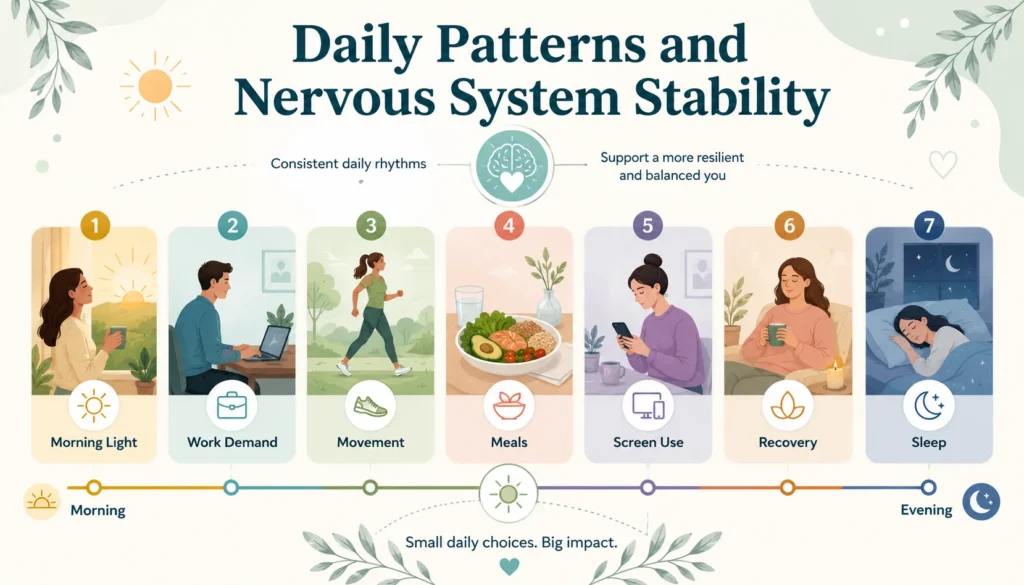
Daily Patterns and Nervous System Stability explains how daily routines may shape body rhythm, stress load, rest, movement, energy, and recovery needs. This page does not diagnose or treat any condition. Instead, it gives readers a calm way to understand how daily habits may connect with nervous system load.
Across the day, many signals reach the body. Sleep time, sitting time, meals, stress, screens, posture, movement, and rest breaks may all play a role. Over time, these signals may affect how steady, tired, alert, or sensitive the body feels.
Because nerves do not work alone, daily rhythm matters. Nerves interact with sleep, blood flow, stress response, muscle tone, and recovery systems. Therefore, this page helps readers understand one possible layer behind nerve sensitivity, tired nerves, tingling, numbness, burning feelings, or body-wide sensitivity.
Quick Navigation
What This Means
Daily Patterns and Nervous System Stability means the way repeated daily routines may affect nervous system demand. These routines include wake time, sleep rhythm, meals, water intake, movement, posture, work pressure, screen use, rest breaks, and evening recovery.
In simple terms, the body reads the day. It responds to light, food, movement, pressure, stress, rest, and habits. As a result, daily patterns may become signals that shape how calm, alert, tense, or tired the nervous system feels.
Routine alone does not explain nerve pain, tingling, numbness, burning feelings, weakness, or neuropathy symptoms. Those symptoms may have many causes. Therefore, sudden, severe, unusual, or worsening symptoms need medical guidance.
A simple example is traffic flow. When signals stay clear and steady, movement becomes smoother. In a similar way, steady daily patterns may reduce how much adjustment the body needs to make.
Plain Meaning
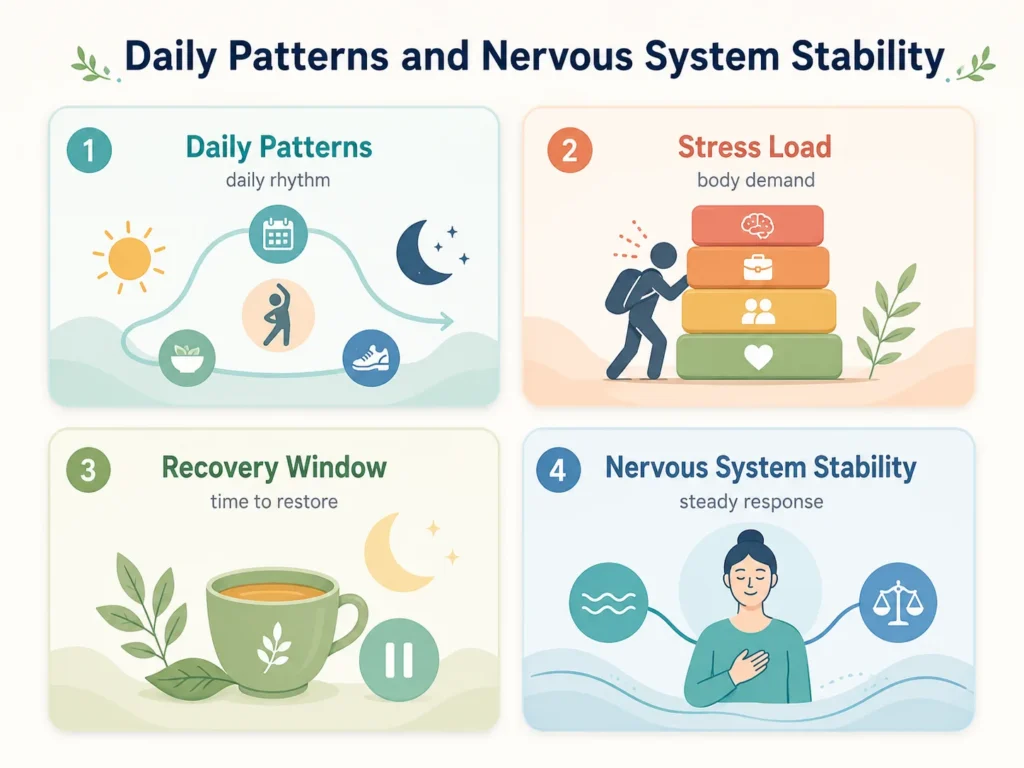
Daily patterns:
The repeated habits and rhythms that shape a normal day.
Nervous system stability:
The body’s ability to stay steady, respond clearly, and return toward calm after demand.
Recovery window:
A time when the body has less demand and more chance to restore energy.
Stress load:
The total pressure the body and mind may need to manage.
Nerve sensitivity:
A state where nerves or the nervous system may react more strongly than expected.
Body rhythm:
The repeated timing of sleep, waking, meals, movement, rest, and activity.
How It Works
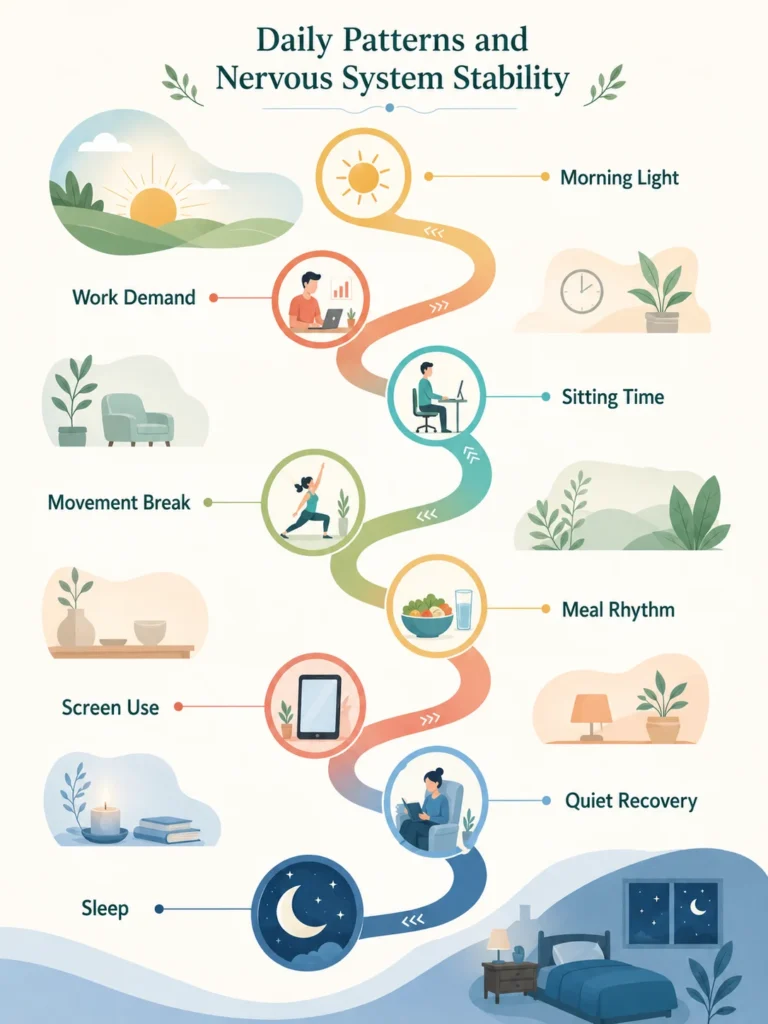
First, the body receives daily signals. Morning light, wake time, food, movement, work pressure, posture, and stress all send information to the nervous system. As a result, the body decides when to stay alert, save energy, move, rest, or recover.
Next, body functions shift during the day. Heart rate, breathing, muscle tone, digestion, attention, temperature, and sleep pressure may all change. In many cases, this is normal and helpful.
Repeated irregular patterns may increase body demand. For example, poor sleep, long sitting, heavy mental load, missed breaks, and late-night screens may keep the body more alert. Because of this, the nervous system may have less time to settle.
Over time, this pattern may interact with nerve sensitivity, stress response, blood flow, and recovery capacity. Therefore, daily patterns may act like background signals that shape body load.
Key Daily Layers
Sleep Rhythm Layer
Sleep rhythm is one of the strongest daily signals. The body uses sleep time to organize rest, memory, energy, hormone rhythm, and repair activity. to understand how rest rhythm may connect with nervous system recovery education.
Poor or uneven sleep may increase the adjustment the nervous system needs. For example, a person may sleep at different times each night. They may also wake often or use screens late in the evening. These patterns do not diagnose a condition. Still, they may affect how rested, tense, alert, or sensitive the body feels.
From a nerve-health view, sleep rhythm matters because tired systems may react more strongly. When recovery windows are reduced, nerve discomfort, body sensitivity, fatigue, or stress load may feel more noticeable.
Because sleep rhythm is closely connected with recovery, readers can explore Sleep & Recovery for a deeper look at rest, recovery demand, and nervous system education.
Stress Timing Layer
Stress is not only about one hard event. It may also build through timing. A rushed morning, missed breaks, long work hours, and evening worry may keep the body in a higher-demand state.
Because the Stress System can raise alertness, muscle tension, and energy demand, repeated stress signals may affect body rhythm. In addition, the body may need more time to return toward calm after a stressful day.
This layer matters because the nervous system needs both action and rest. If the day gives many action signals but few rest signals, the body may feel tense, restless, tired, or more sensitive. Even so, stress timing is only one layer.
Readers can also explore the Stress System to understand how repeated stress signals may interact with nervous system load.
Movement and Posture Layer
Movement gives the nervous system useful information from muscles, joints, balance, and blood flow. Meanwhile, posture and long sitting may change pressure patterns, muscle tone, and comfort signals. Therefore, readers can explore Movement, Posture, and Nerve Regulation to understand how movement rhythm and body position may connect with nerve-health education.
Someone may sit for long hours, hold the neck forward, or move very little between work sessions. This does not mean posture alone causes nerve symptoms. However, it may add mechanical load in some cases.
In addition, movement is part of daily rhythm, not only exercise time. Walking, standing, stretching, and changing position may all send useful body signals. Still, readers should seek guidance if movement causes worse pain, weakness, or severe numbness.
Because movement and posture are closely linked with daily rhythm, Movement, Posture, and Nerve Regulation can help readers continue this topic in more detail.
Energy and Meal Rhythm Layer
Meal timing and energy rhythm may affect how steady the body feels. Food patterns may interact with alertness, fatigue, digestion, blood sugar rhythm, and stress response. Therefore, irregular meals may become one background layer of nervous system demand.
Long gaps without food, heavy late meals, low water intake, or sudden energy drops may affect comfort and focus. These patterns should not be used for self-diagnosis. Still, they may help readers understand why body rhythm can feel uneven.
From a system view, energy rhythm matters because nerves depend on body-wide support. Nerves interact with blood flow, oxygen delivery, nutrients, and metabolic stability. For deeper nutrition-related education, readers can continue with Nerve Food Repair. However, this page does not give diet rules, supplement advice, or treatment steps.
Because food quality may connect with body-wide support, Nerve Food Repair can help readers understand nutrition-related nerve-health education in a safer way.
Recovery Window Layer
Recovery windows are moments when the body has less pressure and more chance to settle. These moments may include quiet breaks, gentle movement, calm breathing, restful sleep, slower meals, relaxed evenings, or time away from heavy mental demand.
Many people move from one demand to another without pause. Work, screens, worry, noise, poor sleep, and constant alerts may reduce true recovery time. Because of this, the nervous system may stay in a more guarded pattern.
This layer matters because stability is not only built during sleep. It may also be shaped by small recovery moments across the day. Therefore, recovery windows are useful to understand, even when they are short.
Sensory Load Layer
Sensory load includes light, noise, screens, multitasking, alerts, crowded spaces, and constant information. These signals may keep attention systems active. Over time, high sensory load may make the day feel more demanding.
During a busy day, a person may work under bright light, scroll during breaks, answer messages quickly, and use screens late at night. Each signal may be small. However, together they may add pressure to attention, sleep rhythm, and stress response.
Some readers may notice sensitive nerves, body tension, headaches, fatigue, or discomfort during high-demand days. These experiences can have many causes. Therefore, this section is only an educational bridge, not a diagnosis.
System Links
Nervous System Link
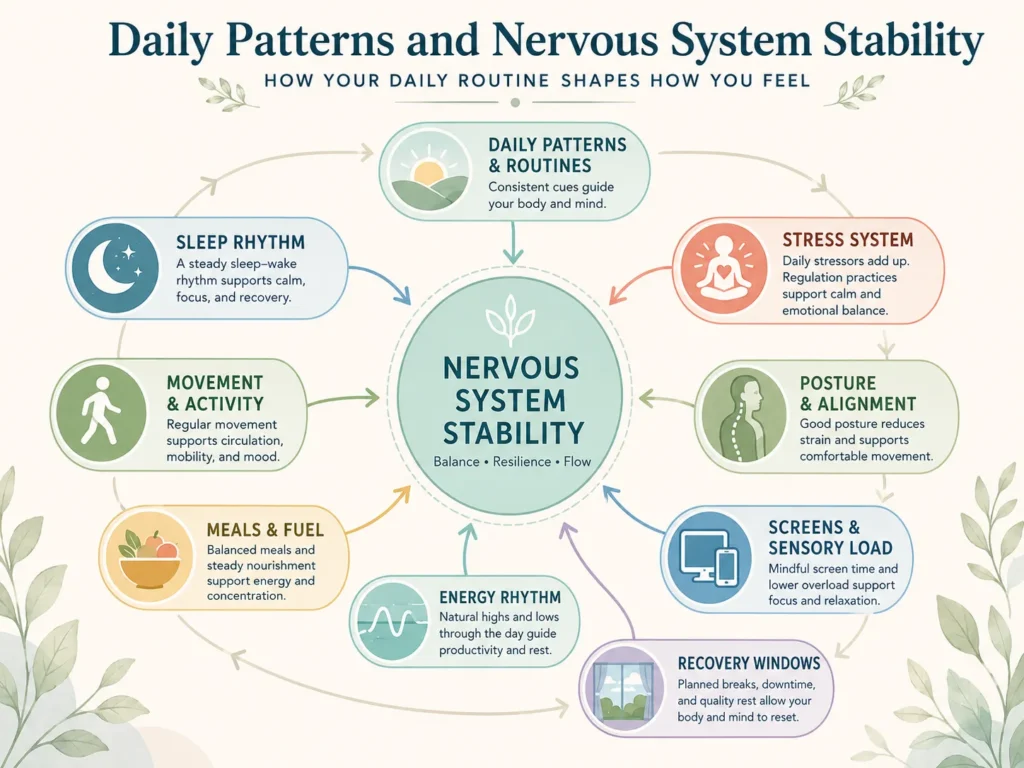
Daily rhythm and the nervous system have a two-way link. The nervous system reads daily signals. At the same time, those signals shape nervous system demand.
Sleep, movement, stress, posture, and rest breaks may affect alertness and settling. A sensitive nervous system may also make daily patterns feel harder to manage.
Rather than blaming one system, this shows how connected the body can be. Therefore, nervous system stability is best understood as a network pattern. Still, these patterns should not replace medical checks when symptoms are new, severe, or changing quickly.
Stress System Link
The stress system helps the body respond to challenge. However, repeated stress signals may keep the body more alert than needed. Over time, this may affect sleep, muscle tension, digestion, attention, and energy.
Because stress can show up differently in each person, daily pattern tracking should stay gentle. It should not become fearful. Instead, it can help readers notice how stress timing may interact with body rhythm.
Stress late at night may make settling harder. Meanwhile, a rushed morning may shape the tone of the day. Therefore, stress timing belongs inside the daily-pattern picture.
Circulation Link
Circulation helps deliver oxygen and nutrients. It also helps clear waste products. Therefore, movement, posture, water intake, breathing rhythm, and long sitting may all interact with delivery and clearance demand. Readers can continue with Circulation & Oxygenation to understand this delivery-and-clearance system in more detail.
This does not mean circulation explains every nerve symptom. However, blood flow is one body-wide system that may interact with nerve comfort, tissue recovery, and energy.
Long sitting may reduce movement signals. In contrast, gentle movement may support normal blood-flow patterns. These links do not prove a cause. Instead, they show why daily patterns should be viewed as connected body signals.
Because oxygen delivery is part of body-wide rhythm, Circulation & Oxygenation can help readers understand how blood flow may connect with nerve-health education.
Metabolic System Link
The metabolic system helps the body use and store energy. Meal timing, sleep rhythm, stress, movement, and rest may all interact with metabolic rhythm. Because nerves need steady body-wide support, uneven energy patterns may increase demand.
Poor sleep may affect appetite and energy. Meanwhile, high stress may change food choices. In addition, low movement may reduce metabolic flexibility.
These patterns often overlap, so daily rhythm is best understood as a network. However, this does not mean readers need a strict food plan. Instead, the point is to understand how timing, energy, and body demand may connect.
Regeneration Systems Link
Regeneration systems include repair, adaptation, stability, and recovery capacity. These processes need time, energy, blood flow, sleep, and lower overload. Therefore, daily patterns may shape the setting in which recovery processes occur.
This does not mean routine heals nerves or guarantees repair. Instead, daily rhythm may help readers understand one possible support layer.
Sleep, movement, calmer evenings, and regular breaks may all reduce total demand. At the same time, poor sleep and high stress may add pressure. Because of this, regeneration should be viewed as a system process, not a quick fix.
Nerve Function
Daily Patterns and Nervous System Stability may connect with nerve function through sleep quality, stress response, muscle tension, blood flow, energy rhythm, sensory load, and recovery demand.
Some readers may search this topic because they notice nerve pain, tingling, numbness, burning feelings, sensitive nerves, tired nerves, weakness, or changes in comfort. These symptoms can have many causes. Readers who want safe condition-based education can also explore Peripheral Neuropathy for a broader overview of nerve symptoms and possible medical context.
Daily rhythm should never be used as the only explanation. Instead, this topic can help readers understand one possible layer of body-wide demand. For this reason, sudden, severe, worsening, or unusual symptoms need medical care.
In many cases, nervous system stability is about flexibility. A flexible system can activate when needed and settle afterward. However, poor sleep, high stress, low movement, and high sensory load may reduce that flexibility.
Because symptoms such as tingling, numbness, and burning feelings need careful context, Peripheral Neuropathy can help readers continue with safer condition-based education.
Visual Flow
Daily routine signals
↓
Sleep rhythm, movement, meals, stress, posture, and sensory load
↓
Body alertness and energy demand
↓
Muscle tone, blood flow, breathing, attention, and recovery windows
↓
Nerve sensitivity and body comfort may be influenced
↓
Recovery demand may increase or decrease over time
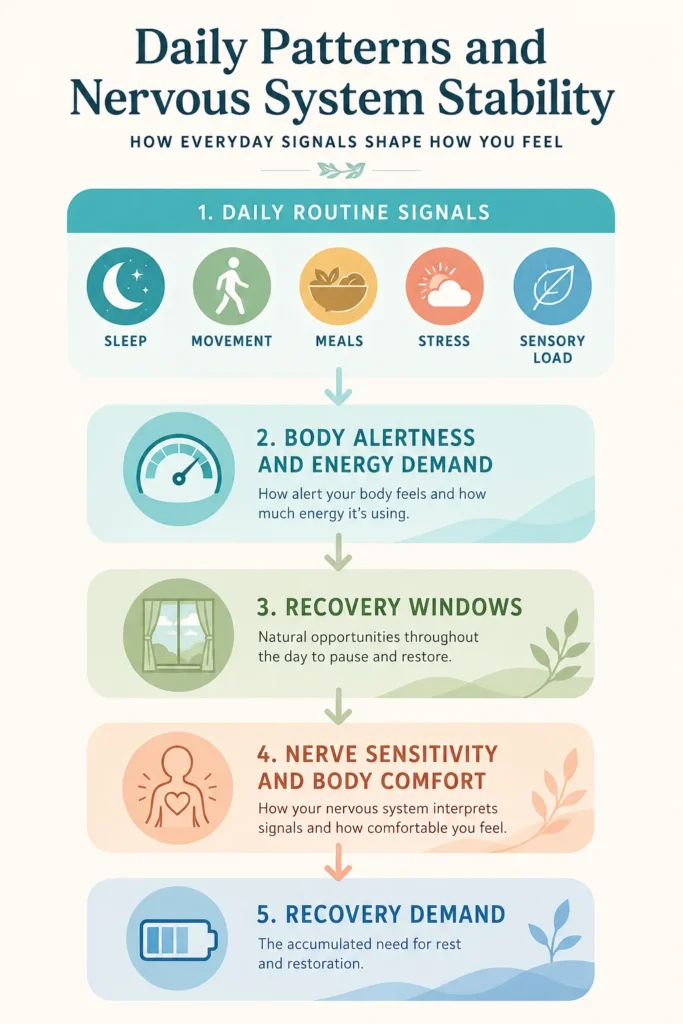
This flow is not always straight. In real life, it may work like a cycle. For example, poor sleep may increase stress sensitivity. Then stress may affect the next night’s sleep.
Meanwhile, long sitting may increase discomfort. That discomfort may reduce movement. Therefore, one pattern may feed into another.
Different people may experience different patterns. Because of this, the model should be used only as an educational guide. It does not diagnose nerve damage, explain every symptom, or replace medical care.
Recovery Role
Recovery Needs System Coordination
Recovery is not handled by one system alone. It involves nervous system signals, blood flow, sleep, energy, tissue response, immune activity, and daily demand. Therefore, daily patterns may matter because they influence several systems at once.
A calmer evening may support sleep rhythm. Meanwhile, movement during the day may support blood flow and muscle comfort. These patterns are not treatments.
However, they may shape the setting in which the body tries to restore stability. In addition, repeated daily signals may become more important than one single good or bad day.
Recovery Needs Energy and Rest
The body needs energy for normal function. It also needs rest signals to decide when to stay alert and when to settle. Because of this, repeated overload may increase recovery demand.
When sleep is poor, stress is high, and rest is limited, the body may feel less steady. As a result, nerve discomfort or body sensitivity may become more noticeable for some readers.
Even then, this does not prove one cause. Instead, it shows that energy and rest may interact with comfort. Therefore, energy and rest belong inside the wider recovery picture.
Recovery Needs Delivery and Clearance
Nerves and tissues depend on oxygen, nutrients, fluid movement, and waste clearance. Blood flow, movement, breathing rhythm, water intake, and posture may all interact with these processes.
This does not mean one daily habit controls recovery. Rather, delivery and clearance are part of a wider system. Therefore, daily patterns may help or challenge the body’s ability to manage load.
Long sitting may reduce movement signals. In contrast, regular movement may support normal circulation patterns. These changes are not a diagnosis.
Recovery Needs Nervous System Stability
A stable nervous system does not mean a person never feels stress. Instead, it means the body can respond and then return toward a calmer state. This flexibility may matter for comfort, sleep, movement, and energy.
Because nerve sensitivity may rise when the body feels overloaded, stability becomes an important educational idea. It helps readers understand why rhythm, rest, and repeated low-demand signals may matter.
Still, stability should not mean perfect control. Daily life will always include pressure, change, and demand. Therefore, the goal is not perfection.
Recovery May Change With Repeated Load
Repeated system stress may come from many directions. Poor sleep, worry, low movement, irregular meals, high screen use, and long sitting can combine. Over time, the combined load may matter more than one single factor.
For this reason, daily patterns should be viewed as a background system. They may not explain everything. However, they can influence the overall demand placed on the body.
In addition, small patterns may become more meaningful when they repeat for weeks or months. Therefore, daily rhythm can be useful for education, even when symptoms have many possible causes.
Misunderstandings
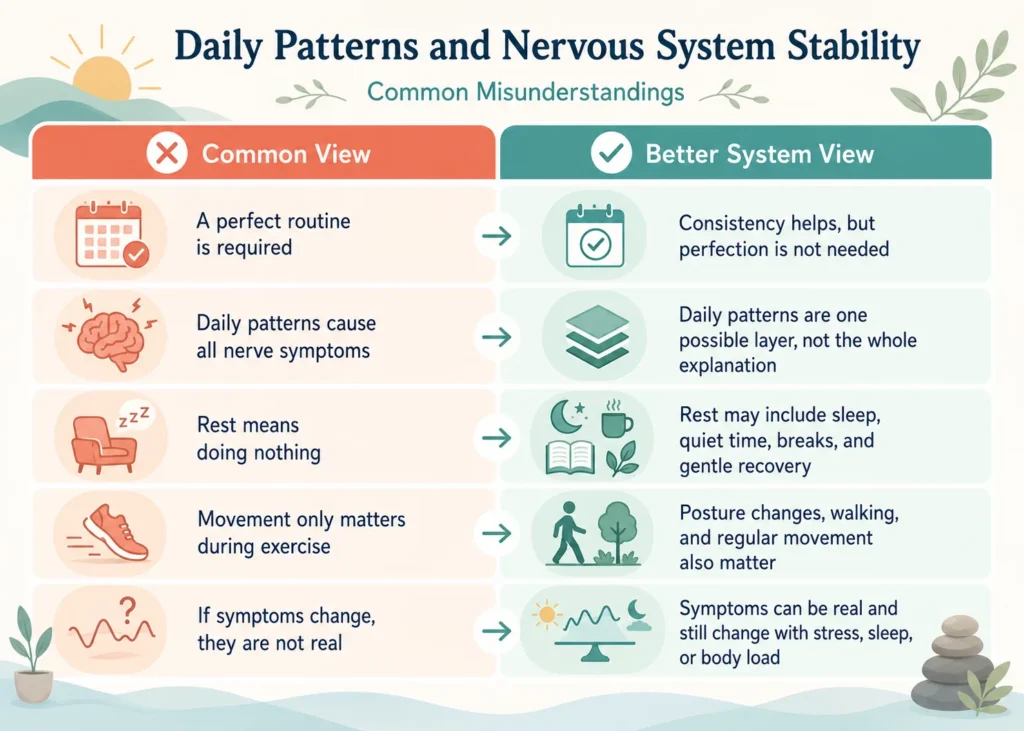
Misunderstanding 1: A perfect routine is required for nervous system stability.
Clarification:
A perfect routine is not realistic or needed. Instead, the goal is to understand repeated patterns. Small rhythm changes may be easier to keep than strict rules. Therefore, readers should avoid turning daily rhythm into pressure.
Misunderstanding 2: Daily patterns are the cause of all nerve symptoms.
Clarification:
Nerve symptoms can have many causes. Daily patterns may be one possible layer. However, they should not replace diagnosis, testing, or medical guidance. Because of this, symptoms need careful context.
Misunderstanding 3: Rest always means doing nothing.
Clarification:
Rest can include sleep, quiet time, lower sensory load, gentle movement, slower meals, or breaks from mental pressure. Therefore, recovery windows can look different for different people.
Misunderstanding 4: Movement only matters during exercise.
Clarification:
Exercise can matter, but daily movement also includes standing, walking, stretching, changing posture, and reducing long sitting. In addition, these small patterns may affect body comfort and blood flow.
Misunderstanding 5: If symptoms change with stress or sleep, they are not real.
Clarification:
Symptoms can be real and still interact with stress, sleep, and body rhythm. Since the nervous system responds to many signals, changing patterns do not mean symptoms are imaginary.
FAQ
Can daily patterns affect nerve sensitivity?
Daily patterns may influence nerve sensitivity through sleep, stress load, blood flow, posture, movement, and recovery demand. However, nerve sensitivity can have many causes. Therefore, this page should not be used for self-diagnosis.
Does poor sleep cause nerve problems?
Poor sleep should not be called the only cause of nerve problems. However, sleep is an important body rhythm. In addition, reduced sleep may affect stress response, energy, attention, and recovery demand.
Can stress make nerve discomfort feel worse?
Stress may increase body alertness, muscle tension, sleep disruption, and sensitivity in some people. However, nerve discomfort needs careful context. This is especially important when symptoms are severe, new, or worsening.
Is movement always helpful for nerve stability?
Movement is an important daily signal, but each person’s situation is different. This page does not give exercise instructions. If movement causes pain, weakness, severe numbness, or worsening symptoms, medical guidance is important.
Should I track my daily patterns?
Gentle tracking may help some readers notice links between sleep, stress, movement, meals, and comfort. However, tracking should not become fear-based or obsessive. Instead, it should be used only as an educational tool.
When should nerve symptoms be checked urgently?
Seek urgent care for sudden weakness, loss of bladder or bowel control, chest pain, trouble breathing, severe numbness, severe pain, or rapidly changing neurological symptoms.
Continue Learning
Lifestyle Healing
Learn how everyday habits may interact with body rhythm, stress load, and recovery demand.
Sleep & Recovery
Explore how rest rhythm may connect with nervous system recovery education.
Circadian Rhythm
Understand how light, timing, sleep, and daily rhythm may affect body timing.
Stress System
Learn how stress response may interact with nervous system load.
Movement, Posture, and Nerve Regulation
Continue with the next Lifestyle Healing child page.
Circulation & Oxygenation
Review how oxygen delivery and blood flow may connect with nerve-health education.
Nerve Food Repair
Learn how food quality may connect with nerve repair education without supplement claims.
Peripheral Neuropathy
Use this as a condition bridge for readers who want safe education about nerve symptoms.
Learning Path
Follow a clear step-by-step route through the website.
Related Condition Connections
Daily Patterns and Nervous System Stability may help readers understand how daily rhythm, sleep, stress, movement, and recovery windows may relate to condition-based education. However, this section does not say that daily patterns cause these conditions. Instead, it gives safe learning bridges for readers who want to explore related condition pages.
Peripheral Neuropathy
Daily patterns may help readers understand one possible body-load layer behind nerve sensitivity, tingling, numbness, burning feelings, or tired nerves. However, peripheral neuropathy can have many causes, so readers should not use daily rhythm as a diagnosis.
Diabetic Neuropathy
Daily rhythm may connect with sleep, movement, stress load, and energy patterns. Therefore, this page may support diabetic neuropathy education without giving blood sugar advice, diet rules, or treatment instructions.
Nerve Compression
Movement, posture, sitting time, and recovery breaks may help readers understand one possible mechanical-load layer. However, nerve compression needs proper medical context when symptoms are severe, worsening, or linked with weakness.
Sciatic Nerve Pain
Daily sitting patterns, posture, movement rhythm, and recovery windows may be useful educational bridges for sciatic nerve pain readers. Still, this does not mean daily patterns are the cause of sciatic symptoms.
Post-Injury Nerve Damage
After injury, recovery demand may interact with sleep, stress load, movement rhythm, and body-wide stability. Therefore, this page may help readers understand one possible recovery-load layer without making repair or healing claims.
Chronic Nerve Pain
Daily rhythm may help readers understand how stress load, poor sleep, sensory demand, and recovery windows may interact with long-term nerve discomfort. Use this link only if this page exists. Otherwise, keep it as a future condition-page idea.
Related Systems
Stress System
Stress System: Daily patterns may influence how often the body enters alert mode. In addition, they may affect how easily the body settles afterward.
Sleep & Recovery
Sleep & Recovery: Sleep is a core rhythm. It may affect energy, attention, comfort, and recovery demand.
Circadian Rhythm
Circadian Rhythm: Light, sleep timing, meals, and activity patterns may help shape the body’s inner clock. Therefore, circadian rhythm connects strongly with daily patterns.
Circulation & Oxygenation
Circulation & Oxygenation: Movement, posture, water intake, and breathing rhythm may interact with blood flow and oxygen delivery. Because of this, circulation belongs in the wider daily-pattern picture.
Lifestyle Healing
Lifestyle Healing: Lifestyle Healing is the parent cluster for this topic. It includes daily routine, movement, sleep, stress load, and long-term body rhythm education.
Regeneration Systems
Regeneration Systems: Recovery capacity depends on several systems working together. These include rest, repair, adaptation, blood flow, and stability.
Sources / References
MedlinePlus — Stress
Used for general education about stress response and body effects.
MedlinePlus — Stress and Your Health
Used for safe general education about stress-related body signs.
CDC — Physical Activity Basics for Adults
Used for general physical activity education and movement context.
NINDS — Peripheral Neuropathy
Used for general education about peripheral nerve symptoms and nerve function.
MedlinePlus — Peripheral Nerve Disorders
Useful additional source for general patient-friendly nerve education.
Educational Trust Note
This article was created for educational purposes by Heal Your Nerves Naturally. It uses calm, non-diagnostic language and source-based health education. It does not claim to treat, cure, prevent, or diagnose disease.
Therefore, readers should use this page as a learning guide only. For more context, they can visit the About page, Health Disclaimer, and Contact page.
Safety Notice
This page is for educational purposes only. It does not diagnose, treat, cure, or prevent disease. It is not a substitute for medical advice, diagnosis, or treatment.
Seek urgent medical care for severe, sudden, unusual, or worsening symptoms. These may include sudden weakness, loss of bladder or bowel control, chest pain, trouble breathing, severe numbness, severe pain, or fast-changing neurological symptoms.
Because this topic may involve nervous system symptoms, readers should not use this information to self-diagnose. Also, they should not stop medicine, begin supplements, follow extreme routines, or delay care.