Regeneration Processes During Sleep Guide
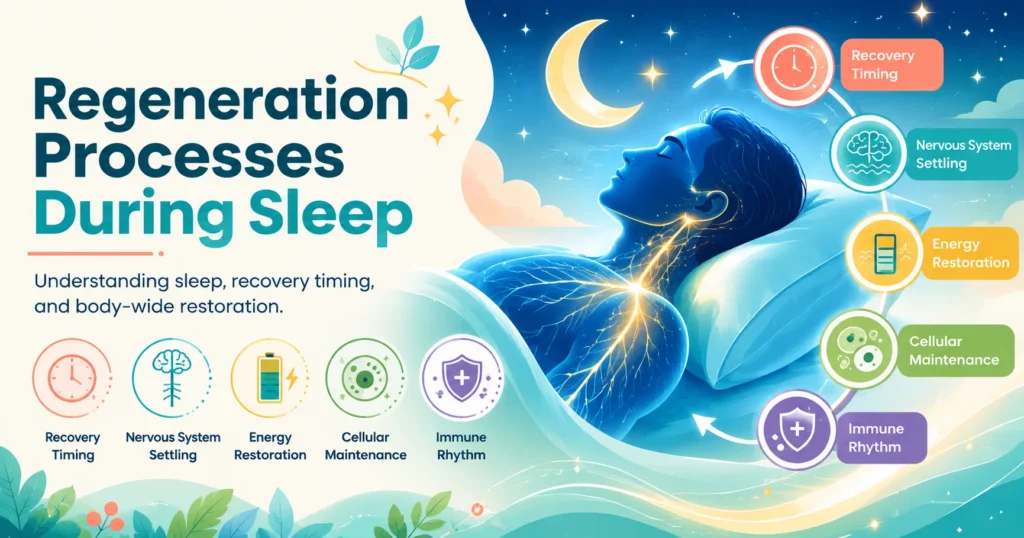
Regeneration Processes During Sleep is an educational way to understand how sleep may relate to body-wide recovery timing, nervous system settling, energy restoration, tissue maintenance, immune rhythm, memory processing, and repair-related biology. It is not a treatment plan. Instead, it helps explain why sleep is often viewed as one of the body’s most important recovery windows.
Sleep is not a passive shutdown state. During sleep, the brain and body remain active in organized ways. MedlinePlus explains that sleep helps the body restore energy and supports learning and memory. NCBI Bookshelf also describes sleep as moving through non-REM and REM stages across the night, with different patterns of brain activity, eye movement, and muscle tone.
From a nerve health perspective, this topic matters because nerves do not recover or function separately from the rest of the body. They are influenced by sleep rhythm, energy availability, circulation, immune activity, inflammation, stress load, pain processing, and autonomic regulation. Therefore, Regeneration Processes During Sleep can be understood as one possible educational lens for how the body organizes recovery conditions overnight.
Quick Navigation
What Are Regeneration Processes During Sleep?
Regeneration Processes During Sleep refers to the body-wide recovery activities that may become more organized during sleep. These may include energy restoration, immune rhythm, tissue maintenance, memory processing, hormone timing, nervous system settling, and repair-related signaling.
In simple terms, sleep gives the body a repeated recovery window. During the day, the body manages movement, stress, sensory input, posture, meals, work, emotions, and environmental demand. During sleep, the body shifts into different patterns that may help organize recovery and reduce daily system load.
A helpful analogy is a workshop after closing time. During open hours, the workshop is busy with activity. After closing, tools can be cleaned, materials can be sorted, and the space can be prepared for the next day. Sleep may work in a similar way for the body. It does not stop activity; instead, it changes the type of activity.
This topic matters for nerve-related education because nerve sensitivity, pain perception, energy rhythm, emotional load, and recovery capacity may all be influenced by sleep quality. However, sleep should not be understood as a cure. It is one important layer inside a larger recovery environment.
How Regeneration Processes During Sleep Work
First, the body moves from daytime demand toward sleep readiness. This shift may be influenced by Circadian Rhythm, sleep pressure, light exposure, stress load, evening routine, pain levels, meals, and nervous system activation.
Next, the body moves through sleep stages. NCBI Bookshelf explains that sleep includes wake, N1, N2, N3, and REM stages. N1 to N3 are non-REM stages, and a typical night includes several cycles through sleep stages.
As a result, different recovery-related processes may become more organized. MedlinePlus explains that sleep helps restore energy and supports learning and memory. NCBI Bookshelf describes restorative theories of sleep that include physiologic recovery, tissue growth, protein synthesis, and hormone-related biological processes.
However, when sleep is short, irregular, fragmented, or affected by stress, recovery rhythm may become less stable. Over time, this may influence energy availability, immune rhythm, pain sensitivity, emotional control, and nervous system settling.
For this reason, Regeneration Processes During Sleep should be understood as a rhythm and coordination system. It is not only about sleeping more hours. Instead, it involves timing, depth, continuity, body state, and the ability to move through sleep stages in a more organized way.
Key Layers of Regeneration Processes During Sleep
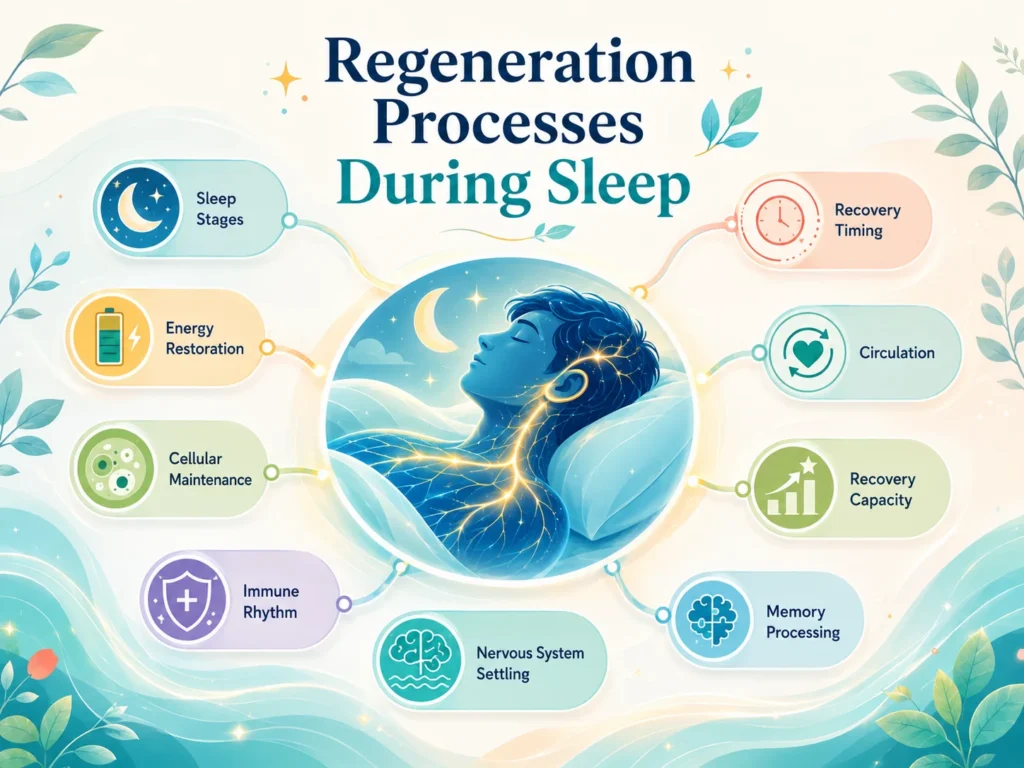
Sleep Stage Layer
Sleep is not one single state. It includes different stages that repeat across the night. Non-REM sleep and REM sleep have different patterns, and the body usually cycles through these stages several times.
For example, deeper non-REM sleep may be associated with more restorative body processes, while REM sleep is often linked with dreaming, emotional processing, and brain activity. These stages do not work separately. Instead, they form a repeating sleep architecture.
This layer matters because recovery depends on rhythm. If sleep is frequently interrupted, the body may have fewer stable opportunities to move through these stages.
Energy Restoration Layer
Sleep helps the body restore energy. This does not mean sleep works like a simple battery charger. Instead, sleep helps organize energy use, alertness, metabolic rhythm, and next-day capacity.
For example, after poor sleep, small tasks may feel larger. The body may feel more tired, the mind may feel less clear, and stress may feel harder to manage. Over time, this may increase total system demand.
This layer matters for nerve health education because nerve function and recovery capacity depend on energy availability. The nervous system, immune system, circulation, and repair-related processes all require energy coordination.
Cellular Maintenance Layer
Sleep may support cellular maintenance and repair-related biology. NCBI Bookshelf describes restorative theories of sleep that include physiologic recovery, tissue growth, protein synthesis, and hormone-related processes.
This does not mean sleep directly repairs every nerve issue or guarantees regeneration. Instead, it means sleep may be part of the body’s broader recovery environment.
For example, if the body is under repeated stress and sleep is poor, maintenance processes may have less stable timing. Because of this, sleep can be understood as one important condition for better recovery organization.
Immune Rhythm Layer
Sleep and immune activity are closely connected. The body’s immune system does not operate randomly. It follows rhythms that can interact with sleep, stress, inflammation, and recovery demand.
For example, a person may feel more tired or sensitive when sleep has been disrupted for several nights. This may reflect higher system demand, not one simple cause.
This layer matters because nerve sensitivity can interact with immune and inflammatory signaling. Sleep may help provide a more organized rhythm for these body-wide signals.
Nervous System Settling Layer
Sleep gives the nervous system an opportunity to shift away from daytime alertness. During better sleep, the body may spend more time in states that support settling, signal organization, and lower reactivity.
For example, someone who sleeps poorly may feel more easily startled, tense, or emotionally reactive the next day. This does not prove a specific disease. However, it may suggest that the nervous system had less time to settle.
This layer matters because nerve-related symptoms are often influenced by sensitivity, attention, stress response, and body state.
Memory and Signal Processing Layer
Sleep supports learning and memory. MedlinePlus explains that sleep supports learning and memory, and NINDS describes sleep as a dynamic activity involving active brain processes.
This matters because the nervous system is always processing signals. Sensations, stress, emotions, movement patterns, and pain experiences may all be interpreted by the brain and body.
For example, after poor sleep, discomfort may feel more intense or harder to ignore. Better sleep may not remove the cause of symptoms, but it may help the nervous system process signals with more stability.
Recovery Timing Layer
Recovery timing refers to when the body has enough space to organize repair-related processes. Sleep is one of the most repeated and predictable recovery windows.
For example, one poor night does not define long-term recovery. However, repeated sleep disruption may reduce the number of stable recovery windows available to the body.
This layer matters because recovery is not only about effort. It also depends on timing, rhythm, and repeated opportunities for the body to shift into restoration.
Regeneration Processes During Sleep Interactions
Sleep & Recovery Interaction
Sleep & Recovery is the closest parent topic for this page. It explains how sleep may influence nervous system settling, energy rhythm, stress response, and recovery capacity.
Regeneration Processes During Sleep goes deeper into the recovery side of sleep. It helps readers understand how sleep may connect with cellular maintenance, immune rhythm, repair timing, and body-wide restoration.
Explore related page: Sleep & Recovery
Circadian Rhythm Interaction
Circadian Rhythm helps organize when sleep and recovery are most likely to occur. It gives the body timing signals through light, darkness, sleep-wake rhythm, meals, and daily routine.
When Circadian Rhythm is steady, sleep-related recovery windows may become more predictable. However, when timing is irregular, sleep and recovery rhythm may become less organized.
Explore related page: Circadian Rhythm
Recovery Cycles Interaction
Recovery Cycles explains how the body moves between effort, rest, repair, and adaptation. Sleep is one of the strongest daily recovery windows inside this larger cycle.
For example, daytime effort may be easier to handle when nighttime recovery is more stable. When sleep is disrupted, effort and recovery may become less balanced.
Explore related page: Recovery Cycles
Cellular Repair Interaction
Cellular Repair explains how cells may maintain energy, structure, signaling, and repair-related functions. Sleep may provide a repeated timing window where some maintenance processes become more organized.
This does not mean sleep directly fixes cellular problems. Instead, it may help create a more supportive recovery environment.
Explore related page: Cellular Repair
Growth Signals Interaction
Growth Signals can help readers understand how the body uses repair-related signals to coordinate adaptation and maintenance. Sleep may interact with some hormone-related and recovery-related signaling patterns.
This should be understood carefully. Growth signals are not a guarantee of regeneration. They are part of a larger body-wide coordination system.
Explore related page: Growth Signals
Autonomic Regulation Interaction
Autonomic Regulation helps explain how the body shifts between activation and recovery. Sleep may give the body more time to settle away from daytime stress and demand.
However, if stress remains high at night, the body may stay more activated. As a result, sleep may feel lighter or less restorative.
Explore related page: Autonomic Regulation
Pain Processing Interaction
Pain Processing may be influenced by sleep quality, fatigue, stress, inflammation, and attention. When sleep is poor, the nervous system may become more sensitive to signals.
This does not mean pain is only a sleep issue. Pain can involve many systems. However, sleep may shape the internal context in which pain signals are processed.
Explore related page: Pain Processing
Patterns That Influence Regeneration Processes During Sleep
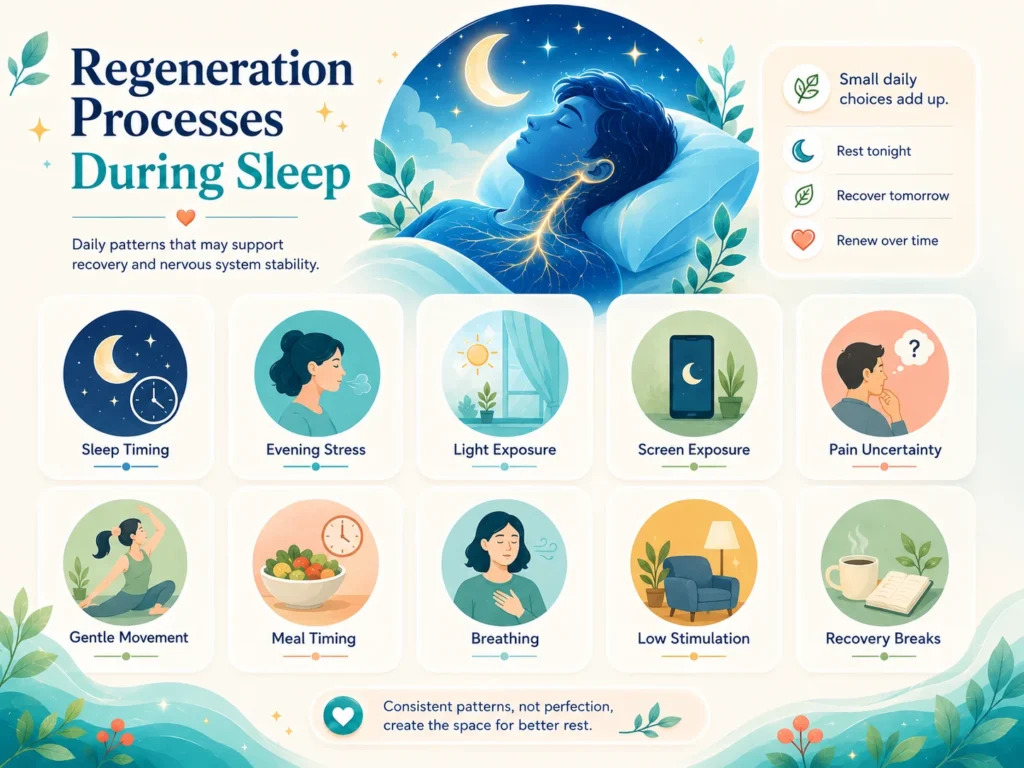
Daily patterns can strongly influence sleep-related recovery. Often, the body responds not only to how long a person sleeps, but also to timing, consistency, stress load, light exposure, evening routine, movement, pain uncertainty, and recovery space.
For example, high evening stress may keep the nervous system more alert. Late-night screen exposure may affect light-related timing signals. Irregular wake time may make the body’s rhythm less predictable. Pain uncertainty may increase monitoring and make it harder to settle.
This section is not a treatment plan. Instead, it helps readers understand how everyday patterns may shape sleep-related recovery conditions.
| Daily Pattern | Possible System-Based View |
|---|---|
| Irregular sleep time | May make recovery timing less predictable |
| High evening stress | May keep alertness systems active near bedtime |
| Late-night screen exposure | May affect light-related timing signals |
| Pain uncertainty | May increase monitoring, worry, and sleep disruption |
| Long daytime inactivity | May reduce natural tiredness and energy rhythm |
| Late heavy meals | May keep digestion more active close to sleep time |
| Inconsistent wake time | May confuse daily timing patterns |
| Low recovery breaks | May increase total system demand before sleep |
In simple terms, Regeneration Processes During Sleep often depend on the whole-day rhythm. Therefore, sleep-related recovery should be understood as part of a full daily pattern, not only a nighttime event.
Regeneration Processes During Sleep and Nerve Function
Regeneration Processes During Sleep may connect with nerve function through energy restoration, nervous system settling, pain processing, immune rhythm, inflammation balance, circulation, and recovery timing. When sleep is more stable, the nervous system may have clearer windows for restoration and signal organization.
For example, poor sleep may make nerve sensations feel more noticeable the next day. A person may feel more burning, tingling, aching, fatigue, or body-wide sensitivity during periods of poor sleep, high stress, or irregular routine. This does not mean sleep is the only cause. It means sleep may be one layer that changes nervous system sensitivity.
Nerve symptoms should always be taken seriously, especially when they are sudden, severe, worsening, or linked with weakness, balance changes, bladder or bowel changes, chest pain, fainting, confusion, or difficulty breathing. This page is for education only.
From a system perspective, the key idea is simple: nerves live inside a body that needs rhythm, energy, circulation, immune coordination, and recovery timing. Sleep may provide one of the most important repeated windows for that coordination.
Regeneration Processes During Sleep Visual Flow
Simple Educational Flow:
Daily Demand
↓
Sleep Readiness
↓
Sleep Stages
↓
Nervous System Settling
↓
Energy Restoration
↓
Cellular and Tissue Maintenance
↓
Immune and Repair Signal Coordination
↓
Next-Day Recovery Capacity
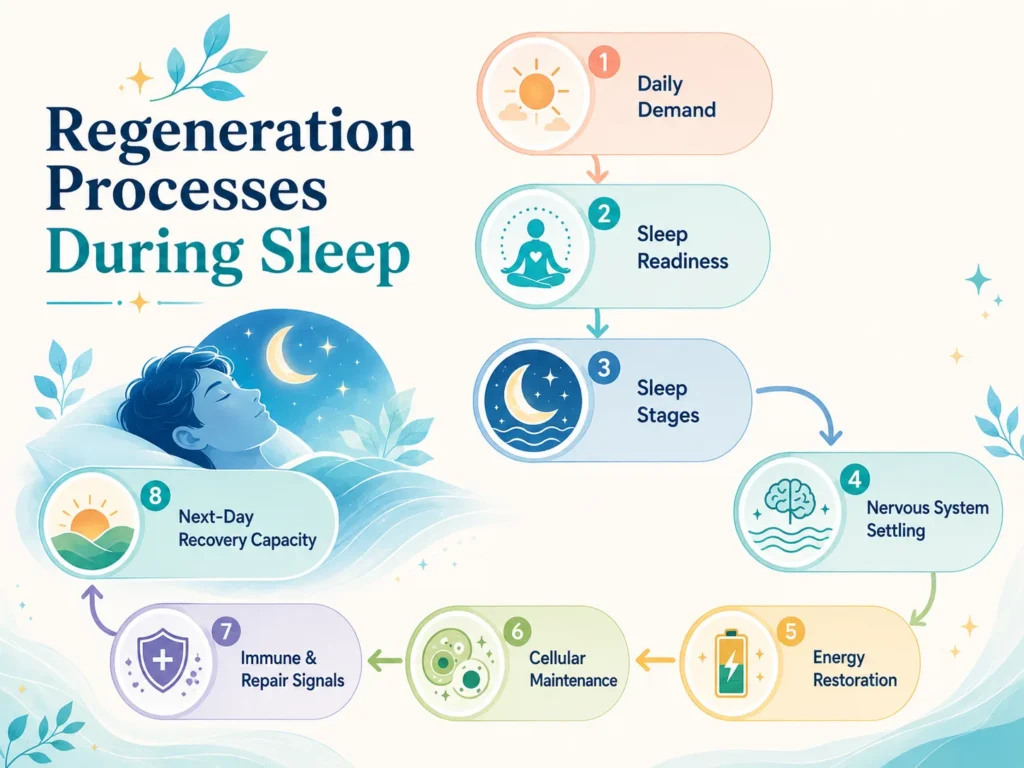
This flow is not always perfect or linear. In many cases, sleep-related regeneration works as a cycle. Better sleep may improve next-day capacity, while poor sleep may increase stress sensitivity and make the next night harder.
Different people may experience different patterns. One person may feel tired but wired. Another may sleep many hours but wake unrefreshed. Another may notice more nerve sensitivity after several nights of disrupted sleep.
This is an educational model only. It does not diagnose insomnia, sleep apnea, neurological disease, hormone issues, immune problems, or medical causes of fatigue.
Why Regeneration Processes During Sleep Matter for Recovery Capacity
1. Recovery Requires Regular Restoration Windows
Recovery is not only about activity, nutrition, or effort. The body also needs regular windows where it can settle, organize signals, and maintain tissue function.
Sleep provides one of the most important daily restoration windows. When sleep becomes inconsistent, recovery may feel less predictable.
2. Recovery Requires Nervous System Settling
The nervous system needs time away from constant stimulation. During sleep, the body may have more opportunity to reduce daytime alertness and organize signals.
This matters because an overloaded nervous system may feel more sensitive, reactive, or tired. Sleep may help create space for more stable signal processing.
3. Recovery Requires Energy Restoration
Sleep helps restore energy and organize energy rhythm. When sleep is poor, the body may begin the next day with less reserve.
As a result, stress, pain, movement, work, and emotional load may feel harder to manage. This can increase total recovery demand.
4. Recovery Requires Cellular and Tissue Maintenance
The body performs many maintenance activities during sleep. NCBI Bookshelf describes restorative sleep theories involving tissue growth, protein synthesis, physiologic recovery, and hormone-related processes.
This does not mean sleep guarantees tissue repair or nerve regeneration. Instead, it shows why sleep can be understood as a supportive recovery environment.
5. Recovery May Be Influenced by Repeated Sleep Disruption
One difficult night does not define recovery. However, repeated sleep disruption may increase system demand over time.
Because of this, Regeneration Processes During Sleep matter for long-term nerve health education. They help explain why recovery often depends on rhythm, timing, settling, and repeated restoration windows.
Common Misunderstandings About Regeneration Processes During Sleep
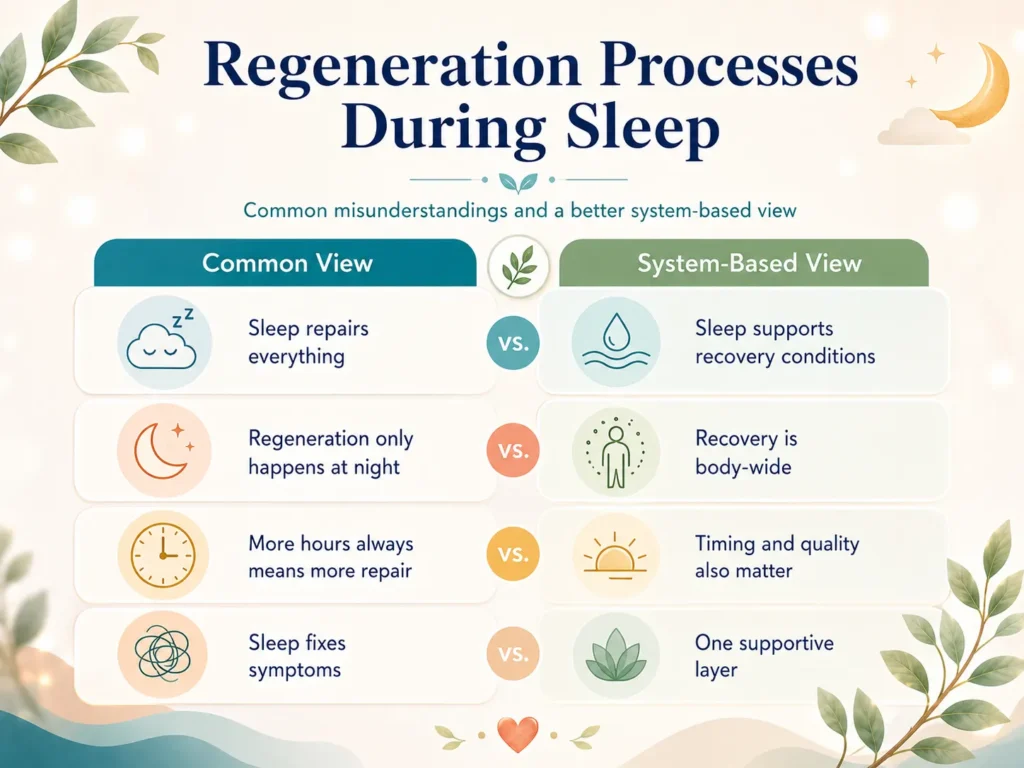
| Common View | Better System-Based View |
|---|---|
| Sleep automatically repairs everything | Sleep may support recovery conditions, but it is not a cure |
| Regeneration only happens at night | Recovery processes happen across the day, but sleep may provide key timing windows |
| More hours always means better recovery | Sleep quality, timing, continuity, and rhythm also matter |
| Poor sleep means recovery is impossible | The body can still adapt, but repeated disruption may increase system demand |
| Sleep fixes nerve symptoms | Sleep may be one supportive layer, not a treatment or guarantee |
Misunderstanding 1: Sleep automatically regenerates everything.
Clarification:
Sleep may support recovery conditions, but it does not guarantee repair, regeneration, or symptom resolution. It is one important layer inside a larger body-wide system.
Misunderstanding 2: Regeneration only happens during sleep.
Clarification:
The body performs maintenance and adaptation throughout the day. However, sleep may provide a more organized window for restoration, energy recovery, and nervous system settling.
Misunderstanding 3: More sleep always means more recovery.
Clarification:
Sleep amount matters, but timing, depth, continuity, and rhythm also matter. A person may spend many hours in bed and still feel unrefreshed if sleep is disrupted.
Misunderstanding 4: Poor sleep means recovery is impossible.
Clarification:
Recovery is not all-or-nothing. The body can still adapt. However, repeated poor sleep may increase total system demand and make recovery feel harder.
Misunderstanding 5: Sleep is a treatment for nerve symptoms.
Clarification:
This page does not provide treatment instructions. Sleep may support recovery conditions, but it does not diagnose, treat, cure, or prevent disease.
FAQs About Regeneration Processes During Sleep
Do regeneration processes happen during sleep?
Sleep may support several recovery-related processes, including energy restoration, nervous system settling, tissue maintenance, memory processing, and immune rhythm. However, this does not mean sleep guarantees regeneration or symptom improvement.
Is this page saying sleep heals nerves?
No. This page does not claim that sleep heals nerves. It explains how sleep may create a more supportive recovery environment from a system-based educational perspective.
Can poor sleep affect nerve sensitivity?
Poor sleep may make nerve sensations feel stronger by increasing fatigue, stress reactivity, pain sensitivity, and nervous system alertness. However, nerve symptoms may have many causes and should be evaluated when concerning.
Is deep sleep more important than REM sleep?
Different sleep stages may play different roles. The goal is not to value one stage as the only important stage. Instead, sleep quality often depends on moving through sleep stages in an organized rhythm.
Does more sleep always mean better recovery?
Not always. Sleep amount matters, but timing, continuity, depth, and body state also matter. Many people need both enough sleep and a stable rhythm.
When should someone seek medical care?
Seek medical care for severe insomnia, suspected sleep apnea, sudden neurological symptoms, worsening nerve symptoms, severe fatigue, fainting, confusion, chest pain, difficulty breathing, or symptoms that interfere with daily life.
Continue Learning
After understanding Regeneration Processes During Sleep, readers can continue exploring how sleep timing, recovery rhythm, nervous system stability, cellular maintenance, and repair-related biology connect inside the larger Heal Your Nerves Naturally learning system.
Sleep & Recovery — learn how sleep may influence nervous system settling, energy rhythm, stress response, and recovery capacity.
Circadian Rhythm — learn how body timing may influence sleep-wake rhythm, energy rhythm, stress response, and recovery capacity.
Recovery Cycles — understand how the body moves between effort, rest, repair, and adaptation.
Cellular Repair — explore how cells may maintain energy, structure, signaling, and repair-related function.
Growth Signals — understand how repair-related signals may help coordinate adaptation and maintenance.
Autonomic Regulation — learn how the body shifts between activation and recovery states through automatic nervous system patterns.
Learning Path — follow a structured education journey from symptoms to systems, then from systems to recovery concepts.
Health Disclaimer — review important safety guidance for educational health content.
Related Systems
Sleep & Recovery
Sleep & Recovery is the parent concept for this page. It explains how sleep may influence nervous system settling, energy restoration, stress response, and recovery capacity.
Circadian Rhythm
Circadian Rhythm helps organize sleep-wake timing, light-dark signals, energy rhythm, and daily recovery patterns. It gives sleep-related regeneration a timing structure.
Recovery Cycles
Recovery Cycles explains how the body moves between effort, rest, repair, and adaptation. Sleep is one of the most important recovery windows inside this larger cycle.
Cellular Repair
Cellular Repair connects with this topic because sleep may provide a repeated timing window where cellular maintenance and energy organization may become more stable.
Growth Signals
Growth Signals helps readers understand how repair-related signals may coordinate adaptation. Sleep may interact with some recovery-related signaling patterns, but it should not be framed as a guaranteed regeneration method.
Autonomic Regulation
Autonomic Regulation helps explain how the body shifts between activation and recovery. Sleep may support this shift by giving the body more opportunity to settle.
Pain Processing
Pain Processing may connect with sleep-related regeneration because poor sleep, fatigue, stress, and inflammation can influence how strongly the nervous system interprets signals.
Sources / References
MedlinePlus explains that sleep helps the body restore energy and supports learning and memory. This supports the educational view that sleep is an active recovery-related process, not simply passive rest.
NINDS explains that circadian rhythm and sleep homeostasis work together to regulate wakefulness and sleep. This supports the role of timing and sleep pressure in sleep-related recovery rhythm.
NCBI Bookshelf explains that sleep includes wake, N1, N2, N3, and REM stages, with typical cycles across the night. This supports the idea that sleep is structured and stage-based.
NCBI Bookshelf describes restorative theories of sleep, including physiologic recovery, tissue growth, protein synthesis, and hormone-related biological processes during sleep.
NCBI Bookshelf also notes that REM and non-REM sleep alternate cyclically across the night, with most REM sleep occurring in the second half of the night. This supports the idea that sleep-related processes are time-structured.
Educational Trust Note
This page is part of the Heal Your Nerves Naturally educational library. Its purpose is to help readers understand Regeneration Processes During Sleep as one possible body-wide recovery system that may influence nervous system settling, energy restoration, cellular maintenance, immune rhythm, and recovery capacity.
This content does not diagnose, treat, cure, or prevent disease. It does not replace professional medical advice, diagnosis, testing, or treatment. For more context, readers may review the About page, Health Disclaimer, and Contact page.
Safety & Education Notice
This page is for educational purposes only. It is designed to help readers understand Regeneration Processes During Sleep from a calm, system-based perspective. However, it does not diagnose, treat, cure, or prevent any disease. It is also not a substitute for professional medical advice, diagnosis, or treatment.
In addition, sleep problems, nerve-related symptoms, fatigue, or sudden neurological changes may sometimes need professional evaluation. Therefore, readers should seek urgent medical care for severe, sudden, unusual, or worsening symptoms. These may include sudden weakness, loss of bladder or bowel control, chest pain, difficulty breathing, severe numbness, severe pain, fainting, confusion, or rapidly changing neurological symptoms.
Because this topic may involve medically sensitive body systems, readers should use this information for education only. For this reason, they should not use it to self-diagnose, stop medication, begin supplements, follow extreme sleep routines, or delay professional care. When symptoms feel concerning or unclear, it is always safer to speak with a qualified healthcare professional.