
Recovery Cycles: Essential Guide to Nervous System Repair Rhythm
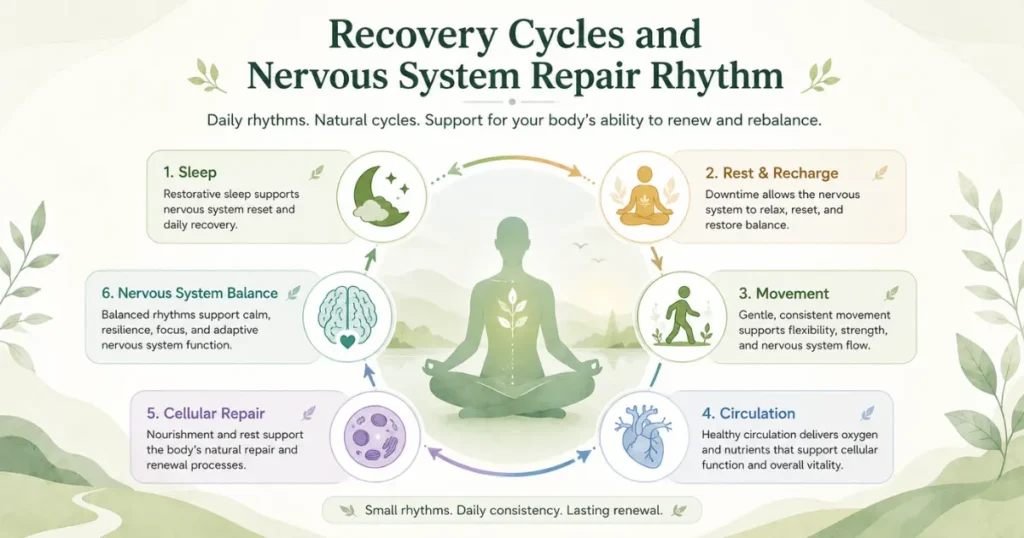
Recovery Cycles are an important part of nervous system recovery education. They explain how the body moves between activity, stress, repair, rest, and adaptation over time.
The body does not recover in one straight line. Instead, it works in rhythms. For example, these rhythms include sleep and wake cycles, activity and rest cycles, stress and calm cycles, and repair and adaptation cycles. Because of this, recovery often feels like a pattern, not a straight path.
Because of this, recovery is not only about doing more. It is also about knowing when the body needs rest, when it needs movement, and when it needs lower stress demand.
For example, nerve-related recovery may depend on sleep rhythm, cellular repair, inflammation balance, circulation, nutrition, movement, and pacing. When these systems work together, the body may have a stronger recovery environment.
This page explains Recovery Cycles in a safe educational way. It does not diagnose, treat, cure, or prevent any condition. Instead, it helps you understand how rhythm, rest, pacing, and repair support may relate to nervous system resilience.
Quick Navigation
What Are Recovery Cycles?
Recovery Cycles are the repeated patterns that help the body return toward balance after stress or activity. These cycles may include sleep, rest, movement, nutrition, breathing rhythm, emotional regulation, and tissue repair.
In simple terms, the body needs rhythm. First, it needs periods of effort. Then, it needs periods of repair. When effort and repair stay balanced, the nervous system may feel more stable. As a result, recovery can feel more organized.
However, many people think recovery only means resting after pain or fatigue appears. In reality, recovery happens all the time. The body repairs, clears waste, restores energy, and adjusts signals each day.
Recovery Cycles also help the body adapt. For example, gentle movement may create a small demand. Then rest and nutrition help the body respond. Over time, this cycle may support better resilience.
Because of this, recovery is not a passive process. It is active, organized, and system-based. It depends on timing, consistency, and the body’s current capacity.
Why Recovery Cycles Matter for Nerve Health
Nerve health depends on rhythm. Nerves need energy, oxygen, nutrients, signal balance, immune support, and time to settle after stress.
When recovery cycles work well, the body has more chances to repair and regulate. For example, sleep supports cleanup. In addition, rest supports calming. Movement supports circulation, while nutrition supports energy. Also, pacing helps prevent overload.
However, when recovery cycles are weak, the nervous system may stay under pressure. The body may spend too much time in stress mode and not enough time in repair mode.
As a result, sensitivity may increase. A person may feel more reactive to pain, stress, movement, poor sleep, or daily demands. This does not always mean new damage is happening. Sometimes it means the system has not had enough recovery rhythm.
This is why Recovery Cycles matter in nerve health education. They help explain why recovery often needs timing, rest, and gradual progress. They also show why “more effort” is not always better.
The Main Layers of Recovery Cycles
Recovery Cycles include several connected layers. Each layer helps the body move from stress toward repair and adaptation.
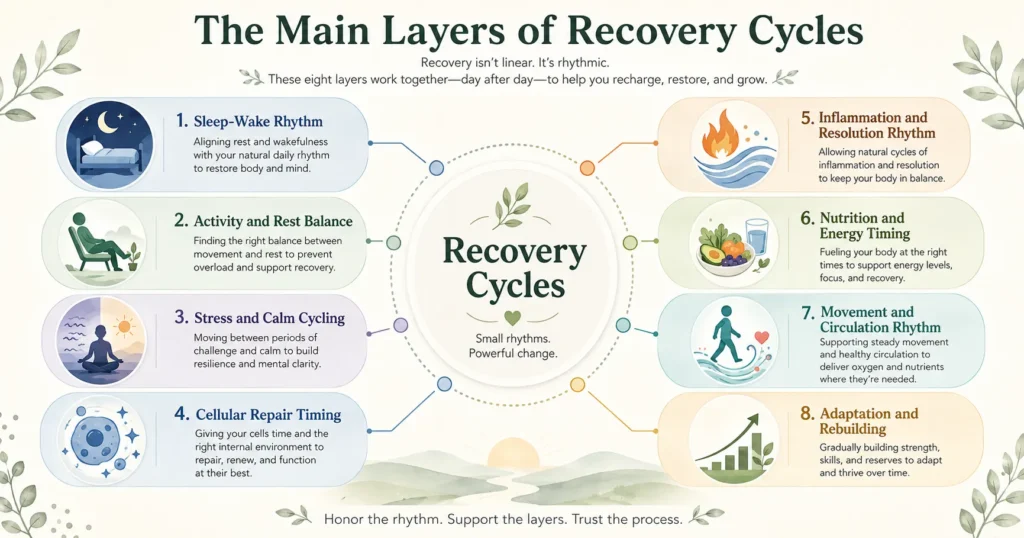
1. Sleep-Wake Rhythm
Sleep is one of the body’s strongest recovery signals. It supports cleanup, hormone rhythm, immune balance, brain-body regulation, and cellular repair.
When sleep timing is irregular, the body may struggle to organize repair. Also, poor sleep can increase stress signals and nervous system sensitivity.
Because of this, a steady sleep-wake rhythm matters. It gives the body a predictable recovery window.
However, sleep support is not only about sleeping longer. Quality, timing, light exposure, evening habits, and stress level all matter.
2. Activity and Rest Balance
The body needs activity. For example, movement supports circulation, tissue input, oxygen delivery, and nervous system signaling. At the same time, the body also needs enough rest.
However, the body also needs rest. Without rest, activity can become overload. When overload repeats, recovery demand may rise.
Therefore, activity and rest must work together. A healthy recovery cycle includes useful movement followed by enough recovery time.
This is especially important for sensitive nervous systems. Small amounts of well-timed movement may help more than large bursts of effort.
3. Stress and Calm Cycling
The body can handle stress better when it also gets enough calm. Stress activates energy, alertness, and protection. Calm helps the body digest, repair, sleep, and regulate.
However, when stress stays high for too long, the body may remain in a high-alert state. As a result, repair processes may slow down.
Recovery Cycles need both activation and settling. The nervous system should be able to rise for demand and then return toward calm.
For this reason, breathing, rest breaks, quiet routines, and emotional safety may support recovery rhythm.
4. Cellular Repair Timing
Cells repair and maintain themselves every day. They make energy, clear waste, protect membranes, repair proteins, and respond to stress.
However, cellular repair needs timing. If the body stays overloaded, cells may spend more energy on defense and less on repair.
Sleep, nutrition, circulation, hydration, and stress balance all help shape cellular repair timing.
Because of this, Recovery Cycles and Cellular Repair work closely together.
5. Inflammation and Resolution Rhythm
Inflammation is part of the body’s response system. It helps the body react to stress, injury, or irritation.
However, inflammation should not stay high all the time. The body also needs resolution. Resolution means the system moves away from defense and toward repair.
When this cycle works well, the body can respond and then calm down. When it does not work well, tissues may stay more sensitive.
Therefore, inflammation balance is a key part of Recovery Cycles.
6. Nutrition and Energy Timing
The body needs steady fuel to recover. Cells use nutrients to make energy, repair structures, and regulate signals.
Meal timing and food quality can affect energy rhythm. For example, unstable energy may increase stress demand. On the other hand, balanced nutrition may support steadier recovery conditions.
However, nutrition does not work alone. It works with sleep, digestion, movement, and stress regulation.
Because of this, nutrition timing is one layer inside the larger recovery cycle.
7. Movement and Circulation Rhythm
Movement helps blood flow. It supports oxygen delivery, waste removal, tissue mobility, and nervous system input.
However, movement must match capacity. Too much may increase stress. Too little may reduce useful circulation and input.
Therefore, recovery-friendly movement often works best in cycles. Move, rest, observe, and adjust.
This rhythm may help the body receive movement as support instead of threat.
8. Adaptation and Rebuilding
Recovery is not only about returning to baseline. It can also support adaptation. When the body receives a safe demand and then recovers, it may become more resilient over time.
However, adaptation needs the right dose. Too much demand can overload the system. Too little demand may not create useful change.
For this reason, pacing is important. It helps the body rebuild gradually.
How Poor Recovery Cycles Build Stress Over Time
Poor recovery cycles can build stress slowly. At first, the body may adapt. It may use more energy, increase alertness, and push through demand.
However, if this pattern continues, recovery debt may build. Recovery debt means the body keeps spending more energy than it restores.
For example, poor sleep may reduce energy. Then stress may feel harder to handle. Next, movement may feel more demanding. After that, pain or sensitivity may increase. As a result, the body may need even more recovery.
This can create a cycle:
Stress increases demand.
Then the body uses more energy.
Next, sleep and repair may become weaker.
After that, sensitivity may rise.
As a result, normal activity may feel harder.
For this reason, small rhythm changes may matter more than extreme effort.
Because of this, the goal is not to force progress. The goal is to rebuild rhythm. Better sleep, gentle movement, steady nutrition, rest breaks, and pacing may all help support the cycle.
Recovery Cycles and Nervous System Sensitivity
Nervous system sensitivity often increases when recovery cycles are weak. The body may stay in a state of protection for too long.
When the nervous system has enough recovery, it may settle more easily after stress. However, when recovery is limited, the system may stay alert. As a result, signals may feel louder or more uncomfortable.
For example, poor sleep can increase pain sensitivity. High stress can increase muscle tension. Low movement can reduce circulation. Poor pacing can cause repeated overload.
Together, these patterns may make the nervous system more reactive. As a result, normal daily signals may feel stronger than expected.
However, sensitivity does not always mean ongoing damage. It can reflect a protective response. The nervous system may be trying to guard the body because it senses low recovery capacity.
Therefore, Recovery Cycles are important. They help the body receive signals of safety, rest, and rhythm. Over time, this may support better resilience.
How Recovery Cycles Connect With Other Systems
Recovery Cycles are part of the larger Regeneration Systems category. They connect with many other pages on this site.
Recovery Cycles and Cellular Repair
Cellular Repair needs rhythm. Cells need time to make energy, clear waste, and restore balance.
Recovery Cycles provide the timing that helps cellular repair work more smoothly.
Recovery Cycles and Axonal Regrowth
Axonal Regrowth depends on energy, repair signals, tissue support, and time. Recovery Cycles help create the rhythm needed for these support processes.
Recovery Cycles and Myelin Regeneration
Myelin support needs cellular energy, nutrient balance, inflammation resolution, and sleep rhythm. Recovery Cycles help organize these support layers.
Recovery Cycles and Inflammation Resolution
Inflammation should rise when needed and then settle. Recovery Cycles help the body move from stress response toward resolution.
Recovery Cycles and Autonomic Regulation
Autonomic Regulation controls stress response, breathing, circulation, digestion, and rest state. These functions strongly shape recovery rhythm.
Recovery Cycles and Lifestyle Healing
Lifestyle Healing focuses on daily habits that support recovery capacity. Sleep, movement, nutrition, and stress balance all shape Recovery Cycles.
Recovery Cycles and Sleep & Regeneration
Sleep is one of the strongest recovery cycles. It supports cleanup, repair signals, immune balance, and nervous system regulation.
Common Misunderstandings About Recovery Cycles
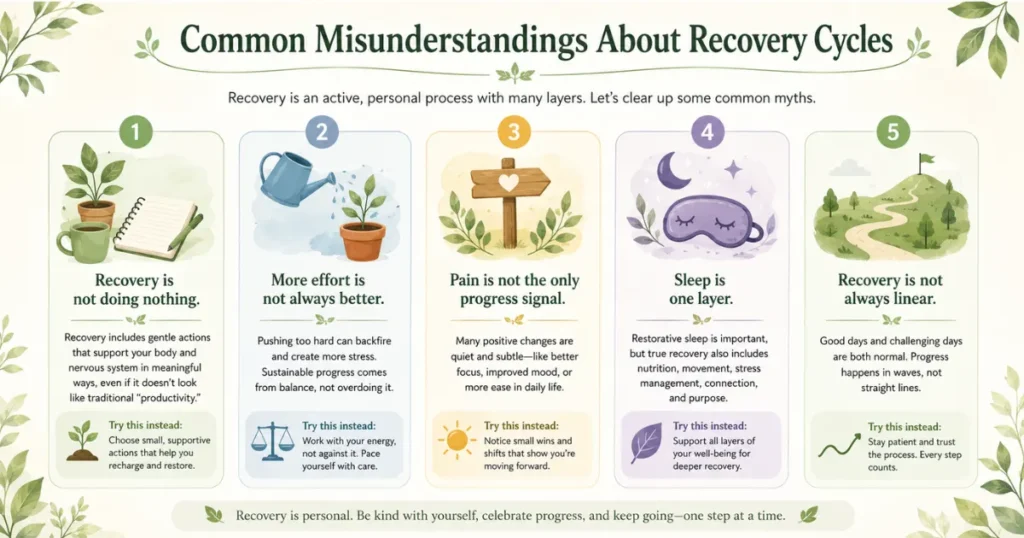
Misunderstanding 1: Recovery Means Doing Nothing
Recovery does not always mean complete rest. Sometimes recovery includes gentle movement, breathing, nutrition, hydration, and calm routines.
The goal is not to stop living. Instead, the goal is to match activity with capacity.
Misunderstanding 2: More Effort Always Means Faster Progress
More effort does not always help recovery. In some cases, too much effort can increase stress load.
Recovery Cycles need balance. The body often improves when it gets the right amount of challenge followed by enough rest.
Misunderstanding 3: Pain Means Recovery Has Failed
Pain does not always mean recovery has failed. It may reflect sensitivity, stress load, inflammation, poor sleep, or protective signaling.
Therefore, pain should not be the only measure of progress.
Misunderstanding 4: Sleep Alone Fixes Recovery
Sleep is very important. However, recovery also depends on movement, nutrition, stress balance, circulation, and pacing.
Because of this, sleep is one key layer, not the whole system.
Misunderstanding 5: Recovery Should Be Linear
Recovery often moves in waves. Some days may feel better. Other days may feel harder.
This does not always mean failure. Sometimes it means the body is responding to load, rhythm, and recovery demand.
How Daily Patterns Support Better Recovery Cycles
Daily patterns shape Recovery Cycles. In fact, small choices repeated over time can influence the body’s rhythm. Because of this, simple routines may support recovery better than sudden extreme changes.
Keep a Steady Sleep-Wake Pattern
A steady sleep-wake pattern helps the body predict rest and activity. This may support hormone rhythm, nervous system balance, and repair timing.
For example, consistent sleep and wake times may give the body a clearer signal for recovery.
Use Gentle Movement
Gentle movement can support circulation and nervous system input. It may also help the body feel safer with activity.
However, the movement should match current capacity. If activity causes repeated flare-ups, the dose may need adjustment.
Therefore, start with manageable movement and build slowly.
Add Rest Breaks Before Overload
Many people rest only after they feel exhausted. However, recovery often works better when rest happens before overload.
Short breaks can help the nervous system settle. They may also reduce the chance of repeated stress spikes.
Support Steady Nutrition
The body needs fuel to recover. Balanced meals may support energy, blood sugar rhythm, and cellular repair.
However, nutrition should stay realistic. The goal is steady support, not perfection.
Reduce Evening Stress Load
Evening stress can affect sleep quality. Bright screens, intense work, emotional stress, or heavy stimulation may keep the nervous system alert.
Because of this, a calming evening routine may help recovery rhythm.
Pace Physical and Mental Demand
Both physical and mental effort use energy. Long periods of worry, focus, or emotional stress may increase recovery demand.
Therefore, pacing should include both body and mind. Alternating effort with rest may support better rhythm.
Watch for Recovery Signals
The body often gives signals. These may include fatigue, tension, irritability, poor sleep, sensitivity, or low motivation.
These signals do not always mean danger. However, they may show that the recovery cycle needs support.
Recovery Cycles System Map
Recovery Cycles sit at the center of many support systems. They connect effort, rest, repair, and adaptation.
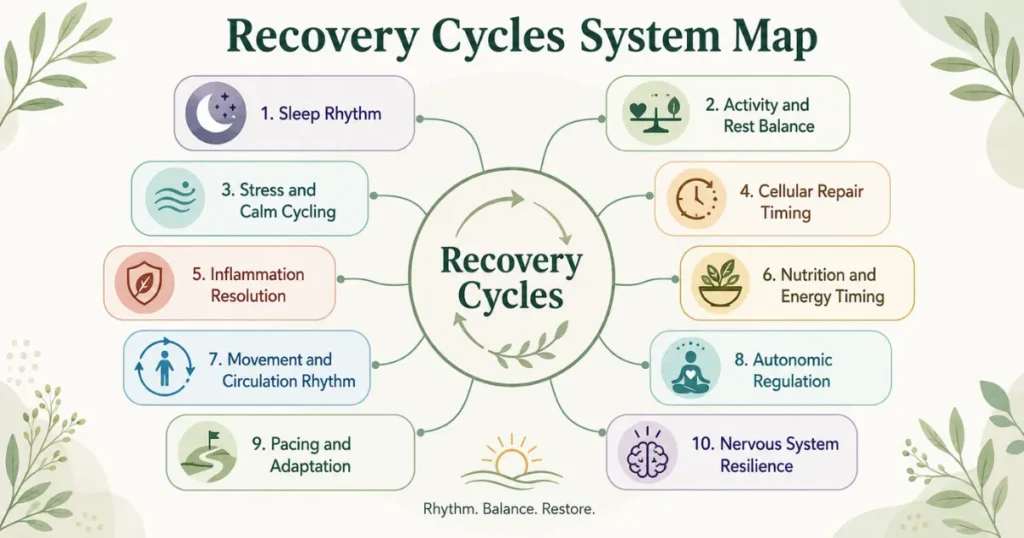
Recovery Cycles connect with:
- Sleep rhythm
- Activity and rest balance
- Stress and calm cycling
- Cellular repair timing
- Inflammation resolution
- Nutrition and energy timing
- Movement and circulation rhythm
- Autonomic regulation
- Pacing and adaptation
- Nervous system resilience
Together, these layers help the body move between demand and recovery.
For example, activity raises demand. Rest helps the body settle. Sleep supports repair. Nutrition provides fuel. Then pacing helps the system adapt.
This is why Recovery Cycles matter. They help the body organize repair instead of staying in constant stress mode.
Recovery Cycles Flow
A simple flow can explain how Recovery Cycles support nervous system resilience:
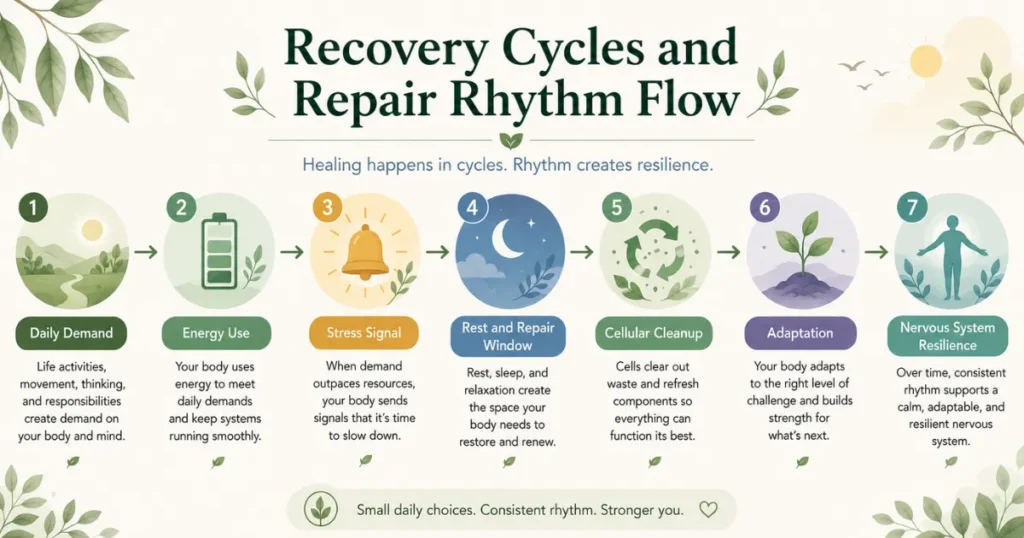
Daily Demand → Energy Use → Stress Signal → Rest and Repair Window → Cellular Cleanup → Adaptation → Nervous System Resilience
This flow shows why recovery needs rhythm.
First, daily demand uses energy. Then the body creates stress signals to respond. Next, the system needs a rest and repair window. After that, cells can clean up, restore balance, and adapt.
However, if the repair window is too short, the cycle may stay overloaded. As a result, sensitivity may increase.
On the other hand, better recovery rhythm may support resilience. Sleep, movement, nutrition, stress balance, and pacing can all help create this rhythm.
Key Takeaways
Recovery Cycles are a core part of regeneration support. They explain how the body moves between effort, stress, repair, rest, and adaptation.
Recovery is not a straight line. Instead, it works through rhythms. These rhythms may include sleep and wake cycles, activity and rest cycles, stress and calm cycles, and repair timing.
Because of this, more effort is not always better. The nervous system often needs the right balance between activity and recovery.
Recovery Cycles also connect with cellular repair, axonal regrowth, myelin support, inflammation resolution, circulation, nutrition, and autonomic regulation.
In simple terms, Recovery Cycles help explain why nervous system recovery is system-based. The body needs not only support, but also rhythm, timing, rest, and gradual adaptation.
Safety and Education Notice
This page is for educational purposes only. It does not diagnose, treat, cure, or prevent any disease or medical condition.
Recovery Cycles are discussed here as a general body system concept. The goal is to explain how rest, repair, pacing, sleep, and daily rhythm may relate to nervous system education.
If you have persistent pain, numbness, tingling, burning, weakness, loss of function, injury, diabetes-related nerve concerns, autoimmune symptoms, severe fatigue, sleep problems, or worsening symptoms, please speak with a qualified healthcare professional.
Seek urgent medical care for sudden weakness, loss of bladder or bowel control, chest pain, difficulty breathing, severe numbness, severe pain, loss of coordination, sudden vision changes, confusion, fainting, irregular heartbeat, severe sleep-related breathing problems, or rapidly changing neurological symptoms.