
Axonal Regrowth: Essential Guide to Nerve Repair Support
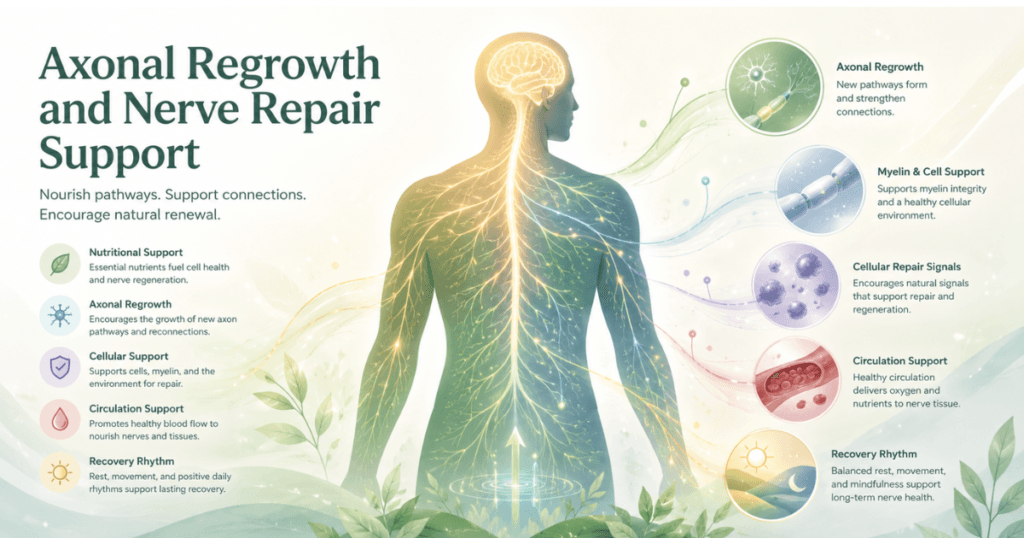
Axonal Regrowth is an important part of nerve repair education. It refers to the way nerve fibers may attempt to extend, reconnect, or adapt after stress or injury. However, this process is not simple. It depends on many support systems working together.
A nerve cell has a long fiber called an axon. This axon helps carry signals from one place to another. When the axon faces stress, irritation, compression, metabolic strain, or injury, the body may need repair support at the cell level and tissue level.
However, Axonal Regrowth does not mean instant nerve healing. It also does not mean every nerve problem will fully reverse. Instead, it helps explain one part of the larger regeneration system.
For example, axonal support may involve cellular repair, growth signals, immune balance, myelin support, blood flow, oxygen delivery, and recovery timing. Because of this, axonal repair is best understood as a system-based process.
This page explains Axonal Regrowth in a safe educational way. It does not diagnose, treat, cure, or prevent any condition. Instead, it helps you understand how nerve fibers, repair signals, and recovery conditions may support nervous system resilience.
Quick Navigation
What Is Axonal Regrowth?
Axonal Regrowth means the body’s attempt to support nerve fiber repair, extension, or adaptation. The axon is the long part of a nerve cell that carries signals. Because of this, axons play a key role in communication between the nervous system and the body.
In simple terms, an axon works like a signal pathway. It helps information move from one area to another. However, this pathway needs support. It needs energy, oxygen, nutrients, cell protection, immune balance, and a healthy tissue environment.
When an axon is under stress, the body may respond with repair signals. These signals may help guide cleanup, protection, and rebuilding activity. However, the process depends on many conditions.
For example, blood flow must bring oxygen and nutrients. Cells must manage energy. The immune system must help clear stress without staying overactive. Also, the surrounding tissue must allow signals to move in a more stable way.
Therefore, Axonal Regrowth is not one single event. It is a layered process. It connects with regeneration biology, cellular repair, myelin support, inflammation balance, and recovery rhythm.
Why Axonal Regrowth Matters for Nerve Health
Nerve health depends on communication. Axons help carry that communication. Therefore, axonal support is important for nervous system function.
When axons are healthy, signals may move more efficiently. However, when axons face stress, the nervous system may need more support to maintain clear communication.
Axonal stress may come from many sources. For example, compression, inflammation, poor circulation, metabolic strain, trauma, poor sleep, and long-term stress can all affect the nerve environment.
As a result, the nervous system may become more sensitive. It may send stronger signals. It may also take longer to settle after strain.
However, nerve symptoms do not always mean axonal damage is happening. Pain, tingling, burning, numbness, or sensitivity can involve many systems. These may include the brain, spinal cord, immune system, circulation, muscles, and surrounding tissues.
This is why Axonal Regrowth must be viewed carefully. It is not a simple explanation for every symptom. Instead, it is one important part of nerve repair education.
The Main Layers of Axonal Regrowth Support
Axonal Regrowth depends on several support layers. These layers help create a better environment for nerve fiber repair and adaptation.
1. Cellular Energy Support
Axons need energy. Nerve cells use energy to send signals, maintain structure, and respond to stress.
When cellular energy is low, repair processes may struggle. Also, the nervous system may become more reactive to daily strain.
For this reason, cellular energy support is important. It depends on oxygen, nutrients, blood sugar balance, sleep, movement, and stress load.
In addition, repair itself requires energy. The body cannot build, clear, protect, and adapt without fuel. Therefore, energy support is one of the foundations of Axonal Regrowth.
2. Growth Signals
Growth signals help guide repair and adaptation. They tell cells when to respond, where to support tissue, and how to organize repair activity.
However, growth signals do not work alone. They need a supportive environment. For example, the body also needs good circulation, balanced inflammation, and enough cellular energy.
If the environment stays stressed, growth signals may not work as well. Therefore, Axonal Regrowth depends on both signals and conditions.
3. Inflammation Balance
Inflammation can help the body respond to stress. In the short term, it may support cleanup and repair signaling.
However, long-term inflammation may increase cellular stress. It may also keep the nervous system in a more sensitive state.
Because of this, inflammation balance matters. The body needs a clear response, but it also needs to calm down when the job is done.
This is why inflammation resolution is closely linked with Axonal Regrowth.
4. Cleanup and Waste Removal
After stress or injury, the body may need to clear damaged materials. This cleanup helps prepare the tissue environment for repair.
If cleanup is slow or overloaded, repair may become harder. Also, the surrounding area may stay irritated for longer.
Cleanup depends on immune activity, circulation, hydration, sleep, and cellular repair. Therefore, it is not separate from the rest of the recovery system.
In simple terms, the body often needs to clear before it can rebuild.
5. Myelin and Signal Support
Myelin is the protective covering around many nerve fibers. It helps signals move more efficiently.
Axons and myelin work closely together. When myelin support is weak, signaling may become less efficient. Also, the nerve fiber may need more support.
Because of this, Axonal Regrowth connects with myelin regeneration. The axon needs structure, while myelin helps support signal quality.
6. Circulation and Oxygen Delivery
Blood flow supports nerve repair conditions. It brings oxygen, nutrients, immune cells, and repair signals. It also helps remove waste.
When circulation is weak, tissues may receive less support. As a result, the repair environment may become less stable.
Gentle movement, breathing rhythm, hydration, and vascular health may all influence circulation. Therefore, circulation is a key support layer for Axonal Regrowth.
7. Tissue Pathway and Mechanical Space
Nerve fibers need a supportive path. If the surrounding tissue stays tight, compressed, inflamed, or irritated, signals may remain stressed.
Mechanical load can affect nerve comfort. For example, posture, repetitive strain, old injury patterns, and tissue stiffness may influence the nerve environment.
This does not mean posture alone explains nerve problems. However, mechanical space is one part of the system. When tissues move better and load is managed well, the nerve pathway may have better support.
8. Recovery Timing and Rhythm
Repair processes need timing. The body cannot stay in high-demand mode all the time and still recover well.
Sleep, rest, meal rhythm, movement rhythm, and stress balance all affect repair timing. When rhythm is poor, the body may struggle to organize recovery.
Therefore, Axonal Regrowth needs recovery rhythm. It needs periods of support, rest, and lower stress demand.
How Axonal Stress Can Build Over Time
Axonal stress may build slowly. It often comes from repeated pressure, poor recovery, or several stressors happening together.
For example, a person may have poor sleep, low movement, high stress, weak nutrition, inflammation, and poor posture at the same time. Each factor may seem small. However, together they can increase nervous system demand.
At first, the body may adapt. It may use more energy and increase protective signals. But over time, the system may become less efficient.
This can create a cycle:
Daily stress increases nerve demand.
Then cells need more energy.
Next, inflammation and sensitivity may rise.
After that, repair systems need more support.
As a result, recovery may feel slower.
This cycle does not mean the body is broken. Instead, it shows that the nervous system may need better conditions for repair support.
Because of this, Axonal Regrowth should not be viewed as an isolated process. It connects with sleep, movement, nutrition, inflammation, circulation, stress balance, and cellular repair.
Axonal Regrowth and Nervous System Sensitivity
Nervous system sensitivity can increase when the body feels under threat or strain. Axonal stress may be one part of this picture.
When nerve fibers face irritation, poor support, or repeated load, the nervous system may become more alert. As a result, signals may feel stronger or more uncomfortable.
However, sensitivity does not always mean ongoing damage. Sometimes it reflects a protective nervous system response. The brain and body may increase alertness when the internal environment feels unstable.
For example, poor sleep may increase sensitivity. Stress may increase muscle tension. Inflammation may raise signal activity. Poor circulation may reduce tissue support. Together, these factors can make symptoms feel more intense.
Therefore, Axonal Regrowth education should stay balanced. It can help explain repair support, but it should not create fear. The goal is to understand the system, not to assume worst-case damage.
How Axonal Regrowth Connects With Other Systems
Axonal Regrowth is part of the larger Regeneration Systems category. It works closely with several other systems.
Axonal Regrowth and Cellular Repair
Cellular Repair supports the energy, cleanup, and protection needed for axonal repair conditions. Without cell-level support, nerve fiber repair may have a weaker foundation.
Axonal Regrowth and Myelin Regeneration
Axons and myelin work together. The axon carries signals, while myelin helps signals move more efficiently.
Because of this, Axonal Regrowth and Myelin Regeneration are closely connected.
Axonal Regrowth and Growth Signals
Growth Signals help guide repair and adaptation. They help the body organize response and support tissue changes.
However, these signals need a supportive environment. Therefore, growth signals and axonal repair conditions work together.
Axonal Regrowth and Inflammation Resolution
Inflammation may support short-term repair. However, long-term inflammation can increase nerve sensitivity and cellular stress.
Inflammation Resolution helps the body shift from defense toward repair readiness.
Axonal Regrowth and Vascular Regeneration
Blood flow supports oxygen, nutrients, and waste removal. This matters for nerve repair conditions.
Vascular Regeneration helps explain how circulation support connects with regeneration education.
Axonal Regrowth and Mechanical Damage System
Mechanical stress can affect nerve pathways. Compression, tension, poor movement, or repetitive strain may increase nerve demand.
Mechanical Damage System explains how physical load may influence nerve health education.
Axonal Regrowth and Pain Processing
Pain Processing explains how the nervous system filters and interprets signals. This matters because sensitivity does not always equal damage.
Common Misunderstandings About Axonal Regrowth
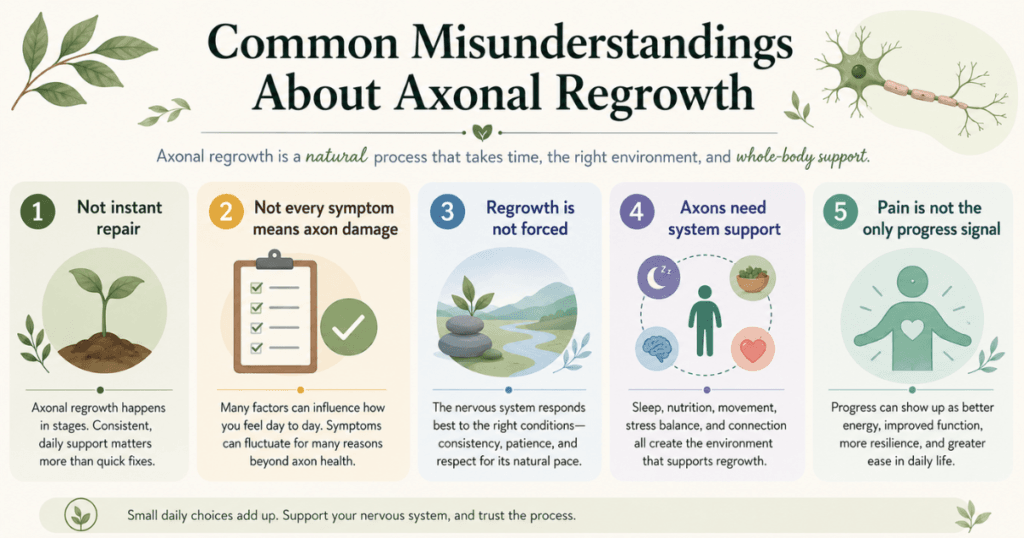
Misunderstanding 1: Axonal Regrowth Means Instant Nerve Repair
Axonal Regrowth is not instant. It is a slow and complex process. It may involve cleanup, energy support, growth signals, myelin support, and tissue guidance.
Therefore, it is better to think of it as a support process, not a quick result.
Misunderstanding 2: Every Nerve Symptom Means Axon Damage
Pain, tingling, burning, numbness, or sensitivity can feel serious. However, symptoms do not always mean axon damage.
The nervous system can become sensitive for many reasons. For example, stress, inflammation, sleep loss, poor movement, or brain-body signaling may all play a role.
Because of this, symptoms need careful evaluation when they persist or worsen.
Misunderstanding 3: Regrowth Happens by Force
More effort does not always mean better repair. In fact, too much stress may increase recovery demand.
Axonal repair support works best with pacing, rhythm, and balance. The body often needs steady support rather than force.
Misunderstanding 4: Axonal Regrowth Works Alone
Axons do not repair in isolation. They depend on nearby cells, immune signals, blood flow, myelin support, and cellular energy.
Therefore, Axonal Regrowth is part of a larger repair network.
Misunderstanding 5: Pain Always Shows Repair Failure
Pain does not always mean repair has failed. Sometimes pain reflects sensitivity, inflammation, stress load, or nervous system protection.
For this reason, pain should not be used as the only sign of recovery progress.
How Daily Patterns Support Axonal Repair Conditions
Daily patterns can shape the environment around nerve fibers. These patterns do not guarantee regrowth. However, they may support better recovery conditions.
Sleep Rhythm
Sleep supports repair, cleanup, hormone rhythm, and nervous system regulation. When sleep is poor, the body may stay more stressed.
Therefore, sleep rhythm matters for axonal support. It gives the body time to organize repair activity.
Nutrition Quality
Nerve repair support needs nutrients. Cells need protein, healthy fats, vitamins, minerals, and steady energy.
However, nutrition is not a single cure. Instead, it helps provide building blocks for the repair environment.
Because of this, steady nutrition may support Axonal Regrowth conditions over time.
Gentle Movement
Movement supports circulation, tissue mobility, and nervous system input. It may also help reduce stiffness around nerve pathways.
However, movement should match capacity. Too much intensity may increase stress. Too little movement may reduce useful circulation.
Therefore, the goal is appropriate movement, not force.
Stress Balance
Stress affects inflammation, sleep, muscle tension, breathing, digestion, and blood flow. Because of this, stress can influence nerve repair conditions.
Simple calming routines may help the body shift toward a more supportive state. For example, slow breathing, rest breaks, gentle stretching, and predictable routines may support regulation.
Circulation Support
Blood flow helps deliver oxygen and nutrients. It also helps clear waste.
Because axons need energy and support, circulation matters. Gentle movement, hydration, breathing rhythm, and overall vascular health may all support this area.
Recovery Pacing
Pacing helps match activity with recovery capacity. It can reduce repeated overload.
For example, a person may need to alternate activity with rest. They may also need to increase movement slowly.
This does not mean avoiding life. Instead, it means supporting repair conditions with better timing.
Axonal Regrowth System Map
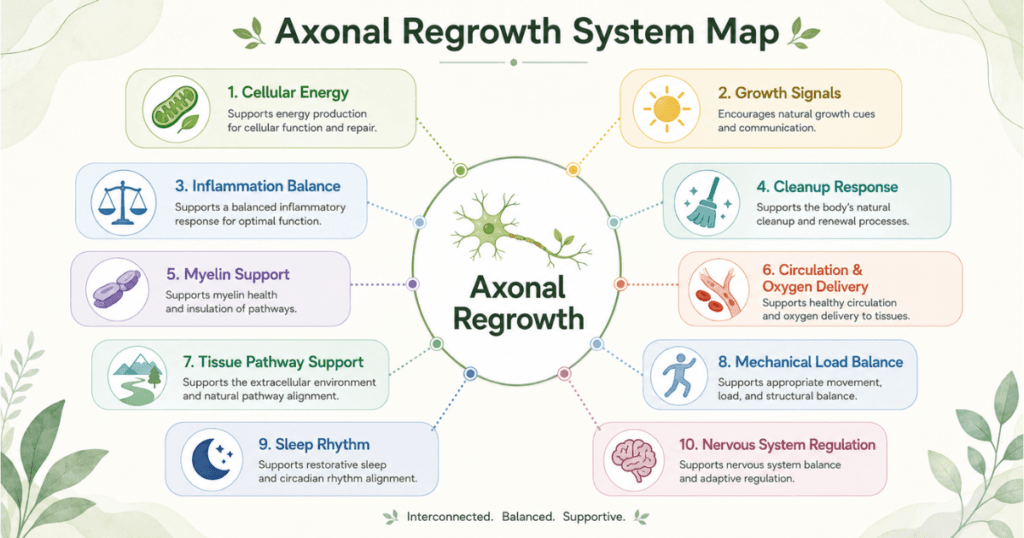
Axonal Regrowth sits inside a larger recovery network. It connects with many support layers.
Axonal Regrowth connects with:
- Cellular energy
- Growth signals
- Inflammation balance
- Cleanup and waste removal
- Myelin support
- Circulation and oxygen delivery
- Tissue pathway support
- Mechanical load balance
- Sleep and recovery rhythm
- Nervous system regulation
Together, these layers help create a better environment for nerve repair education. When several layers are strained, the nervous system may need more support.
For example, poor circulation may reduce oxygen delivery. Low energy may slow cleanup. High inflammation may raise sensitivity. Then nerve signals may feel more reactive.
This is why system thinking matters. Axonal Regrowth is not only about the nerve fiber. It is also about the environment around it.
Axonal Regrowth Flow
A simple flow can explain how axonal repair support may work:
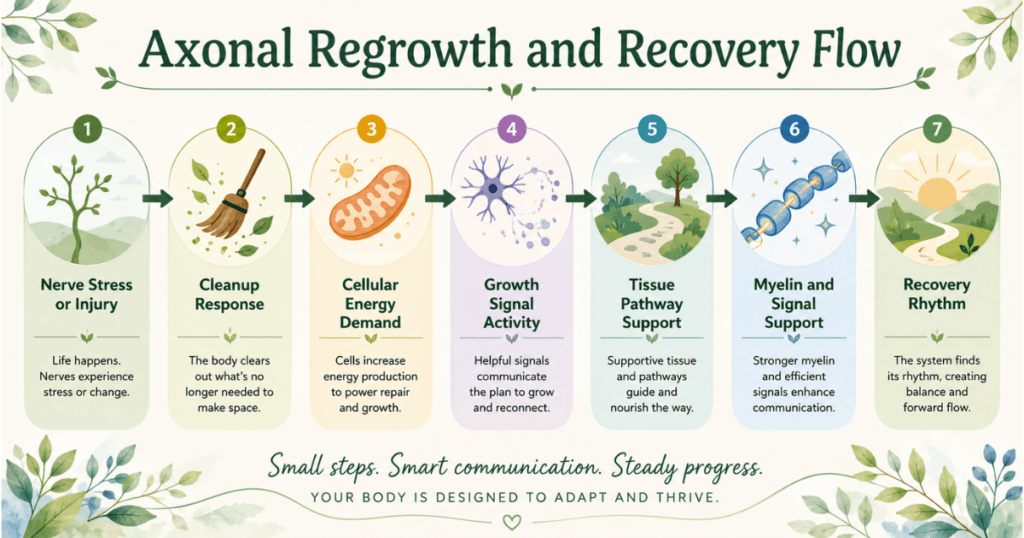
Nerve Stress or Injury → Cleanup Response → Cellular Energy Demand → Growth Signal Activity → Tissue Pathway Support → Myelin and Signal Support → Recovery Rhythm
This flow shows why Axonal Regrowth takes support from many systems.
First, the body responds to stress. Then it may need cleanup and protection. Next, cells need energy and growth signals. After that, the tissue pathway and myelin support become important.
However, if stress continues without enough recovery, the process may stay overloaded. As a result, sensitivity may remain high.
On the other hand, better rhythm may support resilience. Sleep, nutrition, movement, circulation, and pacing can help create a more supportive recovery environment.
Key Takeaways
Axonal Regrowth is an important part of nerve repair education. It refers to nerve fiber repair, extension, and adaptation support.
However, it is not instant. It is not guaranteed. It is also not separate from the rest of the body.
Axonal repair conditions depend on energy, cleanup, growth signals, inflammation balance, myelin support, circulation, tissue space, and recovery rhythm.
Because of this, daily patterns matter. Sleep, nutrition, movement, stress balance, circulation, and pacing can all shape the nerve environment.
In simple terms, Axonal Regrowth helps explain why recovery is system-based. The nerve fiber matters, but the whole recovery environment matters too.
Safety and Education Notice
This page is for educational purposes only. It does not diagnose, treat, cure, or prevent any disease or medical condition.
Axonal Regrowth is discussed here as a general body system concept. The goal is to explain how nerve fibers, repair signals, cellular support, and recovery rhythm may relate to nervous system education.
If you have persistent pain, numbness, tingling, burning, weakness, loss of function, injury, diabetes-related nerve concerns, autoimmune symptoms, or worsening symptoms, please speak with a qualified healthcare professional.