
Movement Therapy for Nerve Health: Safety, Exercise, Recovery & Function
If you have nerve-related pain, tingling, numbness, weakness, balance problems, or changes in the way you move, one of the first questions may be whether you should keep moving or whether movement could make things worse. This page explains the supportive role of movement therapy, what evidence can and cannot establish, how to interpret your response, when normal exercise may need adaptation, and when professional guidance may be important.

Evidence standard.
Claims are interpreted according to the population, intervention, outcome, and certainty reported by the source. Evidence from one condition or exercise strategy is not automatically generalized to every nerve-health problem.
Introduction
Educational scope: This page provides general health education and rehabilitation context. It does not diagnose a nerve problem, clear a person for exercise, or provide an individualized exercise prescription.
If you have nerve-related pain, tingling, numbness, weakness, balance problems, or changes in the way you move, one of the first questions that may come to mind is:
“Should I keep moving, or could movement make things worse?”
You may also be wondering:
- Can I exercise with nerve damage?
- Is movement safe when I have nerve pain?
- Is walking good for neuropathy?
- What exercise is actually appropriate?
- How much movement is enough?
- What if I feel worse after exercising?
- Can movement help me walk, balance, or function better?
- What if normal exercise is no longer possible?
- Can exercise repair or regenerate a damaged nerve?
- When should I get professional guidance?
These questions are related, but they are not the same question.
This page approaches movement from a rehabilitation and function perspective rather than treating movement as a universal cure for nerve problems.
The broader rehabilitation framework used by major health and professional organizations focuses on helping people improve or maintain function, activity, independence, and participation. That is important because recovery is not only about what happens inside a nerve. It can also involve what a person can do, how safely they can move, and how well they can participate in everyday life.
At the same time, evidence about exercise and nerve-related conditions is not equally strong for every condition or every outcome. Research in diabetic peripheral neuropathy and chemotherapy-induced peripheral neuropathy has reported improvements in selected symptoms, balance, strength, function, or quality of life, but these findings cannot automatically be transferred to every type of nerve problem.
That distinction is central to this page.
Movement may support rehabilitation and function without automatically proving biological nerve regeneration.
So this is not a page that simply tells you to “exercise more.”
It is a guide for understanding:
Can I move? → Could movement make things worse? → Which movement? → How much? → What if I feel worse afterward? → Can movement help me function? → What if normal exercise is not possible? → When should I seek professional guidance? → Can movement actually repair or regenerate nerves?
Evidence and Authority
This page draws on rehabilitation frameworks, professional standards, systematic reviews, meta-analyses, and condition-specific clinical guidance.
The evidence is used according to the question it can actually answer:
- WHO Rehabilitation 2030 — Rehabilitation, functioning, participation, and health-system context. View source
- World Physiotherapy Standards of Physiotherapist Practice (2025) — Professional competence and safe, effective, context-sensitive physiotherapy practice. View source
- American Diabetes Association Standards of Care in Diabetes—2026 — Condition-specific diabetes/peripheral-neuropathy activity and foot/autonomic safety. View source
- Cochrane — Exercise for peripheral neuropathy (2004) — Older systematic evidence on strength and functional-ability outcomes; interpreted with newer reviews. View source
- Cochrane — Interventions for promoting physical activity in neuromuscular disease (2021) — Activity barriers, uncertainty, and adverse-event evidence in neuromuscular disease. View source
- Streckmann et al. — Exercise and Neuropathy: Systematic Review with Meta-Analysis (2022) — Exercise evidence across DPN, CIPN, and other neuropathy populations. View source
- Hernando-Garijo et al. — Effects of exercise therapy on diabetic neuropathy (2024; online 2023) — Diabetic neuropathy symptoms, signs, and physical function; very-low certainty overall. View source
- Zhang et al. — Exercise for Neuropathic Pain: Systematic Review and Expert Consensus (2021) — Neuropathic-pain exercise evidence and condition-specific interpretation. View source
- Amarelo et al. — Effects of Physical Exercise on CIPN: Systematic Review and Meta-Analysis (2025) — Recent CIPN-specific evidence on exercise, symptoms, function, balance, ADLs, and quality of life. View source
- WHO Guidelines on Physical Activity and Sedentary Behaviour (2020) — Population-level physical-activity guidance; not a nerve-specific individualized dose. View source
- NIDDK — Peripheral Neuropathy — Diabetic peripheral-neuropathy context for reduced sensation, foot injury, balance, and foot safety. View source
These sources are not interchangeable. A finding from diabetic peripheral neuropathy or chemotherapy-induced peripheral neuropathy should not automatically be generalized to every nerve condition.
View source — WHO Rehabilitation 2030
View source — World Physiotherapy Standards
View source — ADA Standards of Care in Diabetes—2026
View source — Cochrane: Exercise for peripheral neuropathy
View source — Exercise and Neuropathy systematic review/meta-analysis
S01 — What Is Movement Therapy?
“What exactly is movement therapy?”
Movement therapy is best understood here as a movement-based rehabilitation approach, rather than one single exercise, technique, or universally standardized treatment.
Depending on the situation, movement-based rehabilitation can involve physical activity, exercise, functional movement, strengthening, balance work, mobility training, motor-control work, walking practice, or other rehabilitation strategies.
The purpose is not simply to make a person move more.
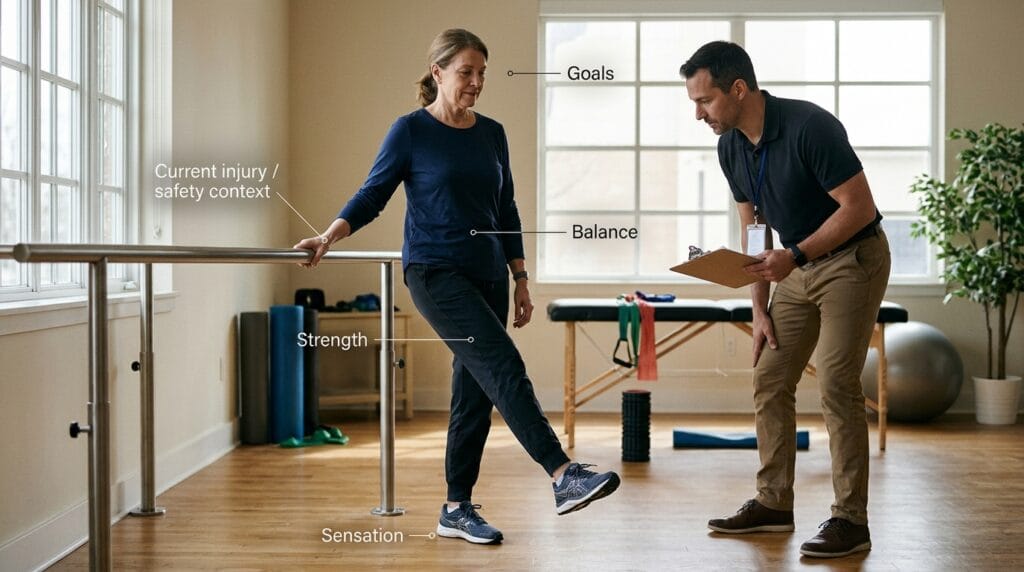
The purpose is to use movement appropriately in relation to a person’s:
- current ability,
- symptoms,
- strength,
- sensation,
- balance,
- mobility,
- functional goals,
- and safety context.
This distinction matters when nerve symptoms are involved.
A person with tingling but normal strength and balance may have a very different rehabilitation context from someone with marked sensory loss, weakness, repeated falls, or a foot injury.
“Is movement therapy the same as exercise?”
Not exactly.
Exercise is one part of movement-based care. Rehabilitation can be broader and may include assessment, education, functional training, activity modification, assistive strategies, and monitoring of response.
That is why this page does not try to give every reader the same exercise routine.

“Is movement therapy the same as physiotherapy?”
Physiotherapy is broader than any single movement intervention.
Professional physiotherapy practice includes assessment and clinical reasoning as well as intervention. World Physiotherapy’s standards emphasize competence and safe, effective practice within context.
So when this page discusses movement therapy, it is describing a supportive rehabilitation concept, not replacing individualized physiotherapy assessment.
“Is movement therapy part of rehabilitation?”
Yes. Movement can be an important component of rehabilitation, particularly when the goal involves improving or maintaining function.
WHO describes rehabilitation in terms of optimizing functioning and reducing disability, including helping people remain as independent as possible and participate in everyday life.
That gives us a useful starting point:
Movement is not the whole of rehabilitation. Movement can be one of the tools used within rehabilitation.
What does that mean for nerve health?
It means that the most useful question is often not:
“What exercise heals nerves?”
but:
“What role can appropriate movement play in my current function, symptoms, and rehabilitation goals?”
Evidence boundary: movement-based rehabilitation is broader than a single exercise prescription, and the exact intervention depends on context. Evidence / Authority — Rehabilitation framework
WHO defines rehabilitation around optimizing functioning and reducing disability; movement is one component of a broader rehabilitation process. World Physiotherapy standards emphasize competent, safe and context-sensitive professional practice.
View WHO source · View World Physiotherapy source
Semantic handoff: If your question has become “Which exercises should I actually do?”, this page has reached its boundary. Continue to the Exercises page for practical exercise discovery rather than turning Movement Therapy into an exercise catalogue.
S02 — Why Might Movement Matter for Nerve Health?
“Why would movement matter if the problem is with my nerves?”
Because nerve-related problems can affect more than sensation.
Depending on the condition, they may affect:
- strength,
- coordination,
- balance,
- walking,
- endurance,
- mobility,
- confidence with movement,
- and everyday activities.
Rehabilitation therefore often has goals that are functional as well as symptom-related.

WHO’s rehabilitation framework places functioning and participation at the centre of rehabilitation rather than treating rehabilitation as a narrow collection of treatments.
That helps explain why movement may remain relevant even when the underlying nerve problem is not itself caused by lack of exercise.
“Can exercise help neuropathy?”
Research suggests that some exercise-based approaches can help selected outcomes in selected neuropathic conditions.
Evidence / Authority — Diabetic neuropathy evidence
A 2024 systematic review and meta-analysis of 11 randomized trials (517 participants) found short-term benefits in symptoms, signs, and physical function in diabetic neuropathy, but rated the overall certainty of evidence as very low. This supports cautious, condition-specific wording rather than a universal exercise claim.
For example, systematic reviews and meta-analyses have reported benefits involving symptoms, balance, functional mobility, gait, strength, or quality of life in particular neuropathy populations.
However, the evidence is not uniform.
The 2022 systematic review and meta-analysis of exercise in neuropathy included 41 randomized controlled trials, but the evidence base differed across neuropathy types. More recent work has also continued to show condition-specific findings rather than one universal exercise effect.
This is why the wording matters:
“Exercise can help some people with some neuropathic conditions”
is more defensible than:
“Exercise heals neuropathy.” Evidence / Authority — Exercise evidence
The 2022 systematic review included 41 randomized controlled trials, but the evidence base differed by neuropathy type; the strongest evidence was concentrated in diabetic and chemotherapy-induced peripheral neuropathy, with much thinner evidence for other causes.
View Streckmann et al. source · View 2025 CIPN review
If your deeper question is which condition might be producing your symptoms, move from this supportive-therapy page to the relevant condition page rather than treating exercise evidence as a diagnosis. For example, Nerve Compression, Sciatic Nerve Pain, and Post-Injury Nerve Damage each own their condition-level questions.
“Can movement help me stay functional when I have nerve problems?”
Yes. Maintaining or improving function is a legitimate rehabilitation goal. Movement may be used to support mobility, strength, balance, activity, and participation, but the appropriate approach depends on the person and the condition.
“Can movement help balance?”
In selected neuropathy research, balance has improved following exercise-based interventions.
This is particularly relevant because sensory loss can affect the information a person receives from their feet and body while moving.
Balance is a functional outcome. As explained later on this page, functional improvement should not be treated as direct proof of biological nerve regeneration.
“Can movement help walking?”
Walking ability can be an important rehabilitation goal.
Research has examined gait and functional mobility in neuropathy populations, and walking may be one component of an appropriate activity program for some people.
But walking is not automatically suitable for every person.
Reduced sensation, weakness, balance problems, foot injury, or other complications can change the safety picture.
“Can movement improve everyday function?”
This is one of the most important questions in rehabilitation.
A person may care less about a numerical symptom score and more about whether they can:
- stand longer,
- walk safely,
- climb stairs,
- get around the home,
- return to an activity,
- maintain independence,
- or participate in daily life.
Movement-based rehabilitation can target these functional goals.
That is why this page uses function as one of its central concepts.
Evidence boundary: functional or symptom improvement does not by itself establish biological nerve regeneration; that distinction is addressed directly in S11.
S03 — Can I Move?
“Can I exercise with nerve damage?”
Nerve symptoms do not automatically mean that all movement should stop.
But the right movement depends on the context.
Important questions include:
- What is affecting the nerve?
- How much strength do you have?
- How much sensation do you have?
- How is your balance?
- What movement can you already perform?
- What is your goal?
- What happens when you move?
- Are there safety issues that make ordinary exercise inappropriate?
This is why there is no universal answer such as:
“Everyone with nerve damage should exercise.”
There is also no universal answer such as:
“Anyone with nerve symptoms should rest.”
The useful middle ground is appropriate movement within an appropriate rehabilitation context.
“Is movement safe with nerve pain?”
Nerve pain does not automatically make all movement unsafe.
At the same time, pain should not be ignored simply because exercise is generally considered healthy.
The response to movement should be interpreted in context.
For example, a person may experience temporary discomfort with activity while another person may develop a new neurological change that needs assessment.
The symptom label alone cannot tell you which situation you are in.
“Can I move if I have numbness or tingling?”
Numbness or tingling does not by itself establish that all movement must stop. The more important questions are how much sensation, strength, balance, and function you have, what is happening to the symptoms, and whether there are safety concerns that require assessment.
“Should I move or rest?”
This is rarely an all-or-nothing question.
Complete rest can reduce activity and function, while poorly matched activity can be difficult to tolerate.
The more useful question is:
“What level and type of activity fits my current ability, condition, goals, and safety?”
That question belongs within rehabilitation rather than a universal rule.
“Can I exercise during a flare?”
A “flare” can mean different things in different conditions.
A temporary increase in symptoms does not, by itself, tell you exactly what has happened to the underlying nerve.
But a response becomes more concerning when it includes things such as:
- new or progressive weakness,
- repeated falls,
- major new balance problems,
- new or worsening neurological changes,
- significant trauma,
- or a foot injury that may not be felt normally.
In those situations, the question may no longer be:
“Which exercise should I do?”
It may become:
“Why are these symptoms changing, and do I need an assessment?”
“Is walking good for neuropathy?”
Walking can be a useful form of physical activity for some people. Evidence / Authority — Condition-specific safety
ADA 2026 discusses moderate-intensity walking in people with peripheral neuropathy alongside proper footwear, foot protection and daily inspection. This evidence is specific to the relevant diabetic-neuropathy context and should not be generalized to every nerve condition.
The ADA’s 2026 Standards of Care note that moderate-intensity walking may not increase foot-ulcer risk in people with peripheral neuropathy when appropriate footwear is used, while also emphasizing assessment, foot protection, and daily inspection.
That is important because it illustrates the correct way to interpret an exercise recommendation:
walking can be appropriate in a particular safety context.
It does not mean:
walking is always safe for every person with neuropathy.
“Is walking enough?”
That depends on the goal.
Walking may help with general activity and mobility, but someone whose main limitation is strength, balance, coordination, or another functional problem may have different rehabilitation needs.
This page therefore avoids treating walking as a universal solution.
“Can I exercise if I have numb feet?”
This is an important safety question.
Reduced sensation can make it harder to notice pressure, skin injury, or other problems.
The ADA’s diabetes guidance specifically emphasizes foot assessment and daily inspection in people with peripheral neuropathy and gives additional restrictions when a foot injury or open sore is present.
The strongest direct evidence here is diabetes-specific, so it should not be generalized carelessly to every type of neuropathy.
The broader principle is:
When protective sensation is reduced, ordinary feedback from the feet may be less reliable, so movement safety needs more attention.
“What if I have weakness?”
Weakness changes the movement question.
If weakness is mild and stable, rehabilitation may include strengthening or functional movement.
If weakness is new, unexplained, or progressively worsening, the priority may be assessment rather than simply increasing exercise.
“What if I have balance problems?”
Balance problems can change exercise safety.
A person who feels unstable may need an adapted environment, support, supervision, or a different starting point.
Again, the goal is not “exercise at all costs.”
The goal is to support movement while protecting function and safety.
“What if I cannot walk normally?”
Not being able to walk normally does not mean rehabilitation has nothing to offer.
Rehabilitation can address function even when normal walking is not currently possible.
The appropriate question becomes:
“What movement or activity is possible and meaningful for me right now?”
That may require professional assessment when the limitation is substantial or changing.
Practical safety boundary
The page uses a three-level decision hierarchy so that “movement may be useful” is never read as “movement is always safe.”

STOP / SEEK PROMPT ASSESSMENT
Stop the activity and seek prompt medical assessment when there is a new or rapidly worsening neurological problem, such as significant or progressive weakness, a major new loss of function, or another unexplained neurological change that is not behaving like an ordinary activity response.
If a serious injury or acute neurological change is suspected, this page should not be used to decide that continued exercise is safe.
ASSESS SOON
Arrange professional assessment when there is substantial sensory loss, repeated balance or fall difficulty, major mobility limitation, significant trauma, uncertainty about safe loading, or a foot problem that changes what activity can safely be performed.
For people with diabetic peripheral neuropathy, ADA guidance gives additional safety considerations around reduced sensation, foot inspection, footwear, foot injury/open sores, and autonomic neuropathy.
MODIFY / MONITOR
When there is no clear escalation signal, movement may sometimes be modified and observed rather than automatically abandoned. Consider the type and amount of activity, the response during and after it, and whether the same response recurs.
This is a response-monitoring framework, not a diagnosis or individualized treatment prescription.
S04 — Could Movement Make Things Worse?
“Could movement hurt me?”
It can be poorly tolerated in some circumstances.
The important point is that movement is not automatically harmful, but neither is every movement automatically appropriate.
Problems can arise when:
- the activity is poorly matched to current ability,
- the load is too high,
- balance is inadequate for the activity,
- protective sensation is reduced,
- a foot or other injury is present,
- or the underlying condition requires a different approach.
“Can exercise make neuropathy worse?”
There is no basis for saying that exercise universally worsens neuropathy.
But it would be equally inappropriate to say that exercise is always safe for every person with every type of neuropathy.
The evidence is condition-specific.
“Why do my symptoms get worse when I move?”
There is no single explanation that can be inferred from the symptom alone. The response may reflect how the activity interacts with the person’s current condition and capacity, but a repeated or progressive neurological change requires reassessment rather than assuming either harmlessness or new nerve damage.
“Can exercise cause more nerve damage?”
A general warning that exercise will cause additional nerve damage is not supported.
But symptoms after exercise should not automatically be dismissed either.
The response should be interpreted using:
activity → symptom change → timing → duration → function → recurrence

If symptoms repeatedly worsen, function declines, or new neurological changes appear, reassessment becomes more important.
“Is pain after exercise a warning sign?”
Pain is a signal, but pain alone does not identify the cause.
Similarly:
- tingling does not automatically prove new nerve damage,
- soreness does not automatically prove injury,
- feeling better does not automatically prove regeneration.
The context matters.
“Is more exercise always better?”
No.
There is no universal nerve-specific rule that says more movement is always better.
Appropriate rehabilitation considers the relationship between load, ability, goals, response and safety.
S05 — Which Movement?
“What exercises are good for nerve health?”
There is no single exercise that can be called the universally best movement for nerve health.
Research has studied different approaches, including:
- aerobic activity,
- walking,
- resistance or strengthening exercise,
- balance training,
- sensorimotor training,
- stretching,
- motor-control approaches,
- and combined programs.
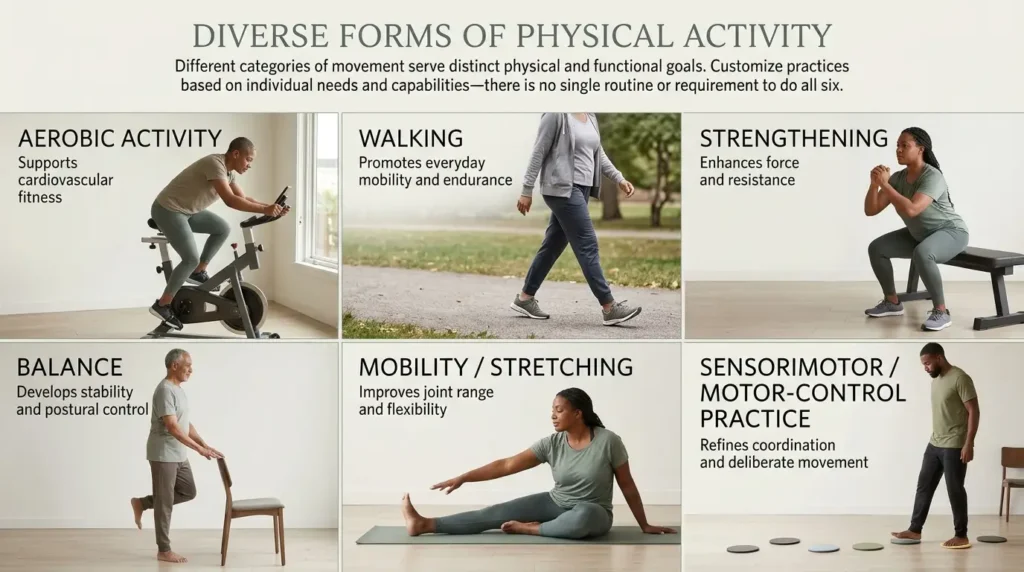
Different approaches may target different outcomes.
For example, strengthening may be particularly relevant when the goal is muscle strength, while balance work may be more relevant when postural stability is the main limitation.
“What type of movement should I start with?”
Start with fit rather than a universal “best” exercise: what movement matches your current ability, goal, symptoms, sensation, balance, and safety context? Technique-level selection belongs on Exercises or in individualized rehabilitation.
“Is strength training useful for neuropathy?”
Evidence supports strengthening as a rehabilitation strategy in selected neuropathy populations, including evidence that progressive resisted exercise can improve strength. Evidence / Authority — Exercise evidence
Cochrane and systematic-review evidence supports cautious interpretation of strength and functional outcomes in peripheral neuropathy; the evidence is not a universal prescription for every neuropathy.
View Cochrane source · View systematic review
But strength improvement should not be treated as proof that a damaged nerve has regenerated.
“Is balance training useful?”
Balance training has been studied particularly in diabetic and chemotherapy-induced peripheral neuropathy.
Evidence / Authority — Selected neuropathy populations
Balance outcomes have been studied in selected neuropathy populations, particularly diabetic and chemotherapy-induced peripheral neuropathy. Findings are condition- and intervention-specific and should not be generalized to every nerve condition.
[View Streckmann et al. source] · [View 2025 CIPN review]
Selected studies report improvements in balance or related function.
The evidence does not establish one universal balance program for everyone.
“Is aerobic exercise useful?”
Aerobic exercise is one of the approaches studied in neuropathy research.
Evidence / Authority — Aerobic exercise
Aerobic exercise is one of several approaches studied in neuropathy research, but the evidence varies by neuropathy type, intervention and outcome. This does not establish a universal aerobic-exercise prescription for nerve conditions.
[View Streckmann et al. source] · [View 2025 CIPN review]
Its relevance may include general physical activity, endurance, mobility and participation.
Again, the appropriate dose depends on the person and the goal.
“Should I stretch?”
Stretching may be appropriate in some rehabilitation contexts, but it is not a universal nerve treatment.
This page explains the role of movement; it does not prescribe a specific stretching routine.
Internal handoff: For exercise selection and technique-level guidance, continue to Exercises.
S06 — How Much Movement?
“How much exercise is enough?”
There is no single nerve-specific amount of exercise that applies to everyone. If the deeper problem is how to sequence, monitor, and adapt recovery over time, that question belongs to Recovery Engineering.
General physical-activity guidelines are useful at the population level, but they are not the same thing as an individualized rehabilitation prescription.
The appropriate amount depends on:
- condition,
- current ability,
- goals,
- symptoms,
- strength,
- balance,
- sensation,
- and response.

“Is 30 minutes enough?”
There is no scientifically responsible way to say that 30 minutes is automatically enough for every person with a nerve problem.
The same duration can represent very different physical demands for different people.
“Is 150 minutes enough for neuropathy?”
General physical-activity guidance may use weekly activity targets, and ADA guidance discusses 150 minutes/week in specific contexts. Evidence / Authority — Activity guidance
General physical-activity guidance operates at a population level; it should not be converted into an individualized nerve-rehabilitation dose. ADA guidance provides condition-specific context rather than a universal nerve-treatment prescription.
View WHO activity guidance · View ADA source
But this should not be converted into:
“150 minutes is the correct treatment dose for nerve damage.”
It is not a universal nerve-rehabilitation prescription.
“How should I approach frequency, duration, and progression?”
There is no universal nerve-specific schedule. In general, the relevant variables are how often you move, how long each activity lasts, what the activity demands, and how your body responds during and afterward. A person who cannot tolerate a longer session may sometimes use shorter bouts of activity, but the appropriate pattern depends on the condition, ability, goals, and safety context.
“Should I exercise every day?”
Not as a universal nerve-health rule. Frequency should be considered alongside the type of activity, recovery between sessions, current ability, and response. General physical-activity guidance is population-level guidance, not a personalized nerve-rehabilitation prescription.
“Can I break activity into shorter sessions?”
Shorter bouts can be a practical way to fit activity around limited tolerance, fatigue, pain, or mobility barriers. The page does not prescribe a specific number or duration of bouts; the key is whether the approach remains appropriate and safe for the person and goal.
Evidence / Authority — Population activity guidance
WHO physical-activity guidance applies at the population level and includes adults living with chronic conditions or disability; it should not be converted into a nerve-specific treatment dose. WHO also emphasizes that people who cannot meet standard targets because of health conditions should be as active as their abilities and conditions allow.
“How do I know if I have done too much?”
Look at the whole response.
Ask:
- What changed?
- When did it change?
- How severe was it?
- How long did it last?
- Did function change?
- Does the same response happen repeatedly?
- Is there new weakness or another neurological change?
This creates a more useful assessment pattern than relying on pain alone.
S07 — What If Movement Makes Me Feel Worse?
“What if exercise makes my symptoms worse?”
This is one of the questions Movement Therapy owns most directly: the immediate response to movement and what to do with that information. If the deeper question becomes how an entire recovery plan should be sequenced and adapted over time, transfer to Recovery Engineering.
Do not automatically assume either:
“I damaged my nerve.”
or
“This is completely harmless.”
Both conclusions can be too strong.
Instead, observe the response.

MOVE
What activity did you perform?
NOTICE
What changed?
INTERPRET
Was the change pain, tingling, fatigue, soreness, weakness, balance difficulty, or something else?
REASSESS
Did the change settle, persist, recur, or progressively worsen?
MODIFY / MONITOR → STOP / SEEK PROMPT ASSESSMENT
Choose the next step according to the response and safety context.
This is the page’s Movement Response Assessment loop.
“What if I feel worse later or the next morning?”
Timing matters, but there is no single symptom-duration cutoff on this page that can diagnose whether an activity was harmful. Note when the change began, how long it lasted, whether it recurred, whether function changed, and whether new weakness or another neurological change appeared.
“Should I reduce or change the movement if I react badly?”
That can be a reasonable question, but this page does not prescribe a personalized adjustment. A repeated or concerning response should shift attention toward reassessment; when no clear escalation signal is present, the movement, amount, environment, or timing may need to be reviewed in relation to current ability and goals.
“Does feeling worse mean I damaged my nerve?”
Not automatically.
A symptom change after activity does not by itself identify new nerve injury.
But a new or progressive neurological deficit deserves more attention than ordinary exercise discomfort.
“Does feeling better mean my nerve is healing?”
Not automatically.
Feeling better is valuable, but symptom relief is not the same thing as direct evidence of biological nerve regeneration.
This distinction is especially important because people naturally use symptom changes to judge whether an intervention is “working.”
A more careful interpretation is:
“Something changed.”
Then ask:
“What changed, in what way, for how long, and what does the available evidence allow me to conclude?”
S08 — Can Movement Help Me Function?
“Can movement help me walk better?”
Walking and gait are legitimate rehabilitation outcomes. Evidence / Authority — Function and exercise outcomes
Exercise research in selected neuropathy populations has examined gait, functional mobility, balance and related outcomes, but effects differ by condition and intervention.
View Streckmann et al. source · View 2025 CIPN review
Exercise studies in neuropathy have examined functional mobility and gait, and selected interventions have produced improvements.
But effects differ between populations.
“Can exercise improve balance?”
Yes, selected neuropathy research reports balance improvements. Evidence / Authority — Selected neuropathy outcomes
Balance improvements have been reported in selected neuropathy exercise research. The finding is condition- and intervention-specific and should not be generalized as a universal exercise effect.
View systematic review · View 2025 CIPN review
But balance is an outcome, not a diagnosis.
“Can exercise improve strength?”
Strengthening can improve muscle strength in some neuropathy populations.
Strength improvement is a functional outcome; it should not be used by itself to infer biological nerve regeneration.
“What about coordination, endurance, or getting back to daily life?”
These can also be legitimate rehabilitation outcomes. Depending on the condition, a person may care about coordinating movement, tolerating activity for longer, returning to work or travel, managing hobbies, or handling ordinary tasks more independently. The appropriate intervention depends on the person’s current abilities and goals rather than a single standard exercise formula.
“Can movement improve everyday activities?”
This is one of the strongest reasons to think about movement through a rehabilitation lens.
The meaningful outcome may be:
- getting out of a chair,
- walking safely,
- standing long enough to cook,
- climbing stairs,
- returning to work,
- or maintaining independence.
Function is not a secondary issue.
It is one of the central purposes of rehabilitation.
S09 — What If Normal Exercise Isn’t Possible?
“What if I cannot exercise normally?”
Normal exercise is not a prerequisite for rehabilitation.
A person may have:
- severe weakness,
- limited walking ability,
- balance problems,
- fatigue,
- pain,
- reduced sensation,
- an assistive device,
- or another barrier to conventional exercise.
Rehabilitation can be adapted around ability and participation.

Evidence / Authority — Rehabilitation framework
WHO describes rehabilitation in terms of optimizing functioning and reducing disability, including participation and independence. This supports adapting rehabilitation around the person’s current abilities and goals rather than assuming a standard exercise model.
[View WHO Rehabilitation 2030]
“What if I cannot walk?”
The absence of normal walking does not mean the absence of meaningful movement.
The question becomes:
“What movement or activity is currently possible and useful for my goals?”
The exact answer belongs to individualized rehabilitation rather than a generic article.
“What if I need a chair or support?”
Assistive equipment and supported movement can be part of rehabilitation.
The aim is not to force a person into a standard exercise model.
The aim is to support safe and meaningful function.
“What if I cannot stand for long or can only move for a few minutes?”
Limited standing or very low exercise tolerance does not make rehabilitation irrelevant. It changes the starting point. The useful question is what movement or activity is currently possible without exceeding the person’s safety and functional limits.
“What if I cannot do weight-bearing exercise?”
Rehabilitation does not require a single weight-bearing model. Depending on the condition, non-weight-bearing or supported activity may be considered, but the exact option is individualized and falls outside this page’s generic exercise prescription boundary.
“What if pain prevents me from exercising normally?”
Pain can be a barrier to activity, but pain intensity alone does not determine the safest or most useful approach. Persistent or worsening symptoms, functional decline, or uncertainty about the cause are reasons to move toward professional assessment rather than simply pushing harder.
“What if I have a foot wound?”
This is a specific safety situation.
In the diabetes/peripheral-neuropathy context, ADA guidance states that a foot injury or open sore changes activity recommendations and calls for non-weight-bearing activity in the relevant context.
In the diabetes/peripheral-neuropathy context, an open wound, unexplained swelling, redness, increased skin temperature, or other concerning foot change should be treated as a foot-safety issue rather than simply an exercise problem.
S10 — When Should I Seek Professional Guidance?
“When should I see a physical therapist?”
Professional guidance becomes particularly useful when the movement question is difficult to answer safely from general information.

Evidence / Authority — Professional practice
Professional physiotherapy standards emphasize competent, safe, effective and context-sensitive practice. That supports using professional assessment when the movement question depends on individual neurological or safety factors that general information cannot resolve.
[View World Physiotherapy Standards]
Examples include:
- substantial weakness,
- progressive weakness,
- major balance problems,
- repeated falls,
- significant sensory loss,
- inability to walk normally,
- symptoms after significant trauma,
- unclear neurological symptoms,
- or difficulty identifying an appropriate starting point.
“Do I need an assessment before exercising?”
Not every person needs an assessment before every form of physical activity.
But assessment becomes more important when there are significant neurological deficits, safety concerns, or an unclear cause.
World Physiotherapy’s professional standards emphasize competent and safe practice within context.
That means assessment is not simply a formality.
It is part of determining whether the proposed movement actually fits the person’s situation.
“What if I have an open sore on a numb foot?”
This should not be handled by simply choosing a different exercise video.
In the relevant diabetic-neuropathy context, ADA guidance recommends specific foot assessment and changes to weight-bearing activity when injury or an open sore is present.
“What if I have autonomic symptoms?”
Autonomic neuropathy can create exercise-related cardiovascular and other safety concerns.
This is one reason condition-specific professional assessment matters.
“What if I develop new neurological symptoms or do not know the cause?”
New neurological symptoms, an unexplained change, or uncertainty about the cause can move the problem beyond generic movement advice. In that situation, assessment may be more useful than choosing an exercise from a list.
“When should I stop trying to manage this on my own?”
When symptoms are progressive, function is deteriorating, significant weakness or balance problems are developing, injury has occurred, or the safe starting point is unclear, the balance shifts toward professional assessment.
Internal handoff: When the question becomes individualized safety or treatment selection, the next destination is professional assessment, not another generic exercise list.
S11 — Can Movement Repair or Regenerate Nerves?
“Can exercise repair damaged nerves?”
This is where the page needs a firm evidence boundary. Evidence / Authority — Regeneration boundary
Exercise reviews report selected symptom and functional outcomes in particular neuropathy populations. They do not establish a universal claim that exercise repairs or regenerates damaged nerve tissue across nerve conditions.
View Streckmann et al. source · View 2025 CIPN review
Research supports selected improvements in:
- symptoms,
- strength,
- balance,
- mobility,
- function,
- and quality of life
in selected neuropathic conditions.
That does not establish that exercise universally repairs damaged nerve tissue.
“Can exercise regenerate nerves?”
The human exercise literature discussed here does not establish a universal claim of biological nerve regeneration across nerve conditions.
A functional improvement can result from several interacting processes.
Therefore:
better walking ≠ proven nerve regeneration
better balance ≠ proven nerve regeneration
less pain ≠ proven nerve regeneration
greater strength ≠ proven nerve regeneration
“Does feeling better mean my nerves are recovering?”
It can mean that something beneficial changed.
But the exact biological explanation cannot be inferred from symptom improvement alone.
This page therefore separates:
Functional recovery
What you can do.
Symptom improvement
What you feel.
Biological regeneration
What happens to neural tissue.
These can overlap, but they are not interchangeable.

Internal handoff: For the biology of nerve regeneration, continue to Regeneration.
S12 — What Movement Therapy Can—and Cannot—Do
What movement therapy may support
Depending on the condition and intervention, movement-based rehabilitation may support:
Evidence / Authority — Selected outcomes, not a universal effect
Exercise research in selected neuropathy populations has examined outcomes including mobility, strength, balance, gait, function and selected symptoms. The evidence varies by condition, intervention and outcome, so this list should not be read as a universal benefit profile for every nerve condition.
[View Streckmann et al. source] · [View 2025 CIPN review] · [View Cochrane evidence]
- mobility,
- strength,
- balance,
- walking,
- physical activity,
- functional capacity,
- everyday participation,
- and selected symptoms.
What movement therapy cannot automatically establish
Movement therapy cannot automatically establish that a nerve has regenerated, that the original cause has been corrected, that a compression has been structurally removed, or that nerve damage has been reversed. Nor can it establish that every nerve condition will improve or that more exercise will produce better recovery. See S11 for the full function-versus-regeneration boundary.
“How long should I expect movement to take to help?”
There is no single timeline that applies to every nerve-related condition or rehabilitation goal. Some outcomes may be noticed before others, and lack of symptom change does not by itself prove that a nerve has worsened or improved biologically. The useful comparison is between current function, symptoms, activity tolerance, and goals over time.
“What if movement does not seem to help?”
That is information, not a diagnosis. Review what changed, what outcome you were trying to improve, and whether the response suggests that the activity needs modification or professional reassessment. Do not convert “no improvement” into a claim that the nerve is permanently damaged or that another intervention will necessarily work.
“What if my function improves but numbness or pain remains?”
That can happen because functional recovery, symptom change, and biological regeneration are related but distinct outcomes. Improvement in one does not automatically establish what happened to the others.
“Can movement therapy replace medical treatment?”
Not as a universal rule.
Nerve-related problems can have many different causes.
Depending on the situation, management may involve diagnosis, medical treatment, rehabilitation, activity modification, nutrition, medication, surgery, or other approaches.
Movement can be one component of that broader picture.
“Is movement therapy enough on its own?”
Sometimes movement is an important component of rehabilitation.
But it should not be assumed to be the complete answer to every nerve-related problem.
This is where HYN’s ownership structure matters:
Cause → Condition → Supportive System → Practical Discovery
Movement Therapy owns the supportive movement role.
It does not absorb every cause, every condition, every exercise prescription, or every regeneration mechanism.
S13 — Where Should I Go Next?
Movement Therapy is deliberately not the final destination for every nerve-related question.
Choose your next page according to the question you now want answered. The links below are semantic handoffs: each destination owns a deeper question that Movement Therapy only contextualizes.
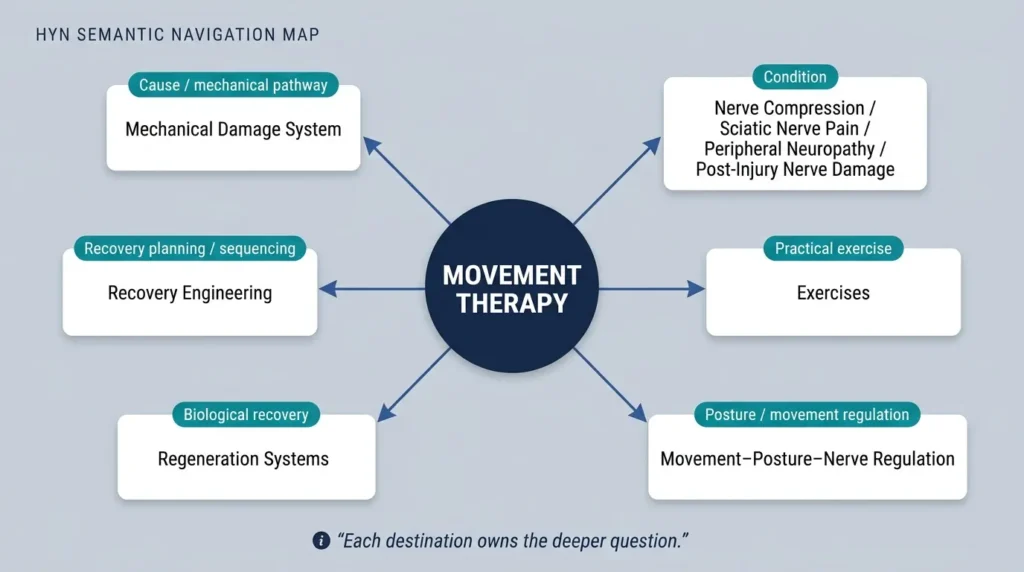
“What is causing my nerve symptoms?”
If the question is about a broader mechanical cause or sustaining pathway, continue to the Mechanical Damage System.
“Could compression be affecting my nerve?”
Continue to Nerve Compression for the condition-level questions about nerve compression.
“Could this be sciatic nerve pain?”
Continue to Sciatic Nerve Pain for the condition-level questions about sciatic nerve pain.
“What happens after a nerve injury?”
Continue to Post-Injury Nerve Damage for the condition-level orientation after nerve injury.
“Could posture or movement patterns matter?”
Continue to Movement–Posture–Nerve Regulation for the supportive-system question about posture, movement patterns, and nerve regulation.
“Which exercises should I actually do?”
Continue to Exercises for practical exercise discovery.
“How does a nerve recover biologically?”
Continue to Regeneration Systems for biological repair and regeneration questions.
“How should recovery be organized?”
Continue to Recovery Engineering for sequencing, monitoring, adaptation, and recovery-management questions.
“I have peripheral neuropathy and want to understand the condition.”
Continue to Peripheral Neuropathy for condition-level orientation.
The principle is:
One page should answer the question it owns well, then transfer the reader when the next question belongs somewhere else.
S14 — FAQ
The FAQ is intentionally different from the section headings. Its job is to capture common search-language variants and practical edge questions without repeating the full body answers.
Can I still move if I have tingling or numbness?
Possibly. Tingling or numbness does not by itself establish that all movement should stop. The appropriate activity depends on the condition, current ability, sensory loss, balance, strength, goals, and safety context.
Is rest better than exercise when a nerve is irritated?
Not universally. Some situations call for reducing or modifying activity, while others may benefit from continued or adapted movement. The key question is what the current response and safety context support.
How can I tell whether a movement response is something to monitor?
Look at what changed, when it changed, how severe it was, how long it lasted, whether function changed, and whether the same response keeps recurring. New or progressive neurological changes deserve assessment rather than simple monitoring.
Does a flare mean I should stop all exercise?
Not necessarily. A flare should not automatically be interpreted as either proof of damage or proof that everything is safe. Use the response-assessment framework and consider whether the activity needs to be modified, stopped, or professionally assessed.
Is walking a treatment for neuropathy?
Walking can be one form of physical activity or rehabilitation for some people, but it is not a universal treatment for every neuropathy. In diabetic peripheral neuropathy, foot safety and sensory loss can change what is appropriate.
What if I can exercise but cannot tolerate much?
The amount that can be tolerated may need to be adapted to current ability and response. “More” is not automatically better, and a universal nerve-specific dose cannot be assumed.
Can strength and balance work be part of nerve rehabilitation?
Yes, selected studies in neuropathic conditions have examined strengthening, balance, aerobic activity, and combined approaches. The evidence varies by condition, intervention, and outcome.
What if normal walking is not possible?
Rehabilitation does not require normal walking. The relevant question becomes what movement or activity is possible and meaningful at the person’s current level of function.
When is numbness a safety issue during exercise?
Reduced sensation can make injuries harder to notice. This is especially important in diabetic peripheral neuropathy, where ADA guidance emphasizes foot inspection, appropriate footwear, and additional precautions when a foot injury or open sore is present.
When should I stop trying to work through symptoms?
Stop and seek assessment when there is a new or rapidly worsening neurological problem, significant or progressive weakness, major new functional loss, or another concerning change that should not be assumed to be an ordinary activity response.
Can improvement in walking prove that a nerve has regenerated?
No. Better walking or other functional improvement can be meaningful without proving biological nerve regeneration.
Can symptom relief prove that a damaged nerve has repaired itself?
No. Symptom improvement and biological regeneration are different outcomes and should not be treated as interchangeable.
What if I want a specific exercise program?
That is a deeper practical-prescription question. Movement Therapy explains the rationale, boundaries, and response framework; continue to Exercises for practical exercise discovery, and seek individualized professional guidance when your safety context warrants it.
What if I think compression is causing my symptoms?
That is a cause/condition question rather than a movement-therapy question. Continue to Nerve Compression for that deeper topic.
What if I want to understand the biology of nerve repair?
Continue to Regeneration Systems for the biological repair and regeneration layer.
Evidence Governance
Source Roles
The page uses different sources for different questions rather than treating every source as interchangeable.
Rehabilitation framework
WHO — Rehabilitation 2030
Supports the rehabilitation focus on functioning, participation, and rehabilitation as an essential health service.
Professional practice
World Physiotherapy — Standards of Physiotherapist Practice
Supports the emphasis on competent, safe, effective, and context-sensitive professional practice.
Condition-specific safety
American Diabetes Association — Standards of Care in Diabetes—2026
Supports the page’s diabetic-peripheral-neuropathy safety boundaries involving sensory loss, foot care, activity, foot injury/open sores, and autonomic complications.
Evidence synthesis
Cochrane — Exercise for peripheral neuropathy
Supports the cautious interpretation of evidence on exercise, strength, function, and uncertainty in peripheral neuropathy.
Peer-reviewed evidence
Streckmann et al. — Exercise and Neuropathy systematic review/meta-analysis
The evidence base is strongest in some neuropathy populations, particularly diabetic and chemotherapy-induced peripheral neuropathy, and is much thinner for other neuropathy causes.
2025 chemotherapy-induced peripheral neuropathy systematic review/meta-analysis
Provides more recent condition-specific evidence on exercise approaches and selected symptoms and functional outcomes in CIPN.
NIDDK — Peripheral Neuropathy
Provides diabetes-related context for reduced sensation, foot injury, balance, and foot safety.
Patient-safety context
Zhang et al. — Exercise for Neuropathic Pain (2021)
Provides condition-specific neuropathic-pain evidence and expert-consensus context.
Neuropathic-pain evidence
Hernando-Garijo et al. — Diabetic neuropathy exercise meta-analysis
Provides condition-specific evidence on symptoms, signs, and physical function, with very-low overall certainty.
Condition-specific evidence
Cochrane — Interventions for promoting physical activity in neuromuscular disease (2021)
Supports cautious interpretation of activity barriers, uncertainty, and serious-harm evidence in neuromuscular disease.
Evidence synthesis
Source-Traceability Rule
Every consequential medical or evidence claim in the final WordPress implementation should have a visible source relationship.
Preferred pattern:
Evidence / Authority — [claim-specific source]
Short evidence statement.
[direct source link]
The link should lead directly to the original guideline, PubMed record, systematic review, professional standard, or authoritative source that supports the claim.
A source name alone is not sufficient, and a source must not be presented as supporting a broader conclusion than it actually establishes.
Movement Response Assessment
MOVE → NOTICE → INTERPRET → REASSESS → MODIFY / MONITOR → STOP / SEEK PROMPT ASSESSMENT
This is the page’s main original practical framework for the question:
“I moved, I feel different—what does that mean?”
It is not a diagnostic algorithm and it does not determine whether a nerve has been damaged or regenerated.
MOVE
What did you do?
Record the broad activity or movement, without assuming the activity itself explains the symptom.
NOTICE
What changed?
Notice the type of response: pain, tingling, numbness, fatigue, soreness, weakness, balance difficulty, or a functional change.
INTERPRET
What kind of change was it?
Do not jump directly from “symptom changed” to “nerve damage occurred.”
Also do not jump from “symptom changed” to “nothing is wrong.”
REASSESS
Did the change:
- settle,
- persist,
- recur,
- interfere with function,
- or progressively worsen?
A repeated or progressively worsening neurological change deserves more attention than a brief, nonspecific activity response.
MODIFY / MONITOR → STOP / SEEK PROMPT ASSESSMENT
Use the response and safety context to choose the next step:
MODIFY / MONITOR when no clear escalation signal is present and the response can reasonably be observed.
STOP when continuing the activity does not appear appropriate based on the response or safety context.
STOP / SEEK PROMPT ASSESSMENT when there is new or progressive weakness, major new functional loss, significant injury, concerning neurological change, or another reason the situation cannot safely be interpreted from the page alone.
Why this framework matters
It avoids two opposite errors:
“Any symptom after exercise means I damaged my nerve.”
and
“Any symptom after exercise is harmless.”
Neither conclusion is justified by the symptom alone.
The useful question is:
What changed, what happened next, and what does the available evidence allow me to conclude?
HYN Learning Return
After reading this page, your next question may change.
That is expected.
Use:
LEARN → OBSERVE → REASSESS → RETURN → NEXT QUESTION
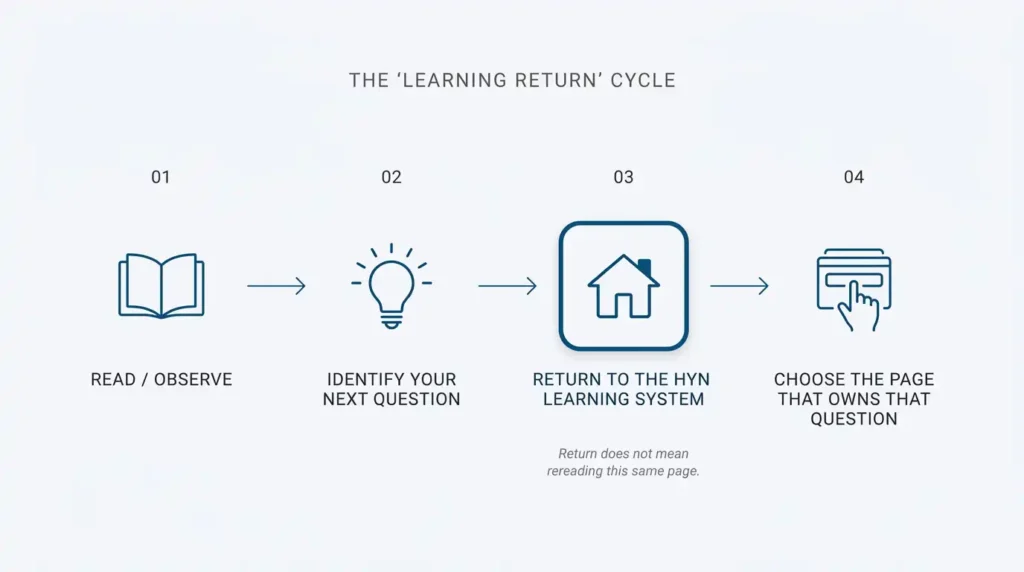
The RETURN step is a semantic transfer, not a request to reread the same page. If your new question belongs to another HYN owner, follow that destination rather than extending Movement Therapy into the adjacent topic.
“Return” does not mean simply returning to this article.
It means returning to the HYN learning system and selecting the page that owns the question you now have.
For example:
Movement question
→ Movement Therapy
Condition question
→ Nerve Compression / Sciatic Nerve Pain / Peripheral Neuropathy / Post-Injury Nerve Damage
Practical exercise question
→ Exercises
Biological recovery question
→ Regeneration
Broader recovery planning question
→ Recovery Engineering
Editorial governance
Author, Clinical Review & Evidence Update
Author / Editorial owner: Heal Your Nerves Naturally Editorial Team
Medical / clinical reviewer:Dr. Chinmoy Shaa Poddar
Last reviewed: 23/09/2026
Evidence update: 25/09/2026
Reviewer identity, credentials and review dates are intentionally not invented. They must be populated from the actual editorial and clinical review record before the page receives final publication approval.
Final takeaway
Movement can be an important part of rehabilitation for some people with nerve-related problems.
But the useful question is not simply:
“Does exercise heal nerves?”
A better sequence is:
Can I move safely?
What kind of movement fits my current situation?
How much is appropriate?
What does my response mean?
Can movement improve function?
When do I need professional guidance?
And what can movement realistically tell me about nerve recovery?
The evidence supports a careful middle ground:
Movement may support function, mobility, strength, balance and selected symptoms in selected conditions.
But:
Movement does not automatically equal biological nerve regeneration.
That distinction allows movement to have an important place in rehabilitation without asking it to do what the evidence has not established.
Learn → Observe → Reassess → Return
About · Disclaimer · Privacy Policy · Contact
© 2026 Heal Your Nerves Naturally