
Nutritional Timing: Learn How Food Timing Connects to Nerve Nutrition

Nutritional Timing explains how the timing of food intake may connect with daily body rhythms, digestion, energy use, recovery patterns, and nerve-health education. While many nutrition discussions focus on what people eat, this topic explores when food is consumed and how meal timing may fit into broader body-system function. Therefore, Nutritional Timing helps readers understand one additional layer of nutrition without focusing on strict meal plans, diet rules, or treatment approaches.
This page belongs to the Nutritional Intelligence learning system. In addition, it works alongside Gut Axis, Protein and Amino Acids, Micronutrients and Nerve Function, and Metabolic Support Through Diet Patterns. Together, these topics help explain how food becomes usable nutrition and how nutrition may connect with wider discussions about energy availability, recovery education, and nervous system function. As a result, readers can view food timing as part of a larger educational picture rather than as an isolated topic.
Many visitors arrive here because they are searching for nerve food repair, nervous system regulation, autonomic response, neurological regulation, energy patterns, or recovery concepts. Consequently, they often want to know whether meal timing matters. Nutritional Timing may help explain one part of that question because food intake occurs within daily patterns that also include sleep, movement, digestion, stress response, and work schedules. However, nerve pain, tingling, numbness, burning sensations, weakness, fatigue, and sensitivity can have many possible causes. Therefore, this page is designed for education rather than diagnosis. Instead, its purpose is to help readers understand how food timing may fit into broader learning about nutrition, recovery, and body systems.
Quick Navigation
What Is Nutritional Timing?
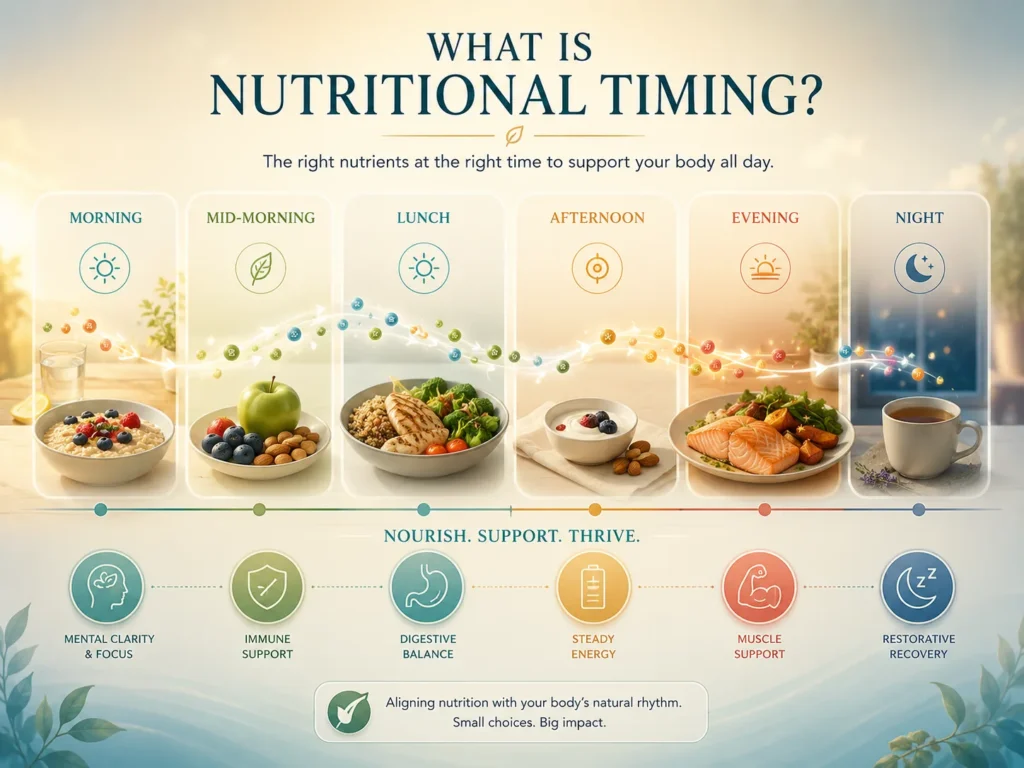
Nutritional Timing is the study of when food is consumed throughout the day and how meal timing may fit into broader nutrition education. Although food quality remains important, meal timing adds another layer of understanding because food intake occurs within changing daily patterns. For example, meals may take place before work, after activity, during periods of rest, or alongside recovery routines. Consequently, food timing becomes part of a wider conversation about digestion, energy use, and daily rhythm.
Throughout the day, the body moves through periods of activity, learning, movement, rest, and sleep preparation. As a result, food intake rarely happens in isolation. Instead, it occurs within a larger system that includes digestion, nutrient availability, sleep patterns, stress response, and recovery demand. Therefore, Nutritional Timing helps readers understand how meal timing may connect with broader body-system education. However, this topic does not recommend meal schedules, fasting plans, or treatment strategies. Rather, it provides a framework for understanding how food timing may fit into wider discussions about nutrition and recovery.
Plain Meaning / Glossary Box
Nutritional Timing
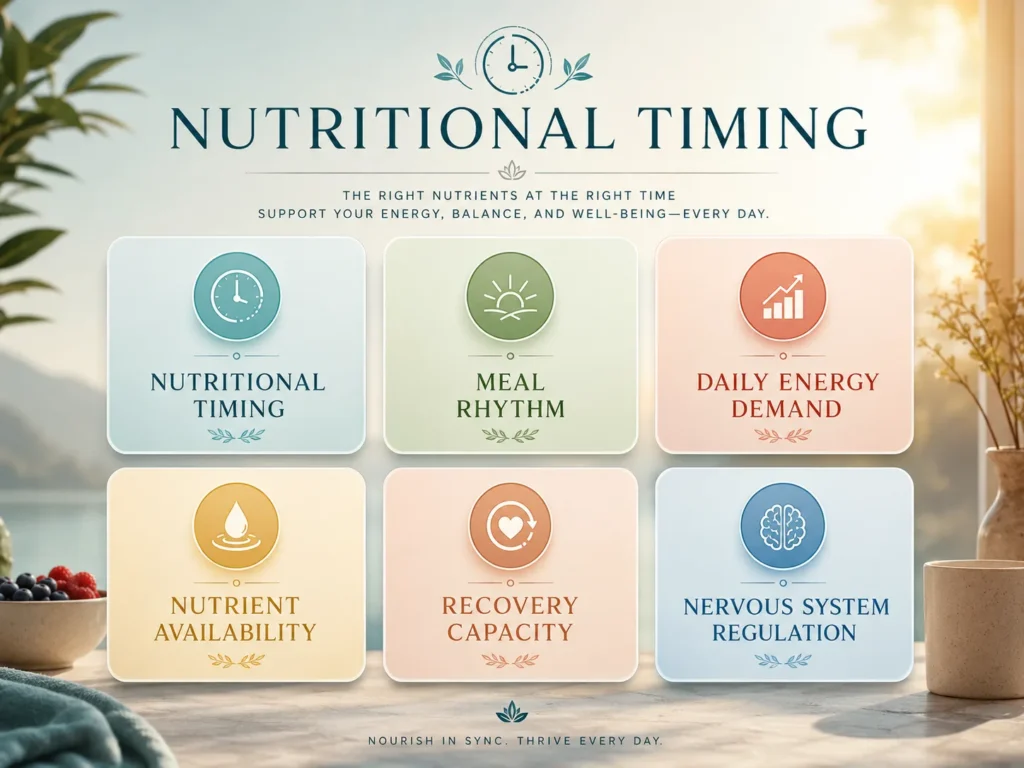
Nutritional Timing refers to when food is consumed throughout the day.
Meal Rhythm
Meal rhythm describes the general pattern and spacing of meals over time.
Nutrient Availability
Nutrient availability refers to how usable nutrition becomes accessible after digestion and absorption.
Daily Energy Demand
Daily energy demand refers to the amount of energy the body uses during work, movement, learning, and everyday activities.
Recovery Capacity
Recovery capacity describes the body’s ability to adapt to demands and maintain function over time.
Nervous System Regulation
Nervous system regulation refers to how the body manages communication, adaptation, and response patterns throughout daily life.
How Nutritional Timing Works
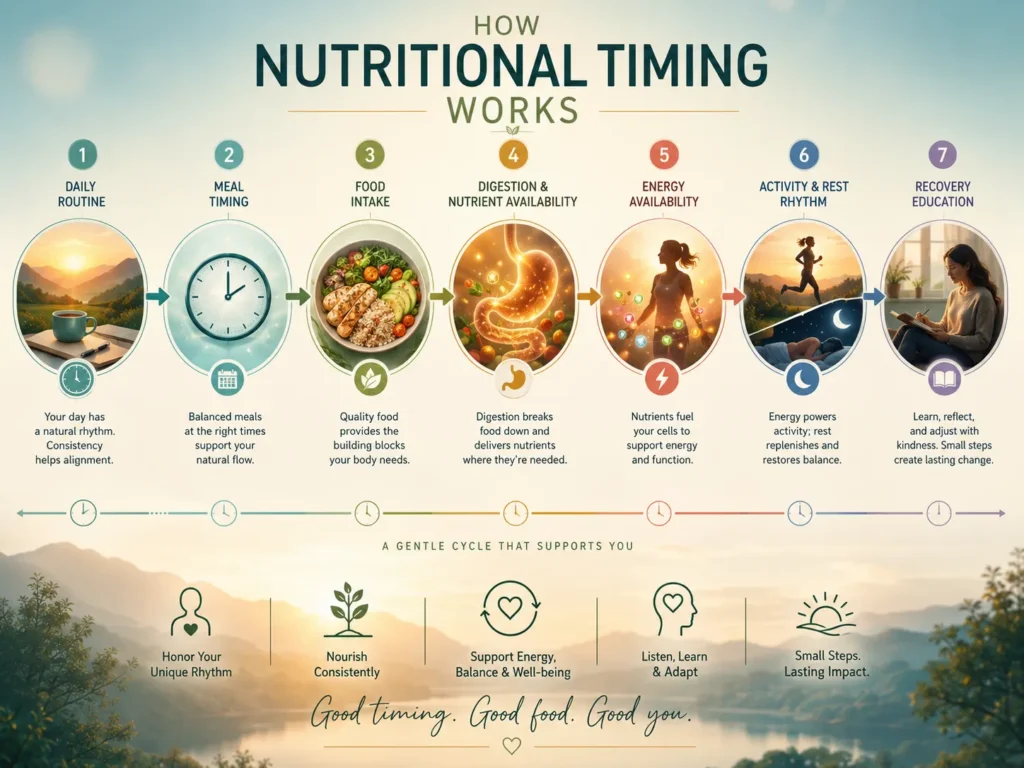
Nutritional Timing begins with food intake. However, its educational value comes from understanding when food enters the body rather than focusing only on what food contains. Throughout the day, people move through changing periods of work, activity, rest, learning, and recovery. Consequently, meals often occur within these changing conditions. Therefore, food timing may interact with appetite patterns, digestion, energy availability, and daily routines.
At the same time, Nutritional Timing should not be viewed as a direct cause-and-effect system. Sleep quality, hydration, digestion, stress response, activity levels, work schedules, and overall health may all influence how food timing fits into daily life. Because of this, meal timing works best as one educational layer within a much larger body-system framework. Rather than offering rules or guarantees, Nutritional Timing helps readers understand how food patterns may connect with broader discussions about nutrition, adaptation, and recovery education.
Key Layers of Nutritional Timing
Meal Rhythm
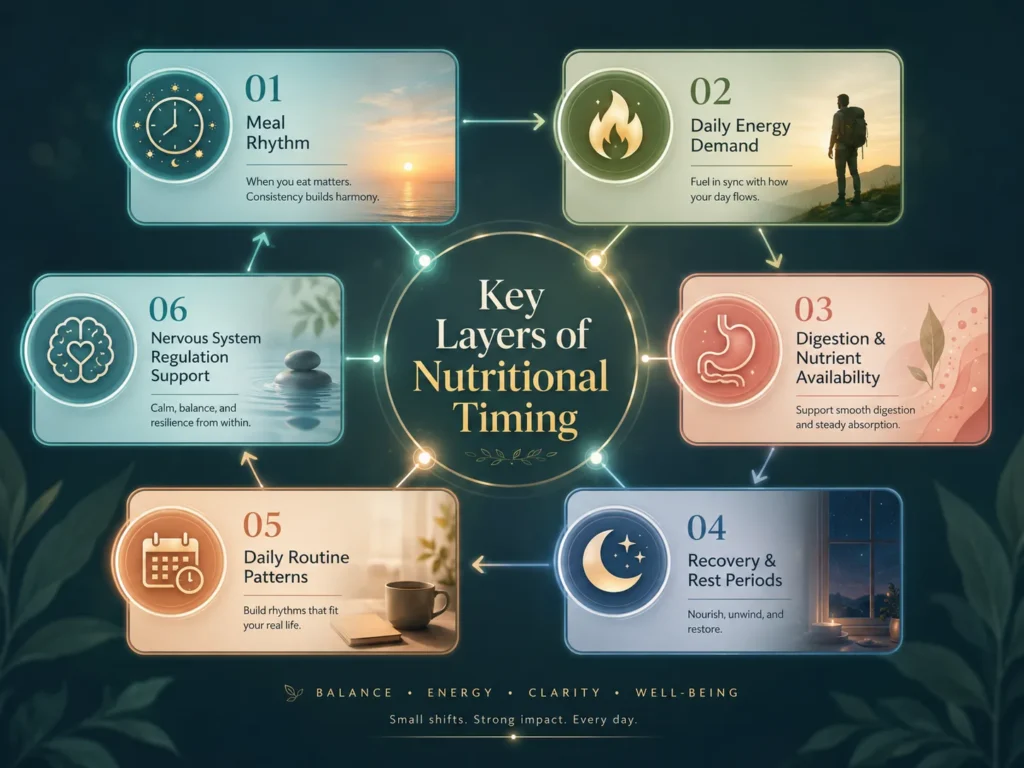
Meal rhythm refers to the overall pattern of when food is consumed throughout the day. While some people follow fairly consistent schedules, others experience frequent changes because of work demands, travel, family responsibilities, shift work, or lifestyle preferences. Therefore, meal rhythm can vary significantly from one person to another. Nevertheless, understanding meal rhythm helps readers see how food timing may fit into broader daily routines.
Daily Energy Demand
Energy demand changes throughout the day. Physical activity, mental effort, movement, work responsibilities, and learning tasks may all influence how much energy the body uses. As a result, food intake often occurs alongside changing energy requirements. Therefore, Nutritional Timing helps explain how meals fit into those shifting patterns without suggesting that timing alone determines outcomes.
Digestion and Nutrient Availability
Food timing naturally connects with digestion because nutrients must first be processed before becoming available to the body. While meal timing does not replace digestion, both processes work together. Consequently, Nutritional Timing connects closely with Gut Axis education, which explains how food becomes usable nutrition through digestion and absorption. This relationship helps readers understand why food timing and nutrient availability are often discussed together.
Recovery and Rest Periods
Throughout the day, the body moves between periods of activity and periods of rest. Consequently, food intake often occurs before, during, or after changing recovery demands. Some meals may take place around work schedules, while others occur near periods of relaxation or sleep preparation. Therefore, Nutritional Timing helps readers understand how food patterns may fit into broader recovery education without promoting one ideal schedule.
Daily Routine Patterns
Daily routines influence many aspects of life, including meal timing. Work schedules, school commitments, travel, family responsibilities, sleep habits, and personal preferences may all affect when food is consumed. Because of this, Nutritional Timing is not about creating perfect schedules. Instead, it helps readers understand how eating patterns may fit into wider lifestyle patterns and body-system education.
Nervous System Regulation Support
Food intake occurs within daily patterns that also include movement, sleep, stress response, digestion, and recovery. Therefore, Nutritional Timing may connect with broader discussions about nervous system regulation. However, nervous system function is influenced by many different factors. As a result, food timing should not be viewed as a direct explanation for symptoms or health outcomes. Instead, it represents one educational layer that helps readers understand how nutrition may fit into larger body-system discussions.
Real-Life Symptom Language Bridge
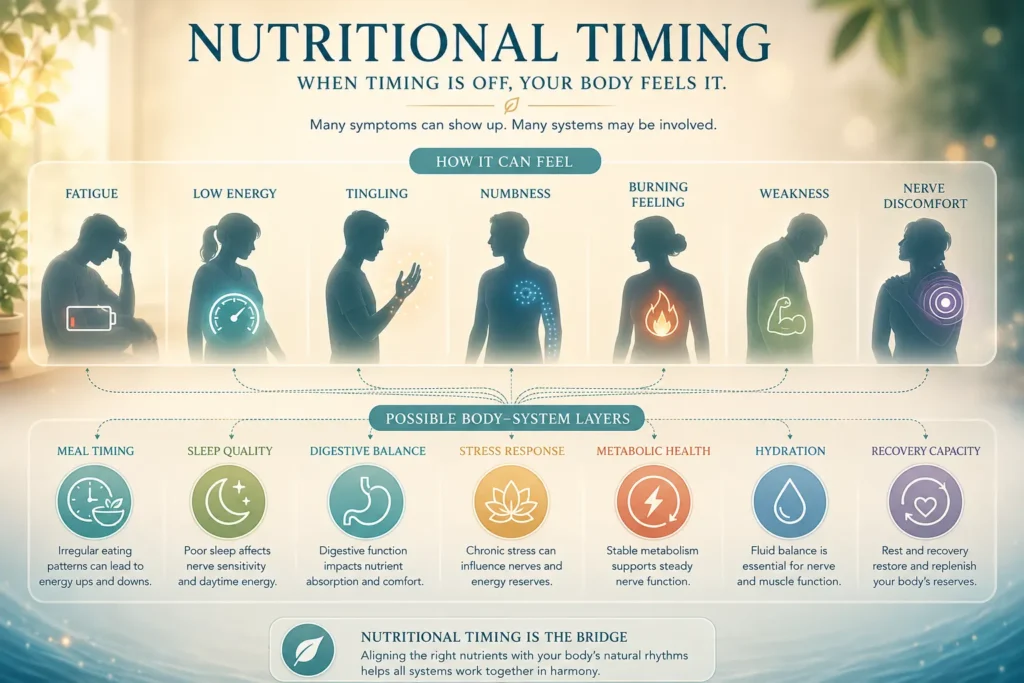
Many readers arrive at this topic because they are searching for nerve pain, tingling, numbness, burning sensations, weakness, fatigue, low energy, nervous system regulation, or recovery-related questions. In addition, some visitors are exploring topics such as autonomic response, nerve food repair, neurological regulation, or healing your neurological system because they want to understand how daily habits may fit into broader health education. As a result, they often wonder whether meal timing plays a role.
Nutritional Timing may help explain one part of that larger picture. Food intake occurs within daily patterns that also include sleep, movement, digestion, hydration, stress response, and recovery demand. Therefore, meal timing can be viewed as one educational layer within a much wider body-system framework. However, it is important to stay balanced. Nerve symptoms can have many possible causes, and those causes may differ significantly from person to person. Consequently, meal timing should never be used as a diagnosis or as the sole explanation for symptoms.
Instead, Nutritional Timing helps readers understand how food timing may fit into wider discussions about nutrition, daily routines, energy use, and nervous system education. Furthermore, this topic encourages a systems-based perspective rather than a symptom-based assumption. In other words, it helps readers explore how food timing may interact with broader lifestyle patterns without suggesting that it explains every health concern.
Nutritional Timing Interactions
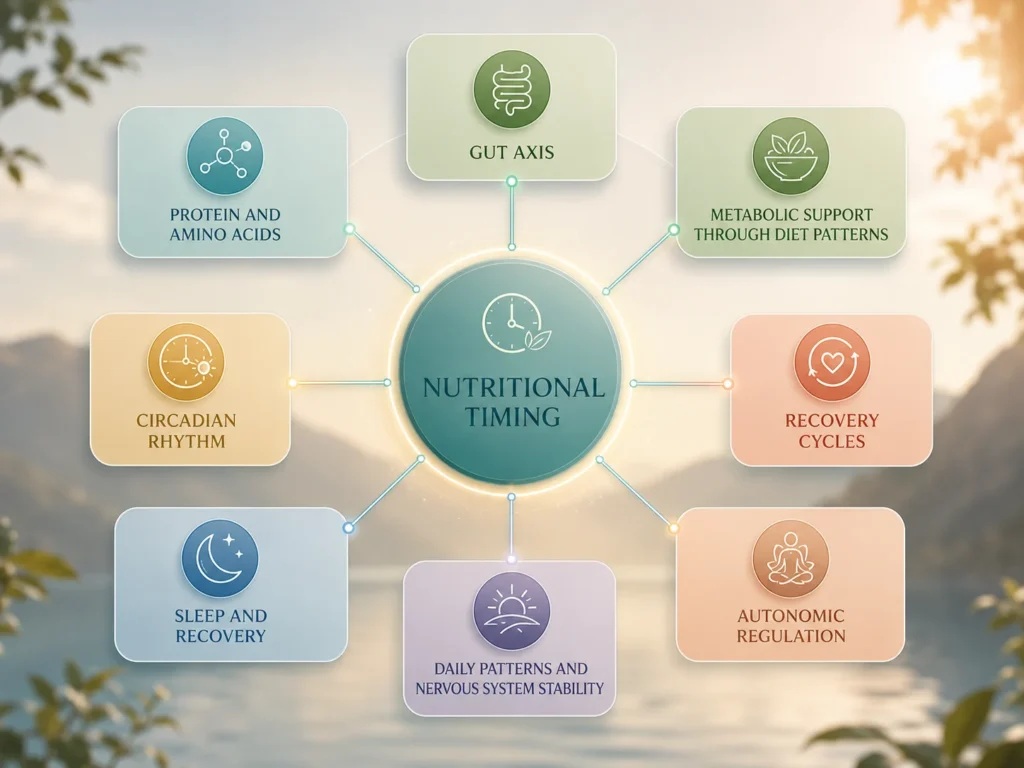
Nutritional Timing and Gut Axis
Nutritional Timing naturally connects with Gut Axis education because food timing and digestion often occur together. While the Gut Axis explains how food becomes usable nutrition through digestion and absorption, Nutritional Timing explains when food enters that process. Therefore, these topics complement one another while remaining clearly different.
Nutritional Timing and Protein and Amino Acids
Food timing also connects with Protein and Amino Acids because meal patterns influence when protein-containing foods are consumed. However, this page does not recommend protein schedules, meal plans, or nutrition protocols. Instead, it helps readers understand how timing and nutrient availability may fit into broader nutrition education.
Nutritional Timing and Metabolic Support
In addition, Nutritional Timing connects closely with Metabolic Support Through Diet Patterns because food intake often occurs alongside changing energy demands. Nevertheless, the two topics are not identical. Metabolic Support focuses on broader food-pattern education, whereas Nutritional Timing focuses specifically on when food is consumed.
Nutritional Timing and Circadian Rhythm
Daily body rhythms may influence appetite, sleep preparation, wakefulness, and activity patterns. Consequently, Nutritional Timing naturally overlaps with Circadian Rhythm education. However, Circadian Rhythm focuses on body-clock function, while Nutritional Timing focuses on food timing within those daily rhythms.
Nutritional Timing and Recovery Cycles
Finally, Nutritional Timing connects with Recovery Cycles because food intake often occurs alongside periods of activity, adaptation, and rest. Therefore, meal timing becomes one part of broader recovery education rather than the entire explanation.
Practical Daily-Life Examples
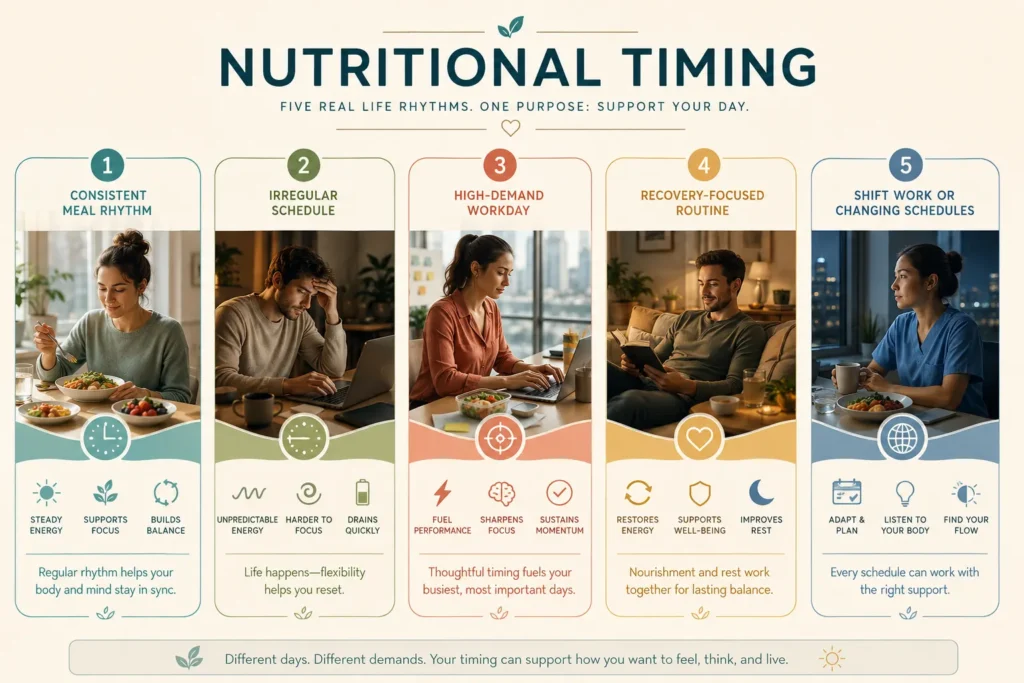
Example 1: Consistent Meal Rhythm
A person who generally eats breakfast, lunch, and dinner at similar times each day may experience a fairly predictable routine. While this does not guarantee specific health outcomes, it demonstrates how meal timing can become part of an organized daily pattern. As a result, Nutritional Timing helps readers understand how food intake may fit within broader lifestyle habits.
Example 2: Irregular Schedule
Another individual may work unpredictable hours, travel frequently, or manage changing responsibilities. Consequently, meal timing may vary considerably from one day to the next. Even so, Nutritional Timing remains relevant because it explains how food patterns can differ between people without suggesting that one approach is universally correct.
Example 3: High-Demand Days
Busy work periods, study sessions, travel days, or family commitments may cause some people to delay meals. Therefore, food timing sometimes changes because of daily demands rather than deliberate planning. This example highlights how nutrition often operates within real-life circumstances.
Example 4: Recovery-Focused Routine
Following periods of illness, stress, travel, or high workload, many people pay closer attention to daily habits. During these periods, meal timing may become one part of a broader routine that also includes sleep, hydration, movement, and recovery education.
Example 5: Shift Work and Changing Schedules
Shift workers often experience changing meal patterns because work hours can vary significantly. As a result, food timing may not follow traditional schedules. Nevertheless, Nutritional Timing still provides a useful educational framework because it helps explain how food intake fits within changing daily rhythms and recovery demands.
Nutritional Timing Visual Flow
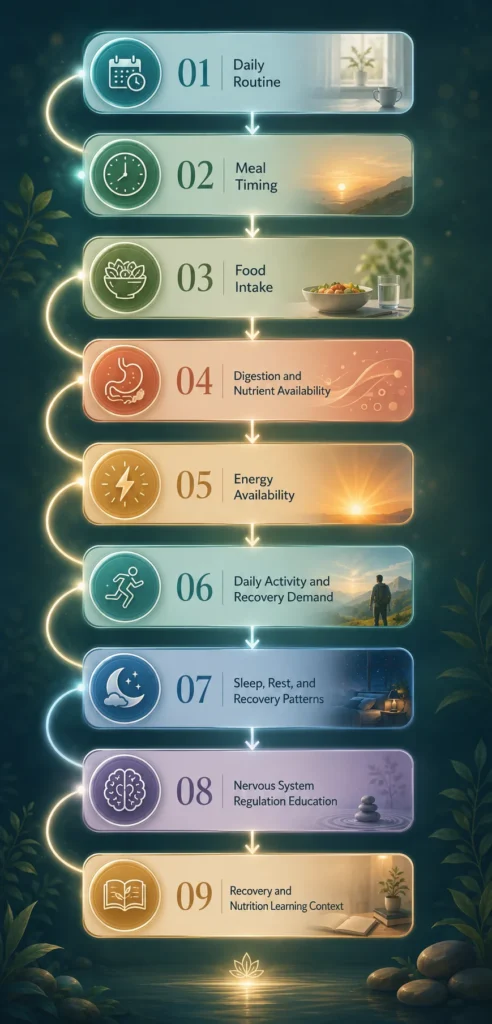
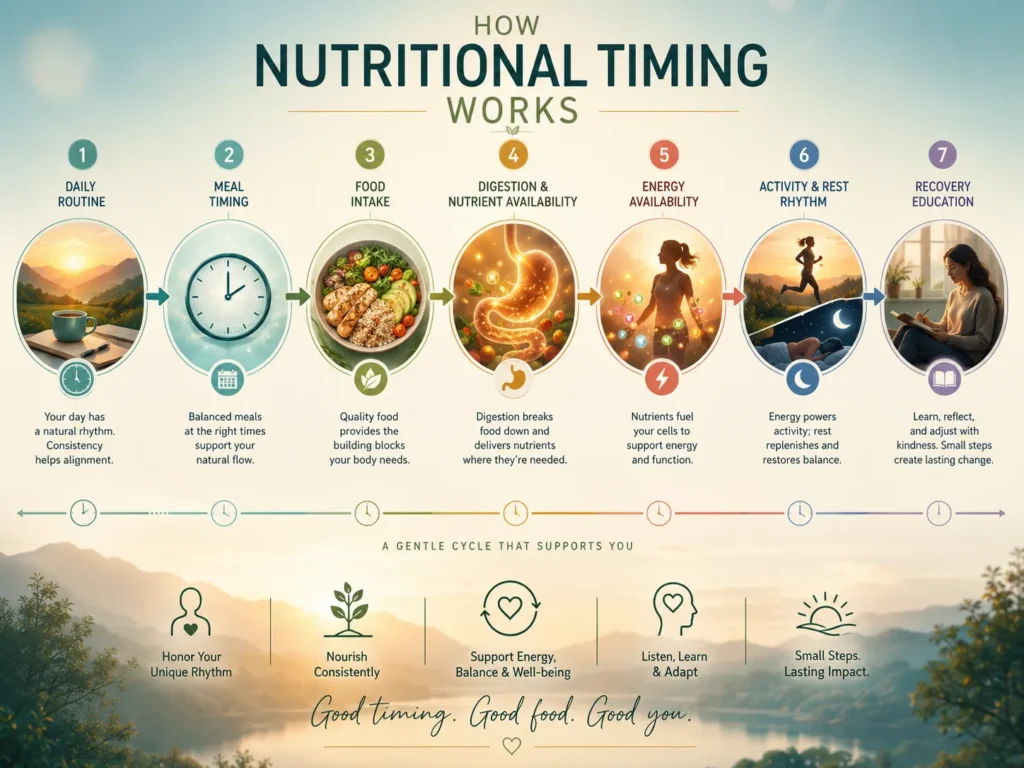
Daily Routine
↓
Meal Timing
↓
Food Intake
↓
Digestion and Nutrient Availability
↓
Energy Availability
↓
Daily Activity and Recovery Demand
↓
Sleep, Rest, and Recovery Patterns
↓
Nervous System Regulation Education
↓
Recovery and Nutrition Learning Context
This visual flow is educational rather than diagnostic. It does not suggest that meal timing directly changes symptoms, repairs nerves, or determines health outcomes. Instead, it helps readers understand how food timing may fit into broader discussions about digestion, energy use, recovery capacity, and daily body rhythms.
At the same time, the process is not completely linear. Sleep may influence appetite, while stress may affect meal timing. Likewise, work schedules may alter eating patterns, and activity levels may change daily energy demand. Therefore, Nutritional Timing is best understood as part of a connected network rather than a simple cause-and-effect pathway.
Why Nutritional Timing Matters for Recovery
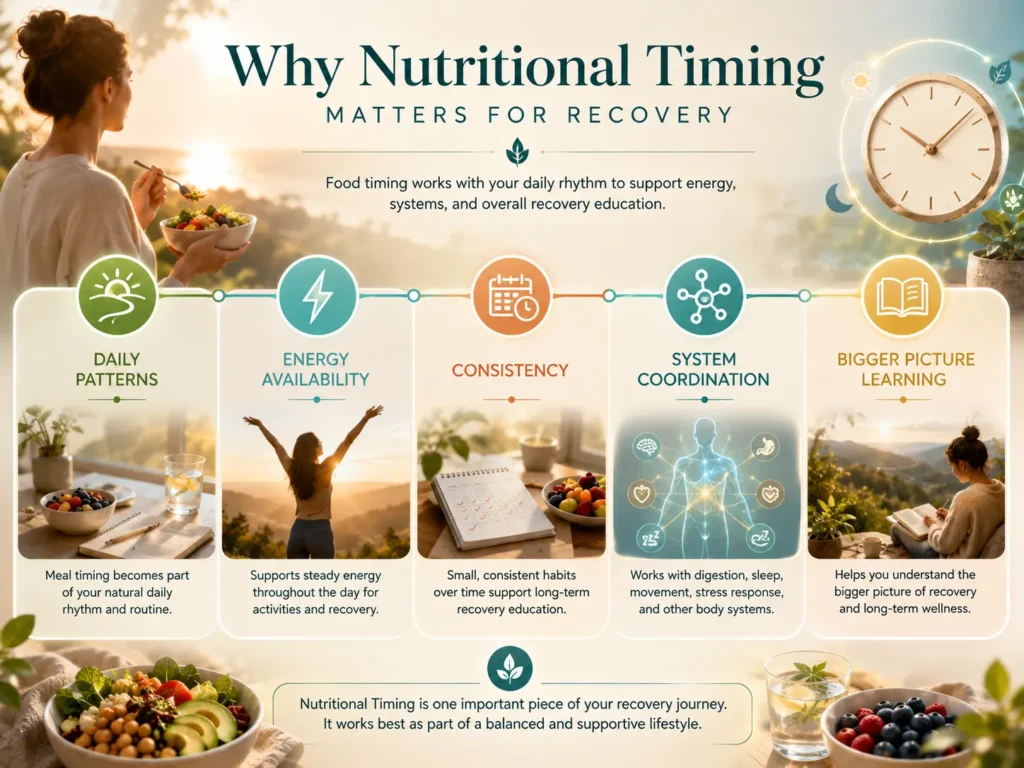
Recovery education often focuses on what people eat. However, Nutritional Timing encourages readers to consider when food is consumed as well. Food intake occurs alongside movement, work schedules, sleep preparation, stress response, recovery periods, and daily responsibilities. Therefore, meal timing can be viewed as one organizational layer within broader recovery education.
In addition, the body uses energy throughout the day for movement, learning, adaptation, maintenance, and everyday activities. Consequently, food intake often occurs alongside changing energy demands. Nutritional Timing helps readers understand how meals may fit into those patterns. Nevertheless, energy availability also depends on digestion, hydration, food quality, sleep, activity levels, and overall health.
Perhaps most importantly, recovery involves multiple interconnected systems rather than one isolated habit. Digestion, nutrient availability, metabolism, sleep, circulation, movement, and nervous system function may all interact throughout the day. Therefore, Nutritional Timing should be viewed as one educational piece of a much larger picture. Rather than offering rules or guarantees, it helps readers understand how food timing may fit into wider discussions about adaptation, daily rhythms, and recovery learning.
Common Misunderstandings About Nutritional Timing
Many nutrition discussions focus on simple rules. As a result, people sometimes assume that meal timing alone determines health outcomes. However, Nutritional Timing is only one part of a much larger picture. Digestion, food quality, nutrient availability, hydration, sleep, movement, stress response, recovery capacity, and overall health may all influence daily function. Therefore, this topic should be viewed as one educational layer rather than a complete explanation.
| Common View | Better System-Based View |
|---|---|
| There is one perfect time to eat. | Food timing may vary because daily routines and individual circumstances differ. |
| Nutritional Timing is more important than food quality. | Both food quality and meal timing contribute to broader nutrition education. |
| Missing one meal ruins recovery. | Long-term patterns are usually more important than isolated events. |
| Everyone should follow the same schedule. | Meal timing may differ because of work, family, travel, and lifestyle demands. |
| Nutritional Timing explains symptoms. | Symptoms can have many possible causes and require proper evaluation. |
| Nutritional Timing can heal the nervous system. | Nutritional Timing is an educational topic, not a treatment or cure. |
In addition, many readers search for quick solutions when exploring recovery concepts. Nevertheless, recovery education is often more complex than a single habit. Consequently, this page encourages readers to think in systems rather than shortcuts.
Related Condition Connections
Nutritional Timing is not a condition page. Instead, it helps readers understand how meal timing may fit into broader discussions about nutrition, digestion, energy use, and recovery education. Because food intake occurs within daily routines, some readers exploring nerve-related conditions may also find this topic useful.
For example, visitors reading about Peripheral Neuropathy, Diabetic Neuropathy, Nerve Compression, Sciatic Nerve Pain, or Post-Injury Nerve Damage may wish to understand how nutrition fits into wider body-system education. Therefore, Nutritional Timing provides one additional perspective that may help explain how daily food patterns interact with broader lifestyle habits.
At the same time, these conditions can involve many different factors. Consequently, meal timing should never be viewed as the sole explanation for symptoms. Instead, Nutritional Timing serves as an educational topic that helps readers understand one layer of a much larger health-learning framework.
Topic Cluster Placement
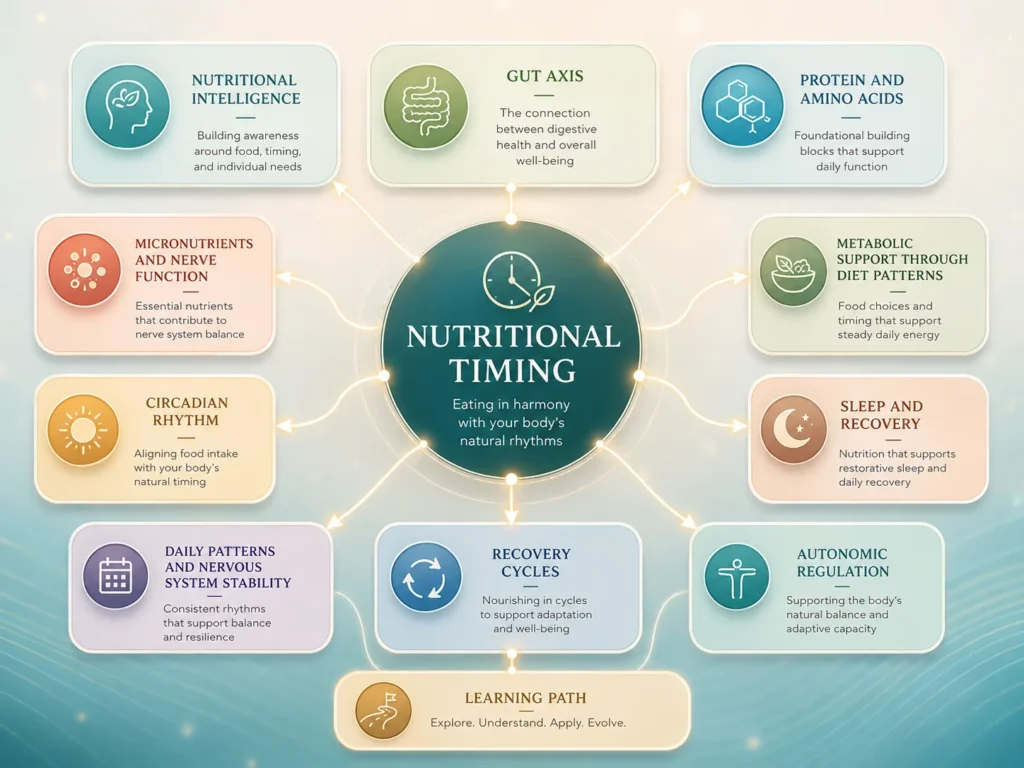
Nutritional Timing belongs within the Nutritional Intelligence cluster because it focuses on when food is consumed and how meal timing may fit into broader nutrition education. While some pages explain digestion, nutrient availability, or food quality, this topic explores how food timing interacts with daily routines, energy patterns, and recovery education.
Naturally, Nutritional Timing connects with Gut Axis, Protein and Amino Acids, Micronutrients and Nerve Function, and Metabolic Support Through Diet Patterns because all of these topics explain different parts of how nutrition functions within the body. In addition, it connects closely with Circadian Rhythm, Sleep & Recovery, Daily Patterns and Nervous System Stability, and Recovery Cycles because food timing occurs within broader daily rhythms.
Readers who want a wider understanding of nerve-health education can continue through the Learning Path, which connects symptoms, body systems, root causes, neurobiology, regeneration concepts, and recovery education into one structured learning journey.
Nutritional Timing FAQ
What is Nutritional Timing?
Nutritional Timing refers to when food is consumed throughout the day and how meal timing may fit into broader nutrition education.
Does Nutritional Timing tell people exactly when to eat?
No. This page explains food-timing concepts for educational purposes and does not provide personal meal schedules.
Is Nutritional Timing the same as Circadian Rhythm?
No. Circadian Rhythm focuses on body-clock patterns, whereas Nutritional Timing focuses on when food is consumed within daily routines.
Can Nutritional Timing explain nerve symptoms?
No. Nerve symptoms can have many possible causes. Therefore, this page is designed for education rather than diagnosis.
Does Nutritional Timing replace food quality?
No. Food quality, digestion, nutrient availability, hydration, sleep, and recovery habits all remain important.
Does this page recommend fasting plans or meal schedules?
No. This page does not recommend diets, fasting plans, protocols, or treatment strategies.
Continue Learning
Readers can continue learning through related pages that explore nutrition, digestion, energy patterns, recovery education, and nervous system topics from different perspectives. Together, these pages help build a broader understanding of how Nutritional Timing fits within the Heal Your Nerves Naturally learning system.
Start with Nutritional Intelligence to understand how food, nutrient availability, digestion, and body systems connect. Then continue with Gut Axis to learn how food becomes usable nutrition through digestion and absorption. Afterward, explore Protein and Amino Acids and Micronutrients and Nerve Function to understand how different nutrients fit into broader nutrition education.
Readers interested in energy patterns can continue with Metabolic Support Through Diet Patterns, while those exploring daily rhythms may benefit from Circadian Rhythm, Sleep & Recovery, and Daily Patterns and Nervous System Stability. Finally, follow the Learning Path to continue through symptoms, body systems, neurobiology, regeneration concepts, and recovery education.
Sources / References
This page uses trusted educational sources to explain Nutritional Timing in a simple, balanced, and user-friendly way. These references help support discussions about meal timing, digestion, nutrient availability, energy use, recovery education, and body-system interactions. However, they do not turn this page into medical advice, diagnosis, or treatment guidance.
For general nutrition education, MedlinePlus Healthy Eating Resources provide practical information about food patterns and nutrition. In addition, MedlinePlus Digestive System Resources explain how food is processed and how nutrients become available to the body.
For broader nutrition science, NCBI Bookshelf Protein and Amino Acids provides educational information about nutrient processing and nutritional biology. Furthermore, NINDS Peripheral Neuropathy Overview helps explain why nerve symptoms can have many possible causes and why nutrition should not be used as a diagnosis.
Finally, CDC Sleep and Sleep Health Resources and NHLBI Healthy Sleep Information provide educational background regarding daily rhythms, sleep, and recovery concepts.
Author / Editorial Trust Note
This page is part of the Heal Your Nerves Naturally educational platform. It was created to help readers understand Nutritional Timing, meal rhythm, food timing patterns, nutrient availability, recovery education, and nervous system learning from a systems-based perspective.
The content follows an educational approach focused on understanding body systems rather than diagnosing conditions or providing treatment recommendations. Therefore, its purpose is to encourage informed learning while promoting safe exploration of nerve-health topics.
Educational Trust Note
This page explains Nutritional Timing as part of Nutritional Intelligence and nerve-health education. It does not diagnose symptoms, replace professional care, or suggest that meal timing, food schedules, eating patterns, fasting approaches, or dietary changes can cure nerve conditions.
Because nutrition needs, work schedules, activity levels, sleep patterns, medications, medical history, and health status vary widely among individuals, educational information should always be interpreted within the context of personal healthcare guidance when needed.
Safety & Education Notice
This page is for educational purposes only.
It does not diagnose, treat, cure, or prevent disease. Furthermore, it is not a substitute for professional medical advice, diagnosis, or treatment.
Seek urgent medical care for severe, sudden, unusual, worsening, or progressive symptoms, including sudden weakness, severe numbness, loss of bladder or bowel control, severe pain, chest pain, difficulty breathing, symptoms after injury, rapidly changing neurological symptoms, unexplained weight loss, persistent vomiting, loss of consciousness, or other serious health concerns.
Because nutrition, digestion, metabolism, recovery patterns, and nerve symptoms may involve many possible causes, readers should not use this information to self-diagnose, stop medication, begin supplements, follow restrictive diets, start fasting protocols, or delay professional care.
The purpose of this page is to support learning, improve understanding, and encourage safe exploration of nerve-health education topics.