
Vascular Regeneration: Essential Guide to Circulation Support
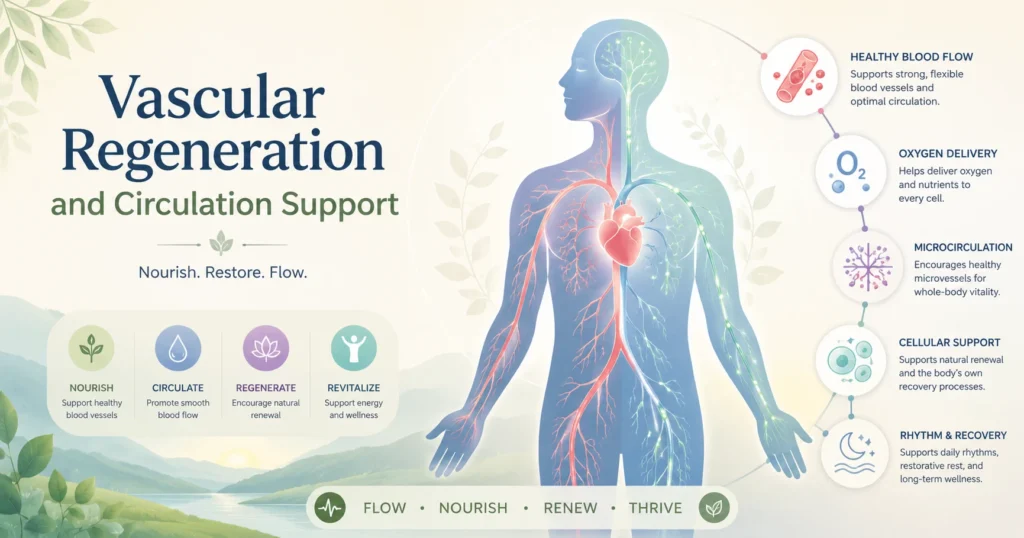
Vascular Regeneration is the body’s process of maintaining, repairing, and adapting the blood vessel network that helps deliver oxygen, nutrients, immune signals, and repair-related resources. From a nerve health education view, this topic matters because nerves depend on steady delivery and cleanup.
A nerve does not work alone. It sits inside a living environment that needs blood flow, oxygen, cellular energy, immune coordination, and waste removal. When circulation is limited or poorly timed, the area around nerve tissue may have more difficulty staying steady.
However, Vascular Regeneration should not be understood as a cure, treatment, or guaranteed repair process. It is a system-level concept. It helps explain how the vascular network may shape the environment around nerve signaling, sensitivity, cellular repair, and recovery rhythm.
For example, vascular health may connect with Cellular Repair, Growth Signals, Immune Repair, Recovery Cycles, Neuroinflammation, and Autonomic Regulation.
This page is educational only. It does not diagnose, treat, cure, or prevent any condition. Instead, it explains how circulation, oxygen delivery, vascular signaling, and daily patterns may relate to nervous system recovery education.
Quick Navigation
What Is Vascular Regeneration?
Vascular Regeneration refers to the body’s ability to maintain and adapt the blood vessel network. This network includes larger blood vessels and tiny microvessels that help deliver oxygen, nutrients, immune cells, and repair signals.
In simple terms, vascular regeneration is about circulation quality and vessel support. It includes blood flow, oxygen delivery, vessel lining health, microcirculation, cleanup, and communication between blood vessels and nearby tissues.
This matters for nerve health because nerves need a steady supply of oxygen and nutrients. They also need waste products to be cleared away. Without a good delivery and cleanup environment, nerve-related tissues may face more demand.
Still, circulation is only one part of the picture. Symptoms such as tingling, burning, numbness, pain, fatigue, or sensitivity can have many possible causes. These may include nerve compression, inflammation, blood sugar problems, immune changes, injury, medication effects, or other medical conditions.
Therefore, Vascular Regeneration should be understood as one connected process within a larger nerve health environment. It connects with Neural Signaling, Pain Processing, Cellular Repair, and Regeneration Systems.
Why this matters:
This matters because many people think nerve recovery is only about the nerve itself. A wider view shows that blood flow, oxygen delivery, energy use, immune cleanup, and daily rhythm can all shape the environment around nerve signals.
How Vascular Regeneration Works
Vascular Regeneration works through delivery, cleanup, vessel adaptation, and communication. First, tissues need blood flow to bring oxygen and nutrients. Next, the vascular network helps remove waste products. After that, blood vessels may adapt to repeated demand over time.
For example, tissues that receive regular, appropriate movement may need better circulation. Meanwhile, areas under high strain, poor posture, inflammation, or low movement may receive different signals.
The vascular network also communicates with the nervous system. Blood vessels can widen or narrow based on body state, temperature, stress, movement, and autonomic activity. Because of this, circulation is not only mechanical. It is also responsive.
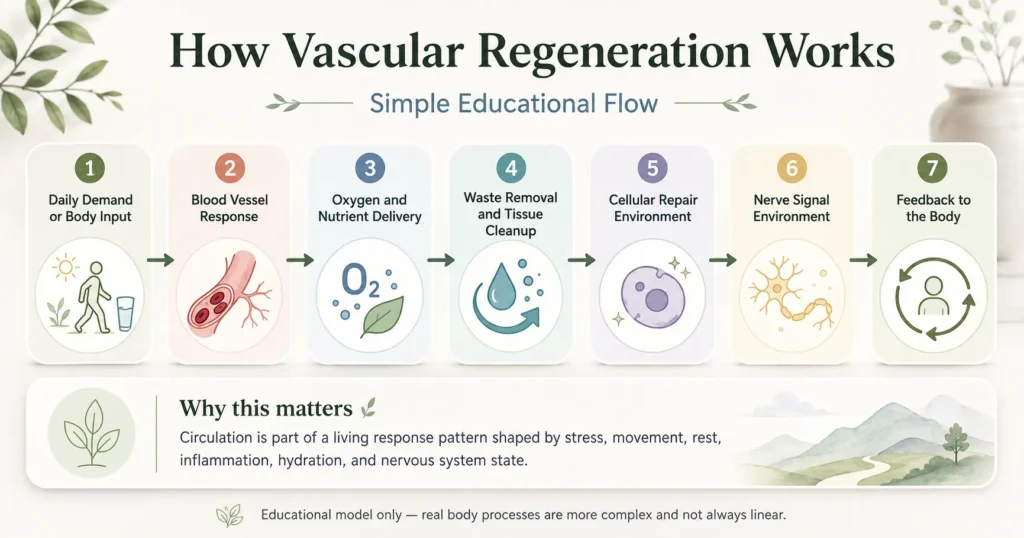
A helpful way to picture this is through a simple educational model:
Simple Vascular Regeneration Diagram
Daily Demand or Body Input
↓
Blood Vessel Response
↓
Oxygen and Nutrient Delivery
↓
Waste Removal and Tissue Cleanup
↓
Cellular Repair Environment
↓
Nerve Signal Environment
↓
Feedback to the Body
This diagram is only a learning model. Real body processes are more complex and are not always linear. It should not be used to diagnose symptoms or guide medical treatment.
Why this matters:
This matters because circulation is not just “blood moving.” It is part of a living response pattern. Blood flow may change with stress, movement, rest, inflammation, hydration, and nervous system state.
Key Layers of Vascular Regeneration
Vascular Regeneration includes several connected layers. Each layer helps shape the delivery and cleanup environment around tissues and nerves.
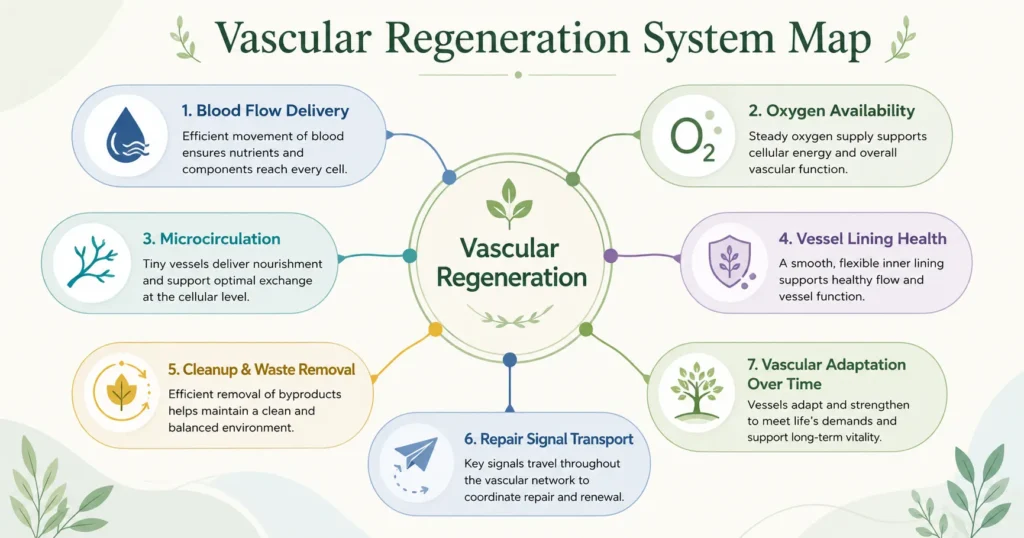
1. Blood Flow Delivery
Blood flow delivery is the basic movement of blood through vessels. It brings oxygen, nutrients, immune signals, hormones, and repair-related materials to tissues.
For nerves, delivery matters because nerve cells and support cells use energy constantly. Even small changes in the local environment can affect how signals are processed or felt.
However, blood flow is not only about volume. Timing, vessel tone, microcirculation, and tissue demand also matter.
Because of this, blood flow delivery is one foundation of vascular regeneration.
2. Oxygen Availability
Oxygen helps cells make energy. Nerve-related tissues, immune cells, and repair cells all need energy to function.
When oxygen delivery is less efficient, cells may have a harder time maintaining normal activity. As a result, the surrounding tissue environment may feel more strained.
This does not mean oxygen alone explains symptoms. Instead, oxygen availability is one part of the larger repair environment.
For this reason, vascular regeneration and cellular energy are closely connected.
3. Microcirculation
Microcirculation refers to very small blood vessels that reach local tissues. These tiny vessels are important because they bring resources close to cells.
In daily life, microcirculation may be shaped by movement, temperature, hydration, metabolic health, inflammation, and autonomic tone.
When microcirculation is less flexible, tissues may have a harder time receiving what they need at the right time.
Therefore, microcirculation is an important layer of Vascular Regeneration, especially from a nerve health education view.
4. Vessel Lining Health
The inner lining of blood vessels helps control vessel tone, blood flow, immune signaling, and tissue communication.
This lining is not just a passive tube. It helps decide when vessels widen, when they tighten, and how they interact with immune and repair signals.
However, vessel lining health can be affected by many patterns, including inflammation, blood sugar rhythm, oxidative load, stress, smoking, poor sleep, and low movement.
Because of this, vessel lining health belongs inside the larger vascular regeneration picture.
5. Cleanup and Waste Removal
Circulation does not only deliver helpful materials. It also helps remove waste products and byproducts from tissue activity.
For example, after movement or stress, tissues may need help clearing metabolic waste. When cleanup is slower, the local tissue environment may feel more loaded.
This cleanup process also connects with immune activity and inflammation resolution.
Therefore, vascular regeneration includes both delivery and removal.
6. Repair Signal Transport
Repair signals need pathways. Blood flow helps move immune cells, signaling molecules, nutrients, and other materials through the body.
This connects strongly with Growth Signals and Immune Repair. Signals may be present, but they still need a healthy environment to be useful.
However, transport alone is not enough. Cells also need energy, timing, and body-state steadiness.
Because of this, repair signal transport is one layer, not the whole answer.
7. Vascular Adaptation Over Time
Blood vessels can adapt to repeated patterns. For example, regular movement may create different vascular signals than long periods of stillness.
At the same time, too much strain or too little recovery may add load to the vascular network.
Over time, vascular adaptation depends on the pattern. The body often responds best to realistic demand followed by enough rest.
For this reason, Vascular Regeneration connects with pacing, Recovery Cycles, and long-term consistency.
System Interactions
Vascular Regeneration interacts with many body processes. It is not separate from nerve signaling, inflammation, metabolism, immune activity, or autonomic control.
Nervous System Interaction
The nervous system helps control vessel tone. It can change blood flow based on stress, temperature, movement, pain, posture, and body state.
For example, when the body is under high pressure, blood flow patterns may shift toward protection. In calmer states, circulation may become more flexible.
This does not mean stress is the only cause of circulation problems. Instead, it shows how body-state control and vascular rhythm can interact.
Neural Signaling Interaction
Neural Signaling explains how nerves send and receive messages. Vascular Regeneration may shape the environment around those messages by affecting oxygen, nutrients, and tissue cleanup.
If the local tissue environment is strained, nerve signals may feel more sensitive or less steady.
However, vascular patterns do not directly explain every nerve symptom. They are one part of a larger signal environment.
Pain Processing Interaction
Pain Processing involves how the nervous system filters and interprets danger-related information.
Circulation may shape this process indirectly. For example, poor sleep, inflammation, low movement, and vascular strain may all add demand to the body.
As a result, the nervous system may become more alert. Still, pain should not be used as a direct measure of vascular regeneration.
Neuroinflammation Interaction
Neuroinflammation and vascular activity often interact. Blood vessels help immune cells move, and immune signals can affect vessel tone.
For example, inflammation may change the local environment around nerves. At the same time, circulation helps deliver cleanup and resolution signals.
Because of this, vascular regeneration and inflammation resolution are closely related.
Autonomic Regulation Interaction
Autonomic Regulation affects heart rate, breathing, digestion, blood vessel tone, temperature control, and recovery state.
This makes it highly relevant to Vascular Regeneration. When autonomic tone is strained, circulation may become less flexible.
For this reason, breathing rhythm, rest, sleep, and stress state may all shape vascular patterns.
Cellular Repair Interaction
Cellular Repair depends on delivery and cleanup. Cells need oxygen, nutrients, and waste removal to maintain function.
Vascular Regeneration contributes to this environment by helping resources reach cells.
At the same time, cells must be able to use those resources. So vascular support and cellular repair work together.
Growth Signals Interaction
Growth Signals help explain repair communication. Vascular pathways help carry some of these messages and resources.
However, growth signals do not guarantee repair. The body also needs energy, circulation, immune coordination, and recovery rhythm.
Because of this, Growth Signals and Vascular Regeneration are connected but not identical.
Recovery Cycles Interaction
Recovery Cycles explain how the body moves between effort, rest, repair, and adaptation.
Vascular Regeneration also works in rhythms. Blood flow changes with activity, rest, sleep, breathing, posture, and stress.
Therefore, recovery timing can shape how vascular support is used over time.
Patterns That Influence Vascular Regeneration
Daily patterns may shape Vascular Regeneration by affecting blood flow, vessel tone, oxygen delivery, cleanup, and body-state control.
Sleep Rhythm
Sleep gives the body time to organize cleanup, repair signals, immune rhythm, and nervous system settling.
When sleep is poor, vascular rhythm may become less steady. The body may also stay more alert the next day.
Over time, poor sleep may add demand to circulation, energy use, and nervous system sensitivity.
Movement Patterns
Movement helps circulation. It can improve blood flow, tissue mobility, oxygen delivery, and sensory feedback.
However, movement should match capacity. Too much intensity may add strain, while too little movement may reduce useful circulation.
A helpful pattern is gentle movement followed by rest. This allows the body to receive input and then recover.
Breathing Rhythm
Breathing rhythm can affect autonomic tone, oxygen-carbon dioxide balance, heart rhythm, and blood flow patterns.
For example, fast shallow breathing may reflect a higher alert state. Slower comfortable breathing may help the body settle.
This does not mean breathing is a treatment. It simply shows how body rhythm and vascular response can interact.
Hydration
Hydration affects blood volume, circulation, temperature control, and tissue fluid movement.
When hydration is low, the body may work harder to maintain normal circulation. This may add load to the vascular network.
However, hydration needs vary from person to person. People with medical conditions should follow professional guidance.
Nutrition Quality
Nutrition provides building blocks for cells, blood vessels, and energy production.
For example, protein, healthy fats, vitamins, minerals, fiber, and steady energy all play roles in general tissue health.
Still, nutrition is not a cure or a single repair solution. It is one part of the larger vascular and nerve health environment.
Inflammatory Load
Inflammation can affect blood vessel tone, tissue signaling, and local sensitivity.
Short-term inflammation may help the body respond. However, if inflammatory signals remain high, the vascular environment may become more strained.
Because of this, inflammation resolution is an important partner of Vascular Regeneration.
Emotional Safety and Stress Load
Emotional pressure, worry, fear, or chronic demand can change body-state control. This may affect breathing, muscle tension, digestion, blood flow, and sleep.
In daily life, this may show up as cold hands or feet, tension, fatigue, or stronger sensitivity during stressful periods.
This does not mean symptoms are “only stress.” It means the vascular and nervous systems respond to body-state changes.
Vascular Regeneration and Nerve Function
Vascular Regeneration may relate to nerve function because nerves need oxygen, nutrients, steady energy, and regular cleanup. In daily life, the vascular network helps create the body environment where nerve signals can be processed more clearly.
For example, blood flow may shape how well tissues receive oxygen and nutrients. At the same time, microcirculation may affect local delivery in smaller tissue areas. In addition, inflammation may change vessel tone and immune activity, while autonomic state may affect circulation patterns during stress, rest, movement, or sleep.
As a result, vascular patterns may interact with sensations such as tingling, burning, numbness, pain, fatigue, or body-wide sensitivity. However, this does not mean Vascular Regeneration directly causes these symptoms. Instead, it means circulation may be one part of the larger nerve signal environment.
Symptoms can have many possible causes. For example, they may relate to nerve compression, diabetes-related changes, vitamin deficiency, autoimmune activity, injury, infection, medication effects, circulation problems, or other medical conditions.
Therefore, this section should be used only for education. It should not be used for self-diagnosis. A safer way to understand this topic is that circulation and vascular patterns may help shape the environment around nerve signaling, but they do not explain every symptom by themselves.
Because of this, readers should seek medical guidance for persistent, unusual, severe, sudden, or worsening symptoms. Personal symptoms need personal medical evaluation, especially when they change quickly or affect daily function.
Practical Examples of Vascular Regeneration in Daily Life
Example 1: Movement and Local Blood Flow
A person who sits for long periods may notice stiffness or heaviness. From an educational view, long stillness may reduce local circulation and tissue input.
Gentle movement may change blood flow and sensory feedback. However, it should not be forced, especially if symptoms worsen.
This example does not diagnose the cause of symptoms. It only shows how activity-rest rhythm may shape the vascular environment.
Example 2: Poor Sleep and Circulation Demand
After poor sleep, the body may feel more reactive. Energy may feel lower, and sensitivity may feel stronger.
One reason is that sleep affects nervous system state, immune rhythm, and vascular control. When sleep is disrupted, the body may have less time to settle.
This does not mean sleep alone solves nerve concerns. Instead, it shows how sleep rhythm may affect the larger repair environment.
Example 3: Stress and Cold Hands or Feet
During stress, the body may shift blood flow patterns. Some people notice colder hands or feet, tighter muscles, or shallow breathing during high-demand periods.
This does not prove a serious vascular problem. It simply shows how body-state control can change circulation patterns.
Still, persistent or severe circulation symptoms should be discussed with a qualified healthcare professional.
Example 4: Hydration and Tissue Comfort
Hydration may affect circulation, tissue fluid movement, and overall body comfort.
When hydration is low, the body may need to work harder to maintain normal function. Some people may feel more fatigued or tense.
However, hydration needs are personal. People with kidney, heart, blood pressure, or medical concerns should follow professional guidance.
Vascular Regeneration Visual Flow
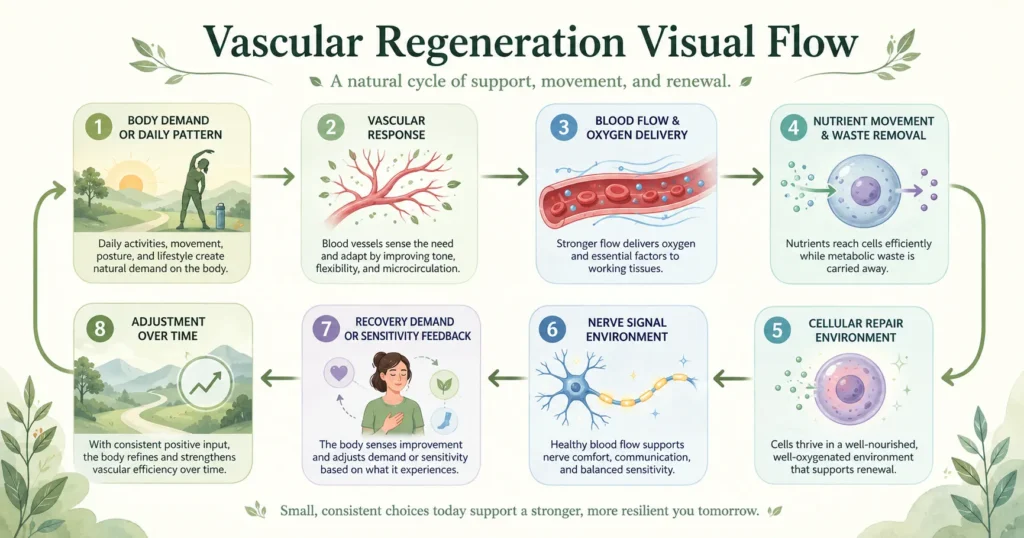
Body Demand or Daily Pattern
↓
Vascular Response
↓
Blood Flow and Oxygen Delivery
↓
Nutrient Movement and Waste Removal
↓
Cellular Repair Environment
↓
Nerve Signal Environment
↓
Recovery Demand or Sensitivity Feedback
↓
Adjustment Over Time
This flow is a simple educational model. It helps show how Vascular Regeneration may fit into a wider nerve health environment.
However, real body processes are not always linear. Blood flow, inflammation, immune response, stress state, and cellular energy may all interact at the same time.
Therefore, this flow is not a diagnosis. It is only a learning tool.
Why Vascular Regeneration Matters for Recovery
1. Recovery Requires Delivery
Repair-related processes need oxygen, nutrients, immune signals, and cellular resources.
Vascular Regeneration matters because blood vessels help move these materials to tissues.
Without delivery, repair communication may be less useful.
2. Recovery Requires Cleanup
The body also needs to remove waste products and byproducts of activity.
Circulation helps clear materials that tissues no longer need. In this way, vascular flow supports both input and cleanup.
This matters because tissue environments can become strained when cleanup is slow.
3. Recovery Requires Flexible Vessel Response
Blood vessels are not fixed pipes. They respond to activity, stress, temperature, breathing, sleep, and nervous system state.
A flexible vascular response may help tissues receive resources when demand changes.
However, this flexibility depends on many body patterns.
4. Recovery Requires Energy Availability
Cells use oxygen and nutrients to make energy. Nerve-related tissues need energy to maintain signals and respond to demand.
Vascular Regeneration contributes to the energy environment by supporting delivery.
Still, energy also depends on sleep, nutrition, mitochondria, inflammation, and stress load.
5. Recovery Requires Whole-Body Coordination
Circulation works with the immune system, nervous system, metabolism, and repair signals.
Because of this, Vascular Regeneration should not be isolated from the rest of the body.
A whole-body view is safer and more realistic.
Common Misunderstandings About Vascular Regeneration
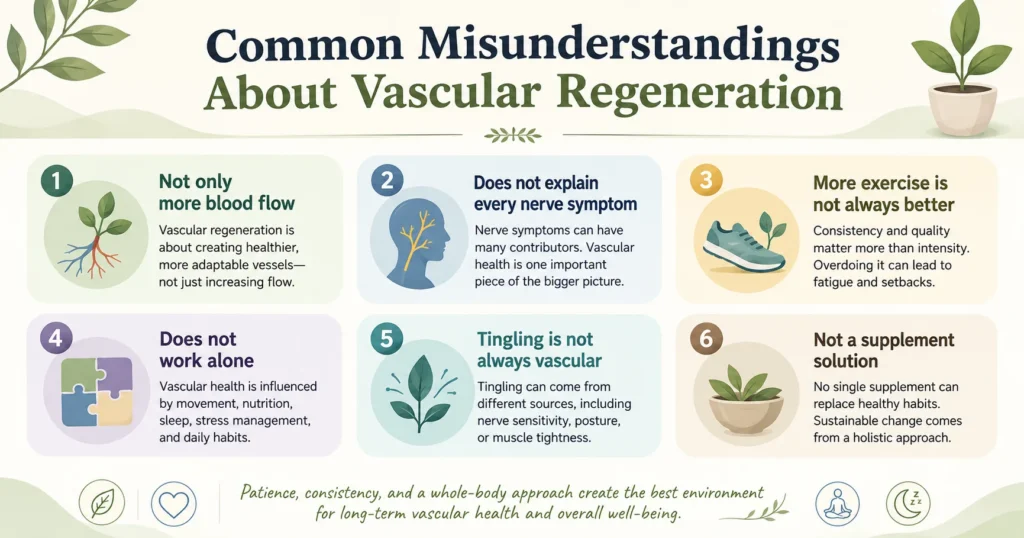
Misunderstanding 1: Vascular Regeneration Only Means More Blood Flow
Clarification:
More blood flow is not always the whole answer. Timing, vessel tone, microcirculation, oxygen use, cleanup, and tissue demand also matter.
A better view is to think about circulation quality, not just quantity.
Misunderstanding 2: Poor Circulation Explains Every Nerve Symptom
Clarification:
Nerve symptoms can have many causes. Circulation may be one layer, but it should not be assumed to explain everything.
Symptoms should not be self-diagnosed, especially if they are severe, sudden, or worsening.
Misunderstanding 3: Exercise Always Improves Vascular Support
Clarification:
Movement can shape circulation, but dose matters. Too much intensity may increase strain, especially when the body is already overloaded.
Gentle, appropriate movement may be useful as part of a wider rhythm. However, intense activity should not be forced.
Misunderstanding 4: Vascular Regeneration Works Alone
Clarification:
Vascular Regeneration works with cellular repair, immune repair, growth signals, inflammation resolution, recovery cycles, and nervous system state.
It is one part of a larger connected network.
Misunderstanding 5: Coldness or Tingling Always Means a Vascular Problem
Clarification:
Coldness, tingling, numbness, or burning can relate to many factors. These may include nerve irritation, circulation changes, stress state, compression, metabolic issues, or other medical causes.
Professional guidance is important for persistent, unusual, or worsening symptoms.
Misunderstanding 6: Supplements Are the Main Solution
Clarification:
This page does not recommend supplements, dosages, or protocols.
Vascular Regeneration is explained as an educational body process. It should not be reduced to a product or quick fix.
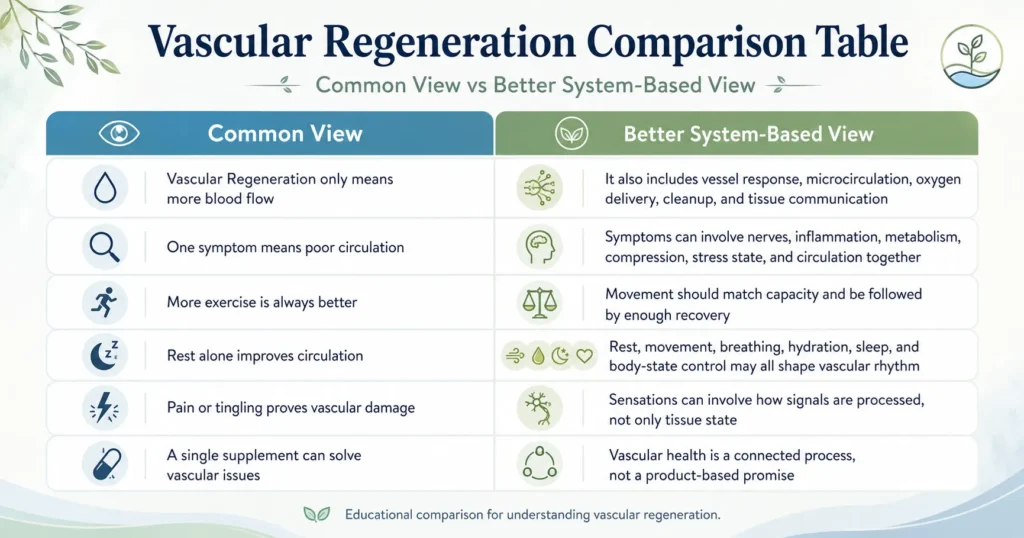
Comparison Table
| Common View | Better System-Based View |
|---|---|
| Vascular Regeneration only means more blood flow | It also includes vessel response, microcirculation, oxygen delivery, cleanup, and tissue communication |
| One symptom means poor circulation | Symptoms can involve nerves, inflammation, metabolism, compression, stress state, and circulation together |
| More exercise is always better | Movement should match capacity and be followed by enough recovery |
| Rest alone improves circulation | Rest, movement, breathing, hydration, sleep, and body-state control may all shape vascular rhythm |
| Pain or tingling proves vascular damage | Sensations can involve how signals are processed, not only tissue state |
| A single supplement can solve vascular issues | Vascular health is a connected process, not a product-based promise |
FAQs About Vascular Regeneration
Is Vascular Regeneration a treatment?
No. This page is educational only. It does not diagnose, treat, cure, or prevent disease.
Vascular Regeneration is explained here as a body process that may help readers understand circulation, oxygen delivery, and nerve health education.
Why does Vascular Regeneration matter for nerve health education?
It matters because nerves need oxygen, nutrients, energy, and waste removal.
A vascular view helps readers understand how circulation may shape the environment around nerve signals, sensitivity, and recovery demand.
Can daily patterns affect Vascular Regeneration?
Daily patterns such as movement, sleep, hydration, breathing, nutrition, and rest rhythm may shape the body environment.
However, these patterns should not be treated as medical advice or a replacement for professional care.
Can Vascular Regeneration explain tingling or numbness?
It may help explain one possible layer of how signals are processed or felt. However, tingling, numbness, burning, weakness, or pain can have many causes.
Do not use this page to self-diagnose symptoms.
Is poor circulation always visible?
Not always. Some circulation issues may be subtle, while others may have clear signs.
Persistent coldness, color changes, swelling, severe pain, wounds that do not heal, or sudden symptoms should be discussed with a healthcare professional.
When should someone seek medical help?
Seek urgent medical care for sudden weakness, chest pain, difficulty breathing, severe numbness, severe pain, loss of coordination, sudden vision changes, confusion, fainting, or rapidly changing neurological symptoms.
Continue Learning
To understand Vascular Regeneration more clearly, it may help to explore related pages.
Start with Cellular Repair because vascular delivery helps cells receive oxygen and nutrients.
Then read Growth Signals to understand how repair communication may interact with blood flow and tissue response.
You may also explore Immune Repair because immune cleanup and vessel activity often work together.
For nervous system context, visit Neural Signaling and Pain Processing. These pages explain how signals may be sent, filtered, and felt.
To understand body-state control, continue with Autonomic Regulation. This page connects strongly with circulation, stress response, breathing, and recovery rhythm.
For the broader category, visit Regeneration Systems.
For general educational background on the vascular system, readers may explore the NCBI Bookshelf.
Related Systems
Cellular Repair
Cellular Repair explains how cells maintain energy, clear waste, and respond to stress.
This connects with Vascular Regeneration because cells depend on blood flow for oxygen, nutrients, and waste removal. At the same time, cells must be able to use those resources well.
Growth Signals
Growth Signals explain repair communication.
Vascular Regeneration connects with Growth Signals because blood flow may help transport repair-related messages and resources. However, signals still need timing, energy, and a healthy tissue environment.
Immune Repair
Immune Repair involves immune sensing, cleanup, response, and resolution.
This connects with Vascular Regeneration because immune cells travel through blood vessels. Also, inflammation and vessel tone can affect each other.
Recovery Cycles
Recovery Cycles explain how the body moves between effort, rest, repair, and adaptation.
Vascular Regeneration also follows rhythm. Blood flow changes with activity, rest, sleep, breathing, and stress load.
Autonomic Regulation
Autonomic Regulation affects blood vessel tone, heart rhythm, breathing, digestion, and recovery state.
Because of this, autonomic state can shape vascular patterns. In daily life, this may affect circulation during stress, rest, movement, or sleep.
Neuroinflammation
Neuroinflammation explains immune-related activity around the nervous system.
This connects with Vascular Regeneration because blood vessels help immune signals reach tissue. At the same time, inflammatory activity can change the local vascular environment.
Safety and Education Notice
This page is for educational purposes only. It does not diagnose, treat, cure, or prevent disease. Also, it is not a substitute for professional medical advice, diagnosis, or treatment.
Because nervous system, vascular, and body-related symptoms can have many possible causes, readers should use this page only as a learning guide. Therefore, it should not be used to self-diagnose, stop medication, begin supplements, follow detox protocols, attempt self-treatment, force intense exercises, or delay professional care.
Seek urgent medical care for severe, sudden, unusual, or worsening symptoms. For example, these may include sudden weakness, loss of bladder or bowel control, chest pain, difficulty breathing, severe numbness, severe pain, loss of coordination, sudden vision changes, confusion, fainting, irregular heartbeat, sudden color change in a limb, severe swelling, or rapidly changing neurological symptoms.
In simple terms, this information is meant to help readers understand the topic more clearly. However, personal symptoms need personal medical guidance, especially when symptoms are new, severe, changing quickly, or affecting daily function.