
Neural Signaling
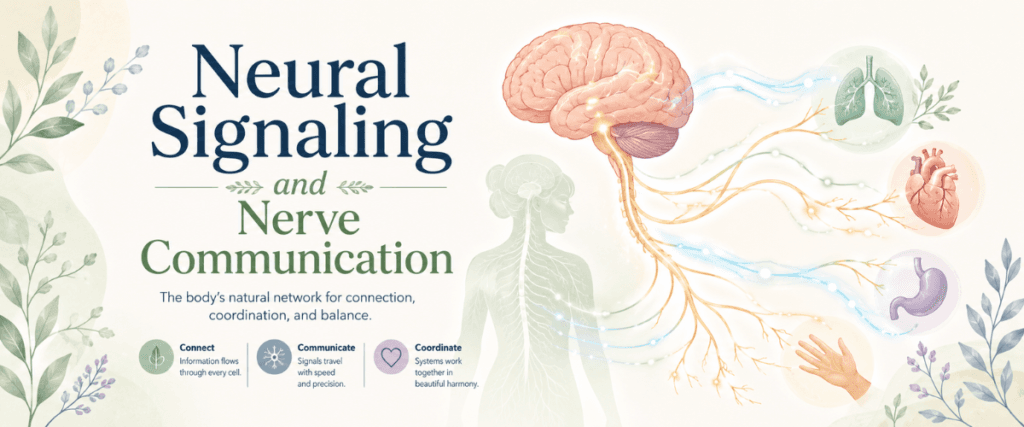
Neural signaling is the way nerves communicate. It helps the body send, receive, filter, and respond to information. Because of this, it plays an important role in sensation, movement, pain awareness, and nervous system balance.
In simple terms, neural signaling is the body’s message system. It allows the brain, spinal cord, and nerves to stay connected. As a result, the body can notice touch, pressure, heat, cold, movement, and internal changes.
However, neural signaling is not only about one nerve or one symptom. It works with many body systems. For example, stress, sleep, circulation, inflammation, metabolism, and recovery capacity may all influence how signals are processed.
For this reason, neural signaling can help explain why nerve-related symptoms may change. Pain, tingling, burning, numbness, fatigue, or sensitivity may feel stronger when the nervous system is under more load. This does not mean the symptoms are imaginary. Instead, it means the nervous system is active and responsive.
From an educational view, neural signaling helps us understand nerve communication as a whole-body process. It does not diagnose or treat any condition. Rather, it gives a calm way to understand how the nervous system may respond, adapt, and protect.
Quick Navigation
What Is Neural Signaling?
Neural signaling means nerve communication. Nerve cells send messages through electrical and chemical signals. These messages help the body sense, move, respond, and stay aware of change.
For example, when you touch something warm, sensory nerves send information toward the spinal cord and brain. Then the nervous system helps decide what the signal means. As a result, the body can respond in a useful way.
This system is always working. It does not only turn on when pain appears. Instead, it helps track pressure, movement, balance, temperature, stretch, and internal body state.
In simple terms, neural signaling is like a communication network. The nerves are the lines. The spinal cord is a major relay center. Meanwhile, the brain helps understand the message and choose a response.
However, this network does not work alone. It is influenced by sleep, stress, inflammation, circulation, energy, and recovery. Because of this, neural signaling should not be viewed as a separate issue.
Neural signaling matters for nerve health education because many symptoms involve signal processing. Pain, tingling, burning, numbness, and sensitivity may involve local nerve input. At the same time, they may involve spinal cord filtering and brain interpretation.
Therefore, neural signaling gives a wider way to understand symptoms. It does not say that one system is to blame. Instead, it shows how body-wide patterns may affect the way signals are received and understood.
A simple analogy is a phone network. If the network is calm and clear, messages move smoothly. However, if the system is crowded or stressed, messages may become louder, delayed, or harder to filter.
How Neural Signaling Works
Neural signaling begins when the body detects a change. This change may come from touch, pressure, heat, cold, movement, stretch, or irritation. After that, sensory nerves carry the message toward the spinal cord.
First, sensory receptors notice the input. These receptors are found in the skin, muscles, joints, tissues, and organs. They act like small detectors that watch for change.
Next, the signal travels through nerve fibers. These fibers carry information using electrical activity. In many cases, the message moves very quickly.
Then the spinal cord helps filter the signal. It does not simply pass every message forward. Instead, it helps decide which signals need more attention.
After that, the brain interprets the information. The brain looks at the signal and compares it with the whole body state. For example, it may consider stress, sleep, past experience, current danger level, and recovery status.
As a result, the same signal may feel different at different times. A mild signal may feel stronger during stress or poor sleep. Meanwhile, a stronger signal may feel less intense when the system is calm and well supported.
Over time, repeated signal load may make the nervous system more alert. This can increase sensitivity. However, sensitivity does not always mean new damage. It may mean the system is working in a more protective state.
For this reason, neural signaling is useful for education. It shows that nerve symptoms are not always simple. They may involve input, filtering, interpretation, response, and adaptation.
Key Layers of Neural Signaling
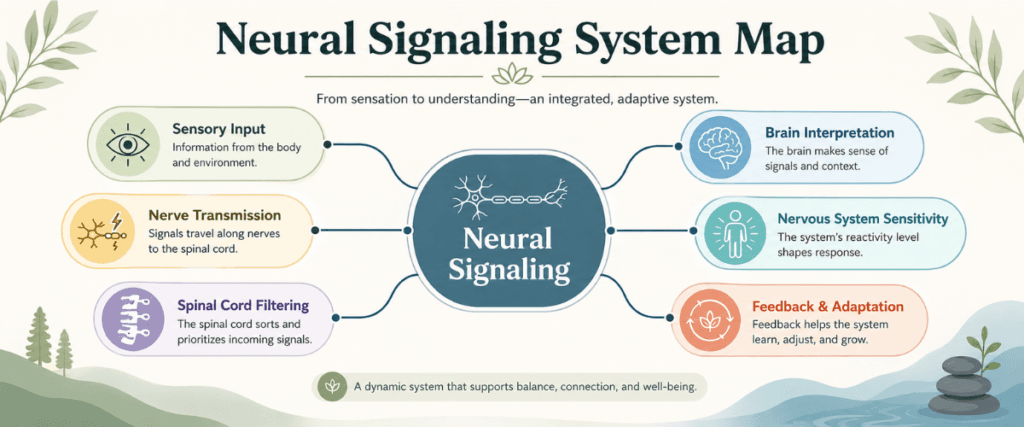
1. Sensory Input Layer
The sensory input layer is where messages begin. Sensory receptors detect changes in the body and environment. These changes may include pressure, heat, cold, vibration, stretch, or movement.
For example, long sitting may increase pressure in one area. As a result, nerves may send more input from that region. In a calm system, this input may stay mild.
However, if the nervous system is already under stress, the same input may feel stronger. Therefore, symptoms may depend on both the local signal and the overall system state.
This layer matters because it shows that the body is always collecting information. Not every signal is harmful. Instead, many signals are normal updates from the body.
2. Nerve Transmission Layer
The nerve transmission layer explains how messages travel. Nerves carry signals from the body to the spinal cord and brain. They also carry messages from the brain back to the body.
This process needs energy and support. For example, nerves need oxygen, nutrients, and stable cell conditions. In addition, they depend on healthy communication between nearby tissues.
When the body is under repeated stress, signal transmission may feel less steady. This does not prove damage by itself. Instead, it may show that the communication system is under more demand.
Because of this, nerve transmission is connected with circulation, metabolism, and recovery capacity. The signal pathway does not work in isolation.
3. Spinal Cord Filtering Layer
The spinal cord is an active filter. It receives signals and helps decide how strongly they should move toward the brain. Therefore, it plays a key role in sensitivity.
For example, repeated irritation may make this filter more responsive. As a result, signals that were once quiet may become more noticeable.
At the same time, the spinal cord can also reduce certain signals. This helps the body avoid reacting to every small input. In this way, filtering supports balance.
However, when the system is under ongoing load, filtering may change. This may influence pain, tingling, burning, or body-wide sensitivity.
4. Brain Interpretation Layer
The brain helps give meaning to signals. It does not only ask, “What is the signal?” It also asks, “Is this safe?”
To answer that question, the brain uses many clues. These may include past experience, current stress, sleep quality, mood, immune activity, and body state.
For this reason, symptoms can change from day to day. For example, discomfort may feel stronger during stress. Meanwhile, the same area may feel calmer after better rest.
This does not mean the symptom is false. Instead, it shows that the brain is part of the body’s protection system. Pain and sensitivity are real body experiences.
5. Sensitivity Layer
Sensitivity describes how easily the nervous system responds. A calm system may respond in a balanced way. However, a loaded system may react faster or more strongly.
For example, a person may notice burning, tingling, or pain more during fatigue. In addition, stress or poor sleep may make the system feel more alert.
Sensitivity is not weakness. Rather, it is a state of the nervous system. It may change depending on body load, recovery, and regulation.
Therefore, this layer helps explain why symptoms may rise and fall. The nervous system is not random. It is responsive.
6. Feedback and Adaptation Layer
Neural signaling is not a one-way process. The body sends signals to the brain. Then the brain sends responses back to the body.
For example, the brain may change muscle tension, movement, posture, or attention. These changes may protect the body in the short term.
However, if protective patterns continue for a long time, they may add more load. As a result, the body may send even more signals back into the system.
This creates a feedback loop. Over time, the nervous system may learn new patterns. Because of this, neural signaling is closely connected with adaptation.
Neural Signaling Interactions
Nervous System Interaction
Neural signaling is the main language of the nervous system. It helps the brain, spinal cord, and nerves communicate. As a result, the body can sense, move, respond, and regulate.
However, the nervous system does not work alone. It responds to sleep, stress, movement, circulation, inflammation, and energy. Therefore, neural signaling is best understood as part of a wider network.
Stress System Interaction
Stress can influence neural signaling. During stress, the body becomes more alert. Heart rate, breathing, attention, and muscle tension may also change.
As a result, signals may feel stronger. For example, mild discomfort may become more noticeable during a stressful day. Meanwhile, the same sensation may feel less intense when the body feels safe.
This does not mean stress is the only reason for symptoms. Instead, stress may add load to the nervous system.
Metabolic System Interaction
The metabolic system helps the body produce and manage energy. Nerves need energy to send and process signals. Therefore, metabolism and neural signaling are closely connected.
For example, unstable energy patterns may increase body stress. In turn, this may affect how the nervous system handles signals.
However, this should not be viewed as a simple cause-and-effect claim. It is better understood as a system connection.
Nutritional System Interaction
Nutrition supports nerve cells and body tissues. It helps maintain normal function, energy, and repair capacity. In addition, it supports the environment around nerves.
However, nutrition is not about one magic food or supplement. Instead, it is part of the wider support system. It works with metabolism, circulation, inflammation, and recovery.
Because of this, nutritional health may influence the conditions that support neural signaling.
Circulatory System Interaction
Circulation helps deliver oxygen and nutrients. It also helps clear waste from tissues. Therefore, blood flow supports the environment where nerves operate.
When circulation is under strain, tissues may have more difficulty maintaining balance. As a result, sensory signals may become more noticeable.
At the same time, nerve activity may affect blood flow and tissue response. This shows a two-way relationship between circulation and signaling.
Inflammatory System Interaction
Inflammation is part of the body’s defense and repair process. It can affect the environment around nerves. Because of this, it may influence nerve sensitivity.
For example, inflammatory signals may make nearby nerve endings more alert. As a result, the body may notice discomfort more easily.
However, inflammation is not always bad. It has a normal role in repair. The key point is balance and timing.
Regeneration Systems Interaction
Regeneration systems help the body repair, adapt, and regain stability. Neural signaling supports this process by sending feedback about the body state.
For example, the nervous system may guide movement, protection, and rest needs. Meanwhile, better repair capacity may support calmer signaling.
Therefore, regeneration and neural signaling work together. One helps guide the other.
Patterns That Influence Neural Signaling
Many daily patterns may influence neural signaling. These patterns do not always act alone. Instead, they may combine and raise total system load.
Sleep rhythm is one important pattern. Poor sleep may make the nervous system more reactive. In addition, it may reduce the body’s ability to regulate stress and recovery.
Stress patterns may also play a role. Ongoing worry, pressure, emotional strain, or mental overload may keep the body alert. As a result, signals may feel louder.
Movement patterns can also affect signaling. Long sitting, repeated posture load, low movement variety, or sudden overload may increase input from muscles and joints.
Nutrition and hydration may matter as well. The nervous system needs steady support. Therefore, irregular meals, low nutrient quality, or low fluid intake may increase regulation demand.
Work habits can add another layer. Long screen time, fixed posture, and high focus demand may increase both body load and mental load. Over time, this may affect signal processing.
Environmental load may also influence the system. For example, noise, poor air quality, heat, cold, and overstimulation may add stress to the nervous system.
However, the goal is not to blame. The goal is pattern awareness. When many small loads build up, neural signaling may become more sensitive.
Neural Signaling and Nerve Function
Neural signaling is closely linked to nerve function. Nerves help the body sense, move, respond, and regulate. Therefore, clear communication is important for body awareness.
When signaling is balanced, the body can respond to input in a stable way. However, when the system is under load, signals may become stronger or harder to filter.
This may relate to pain, tingling, burning, numbness, fatigue, or body-wide sensitivity. In many cases, these experiences involve both local input and central processing.
Pain is one important example. Pain is not just a message from one tissue. Instead, it is an experience created after the nervous system reviews many signals.
Because of this, pain is real even when it does not match tissue damage exactly. The body may create pain when it believes protection is needed.
Tingling and burning may also involve changed signal activity. For example, nerves may send unusual sensory input. In addition, the nervous system may process that input with more alertness.
Numbness may involve reduced or changed signal flow. However, sudden, severe, or worsening numbness should be taken seriously. It may need urgent medical attention, especially with weakness or loss of function.
Fatigue may also connect with neural signaling. When the nervous system works hard to protect and regulate, the body may feel drained. As a result, recovery capacity becomes more important.
Overall, neural signaling helps explain why nerve symptoms can be complex. It connects communication, sensitivity, interpretation, and system-wide regulation.
Neural Signaling Visual Flow
Body or Environmental Input
↓
Sensory Receptor Activation
↓
Nerve Signal Transmission
↓
Spinal Cord Filtering
↓
Brain Interpretation
↓
Nervous System Response
↓
Sensitivity, Protection, Movement, or Recovery Demand
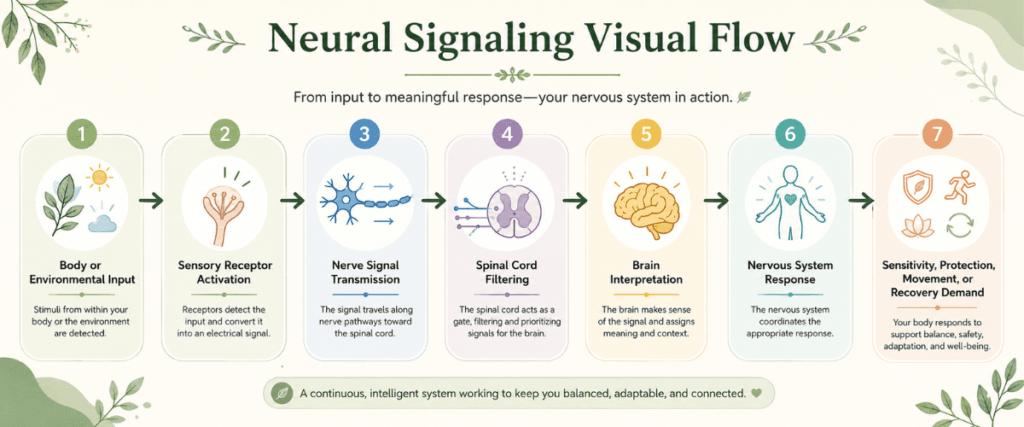
This flow shows how information may move through the nervous system. However, real neural signaling is not always a straight line.
Instead, it often works as a cycle. The body sends information to the brain. Then the brain sends responses back to the body.
For example, the brain may change muscle tension, posture, breathing, attention, or movement. As a result, the body may create new sensory input.
Different people may also feel different symptoms. One person may feel tingling. Another may feel burning, pain, tightness, or fatigue.
Therefore, this visual flow is only an educational model. It is not a diagnosis. It helps explain how input, filtering, response, and adaptation may connect.
Why Neural Signaling Matters for Recovery
1. Recovery Requires System Balance
Recovery depends on many systems working together. Neural signaling helps coordinate these systems. As a result, the body can respond to change.
However, when the system is overloaded, signals may become harder to regulate. This may increase sensitivity and recovery demand.
2. Recovery Requires Energy and Regulation
Nerve communication uses energy. The body also needs energy for repair, sleep, stress control, and daily function.
Therefore, low recovery capacity may affect signaling. In addition, repeated stress may use energy that the body needs for balance.
3. Recovery Requires Delivery and Clearance
Nerves and tissues need oxygen and nutrients. They also need waste products to be cleared. Circulation helps support both jobs.
When delivery and clearance are under pressure, tissues may send more input. As a result, the nervous system may have more signals to process.
4. Recovery Requires Nervous System Stability
A stable nervous system can respond and then return toward calm. This matters because the body should not stay in alert mode all the time.
However, when signaling stays highly sensitive, the body may remain protective. This may affect movement, sleep, comfort, and daily energy.
5. Recovery May Be Influenced by Repeated Load
Repeated load may shape how the nervous system responds. This load may come from stress, poor sleep, inflammation, posture, low physical activity, or high daily demands.
Over time, these patterns may increase recovery needs. Therefore, neural signaling is important for understanding long-term nerve health education.
Common Misunderstandings About Neural Signaling
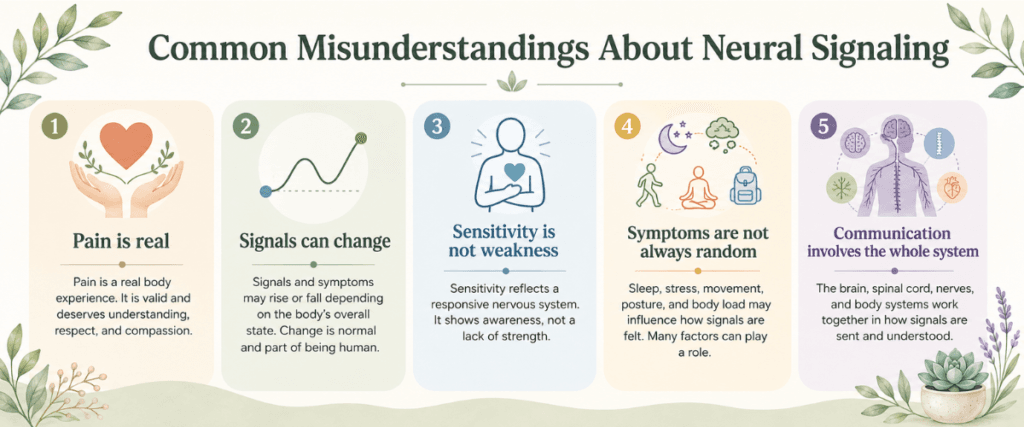
Misunderstanding 1: Neural signaling is only about pain.
Clarification:
Neural signaling includes many types of messages. It helps the body sense touch, pressure, temperature, movement, balance, and internal change. Pain is only one possible output.
Misunderstanding 2: Strong symptoms always mean severe damage.
Clarification:
Strong symptoms may happen when the nervous system is highly alert. However, symptoms should still be taken seriously. The key is to understand them safely and calmly.
Misunderstanding 3: Changing symptoms are random.
Clarification:
Symptoms may change for many reasons. For example, sleep, stress, posture, movement, inflammation, and recovery load may affect signal processing. Therefore, changing symptoms are not always random.
Misunderstanding 4: If the brain is involved, the pain is not real.
Clarification:
Pain is real. The brain is part of the body. It helps create pain as a protective experience after reviewing many signals.
Misunderstanding 5: Neural signaling can be fixed by a single solution.
Clarification:
Neural signaling is part of a larger system. It may interact with stress, metabolism, circulation, inflammation, movement, and recovery. Because of this, it should not be reduced to one quick fix.
Continue Learning
Learn how nerve biology, signaling, sensitivity, and regulation work together.
Explore how the nervous system receives, filters, and interprets pain-related signals.
Understand body-wide patterns that may influence nerve sensitivity and recovery demand.
Learn about support systems such as sleep, movement, stress regulation, and circulation from a safe educational view.
Explore how repair, adaptation, and stability may support long-term recovery capacity.
Follow a step-by-step education journey through nerve function, sensitivity, root causes, and recovery concepts.
Related Systems
Pain Processing
Pain processing is closely linked to neural signaling. It explains how signals may become pain through filtering, interpretation, and protective response.
Neuroinflammation
Neuroinflammation may interact with nerve sensitivity and signal processing. It helps explain how immune activity and nervous system communication may connect.
Myelin System
Myelin supports signal speed and efficiency. Therefore, it is closely related to how nerve messages travel.
Neuroplasticity
Neuroplasticity explains how the nervous system changes with experience. It connects learning, adaptation, sensitivity, and recovery patterns.
Autonomic Regulation
Autonomic regulation helps manage heart rate, breathing, digestion, stress response, and body state. As a result, it may influence neural signaling.
Metabolic Damage System
Energy balance may affect nerve communication. The metabolic system helps support the energy needs of signaling and regulation.
Circulatory Impairment System
Circulation supports oxygen and nutrient delivery. It also supports clearance, which may influence tissue signals and sensitivity.
Inflammatory System
Inflammatory activity may change the environment around nerves. This may influence how easily nerve endings become alert.
Lifestyle Degeneration
Daily patterns such as sleep, movement, stress, posture, and nutrition may influence neural signaling over time.
Regeneration Systems
Repair and adaptation systems help explain how the body may support long-term stability and recovery capacity.
Safety & Education Notice
This page is for educational purposes only. It does not diagnose, treat, cure, or prevent disease. It is not a substitute for professional medical advice, diagnosis, or treatment.
Seek urgent medical care for severe, sudden, unusual, or worsening symptoms, including sudden weakness, loss of bladder or bowel control, chest pain, difficulty breathing, severe numbness, severe pain, or rapidly changing neurological symptoms.
Because this topic involves nervous system function and nerve-related symptoms, readers should not use this information to self-diagnose, stop medication, begin supplements, follow detox protocols, or delay professional care.