
Circulatory Impairment System
The Circulatory Impairment System explains how blood flow, oxygen delivery, nutrient transport, microcirculation, waste clearance, inflammation, metabolism, and nerve sensitivity may connect within the nerve support environment.
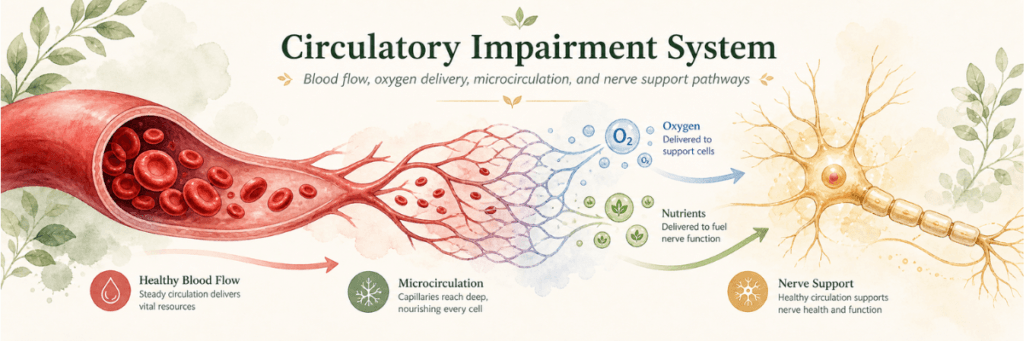
In other words, circulation is not only about moving blood. It also helps deliver oxygen and nutrients, support local tissue balance, and remove metabolic waste. Because nerves do not work in isolation, they depend on this stable internal environment to maintain healthy signaling and recovery capacity.
However, this page is not about diagnosing a circulatory disease. Instead, it offers an educational root-cause system overview to help you understand how circulation may influence the environment around nerves over time.
Quick Navigation
What Is the Circulatory Impairment System?
The Circulatory Impairment System refers to the relationship between blood flow and the internal environment that supports the nervous system.
To begin with, circulation helps move important resources throughout the body, including oxygen, glucose and other nutrients, fluids, immune-related signals, hormonal and metabolic signals, and waste products that need to be cleared.
For nerves, this process is especially important because nerve tissue requires a stable supply of oxygen and nutrients to support normal signaling, repair processes, and cellular energy balance.
However, when circulation becomes less efficient, the tissue environment may experience more stress. This does not automatically mean disease is present. Instead, it means blood flow, oxygen delivery, nutrient transport, inflammation, metabolism, and nerve sensitivity should be understood as connected systems.
Therefore, in root-cause thinking, circulation is not viewed as a single isolated issue. Rather, it is part of a wider network that can influence how the nervous system responds, adapts, and recovers.
How the Circulatory Impairment System Works
The circulatory system plays a vital role in supporting nerve health through various interconnected functions.
Circulatory Impairment System and Blood Flow Support
Blood flow delivers oxygen and nutrients to tissues, which are essential for nerve cells and their supporting cells to maintain energy, communication, and structural integrity. When blood flow is consistent, the local tissue environment is more likely to stay balanced. Conversely, reduced or inconsistent blood flow can create stress in the nerve environment, affecting the tissue’s ability to manage energy, inflammation, fluid balance, and sensitivity.
Circulatory Impairment System and Oxygen Delivery
Oxygen is crucial for cellular energy production. Nerves and surrounding support tissues require energy to maintain normal signaling and repair functions. If oxygen delivery becomes inefficient, tissues must exert more effort to maintain balance, potentially leading to cellular stress, increased metabolic load, and heightened sensitivity in the nerve environment. It’s important to note that oxygen is just one component of a larger support system and does not solely account for nerve symptoms.
Circulatory Impairment System and Nutrient Transport
Circulation is essential for transporting nutrients to tissues. These nutrients are vital for maintaining cell membranes, energy pathways, antioxidant defenses, and tissue repair. When circulation becomes less efficient, nutrient delivery may become inconsistent, affecting nutritional status, metabolism, inflammation, and recovery capacity. This highlights the close connection between the Circulatory Impairment System and the Nutritional Deficiency and Metabolic Damage Systems.
Circulatory Impairment System and Waste Clearance
Blood flow not only delivers essential materials but also helps eliminate metabolic byproducts and waste from tissues. When waste removal is inefficient, the local environment may experience increased stress, which can lead to inflammatory signaling, oxidative stress, and sensitivity issues. This underscores the importance of understanding circulation as both a delivery and a clearance system.
Microcirculation in the Circulatory Impairment System
Microcirculation refers to the movement of blood through very small vessels, including capillaries. This network of small vessels is crucial for matching local blood supply with tissue demand. For nerve-related systems, microcirculation is important because nerves rely not only on larger blood vessels but also on the smaller vessels around them. Even if general circulation appears normal, the support of local tissues depends heavily on how well microcirculation responds to demand, inflammation, movement, temperature, and metabolic stress.
Circulatory Impairment System Interactions: Network Thinking
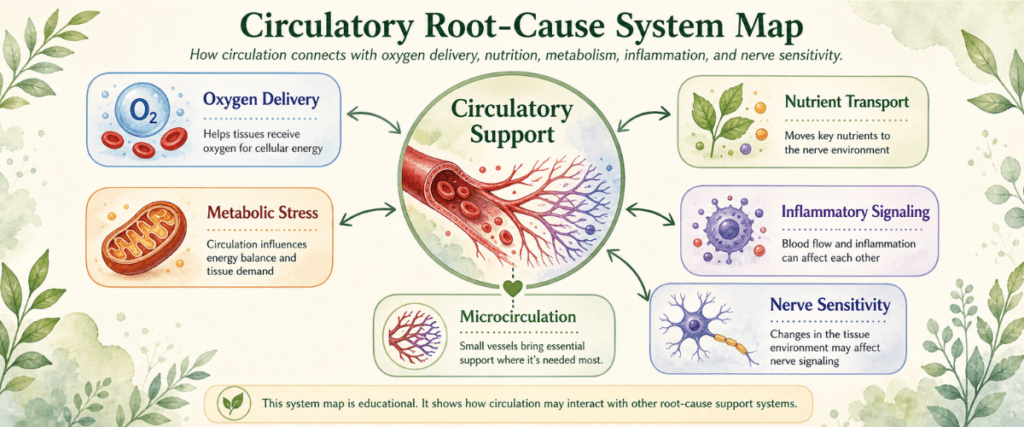
The Circulatory Impairment System does not work alone. It interacts with other root-cause systems.
Circulatory Impairment System and Inflammation
Inflammation can impact blood vessel function, tissue fluid balance, and local circulation. Similarly, inadequate blood flow can heighten stress signals that interact with inflammatory pathways. This relationship is bidirectional:
- Circulatory stress can influence inflammation.
- Inflammation can affect the quality of circulation.
This connection is important because nerve sensitivity often arises within a broader context of inflammation and metabolism.
Circulatory Impairment System and Metabolism
Metabolism relies on oxygen, nutrients, and the removal of waste products, all of which are supported by circulation. When circulation becomes less efficient, tissues may face an increased metabolic load. If metabolism is stressed, tissues may require more oxygen and improved waste removal. This highlights the necessity of considering circulation and metabolism together, rather than separately.
Circulatory Impairment System and Nutrition
Nutritional support depends not only on food intake but also on the efficient transport of nutrients to tissues. The body may have access to nutrients, but circulation is what delivers them to where they are needed most. This is especially crucial for tissues with high energy demands, such as those related to nerve function.
Circulatory Impairment System and Nerve Sensitivity
Nerve sensitivity can be influenced by the surrounding tissue environment. When there is stress in oxygen delivery, nutrient transport, waste clearance, inflammation, or metabolic balance, nerves may become more reactive. However, this does not mean that poor circulation is always the cause of nerve sensitivity. Rather, circulation is just one of several factors in the support system that can influence how nerves respond.
Patterns That Influence the Circulatory Impairment System
Several patterns may influence the Circulatory Impairment System. However, these are not diagnostic signs. Instead, they are general system-level patterns that may affect circulation and tissue support over time.
Reduced Movement and the Circulatory Impairment System
First, movement supports circulation by helping blood and fluid move through the body. When the body stays inactive for long periods, circulation demand may decrease. As a result, stiffness, fluid stagnation, or reduced tissue adaptability may become more noticeable.
Chronic Inflammatory Load in the Circulatory Impairment System
Next, long-term inflammatory stress may affect the blood vessel environment and tissue response. In turn, this can influence local perfusion, fluid balance, and sensitivity patterns.
Metabolic Stress and the Circulatory Impairment System
In addition, metabolic stress may increase the demand placed on circulation. For example, blood sugar instability, cellular energy stress, oxidative load, and mitochondrial strain may all increase tissue demand.
When this demand rises, circulation becomes even more important for oxygen delivery and waste clearance.
Oxygen Demand Matching in the Circulatory Impairment System
Similarly, the body needs to match oxygen delivery with tissue demand. If tissue demand increases but delivery does not keep up, the local environment may become more stressed.
Therefore, oxygen demand matching is an important part of understanding how circulation supports the nerve environment.
Nutrient Transport Challenges in the Circulatory Impairment System
Moreover, nerves need consistent nutritional support. Circulation helps transport nutrients that support energy production, cell maintenance, and repair activity.
When nutrient transport becomes less efficient, the nerve environment may have fewer resources available for balance and recovery.
Waste Clearance Stress in the Circulatory Impairment System
Furthermore, poor clearance may affect the tissue environment around nerves. This may contribute to heaviness, pressure, sensitivity, or slower recovery patterns in some people.
For this reason, circulation should be viewed not only as a delivery pathway but also as a clearance pathway.
Vessel Response in the Circulatory Impairment System
Finally, blood vessels respond to temperature, stress, activity, and nervous system signals. When these responses change, local circulation and tissue comfort may also be affected.
Together, these patterns show how the Circulatory Impairment System can interact with movement, inflammation, metabolism, oxygen demand, nutrient transport, waste clearance, and nerve sensitivity.
Circulatory Impairment System and Nerve Function
Nerve function depends on communication. In simple terms, nerves send and receive signals through complex electrical and chemical processes.
To support this communication, nerves need several conditions to remain balanced, including energy, oxygen, nutrients, a balanced fluid environment, waste clearance, low tissue stress, healthy support cells, and stable inflammatory signaling.
Importantly, circulation contributes to many of these conditions. It helps deliver oxygen and nutrients, supports fluid movement, and assists with waste clearance in the tissue environment around nerves.
However, when the local nerve environment becomes stressed, nerve signals may become more sensitive or less stable. As a result, some people may notice patterns such as tingling, burning, numbness, coldness, heaviness, or increased sensitivity. Even so, these experiences can have many causes and should not be self-diagnosed from this page.
The key idea is this: nerve sensitivity is not only about the nerve itself. Instead, it may also reflect the environment around the nerve.
Therefore, that environment should be understood as a connected network that includes circulation, inflammation, metabolism, nutrition, mechanical stress, immune activity, and recovery capacity.
Circulatory Impairment System Visual Flow
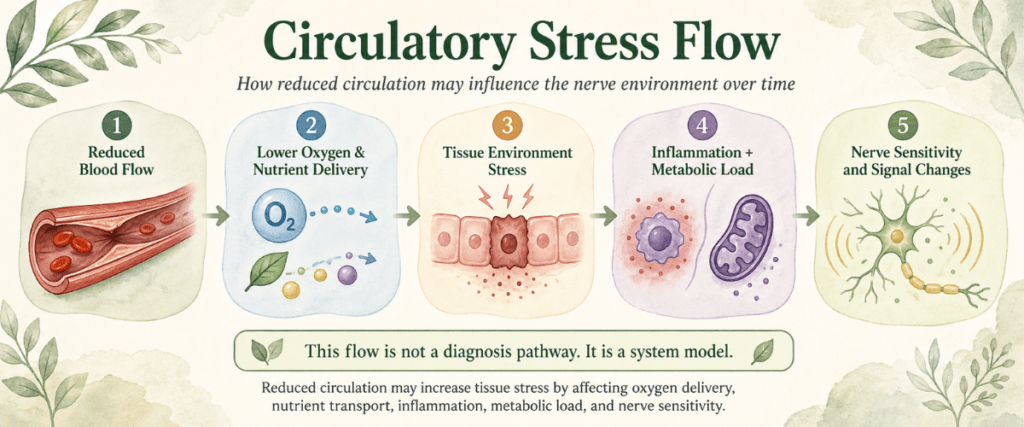
Circulatory Stress Flow
Reduced Blood Flow
↓
Lower Oxygen & Nutrient Delivery
↓
Tissue Environment Stress
↓
Inflammation + Metabolic Load
↓
Nerve Sensitivity and Signal Changes
This flow is not a diagnosis pathway. It is a system model.
It helps explain how circulation-related stress may contribute to a less supportive nerve environment over time.
Why the Circulatory Impairment System Matters for Recovery
Recovery is not only about reducing symptoms. Instead, it also depends on whether the body has enough support to repair, adapt, and regulate.
The Circulatory Impairment System matters because circulation helps create the internal conditions needed for recovery. In other words, blood flow supports both delivery and clearance within the tissue environment.
Circulatory Impairment System Recovery Requires Delivery
First, repair processes require oxygen, nutrients, and cellular energy. Circulation supports the delivery of these resources to tissues that need them.
Circulatory Impairment System Recovery Requires Clearance
Next, tissues also need to clear waste products and inflammatory byproducts. Circulation supports this clearance process by helping move unwanted materials away from the local environment.
Circulatory Impairment System Recovery Requires Adaptation
In addition, the body adapts to movement, rest, stress, and changing demand. Circulation helps tissues respond to these changing needs by supporting oxygen delivery, nutrient movement, and fluid balance.
Circulatory Impairment System Recovery Requires Network Balance
Finally, circulation interacts with inflammation, metabolism, nutrition, and regeneration. If one system is under stress, it may influence the others.
For this reason, circulation should be understood as a foundational support system within nerve recovery education. Rather than working alone, it helps support the wider network that recovery depends on.
Common Misunderstandings About the Circulatory Impairment System
Misunderstanding 1: “Poor circulation always means a serious disease.”
Not always. Circulation-related stress can exist as a broad system pattern, but only a qualified healthcare professional can evaluate whether a disease or medical condition is present.
This page is not for diagnosis.
Misunderstanding 2: “Nerve symptoms are only caused by nerve damage.”
Nerve-related sensations may be influenced by many systems, including inflammation, metabolism, nutrition, mechanical pressure, immune activity, and circulation.
The nerve itself matters, but the surrounding environment also matters.
Misunderstanding 3: “If blood flow improves, nerves automatically heal.”
Nerve recovery is complex. Circulation may support the environment for repair, but it does not guarantee healing or symptom resolution.
Recovery depends on many systems working together.
Misunderstanding 4: “Microcirculation is not important.”
Microcirculation is important because small blood vessels help deliver oxygen and nutrients close to tissues. Large blood vessels matter, but local tissue-level circulation also matters.
Misunderstanding 5: “Circulation is separate from inflammation and metabolism.”
Circulation, inflammation, and metabolism are deeply connected. Changes in one system may influence the others.
Continue Learning
To understand this topic more deeply, continue with related root-cause and recovery systems.
Recommended Reading Path
- Root-Cause Systems
Start with the main overview of how different body systems may influence nerve health. - Metabolic Damage System
Learn how energy imbalance, oxidative stress, and cellular load may affect nerve sensitivity. - Inflammatory System
Explore how inflammatory signaling may influence tissue stress and nerve reactivity. - Nutritional Deficiency System
Understand how nutrient availability and transport may support nerve function. - Regeneration Systems
Learn how the body’s repair and adaptation systems may support long-term recovery capacity. - Therapeutic Systems
Explore how different support approaches can be organized without relying on single-solution thinking.
Related Systems
The Circulatory Impairment System connects with several other educational areas:
- Root-Cause Systems
- Inflammatory System
- Metabolic Damage System
- Nutritional Deficiency System
- Regeneration Systems
- Therapeutic Systems
- Neurobiology
- Conditions
Safety & Education Notice
This page is for educational purposes only. It does not diagnose, treat, cure, or prevent any disease.
Circulation-related symptoms such as severe pain, sudden numbness, weakness, chest pain, shortness of breath, one-sided body weakness, sudden color change, or unexplained swelling may require urgent medical attention.
If you are experiencing persistent or worsening symptoms, consult a qualified healthcare professional for proper evaluation.
The goal of this page is to explain how circulation may function as part of a broader nerve-support system, not to replace medical care.