
Stress System: A Clear Guide to Nerve Stress
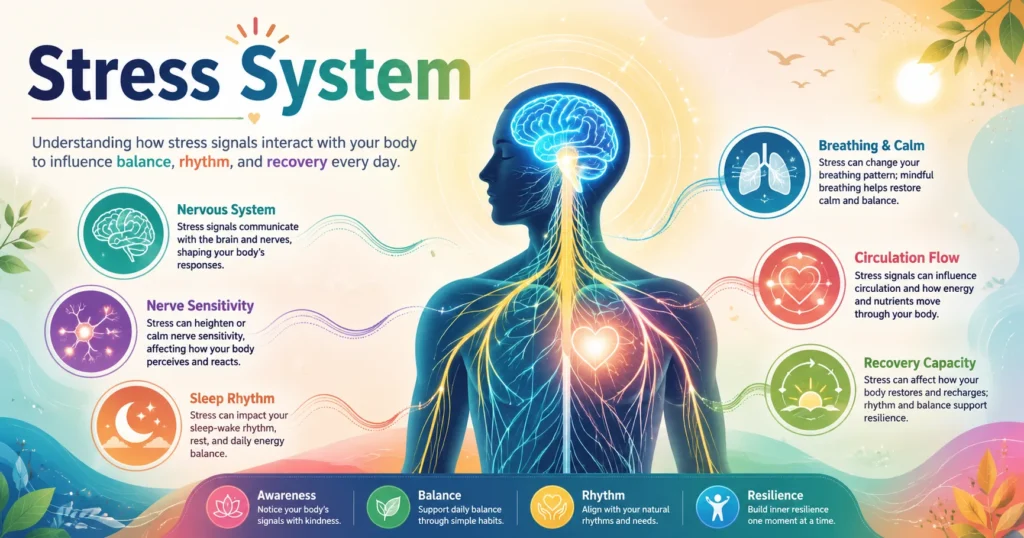
Stress System is an educational way to understand how the body responds to pressure, demand, threat, overload, uncertainty, and repeated strain. It is not a diagnosis. Instead, it helps explain how stress signals may influence the nervous system, hormones, circulation, muscles, digestion, sleep, inflammation, and recovery capacity.
From a nerve health perspective, stress matters because nerves do not work alone. They respond to the environment inside the body and outside the body. For example, poor sleep, emotional pressure, pain, overwork, fear, blood sugar swings, inflammation, and long sitting may all increase system demand in different ways.
However, the Stress System is not “bad.” Short-term stress can help the body respond, focus, move, and protect itself. The problem is not stress itself. The bigger issue is repeated stress without enough recovery, which may keep the body in a higher-alert pattern over time.
Quick Navigation
What Is Stress System?
The Stress System is the body’s built-in response network for handling demand. It includes the brain, autonomic nervous system, hormone signaling, immune activity, circulation, muscles, breathing, digestion, and sleep rhythm. In simple terms, it helps the body decide when to prepare, protect, act, pause, or recover.
A helpful analogy is a home alarm system. When there is a real emergency, the alarm is useful. It gets attention quickly. However, if the alarm keeps ringing every day, even during small events, the whole household becomes tired and less organized. The Stress System can work in a similar way.
For nerve health education, this system matters because stress signals may influence how sensitive the nervous system feels. They may also affect how the body uses energy, manages inflammation, regulates blood flow, and organizes recovery. Therefore, Stress System education can help readers understand one possible layer of nerve sensitivity and recovery demand.
At the same time, the Stress System should not be understood in isolation. It often connects with metabolic patterns, sleep rhythm, nutritional status, inflammation, circulation, pain processing, and emotional load. Because of this, a system-based view is more useful than blaming one single cause.
How the Stress System Works
First, the body notices a demand. This demand may be physical, emotional, mental, environmental, social, or metabolic. For example, pain, poor sleep, financial pressure, overwork, conflict, illness, intense exercise, or repeated worry may all be understood as different types of stress load.
Next, the brain and body prepare for action. The nervous system may increase alertness, muscle tone, breathing rate, heart rate, and energy availability. This short-term response can be useful because it helps the body respond to a challenge.
As a result, the body may temporarily shift resources away from deeper rest, digestion, repair, and recovery. This does not mean harm is happening every time. Instead, it means the body is prioritizing immediate demand.
Over time, repeated stress without enough recovery may keep the body in a more activated pattern. In many cases, this may interact with sleep quality, blood sugar rhythm, inflammatory signaling, circulation, digestion, and nervous system sensitivity.
For this reason, the Stress System is best understood as a coordination system. It is not only about emotions. It is also about how the body organizes energy, protection, attention, movement, and recovery capacity.
Key Layers of the Stress System
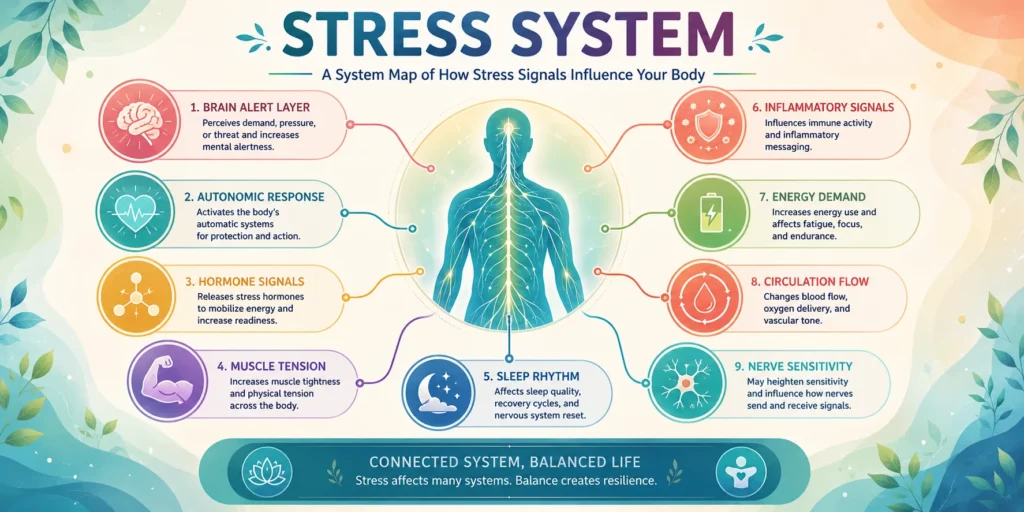
Brain Alert Layer
The brain alert layer helps the body notice possible demand or threat. It may respond to pain, uncertainty, loud environments, conflict, fear, deadlines, poor sleep, or repeated worry. In simple terms, this layer asks, “Do I need to prepare for something?”
For example, a person who has ongoing nerve discomfort may become more alert to body sensations. This does not mean the person is imagining symptoms. Instead, the nervous system may be paying closer attention because it has learned that the body needs monitoring.
Over time, a high-alert pattern may increase sensitivity. Because of this, the brain alert layer can be one important educational piece when discussing pain processing, stress load, and nervous system regulation.
Autonomic Response Layer
The autonomic nervous system controls many automatic body functions, including heart rate, breathing, blood vessel tone, sweating, digestion, and bladder activity. It includes activation patterns often described as “fight or flight” and calming patterns often linked with “rest and digest.”
When stress demand rises, the body may lean more toward activation. For example, breathing may become shallow, muscles may tighten, the pulse may rise, and digestion may slow. These are normal body responses in the right situation.
However, if this pattern continues too often, the body may have less time in deeper recovery states. Therefore, the autonomic response layer may connect with fatigue, sleep disruption, digestive discomfort, muscle tension, and nerve sensitivity.
Hormone Signal Layer
The Stress System also uses hormone signals to help the body respond. One key stress pathway is commonly described as the HPA axis. This pathway helps coordinate stress hormones and energy readiness during demand.
In a short-term situation, this can help the body stay alert and responsive. For example, it may help someone focus during an emergency or complete a difficult task. However, repeated activation may place more demand on sleep, mood, blood sugar rhythm, and recovery organization.
From an educational view, this does not mean stress hormones are “bad.” They are part of normal body function. The key point is rhythm. The body usually needs activation and recovery to work together.
Muscle Tension Layer
Stress often shows up in the body through muscle tension. The neck, shoulders, jaw, back, hips, and hands may hold extra tension during periods of pressure. This can happen without the person noticing it at first.
For example, someone working long hours at a computer may breathe shallowly, lift the shoulders, clench the jaw, and sit with limited movement. Over time, this pattern may increase mechanical load around nerves, joints, and soft tissues.
This layer matters because nerves travel through physical spaces. Muscle tension does not explain every nerve symptom. However, it may be one part of a larger pattern that affects comfort, circulation, movement quality, and sensitivity.
Sleep and Recovery Layer
Sleep is one of the body’s most important recovery rhythms. When the Stress System stays active, sleep may become lighter, shorter, or more interrupted. At the same time, poor sleep may make the Stress System more reactive the next day.
This creates a cycle. Stress can affect sleep, and poor sleep can increase stress load. As a result, the nervous system may have less time to settle, organize signals, and recover from daily demand.
For nerve health education, this layer is important because recovery capacity often depends on rhythm. The body may need repeated windows of rest, not only effort, to maintain better system coordination.
For a deeper understanding of recovery timing and body rhythm, readers may also explore: Recovery Cycles
Inflammatory Signal Layer
Stress and inflammation can interact in complex ways. Stress may influence immune signaling, and ongoing immune activity may also increase body-wide stress demand. This does not mean stress directly causes every inflammatory problem. Instead, both systems can communicate.
For example, when the body is under repeated pressure, inflammatory signaling may become part of the overall load picture. Meanwhile, pain or tissue irritation may also keep the nervous system more alert.
Because of this, the inflammatory signal layer should be understood carefully. It is one possible connection point between stress, nerve sensitivity, recovery demand, and body-wide regulation.
Energy Demand Layer
The Stress System uses energy. When the body prepares for action, it may change how energy is mobilized and used. This may involve blood sugar rhythm, appetite patterns, fatigue, and the ability to recover after exertion.
For example, a person under chronic pressure may feel wired at night but tired during the day. Another person may feel drained after small tasks. These patterns can have many causes, so they should not be self-diagnosed. However, they can be understood as signs of increased system demand.
This layer matters because recovery also requires energy. Cellular repair, circulation, sleep rhythm, and nervous system stability all depend on energy availability and timing.
Stress System Interactions
Nervous System Interaction
The Stress System and nervous system are closely connected. Stress signals may increase alertness, change attention, and influence how strongly the body notices sensations. At the same time, ongoing nerve discomfort may increase stress load.
This is a two-way relationship. Nerve symptoms may make a person more worried, and worry may increase nervous system alertness. Because of this, it is not helpful to blame either the mind or the body alone.
From a system perspective, both signal processing and body state matter. This is why stress education can help explain one layer of nerve sensitivity without claiming that stress is the only cause.
To understand how stress signals connect with body awareness and nervous system coordination, readers may also explore: Brain–Body Integration
Inflammatory System Interaction
Stress may interact with inflammatory signaling through immune and nervous system communication. Meanwhile, inflammation may also create discomfort, fatigue, and sensory changes that increase stress demand.
For example, when the body feels irritated or overloaded, the nervous system may stay more watchful. At the same time, stress-related sleep disruption may make the body less able to settle.
This interaction is best understood as a loop. It does not mean stress directly causes inflammation in every person. Instead, it means stress and inflammation may influence each other within a wider body system.
Circulatory System Interaction
Stress can influence circulation by changing heart rate, blood vessel tone, breathing pattern, and muscle tension. These changes may be useful in short-term situations because the body is preparing to act.
However, repeated activation may affect how the body delivers oxygen and nutrients during recovery windows. For nerves, circulation matters because nerve tissues depend on steady delivery and clearance.
This does not mean stress alone explains circulation problems. Instead, it may be one layer that interacts with movement, hydration, metabolic health, sleep, and vascular function.
Metabolic System Interaction
Stress may influence appetite, cravings, blood sugar rhythm, energy use, and fatigue patterns. Meanwhile, blood sugar swings or poor energy availability may increase stress signals inside the body.
For example, skipping meals, eating irregularly, sleeping poorly, and working under pressure may combine into a larger metabolic stress pattern. Over time, this may affect energy stability and recovery capacity.
This interaction is important for nerve education because nerves need energy and stable internal conditions. Therefore, metabolic patterns and stress patterns should often be viewed together.
Digestive and Gut–Nerve Axis Interaction
Stress can affect digestion by changing motility, appetite, stomach comfort, and gut sensitivity. At the same time, digestive discomfort may create more body-wide stress and make the nervous system more reactive.
For example, someone under pressure may notice bloating, appetite changes, or digestive irregularity. These patterns can have many causes, so they should not be used for self-diagnosis.
From a system view, the gut and nervous system communicate constantly. Because of this, Stress System education may connect naturally with Gut–Nerve Axis learning.
Regeneration Systems Interaction
Recovery depends on coordination. Cellular repair, myelin support, vascular delivery, inflammation resolution, immune repair, and neuroplastic adaptation all require the body to shift between effort and recovery.
If stress demand stays high, the body may have fewer calm windows for repair organization. This does not mean recovery stops. Instead, recovery may require more system coordination.
For this reason, the Stress System is highly connected with regeneration education. It helps explain why rest rhythm, nervous system stability, and reduced overload may matter for recovery capacity.
Patterns That Influence the Stress System
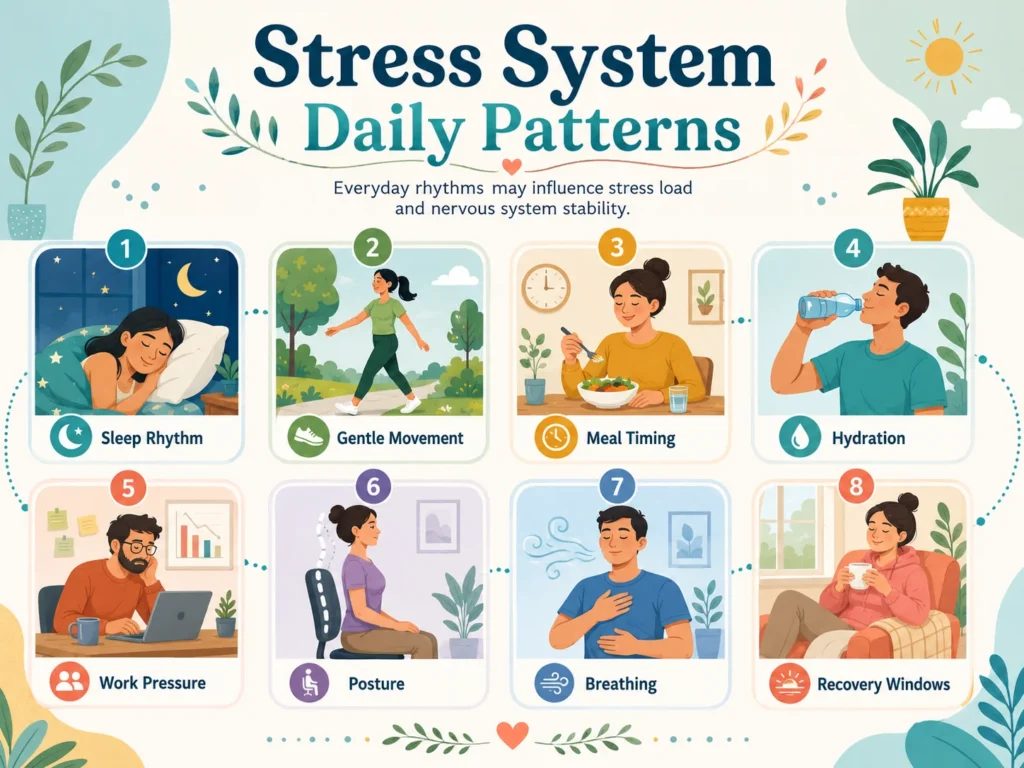
Daily life can influence the Stress System in many small ways. Often, it is not one dramatic event. Instead, repeated patterns may slowly increase system demand.
For example, poor sleep rhythm may make the body more reactive. Long sitting may increase muscle tension and reduce movement variety. Irregular meals may affect energy rhythm. Constant notifications may keep attention activated. Emotional pressure may keep the brain in problem-solving mode.
In addition, pain or nerve discomfort may become a stress pattern by itself. When symptoms are uncertain or unpredictable, the nervous system may keep scanning for changes. This can create a cycle of alertness, worry, tension, and fatigue.
Common daily-life patterns that may influence the Stress System include:
| Daily Pattern | Possible System-Based View |
|---|---|
| Poor sleep rhythm | May reduce recovery windows and increase next-day reactivity |
| Long sitting | May increase muscle tension, stiffness, and mechanical load |
| High mental workload | May keep attention and alertness systems active |
| Irregular meals | May affect energy rhythm and stress demand |
| Emotional conflict | May increase brain alertness and body tension |
| Pain uncertainty | May increase monitoring, worry, and nervous system sensitivity |
| Low recovery time | May reduce the body’s ability to return to calmer states |
These examples are not medical instructions. Instead, they show how everyday patterns may be understood through a system-based educational lens.
Stress System and Nerve Function
The Stress System may connect with nerve function in several ways. It may influence signal processing, pain perception, tingling awareness, burning sensations, numbness concern, fatigue, muscle tension, and body-wide sensitivity. However, it should never be treated as the only explanation for nerve symptoms.
Nerves communicate through signals. The brain and body then interpret those signals based on context. When the body is tired, inflamed, tense, under-slept, or emotionally overloaded, the nervous system may become more sensitive to input.
For example, a mild sensation may feel stronger during a stressful week than during a rested week. This does not mean the sensation is fake. It means the nervous system may be operating in a more protective, alert, or sensitive state.
Stress may also influence nerve function indirectly through sleep, circulation, breathing, muscle tension, immune signaling, and metabolic rhythm. Therefore, Stress System education helps readers understand why nerve health often requires a whole-body view.
Important related condition bridges include Peripheral Neuropathy, Sciatic Nerve Pain, Nerve Compression, Diabetic Neuropathy, Chronic Nerve Pain, and Post-Injury Nerve Damage. These condition pages should not be used for self-diagnosis. However, they may help readers understand how symptoms can relate to many different body systems.
To learn how stress may influence sensitivity and signal interpretation, readers may also explore: Pain Processing
Stress System Visual Flow
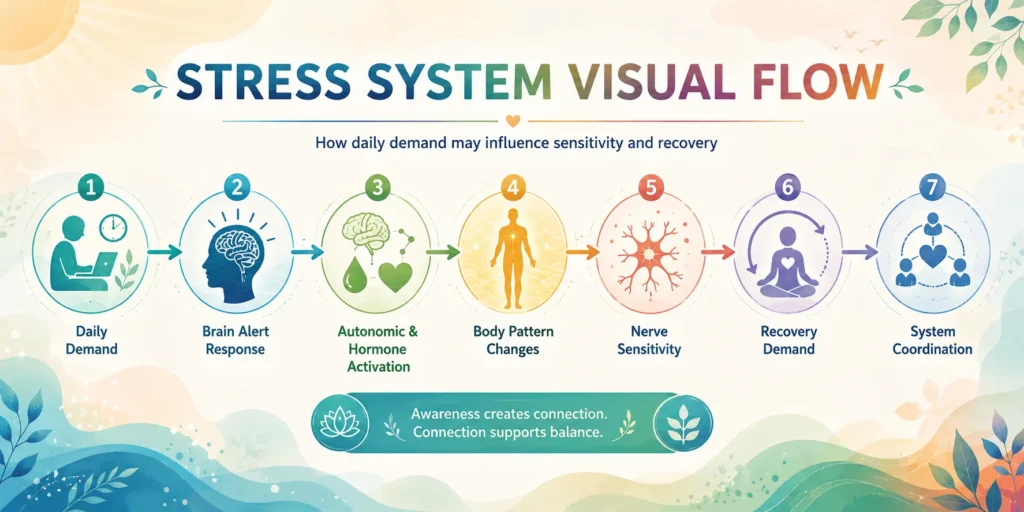
Simple Educational Flow:
Daily Demand / Pressure / Threat Signal
↓
Brain Alert Response
↓
Autonomic and Hormone Activation
↓
Muscle Tension, Energy Shift, Sleep Disruption, Circulation Changes
↓
Higher Nervous System Sensitivity
↓
Increased Recovery Demand
↓
Need for Better System Coordination
This flow is not always linear. In many cases, it works like a cycle. For example, stress may affect sleep, poor sleep may increase pain sensitivity, pain may increase worry, and worry may increase stress activation again.
Different people may experience different patterns. One person may notice tension and poor sleep. Another may notice digestive changes and fatigue. Another may feel more burning, tingling, or body-wide sensitivity during high-stress periods.
This model is educational only. It does not diagnose the cause of symptoms. Instead, it helps readers understand how the Stress System may interact with nerve function and recovery capacity.
Why the Stress System Matters for Recovery
1. Recovery Requires System Coordination
Recovery is not controlled by one body part alone. It depends on coordination between the nervous system, immune system, circulatory system, metabolic system, sleep rhythm, and repair signals.
When stress demand is high, the body may prioritize protection and action. Therefore, recovery may require enough calm periods for the body to reorganize and settle.
2. Recovery Requires Energy and Regulation
The body needs energy for repair, signal organization, and daily function. Stress activation uses energy because the body is preparing to respond.
Over time, repeated stress may increase energy demand. As a result, fatigue, low resilience, and slower recovery feelings may become part of the picture for some people.
3. Recovery Requires Delivery and Clearance
Nerve-related recovery depends on oxygen, nutrients, circulation, and waste clearance. Stress may influence breathing, blood vessel tone, muscle tension, and movement patterns.
This does not mean stress directly blocks recovery. Instead, it may affect the environment where recovery processes happen. For this reason, circulation and stress education often belong together.
4. Recovery Requires Nervous System Stability
A stable nervous system can move between alertness and rest more flexibly. When stress is constant, the body may have difficulty shifting into calmer states.
This matters because nerve sensitivity may increase when the system stays on high alert. Therefore, nervous system stability is one helpful educational concept for understanding recovery capacity.
5. Recovery May Be Influenced by Repeated System Stress
Repeated stress patterns can increase recovery demand. For example, poor sleep, long work hours, worry, pain, inactivity, and irregular routines may combine into a larger load.
In simple terms, the body may not only need support. It may also need better timing, rhythm, and coordination. This is why the Stress System is a core root-cause education page.
Common Misunderstandings About the Stress System
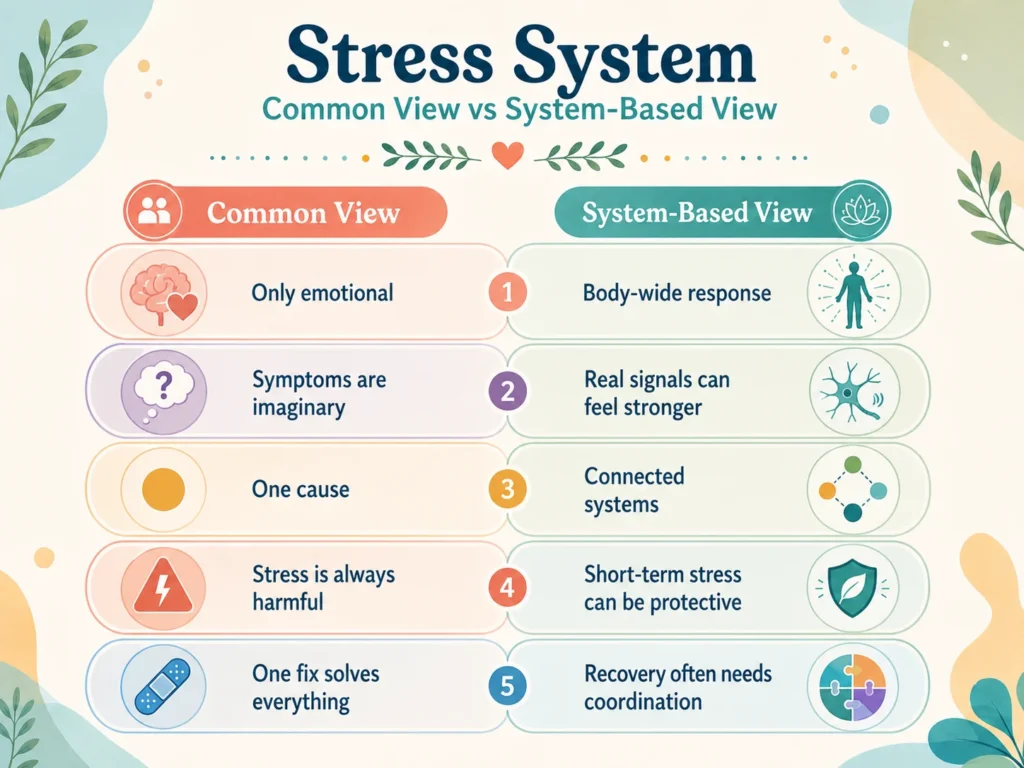
| Common View | Better System-Based View |
|---|---|
| Stress is only emotional | Stress can be emotional, physical, metabolic, environmental, or neurological |
| Stress means weakness | Stress is a normal body response to demand |
| One symptom means one cause | Symptoms may involve several connected systems |
| Relaxing once should solve everything | Recovery patterns often require repeated coordination over time |
| Stress explains all nerve symptoms | Stress may be one layer, but nerve symptoms need proper medical evaluation when concerning |
Misunderstanding 1: Stress is only in the mind.
Clarification:
Stress involves the brain, body, hormones, muscles, circulation, immune signaling, breathing, digestion, and sleep. Emotional stress is one part, but it is not the whole picture.
Misunderstanding 2: Stress means the symptoms are not real.
Clarification:
This is not true. Stress can influence how the nervous system processes real body signals. A system-based view respects both the body and the nervous system.
Misunderstanding 3: Stress is always harmful.
Clarification:
Short-term stress can be useful. It helps the body respond to challenge. The concern is repeated stress without enough recovery, not normal stress itself.
Misunderstanding 4: Stress is the only cause of nerve sensitivity.
Clarification:
Nerve symptoms may involve many factors, including metabolic health, inflammation, mechanical pressure, circulation, immune patterns, injury, and other medical conditions. Stress may be one possible layer, not the only explanation.
Misunderstanding 5: Stress management is a treatment plan.
Clarification:
This page does not provide treatment instructions. It offers education about how stress patterns may interact with nerve function and recovery capacity.
FAQs About the Stress System
Can stress affect nerve sensitivity?
Stress may influence nerve sensitivity by increasing alertness, muscle tension, sleep disruption, and body-wide system demand. However, stress should not be assumed to be the only cause of nerve symptoms.
Is the Stress System the same as anxiety?
No. Anxiety may involve stress responses, but the Stress System is broader. It includes physical, emotional, metabolic, environmental, and nervous system patterns.
Can stress cause tingling or burning?
Stress may make the nervous system more sensitive to body sensations. However, tingling, burning, numbness, weakness, or sudden changes should be medically evaluated, especially if symptoms are severe or worsening.
Why does pain feel worse during stressful times?
During stress, the body may become more alert and protective. Sleep may also worsen, muscles may tense, and inflammation may feel more noticeable. Together, these patterns may make pain feel stronger.
Is reducing stress enough for nerve recovery?
Not always. Nerve-related symptoms may involve many systems. Stress education is one layer, but recovery capacity may also involve circulation, metabolic health, inflammation, movement, nutrition, sleep, and professional care when needed.
When should someone seek urgent care?
Seek urgent care for sudden weakness, loss of bladder or bowel control, chest pain, difficulty breathing, severe numbness, severe pain, or rapidly changing neurological symptoms.
Continue Learning
Root-Cause Systems — explore how different body-wide patterns may influence nerve sensitivity, stress load, inflammation, circulation, and recovery demand.
Stress & Coping — learn how daily pressure, emotional load, worry, and coping patterns may connect with nervous system stability.
Therapeutic Systems — learn about supportive systems such as sleep, movement, breathing, mental recovery, circulation, and lifestyle rhythm without using them as treatment instructions.
Regeneration Systems — understand how recovery capacity may depend on repair signals, cellular energy, vascular delivery, inflammation resolution, and nervous system stability.
Conditions — explore educational pages on Peripheral Neuropathy, Sciatic Nerve Pain, Diabetic Neuropathy, Nerve Compression, Post-Injury Nerve Damage, and Chronic Nerve Pain.
Learning Path — follow a structured education journey that moves from symptoms to systems, then from systems to recovery concepts.
Related Systems
Autonomic Regulation
Autonomic Regulation explains how the body shifts between activation and recovery states. It is closely connected with the Stress System because stress often changes heart rate, breathing, digestion, and muscle tone.
Pain Processing
Pain Processing explains how the nervous system interprets signals. Stress may influence pain sensitivity by changing alertness, attention, sleep, and protective responses.
Neuroinflammation
Neuroinflammation explores inflammatory activity around the nervous system. Stress and inflammatory signaling may interact, especially when the body is under repeated load.
Recovery Cycles
Recovery Cycles explain how the body moves between effort and repair. This is important because stress may increase demand while recovery cycles help the body reorganize.
Inflammation Resolution
Inflammation Resolution explains how the body may calm and clear inflammatory activity. Stress may influence this process indirectly through sleep, immune signaling, and recovery rhythm.
Vascular Regeneration
Vascular Regeneration connects with oxygen delivery, circulation, and tissue nourishment. Stress may influence circulation through breathing, blood vessel tone, and muscle tension.
Lifestyle Degeneration
Lifestyle Degeneration explains how repeated daily patterns may affect body-wide function. Stress load often interacts with sleep, movement, nutrition, posture, and routine quality.
Mental Recovery
Mental Recovery connects with attention, emotional load, cognitive strain, rest, and nervous system stability. It is a natural next step after learning about the Stress System.
Sources / References
The Stress System is often described through body-wide stress physiology, including autonomic nervous system activity and the HPA axis. NCBI Bookshelf explains that the stress system includes the HPA axis and autonomic nervous system, which interact with the central nervous system and peripheral organs during adaptive stress responses.
MedlinePlus explains stress as a brain-and-body response to challenge or demand, including hormone release, increased alertness, raised heart rate, and blood glucose changes during the “fight or flight” response.
NCBI Bookshelf notes that acute or chronic stress can involve autonomic nervous system dysregulation and broader physiological effects. This supports the educational view that stress is not only emotional but body-wide.
Cleveland Clinic describes the autonomic nervous system as controlling automatic functions such as breathing, heart rate, digestion, blood pressure, sweating, and organ regulation. This helps explain why stress patterns can feel body-wide.
NINDS explains peripheral neuropathy as involving damage to the peripheral nervous system, which supports the need to treat nerve symptoms as medically important and not assume stress is the only explanation.
Educational Trust Note
This page is part of the Heal Your Nerves Naturally educational library. Its purpose is to help readers understand the Stress System as one possible body-wide layer in nerve sensitivity and recovery capacity.
This content does not diagnose, treat, cure, or prevent disease. It does not replace medical advice, testing, or professional care. For more context, readers may review the About page, Health Disclaimer, and Contact page.
Safety & Education Notice
This page is for educational purposes only. It is designed to help readers understand the Stress System from a calm, system-based perspective. However, it does not diagnose, treat, cure, or prevent any disease. It is also not a substitute for professional medical advice, diagnosis, or treatment.
In addition, nerve-related symptoms can sometimes need timely medical attention. Therefore, readers should seek urgent medical care for severe, sudden, unusual, or worsening symptoms. These may include sudden weakness, loss of bladder or bowel control, chest pain, difficulty breathing, severe numbness, severe pain, or rapidly changing neurological symptoms.
Because this topic may involve medically sensitive body systems, readers should use this information for education only. For this reason, they should not use it to self-diagnose, stop medication, begin supplements, follow detox protocols, or delay professional care. When symptoms feel concerning or unclear, it is always safer to speak with a qualified healthcare professional.