
Cognitive Load, Rumination, and Nervous System Fatigue
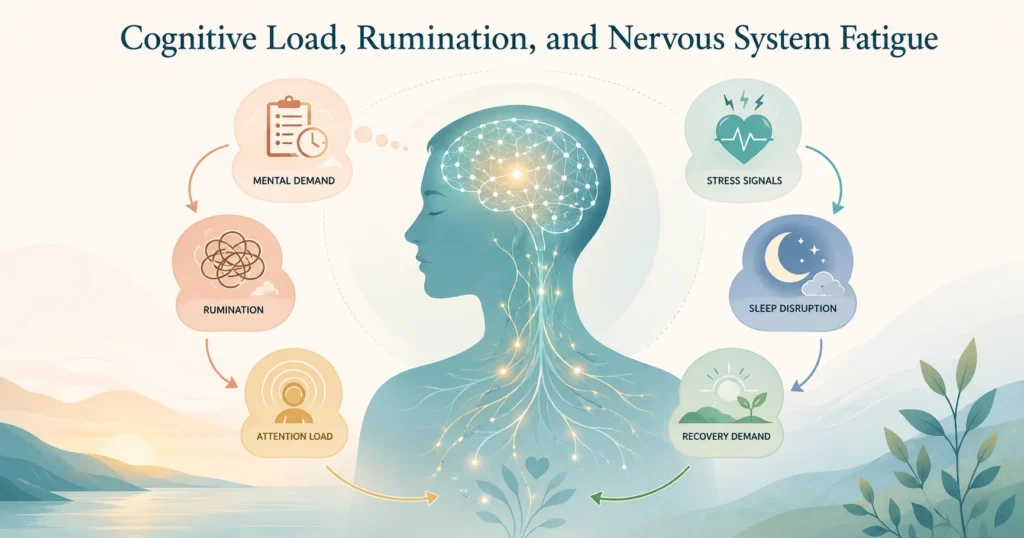
Cognitive Load, Rumination, and Nervous System Fatigue describes how mental effort, repeated thinking, and tired brain-body signals may interact. This system can affect attention, stress response, sleep quality, energy use, and recovery capacity.
In simple words, the brain can become tired when it has too much to process for too long. However, this does not mean every tired feeling is caused by the mind. Fatigue may involve sleep, stress, illness, nutrition, movement, medications, and other health factors.
This page is for education only. It does not diagnose or treat any condition. Instead, it explains how mental load and repeated thought patterns may become one layer in a wider nervous system picture.
Quick Navigation
What Is Cognitive Load, Rumination, and Nervous System Fatigue?
Cognitive Load, Rumination, and Nervous System Fatigue is a system-based way to understand mental demand. Cognitive load means the amount of mental effort used for thinking, remembering, deciding, planning, and paying attention.
Rumination means repeated thinking about the same concern, mistake, worry, symptom, or problem. It can feel like the mind is looping. As a result, the brain may stay active even when the body needs rest.
Nervous system fatigue is not a formal diagnosis in this page. Instead, it is used as an educational phrase. It describes how the body may feel worn down when attention, stress signals, sleep disruption, and recovery demand build up together.
A simple example is a phone with too many apps open. Each app uses energy. Even if one app is small, many open apps can slow the whole device. In a similar way, the brain and nervous system may feel overloaded when many mental demands stay active.
However, this system should not be viewed alone. Fatigue may also involve sleep quality, medical conditions, pain, infection, mood, stress, nutrition, medications, and many other factors. MedlinePlus notes that fatigue can be a normal response to stress or poor sleep, but it can also be linked with medical or mental health conditions.
How Cognitive Load, Rumination, and Nervous System Fatigue Works
First, the brain receives information. This may include work tasks, family needs, phone alerts, pain signals, money worries, health concerns, or daily decisions.
Next, attention tries to sort and manage this information. However, working memory has limits. Cognitive load theory describes working memory as limited, meaning too much demand can reduce mental performance and make tasks harder.
As a result, the body may use more energy for alertness and control. The person may feel mentally tired, tense, distracted, or less patient. At the same time, the nervous system may stay more alert.
Over time, rumination may keep the system active. Worry, repeated review, and “what if” thinking can extend stress-related activation beyond the original event. A review on perseverative cognition describes worry and rumination as patterns that may prolong stress-related body activation.
For this reason, Cognitive Load, Rumination, and Nervous System Fatigue is not only about thinking. It may also involve stress chemistry, breathing patterns, muscle tension, sleep rhythm, energy demand, and recovery capacity.
Key Layers of Cognitive Load, Rumination, and Nervous System Fatigue
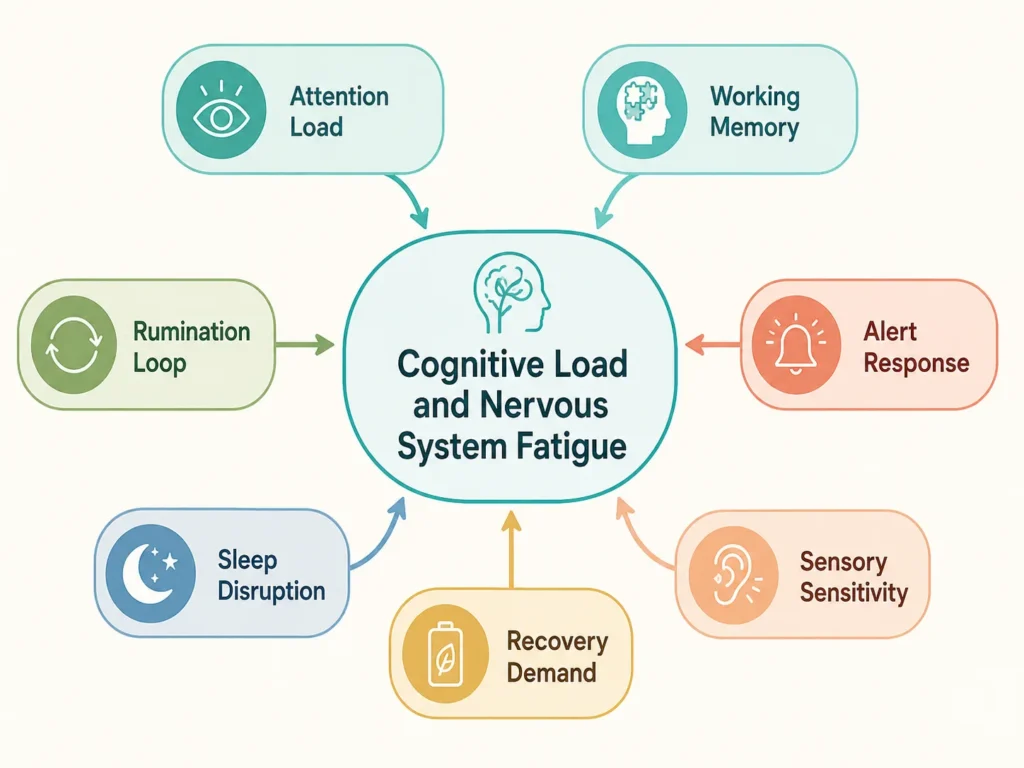
Attention Load in Cognitive Load, Rumination, and Nervous System Fatigue
Attention load means how much the mind must track at one time. This may include messages, tasks, pain, body sensations, plans, and worries. When attention load is high, the brain has less space for calm focus.
For example, a person may try to work while also thinking about sleep, symptoms, bills, family needs, and unfinished tasks. As a result, even a simple task may feel heavier.
This matters because attention uses energy. Therefore, long periods of mental load may increase recovery demand.
Working Memory Load in Cognitive Load, Rumination, and Nervous System Fatigue
Working memory helps hold information for a short time. It helps with planning, problem solving, reading, and decision-making. However, it has limits.
When too much information enters at once, working memory may feel crowded. Because of this, a person may reread the same sentence, forget small steps, or feel slower than usual.
This does not mean the brain is damaged. Instead, it may mean the system is under high demand. Rest, sleep, stress state, pain, and daily load may all shape how working memory feels.
Rumination Loop in Cognitive Load, Rumination, and Nervous System Fatigue
Rumination is repeated thinking that does not feel resolved. It may focus on a symptom, a past event, a mistake, or a future worry. Sometimes, the person may feel stuck in analysis.
This loop can increase mental effort. It may also keep the body more alert. For example, a person may lie down to rest, but the mind continues to replay the day.
Because of this, rumination may reduce the feeling of recovery. The body may be still, but the nervous system may not feel fully settled.
Alert Response in Cognitive Load, Rumination, and Nervous System Fatigue
The brain may treat repeated worry as a signal that something needs attention. As a result, the body may shift toward alertness. This may affect breathing, muscle tone, heart rhythm, and sleep readiness.
This response is not always harmful. Alertness helps people solve problems and respond to danger. However, repeated alertness may increase system demand.
For this reason, Cognitive Load, Rumination, and Nervous System Fatigue may connect with stress load. The issue is not thinking itself. The issue is when the system has little time to settle.
Sleep Disruption in Cognitive Load, Rumination, and Nervous System Fatigue
Sleep gives the brain and body time to restore. However, rumination may make it harder to shift into rest. The mind may stay active even when the body is tired.
Research has explored how worry and rumination may connect with stress and sleep quality. One recent review describes worry and rumination as possible links between stress and sleep quality.
Poor sleep may then increase next-day mental load. As a result, the person may feel more sensitive, tired, and less able to focus. This can create a cycle.
Sensory Sensitivity in Cognitive Load, Rumination, and Nervous System Fatigue
When the nervous system is tired or alert, normal input may feel stronger. Sounds, light, screens, pain signals, or body sensations may feel harder to ignore.
This does not mean the person is weak. Instead, the system may have less spare capacity. When attention and stress load are high, the brain may filter signals less smoothly.
Because of this, sensory sensitivity may become part of the fatigue picture. It may also increase the need for recovery time.
Recovery Demand in Cognitive Load, Rumination, and Nervous System Fatigue
Recovery demand means how much rest, repair, and reset the system may need. Cognitive load, rumination, poor sleep, stress, and sensory input may all add demand.
For example, a busy day with many decisions may feel more tiring if sleep was poor. In addition, worry at night may reduce recovery before the next day starts.
This is why Cognitive Load, Rumination, and Nervous System Fatigue should be viewed as a cycle. Mental effort affects the body, and the body affects mental effort.
Cognitive Load, Rumination, and Nervous System Fatigue Interactions
Cognitive Load, Rumination, and Nervous System Fatigue and the Stress System
Stress can increase alertness. It can also change breathing, muscle tone, attention, and sleep. When stress is repeated, the brain may stay on guard.
Rumination may extend this stress state. The event may be over, but the mind may keep replaying it. As a result, the body may keep responding as if the issue is still active.
This does not mean stress explains everything. However, it may be one layer that increases nervous system demand.
Cognitive Load, Rumination, and Nervous System Fatigue and Sleep
Sleep and mental load affect each other. Poor sleep may reduce focus and increase emotional reactivity. At the same time, worry and rumination may make sleep less restful.
MedlinePlus explains that poor-quality sleep can affect thinking, daily function, and physical and mental health.
Because of this, sleep rhythm is important in this system. It may shape how much mental load the brain can handle the next day.
Cognitive Load, Rumination, and Nervous System Fatigue and Pain Processing
Pain signals use attention. When the mind is already overloaded, pain may feel harder to ignore. At the same time, pain can add more cognitive load.
For example, a person may keep checking, predicting, or worrying about a sensation. This may increase attention toward the body. As a result, the symptom may feel more present.
This does not mean pain is imagined. Instead, it means attention and pain processing can interact.
Cognitive Load, Rumination, and Nervous System Fatigue and Autonomic Regulation
The autonomic nervous system helps manage heart rhythm, breathing, digestion, temperature, and stress response. Mental load can influence this system.
For example, intense focus or worry may lead to shallow breathing, jaw tension, or a tight chest. Meanwhile, these body signals may make the mind feel more alert.
Therefore, Cognitive Load, Rumination, and Nervous System Fatigue may connect with autonomic regulation. This connection is one reason the topic belongs in a body-wide system map.
Cognitive Load, Rumination, and Nervous System Fatigue and Energy Use
Thinking uses energy. The brain must process information, control attention, and manage decisions. When demand stays high, energy may feel low.
This can feel like mental fog, reduced patience, slower thinking, or low motivation. However, fatigue has many possible causes, so it should not be explained by cognitive load alone.
Instead, energy use should be viewed with sleep, stress, movement, nutrition, and medical context.
Patterns That Influence Cognitive Load, Rumination, and Nervous System Fatigue
Daily patterns can raise or lower mental demand. These patterns do not diagnose a problem. They also do not replace care. However, they can help readers understand how load builds over time.
Screen overload is one common pattern. Phones, messages, news, videos, and alerts can keep the brain switching tasks. As a result, attention may feel scattered.
Unfinished tasks can also add load. The mind may keep returning to what is not complete. Because of this, the body may feel like it is still “working” after the work is done.
Poor sleep can increase the effect of mental demand. After a short or restless night, normal tasks may feel harder. In addition, stress may feel stronger.
Pain or body discomfort can also increase cognitive load. The brain may keep tracking the sensation. Over time, this may increase worry and reduce focus.
Low recovery time may make the pattern worse. If every day includes work, worry, screens, and poor rest, the system may have little time to reset.
Cognitive Load, Rumination, and Nervous System Fatigue and Nerve Function
Cognitive Load, Rumination, and Nervous System Fatigue may connect with nerve function through attention, stress response, sleep, and sensory processing. Nerves send signals, but the brain must also interpret those signals.
When the system is tired or alert, signals may feel stronger. For example, tingling, tightness, or discomfort may take up more attention. As a result, the person may monitor the body more often.
This does not mean symptoms are “only mental.” Nerve symptoms can involve many body systems. They may relate to compression, metabolic health, inflammation, injury, sleep, stress, or other medical issues.
However, mental load can still shape the experience of symptoms. If the nervous system has less recovery capacity, it may be harder to filter signals smoothly.
In simple terms, the brain and body work together. Therefore, nerve education should include both tissue health and nervous system load.
Cognitive Load, Rumination, and Nervous System Fatigue Visual Flow
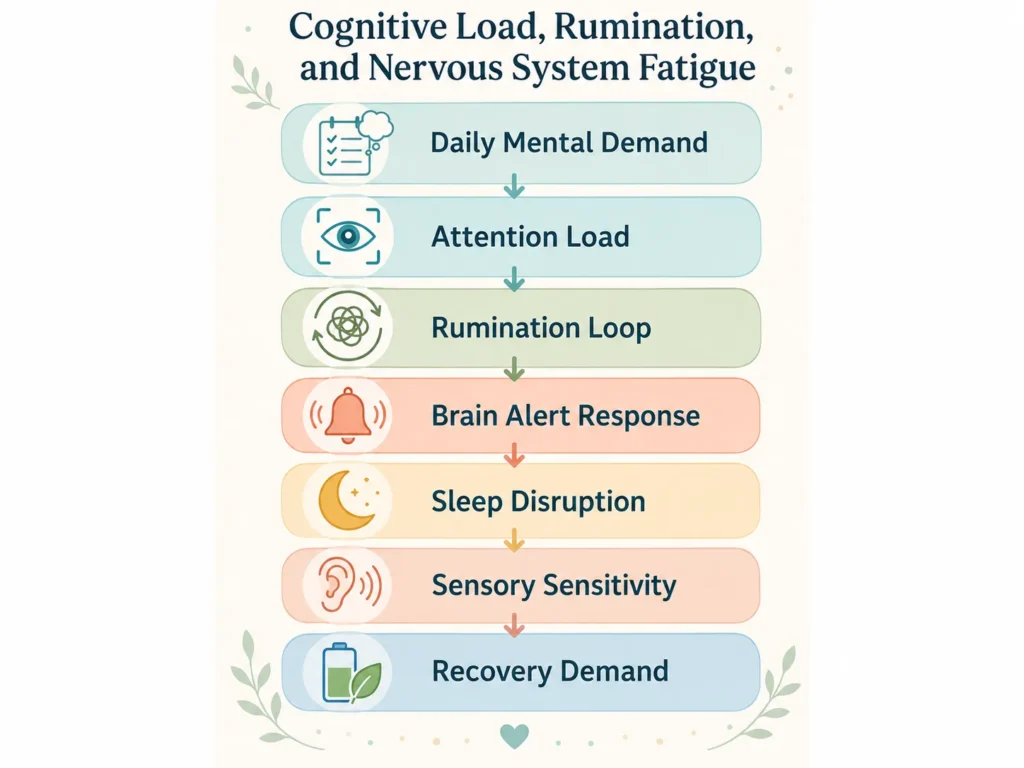
Simple Educational Flow:
Daily Mental Demand
↓
Attention Load
↓
Rumination or Repeated Thinking
↓
Brain Alert Response
↓
Stress Signals and Muscle Tension
↓
Sleep Disruption and Energy Drain
↓
Higher Sensory Sensitivity
↓
More Recovery Demand
This flow is not always straight. In many cases, it works like a loop. For example, stress may increase rumination. Rumination may affect sleep. Poor sleep may increase next-day fatigue.
Then fatigue may make normal tasks feel harder. Because of this, the person may worry more about performance, symptoms, or recovery. The cycle may continue.
Different people may notice different patterns. One person may feel brain fog. Another may feel tension, worry, poor sleep, or higher sensitivity.
This is an educational model only. It should not be used for self-diagnosis.
Why Cognitive Load, Rumination, and Nervous System Fatigue Matters for Recovery
Cognitive Load, Rumination, and Nervous System Fatigue Requires Mental Space
Recovery needs space. The body may need rest, sleep, energy, calm signals, and lower overload. However, constant mental demand can make rest feel difficult.
For example, the body may be sitting still, but the mind may still be solving problems. As a result, the system may not feel fully restored.
This is why mental space matters. It may help the nervous system shift away from constant alertness.
Cognitive Load, Rumination, and Nervous System Fatigue Requires Sleep Quality
Sleep is one of the main recovery windows. It helps restore thinking, body function, and daily performance. However, rumination may make sleep less restful.
Poor sleep can then raise next-day mental load. Therefore, sleep and cognitive load may affect each other in both directions.
This does not mean sleep is a cure. Instead, sleep is one key system that may shape recovery capacity.
Cognitive Load, Rumination, and Nervous System Fatigue Requires Energy Balance
Mental work uses energy. Emotional stress also uses energy. In addition, pain monitoring can use attention and energy.
When these demands build up, the person may feel drained. Therefore, recovery may require more than physical rest.
From a system view, energy balance includes sleep, food quality, stress load, movement, and mental pacing.
Cognitive Load, Rumination, and Nervous System Fatigue Requires Nervous System Flexibility
A flexible nervous system can shift between alertness and rest. It can focus when needed and settle when demand is lower.
However, repeated rumination may keep the system more alert. As a result, the body may feel tense even during rest.
For this reason, nervous system flexibility matters. It helps explain why recovery is not only physical.
Cognitive Load, Rumination, and Nervous System Fatigue May Increase Recovery Demand
Repeated mental load may increase recovery demand. This may happen through poor sleep, high alertness, muscle tension, or sensory sensitivity.
Over time, the system may feel less able to handle normal stress. However, this does not mean the person is broken.
Instead, it means the system may need more time, support, and lower overload. This page only explains the pattern from an educational view.
Common Misunderstandings About Cognitive Load, Rumination, and Nervous System Fatigue
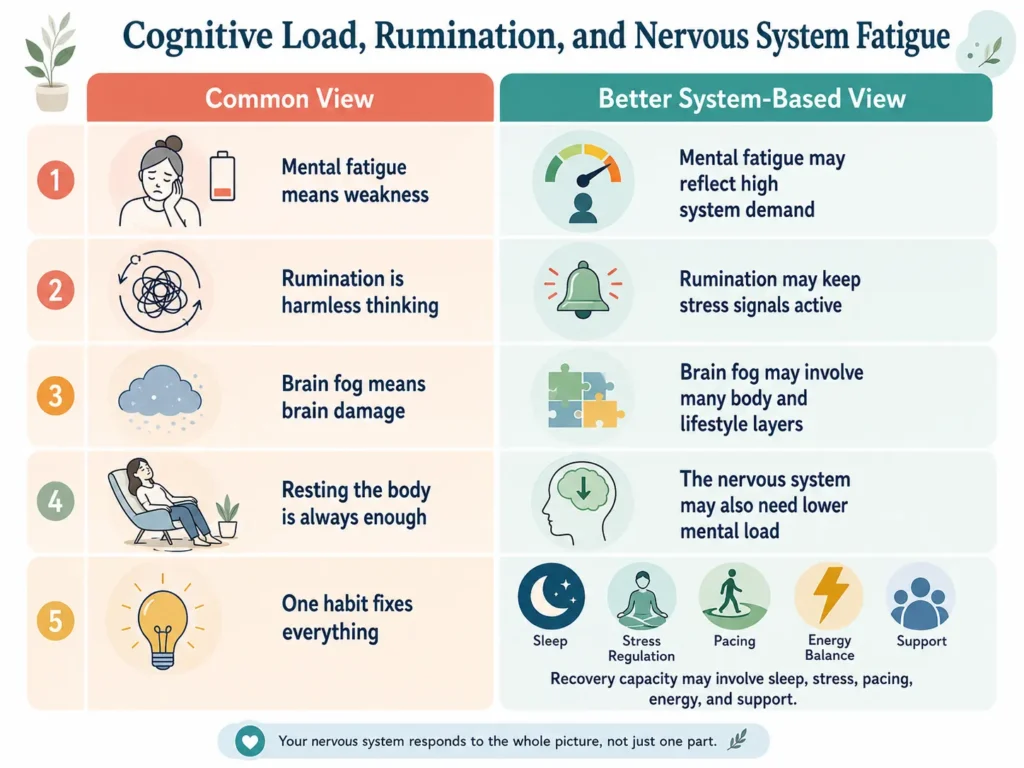
Misunderstanding 1: Mental fatigue means weakness.
Clarification:
Mental fatigue does not mean weakness. It may reflect high demand, poor sleep, stress, pain, emotional load, or other health factors. Therefore, it should be viewed with care, not judgment.
Misunderstanding 2: Rumination is just overthinking.
Clarification:
Rumination is more than casual thinking. It is repeated thinking that can feel hard to stop. It may keep stress signals active and reduce the feeling of rest.
Misunderstanding 3: Brain fog always means brain damage.
Clarification:
Brain fog can have many possible causes. These may include poor sleep, stress, illness, pain, medications, mood, nutrition, or other health issues. It should not be self-diagnosed.
Misunderstanding 4: Resting the body always rests the nervous system.
Clarification:
Physical rest does not always mean nervous system rest. If the mind keeps replaying concerns, the system may stay active.
Misunderstanding 5: One habit can fix nervous system fatigue.
Clarification:
Nervous system fatigue is usually multi-layered. Sleep, stress, daily load, pain, emotions, movement, and medical history may all matter. Therefore, no single habit should be presented as a guaranteed solution.
Cognitive Load, Rumination, and Nervous System Fatigue Comparison Table
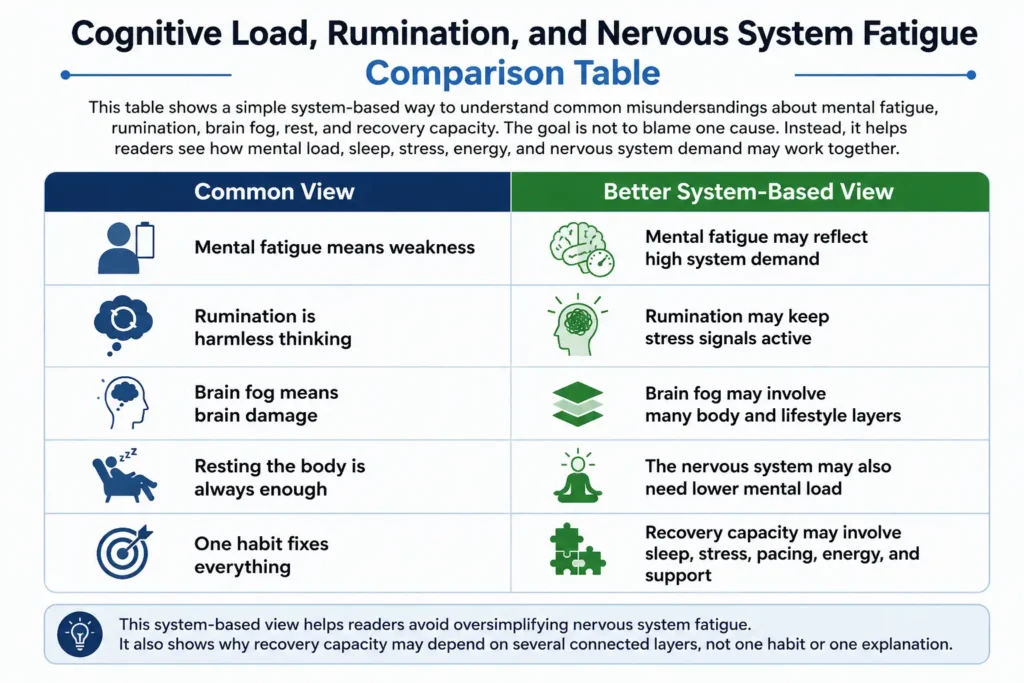
| Common View | Better System-Based View |
|---|---|
| Mental fatigue means weakness | Mental fatigue may reflect high system demand |
| Rumination is harmless thinking | Rumination may keep stress signals active |
| Brain fog means brain damage | Brain fog may involve many body and lifestyle layers |
| Resting the body is always enough | The nervous system may also need lower mental load |
| One habit fixes everything | Recovery capacity may involve sleep, stress, pacing, energy, and support |
Cognitive Load, Rumination, and Nervous System Fatigue FAQs
Can Cognitive Load, Rumination, and Nervous System Fatigue affect nerve sensitivity?
It may affect how strongly the brain notices signals. When mental load is high, the nervous system may have less room to filter input. However, nerve sensitivity can involve many systems.
Is rumination the same as anxiety?
Not always. Rumination means repeated thinking. Anxiety may include fear, worry, body tension, and alertness. They may overlap, but they are not exactly the same.
Can poor sleep make cognitive load feel worse?
Yes, poor sleep may make thinking, focus, and daily function harder. It may also increase stress sensitivity. However, ongoing sleep problems should be discussed with a healthcare professional.
Is nervous system fatigue a diagnosis?
In this page, nervous system fatigue is used as an educational phrase. It is not used as a formal diagnosis. Fatigue can have many causes.
When should fatigue be checked by a professional?
Fatigue should be checked if it is severe, new, persistent, worsening, or unexplained. It should also be checked if it comes with chest pain, trouble breathing, fainting, sudden weakness, severe numbness, or fast-changing symptoms.
Continue Learning
Mental Stress and Nervous System Load — learn how mental pressure may increase alertness, tension, sleep disruption, and recovery demand.
Sleep & Recovery — explore how sleep rhythm may support nervous system repair, energy, and daily function.
Regeneration Processes During Sleep — understand how sleep may connect with cleanup, repair timing, and recovery capacity.
Chronic Stress and Nervous System Dysregulation — learn how repeated stress may affect body-wide regulation.
Circulation & Oxygenation — explore how blood flow, oxygen delivery, and energy may connect with nerve function.
Learning Path — follow a step-by-step education path through nerve function, sensitivity, root causes, and recovery capacity.
Related Systems
Stress System — connects with alertness, worry, body tension, and recovery demand.
Autonomic Regulation — explains how the body shifts between alertness, rest, digestion, and repair.
Pain Processing — helps explain how the brain and nervous system interpret body signals.
Sleep & Recovery — connects with fatigue, mental clarity, and recovery rhythm.
Brain–Body Integration — explains how thoughts, sensations, stress, and body signals may interact.
Recovery Cycles — explains why rest and effort need timing.
Mental Stress and Nervous System Load — closely related to cognitive demand, worry, and nervous system fatigue.
Sources / References
MedlinePlus — Fatigue education. MedlinePlus explains that fatigue can be a normal response to stress, boredom, physical activity, or lack of sleep. It also notes that fatigue can sometimes be linked with mental or physical conditions.
MedlinePlus — Sleep disorder education. MedlinePlus explains that poor-quality sleep can affect thinking, daily function, and physical and mental health.
NCBI / PMC — Cognitive load education. A systematic review explains that working memory has limited capacity and that too much cognitive demand can affect performance.
PubMed — Perseverative cognition review. This review describes how worry and rumination may prolong stress-related body activation.
NCBI / PMC — Rumination, stress, and sleep education. Research discusses worry and rumination as possible links between stress and sleep quality.
These sources are used for education only. This page does not diagnose, treat, cure, or prevent disease.
Educational Trust Note
This page is part of the Heal Your Nerves Naturally education system. Its purpose is to help readers understand how mental demand, repeated thinking, sleep, stress, and recovery capacity may connect with nervous system function.
This page does not diagnose, treat, cure, or prevent disease. It does not replace medical advice, diagnosis, or treatment. Readers can also review the About page, Health Disclaimer, and Contact page.
Safety & Education Notice
This page is for education only. It does not diagnose, treat, cure, or prevent disease. It is not a substitute for medical advice, diagnosis, or treatment.
Seek urgent medical care for severe, sudden, unusual, or worsening symptoms. These may include sudden weakness, loss of bladder or bowel control, chest pain, trouble breathing, severe numbness, severe pain, confusion, fainting, or fast-changing neurological symptoms.
Because this topic involves fatigue, stress, sleep, mental load, and nervous system function, readers should not use this page to self-diagnose. They should not stop medicine, begin therapy, delay care, or replace medical evaluation.