
Environmental Factors and Nerve Health
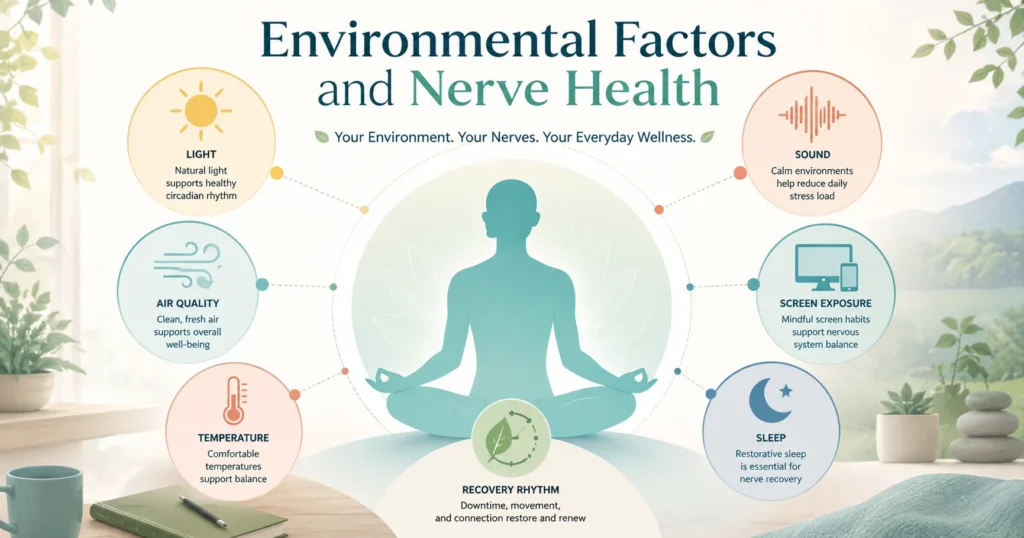
Environmental Factors and Nerve Health describes how the spaces around us may shape the body’s daily load. For example, light, noise, air quality, temperature, screen exposure, chemicals, work settings, and home surroundings may all influence how the body feels and responds.
In many cases, these factors may affect stress load, sleep rhythm, sensory input, breathing comfort, and recovery demand. Because of this, the environment can be understood as one background layer in nervous system education.
However, this does not mean the environment explains every nerve symptom. Instead, it may be one part of a wider body system. Nerve sensitivity, fatigue, sleep disruption, muscle tension, and recovery capacity may involve many connected patterns.
For this reason, Environmental Factors and Nerve Health should be viewed with balance. Daily surroundings may matter, but they should not be used for self-diagnosis or fear-based conclusions.
In simple terms, this page explains how Environmental Factors and Nerve Health may connect with the nervous system. It is not a diagnosis or treatment plan. Instead, it is a calm educational guide to help readers understand how daily surroundings, body load, and recovery needs may work together.
Quick Navigation
What Is Environmental Factors and Nerve Health?
Environmental Factors and Nerve Health is a system-based way to understand how surroundings may affect body load. The environment is not only outdoor pollution. It also includes indoor air, light exposure, sound, temperature, screens, work pressure, home setup, and daily sensory input.
The environment can affect health in many ways. MedlinePlus explains that air, water, soil, and other environmental conditions may influence health when polluted or unsafe. NIEHS also describes environmental health as the study of how the environment affects biological systems across life.
For nerve health education, this matters because the nervous system receives signals all day. It responds to light, sound, temperature, air quality, posture, activity, stress, and sleep timing. Therefore, the environment may shape the background load that the nervous system must manage.
A simple example is a room with bright lights, noise, poor air, and constant phone alerts. Each factor may seem small. However, together they may increase alertness, reduce rest, and raise sensory demand.
Because of this, Environmental Factors and Nerve Health should not be viewed as one simple cause. Instead, it should be viewed as a group of daily inputs that may affect stress load, sleep rhythm, energy, and recovery capacity.
How Environmental Factors and Nerve Health Works
First, the body receives signals from the environment. These signals may include light, sound, temperature, air quality, screen input, smells, physical surroundings, and social pressure.
Next, the nervous system helps decide how to respond. For example, bright light may affect alertness. Loud noise may raise stress. Poor air quality may affect breathing comfort. Heat or cold may change body comfort and energy demand.
As a result, the body may adjust breathing, muscle tone, heart rhythm, attention, sleep timing, and stress response. These changes are normal. However, repeated or intense environmental load may increase demand over time.
Over time, the system may have less room to recover. For example, poor sleep from late-night light, stress from noise, or low movement from indoor work may add to the same recovery burden.
For this reason, Environmental Factors and Nerve Health is not only about toxins or pollution. It is also about daily surroundings, sensory load, recovery rhythm, and nervous system regulation.
Key Layers of Environmental Factors and Nerve Health
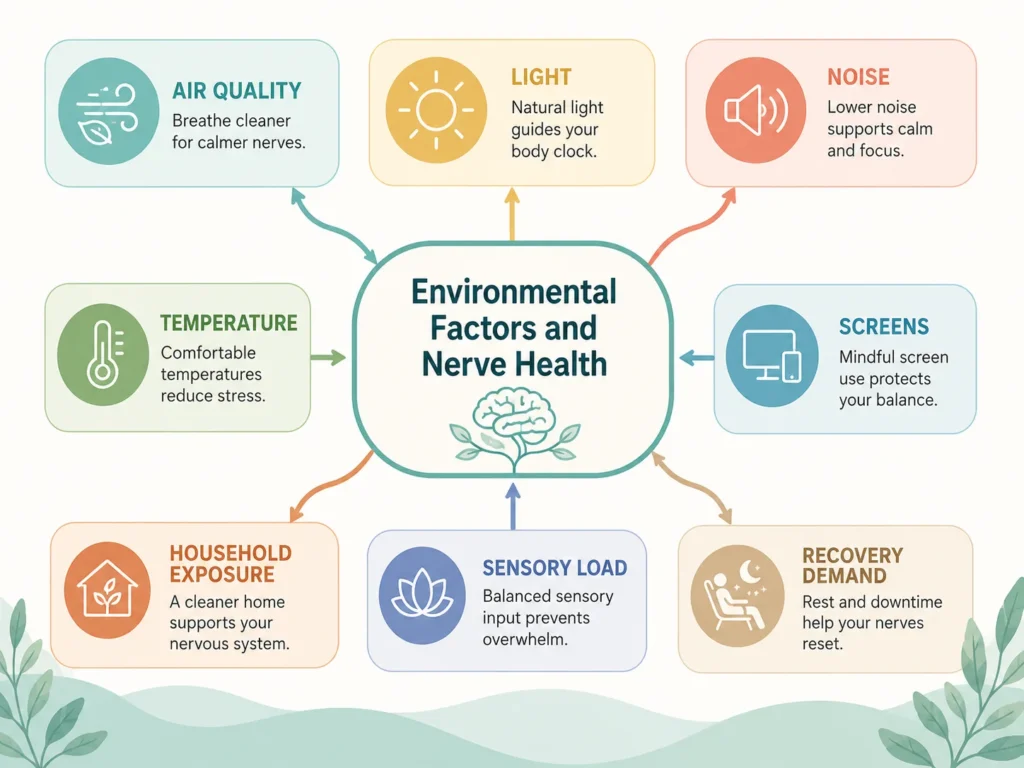
Air Quality in Environmental Factors and Nerve Health
Air quality includes outdoor air and indoor air. Outdoor air may include smoke, traffic pollution, dust, and other pollutants. Indoor air may include cleaning smells, mold, poor ventilation, smoke, or chemical exposure.
Air quality matters because breathing is linked with body comfort and oxygen exchange. NIEHS explains that air pollution can affect health in many ways and can come from both outdoor and indoor sources.
For nerve health education, air quality may be one environmental layer. It does not explain every symptom. However, poor air may increase body stress, reduce comfort, and affect sleep or recovery in some people.
Light Exposure in Environmental Factors and Nerve Health
Light helps the brain understand time. Morning light may help the body feel more awake. Evening and night light may affect the body clock and sleep timing.
Research reviews explain that light can affect circadian rhythms, sleep, and mood. In simple terms, light exposure can help set the body’s daily rhythm. However, timing matters.
For nerve health education, sleep rhythm is important because poor sleep may increase fatigue and sensitivity. Therefore, light is not just a vision topic. It may also connect with recovery capacity.
Noise Load in Environmental Factors and Nerve Health
Noise is another environmental layer. Loud or repeated sound may affect attention, sleep, stress, and hearing health. The CDC notes that repeated workplace noise exposure at or above 85 dBA over an eight-hour workday can raise the risk of hearing loss.
Noise may also increase alertness. Even when it is not very loud, repeated noise can make it harder to rest, focus, or sleep well. Public health sources also describe chronic noise as a possible stress and sleep disruption factor.
For nerve-related education, noise may matter because the nervous system processes sound as input. If the system is already tired, stressed, or sensitive, sound may feel stronger.
Temperature and Comfort in Environmental Factors and Nerve Health
Temperature can affect comfort, sleep, muscle tension, and energy use. Heat may feel draining. Cold may increase stiffness or tension in some people. However, responses can differ from person to person.
This does not mean temperature directly causes nerve problems. Instead, temperature may affect the body’s comfort level and recovery demand.
For example, a hot room may disturb sleep. A cold work area may increase body tension. Over time, these patterns may add to stress load or fatigue.
Screen and Digital Load in Environmental Factors and Nerve Health
Screens can add light, attention demand, posture load, and mental stimulation. Phones, computers, messages, videos, and alerts can keep the brain switching tasks.
This may matter because the nervous system needs quiet periods. If screens continue late into the night, they may also interact with sleep timing through light and mental stimulation.
Because of this, screen exposure belongs in Environmental Factors and Nerve Health. It is not only about eyesight. It may also connect with attention load, sleep, posture, and recovery rhythm.
Chemical and Household Exposure in Environmental Factors and Nerve Health
Household environments may include cleaning products, fragrances, smoke, pesticides, solvents, dust, or other exposures. Some people may notice strong smells or indoor irritants more than others.
This page does not give detox advice. It also does not claim that chemicals explain nerve symptoms. However, environmental health education recognizes that polluted air, water, soil, or unsafe exposures may affect health.
For this reason, chemical exposure should be discussed carefully. It is a health-sensitive topic and should not be used for self-diagnosis or fear-based conclusions.
Sensory Load in Environmental Factors and Nerve Health
Sensory load means how much input the nervous system receives. It may include light, sound, touch, smell, movement, screens, pain signals, and social demand.
When the nervous system is calm, these inputs may feel manageable. However, when the system is tired or stressed, the same input may feel stronger.
This helps explain why Environmental Factors and Nerve Health is a useful topic. It shows how surroundings may affect the nervous system’s daily workload.
Environmental Factors and Nerve Health Interactions
Environmental Factors and Nerve Health and the Stress System
The stress system responds to demand. Noise, bright light, crowded spaces, poor sleep, and heavy workload may all increase alertness.
This does not mean the environment is always harmful. Many environmental signals are normal. However, repeated overload may keep the body more alert than needed.
Because of this, Environmental Factors and Nerve Health connects closely with stress load, muscle tension, breathing rhythm, and recovery demand.
Environmental Factors and Nerve Health and Sleep
Sleep is strongly shaped by the environment. Light, noise, temperature, screens, and air quality may all affect sleep quality. Research on light shows that timing of light exposure can influence circadian rhythm and sleep patterns.
Poor sleep may then affect next-day energy, focus, mood, and sensitivity. As a result, the environment may affect recovery capacity through sleep.
For this reason, sleep should be part of any Environmental Factors and Nerve Health discussion.
Environmental Factors and Nerve Health and Sensory Sensitivity
Sensory sensitivity means normal input may feel stronger than expected. This may include sound, light, temperature, touch, or body sensations.
Environmental load may increase this feeling. For example, noise plus poor sleep plus screen overload may make the nervous system feel less settled.
This does not mean the person is weak. Instead, it may mean the system has less spare capacity.
Environmental Factors and Nerve Health and Circulation
Environment may influence circulation through temperature, activity level, stress, hydration, and air quality. For example, heat may increase fluid demand. Cold may change muscle tension. Stress may affect vessel tone.
This connection does not mean environment causes circulation problems. Instead, it means surroundings may influence how the body manages comfort, blood flow, and recovery demand.
Because of this, Environmental Factors and Nerve Health connects well with Circulation & Oxygenation.
Environmental Factors and Nerve Health and Recovery Systems
Recovery systems need rest, energy, sleep, calm signals, and lower overload. A stressful environment may make recovery feel harder.
For example, a noisy room may make sleep lighter. A bright screen at night may delay rest. Poor air may reduce comfort. Repeated interruptions may keep the mind alert.
Therefore, Environmental Factors and Nerve Health may influence recovery capacity by shaping the body’s daily background load.
Patterns That Influence Environmental Factors and Nerve Health
Daily surroundings can either reduce or increase system demand. These patterns do not diagnose disease. They also do not replace medical care. However, they can help readers understand how environment and body load may connect.
One pattern is late-night screen use. Screens may add light and mental stimulation. Because of this, the body may have more trouble shifting into rest.
Another pattern is constant noise. Traffic, devices, loud workspaces, and household sounds may keep the nervous system alert. Over time, this may affect focus, sleep, or stress load.
Indoor air quality is another layer. Poor ventilation, smoke, mold, dust, or strong smells may affect comfort for some people. Because of this, the indoor environment can matter as much as the outdoor environment.
Work setup may also play a role. Long sitting, poor lighting, clutter, repeated alerts, and time pressure may add physical and mental demand.
Temperature and comfort matter as well. A room that is too hot, too cold, or poorly ventilated may make rest and focus harder.
Finally, recovery space matters. The nervous system often needs periods of lower input. Without quiet time, the system may stay more activated.
Environmental Factors and Nerve Health and Nerve Function
Environmental Factors and Nerve Health may connect with nerve function through stress response, sleep, sensory input, breathing comfort, and recovery demand. Nerves send signals, but the brain and body must process those signals in context.
For example, poor sleep may make the nervous system more sensitive. Noise may increase alertness. Bright light at the wrong time may disturb rhythm. Heat, cold, or poor air may affect comfort.
This does not mean environmental factors directly cause nerve symptoms. Nerve symptoms can involve many causes, including compression, injury, metabolic health, inflammation, vitamin issues, stress, sleep, and medical conditions.
However, environmental load may shape how strongly signals are noticed. If the system is already tired, stressed, or under-recovered, normal input may feel more intense.
In simple terms, the nervous system does not work in isolation. It works inside a body, and the body works inside an environment.
Environmental Factors and Nerve Health Visual Flow
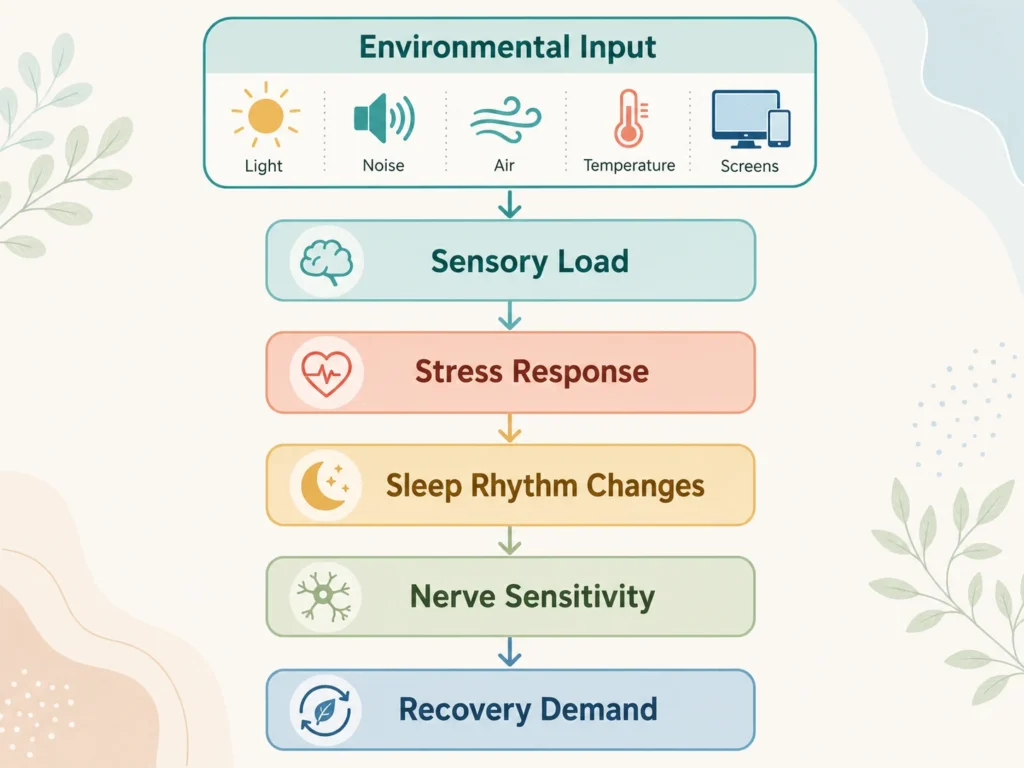
Simple Educational Flow:
Environmental Input
↓
Light, Noise, Air, Temperature, Screens, and Daily Surroundings
↓
Sensory Load and Stress Response
↓
Sleep Rhythm, Breathing Comfort, and Muscle Tension
↓
Nerve Sensitivity and Energy Demand
↓
Recovery Capacity or Recovery Demand
This flow is not always straight. In many cases, it works like a cycle. For example, noise may affect sleep. Poor sleep may increase sensitivity. Higher sensitivity may make noise feel stronger the next day.
Different people may respond in different ways. One person may be more affected by light. Another may be more affected by noise, smell, heat, cold, or screens.
This model is for education only. It should not be used for self-diagnosis.
Why Environmental Factors and Nerve Health Matters for Recovery
Environmental Factors and Nerve Health Requires Lower Background Load
Recovery is easier when the body has fewer demands to manage. If the environment is noisy, bright, stressful, or uncomfortable, the nervous system may stay more alert.
However, this does not mean every environment must be perfect. Instead, it means background load may matter.
From a system view, small changes in daily surroundings may help explain why some days feel more draining than others.
Environmental Factors and Nerve Health Requires Sleep Rhythm
Sleep is one of the body’s main recovery windows. Light, noise, screens, temperature, and stress can all shape sleep quality.
Because of this, Environmental Factors and Nerve Health is closely linked with sleep rhythm. A better sleep environment may support a better recovery setting, but it should not be presented as a cure.
Sleep is one part of a larger recovery system.
Environmental Factors and Nerve Health Requires Sensory Regulation
The nervous system processes input all day. Too much sound, light, screen activity, or social demand may increase sensory load.
When sensory load is high, the body may need more recovery time. This is especially important for people who already feel fatigued, stressed, or sensitive.
Therefore, sensory regulation is a key part of environmental education.
Environmental Factors and Nerve Health Requires Body Comfort
Body comfort includes temperature, posture, air quality, lighting, and movement space. These factors may affect how tense, tired, or settled a person feels.
For example, poor lighting may increase eye strain. A loud room may increase alertness. A hot room may disturb rest. A poor work setup may add mechanical load.
Because of this, body comfort can shape recovery demand.
Environmental Factors and Nerve Health May Increase Recovery Demand
Repeated environmental load may increase recovery demand. This may happen through poor sleep, stress activation, sensory overload, or physical discomfort.
Over time, the body may feel less able to reset. However, this does not mean the person is damaged.
Instead, it means the body may be responding to many inputs at once. This page explains the pattern from a safe educational view.
Common Misunderstandings About Environmental Factors and Nerve Health
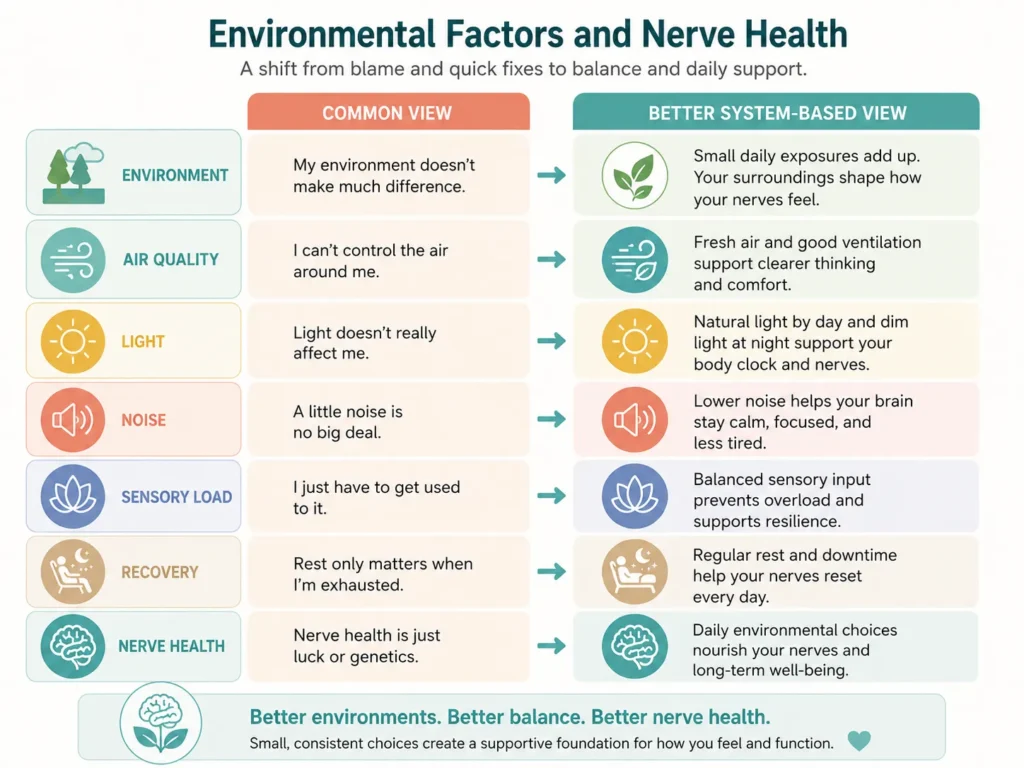
Misunderstanding 1: The environment explains every nerve symptom.
Clarification:
Environmental factors may be one layer. However, nerve symptoms may involve many causes. These may include compression, injury, inflammation, metabolic issues, sleep, stress, vitamin status, or medical conditions.
Misunderstanding 2: Only outdoor pollution matters.
Clarification:
Outdoor pollution can matter, but indoor surroundings matter too. Light, sound, air quality, temperature, screens, and work setup may all shape daily body load.
Misunderstanding 3: Sensitivity means weakness.
Clarification:
Sensitivity does not mean weakness. It may mean the nervous system is handling high load, poor sleep, stress, or many signals at once.
Misunderstanding 4: A perfect environment is required for recovery.
Clarification:
A perfect environment is not realistic. The goal is not perfection. Instead, the goal is understanding how repeated load may affect the body.
Misunderstanding 5: Environmental health means detox protocols.
Clarification:
This page does not teach detox protocols. Environmental health education is about understanding surroundings, exposure, body load, and safety. Medical concerns should be discussed with qualified professionals.
Environmental Factors and Nerve Health Comparison Table
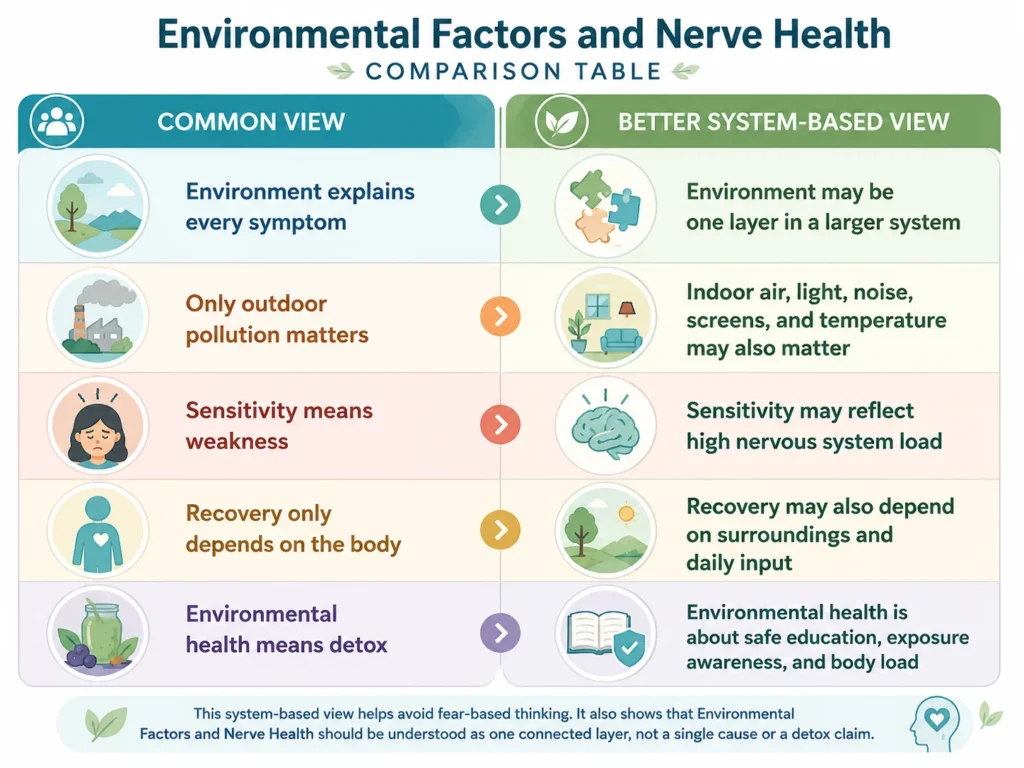
| Common View | Better System-Based View |
|---|---|
| Environment explains every symptom | Environment may be one layer in a larger system |
| Only outdoor pollution matters | Indoor air, light, noise, screens, and temperature may also matter |
| Sensitivity means weakness | Sensitivity may reflect high nervous system load |
| Recovery only depends on the body | Recovery may also depend on surroundings and daily input |
| Environmental health means detox | Environmental health is about safe education, exposure awareness, and body load |
Environmental Factors and Nerve Health FAQs
Can Environmental Factors and Nerve Health affect nerve sensitivity?
Environmental factors may affect stress load, sleep, sensory input, and recovery demand. These layers may influence how strongly the nervous system responds. However, nerve sensitivity can have many causes.
Can noise affect the nervous system?
Noise can affect hearing, sleep, attention, and stress. CDC guidance also notes that repeated loud workplace noise can increase hearing loss risk. Sudden or severe hearing changes should be checked by a professional.
Can light affect sleep and recovery?
Light can affect circadian rhythm and sleep timing. Research shows that light exposure can influence sleep and mood. Because sleep is a recovery window, light timing may matter.
Does air quality matter for nerve health?
Air quality can affect overall health and breathing comfort. It may also shape body stress load. However, it should not be used to self-diagnose nerve symptoms.
Are environmental factors the same as toxins?
No. Environmental factors include many things, such as light, noise, air, temperature, screens, posture, and surroundings. Toxins are only one possible category.
When should someone seek medical care?
Seek medical care for severe, sudden, unusual, or worsening symptoms. This includes sudden weakness, severe numbness, chest pain, trouble breathing, fainting, confusion, or fast-changing neurological symptoms.
Continue Learning
Circulation & Oxygenation — explore how blood flow, oxygen delivery, and energy may connect with nerve function.
Sleep & Recovery — learn how sleep rhythm may support repair, energy, and nervous system stability.
Cognitive Load, Rumination, and Nervous System Fatigue — understand how mental demand, repeated thinking, and sensory load may affect recovery demand.
Mental Stress and Nervous System Load — learn how stress, attention load, tension, and recovery capacity may interact.
Lifestyle Healing — explore how daily patterns may shape body-wide health education.
Learning Path — follow a step-by-step education path through nerve function, sensitivity, root causes, and recovery capacity.
Related Systems
Stress System — connects with alertness, worry, tension, and recovery demand.
Sleep & Recovery — explains how sleep rhythm may support repair and nervous system regulation.
Circulation & Oxygenation — connects with air quality, breathing comfort, blood flow, and energy.
Cognitive Load, Rumination, and Nervous System Fatigue — connects with screen load, attention demand, rumination, and sensory overload.
Mental Stress and Nervous System Load — explains how daily stress may increase system demand.
Light Therapy — should be explained with strong safety language and no treatment claims.
Thermal Therapy — should be explained with strong safety language and no treatment claims.
Toxic Load System — connects with careful education about exposure, safety, and body burden without detox claims.
Sources / References
The following sources are used for educational context only. They help readers understand how environmental factors may relate to health, sleep, stress load, sensory input, and recovery demand. However, these sources should not be used for self-diagnosis or treatment decisions.
MedlinePlus — Environmental Health
MedlinePlus explains that the environment can affect health in different ways. For example, air, water, soil, pollution, and unsafe exposures may all play a role in overall health. Because of this, environmental health can be understood as one important layer in whole-body education.
NIEHS — Environmental Health and Air Pollution
NIEHS studies how environmental factors may affect biological systems. In addition, NIEHS explains that air pollution can affect health in many ways. This source is useful because it helps show why air quality may be part of a wider Environmental Factors and Nerve Health discussion.
CDC / NIOSH — Noise Exposure
CDC / NIOSH explains that repeated noise exposure at or above 85 dBA over an eight-hour workday can increase the risk of hearing loss. Therefore, noise should not be viewed only as an annoyance. It may also be part of sensory load, stress response, sleep disruption, and long-term health education.
NCBI / PMC — Light, Circadian Rhythm, Sleep, and Mood
Research reviews explain that light exposure can affect circadian rhythm, sleep, and mood. For this reason, light is not only a vision-related topic. It may also help readers understand how timing, screen exposure, sleep rhythm, and recovery capacity may connect.
Public Health Noise Research
Public health research suggests that chronic noise may affect sleep, stress, and long-term health risk. However, this does not mean noise explains every symptom. Instead, it shows that repeated environmental input may become one layer in a larger body-wide system.
These sources are included to improve trust and educational accuracy. At the same time, this page does not diagnose, treat, cure, or prevent disease.
Educational Trust Note
This page is part of the Heal Your Nerves Naturally education system. Its purpose is to help readers understand how surroundings, sensory input, sleep rhythm, stress load, and recovery capacity may connect with nerve health education.
However, this page is not medical advice. It does not diagnose, treat, cure, or prevent disease. Instead, it offers a calm and system-based learning view.
In addition, readers should remember that nerve symptoms can have many possible causes. Environmental factors may be one layer, but they should not be used as the only explanation.
For more context, readers can also review the About page, Health Disclaimer, and Contact page. These pages explain the educational purpose of the website and the limits of the information shared here.
Safety & Education Notice
This page is for education only. It does not diagnose, treat, cure, or prevent disease. It is not a substitute for medical advice, diagnosis, or treatment.
Environmental factors may include air quality, light, noise, temperature, screens, chemicals, household exposure, and daily surroundings. However, readers should not use this information to self-diagnose symptoms or make medical decisions on their own.
Seek urgent medical care for severe, sudden, unusual, or worsening symptoms. These may include sudden weakness, loss of bladder or bowel control, chest pain, trouble breathing, severe numbness, severe pain, confusion, fainting, or fast-changing neurological symptoms.
Because this topic may involve environmental exposure, air quality, chemicals, sleep, stress, and nervous system symptoms, readers should use extra caution. They should not stop medicine, begin detox protocols, start unproven therapies, delay care, or replace medical evaluation based on this page.
Instead, this page should be used as a safe educational guide. Its goal is to help readers understand how the environment may add to body load, sensory demand, sleep disruption, and recovery needs within a larger nervous system picture.