
Regeneration Biology: A Clear Guide to Nervous System Repair
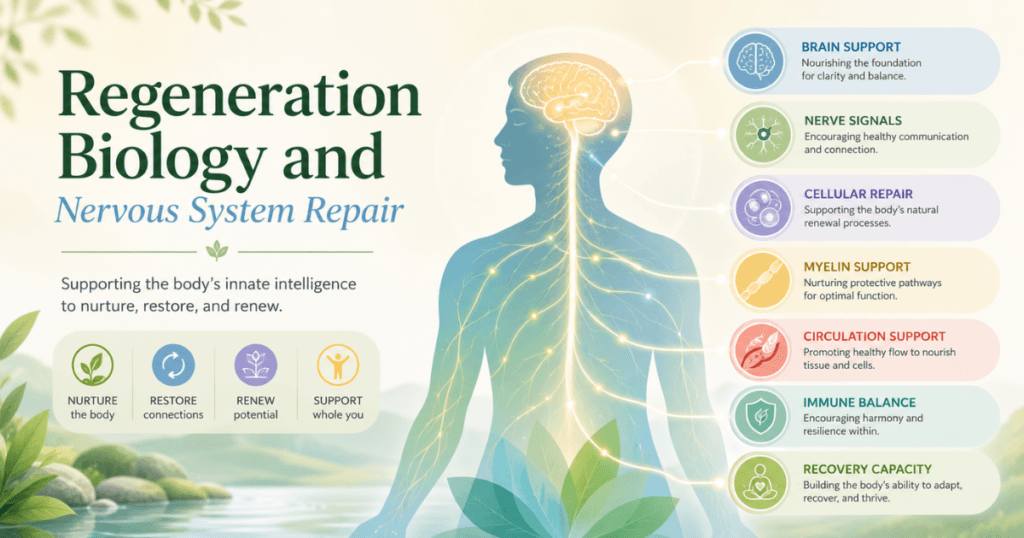
Regeneration Biology explains how the nervous system may support repair, renewal, and better balance after stress or strain. In simple terms, it looks at how nerve-related systems may respond when the body needs recovery support.
However, regeneration is not a quick fix. It is also not one simple event. Instead, it is a slow and layered process.
For example, nerve repair support may involve cell energy, blood flow, immune signals, myelin support, and nervous system regulation. At the same time, stress, poor sleep, inflammation, or overload may raise recovery demand.
This page is educational only. It does not diagnose, treat, cure, or prevent disease. Therefore, use it as a learning guide, not as medical advice.
Quick Navigation
What Is Regeneration Biology?
Regeneration Biology is the study of how living systems may repair, renew, and adapt after stress or damage.
In nerve health education, this topic helps explain how the nervous system may support repair over time. It may involve nerve cells, support cells, immune signals, blood flow, and signal balance.
Still, regeneration should not be seen as a guaranteed result. The body is complex. Many factors may shape recovery.
For example, sleep may affect repair capacity. Blood flow may support delivery. Immune signals may help guide repair. Meanwhile, high stress may increase nervous system load.
Because of this, Regeneration Biology is best understood as a system. One layer may support another layer. Also, one strained layer may add pressure to the whole system.
This topic connects with Neural Signaling, because repair support depends on clear communication. It also connects with the Myelin System, because myelin helps many nerve signals move smoothly.
How Regeneration Biology Works
Regeneration Biology may begin when the body senses stress, strain, or repair demand.
First, the nervous system receives information from the body. This may include pain signals, movement feedback, inflammation, pressure, fatigue, or stress state.
Next, cells and support systems respond. Some cells may help clean waste. Others may support repair, protection, or energy use.
After that, blood flow may help deliver oxygen and nutrients. This matters because repair needs both energy and materials.
Over time, the nervous system may adapt. Signals may become calmer. Movement may feel safer. Recovery demand may also change.
However, this process is not always straightforward. Some days may feel better. Other days may feel more sensitive.
For this reason, Regeneration Biology should be viewed as a learning model. It should not be used to predict recovery or diagnose symptoms.
Key Layers of Regeneration Biology
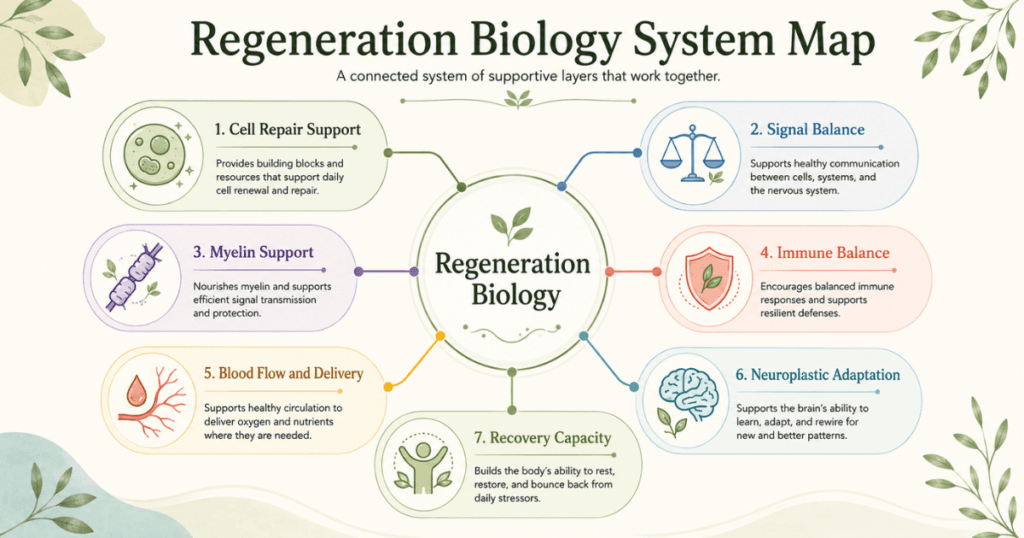
1. Cell Repair Support
Cells need energy to repair normal stress.
Nerve-related cells also need support for structure, signals, and protection. So, cell repair is one key layer of Regeneration Biology.
However, repair does not happen in isolation. Sleep, blood flow, immune balance, nutrition quality, and stress load may all shape the body environment.
As a result, cell repair is best understood as part of a whole system.
2. Signal Balance
Nerves send messages all day.
These messages help the body feel, move, protect, and respond. Because of this, signal balance matters for nerve function.
When signals are too strong or unclear, the nervous system may become more protective. As a result, sensitivity may rise.
Regeneration Biology includes signal balance because repair is not only about tissue. It also involves how the nervous system communicates.
This layer connects with Neural Signaling.
3. Myelin Support
Myelin is a protective layer around many nerves.
In simple terms, it helps nerve messages move more smoothly. It also supports timing and signal speed.
Regeneration Biology may include myelin support as one repair-related layer. However, symptoms alone cannot confirm myelin problems.
For this reason, myelin should be learned carefully. Readers can continue with Myelin System for more details.
4. Immune and Inflammatory Balance
The immune system can help protect the body.
It may also support clean-up and repair signals. However, too much unresolved inflammation may add stress.
Because of this, immune balance matters. The goal is not to fear inflammation. Instead, the goal is to understand timing and balance.
This layer connects with Neuroinflammation.
5. Blood Flow and Delivery
Repair needs delivery.
Blood flow helps bring oxygen and nutrients to tissues. It also helps remove waste.
Therefore, blood flow is a key support layer in Regeneration Biology.
Still, circulation works with other systems. Movement, breathing, sleep, stress state, and energy balance may all interact with it.
6. Neuroplastic Adaptation
Neuroplasticity means the nervous system can change.
This can support learning, movement, balance, and body awareness. It may also help the system adapt to safer patterns over time.
However, the nervous system can also adapt to stress. So, repeated stress may keep the system protective.
For this reason, Neuroplasticity is closely connected to Regeneration Biology.
7. Recovery Capacity
Recovery capacity means how well the body returns to balance after stress.
It may include sleep, rest, energy, blood flow, emotional safety, movement tolerance, and stress regulation.
When recovery demand is higher than recovery capacity, the body may stay under pressure. As a result, sensitivity may feel stronger.
Because of this, recovery capacity is one of the most important layers of Regeneration Biology.
System Interactions
Regeneration Biology does not work alone.
Instead, it depends on many body systems. These systems may support or strain each other.
Nervous System Interaction
The nervous system guides sensation, movement, protection, and response.
When the body feels unsafe, the nervous system may increase sensitivity. This can be protective in the short term.
Over time, strong protective signals may raise recovery demand. Therefore, repair support may also need better regulation.
Neural Signaling
Neural signaling is how nerves communicate.
Clear signals help the body sense and respond smoothly. Strained signals may make the body feel more reactive.
Because of this, Neural Signaling is a key related system.
In simple terms, repair support also needs message clarity.
Pain Processing Interaction
Pain is real.
However, pain does not always mean damage. It may involve the brain, spinal cord, nerves, stress, memory, and body state.
Regeneration Biology may interact with Pain Processing because recovery often includes better signal tolerance.
Still, pain should not be used alone to judge repair.
Neuroinflammation
Neuroinflammation means immune activity around the nervous system.
This activity may affect sensitivity, cell stress, and recovery demand.
However, inflammation is not always harmful. It can also be part of repair.
For this reason, balance matters more than fear.
Myelin System Interaction
The Myelin System supports signal speed and smooth timing.
When myelin support is part of recovery education, it should be discussed carefully. It is one layer, not a diagnosis.
Therefore, myelin support works best as part of a larger view that includes signals, energy, blood flow, and regulation.
Autonomic Regulation
The autonomic nervous system helps manage stress and the recovery state.
It affects breathing, heart rate, blood flow, digestion, sleep, and alertness.
When this system is under pressure, the body may stay in alert mode. As a result, recovery may feel harder.
This topic connects with Autonomic Regulation.
Regeneration Biology and Degeneration Pathways
Degeneration and regeneration are connected topics.
Degeneration Pathways describe stress, strain, and reduced function. Regeneration Biology explains the repair and support side.
For this reason, both topics should be learned together.
Patterns That Influence Repair Support
Daily patterns may influence Regeneration Biology.
These patterns do not diagnose or treat disease. However, they may shape the body environment where recovery happens.
Sleep Rhythm
Sleep helps the nervous system reset.
It also supports repair, memory, energy, and regulation. Poor sleep may raise recovery demand.
As a result, the body may feel more sensitive after weak sleep.
Over time, a better sleep rhythm may support a calmer recovery environment.
Stress Patterns
Stress affects the whole body.
It may change breathing, heart rate, blood flow, digestion, sleep, and pain sensitivity.
Long-term stress may keep the nervous system in alert mode. Because of this, repair support may feel harder.
Still, stress is not about blame. It is one system signal among many.
Movement Patterns
Movement gives the nervous system feedback.
It also supports blood flow, balance, coordination, and body awareness.
Too little movement may reduce helpful input. Too much forced movement may add stress.
Therefore, movement should be seen as communication between the body and brain.
Nutrition Quality
Cells need building blocks.
They also need steady energy. Nutrition quality may support the general body environment.
However, this page does not give diet plans. It also does not recommend supplements.
Instead, nutrition is presented as one support layer in a larger system.
Circulation
Circulation helps deliver oxygen and nutrients.
It also supports waste clearance. So, blood flow may affect the environment around nerve repair.
However, circulation does not work alone. Movement, breathing, sleep, and stress state may all influence it.
Inflammatory Load
Inflammation may help the body respond to stress.
Yet, unresolved inflammatory load may add pressure to the nervous system.
For this reason, inflammation should be understood in balance. It is not always bad. It is not always helpful either.
Emotional Safety
The nervous system responds to safety and threat.
When the body feels unsafe, it may stay alert. This may affect breathing, sleep, muscle tone, and sensitivity.
Safer body states may support better regulation. However, emotions alone do not control recovery.
Instead, emotional safety is one part of a larger system.
Regeneration Biology and Nerve Function
Regeneration Biology may relate to nerve function through many layers.
These layers may include cell repair, signal balance, myelin support, blood flow, immune timing, and recovery capacity.
For example, clear signals may support better communication. Better blood flow may support delivery. Balanced immune activity may help repair timing.
At the same time, calmer regulation may reduce excess protective load.
However, this page does not claim to cure nerve symptoms. It also does not say that any symptom proves repair is happening.
Nerve-related feelings can have many causes. These may include tingling, burning, numbness, pain, weakness, fatigue, or body-wide sensitivity.
Therefore, readers should not self-diagnose. Sudden, severe, unusual, or worsening symptoms should be checked by a qualified professional.
From a system view, nerve function needs support. It needs clear signals, energy, protection, blood flow, and recovery time.
Because of this, readers may also benefit from Regeneration Systems, Root-Cause Systems, and Therapeutic Systems.
Regeneration Biology Visual Flow
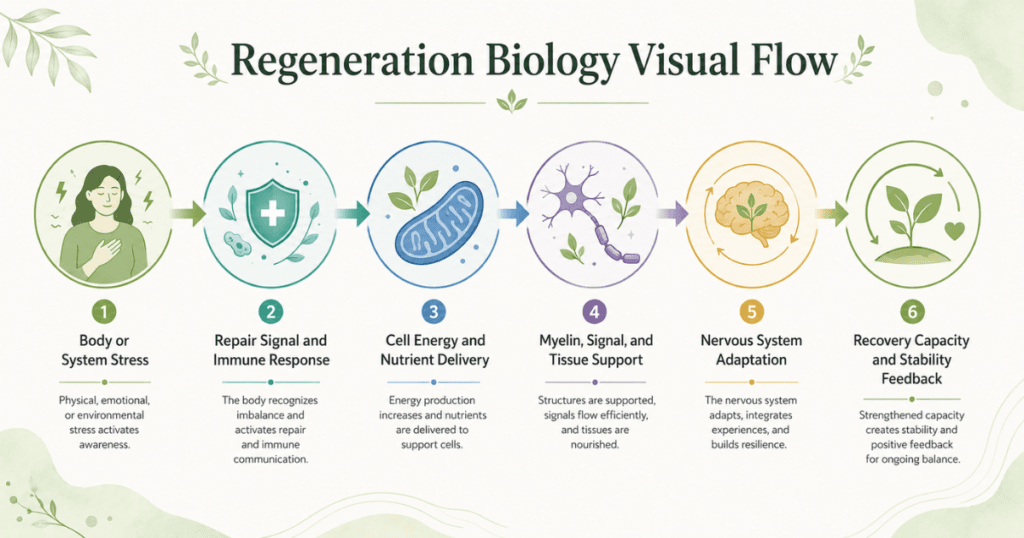
Body or System Stress
↓
Repair Signal and Immune Response
↓
Cell Energy and Nutrient Delivery
↓
Myelin, Signal, and Tissue Support
↓
Nervous System Adaptation
↓
Recovery Capacity and Stability Feedback
This flow is a simple learning model.
Real body processes are not always straightforward. They often work in loops.
For example, better sleep may support recovery capacity. Then, better recovery may support calmer signals. Later, calmer signals may reduce protective stress.
Therefore, this visual flow should not be used as a diagnosis. Instead, it can help readers understand how Regeneration Biology may support nervous system learning.
Why Repair Support Matters for Recovery
1. Recovery Needs Repair Signals
The body needs signals that guide repair.
These signals may involve immune activity, cell response, and nervous system feedback.
Therefore, recovery is not only rest. It also involves communication between systems.
2. Recovery Needs Energy
Repair needs energy.
Nerve cells and support cells need fuel to work, adapt, and respond.
When energy demand is high, recovery may feel slower. As a result, energy balance becomes important.
3. Recovery Needs Delivery
Cells need oxygen and nutrients.
Blood flow helps deliver these resources. It also helps clear waste.
For this reason, circulation is a key part of Regeneration Biology.
4. Recovery Needs Protection
Nerves need support and protection.
Myelin, cell membranes, immune balance, and tissue support may all play a role.
However, protection is not one thing. It is a group of connected layers.
5. Recovery Needs Adaptation
The nervous system learns from repeated patterns.
If the system keeps receiving stress signals, it may become more protective. If it receives safer signals over time, it may adapt differently.
Therefore, adaptation matters in recovery education.
6. Recovery Needs Stability
Recovery is not only change.
It also needs stability. The body must hold better patterns long enough for them to feel more normal.
Because of this, Regeneration Biology connects with sleep, pacing, regulation, and whole-system support.
Common Misunderstandings About Regeneration Biology
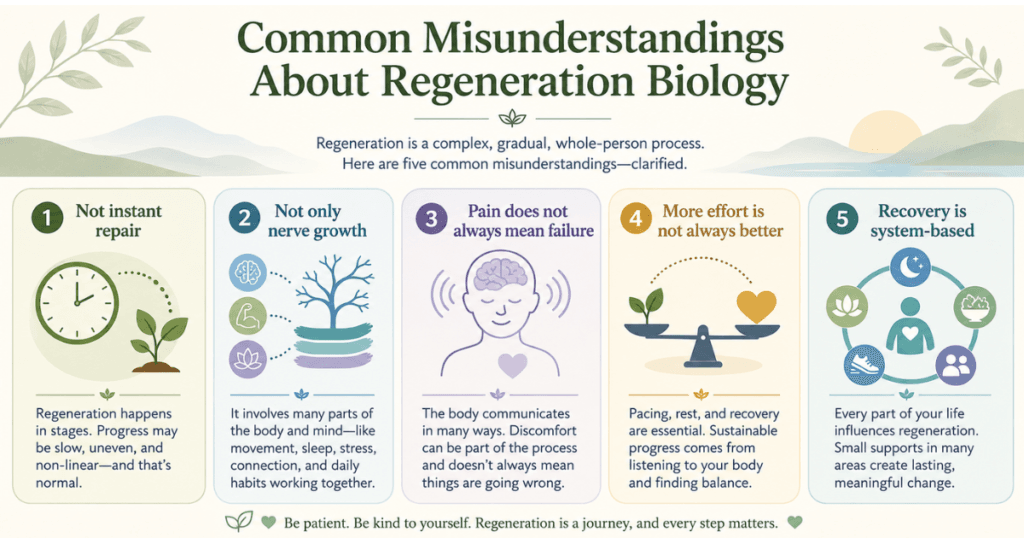
Misunderstanding 1: Repair Is Not Instant
Clarification:
Regeneration is not instant.
It may involve slow support, repair signals, cell response, and adaptation over time.
Therefore, it should not be viewed as a quick result.
Misunderstanding 2: It Is Not Only About Nerve Growth
Clarification:
Nerve growth is only one possible part.
Regeneration Biology may also involve myelin support, immune timing, blood flow, signal balance, and recovery capacity.
Because of this, the topic is broader than one process.
Misunderstanding 3: Pain Does Not Mean Repair Is Failing
Clarification:
Pain is real.
However, pain does not always mean repair is failing.
Pain may involve sensitivity, protection, stress, inflammation, or signal processing.
Therefore, pain should be understood with care.
Misunderstanding 4: More Effort Does Not Always Help
Clarification:
The nervous system does not always respond well to force.
Sometimes, too much effort may increase stress or sensitivity.
For this reason, recovery education should include pacing, tolerance, and safety.
Misunderstanding 5: One Method Does Not Control Everything
Clarification:
No single method controls the whole system.
Sleep, stress, movement, blood flow, nutrition, inflammation, and regulation may all interact.
As a result, Regeneration Biology should be viewed as a whole-system topic.
Misunderstanding 6: Education Does Not Replace Medical Care
Clarification:
This page is educational.
It should not replace professional medical advice, diagnosis, or treatment.
Therefore, serious, sudden, or worsening symptoms should be checked by a qualified professional.
Continue Learning
To understand Regeneration Biology more clearly, start with Neural Signaling. This page explains how nerves communicate.
Next, explore Myelin System to learn how nerve signals may be supported by a protective support structure.
Also, read Neuroplasticity to understand how the nervous system adapts over time.
For immune-related nervous system stress, continue with Neuroinflammation. Then visit Pain Processing to learn how the nervous system reads body signals.
In addition, Autonomic Regulation can help explain stress response and recovery state.
For a wider view, readers may explore Degeneration Pathways, Regeneration Systems, Root-Cause Systems, and Therapeutic Systems.
For general education, readers may also explore this source:
NCBI Bookshelf
Related Systems
Neural Signaling
Neural signaling explains how nerves send and receive messages.
This system is related because Regeneration Biology depends on clear communication. Without stable signals, the body may have more difficulty sensing and adapting.
Myelin System
The Myelin System supports signal speed and timing.
Because Regeneration Biology may involve signal support, myelin is an important related layer.
Still, myelin issues should not be self-diagnosed from symptoms alone.
Neuroplasticity
Neuroplasticity explains how the nervous system changes.
This matters because recovery often involves new patterns. These may include better movement tolerance, calmer signals, and improved regulation.
Neuroinflammation
Neuroinflammation explains immune-related activity around the nervous system.
This system may affect repair timing, sensitivity, and recovery demand.
However, inflammation should be understood with balance.
Pain Processing
Pain processing explains how the nervous system interprets body signals.
This matters because pain can change during recovery. However, pain alone does not prove whether regeneration is happening.
Degeneration Pathways
Degeneration Pathways describe stress, strain, and reduced function.
Regeneration Biology explains the repair and support side.
Therefore, both topics should be learned together for a balanced view.
Regeneration Systems
Regeneration Systems explain repair, rebuilding, recovery cycles, stability, and adaptation.
This is the broader category that connects directly with Regeneration Biology.
Safety & Education Notice
This page is for educational purposes only. It does not diagnose, treat, cure, or prevent disease. It is not a substitute for professional medical advice, diagnosis, or treatment.
Seek urgent medical care for severe, sudden, unusual, or worsening symptoms. These may include sudden weakness, loss of bladder or bowel control, chest pain, difficulty breathing, severe numbness, severe pain, loss of coordination, sudden vision changes, confusion, fainting, irregular heartbeat, or rapidly changing neurological symptoms.
Because this topic involves medically sensitive nervous system and body-related processes, readers should not use this information to self-diagnose, stop medication, begin supplements, follow detox protocols, attempt self-treatment, force intense exercises, or delay professional care.