
Neuroplasticity
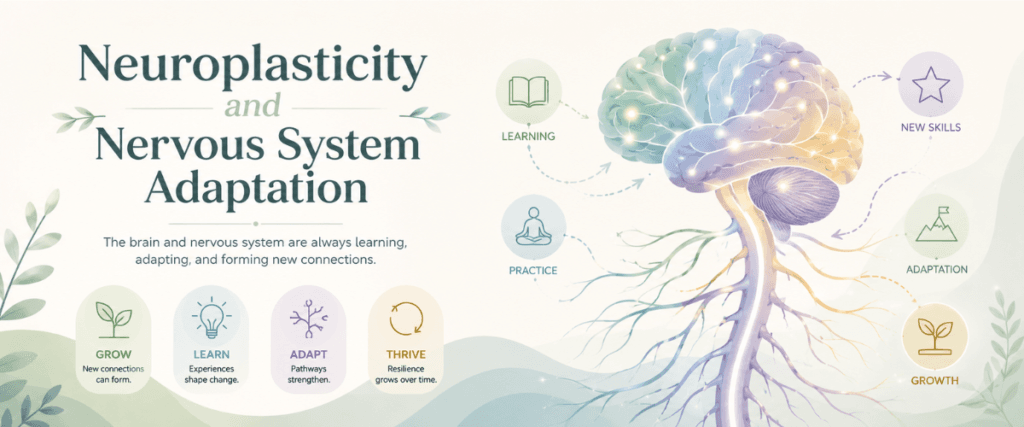
Neuroplasticity is the nervous system’s ability to change, learn, and adapt. It helps the brain, spinal cord, and nerves respond to repeated signals and life experiences over time.
Neuroplasticity is useful because it explains nervous system change without blaming the person. It shows how repeated signals, stress patterns, movement habits, pain processing, and recovery support may shape the way the body responds over time. Therefore, neuroplasticity should be understood as a steady learning process, not a quick cure.
In simple terms, this means the nervous system is not fixed. It can change how it responds to movement, stress, pain, rest, emotions, and daily habits. Because of this, neuroplasticity is an important idea in nerve health education.
However, this process is not a quick fix. The nervous system usually changes through small repeated experiences. These may include movement, rest, learning, safer body awareness, calmer routines, and better recovery support.
This topic matters because nerve-related symptoms are not always linked to one nerve or one body part. Sometimes, symptoms may also involve how the nervous system learns, protects, remembers, and responds.
For example, pain, tingling, burning, numbness, fatigue, or sensitivity may involve signal processing. They may also involve stress load, inflammation, sleep quality, movement patterns, and recovery capacity.
Therefore, this page explains neuroplasticity as a system-level educational concept. It does not diagnose, treat, cure, or prevent disease. Instead, it gives a calm way to understand how nervous system adaptation may relate to sensitivity, regulation, and recovery demand.
Quick Navigation
What Is Neuroplasticity?
Neuroplasticity means the nervous system can change over time. These changes may happen in the brain, spinal cord, nerve pathways, movement patterns, sensory processing, and protective responses.
People often describe it as “rewiring.” That idea can be useful, but it is also too simple. In reality, nervous system change includes many layers. Some pathways may become stronger. Other pathways may become weaker. Also, the body may learn new patterns of movement, safety, attention, or protection.
For example, when you practice a skill, your nervous system learns. When you repeat a movement, that movement may become easier. In the same way, repeated pain, fear, stress, or guarding may also shape how the body responds.
Therefore, nervous system change can move in different directions. It can support balance, confidence, and recovery. However, it can also support high alertness if the body keeps receiving stress or threat signals.
This does not mean symptoms are imaginary. Symptoms are real body experiences. Instead, it means the nervous system may change how it processes and responds to those experiences.
From a system view, this topic connects with neural signaling and nervous system communication, pain processing and sensitivity, neuroinflammation and nerve sensitivity, myelin system and signal timing, stress regulation, sleep, movement, and recovery capacity.
How Nervous System Adaptation Works
Nervous system adaptation happens through repeated input, feedback, and learning. The body sends information to the nervous system all day. Then the nervous system updates its patterns based on what happens often.
First, the body receives signals. These signals may come from movement, posture, touch, pain, sleep, stress, emotions, breathing, or daily habits.
Next, the brain and spinal cord process the signals. They compare new input with past experience. For example, the system may ask whether something feels safe, familiar, stressful, or protective.
After that, the body may change its response. If a signal repeats often, the system may give it more attention. As a result, some pathways may become easier to activate.
Over time, repeated patterns can become learned patterns. This may happen with movement skills, posture habits, pain sensitivity, muscle tension, breathing patterns, or stress reactions.
However, the system can also learn calmer patterns. Safer movement, better rest, steady routines, and lower stress load may give the body different input.
Because of this, adaptation is not one event. It is a gradual process. It depends on time, repetition, feedback, and recovery conditions.
For general educational background, readers may explore the NCBI Bookshelf overview of neuroplasticity. For a simpler brain education resource, BrainFacts also offers helpful learning material on brain plasticity.
Key Layers of Neuroplasticity
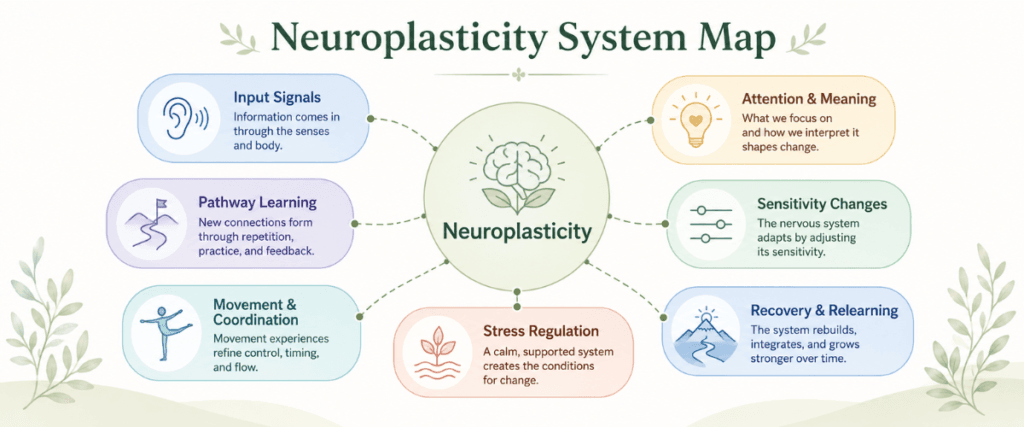
1. Neuroplasticity Input and Signal Layer
The input layer begins with information. Every day, the nervous system receives signals from the body and the environment. These signals may come from movement, pressure, pain, sound, light, temperature, stress, or emotional state.
For example, long sitting may send repeated posture signals. Poor sleep may increase stress signals. In the same way, repeated pain may send more protective signals to the nervous system.
However, input is not always negative. Helpful input can also shape the system in a better direction. Gentle movement, rest, calm breathing, safe touch, and steady routines may send different messages to the body.
Because of this, the quality of input matters. Over time, the nervous system often adapts to what it receives again and again. This is why small repeated patterns can become important.
2. Attention and Meaning Layer
The brain does not treat every signal equally. Instead, it gives more attention to signals that seem important, repeated, unusual, or linked with danger.
For example, if one body area has felt painful for a long time, the nervous system may begin to monitor that area more closely. As a result, small sensations may become easier to notice.
This does not mean the symptom is false. Rather, it shows that attention, memory, and protection can shape body awareness. The body may simply be trying to stay alert and safe.
Because of this, symptoms may feel stronger during stress, fatigue, fear, or poor sleep. At the same time, they may feel calmer when the system has more rest, safety, and support.
3. Pathway Learning Layer
The nervous system becomes better at what it repeats. This can be helpful, but it can also become unhelpful when the repeated pattern is based on stress, fear, or protection.
For example, regular practice may make a movement smoother. In the same way, repeated guarding may make protective movement easier to repeat. Over time, the body may start using that pattern automatically.
This is why repeated habits matter. The system may learn movement, tension, posture, pain attention, stress response, or calming patterns. In simple terms, the body often learns what it practices most.
However, new patterns can also be learned. With steady support, the body may build safer and more flexible responses. Therefore, change is possible, but it usually happens gradually.
4. Sensitivity and Protection Layer
Sensitivity describes how strongly the nervous system responds to input. If the system receives repeated threat signals, it may become more alert and protective.
As a result, pain, tingling, burning, tightness, or fatigue may feel more noticeable. This can happen when the body is trying to protect itself, even if the response feels uncomfortable.
Still, sensitivity is not weakness. It is a nervous system state. It may change with sleep, stress, inflammation, movement, recovery, and the body’s sense of safety.
Therefore, changes in sensitivity should be understood carefully and calmly. Instead of blaming the body, it may be more helpful to see sensitivity as a sign that the system needs more support, stability, and reassurance.
5. Movement and Coordination Layer
Movement is not controlled by muscles alone. It also depends on communication between the brain, spinal cord, nerves, joints, and muscles.
Walking, balance, posture, reaching, and coordination all require timing. The nervous system learns these patterns through repetition, feedback, and daily experience.
However, pain or fear may change movement. The body may begin to guard, stiffen, or avoid certain actions. At first, this may feel protective and useful.
Over time, though, protective movement may add more strain. For this reason, movement learning is an important part of nervous system education. Gentle and gradual movement patterns may help the body feel safer and more coordinated.
6. Stress and Regulation Layer
Stress can shape how the nervous system learns. When the body feels unsafe, overwhelmed, or overloaded, it may become more alert.
This may affect pain processing, muscle tension, sleep, breathing, attention, and recovery. As a result, body signals may feel stronger or harder to ignore.
However, this is not about blame. It is about body state. The nervous system may simply be responding to the level of pressure it is experiencing.
Because of this, a calmer internal state may help the system process signals with less alarm. Over time, stress regulation may support healthier adaptation, better recovery capacity, and a more stable nervous system response.
7. Neuroplasticity Recovery and Relearning Layer
The nervous system can learn protective patterns. However, it can also learn safer, calmer, and more flexible patterns.
This usually takes time. The body often changes through small repeated experiences, not one large action. Therefore, recovery is often more about consistency than force.
For example, better sleep, gradual movement, lower stress load, supportive routines, and safer body experiences may all provide helpful input. Over time, these signals may help the nervous system feel less threatened.
Because of this, recovery and relearning should be understood as a gradual process. The goal is not to force the body to change quickly. Instead, the goal is to create better conditions so the nervous system can adapt with more safety, trust, and stability.
System Interactions
Nervous System Interaction
Adaptation is part of the nervous system function. The brain, spinal cord, and nerves can adjust how they process information.
As a result, the body can learn, protect, move, and respond. Yet these changes do not happen alone. They depend on sleep, stress, inflammation, movement, and recovery capacity.
Neural Signaling Interaction
Neural signaling provides the messages. Adaptation describes how the system changes after receiving those messages many times.
For example, repeated signals may make a pathway stronger. New input may help the system build a different response.
So, signaling and adaptation work closely together.
Pain Processing Interaction
Pain processing is strongly connected with the nervous system’s learning. When pain-related signals repeat, the system may become more protective.
As a result, pain sensitivity may increase. However, this does not mean pain is imaginary. Pain is real and should be understood with care.
This connection helps explain why symptoms can change over time.
Neuroinflammation Interaction
Inflammatory signals may affect the nervous system environment. They may also influence sensitivity and signal processing.
At the same time, repeated stress and high alertness may affect immune activity. Therefore, the relationship can work in both directions.
This is one reason whole-body support matters.
Myelin System Interaction
Myelin supports signal speed, timing, and communication quality. Nervous system learning may also affect how pathways are used over time.
For example, repeated learning and movement may help pathways become more efficient. So, myelin support and adaptation both relate to signal organization.
Stress System Interaction
Stress may train the nervous system to stay alert. During stress, the body may watch for threat, pain, or discomfort more closely.
Over time, this can strengthen protective patterns. However, calmer patterns may also be learned through repeated safe signals.
Therefore, stress balance is important.
Regeneration Systems Interaction
Regeneration systems support repair, adaptation, and stability. The nervous system change also needs recovery capacity.
Without enough sleep, energy, circulation, and regulation, the body may have a harder time adapting in a calm direction.
Therefore, repair systems and the nervous system learning work together.
Patterns That Influence Neuroplasticity
Many daily patterns may influence neuroplasticity. These patterns do not act alone. Instead, they build together over time.
Sleep rhythm is one major pattern. Sleep helps the nervous system process information and recover. Therefore, poor sleep may make the system more reactive.
Stress patterns also matter. Ongoing worry, pressure, emotional strain, or mental overload may train the body to stay alert. As a result, body signals may feel stronger.
Movement patterns can influence learning too. Repeated movement can improve coordination. However, repeated guarding, fear-based movement, or long posture load may teach protective patterns.
Pain history may also shape the system. If pain has lasted for a long time, the body may become better at noticing pain-related signals. This does not mean the pain is false. It means the system has learned to protect.
Attention patterns may add another layer. When a person keeps scanning for symptoms, those signals may feel more important. Still, this should not be used for blame. It simply shows how attention and protection can interact.
Environment can also matter. Noise, screen exposure, poor rest rhythm, social stress, and overstimulation may increase nervous system load.
In addition, emotional safety is important. A nervous system that feels safer may have more room to adapt. A system under constant pressure may stay protective.
The goal is not perfection. Instead, the goal is awareness. When the body receives repeated supportive signals, calmer adaptation may become more possible.
Neuroplasticity and Nerve Function
Neuroplasticity may influence nerve function because it affects how signals are processed. It may shape sensation, movement, coordination, pain processing, and body awareness.
When the system is balanced, it can respond with more flexibility. However, when the system is overloaded, it may become more protective and sensitive.
This may relate to pain, tingling, burning, numbness, tightness, fatigue, or body-wide sensitivity. These symptoms may involve local nerve input. They may also involve brain and spinal cord processing.
For example, repeated pain may train the system to notice signals faster. Repeated guarding may change movement. Repeated stress may make the body feel less safe.
Even so, the body can learn new patterns. With time, safer input and better regulation may support more flexible responses.
This explains why symptoms may change from day to day. Sleep, stress, movement, inflammation, attention, and recovery can all affect signal processing.
Still, some symptoms need urgent care. Sudden weakness, severe numbness, loss of coordination, sudden vision changes, loss of bladder or bowel control, or rapidly changing neurological symptoms should not be ignored.
Neuroplasticity Visual Flow
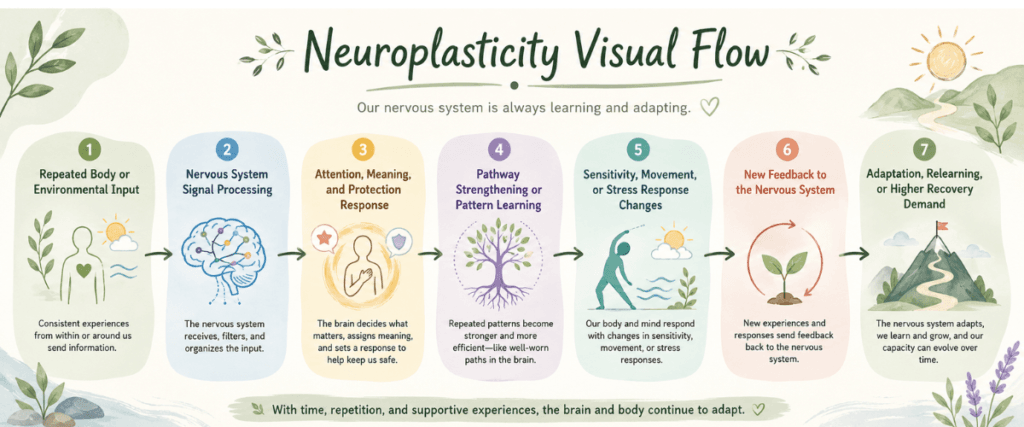
Repeated Body or Environmental Input
↓
Nervous System Signal Processing
↓
Attention, Meaning, and Protection Response
↓
Pathway Strengthening or Pattern Learning
↓
Sensitivity, Movement, or Stress Response Changes
↓
New Feedback to the Nervous System
↓
Adaptation, Relearning, or Higher Recovery Demand
This flow is a simple educational model. It shows how repeated signals may shape the nervous system over time.
However, real change is not always a straight line. It often works as a cycle. The body sends signals. The nervous system responds. Then that response creates new signals.
For example, pain may lead to guarding. Guarding may change movement. Changed movement may create new input. As a result, the body may learn a protective pattern.
Yet new patterns can also be learned. Gentle movement, better rest, safer body experiences, and lower stress load may provide different input over time.
Therefore, this flow is not a diagnosis. It is a learning tool.
Why Neuroplasticity Matters for Recovery
1. Neuroplasticity Recovery Requires Repeated Safe Signals
Recovery often needs repeated safe signals. The nervous system learns from what happens often. So, one single action usually does not change the whole pattern.
For example, steady sleep, gentle movement, calm routines, and lower stress load may send helpful input. Over time, this may support a calmer response.
2. Recovery Requires Time and Consistency
Nervous system change is gradual. The body may need time to build new patterns.
However, consistency does not mean force. It means steady support. Small steps may be more useful than extreme effort.
3. Recovery Requires a Sense of Safety
The nervous system may change more easily when it does not feel under constant threat. Safety can include physical safety, emotional safety, steady routines, and lower overload.
When the body feels safer, signals may be processed with less alarm. As a result, sensitivity may have more room to settle.
4. Recovery Requires Movement Learning
Movement can teach the nervous system. Gentle repeated movement may support body awareness, coordination, circulation, and confidence.
However, movement should not be forced. Too much load may increase protection. Therefore, gradual movement learning is a safer idea.
5. Recovery Requires Stress Regulation
Stress regulation matters because stress shapes nervous system learning. If the body stays alert, it may keep strengthening protective patterns.
In contrast, calmer states may help the system learn flexibility. Therefore, stress regulation supports recovery from a whole-body view.
6. Neuroplasticity Recovery Requires Whole-System Support
Adaptation does not work alone. It depends on sleep, energy, circulation, inflammation balance, myelin support, pain processing, movement, and emotional regulation.
Therefore, recovery should be understood as a system process. The goal is not to force change. Instead, the goal is to create better conditions for change.
Common Misunderstandings About Neuroplasticity
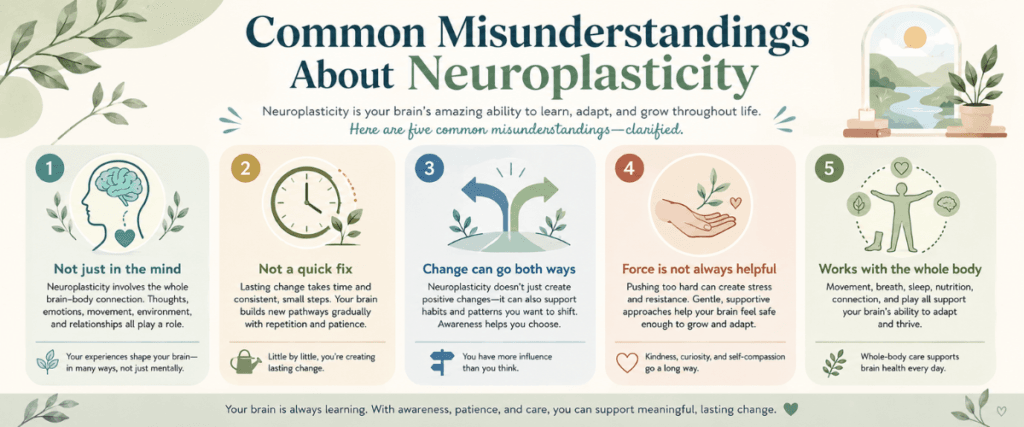
Misunderstanding 1: Neuroplasticity Is Not Only in the Mind
Clarification:
Nervous system change involves the brain and body together. It does not mean symptoms are imaginary. Symptoms are real body experiences shaped by signals, protection, and processing.
Misunderstanding 2: Neuroplasticity Is Not a Quick Fix
Clarification:
Change usually takes time. The nervous system adjusts through repeated input, feedback, and practice. Therefore, quick-fix claims should be viewed carefully.
Misunderstanding 3: Change Can Go Both Ways
Clarification:
Change can go in different directions. Some patterns may support recovery. However, repeated stress, fear, pain, or guarding may also strengthen protective responses.
Misunderstanding 4: Force Is Not Always Helpful
Clarification:
Force is not always helpful. If the system feels threatened, it may become more protective. Gradual and safer input is often a better educational idea.
Misunderstanding 5: Changing Symptoms Can Still Be Real
Clarification:
Changing symptoms can still be real. The body may process signals differently depending on sleep, stress, movement, inflammation, and recovery load.
Misunderstanding 6: Neuroplasticity Works With the Whole Body
Clarification:
The nervous system changes work with the whole body. It connects with circulation, inflammation, metabolism, myelin, stress regulation, and recovery capacity.
Continue Learning
Neurobiology System
Learn how nerve biology, signaling, sensitivity, inflammation, myelin, adaptation, and regulation work together.
Neural Signaling
Explore how nerves send, filter, and interpret messages across the body: Neural Signaling
Pain Processing
Learn how the nervous system may turn signals into pain experiences: Pain Processing
Neuroinflammation
Understand how immune signaling may interact with nerve sensitivity and recovery demand: Neuroinflammation
Myelin System
Learn how myelin may support signal speed, timing, and communication quality: Myelin System
Root-Cause Systems
Explore body-wide patterns that may influence nerve sensitivity and nervous system load: Root-Cause Systems
Therapeutic Systems
Learn about sleep, movement, stress regulation, and circulation from a safe educational view: Therapeutic Systems
Regeneration Systems
Explore how repair and stability may support long-term recovery capacity: Regeneration Systems
Learning Path
Follow a step-by-step education journey through nerve function, root causes, sensitivity, and recovery concepts: Learning Path
Related Systems
Neural Signaling
Neural signaling provides the messages that the nervous system receives. Adaptation helps explain how repeated signals may shape future responses.
Pain Processing
Pain processing is closely linked to nervous system learning. Repeated pain-related signals may influence sensitivity, protection, and body response.
Neuroinflammation
Inflammatory activity may affect the nervous system environment. It may influence sensitivity and signal processing.
Myelin System
The Myelin System supports signal speed and timing. Nervous system learning may influence how pathways are used and organized over time.
Autonomic Regulation
Autonomic regulation affects stress response, breathing, heart rate, digestion, and body state. These states may influence nervous system learning.
Metabolic Damage System
Metabolic stress may affect energy availability. Because adaptation requires energy and regulation, metabolism may influence recovery capacity.
Circulatory Impairment System
Circulation supports oxygen and nutrient delivery. It also helps clear waste products from the nervous system environment.
Inflammatory System
Inflammatory activity may influence sensitivity and alertness. This may shape nervous system patterns over time.
Lifestyle Degeneration
Sleep, stress, posture, movement, nutrition, and daily rhythm may shape body patterns. Over time, these patterns may influence nervous system adaptation.
Regeneration Systems
Regeneration systems support repair, adaptation, and stability. They connect closely with the body’s ability to change and reorganize.
Safety & Education Notice
This page is for educational purposes only. It does not diagnose, treat, cure, or prevent disease. It is not a substitute for professional medical advice, diagnosis, or treatment.
Seek urgent medical care for severe, sudden, unusual, or worsening symptoms. These may include sudden weakness, loss of bladder or bowel control, chest pain, difficulty breathing, severe numbness, severe pain, loss of coordination, sudden vision changes, confusion, fainting, or rapidly changing neurological symptoms.
Because this topic involves medically sensitive nervous system processes, readers should not use this information to self-diagnose, stop medication, begin supplements, follow detox protocols, attempt self-treatment, force intense exercise, or delay professional care.