
Cellular Repair: Essential Guide to Nerve Recovery Support
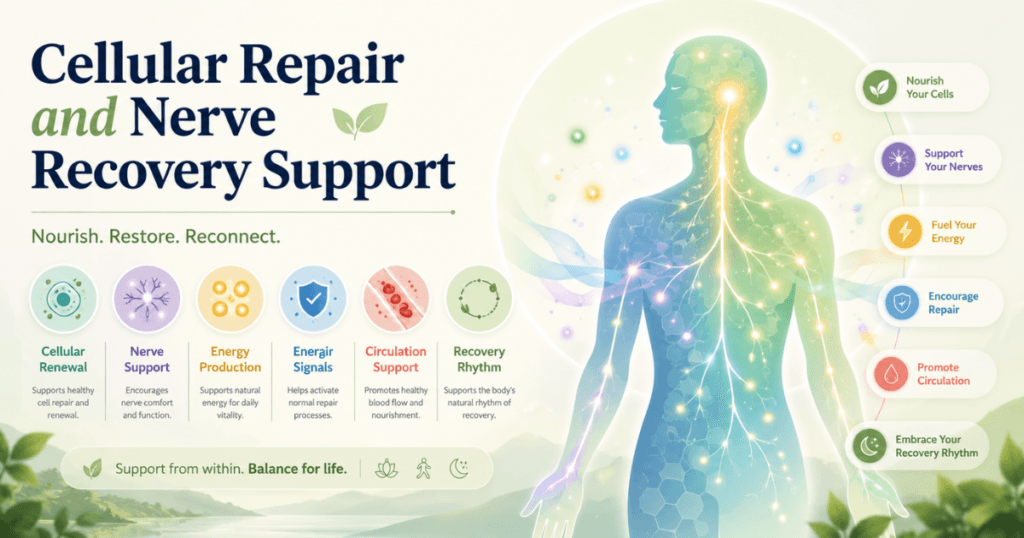
Cellular Repair is an important part of nervous system recovery support. It explains how cells produce energy, clear waste, protect themselves, maintain structure, and return toward balance over time.
Every cell needs the right support to function well. It needs fuel, oxygen, nutrients, rest, cleanup, protection, and clear communication with nearby tissues. When these needs are supported more consistently, the body may have a stronger internal environment for recovery.
However, cellular repair is not an instant healing switch. It does not come from one food, one supplement, or one routine. Instead, it works through many connected body systems.
Sleep, circulation, nutrition, stress balance, inflammation regulation, movement, and recovery rhythm all play important roles. Because of this, Cellular Repair is best understood as a system, not a single action.
This page explains Cellular Repair in a safe educational way. It does not diagnose, treat, cure, or prevent any condition. Instead, it helps you understand how cellular energy, cleanup, protection, and recovery rhythm may support nervous system resilience.
Quick Navigation
What Is Cellular Repair?
Cellular Repair refers to the way cells maintain, protect, renew, and regulate themselves. Cells are active every moment. They produce energy, manage stress, clear waste, repair useful parts, and communicate with surrounding tissues.
In simple terms, Cellular Repair helps cells stay prepared and balanced. It supports the internal environment of the cell and helps the body respond when stress, inflammation, poor sleep, low nutrients, or physical strain increase demand.
This process matters because nerves depend on healthy cells. Nerve signals require energy, stable membranes, oxygen, nutrients, and support from nearby tissues. Therefore, nerve health is not only about the nerves themselves. It also depends on the environment around them.
Cellular Repair does not mean instant recovery. Instead, it works in layers. Some repair activity happens every day, while deeper changes may take more time. For this reason, Cellular Repair should be viewed as a long-term support system.
It also does not work alone. Cellular Repair connects with circulation, immune balance, sleep rhythm, nutrition, movement, and stress regulation. When these areas work together more effectively, the body may have a stronger foundation for recovery support.
Why Cellular Repair Matters for Nerve Health
Nerves are living tissues. They are not simple wires. They need energy, oxygen, blood flow, nutrients, and support from surrounding cells.
Because of this, the environment around the nerve matters. A more stable cellular environment may help nerve signals function more smoothly. In contrast, a stressed cellular environment may increase recovery demand.
Cellular Repair matters because it supports this internal environment. It helps cells manage energy, remove waste, protect membranes, and respond to stress. Over time, these processes may support stronger nervous system resilience.
For example, when cells do not have enough energy, they may struggle to maintain balance. When cleanup systems are under pressure, waste products may build up. When inflammation stays high for too long, cells may remain stressed.
As a result, the nervous system may become more sensitive to daily strain. This does not always mean new damage is happening. Sometimes it means the body needs more support, rest, rhythm, and recovery capacity.
This is why Cellular Repair is important in nerve health education. It helps explain why recovery often takes time. It also shows why sleep, food quality, movement, circulation, and stress balance can all matter.
The Main Layers of Cellular Repair
Cellular Repair has many connected layers. Each layer helps cells stay strong, organized, and ready to respond. When one layer becomes strained, other layers may need to work harder.
1. Cellular Energy Production
Cells need energy for almost every function. They use energy to repair, communicate, move nutrients, clear waste, and protect their structure.
Nerve-related cells often need steady energy because nerve signaling uses a lot of fuel. The body also needs energy to keep membranes stable and support repair activity.
When energy is low or unstable, cells may become less efficient. As a result, the nervous system may feel more sensitive to stress, poor sleep, or overactivity.
However, energy support is not only about eating more food. It also depends on blood sugar balance, oxygen delivery, sleep quality, movement, and stress load. Therefore, cellular energy works best when the whole system receives support.
2. Waste Clearance and Cleanup
Cells create waste during normal activity. This is natural. However, cells also need effective ways to clear that waste.
Cleanup helps the cell stay organized. It removes used materials, damaged parts, and stress byproducts. Because of this, cleanup is a key part of Cellular Repair.
When cleanup systems are under pressure, cells may struggle to maintain balance. Over time, this can increase cellular stress and make the surrounding tissue environment less supportive.
This does not mean the body needs harsh detox methods. Instead, the body needs support for its normal cleanup processes. Sleep, hydration, circulation, nutrition, and immune balance all help this process.
3. Protection Against Oxidative Stress
Cells face oxidative stress every day. Some oxidative stress is normal. In fact, the body uses small stress signals for adaptation.
However, too much oxidative stress can raise cellular demand. It may come from inflammation, poor sleep, high stress, poor nutrition, blood sugar swings, or environmental strain.
The body has natural protection systems that help keep oxidative stress in balance. For this reason, antioxidant balance matters for Cellular Repair.
Still, the goal is not to block all stress. The goal is balance. The body needs enough protection to avoid overload while still allowing normal adaptation.
4. Membrane Stability
Every cell has a membrane. This membrane acts like a smart border. It helps control what enters and leaves the cell.
For nerve-related cells, membrane stability is especially important. Nerve signals depend on electrical balance and clear communication. Therefore, healthy membranes help support stable signaling.
Membranes need the right building blocks. These include fatty acids, proteins, minerals, hydration, and energy. Inflammation and oxidative stress can also affect membrane health.
When membrane stability is better supported, cells may communicate more clearly. As a result, the nervous system may have a more stable internal environment.
5. Protein Repair and Maintenance
Cells use proteins for structure, repair, signaling, and many internal jobs. These proteins must be built, used, repaired, or cleared when they are no longer working well.
When the body is under stress, protein maintenance becomes more demanding. Cells may need to repair damaged proteins or remove parts that are no longer useful.
This process matters because nerve health depends on clear communication, healthy support cells, and stable tissue structure.
Because of this, protein maintenance is an important layer of Cellular Repair. It helps cells stay functional instead of becoming overloaded.
6. Immune Repair Signals
The immune system does more than defend the body. It also helps guide cleanup and repair.
Short-term immune activity may help the body respond to stress or injury. However, long-term inflammatory signaling can raise cellular demand.
This is why immune balance matters. The body needs immune signals that respond clearly and calm down when the job is done.
In nerve health education, this helps explain why inflammation resolution is important. When the body can move from defense mode toward repair mode, the cellular environment may become more supportive.
7. Circulation and Oxygen Delivery
Cells need oxygen and nutrients. They also need help removing waste. Circulation supports both jobs.
Good blood flow helps deliver fuel, supports oxygen use, and assists waste removal. Therefore, circulation is closely connected to Cellular Repair.
Nerve-related tissues may be sensitive to poor circulation because signaling and repair both need steady support.
Gentle movement can help circulation. Breathing rhythm, hydration, and daily activity may also support this system.
8. Sleep and Recovery Rhythm
Sleep is one of the most important recovery signals. During sleep, the body supports cleanup, repair signals, hormone rhythm, and nervous system balance.
However, sleep is not only about the number of hours. Rhythm also matters. A more regular sleep-wake pattern may help the body organize repair processes more effectively.
When sleep is poor, cellular stress may rise. The nervous system may also become more reactive. Over time, this can increase recovery demand.
For this reason, sleep rhythm is a key part of Cellular Repair.
How Cellular Stress Builds Over Time
Cellular stress often builds slowly. It usually does not come from one single cause. Instead, many small pressures can add up over time.
Poor sleep, low movement, high stress, weak nutrition, inflammation, poor circulation, and blood sugar swings can all increase demand. One of these factors may not seem serious alone. However, together they can create a heavier load on the body.
At first, the body may adapt. Cells may work harder and use more resources. But over time, the system may become less efficient.
This can create a cycle:
Daily stress increases cellular demand.
Then cells need more energy.
Next, cleanup systems work harder.
After that, inflammation or oxidative stress may rise.
As a result, the nervous system may become more sensitive.
This cycle does not mean the body is broken. Instead, it shows that the system may need better support. It may need more rest, better rhythm, stronger nutrition, safer movement, and lower stress load.
Because of this, Cellular Repair is not separate from daily life. It connects with the way a person sleeps, moves, eats, breathes, rests, and manages stress.
Cellular Repair and Nervous System Sensitivity
The nervous system can become more sensitive for many reasons. Cellular stress may be one background factor.
When cells struggle with energy, cleanup, or protection, the body may feel less stable. As a result, the nervous system may respond more strongly to normal signals.
For example, stress may feel harder to handle. Poor sleep may have a stronger effect. Physical activity may feel more demanding. The body may also take longer to settle after strain.
This does not mean symptoms are imagined. Pain, tingling, burning, numbness, and sensitivity can feel very real. However, these experiences can involve many systems at once.
The brain, nerves, immune system, circulation, muscles, and cells all send signals. The nervous system then interprets those signals. Because of this, Cellular Repair can influence the background environment for nerve sensitivity.
Therefore, supporting Cellular Repair means supporting the body’s recovery setting. It does not guarantee results. However, it may help explain why system-wide care matters.
How Cellular Repair Connects With Other Systems
Cellular Repair is part of the larger Regeneration Systems category. It connects with many other systems involved in nervous system education.
Cellular Repair and Regeneration Biology
Regeneration Biology explains the broader repair and adaptation process. Cellular Repair is one layer inside that larger system.
Regeneration requires energy, cleanup, immune balance, repair signals, and a supportive internal environment. Without cellular support, deeper repair processes may have a weaker foundation.
Cellular Repair and Myelin Regeneration
Myelin support depends on healthy cells and a stable environment. It also requires energy, fatty acids, immune balance, and repair signals.
Because of this, Cellular Repair supports the background conditions needed for myelin-related recovery education.
Cellular Repair and Axonal Regrowth
Axonal regrowth is a complex process. It may involve growth signals, energy, structure, and a supportive tissue environment.
Cellular Repair helps explain the foundation behind these processes. It supports the cell-level conditions that make repair readiness possible.
Cellular Repair and Inflammation Resolution
Inflammation can help in short-term repair. However, long-term inflammation may keep cells under stress.
Inflammation Resolution helps the body move from defense mode toward a calmer repair state. Therefore, it works closely with Cellular Repair.
Cellular Repair and Lifestyle Degeneration
Daily patterns can either support or strain cells. Poor sleep, low movement, high stress, and weak nutrition may increase cellular demand.
Lifestyle Degeneration explains how repeated lifestyle strain can affect the body over time. For this reason, it connects strongly with Cellular Repair.
Cellular Repair and Autonomic Regulation
Autonomic Regulation affects stress response, blood flow, digestion, breathing rhythm, and recovery state.
When the body stays in high-alert mode for too long, Cellular Repair may become harder. Therefore, a more regulated body state may support better repair conditions.
Cellular Repair and Lifestyle Healing
Lifestyle Healing focuses on daily patterns that support recovery capacity. These include sleep rhythm, movement, nutrition, stress balance, and pacing.
Because these patterns shape the cellular environment, Lifestyle Healing is closely connected with Cellular Repair.
Common Misunderstandings About Cellular Repair
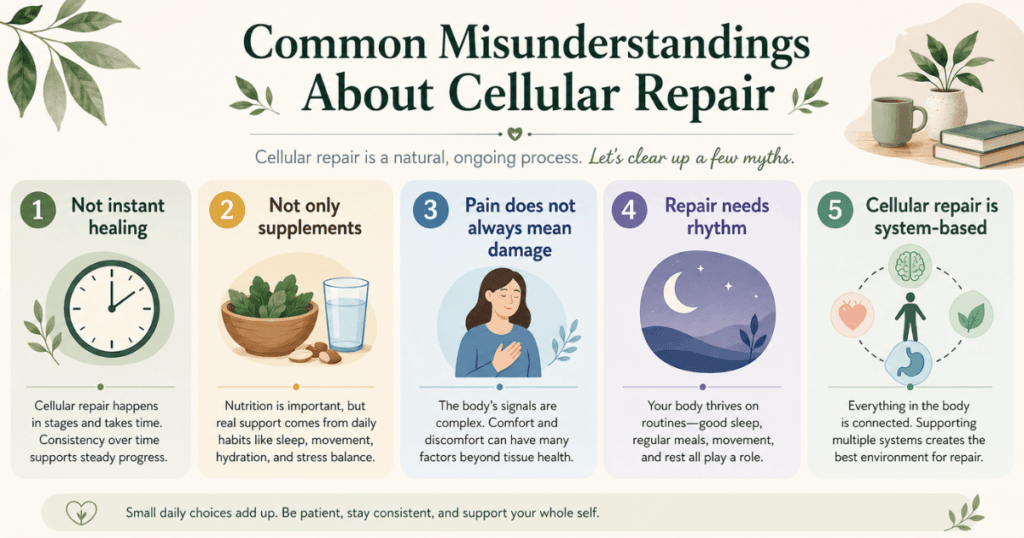
Misunderstanding 1: Cellular Repair Means Instant Healing
Cellular Repair does not work like an instant switch. It is gradual. It happens through many small processes over time.
Cells may need better energy, lower stress, stronger cleanup, and more stable sleep rhythm. These changes often build slowly.
Therefore, Cellular Repair is better understood as a support system, not a quick result.
Misunderstanding 2: One Supplement Can Fix Cellular Repair
Nutrients matter. However, one supplement does not control the whole repair system.
Cells also need oxygen, sleep, circulation, movement, stress balance, and immune regulation. In addition, the body must be able to use nutrients well.
Because of this, Cellular Repair is not only about adding more. It is also about creating better conditions.
Misunderstanding 3: Pain Always Means Cellular Damage
Pain is real. However, pain does not always mean ongoing cellular damage.
Sometimes pain or sensitivity can reflect nervous system alertness. It may also involve inflammation, stress, sleep loss, movement patterns, or brain-body signaling.
Therefore, Cellular Repair is only one part of the bigger picture. It should not be used to explain every symptom by itself.
Misunderstanding 4: Repair Only Happens During Rest
Rest is important. However, repair support can also come from gentle movement, circulation, breathing, nutrition, and emotional safety.
At the same time, too much activity can increase stress load. So the key is balance.
In other words, repair needs both rest and useful input.
Misunderstanding 5: Cellular Repair Is Separate From Nerve Health
Cellular Repair and nerve health are closely connected. Nerves depend on living cells. They also depend on support tissues, immune signals, blood flow, and energy.
Because of this, nerve recovery education should include cell-level support. It gives a clearer picture of how the body works as a system.
How Daily Patterns Support Cellular Repair
Daily patterns can strongly affect Cellular Repair. These patterns do not need to be extreme. In fact, simple and steady habits often support the body better than harsh routines.
Sleep Rhythm
Sleep helps the body restore balance. It supports cleanup, repair signals, hormone rhythm, and nervous system regulation.
When sleep is irregular, the body may stay under more stress. As a result, Cellular Repair may become harder.
Therefore, a stable sleep routine can be one of the most important sources of support.
Nutrition Quality
Cells need nutrients to make energy and repair useful parts. They also need protein, healthy fats, minerals, vitamins, and steady fuel.
However, nutrition should not be viewed as a single cure. Instead, it works as part of a larger system.
For this reason, balanced meals, steady energy, and nutrient quality may support Cellular Repair over time.
Movement and Circulation
Gentle movement helps blood flow. It also supports oxygen delivery and tissue communication.
However, movement should match the body’s current capacity. Too much intensity may raise stress, while too little movement may reduce useful circulation and input.
Therefore, the goal is not force. The goal is steady, safe, and appropriate movement.
Stress Balance
Stress affects sleep, inflammation, blood sugar, muscle tension, digestion, and nervous system activity.
Because of this, stress can increase cellular demand. When the body feels unsafe or overloaded, repair processes may struggle.
Simple calming signals may help support a more balanced state. These may include slow breathing, quiet rest, gentle movement, and regular routines.
Inflammation Balance
Inflammation is not always bad. Short-term inflammation can help the body respond to stress.
However, long-term inflammatory load may keep cells in defense mode. As a result, repair readiness may decrease.
Therefore, inflammation balance is an important part of Cellular Repair.
Blood Flow and Oxygen Support
Cells need oxygen. They also need nutrients to arrive and waste products to leave.
Circulation supports these needs. Because of this, movement, breathing, hydration, and vascular health all matter.
For nerve-related tissues, steady oxygen and nutrient delivery may be especially important.
Recovery Pacing
Pacing means matching activity with recovery capacity. It does not mean doing nothing.
Instead, it means avoiding repeated overload while building support slowly and carefully.
For many people, pacing helps reduce stress on the system. As a result, Cellular Repair may have more room to work.
Cellular Repair System Map
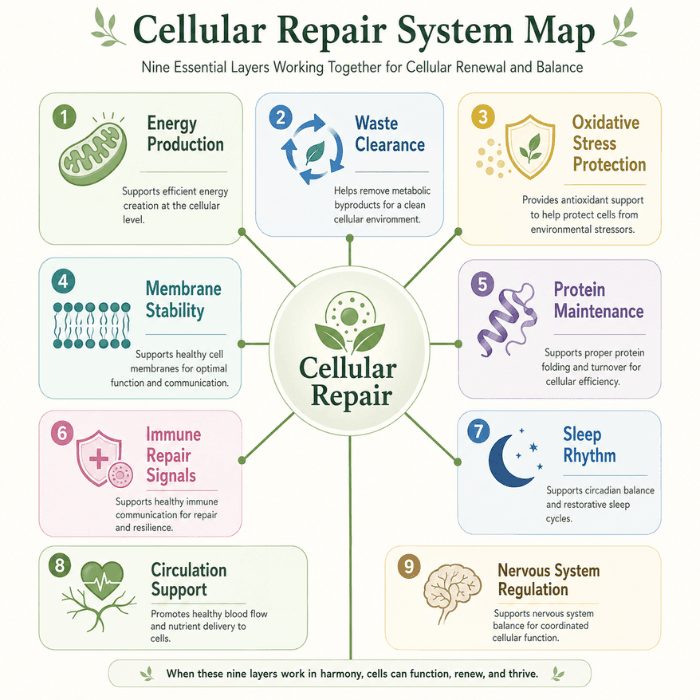
Cellular Repair sits at the center of many support systems. These systems do not work separately. Instead, they interact every day.
Cellular Repair connects with:
- Energy production
- Waste clearance
- Oxidative stress protection
- Membrane stability
- Protein maintenance
- Immune repair signals
- Sleep rhythm
- Circulation and oxygen delivery
- Nervous system regulation
Together, these layers help create a stronger repair environment. When several layers are strained at the same time, the body may need more support and more time.
For example, poor sleep may affect energy. Low energy may affect cleanup. Poor cleanup may increase stress signals. Then the nervous system may become more sensitive.
This is why a system map is useful. It shows that Cellular Repair is not one isolated process. Instead, it is part of a larger recovery network.
Cellular Repair Flow
A simple flow can explain how Cellular Repair works with daily stress and recovery:
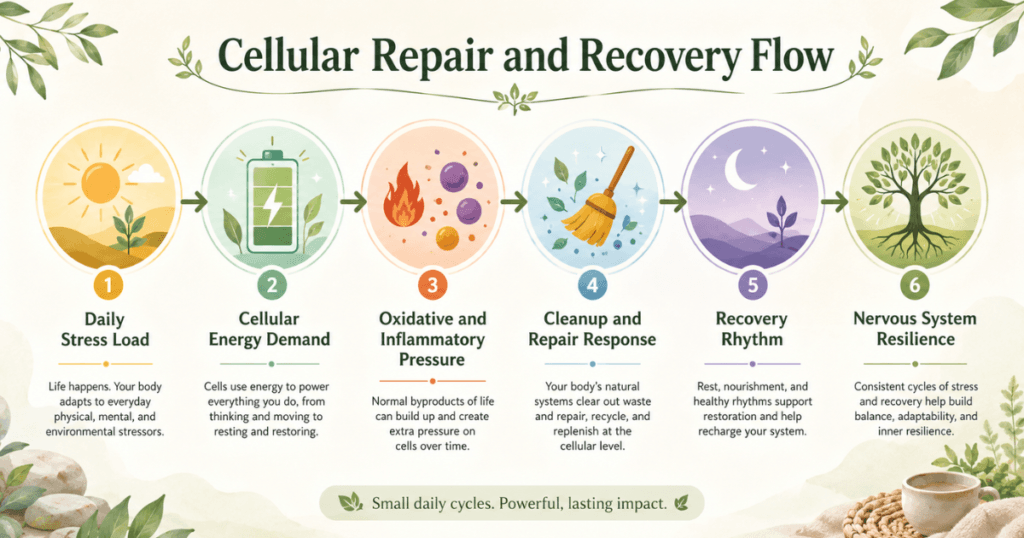
Daily Stress Load → Cellular Energy Demand → Oxidative and Inflammatory Pressure → Cleanup and Repair Response → Recovery Rhythm → Nervous System Resilience
This flow shows how stress can increase cellular demand. It also shows why recovery rhythm matters.
First, daily stress raises demand. Then cells need more energy. Next, cleanup and protection systems respond. After that, rest and rhythm help the body return toward balance.
However, if stress continues without enough recovery, the cycle may stay overloaded. As a result, the nervous system may feel more reactive.
On the other hand, better rhythm may support resilience. Sleep, movement, nutrition, breathing, and pacing can all help the system settle.
Key Takeaways
Cellular Repair is a core part of regeneration support. It helps cells make energy, clear waste, protect themselves, maintain structure, and respond to stress.
It also matters for nerve health. Nerves depend on energy, oxygen, circulation, immune balance, and support from nearby cells. Therefore, the nervous system needs a stable cellular environment.
However, Cellular Repair is not instant. It is not a cure claim. It is not only about supplements. Instead, it works through many connected systems over time.
Because of this, daily patterns matter. Sleep, nutrition, movement, stress balance, circulation, and pacing all help shape the repair environment.
In simple terms, Cellular Repair helps explain why recovery is system-based. When the body has better support, it may have a stronger foundation for resilience and readiness to recover.
Safety and Education Notice
This page is for educational purposes only. It does not diagnose, treat, cure, or prevent any disease or medical condition.
Cellular Repair is discussed here as a general body system concept. The goal is to explain how energy, cleanup, protection, and recovery rhythm may relate to nervous system education.
If you have persistent pain, numbness, tingling, burning, weakness, loss of function, injury, diabetes-related nerve concerns, autoimmune symptoms, or worsening symptoms, please speak with a qualified healthcare professional.