
Growth Signals: Essential Guide to Nerve Repair Communication
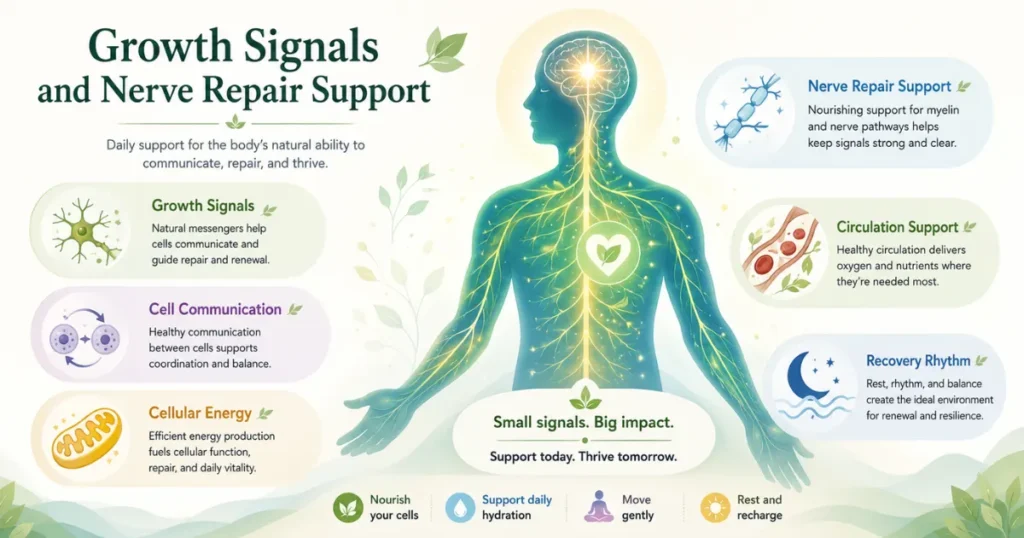
Growth Signals are part of the body’s repair communication system. They help cells send and receive messages that guide protection, cleanup, adaptation, and repair support.
The body does not repair in a random way. Instead, cells use signals to decide when to respond, when to protect, and when to rebuild. Because of this, repair depends on communication as much as it depends on nutrients or rest.
For example, nerve-related repair support may involve cellular energy, immune balance, blood flow, inflammation resolution, and recovery rhythm. These systems work together. As a result, repair messages become more useful when the body has a stable support environment.
However, these signals do not act like an instant healing switch. They do not guarantee recovery. Also, they do not work well when the body stays under constant stress.
This page explains Growth Signals in a safe educational way. It does not diagnose, treat, cure, or prevent any condition. Instead, it helps you understand how repair communication may support nervous system resilience.
Quick Navigation
What Are Growth Signals?
Growth Signals are messages that help cells respond, adapt, and support repair. In simple terms, they act like instructions inside the body.
These messages help cells know what kind of response may be needed. For example, a cell may need to protect itself. Another cell may need to support cleanup. In another situation, tissue may need more oxygen, nutrients, or immune support.
However, repair messages do not work alone. Cells need energy to follow these instructions. They also need oxygen, nutrients, blood flow, balanced immune activity, and enough recovery time.
This is important for nerve health because the nervous system depends on communication. Nerve-related cells must send clear signals, receive useful information, and respond in a balanced way.
Therefore, this process is not only about “growth.” It is also about timing, cleanup, protection, and adaptation. When the body sends better signals and has enough support, the repair environment may become more organized.
Why Repair Messages Matter for Nerve Health
Repair messages matter because nerves need clear communication. A nerve does not work alone. It depends on cells, blood flow, myelin support, immune balance, and energy production.
When the body senses stress or strain, it may send signals to protect tissue. After that, it may send cleanup signals. Then, if conditions are supportive, it may organize repair and adaptation activity.
Because of this, timing matters. The body needs to move from stress response toward repair readiness. If it stays in defense mode too long, recovery support may become less efficient.
For example, long-term inflammation may keep the body alert. Poor sleep may reduce repair timing. Low energy may limit cellular response. Also, poor circulation may reduce delivery of oxygen and nutrients.
As a result, nerve-related tissues may have a harder time returning toward balance. This does not always mean damage is getting worse. Instead, it may mean the body needs better support conditions.
This is why repair signaling belongs inside the Regeneration Systems category. It helps explain how the body coordinates repair support across many layers.
The Main Layers of Repair Signal Support
Repair communication depends on several layers. Each layer helps the body send, receive, and use signals more clearly.
1. Cellular Energy
Cells need energy before they can respond well. Without enough fuel, they may struggle to communicate, repair, clear waste, or adapt.
For example, a cell may receive a repair message. However, if energy is low, the response may be weak. As a result, repair support may slow down.
Cellular energy depends on sleep, nutrients, oxygen, blood sugar rhythm, and stress load. Therefore, energy support is one of the foundations of repair signaling.
In addition, repair work itself uses fuel. The body needs enough resources to act on the messages it receives.
2. Cell Communication
Cells communicate through chemical signals, electrical activity, and local tissue messages. Through this communication, the body can respond to changing needs.
Clear communication helps the nervous system stay organized. It also helps immune cells, support cells, and repair-related tissues work together.
However, stress can affect communication. Poor sleep, inflammation, nutrient gaps, and high stress load may make signals less clear.
Because of this, the body needs a stable internal environment. Better stability may help repair messages become easier to use.
3. Immune Cleanup Response
The immune system helps the body respond to stress. It can help clear damaged material, guide cleanup, and support tissue repair.
Short-term immune activity can be useful. It helps the body notice a problem and begin a response. However, long-term immune activation may keep the system in defense mode.
For this reason, immune balance matters. The body needs a clear response, but it also needs to calm down when the job is done.
This balance helps the nervous system move from protection toward repair readiness.
4. Inflammation Resolution
Inflammation can begin the repair response. However, resolution helps complete the cycle.
If inflammation stays high, the body may keep sending defense signals. In that state, repair messages may become harder to use.
Therefore, inflammation resolution is a key part of this system. It helps the body shift from “protect” toward “repair and adapt.”
In simple terms, repair often works better when the body can calm the stress response.
5. Growth Factor Environment
Growth factors are signal molecules that can guide cell activity. They may help support adaptation, repair response, and tissue maintenance.
However, the growth factor environment depends on the whole body. Sleep, movement, nutrition, blood flow, immune balance, and stress load all play a role.
Because of this, repair signaling should not be reduced to one molecule or one supplement. The larger environment matters.
A supportive signal environment needs both resources and rhythm.
6. Circulation and Oxygen Delivery
Blood flow helps deliver oxygen, nutrients, immune cells, and repair-related molecules. It also helps remove waste.
When circulation is weak, tissues may receive less support. As a result, cells may not respond as well to repair messages.
Gentle movement, breathing rhythm, hydration, and vascular health may all support circulation. In addition, good blood flow connects local tissue needs with whole-body support.
Therefore, circulation is an important bridge between repair signals and real tissue support.
7. Mechanical and Sensory Input
The body responds to input. Movement, posture, pressure, stretching, touch, and sensory feedback can all influence signaling.
For example, gentle movement may give useful information to tissues. At the same time, too much strain may increase stress signals.
This is why dose matters. The body often responds better to safe input followed by enough recovery.
Therefore, repair signaling connects with movement quality, pacing, and mechanical load balance.
8. Recovery Timing
Signals need timing. A useful repair message may not work well if the body stays overloaded all day.
Sleep, rest, meal rhythm, movement pacing, and stress balance all shape timing. When timing improves, the body may organize repair support more clearly.
For this reason, repair signaling depends on Recovery Cycles. The body needs windows of lower stress so it can use repair messages well.
How Signal Stress Can Build Over Time
Signal stress can build when the body receives too much demand and not enough recovery. At first, the body may adapt. Over time, though, the system may become less balanced.
For example, poor sleep may increase stress signals. Then inflammation may rise. Next, cells may use more energy for defense. After that, repair communication may become less efficient.
This can create a cycle:
Daily stress increases demand.
Then cells need more energy.
Next, immune and stress signals rise.
After that, repair messages become harder to use.
As a result, recovery may feel slower.
This cycle does not mean the body is broken. Instead, it shows that the repair environment needs support.
Because of this, the body needs more than stimulation. It needs clear messages, enough resources, and time to respond.
Repair Signals and Nervous System Sensitivity
Nervous system sensitivity may increase when the body stays in a protective state. In that state, the system may send more alert signals than usual.
When repair communication works well, the body can respond to stress and then move toward recovery. However, when stress stays high, the nervous system may remain on guard.
As a result, normal sensations may feel stronger. Movement may feel more demanding. Poor sleep may affect the body more quickly. Also, emotional stress may increase discomfort faster than expected.
This does not always mean tissue damage is getting worse. Sometimes it means the nervous system has not received enough recovery signals.
Therefore, this topic should be understood carefully. The goal is not to force repair. Instead, the goal is to support the conditions that help the body communicate, settle, and adapt.
How This System Connects With Other Pages
Repair signaling is part of the larger Regeneration Systems category. It connects with several other pages on this site.
Repair Messages and Cellular Repair
Cellular Repair gives cells the energy, cleanup support, and protection they need. Without cell-level support, repair messages may not work as well.
Repair Messages and Axonal Regrowth
Axonal Regrowth depends on repair messages, tissue guidance, and cellular energy. This signaling process helps explain how the body may organize nerve fiber support.
Repair Messages and Myelin Regeneration
Myelin support needs nutrients, immune balance, cell communication, and recovery rhythm. Repair messages help coordinate these support layers.
Repair Messages and Recovery Cycles
Recovery Cycles provide timing. They create windows of rest and lower stress demand. Because of this, they help the body use repair messages more clearly.
Repair Messages and Inflammation Resolution
Inflammation can start a response. However, resolution helps the body move toward repair readiness.
When inflammation stays high for too long, the system may remain in defense mode. Therefore, Inflammation Resolution works closely with repair communication.
Repair Messages and Vascular Regeneration
Blood flow helps deliver oxygen, nutrients, and repair-related molecules. Therefore, vascular support plays an important role in the signal environment.
Repair Messages and Neuroplastic Adaptation
The nervous system changes through repeated input, learning, and recovery. Repair communication may help support the background conditions for adaptation.
Common Misunderstandings About Growth Signals
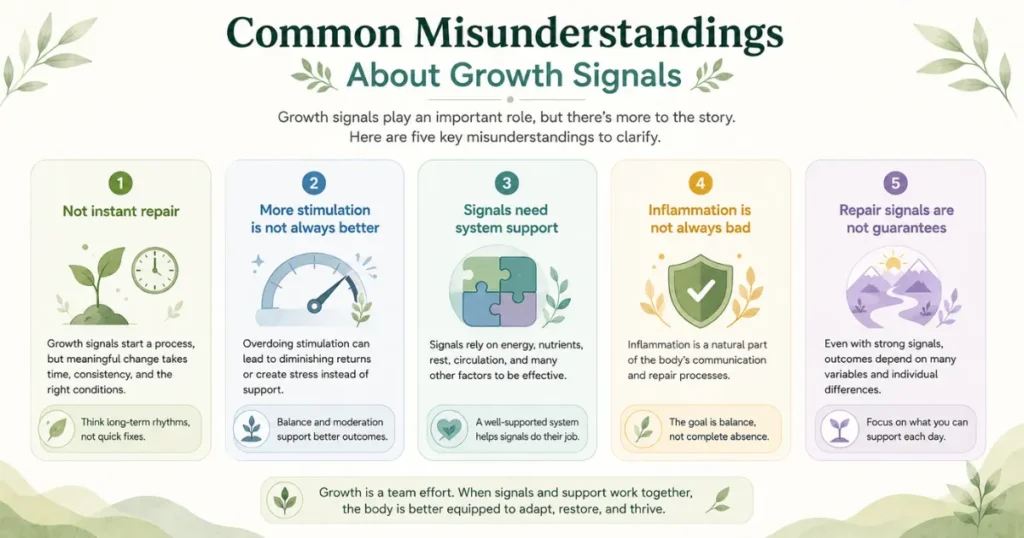
Misunderstanding 1: Growth Signals Mean Instant Repair
Growth Signals do not create instant repair. They help guide the body’s response, but the body still needs time, energy, and support.
Therefore, these messages are better understood as instructions, not instant results.
Misunderstanding 2: More Stimulation Always Helps
More stimulation does not always improve repair support. In some cases, too much input can increase stress signals.
The body needs the right amount of input. It also needs enough recovery after that input.
Because of this, balance matters more than force.
Misunderstanding 3: Repair Messages Work Alone
Repair messages do not work alone. They depend on cellular energy, immune balance, blood flow, nutrients, and recovery rhythm.
For this reason, they belong inside a larger regeneration system.
Misunderstanding 4: Inflammation Is Always Bad
Inflammation is not always bad. Short-term inflammation can help the body start a response.
However, long-term inflammation may keep the system in defense mode. Therefore, the body needs both response and resolution.
Misunderstanding 5: Repair Signals Guarantee Recovery
Repair signals do not guarantee recovery. The body must also have the right environment to use those signals.
Because of this, these messages should be understood as support factors, not promises.
How Daily Patterns Support Repair Communication
Daily patterns can influence repair communication. In most cases, these patterns do not need to be extreme. In fact, steady routines often support the body better than sudden changes.
Sleep Rhythm
Sleep supports repair timing, immune balance, hormone rhythm, and nervous system regulation. Because of this, sleep rhythm may influence repair messages.
When sleep is poor, stress signals may rise. As a result, repair communication may become less organized.
Therefore, a steady sleep-wake rhythm can help the body create better repair conditions.
Gentle Movement
Movement gives the body useful input. It may support circulation, tissue signaling, and nervous system awareness.
However, movement should match capacity. Too much intensity may increase stress signals. Too little movement may reduce useful input.
For this reason, gentle and consistent movement may support signaling balance.
Nutrition Quality
Cells need nutrients to respond to messages. They need protein, healthy fats, vitamins, minerals, and steady energy.
However, nutrition is not a single fix. It works with sleep, digestion, circulation, and stress balance.
Because of this, balanced nutrition may support the environment that helps repair messages work.
Stress Balance
Stress changes signaling. It affects hormones, inflammation, blood flow, sleep, and muscle tension.
When stress stays high, the body may send more defense signals. As a result, repair messages may become harder to use.
Therefore, calming routines may help. For example, slow breathing, quiet rest, light movement, and predictable routines may support better regulation.
Circulation Support
Repair messages need delivery pathways. Blood flow helps move oxygen, nutrients, immune cells, and signal molecules.
Because of this, circulation support matters. Hydration, breathing rhythm, gentle activity, and vascular health may all play a role.
In addition, better circulation may help tissues clear waste and receive repair support.
Recovery Pacing
Pacing helps the body respond to input without overload. It means matching activity with current capacity.
For example, a person may need shorter activity periods and more rest breaks. Over time, the body may tolerate more.
This approach supports repair signaling because it gives the body both demand and recovery.
Growth Signals System Map
This signaling system sits inside a larger regeneration network. It helps coordinate repair messages, but it needs support from many systems.
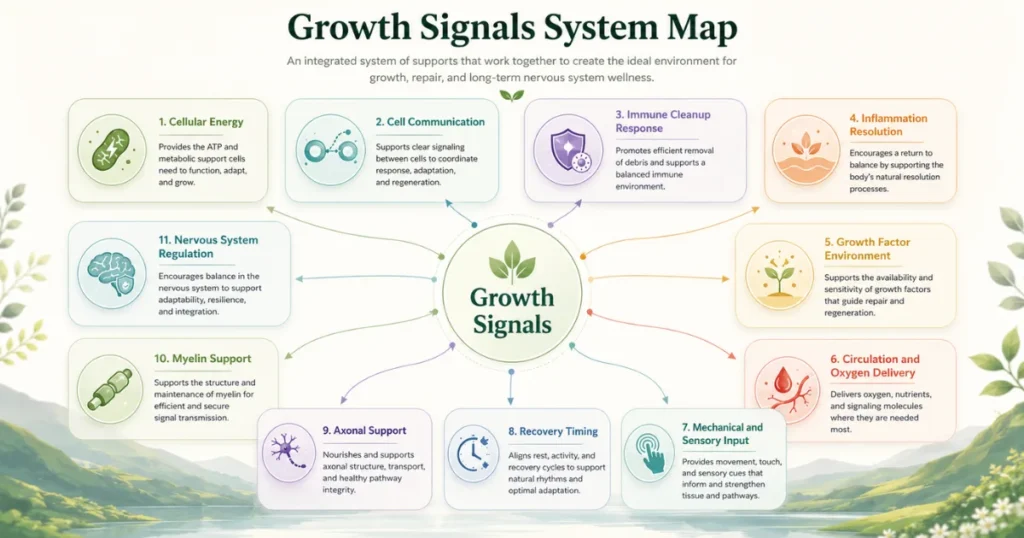
This system connects with:
- Cellular energy
- Cell communication
- Immune cleanup response
- Inflammation resolution
- Growth factor environment
- Circulation and oxygen delivery
- Mechanical and sensory input
- Recovery timing
- Axonal support
- Myelin support
- Nervous system regulation
Together, these layers help create a better environment for repair support.
For example, movement may provide input. Blood flow may deliver resources. Cellular energy may help cells respond. Then recovery timing may help the body organize repair.
This is why system thinking matters. These are not isolated messages. Instead, they work inside a full recovery network.
Repair Signal Flow
A simple flow can explain how repair signals support repair conditions:
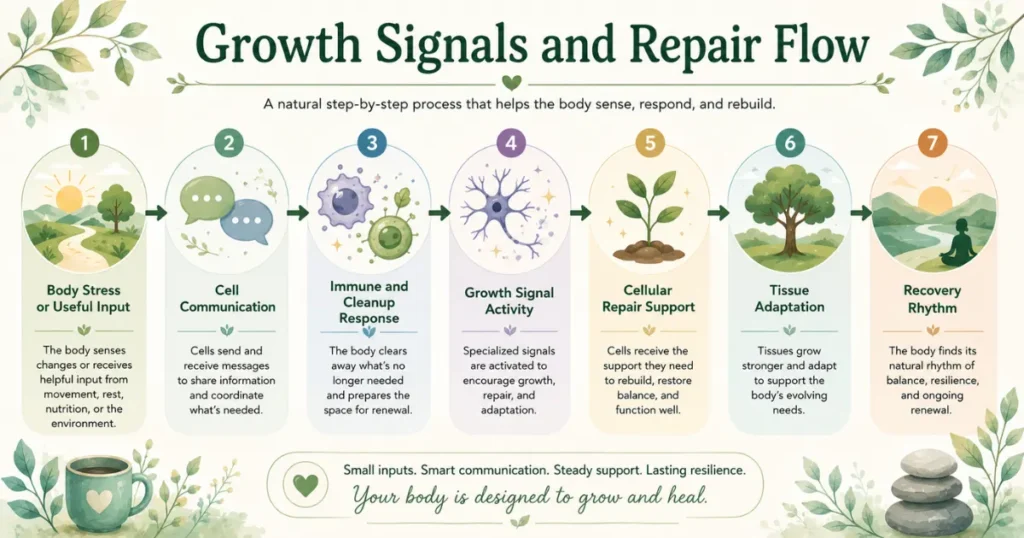
Body Stress or Useful Input → Cell Communication → Immune and Cleanup Response → Growth Signal Activity → Cellular Repair Support → Tissue Adaptation → Recovery Rhythm
This flow shows why timing matters.
First, the body receives stress or useful input. Then cells communicate. Next, the immune system may help with cleanup. After that, repair activity may increase.
However, if stress continues without enough recovery, the system may stay overloaded. As a result, repair messages may become less useful.
On the other hand, better recovery rhythm may support clearer signaling. Sleep, nutrition, movement, circulation, and pacing all help create this rhythm.
Key Takeaways
Growth Signals are part of the body’s repair communication system. They help cells respond, adapt, clear stress, and support repair activity.
However, these signals do not work alone. They need energy, nutrients, blood flow, immune balance, cellular repair, and recovery timing.
They also do not create instant results. Instead, they help guide repair support over time.
Because of this, daily patterns matter. Sleep, movement, nutrition, stress balance, circulation, and pacing can all shape the signal environment.
In simple terms, this topic helps explain why nerve repair support is system-based. The messages matter, but the environment that receives those messages matters too.
Safety and Education Notice
This page is for educational purposes only. It does not diagnose, treat, cure, or prevent any disease or medical condition.
This topic is discussed here as a general body system concept. The goal is to explain how repair messages, cellular support, and recovery rhythm may relate to nervous system education.
If you have persistent pain, numbness, tingling, burning, weakness, loss of function, injury, diabetes-related nerve concerns, autoimmune symptoms, severe fatigue, or worsening symptoms, please speak with a qualified healthcare professional.
Seek urgent medical care for sudden weakness, loss of bladder or bowel control, chest pain, difficulty breathing, severe numbness, severe pain, loss of coordination, sudden vision changes, confusion, fainting, irregular heartbeat, or rapidly changing neurological symptoms.
Because this topic involves medically sensitive nervous system and body-related processes, readers should not use this information to self-diagnose, stop medication, begin supplements, follow detox protocols, attempt self-treatment, force intense exercises, or delay professional care.