
Neuroplastic Adaptation: A Simple Guide to Nervous System Change
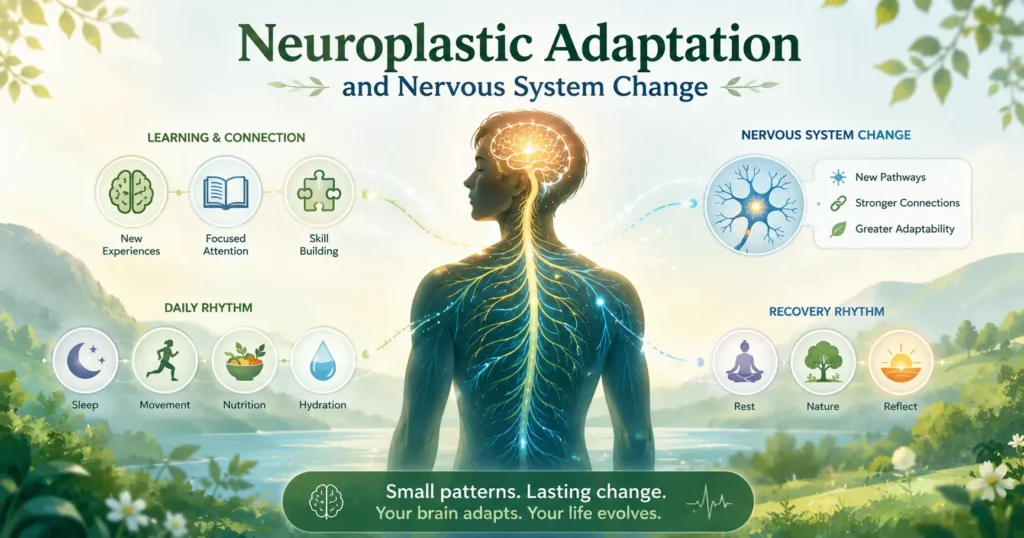
Neuroplastic Adaptation means the nervous system can change over time. It can learn from signals, movement, rest, attention, and body feedback.
However, this page is for education only. It does not diagnose, treat, cure, or prevent disease. Instead, it helps readers understand how nervous system change may fit into nerve health education.
Explore Parent Hub: regeneration systems
This page belongs to the Regeneration Systems section. Also, it connects with Neuroplasticity, Neural Signaling, Pain Processing, Brain–Body Integration, and Recovery Cycles.
Quick Navigation
What Is Neuroplastic Adaptation?
Neuroplastic Adaptation means the nervous system can adjust its patterns. In simple words, it can learn from repeated input.
For example, the nervous system may respond to touch, movement, posture, sleep, stress, emotion, and attention. Over time, these inputs may shape how signals feel.
This topic connects closely with Neuroplasticity. Neuroplasticity is the wider idea that the nervous system can change.
However, Neuroplastic Adaptation focuses more on daily life. It looks at how repeated signals, body feedback, and rest may shape response patterns.
Also, this does not mean the brain can fix every problem. It does not mean symptoms are only mental. Instead, it means the nervous system is active and connected with the body.
Why this matters:
This matters because many people think the nervous system is fixed. However, it can learn from repeated input. Because of this, it helps to look at the whole pattern, not only one symptom.
How Neuroplastic Adaptation Works
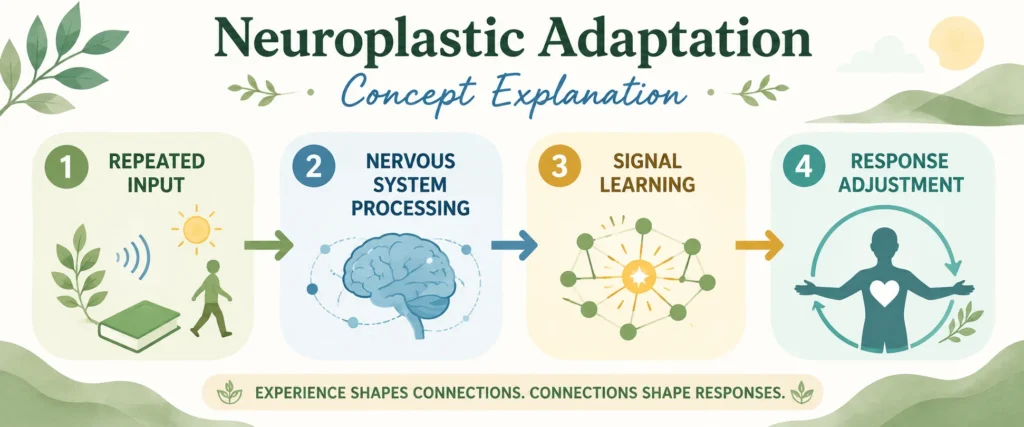
Neuroplastic Adaptation usually happens in steps.
First, the nervous system receives input. This input may come from movement, touch, posture, breathing, sleep, stress, pain signals, or learning.
Next, the brain and nerves process that input. They compare it with past experience. They also compare it with the body’s current state.
After that, repeated input may make some pathways more active. At the same time, unused pathways may become less active.
Over time, this may change how the nervous system responds. Still, this process is not always fast. It can also be shaped by sleep, stress, health history, and rest.
A helpful way to picture this is:
Simple Educational Flow
Repeated Input
↓
Nervous System Processing
↓
Signal Pattern
↓
Response Change
↓
Body Feedback
↓
New Learning Pattern
This is only a simple learning model. Real body processes are more complex. Therefore, it should not be used for self-diagnosis.
Explore Related page: Neural Signaling
Why this matters:
This section matters because adaptation is often misunderstood. It is not only about mindset. Instead, it may involve signals, movement, sleep, attention, and body feedback.
Key Layers of Neuroplastic Adaptation
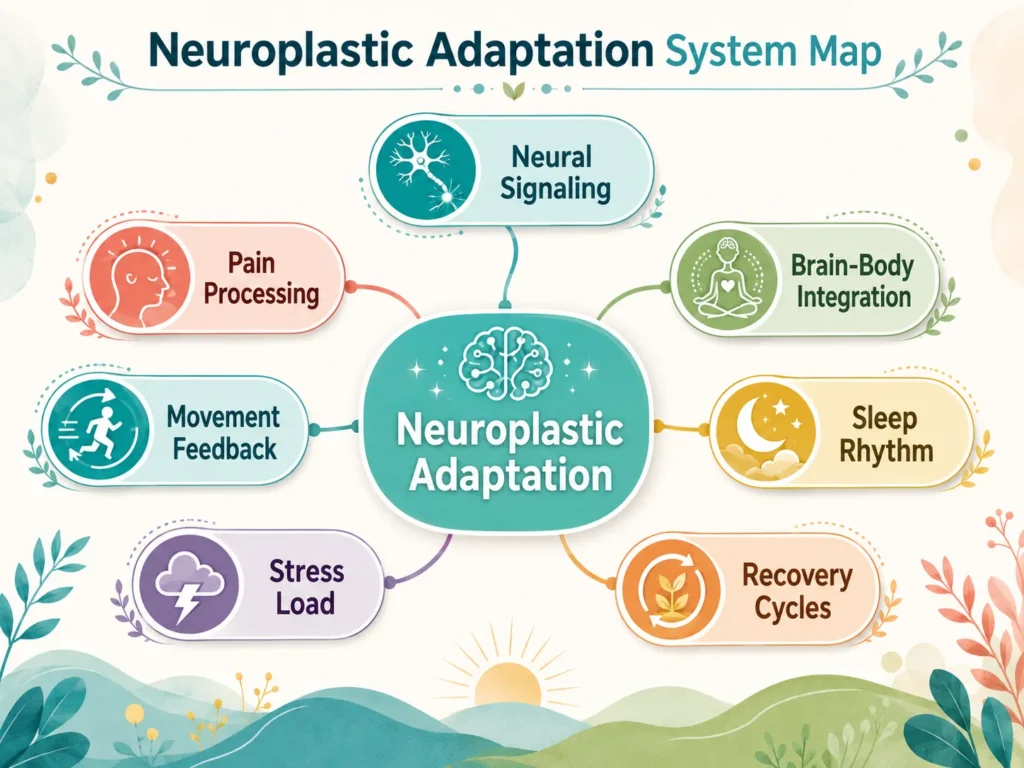
1. Repeated Signals
Repeated signals can shape nervous system patterns. For example, repeated movement may send useful messages to the body.
However, repeated tension may also send alert signals. Also, repeated fear may make the body more watchful.
Therefore, repetition is not always helpful by itself. The amount, timing, and body response also matter.
For this reason, useful adaptation often needs gentle input. It also needs enough rest.
Explore Related page: Neural Signaling
2. Attention and Learning
Attention can change what the nervous system notices. For example, if attention keeps returning to one feeling, that feeling may seem stronger.
At the same time, attention can also help learning. Calm practice can guide the body toward clearer signals.
However, this does not mean attention causes symptoms. Instead, attention is one part of how signals may be processed.
Explore Related page: Pain Processing
3. Body Feedback
The nervous system listens to the body all the time. For example, it receives messages from breathing, sleep, muscles, digestion, blood flow, and body tension.
Because of this, body state can shape adaptation. When the body is under heavy load, the nervous system may become more alert.
Also, when the body has more rest, signals may feel easier to process. This is one reason body feedback matters.
Explore Related page: Autonomic Regulation
4. Sensory Input
Sensory input includes touch, pressure, movement, temperature, sound, light, and body position.
When input feels clear and tolerable, the nervous system may process it more calmly. However, when input feels too strong, the body may become more alert.
Because of this, sensory input should be understood with care. It is part of the larger brain-body pattern.
Explore Related page: Brain–Body Integration
5. Movement and Coordination
Movement gives the nervous system useful feedback. Muscles, joints, skin, and balance centers all send messages during movement.
Gentle movement may help the body send clearer signals. However, too much intensity can add strain.
Therefore, movement should match the body’s current capacity. For this reason, movement should be seen as feedback, not as a cure.
Explore Related page: Movement Therapy
6. Recovery Timing
Adaptation needs time. The nervous system often learns through a rhythm of input, rest, and feedback.
Therefore, recovery windows matter. Without rest, the nervous system may stay loaded.
As a result, learning may become harder. Also, signals may feel stronger when the body has too little recovery time.
Explore Related page: Recovery Cycles
7. Integration and Stability
A new pattern needs time to become steady. This process is often called integration.
However, integration does not mean the body becomes perfect. Instead, it means the nervous system may become more coordinated over time.
Because of this, steadiness matters. Still, change should be understood as gradual, not instant.
Explore Related page: Integration and Stability
System Interactions
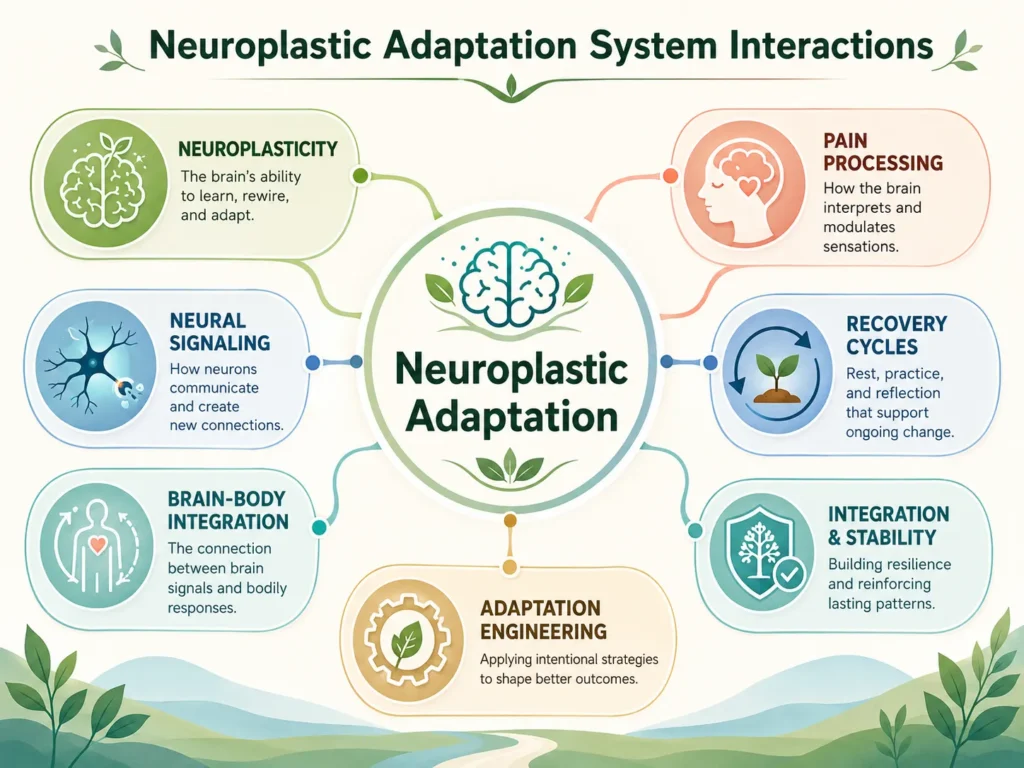
Neuroplastic Adaptation connects with many body and nervous system processes. Therefore, it should not be viewed as a single isolated topic.
Neural Signaling Interaction
Neural Signaling explains how nerve messages move. Neuroplastic Adaptation depends on these messages.
Because of this, repeated signals may shape how pathways are used. Also, clearer signals may help the nervous system organize information.
Learn more: Neural Signaling
Pain Processing Interaction
Pain Processing explains how the nervous system reads protective signals. Neuroplastic Adaptation may connect with this because repeated sensitivity patterns may change how signals are noticed.
However, this does not mean pain is only mental. Instead, it means pain can involve both body signals and nervous system processing.
Learn more: Pain Processing
Neuroplasticity Interaction
Neuroplasticity is the wider topic of nervous system change. Neuroplastic Adaptation is a practical way to understand that change in daily life.
For example, learning, movement, rest, and body feedback may all play a role. Over time, these patterns may shape response habits.
Learn more: Neuroplasticity
Brain–Body Integration Interaction
Brain–Body Integration explains how the brain and body communicate. This matters because the nervous system learns from body feedback.
Also, the body sends signals all day. These signals may come from posture, breathing, movement, digestion, and inner body cues.
Learn more: Brain–Body Integration
Recovery Cycles Interaction
Recovery Cycles explain how effort, rest, and body demand may change over time. Neuroplastic Adaptation often needs this rhythm.
Therefore, more effort is not always better. Instead, the body may need input and rest in a more steady pattern.
Learn more: Recovery Cycles
Adaptation Engineering Interaction
Adaptation Engineering explains change through load, timing, feedback, and steadiness.
This connects well with Neuroplastic Adaptation. Because of this, nervous system learning often works better with gradual input.
Why this matters:
This matters because adaptation is not only a brain topic. It also involves body signals, movement, rest, stress load, and daily habits.
Learn more: Adaptation Engineering
Patterns That Influence Neuroplastic Adaptation
Daily patterns can shape the environment around Neuroplastic Adaptation. However, these patterns are not treatments.
Instead, they are part of the wider body environment. Because of this, small daily patterns may matter over time.
Sleep Rhythm
Sleep gives the nervous system time to organize information. Also, it may help reduce overload.
When sleep is poor, signals may feel stronger for some people. As a result, the nervous system may have less room for calm learning.
However, sleep is not a cure by itself. Instead, it is one part of a larger body pattern.
Explore Related page: Sleep & Recovery
Stress Load
Stress load can change breathing, muscle tension, attention, digestion, and sleep. Because of this, it may shape how signals are processed.
However, stress is not the only cause of symptoms. It is one layer in a larger pattern.
Also, stress can change how safe or unsafe the body feels. For this reason, stress load can affect nervous system learning.
Explore Related page: Stress System
Movement Pattern
Movement gives feedback to the nervous system. Gentle and tolerable movement may help the body send clearer signals.
However, too much intensity may add strain. Therefore, movement should match current capacity.
Also, movement does not need to be perfect. Instead, it should be safe, steady, and appropriate for the person.
Explore Related page: Movement Therapy
Attention Pattern
Attention affects what the nervous system prioritizes. For example, repeated focus on one sensation may make it feel more important.
At the same time, attention can help learning. It may help the body notice safer movement and clearer body cues.
However, attention is not the full story. Instead, it works with sleep, stress, movement, and body feedback.
Explore Related page: Cognitive Systems
Emotional State
Emotion can change nervous system readiness. For example, fear or uncertainty may increase alertness.
Meanwhile, calm routines and clear information may reduce confusion. Because of this, emotional state can be part of the learning environment.
Still, emotions should not be blamed. Instead, they should be understood as one part of the whole pattern.
Explore Related page: Emotional Regulation
Recovery Windows
Adaptation often needs breaks. Without enough rest, the nervous system may stay under load.
For this reason, pacing and rhythm matter. Also, rest gives the body time to process input.
Over time, better spacing may make learning easier. However, this should not be treated as medical advice.
Explore Related page: Load Management
Neuroplastic Adaptation and Nerve Function
Neuroplastic Adaptation may relate to nerve function because nerves are part of a communication network. They send signals, receive feedback, and work with the brain, spinal cord, muscles, skin, and body systems.
However, this topic should not be used to explain symptoms by itself. Nerve-related symptoms can have many causes.
For example, symptoms may involve inflammation, blood flow, compression, injury, immune changes, medication effects, or other medical issues.
Neuroplastic Adaptation may relate to nerve signaling, sensitivity, pain processing, tingling, burning, numbness, fatigue, body-wide sensitivity, and movement confidence.
Still, symptoms should not be self-diagnosed. Therefore, seek medical care for severe, sudden, unusual, or worsening symptoms.
Why this matters:
This matters because readers may think every sensation means damage is getting worse. However, symptoms can involve many layers. These may include tissue state, signal processing, body alarm state, attention, and medical factors.
Helpful related pages include Peripheral Neuropathy, Chronic Nerve Pain, and Post-Injury Nerve Damage.
Practical Examples of Neuroplastic Adaptation in Daily Life
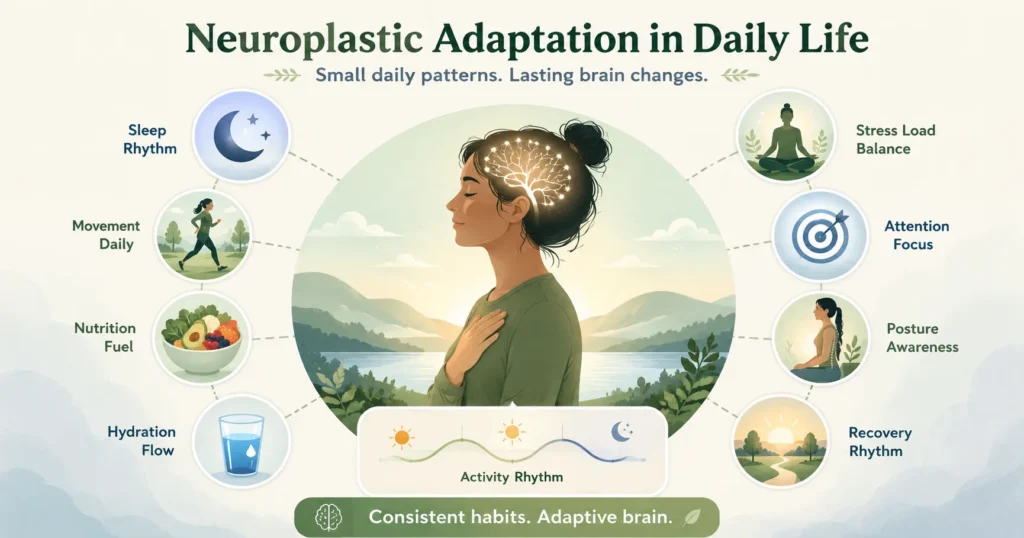
Example 1: Sleep and Signal Sensitivity
When sleep is poor, the nervous system may have less time to organize signals. As a result, sensations may feel stronger the next day.
However, this does not mean sleep alone solves the issue. Instead, it shows how sleep rhythm may shape the body environment.
Explore Related page: Sleep & Recovery
Example 2: Repeated Gentle Movement
A person may notice that small movement feels easier when repeated calmly. This may happen because the nervous system receives clearer movement feedback.
However, movement should not be forced. Too much intensity may increase load.
Therefore, gentle pacing matters. Also, comfort and timing matter.
Explore Related page: Movement Therapy
Example 3: Stress Load and Body Alarm
During stressful periods, breathing, muscle tension, attention, and sleep may change. Because of this, the nervous system may become more alert.
Still, this does not mean stress is the only cause of symptoms. Instead, it is one possible layer.
Explore Related page: Stress & Coping
Example 4: Learning a New Body Pattern
When someone practices a new posture, breathing rhythm, or movement skill, the nervous system receives new input.
Over time, the body may become more familiar with that pattern. However, this depends on timing, comfort, and capacity.
Also, new patterns may need repetition. Therefore, change may take time.
Explore Related page: Adaptation Engineering
Example 5: Pacing and Recovery Windows
If activity happens without enough rest, the nervous system may stay loaded. However, when effort and rest are spaced better, the body may have more room to process input.
Because of this, pacing can be useful as an educational idea. Still, it should not be treated as medical advice.
Explore Related page: Recovery Cycles
Neuroplastic Adaptation Visual Flow
Simple Visual Flow
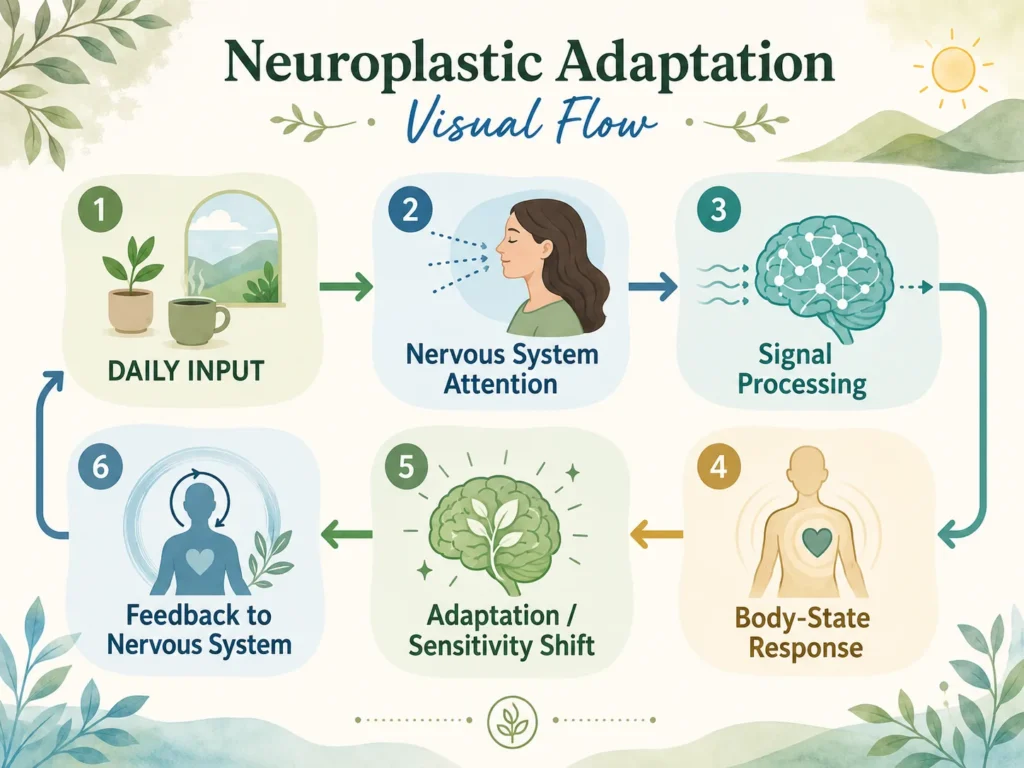
Daily Input
↓
Nervous System Attention
↓
Signal Processing
↓
Body Response
↓
Repeated Pattern
↓
Adaptation or Sensitivity Shift
↓
Feedback to the Nervous System
This flow is only an educational model. Real body processes are not always linear.
In addition, sleep, stress, inflammation, blood flow, movement, and medical history can all shape the process.
Why this matters:
This matters because a simple flow can help readers understand adaptation. However, it should not be turned into a treatment plan.
Why Neuroplastic Adaptation Matters for Recovery
1. Recovery May Need New Signal Patterns
Recovery education is not only about tissue repair. It may also involve how the nervous system learns to process signals.
Because of this, signal patterns matter. Also, repeated input may shape how the body responds.
Explore Related page: Neural Signaling
2. Sensitivity May Involve Processing
Sensitivity can involve how signals are noticed, filtered, and understood. However, this does not mean symptoms are imaginary.
Instead, it means nerve health education should look at both body state and signal processing.
Explore Related page: Pain Processing
3. Adaptation Needs Rhythm
The nervous system often learns through cycles. Input, rest, learning, and feedback all matter.
Therefore, recovery rhythm matters. Also, more effort is not always better.
Explore Related page: Recovery Cycles
4. Daily Patterns Shape the Learning Environment
Sleep, movement, breathing, stress load, nutrition, and emotion can all shape the background environment.
However, daily habits are not cures. Instead, they are part of the larger context.
Explore Related page: Nervous System Regulation
5. Stability Helps New Patterns Last
A new nervous system pattern may need repetition and steadiness. If the body is always overloaded, integration may be harder.
Because of this, stability matters. Still, stability does not mean perfection.
Explore Related page: Integration and Stability
6. Adaptation Is Individual
People do not adapt at the same speed. Health history, sleep, stress load, movement tolerance, and medical conditions can all play a role.
For this reason, this page is for education only. It should not be used for self-treatment.
Explore Related page: Personalization
Common Misunderstandings About Neuroplastic Adaptation
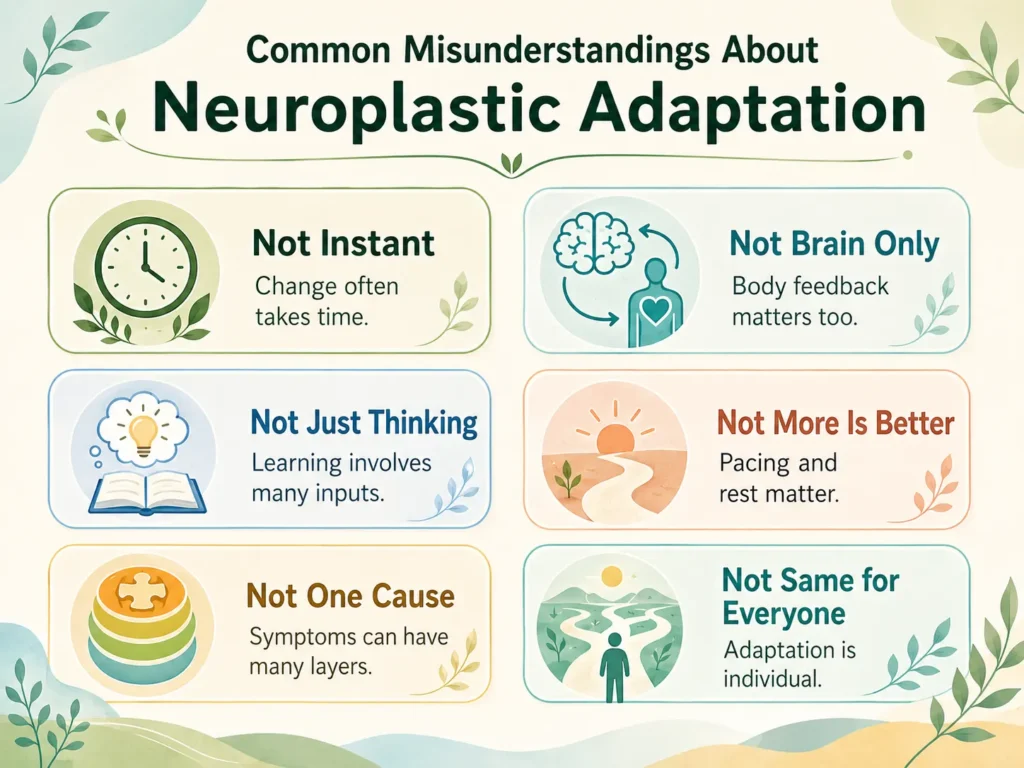
Misunderstanding 1: Neuroplastic Adaptation Means the Brain Can Fix Anything
Clarification:
Neuroplastic Adaptation does not mean the brain can fix every problem. Instead, it means the nervous system can change patterns over time.
However, medical concerns still need proper care.
Misunderstanding 2: It Is Only About Positive Thinking
Clarification:
Positive thinking is not the same as nervous system change. Instead, adaptation may involve signals, movement, attention, sleep, emotion, and body feedback.
Misunderstanding 3: More Practice Is Always Better
Clarification:
More is not always better. In fact, the nervous system may need the right amount of input, not constant effort.
Therefore, rest and timing matter.
Misunderstanding 4: Symptoms Are Always Caused by Poor Adaptation
Clarification:
Symptoms can have many causes. For example, they may involve medical, structural, metabolic, immune, inflammatory, blood flow, or nervous system factors.
Because of this, symptoms should not be self-diagnosed.
Misunderstanding 5: Adaptation Happens Quickly
Clarification:
Some changes may happen quickly. However, many nervous system patterns need repeated input, time, and rest.
Also, each person may adapt at a different pace.
Misunderstanding 6: Neuroplasticity Only Happens in the Brain
Clarification:
The brain is central. Still, adaptation also involves body feedback, movement, sensory input, spinal pathways, and brain-body communication.
Because of this, the whole body context matters.
Explore Related page: Brain–Body Integration
Comparison Table
| Common View | Better System-Based View |
|---|---|
| Neuroplastic Adaptation means the brain can fix anything | It means the nervous system can change patterns, but it does not guarantee recovery |
| More repetition is always better | Repetition needs timing, tolerance, and rest |
| Sensitivity always means damage is getting worse | Sensitivity may involve signal processing, body state, and medical factors |
| Adaptation is only mental | Adaptation can involve body feedback, movement, attention, sleep, and signals |
| One page explains everything | Neuroplastic Adaptation connects with many related systems |
| Daily habits are a cure | Daily patterns may shape the body environment, but they are not treatment |
FAQs About Neuroplastic Adaptation
Is Neuroplastic Adaptation a treatment?
No. This page is educational only. It does not diagnose, treat, cure, or prevent disease.
Why does Neuroplastic Adaptation matter for nerve health education?
It may help readers understand how repeated signals, daily patterns, movement, attention, and body feedback can shape nervous system learning.
Can Neuroplastic Adaptation explain pain, tingling, or burning?
It may help explain how some signals are processed or felt. However, symptoms can have many causes and should not be self-diagnosed.
Can daily habits influence Neuroplastic Adaptation?
Daily patterns such as sleep, movement, breathing, stress load, hydration, and rest rhythm may shape the body environment. However, they are not medical treatments.
Is Neuroplastic Adaptation the same as Neuroplasticity?
They are closely related. Neuroplasticity is the broader idea of nervous system change. Meanwhile, Neuroplastic Adaptation focuses on how those changes may appear through daily input and feedback.
When should someone seek medical help?
Seek urgent medical care for severe, sudden, unusual, or worsening symptoms. For example, seek care for sudden weakness, loss of bladder or bowel control, severe numbness, severe pain, confusion, fainting, chest pain, difficulty breathing, or fast-changing neurological symptoms.
Continue Learning
To understand this topic more clearly, readers may also explore Regeneration Systems.
Also, this topic connects with Neuroplasticity, Neural Signaling, Pain Processing, Brain–Body Integration, Recovery Cycles, Integration and Stability, and Adaptation Engineering.
For safety guidance, readers should review the Health Disclaimer.
Related Systems
Neuroplasticity
Neuroplasticity explains how the nervous system can change over time. This connects directly with Neuroplastic Adaptation because adaptation is one way those changes may appear.
In simple terms, neuroplasticity gives the foundation. Meanwhile, Neuroplastic Adaptation explains how repeated input, attention, movement, and feedback may shape the nervous system environment.
Neural Signaling
Neural Signaling explains how nerve messages travel. Neuroplastic Adaptation depends on these signals because repeated messages may guide how pathways are used.
Because of this, adaptation is not random. Instead, it is shaped by input, feedback, and repeated activity.
Pain Processing
Pain Processing explains how the nervous system reads protective signals. Neuroplastic Adaptation may connect with pain education because repeated sensitivity patterns can change how signals are noticed.
However, this does not mean pain is only in the brain. Instead, it means pain can involve both body state and nervous system processing.
Brain–Body Integration
Brain–Body Integration explains how the brain and body communicate. Neuroplastic Adaptation relies on this link because the nervous system learns from body feedback.
Therefore, this page is useful for readers who want to understand how movement, breathing, posture, emotion, and inner body signals may interact.
Recovery Cycles
Recovery Cycles explain how effort, rest, processing, and adaptation may work together. Neuroplastic Adaptation often needs timing and repetition.
Because of this, more effort is not always better. Instead, rhythm and recovery windows may matter.
Integration and Stability
Integration and Stability explains how new patterns may become steadier over time. Neuroplastic Adaptation connects with this because nervous system change is more useful when it becomes part of daily function.
Still, this does not promise recovery. It simply explains why steadiness matters in nervous system education.
Sources / References
For general educational background, readers may explore:
NCBI Bookshelf:
Neuroplasticity educational overview
Cleveland Clinic:
What Is Neuroplasticity?
BrainFacts:
Neuroplasticity and Practice
NCBI / PMC:
Adaptive Neuroplasticity in Brain Injury Recovery
These sources are for general education only. Therefore, they should not be used as personal medical advice.
Educational Trust Note
This article is for educational purposes only. It does not diagnose, treat, cure, or prevent disease.
Also, it should not replace professional medical advice, diagnosis, or treatment.
To learn more about the educational purpose of this website, visit the About page.
For safety guidance, please review the Health Disclaimer.
If readers have questions about the website, they can use the Contact page.
Safety & Education Notice
This page is for educational purposes only. It does not diagnose, treat, cure, or prevent disease.
Also, it is not a substitute for professional medical advice, diagnosis, or treatment.
Seek urgent medical care for severe, sudden, unusual, or worsening symptoms. These may include sudden weakness, loss of bladder or bowel control, chest pain, difficulty breathing, severe numbness, severe pain, loss of coordination, sudden vision changes, confusion, fainting, irregular heartbeat, or fast-changing neurological symptoms.
Because this topic involves medically sensitive nervous system and body-related processes, readers should not use this information to self-diagnose.
Also, readers should not stop medication, begin supplements, follow detox protocols, attempt self-treatment, force intense exercises, or delay professional care.