
System Architecture Essential Guide to Nervous System Balance
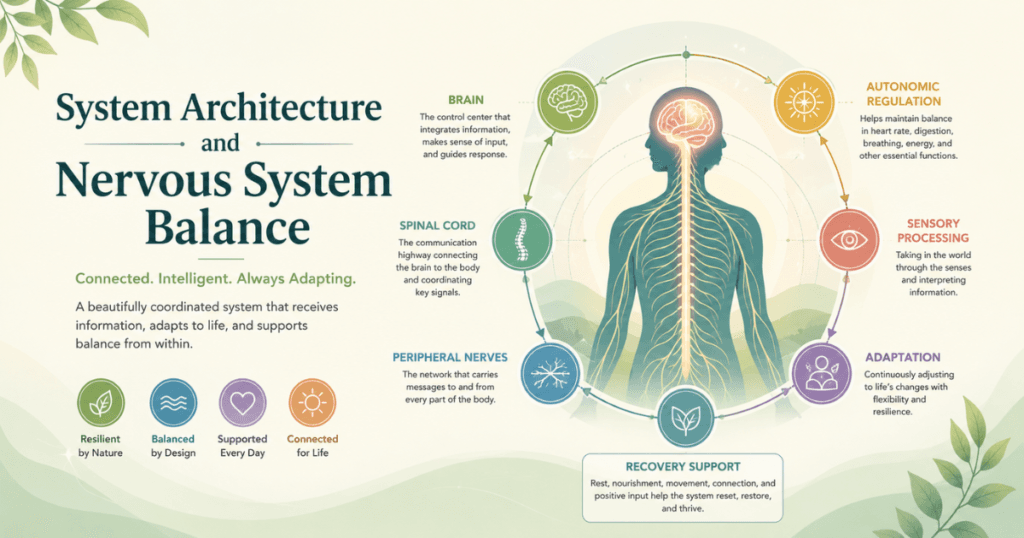
System Architecture explains how the nervous system is arranged.It also shows how different parts send messages to each other. In addition, it helps explain how signals, regulation, sensitivity, protection, adaptation, and recovery demand may interact over time. From an educational view, this topic can make nerve health easier to understand because the nervous system does not work as one isolated part.
Instead, it works through many layers. These layers include the brain, spinal cord, peripheral nerves, sensory pathways, autonomic regulation, immune communication, circulation, metabolism, and recovery systems. Because of this, nerve-related experiences may involve more than one pathway.
For this reason, this page is for education only. It does not diagnose, treat, cure, or prevent disease. However, it may help readers understand how different nervous system layers can work together in a system-based way.
Quick Navigation
What Is System Architecture?
System Architecture means the way the nervous system is built, organized, and connected. In simple terms, it explains how different parts of the nervous system communicate with each other.
In simple terms, the nervous system is not only a set of nerves. Instead, it is a layered system. It receives information, filters signals, creates responses, adapts to stress, and helps coordinate body function.
For example, a sensory signal from the body may travel through peripheral nerves, enter the spinal cord, and then be interpreted by the brain. At the same time, autonomic regulation, inflammation, circulation, and stress response may shape how that signal is processed.
Because of this, nerve health education becomes clearer when the nervous system is viewed as a whole system. A symptom or body sensation may relate to several layers, not just one part.
System Architecture also connects naturally with topics such as Neural Signaling, Pain Processing, Autonomic Regulation, and Neuroplasticity.
How System Architecture Works
In simple terms, System Architecture works through communication, filtering, response, and adaptation.
First, the body collects information. For example, this information may come from touch, movement, temperature, pressure, tissue state, breathing rhythm, posture, digestion, stress load, and internal body changes.
Next, this information travels through nerve pathways. Meanwhile, some signals move through peripheral nerves. At the same time, others are processed through the spinal cord, brainstem, and brain.
After that, the nervous system filters the signal. This filtering process may decide whether the signal is ignored, reduced, amplified, or sent forward for deeper processing.
Over time, repeated patterns may shape the system. For example, ongoing stress, poor sleep, inflammation, low movement, or high recovery demand may influence how the system responds.
Because of this, System Architecture is not only about structure. It is also about function. As a result, it explains how the nervous system organizes information and adapts to changing body conditions.
Key Layers of System Architecture
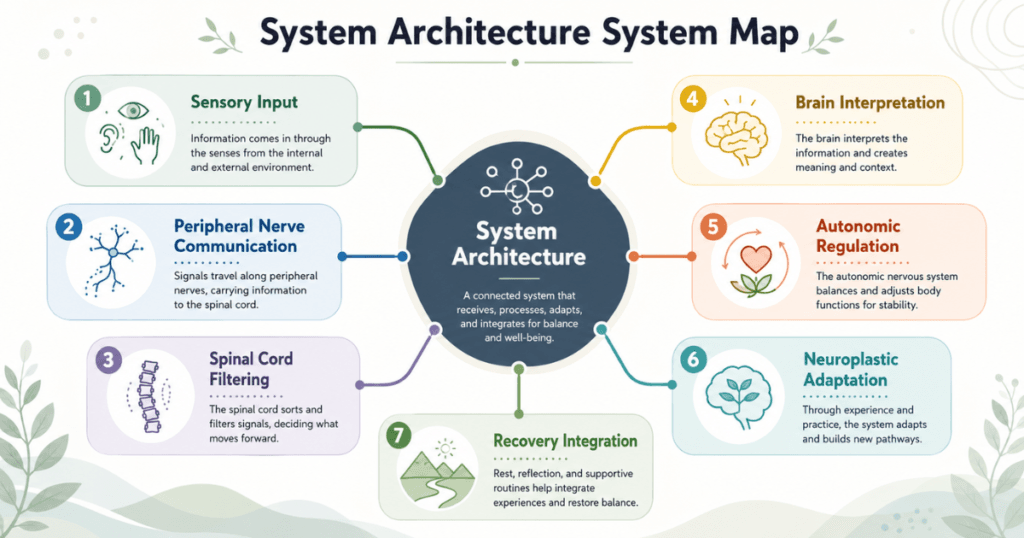
1. Sensory Input Layer in System Architecture
The sensory input layer collects information from the body and environment. This may include touch, pressure, temperature, movement, position, pain-related signals, and internal body sensations.
In simple terms, this layer acts like the nervous system’s information-gathering network. It helps the body notice what is happening.
However, sensory input does not always equal danger. The nervous system still has to interpret the signal. Therefore, the meaning of a signal depends on how it is filtered and processed.
In addition, this layer connects closely with Pain Processing because pain-related experiences involve both signal input and nervous system interpretation.
2. Peripheral Nerve Communication in System Architecture
Peripheral nerves carry signals between the body and the central nervous system. Because of this, these nerves help the body sense, move, and respond.
For example, peripheral nerves may send sensory information toward the spinal cord. At the same time, they may carry motor signals from the nervous system back toward muscles.
Because of this, peripheral nerve communication is an important part of System Architecture. It helps connect the outer body with deeper processing centers.
Still, nerve communication can be influenced by many factors, including circulation, myelin support, inflammation, mechanical load, and metabolic stress.
3. Spinal Cord Filtering in System Architecture
The spinal cord is not just a cable. Instead, it is an active processing layer. It receives signals, filters them, and helps coordinate reflexes and movement patterns.
Some signals may be reduced at this level. Others may be amplified or passed upward to the brain. Because of this, spinal cord filtering can influence how strongly a signal is felt.
For this reason, this layer is important because the nervous system does not wait for every signal to reach conscious awareness. Many responses happen automatically.
From a system view, the spinal cord helps connect sensory input, movement output, pain processing, and protective responses.
4. Brain Interpretation in System Architecture
The brain gives meaning to signals. It looks at what is happening in the body and around the person. It may consider body state, stress level, memory, attention, sleep quality, emotional safety, and previous experiences.
For this reason, the same body signal may feel different in different situations. For example, a mild sensation may feel more noticeable during high stress or poor sleep.
This does not mean the sensation is imaginary. Instead, it means the nervous system processes signals through context.
This layer connects closely with Brain–Body Integration because the brain and body continually influence each other through feedback loops.
5. Autonomic Regulation in System Architecture
The autonomic nervous system helps manage body state. It influences heart rate, breathing rhythm, digestion, blood flow, temperature regulation, stress response, and recovery readiness.
In System Architecture, this layer helps explain why nerve-related sensations may feel different during stress, fatigue, poor sleep, or emotional overload.
For example, when the body is under high demand, the nervous system may shift toward protection and alertness. As a result, some signals may become easier to notice.
For this reason, Autonomic Regulation is an important part of nervous system education.
6. Neuroplastic Adaptation in System Architecture
The nervous system can adapt. This ability is often called neuroplasticity. It means the system may change how it responds based on repeated input, learning, stress, movement, rest, and recovery patterns.
However, adaptation can move in different directions. In some situations, the system may become more flexible. In other situations, it may become more sensitive or protective.
Because of this, Neuroplasticity is not only about improvement. It is about change. The direction of change depends on many interacting factors.
Therefore, System Architecture helps show where these changes may occur across the larger nervous system.
7. Recovery and Integration Layer
This layer explains how the nervous system may settle after stress or demand. It also shows how the body may return toward a steadier state. This may involve rest, sleep rhythm, circulation, metabolic support, immune balance, emotional safety, and movement tolerance.
In addition, recovery is not one single action. Instead, it is a system process. It depends on how well different layers communicate and adapt.
For this reason, System Architecture helps explain why recovery demand may increase when several systems are under load at the same time.
This layer connects with Regeneration Systems because repair, adaptation, and stability require whole-system support.
System Architecture and System Interactions
System Architecture interacts with many related systems. These interactions can help explain why nervous system function is layered and connected.
Nervous System Interaction in System Architecture
System Architecture is the organizing framework of the nervous system. It includes sensory pathways, motor pathways, autonomic regulation, spinal cord filtering, and brain interpretation.
Because these parts work together, one layer may influence another. For example, a change in body state may affect sensory processing. Meanwhile, sensory processing may affect stress response.
Neural Signaling Interaction
Neural Signaling explains how nerve cells communicate. System Architecture explains where that communication happens and how it is organized.
In other words, neural signaling is the message process, while System Architecture is the larger network design.
Still, both are important. Without signaling, the system cannot communicate. Without architecture, the signals have no organized pathway.
Pain Processing and System Architecture
Pain processing involves signal input, spinal filtering, brain interpretation, and protective response. Therefore, it fits directly inside System Architecture.
For example, pain-related signals may be shaped by stress, sleep, inflammation, attention, past experience, and tissue state. Because of this, pain processing should not be viewed as only a single signal.
From an educational view, Pain Processing is one example of how nervous system architecture can influence what is felt.
Neuroinflammation Interaction
Neuroinflammation may influence how nervous system signals are processed. Immune activity can interact with nerve sensitivity, glial cell behavior, and recovery demand.
However, this does not mean inflammation always explains symptoms. Instead, it is one possible system layer that may influence nervous system communication.
Because of this, neuroinflammation belongs inside a larger system-based view.
Myelin System Interaction
The Myelin System supports signal efficiency. Myelin helps protect and organize nerve communication along certain nerve fibers.
When learning about System Architecture, myelin can be understood as part of the communication support layer. It helps signals move in a more organized way.
Still, nerve function depends on more than myelin alone. It also depends on metabolism, circulation, inflammation balance, and nervous system regulation.
Neuroplasticity and System Architecture
Neuroplasticity helps explain how the nervous system may change over time. These changes may involve pathways, sensitivity, coordination, attention, and response patterns.
System Architecture gives structure to those changes. It helps show where adaptation may happen across the nervous system.
Therefore, Neuroplasticity and System Architecture work together as educational concepts.
Autonomic Regulation Interaction
Autonomic regulation helps manage internal body state. This includes stress response, rest state, breathing rhythm, heart rate, digestion, and recovery readiness.
Because body state influences nervous system processing, autonomic regulation is a major part of System Architecture.
For example, a highly alert state may make certain signals feel stronger. Meanwhile, a calmer state may support better signal tolerance. This is not a treatment claim. It is a general educational concept.
Metabolic System Interaction
The nervous system requires energy. Therefore, metabolic patterns may influence nervous system function.
Blood sugar patterns, cellular energy demand, oxidative stress, and nutrient availability may all interact with nerve communication from a system perspective.
This connects with Root-Cause Systems because metabolic stress may be one layer among many that influence nervous system load.
Circulatory System Interaction
Circulation supports oxygen delivery, nutrient delivery, temperature regulation, and waste clearance. Because nerves require a healthy support environment, circulation is part of the larger architecture.
However, circulation should not be viewed alone. It interacts with movement, inflammation, metabolism, sleep, and recovery systems.
From a system view, circulation helps support the environment in which nerve signaling happens.
Regeneration Systems Interaction
Regeneration systems relate to repair, adaptation, and long-term stability. These systems may involve cellular repair, myelin support, vascular support, immune repair, and integration.
System Architecture helps organize these concepts. In addition, it shows how recovery is not only about one tissue or one pathway.
Because of this, recovery demand may involve communication between multiple layers of the body and nervous system.
Patterns That Influence System Architecture
Over time, daily patterns may influence how the nervous system organizes and processes signals. These patterns do not diagnose or explain every symptom. However, they may shape the system over time.
Sleep Rhythm
For example, sleep supports nervous system restoration, memory processing, stress regulation, and recovery readiness. Poor sleep rhythm may increase system load.
As a result, signals may feel stronger or harder to ignore when the body is under-rested.
Stress Patterns
Stress patterns may influence autonomic state, muscle tone, breathing rhythm, attention, and pain processing.
Over time, repeated stress may keep the nervous system in a more alert state. Because of this, the system may require more recovery support.
Movement Patterns
In addition, movement gives the nervous system regular feedback. It helps the brain and body update coordination, balance, posture, and sensory mapping.
However, movement demand must be understood carefully. Too little movement may reduce input. Too much demand may increase load.
Posture Load
Posture may influence mechanical stress, breathing mechanics, circulation, and sensory input.
For example, long periods in one position may increase body load. As a result, certain signals may become more noticeable.
Breathing Rhythm
Breathing rhythm interacts with autonomic regulation. It may influence alertness, body state, and internal feedback.
Because breathing is linked with the nervous system, it can be part of the body’s communication architecture.
Nutrition Quality
Nutrition quality may influence energy availability, metabolic balance, tissue support, and inflammatory load.
This does not mean food is a treatment for nerve symptoms. Instead, nutrition can be viewed as one support layer within the larger nervous system environment.
Hydration
Also, hydration may support circulation, tissue function, and general body regulation.
Still, hydration is only one piece of the system. It should not be viewed as a cure or complete explanation.
Circulation
Circulation helps deliver oxygen and nutrients while supporting waste clearance.
Because nerve communication depends on a stable internal environment, circulation may influence nervous system function from a support-system view.
Inflammatory Load
Inflammatory load may interact with nerve sensitivity and recovery demand. However, inflammation is complex and should not be used for self-diagnosis.
From an educational view, inflammatory balance is one layer that may influence how the nervous system feels and responds.
Emotional Safety
Emotional safety can influence nervous system state. A safer state may support better regulation, while ongoing threat or fear may increase protective responses.
This does not mean symptoms are “just emotional.” Instead, it means the nervous system responds to both body signals and context.
Recovery Capacity
Recovery capacity describes how much demand the body can handle before symptoms, fatigue, or sensitivity increase.
When recovery capacity is low, the system may respond more strongly to normal input. Because of this, recovery capacity is an important part of System Architecture.
System Architecture and Nerve Function
System Architecture may influence nerve function by shaping how signals are sent, filtered, interpreted, and responded to.
In simple terms, nerve signaling depends on communication pathways. However, the experience of a signal also depends on spinal filtering, brain interpretation, autonomic state, immune activity, circulation, and previous nervous system learning.
Because of this, sensations such as tingling, burning, numbness, fatigue, body-wide sensitivity, or pain may involve many possible layers. This page does not explain the cause of symptoms. Instead, it offers a safe educational framework for understanding complexity.
For example, tingling may relate to many different factors. Burning sensations may also have many possible explanations. Numbness, weakness, or sudden changes should always be taken seriously.
Seek urgent medical care for severe, sudden, unusual, or worsening symptoms. These may include sudden weakness, loss of bladder or bowel control, chest pain, difficulty breathing, severe numbness, severe pain, loss of coordination, sudden vision changes, confusion, fainting, irregular heartbeat, or rapidly changing neurological symptoms.
From a learning perspective, System Architecture helps show why nerve function is not isolated. It is connected to the whole body environment.
System Architecture Visual Flow
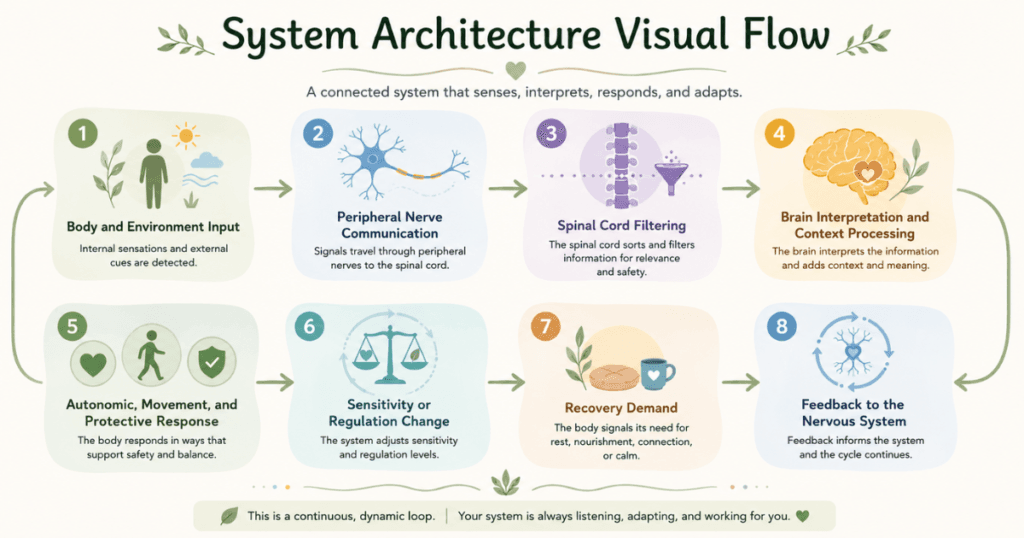
Body and Environment Input
↓
Peripheral Nerve Communication
↓
Spinal Cord Filtering
↓
Brain Interpretation and Context Processing
↓
Autonomic, Movement, and Protective Response
↓
Sensitivity or Regulation Change
↓
Recovery Demand
↓
Feedback to the Nervous System
However, this flow is only a simple educational model. Real body processes are not always linear. In many cases, several steps happen at the same time.
For example, body input may affect autonomic state while the brain is also interpreting context. Meanwhile, inflammation, circulation, metabolism, and recovery capacity may shape the system in the background.
Therefore, this visual flow should not be used as a diagnosis. It is a learning tool to understand how nervous system layers may interact.
Why System Architecture Matters for Recovery
1. Recovery Requires Organized Communication
Recovery depends on communication between body systems. Nerves, blood flow, immune signals, hormones, muscles, and brain pathways all exchange information.
Because of this, recovery is not only about one symptom or one body part. It involves how well the system communicates as a whole.
2. Recovery Requires Flexible Regulation
A flexible nervous system can shift between activity and rest more smoothly. This flexibility may help the body respond to demand and return toward balance.
However, when the system stays highly alert, signals may feel stronger. Therefore, regulation is an important part of recovery education.
3. Recovery Requires Signal Tolerance
Signal tolerance means the nervous system can receive and process normal body input without becoming overly reactive.
Over time, stress, poor sleep, pain history, inflammation, or high demand may influence signal tolerance.
System Architecture helps explain where signal tolerance may be shaped.
4. Recovery Requires Energy Support
The nervous system uses energy to send signals, maintain cell function, and adapt. Therefore, energy balance is part of the larger recovery picture.
This does not mean one food, supplement, or protocol fixes the system. Instead, it means energy support is one layer within a wider architecture.
5. Recovery Requires Protection and Adaptation
The nervous system is designed to protect the body. Sometimes, protective responses may become more active when the system senses high demand.
At the same time, the nervous system can adapt. Because of this, recovery education should include both protection and adaptation.
6. Recovery Requires Whole-System Support
A system-based view helps avoid oversimplification. Nerve health may involve neural signaling, pain processing, myelin support, neuroplasticity, autonomic regulation, metabolism, circulation, and immune balance.
For this reason, System Architecture gives readers a clearer map. It helps explain why multiple support systems may matter from an educational perspective.
Common Misunderstandings About System Architecture
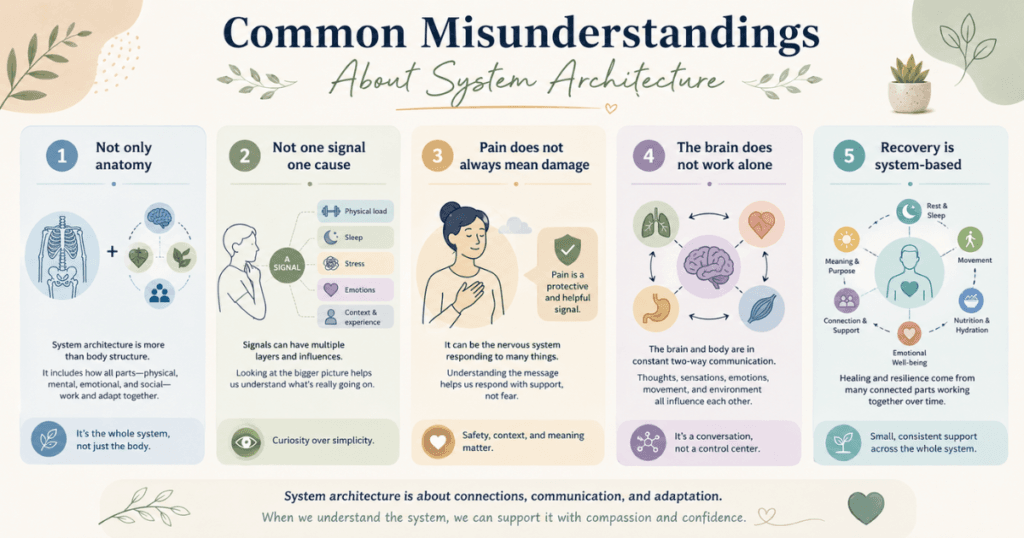
Misunderstanding 1: System Architecture Is Only Anatomy
Clarification:
System Architecture includes anatomy, but it is more than structure. It also includes communication, filtering, regulation, adaptation, and feedback.
In simple terms, it is both the nervous system’s design and how that design functions.
Misunderstanding 2: One Signal Always Has One Cause
Clarification:
Nervous system signals can be shaped by many layers. These may include tissue input, spinal filtering, brain interpretation, autonomic state, stress load, and recovery demand.
Because of this, one sensation should not be used for self-diagnosis.
Misunderstanding 3: Pain Always Means Damage
Clarification:
Pain is real, but pain processing is complex. It may involve tissue signals, nervous system sensitivity, attention, stress state, inflammation, and brain interpretation.
This does not mean pain is imaginary. Instead, it means pain is processed through a wider system.
Misunderstanding 4: The Brain Controls Everything Alone
Clarification:
The brain is important, but it does not work alone. The body sends constant feedback to the brain.
Therefore, System Architecture includes both top-down and bottom-up communication.
Misunderstanding 5: Recovery Is Only About Repair
Clarification:
Repair is important, but recovery also involves regulation, adaptation, energy support, circulation, immune balance, and signal tolerance.
Because of this, recovery should be understood as a system process.
Misunderstanding 6: A Complex System Means No Progress Is Possible
Clarification:
Complex does not mean hopeless. It means the body has many interacting layers.
From an educational view, understanding these layers may help readers think more clearly about nervous system health without fear or oversimplification.
Continue Learning About System Architecture
To understand System Architecture more clearly, continue with these related educational pages:
- Learn how nerve cells communicate in Neural Signaling.
- Explore how the nervous system processes pain-related signals in Pain Processing.
- Read about immune-related nervous system activity in Neuroinflammation.
- Understand signal support through the Myelin System.
- Learn how the nervous system adapts through Neuroplasticity.
- Explore body-state regulation through Autonomic Regulation.
- Review wider body contributors in Root-Cause Systems.
- Explore supportive education in Therapeutic Systems.
- Continue into repair and adaptation topics in Regeneration Systems.
- Follow the full educational sequence through the Learning Path.
For general educational background, readers may also explore the NCBI Bookshelf for basic nervous system and physiology references.
Related Systems in System Architecture
Neural Signaling
Neural signaling explains how nerve cells communicate through electrical and chemical messages.
System Architecture helps show where those messages travel and how they may be organized across the body, spinal cord, and brain.
Pain Processing
Pain processing explains how pain-related signals may be detected, filtered, interpreted, and felt.
Because pain processing uses several nervous system layers, it fits directly inside System Architecture.
Autonomic Regulation
Autonomic regulation helps manage internal body state. This includes stress response, breathing rhythm, heart rate, digestion, and recovery readiness.
System Architecture includes autonomic regulation because body state may shape how signals are processed.
Neuroplasticity
Neuroplasticity describes the nervous system’s ability to change over time.
System Architecture gives structure to this process by showing where adaptation may happen across pathways, responses, and feedback loops.
Myelin System
The myelin system supports signal efficiency in certain nerve pathways.
It is part of System Architecture because organized communication depends on both pathway design and signal support.
Neuroinflammation
Neuroinflammation describes immune-related activity within or around nervous system processes.
It may influence signal sensitivity, recovery demand, and nervous system communication from an educational perspective.
Regeneration Systems
Regeneration systems involve repair, adaptation, stability, and long-term support.
System Architecture helps connect these recovery-related processes to nervous system communication and whole-body feedback.
Safety & Education Notice
This page is for educational purposes only. It does not diagnose, treat, cure, or prevent disease. It is not a substitute for professional medical advice, diagnosis, or treatment.
Seek urgent medical care for severe, sudden, unusual, or worsening symptoms. These may include sudden weakness, loss of bladder or bowel control, chest pain, difficulty breathing, severe numbness, severe pain, loss of coordination, sudden vision changes, confusion, fainting, irregular heartbeat, or rapidly changing neurological symptoms.
Because this topic involves medically sensitive nervous system and body-related processes, readers should not use this information to self-diagnose, stop medication, begin supplements, follow detox protocols, attempt self-treatment, force intense exercises, or delay professional care.