
Oxygen Delivery and Nerve Function
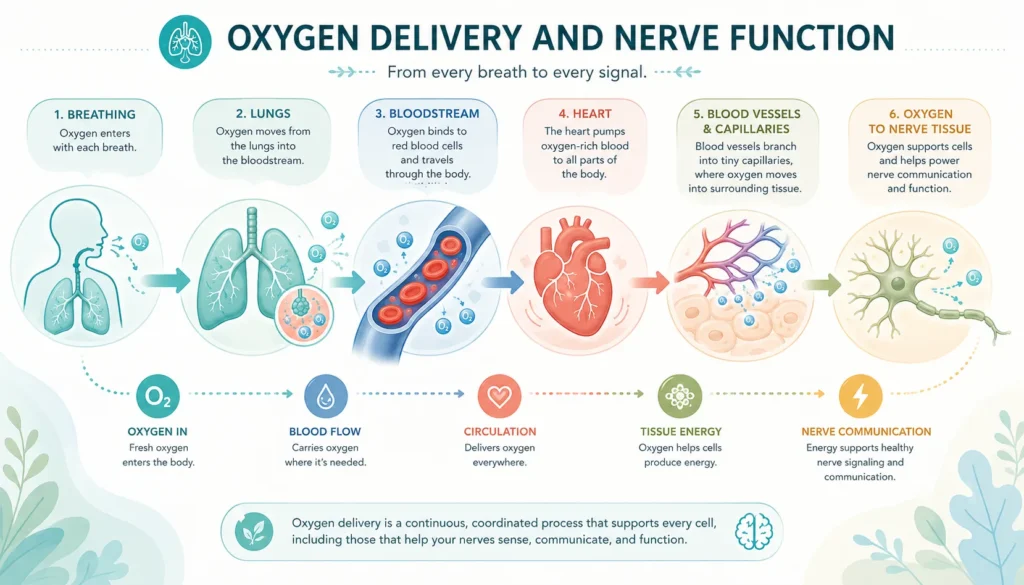
Oxygen Delivery and Nerve Function explains how the body moves oxygen through the bloodstream and how that delivery system may relate to nerve-health education. Oxygen enters through breathing, moves into the blood, and then travels through blood vessels toward tissues. Meanwhile, nerves use energy to send signals, guide movement, sense touch, and communicate with the brain. Therefore, oxygen delivery can be understood as one important part of the body’s working environment, not as a treatment or diagnosis.
At the same time, nerve symptoms are rarely explained by one system alone. Tingling, numbness, burning feelings, weakness, nerve pain, or unusual sensitivity can have many possible causes. For this reason, this page does not claim that oxygen delivery causes or fixes nerve symptoms. Instead, it gives readers a calm system-based view of how blood flow, breathing rhythm, circulation, microcirculation, movement, stress load, sleep, and recovery demand may interact with nerve function.
Quick Navigation
What Is Oxygen Delivery and Nerve Function?
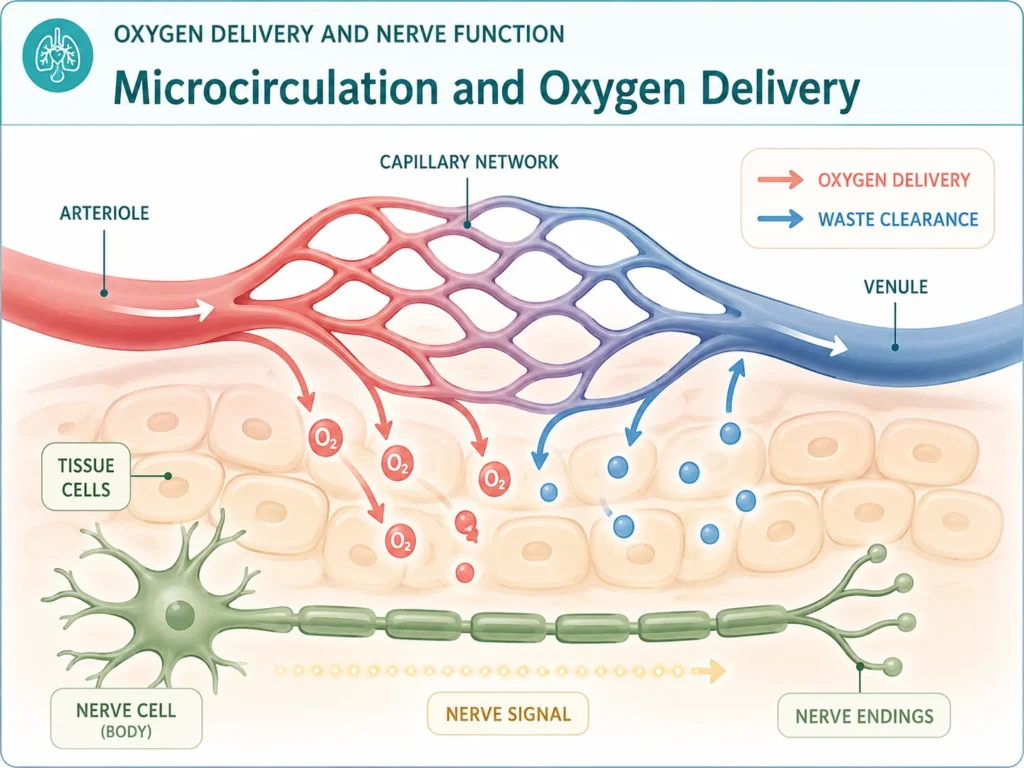
Oxygen Delivery and Nerve Function is the study of how oxygen moves from the lungs into the blood and then toward tissues that need energy. The circulatory system carries oxygen and nutrients to cells through the heart and blood vessels, while veins return oxygen-poor blood toward the heart and lungs so the cycle can continue. This transport system helps tissues receive oxygen and remove waste products as part of normal body function.
From a nerve-health education view, this matters because nerves are active tissues. They send signals, respond to body position, guide movement, and help the body notice touch, temperature, pressure, and discomfort. However, oxygen delivery should not be treated as a single answer for nerve symptoms. Instead, it is one useful lens for understanding how circulation, tissue energy, movement, sleep rhythm, stress response, and recovery capacity may work together.
A simple way to understand this topic is to imagine a delivery network. Oxygen is one important supply. Blood vessels are the roads. The heart is the pump. Smaller vessels help bring supplies closer to local tissues. Meanwhile, nerves work like communication lines. When demand rises, the system may need better coordination.
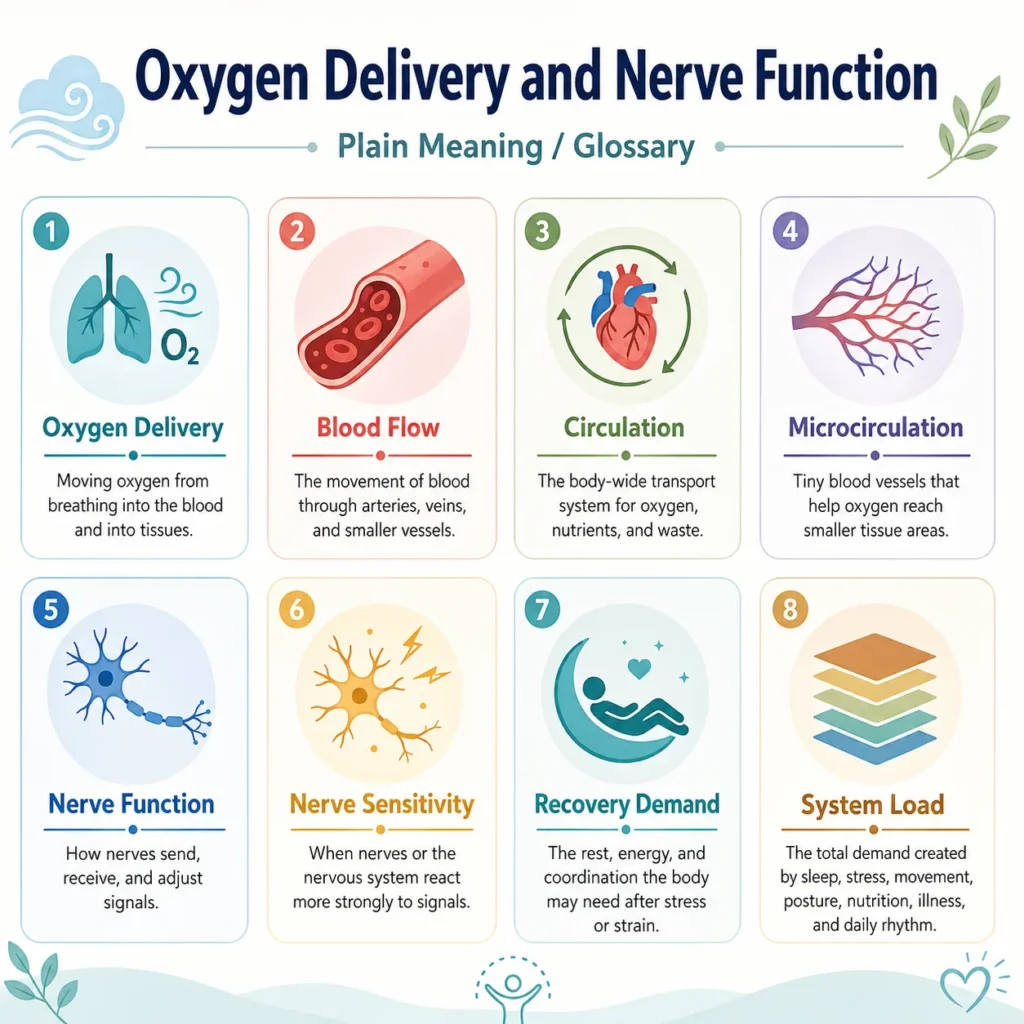
Plain Meaning / Glossary Box
Oxygen Delivery: The process of moving oxygen from breathing into the blood and then into tissues.
Blood Flow: The movement of blood through arteries, veins, and smaller vessels.
Circulation: The body-wide transport system that moves oxygen, nutrients, and waste products.
Microcirculation: The tiny blood-vessel network that helps oxygen reach smaller tissue areas.
Nerve Function: The way nerves send, receive, and adjust signals throughout the body.
Nerve Sensitivity: A state where nerves or the nervous system may react strongly to signals.
Recovery Demand: The amount of rest, energy, and system coordination the body may need after stress, strain, or overload.
Tissue Demand: The amount of oxygen, energy, and clearance a local tissue area may need.
System Load: The total demand created by sleep, stress, movement, posture, nutrition, illness, and daily rhythm.
How Oxygen Delivery and Nerve Function Works
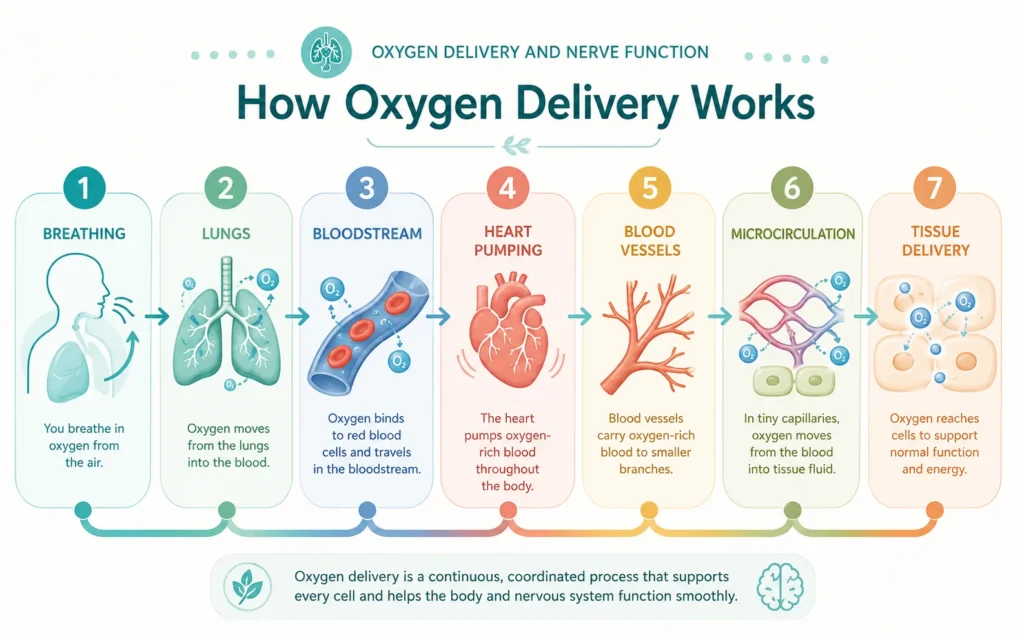
First, oxygen enters the lungs during breathing. Next, oxygen moves into the blood, where it is carried through the circulatory system. Then, arteries and smaller vessels help oxygen-rich blood reach tissues. In addition, blood helps carry nutrients and remove waste products from cells. NCBI Bookshelf explains that the circulatory system brings blood close to cells so oxygen, nutrients, and waste products can exchange through tissues.
As this process continues, nerves operate inside the same tissue environment. They do not float separately from the rest of the body. Instead, they depend on surrounding blood flow, tissue health, energy availability, and body-wide regulation. Therefore, oxygen delivery may connect with nerve function through energy production, local tissue demand, microcirculation, and recovery rhythm.
However, this does not mean that every nerve symptom is caused by poor oxygen delivery. Nerve symptoms may involve diabetes, nerve compression, injury, autoimmune activity, inflammation, medication effects, nutritional deficiency, vascular issues, or unknown causes. For this reason, this page uses oxygen delivery as an educational map, not as a diagnosis.
Key Layers of Oxygen Delivery and Nerve Function
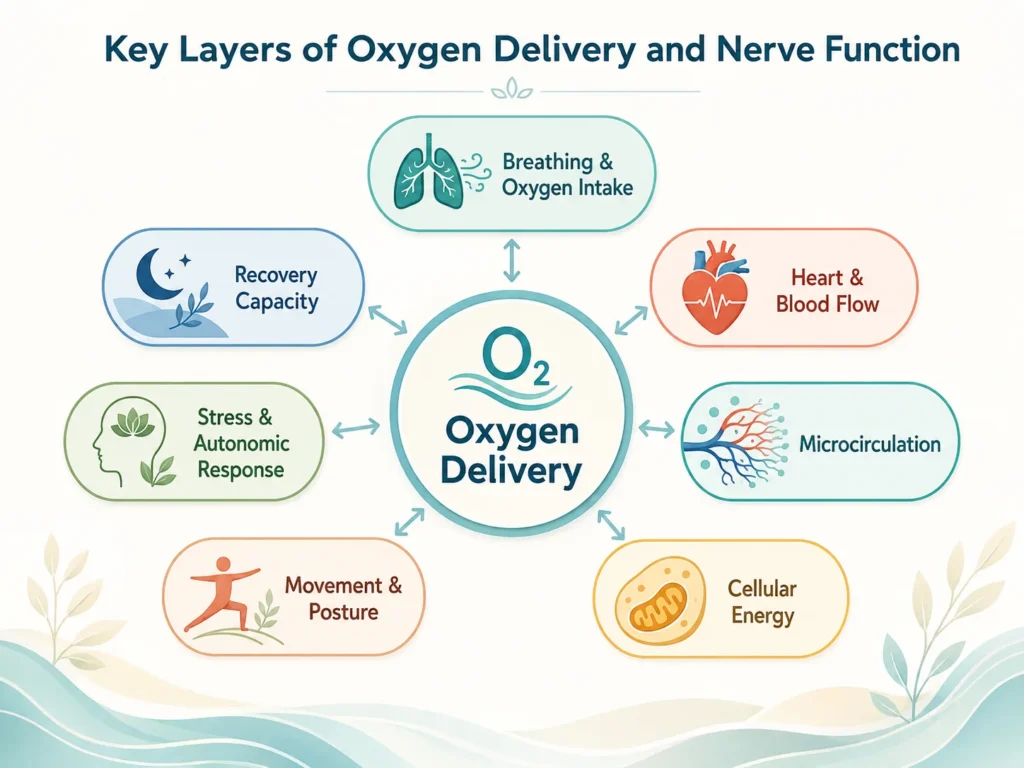
Breathing and Oxygen Intake Layer
Breathing is the starting point for oxygen delivery because oxygen enters the body through the lungs. However, breathing does not work alone. It interacts with posture, stress response, rib movement, physical activity, and overall body rhythm. For example, a tense upper body may make breathing feel shallow, while calm rest may feel easier and more open. Therefore, breathing is one entry point into the larger oxygen delivery system.
At the same time, breathing should not be presented as a cure for nerve symptoms. Breathing difficulty, chest pain, sudden weakness, severe numbness, or rapidly changing symptoms require medical attention. From an educational view, the important idea is that oxygen intake, circulation, and nervous system state may influence each other. Because of this, breathing belongs in the oxygen delivery discussion, but it should remain part of a wider body-system explanation.
Heart and Blood Flow Layer
The heart helps pump oxygen-rich blood through the body. Arteries carry blood away from the heart toward tissues, while veins return blood toward the heart and lungs. MedlinePlus explains that arteries carry oxygen-rich blood toward tissues and organs, while veins return oxygen-poor blood so it can receive oxygen again.
This matters for nerve-health education because nerves live inside tissues that require delivery and clearance. Blood flow helps bring oxygen and nutrients while also helping remove waste products. However, blood flow can be influenced by many factors, including movement, temperature, blood pressure, hydration, metabolic health, smoking, inflammation, and medical conditions. Therefore, oxygen delivery should be understood as a flexible system that changes with body demand rather than a simple on-or-off process.
Microcirculation Layer
Microcirculation refers to the small vessels that help oxygen reach tiny tissue spaces. This layer is important because large blood vessels move blood through the body, but smaller vessels help serve local tissue areas. As a result, microcirculation can connect whole-body circulation with local tissue comfort, energy needs, and recovery demand.
For example, a person may feel local stiffness, heaviness, or sensitivity after long sitting or repeated tension. That does not prove a circulation disorder. However, it shows how local tissue demand and small-vessel delivery may become part of the educational picture. In addition, microcirculation may connect with nerve endings, skin, muscle, and connective tissue. Because of this, Microcirculation and Nerve Sensitivity should be a strong related page in this cluster.
Cellular Energy Layer
Oxygen helps cells produce energy. Cells use that energy for maintenance, movement, repair processes, temperature control, and signaling. Nerves also need energy to maintain signal transmission and respond to changing body conditions. Therefore, oxygen delivery may matter because it helps support the larger energy environment around nerve function.
However, low energy, fatigue, or nerve discomfort should not be explained by oxygen delivery alone. Fatigue may relate to sleep disruption, stress load, low nutrition, inflammation, hormonal patterns, medication effects, illness, or medical conditions. Instead, this layer shows why oxygen delivery belongs inside a bigger system map. In simple terms, the body needs both delivery and demand management. When demand is high and recovery is low, the system may feel less flexible.
Movement and Posture Layer
Movement can affect oxygen delivery because muscles help circulation through repeated contraction and relaxation. Posture may also influence breathing space, muscle tension, joint position, and pressure patterns. For example, long sitting may reduce natural movement through the hips, legs, spine, and shoulders. Meanwhile, repeated static posture may increase local muscle demand.
However, posture is not a complete explanation for nerve symptoms. Numbness, weakness, burning pain, or spreading symptoms may need medical evaluation. Still, from a system perspective, movement and posture can influence oxygen demand, circulation rhythm, and tissue comfort. Therefore, this page should connect with Movement Posture and Nerve Regulation, especially because that page explains long sitting, daily movement patterns, and mechanical body load in more detail.
Stress and Autonomic Response Layer
The autonomic nervous system helps regulate automatic body functions, including heart rate, blood pressure, breathing, and digestion. Because of this, stress can influence oxygen delivery indirectly through breathing rhythm, muscle tension, alertness, and circulation patterns. During stress, the body may shift toward action. At the same time, recovery systems may receive less attention.
This response is not always harmful. The body needs alertness when facing real demand. However, when stress stays high for long periods, the body may feel less settled. Sleep may become lighter, muscles may stay tense, and normal sensations may feel stronger. Therefore, stress response may interact with oxygen delivery and nerve sensitivity as one layer of body-wide regulation. This is why Stress System and Daily Patterns and Nervous System Stability are important internal links for this page.
Recovery Capacity Layer
Recovery capacity depends on oxygen delivery, energy production, sleep rhythm, nervous system flexibility, nutrient delivery, waste clearance, and daily load. When these systems coordinate well, the body may have more room to respond, repair, and settle. However, when stress, poor sleep, low movement, illness, or repeated overload build up, the body may experience higher demand.
This page does not claim that oxygen delivery heals nerve damage. Instead, it explains that oxygen delivery is one part of the environment in which tissues function. NINDS notes that vascular and blood problems that decrease oxygen supply to peripheral nerves can lead to nerve tissue damage, which supports the importance of safe circulation education without turning the topic into self-treatment advice.
Real-Life Symptom Language Bridge
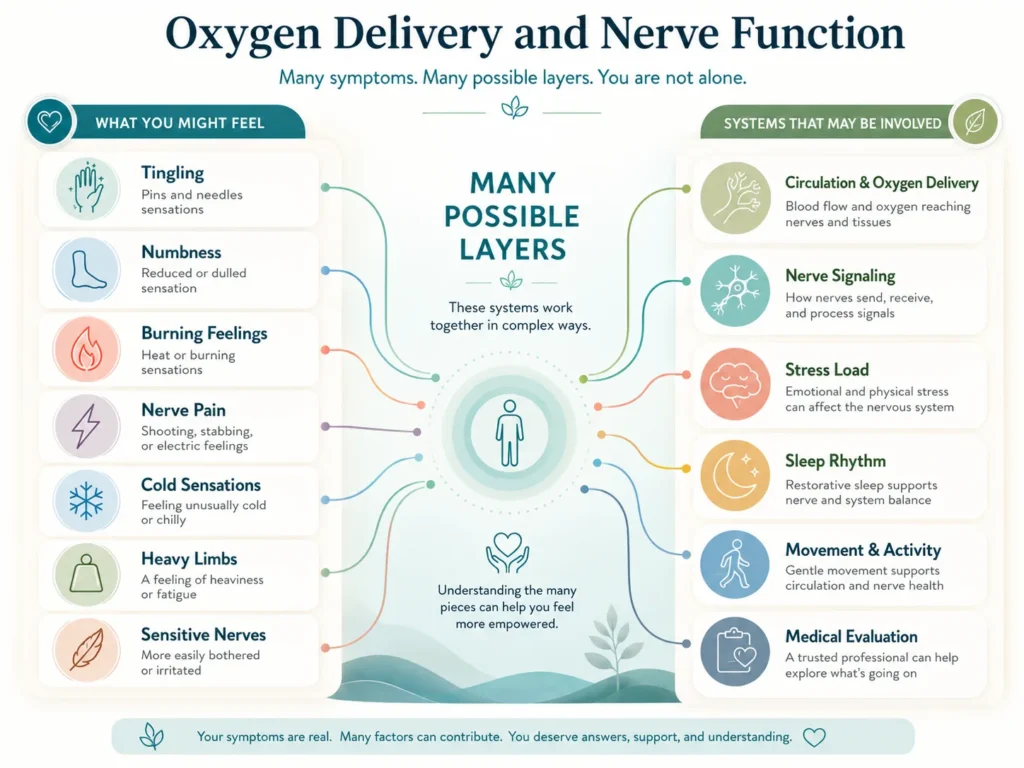
Some readers may search for Oxygen Delivery because they notice tingling, numbness, burning feelings, cold sensations, tired legs, heavy limbs, nerve pain, or sensitive nerves. These symptoms can feel worrying, especially when they repeat or affect daily life. However, symptoms like these can have many causes. Mayo Clinic lists peripheral neuropathy symptoms such as numbness, prickling, tingling, burning pain, sensitivity to touch, coordination problems, and weakness, but the causes can vary widely.
Therefore, oxygen delivery should not be used as the only explanation. Tingling may involve nerve compression, blood sugar problems, inflammation, injury, medication effects, vitamin issues, vascular problems, or other medical causes. Burning feelings may also relate to different forms of nerve sensitivity or neuropathy. Because of this, readers should treat oxygen delivery as one possible educational layer, not as a diagnosis.
For this reason, sudden, severe, spreading, unusual, or worsening symptoms need medical care. In addition, sudden weakness, loss of bladder or bowel control, chest pain, trouble breathing, severe numbness, or rapidly changing neurological symptoms should be treated as urgent warning signs.
Oxygen Delivery and Nerve Function Interactions
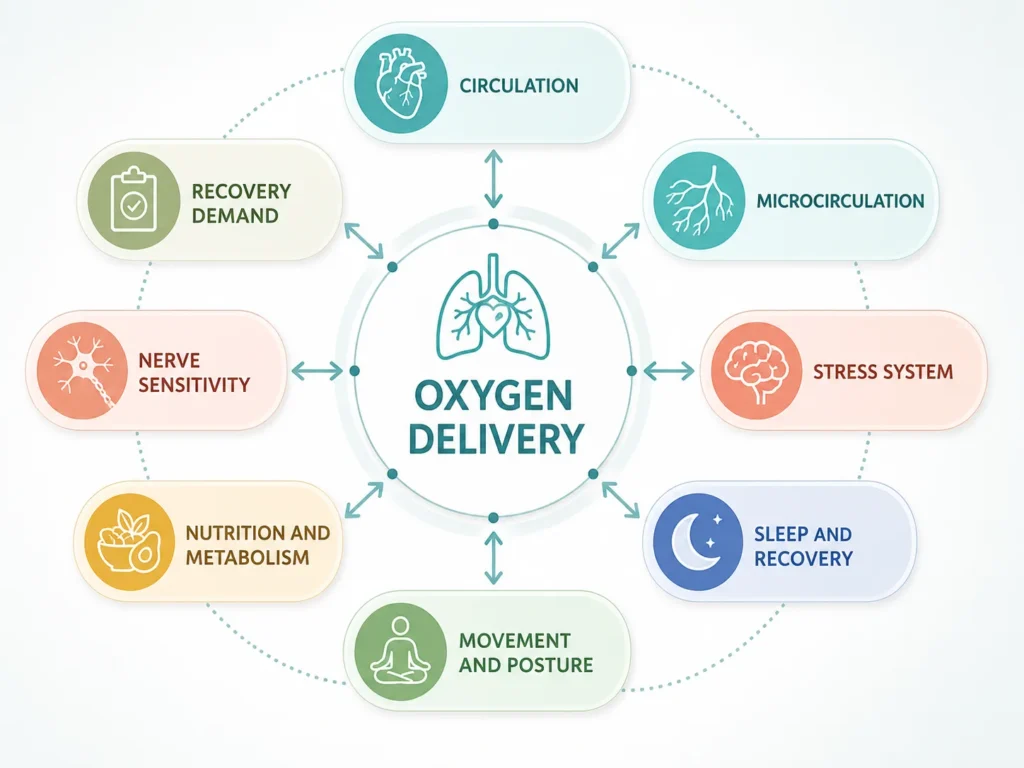
Circulation and Oxygen Delivery Interaction
Circulation is the main transport network for oxygen delivery. It moves oxygen-rich blood from the heart toward tissues and helps return oxygen-poor blood toward the lungs for re-oxygenation. In addition, blood carries nutrients, immune cells, and other materials while helping remove waste products. NCBI Bookshelf explains that blood carries oxygen and nutrients to living cells and takes away waste products.
This interaction matters because nerve-related tissues depend on a stable local environment. However, circulation can be shaped by daily movement, sleep, blood pressure, stress response, metabolic health, inflammation, and medical conditions. Therefore, circulation should not be discussed as a quick fix. Instead, it should be described as one body-wide support system that may influence tissue demand, energy availability, and recovery capacity.
Microcirculation and Nerve Sensitivity Interaction
Microcirculation helps oxygen reach small tissue areas through tiny vessels. This layer may matter for local tissue comfort because nerves, skin, muscles, and connective tissues all exist within small local environments. When demand changes, these areas may need flexible delivery and clearance. Therefore, microcirculation is a useful bridge between circulation and nerve sensitivity.
However, local sensitivity is not always a blood-flow issue. Pain processing, inflammation, mechanical pressure, stress load, sleep quality, and medical conditions may all affect how sensations are felt. Because of this, the best wording is careful: microcirculation may interact with nerve sensitivity, but it should not be blamed as the only cause. This page should later connect strongly to Microcirculation and Nerve Sensitivity.
Stress System Interaction
Stress can change breathing rhythm, heart rate, blood-vessel tone, muscle tension, and body alertness. As a result, it may influence oxygen delivery indirectly. For example, during a stressful day, a person may sit longer, breathe more shallowly, tighten muscles, and sleep poorly. These patterns may increase body load and reduce recovery time.
Still, stress is not always negative. The body uses stress responses to handle real demands. The concern is repeated activation without enough settling time. Therefore, stress should be explained as a rhythm issue, not as a blame statement. This page should link to Stress System and Chronic Stress and Nervous System Dysregulation, where readers can learn more about body-wide stress patterns.
Sleep and Recovery Interaction
Sleep gives the body time to reduce daily load, restore rhythm, and manage energy demand. When sleep is short or disrupted, normal sensations may feel stronger the next day. In addition, fatigue may make nerve discomfort feel harder to manage. Therefore, sleep can interact with oxygen delivery by shaping recovery capacity and nervous system flexibility.
However, sleep should not be described as a cure for nerve symptoms. Many nerve conditions require professional evaluation, and some symptoms may continue even with good sleep. Instead, sleep belongs in this page as one recovery layer. For internal linking, connect this section with Sleep & Recovery, Recovery Cycles, and Regeneration Processes During Sleep.
Nutrition and Metabolic Interaction
Oxygen delivery also connects with nutrition and metabolism because cells need both oxygen and nutrients to produce energy. Blood carries oxygen and important materials through the body. Meanwhile, metabolism helps convert those materials into usable energy. Therefore, oxygen delivery, nutrient availability, blood flow, and tissue demand are connected.
However, this section must avoid supplement claims, dosage advice, or food-as-treatment language. The safe educational message is that nutrition and oxygen delivery are both part of the body’s working environment. This page can later connect with How Nutrition Supports Nerve Repair, Micronutrients and Nerve Function, and Nerve Food Repair without making treatment promises.
Practical Daily-Life Examples
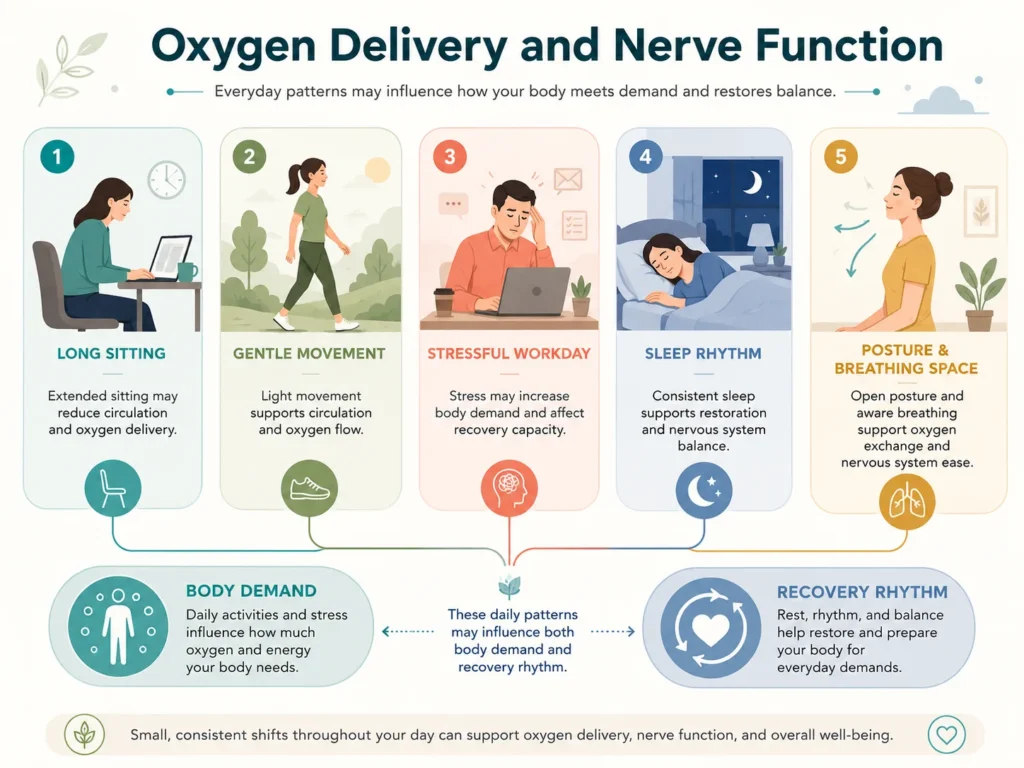
Long sitting is a simple daily example. When someone sits for many hours, the body may move less, muscles may stay still, and posture may become fixed. As a result, some areas may feel stiff, heavy, or uncomfortable. However, this does not mean long sitting directly causes nerve damage. Instead, it shows how movement, posture, circulation rhythm, and tissue demand may interact.
Another example is a stressful workday. During stress, a person may tighten the shoulders, clench the jaw, breathe more shallowly, and move less often. Meanwhile, the nervous system may remain in a more alert state. Over time, this pattern may raise system load. Therefore, stress can connect with breathing rhythm, oxygen delivery, muscle tension, sleep quality, and nerve sensitivity.
A third example is poor sleep rhythm. After short sleep, the body may feel less steady and normal sensations may feel stronger. In addition, fatigue may reduce the body’s ability to settle after daily stress. Because of this, Oxygen Delivery and Nerve Function should link with sleep, recovery cycles, and daily rhythm pages.
A final example is gentle movement during the day. Movement may help the body change position and support normal circulation rhythm. Still, this is not exercise prescription. Readers with symptoms or medical limits should follow professional guidance.
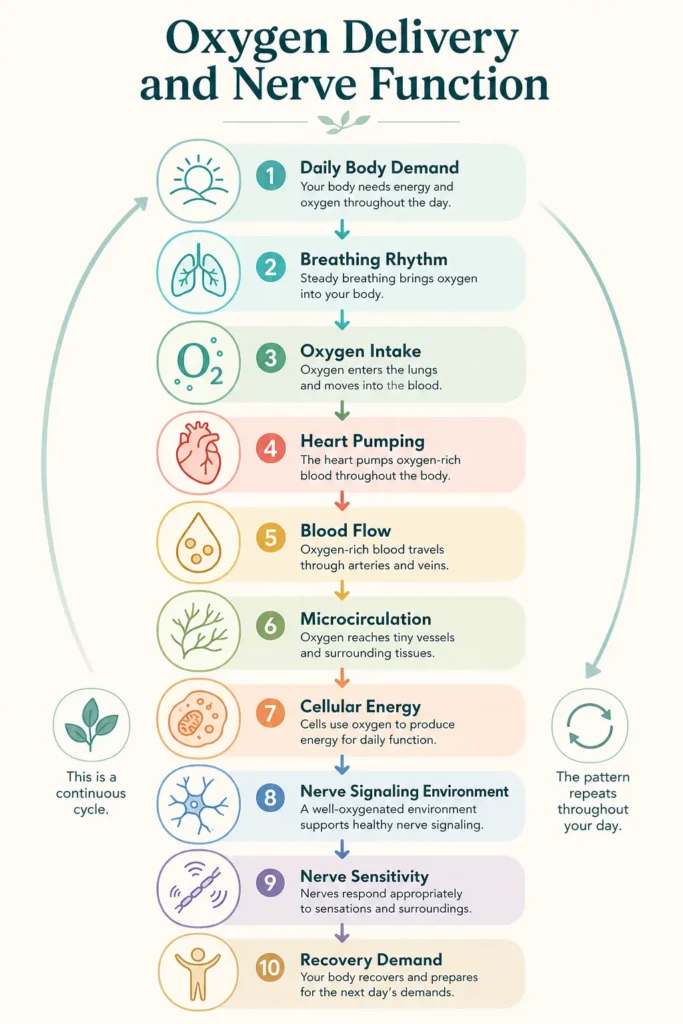
Oxygen Delivery and Nerve Function Visual Flow
Daily body demand
↓
Breathing rhythm and oxygen intake
↓
Heart pumping and blood flow
↓
Microcirculation and tissue delivery
↓
Cellular energy and waste clearance
↓
Nerve signaling environment
↓
Nerve sensitivity and recovery demand
↓
System flexibility or system overload
This flow is an educational model. It shows how oxygen delivery may connect with nerve function through several body layers. First, daily life creates demand through movement, posture, stress, sleep, work habits, and physical activity. Next, breathing and circulation help move oxygen through the body. Then, microcirculation helps local tissues receive oxygen and nutrients.
However, the flow is not always linear. It may work as a cycle. For example, stress may affect breathing, poor sleep may increase sensitivity, and low movement may change circulation rhythm. At the same time, nerve discomfort may reduce movement, which may increase stiffness and body load. Therefore, Oxygen Delivery and Nerve Function should be viewed as part of a connected system, not as a one-way cause-and-effect chain.
Why Oxygen Delivery and Nerve Function Matters for Recovery
Recovery Requires System Coordination
Recovery requires coordination between circulation, sleep, stress response, immune activity, tissue repair, nervous system signaling, and daily load. Oxygen delivery belongs inside that coordination because oxygen helps tissues meet energy needs. In addition, circulation helps move helpful materials toward tissues while carrying waste products away. Therefore, oxygen delivery can be part of a larger recovery-capacity conversation.
However, recovery is not controlled by oxygen alone. Nerves may be affected by compression, injury, diabetes, autoimmune activity, inflammation, toxins, infections, or other medical causes. Because of this, this page does not promise recovery, healing, or symptom relief. Instead, it teaches readers how one body system may interact with other systems during normal function and recovery demand.
Recovery Requires Energy and Regulation
Energy production matters because cells need energy for maintenance, signaling, and repair-related processes. Oxygen plays a role in that energy system. Meanwhile, the nervous system helps regulate movement, sensation, alertness, blood-vessel tone, and body rhythm. As a result, oxygen delivery and nervous system regulation may interact through energy demand and body-wide coordination.
At the same time, fatigue does not always mean poor oxygen delivery. It may relate to sleep, stress, nutrition, hormones, inflammation, medication effects, or medical illness. Therefore, the safest explanation is that oxygen delivery may be one part of the energy environment. It should be understood together with circulation, daily rhythm, and professional medical context when symptoms are concerning.
Recovery Requires Delivery and Clearance
Delivery and clearance are both important. Delivery means oxygen, nutrients, and useful materials reach tissues. Clearance means waste products and excess materials move away. Blood flow supports both of these processes. Cleveland Clinic explains that blood oxygen is exchanged for waste in tiny networks of blood vessels called capillaries before blood returns toward the heart and lungs.
For nerve-health education, this matters because nerves sit inside local tissue environments. If tissue demand rises, the body may need more coordination from circulation, movement, breathing rhythm, and recovery systems. However, this should not be turned into detox language. The correct educational message is that the body already has normal delivery and clearance systems, and those systems may interact with nerve comfort and recovery demand.
Recovery Requires Nervous System Stability
A stable nervous system can activate when needed and settle afterward. When the body is under repeated load, normal sensations may feel stronger, sleep may become lighter, and movement may feel less comfortable. Therefore, oxygen delivery may connect indirectly with nervous system stability through breathing rhythm, stress response, circulation, movement, and recovery windows.
However, stability does not mean the body should feel perfect every day. Fluctuation is normal. The more useful idea is flexibility. A flexible system can adjust to activity, rest, stress, and recovery. Because of this, Oxygen Delivery and Nerve Function should connect with Daily Patterns and Nervous System Stability and Recovery Cycles.
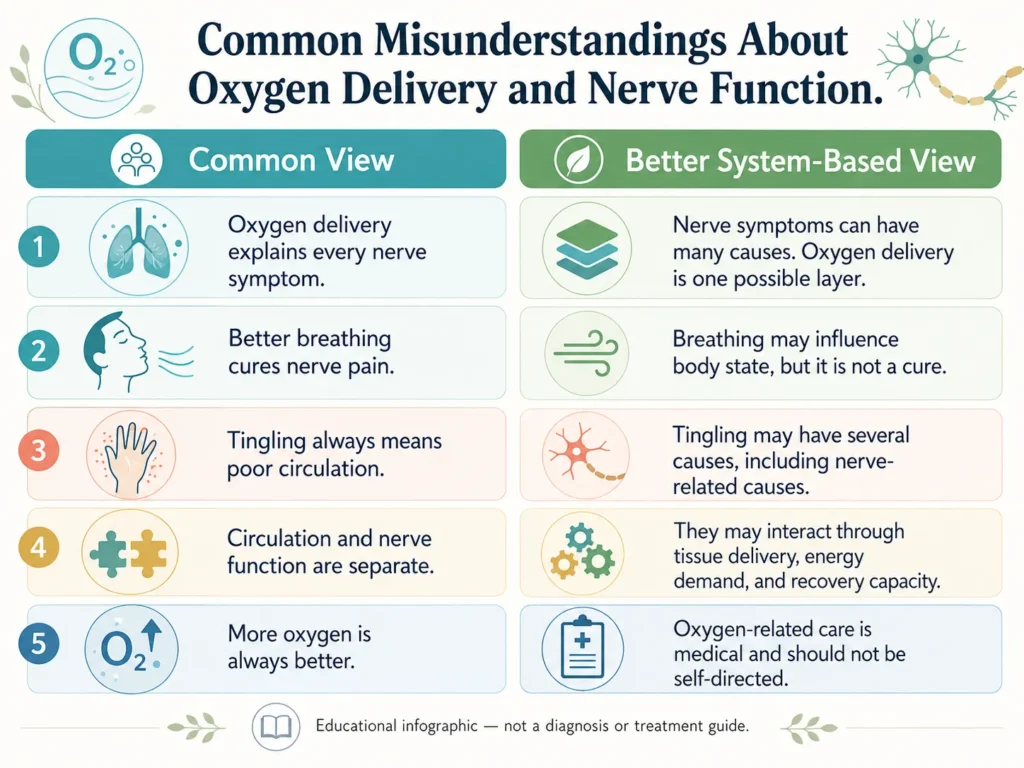
Common Misunderstandings About Oxygen Delivery and Nerve Function
| Common View | Better System-Based View |
|---|---|
| Oxygen delivery explains every nerve symptom. | Nerve symptoms can have many causes, and oxygen delivery is only one possible layer. |
| Better breathing cures nerve pain. | Breathing rhythm may interact with stress and body state, but it is not a cure. |
| Tingling always means poor circulation. | Tingling may involve nerve compression, diabetes, inflammation, injury, or other causes. |
| Circulation and nerve function are separate. | They may interact through tissue delivery, energy demand, and recovery capacity. |
| More oxygen is always better. | Oxygen-related care is medical and should not be self-directed. |
Misunderstanding 1: Oxygen delivery is the main cause of nerve sensitivity.
This is too simple. Nerve sensitivity may involve pain processing, inflammation, sleep disruption, stress response, injury, compression, diabetes, autoimmune patterns, or other medical issues. Therefore, oxygen delivery should be explained as one possible layer, not as the main answer for every person. This protects readers from guessing and keeps the page safe.
Misunderstanding 2: Numbness always means poor blood flow.
Numbness can involve many causes. It may relate to nerve compression, neuropathy, diabetes, injury, circulation problems, medication effects, or other conditions. Because of this, numbness should not be self-diagnosed from one article. Sudden, severe, spreading, or worsening numbness needs medical evaluation, especially when weakness or other neurological changes are present.
Misunderstanding 3: Oxygen delivery content means oxygen therapy advice.
This page does not give oxygen therapy advice. Oxygen therapy is a medical topic and should only be used under professional care when needed. Instead, this page explains the general body-system idea of oxygen movement, circulation, tissue delivery, and nerve-function education.
Misunderstanding 4: Movement automatically fixes circulation and nerve symptoms.
Movement may influence circulation rhythm, posture, muscle activity, and tissue demand. However, it should not be described as a fix for nerve symptoms. Some people need medical evaluation, physical therapy guidance, or condition-specific care. Therefore, movement should be discussed as a daily-life pattern, not as a guaranteed solution.
Related Condition Connections
Oxygen Delivery and Nerve Function may connect educationally with several condition pages. Peripheral Neuropathy is one important bridge because peripheral neuropathy can involve numbness, tingling, burning pain, sensitivity, and weakness. However, this page should not imply that oxygen delivery causes or treats peripheral neuropathy. Instead, it can help readers understand one body-system layer that may relate to nerve tissue environment.
Diabetic Neuropathy may also connect because diabetes can affect nerves and blood vessels. Nerve Compression may connect through posture, pressure, movement patterns, and local tissue demand. Sciatic Nerve Pain may connect through mechanical load, movement limits, and discomfort patterns. Post-Injury Nerve Damage may connect through recovery demand and tissue environment.
Topic Cluster Placement
Oxygen Delivery and Nerve Function belongs inside the Therapeutic Systems cluster because it explains a support system, not a disease. Its strongest parent page is Therapeutic Systems. It should also connect with Circulation & Oxygenation, because that page explains the wider blood-flow and oxygen transport theme.
Supporting pages should include Microcirculation and Nerve Sensitivity, Vascular Regeneration, Movement Posture and Nerve Regulation, Daily Patterns and Nervous System Stability, Sleep & Recovery, and Recovery Cycles. In addition, this page should connect with Stress System because stress may influence breathing rhythm, muscle tension, heart rate, blood pressure, sleep rhythm, and recovery demand.
FAQ
Can Oxygen Delivery affect nerve function?
Oxygen Delivery may interact with nerve function because nerves need a steady tissue environment and energy supply. However, oxygen delivery does not explain every nerve symptom. Tingling, numbness, burning feelings, nerve pain, or weakness can have many causes. Therefore, this topic should be understood as one educational layer.
Does tingling always mean poor oxygen delivery?
No. Tingling may involve nerve compression, neuropathy, diabetes, injury, inflammation, medication effects, vitamin issues, circulation problems, or other causes. For this reason, ongoing, severe, sudden, or worsening tingling should be discussed with a healthcare professional.
Is this page giving oxygen therapy advice?
No. This page does not give oxygen therapy advice, breathing treatment instructions, or medical guidance. Oxygen therapy is a medical topic and should only be used under professional supervision when needed. This page is only for general body-system education.
Why does movement matter for Oxygen Delivery?
Movement may influence circulation rhythm, muscle activity, posture, and tissue demand. Because oxygen travels through blood flow, movement can be part of the oxygen delivery discussion. However, this does not mean movement treats nerve symptoms. It is only one daily-life pattern that may interact with the system.
Can stress affect Oxygen Delivery and nerve sensitivity?
Stress may affect breathing rhythm, heart rate, blood-vessel tone, muscle tension, and sleep quality. As a result, it may interact with oxygen delivery and nerve sensitivity from a system perspective. However, stress should not be blamed as the only cause of symptoms.
When should nerve symptoms be checked urgently?
Seek urgent medical care for sudden weakness, loss of bladder or bowel control, chest pain, difficulty breathing, severe numbness, severe pain, rapidly worsening symptoms, or sudden neurological changes. These symptoms need professional evaluation and should not be managed through online education alone.
Continue Learning
Continue with Circulation & Oxygenation to understand the broader system that moves oxygen-rich blood through the body. This page should act as a close parent-style connection for Oxygen Delivery and Nerve Function.
Next, explore Microcirculation and Nerve Sensitivity to learn how small blood vessels may connect with local tissue demand, sensitivity, and recovery capacity. This is the strongest next related page after Oxygen Delivery because it deepens the small-vessel layer.
Then, read Movement Posture and Nerve Regulation to understand how long sitting, movement rhythm, posture, and body load may interact with circulation and nerve comfort. For recovery context, continue with Sleep & Recovery, Recovery Cycles, and Daily Patterns and Nervous System Stability.
For symptom education, visit Peripheral Neuropathy, Nerve Compression, and Sciatic Nerve Pain. These condition pages should be used for learning only, not for self-diagnosis.
Sources / References
- NINDS — Peripheral Neuropathy. NINDS explains that vascular and blood problems that decrease oxygen supply to peripheral nerves can lead to nerve tissue damage.
- NCBI Bookshelf — The Circulatory System and Oxygen Transport. This source explains the role of blood flow in bringing blood close to cells so oxygen, nutrients, and waste exchange can occur.
- NCBI Bookshelf — In Brief: How Does the Blood Circulatory System Work? This source explains that the cardiovascular system delivers oxygen and nutrients to cells through the heart and blood vessels.
- MedlinePlus — Blood Flow. MedlinePlus explains that arteries carry oxygen-rich blood toward body tissues and veins return oxygen-poor blood to the heart and lungs.
- Mayo Clinic — Peripheral Neuropathy Symptoms and Causes. This source describes symptoms such as tingling, numbness, burning pain, sensitivity, and weakness while explaining that causes vary.
- Cleveland Clinic — Circulatory System. This source explains oxygen and waste exchange in capillaries as part of circulation.
Author / Editorial Trust Note
This article was created for educational purposes by Heal Your Nerves Naturally. It was written with safety-focused wording, non-diagnostic language, and source-based educational framing. The goal is to help readers understand how Oxygen Delivery, blood flow, circulation, microcirculation, stress load, sleep rhythm, movement, and recovery demand may connect with nerve-function education.
This page does not claim medical review unless a qualified reviewer is officially added by the website. It does not diagnose, treat, cure, or prevent disease. Readers should use this page as a learning guide and should contact a qualified healthcare professional for personal symptoms, diagnosis, or treatment decisions.
For more context, readers may visit the About page, Health Disclaimer, and Contact page.
Educational Trust Note
Heal Your Nerves Naturally explains nerve-health topics through calm, structured, and educational language. The goal is to help readers understand body systems without fear, overpromising, or self-treatment claims. Because nerve symptoms can have many causes, no single page should be used as a complete explanation for a person’s symptoms.
This page uses careful phrases such as “may interact with,” “one possible layer,” and “from an educational view.” These phrases are intentional. They help protect readers from oversimplified conclusions and keep the content aligned with safe health-information standards.
Safety & Education Notice
This page is for educational purposes only. It does not diagnose, treat, cure, or prevent disease. It is not a substitute for professional medical advice, diagnosis, or treatment.
Seek urgent medical care for severe, sudden, unusual, or worsening symptoms, including sudden weakness, loss of bladder or bowel control, chest pain, difficulty breathing, severe numbness, severe pain, or rapidly changing neurological symptoms.
Because this topic may involve oxygen delivery, blood flow, circulation, breathing patterns, nerve symptoms, or medically sensitive body systems, readers should not use this information to self-diagnose, start oxygen-related therapy, stop medication, begin supplements, follow protocols, or delay professional care.