
Gut Axis: Learn How Digestion Connects to Nerve Nutrition
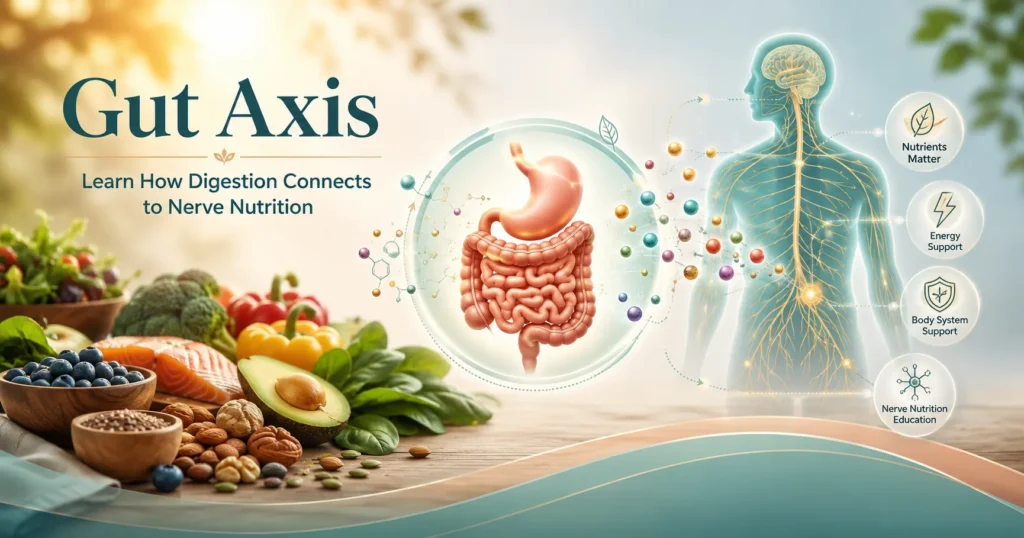
The Gut Axis explains how food is processed, broken down, absorbed, and made available for the rest of the body. While many people think digestion is only about the stomach or intestines, the process is much larger than that. Every meal begins a chain of events that helps transform food into usable nutrition. Therefore, digestion is not only about eating. Instead, it is about making nutrients available for energy production, tissue maintenance, immune activity, and normal body function.
This page belongs to the Nutritional Intelligence learning system. Its purpose is to explain how digestion helps create nutrient availability and why that process matters in wider health education. In addition, the Gut Axis provides an important foundation for understanding Nerve Food Repair, Protein and Amino Acids, Micronutrients and Nerve Function, and Metabolic Support Through Diet Patterns. However, this page does not claim that digestion cures symptoms, repairs nerves, or heals the nervous system. Instead, it explains one nutrition-related layer that may contribute to body-wide regulation and recovery education.
Many readers search for topics such as nerve food repair, nervous system regulation, autonomic response, neurological regulation, and healing your neurological system. As a result, they are often looking for simple explanations about how nutrition fits into recovery learning. The Gut Axis can help answer part of that question. Nevertheless, nerve pain, tingling, numbness, burning sensations, weakness, and sensitivity can have many causes. Therefore, this page should be used as an educational resource rather than a diagnostic tool.
What Is the Gut Axis?
The Gut Axis is the digestion and nutrient-availability system that helps transform food into usable nutrition. Every day, the body receives food, fluids, and nutrients. However, those nutrients cannot support body systems until digestion processes them and makes them available. Because of this, digestion acts as an important bridge between food intake and body function.
Many people assume that nutrients become available immediately after eating. In reality, the digestive system must first break food into smaller components. Proteins may be processed into amino acids, carbohydrates into smaller energy-producing compounds, and fats into forms that can be transported and used. In addition, vitamins, minerals, water, and other nutrients must also move through several stages before becoming accessible to the body.
A helpful way to understand the Gut Axis is to think of it as a preparation and delivery system. Food enters the body as raw material. Digestion then helps prepare that material for absorption and use. Therefore, the Gut Axis is not simply about eating. Instead, it is about how food becomes available to support energy, maintenance, adaptation, and body-wide regulation.
Unlike the Gut–Nerve Axis, which focuses on communication between digestion and the nervous system, the Gut Axis focuses primarily on digestion, nutrient availability, and nutritional support systems. For this reason, it belongs inside Nutritional Intelligence rather than Root-Cause Systems.
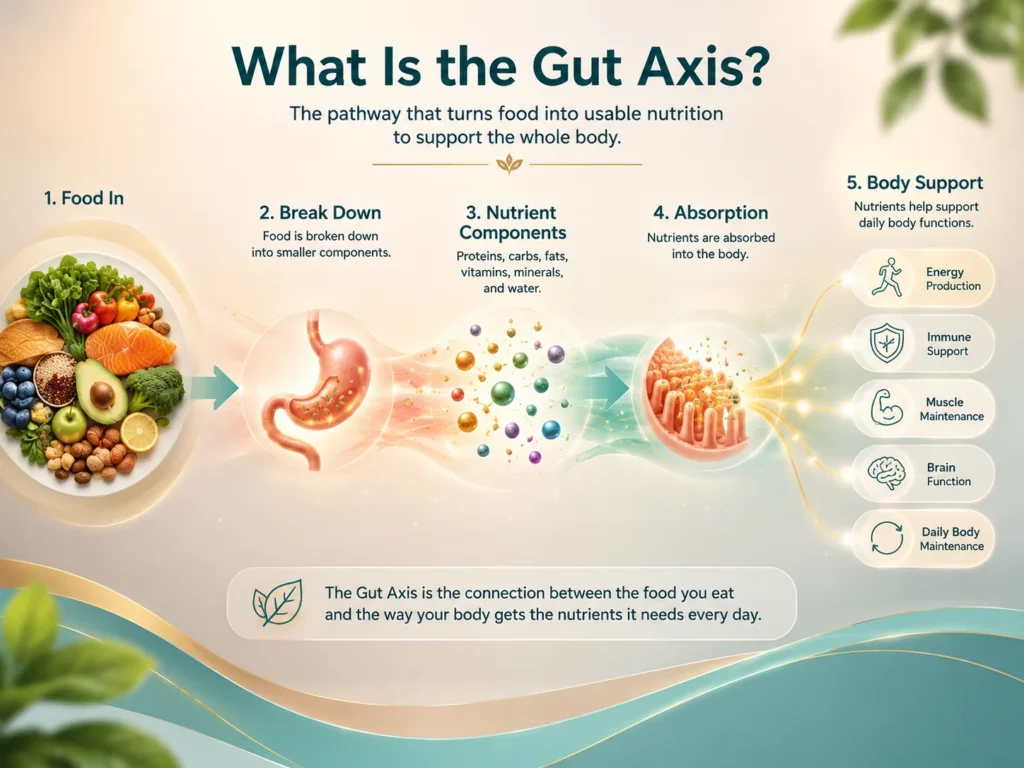
Plain Meaning / Glossary Box
Gut Axis
The Gut Axis is the digestion and nutrient-availability system that helps turn food into usable nutrition.
Digestion
Digestion is the process of breaking food into smaller components that the body can absorb and use.
Nutrient Availability
Nutrient availability refers to how much usable nutrition becomes accessible after digestion and absorption.
Absorption
Absorption is the movement of nutrients from the digestive system into the body’s transport systems.
Nervous System Regulation
Nervous system regulation refers to how the body manages communication, adaptation, internal balance, and response patterns.
Recovery Capacity
Recovery capacity describes the body’s ability to adapt to demands and maintain function over time.
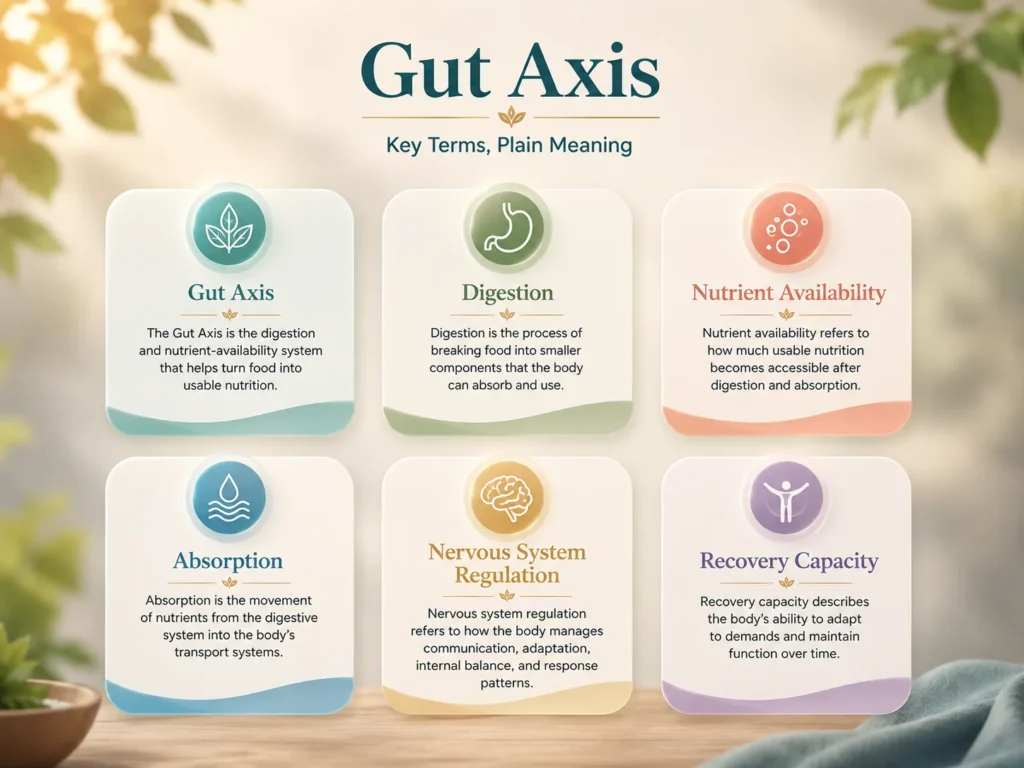
How the Gut Axis Works
The Gut Axis begins whenever food enters the digestive system. First, food is broken into smaller pieces through chewing and digestive activity. Next, the digestive system continues processing those materials so nutrients can become available for absorption. As a result, digestion creates access to the resources the body may use for energy production, tissue maintenance, immune activity, and cellular function.
After food is processed, nutrients move into absorption pathways. During this stage, amino acids, vitamins, minerals, fats, carbohydrates, water, and other nutritional components become available for transport. Therefore, nutrient availability depends not only on food intake but also on how effectively the body processes and absorbs those nutrients.
At the same time, digestion does not work in isolation. Sleep patterns, stress levels, hydration, meal timing, movement, and overall health may all influence digestive function. For example, irregular routines may affect appetite, comfort, energy patterns, and digestive rhythm. Consequently, the Gut Axis is best understood as one part of a larger body-wide system rather than a standalone process.
Once nutrients become available, they may contribute to many different body systems. Energy production, immune activity, tissue maintenance, recovery capacity, metabolic support, and nervous system regulation all depend partly on nutrient availability. Because of this, digestion becomes an important foundation within broader health education.
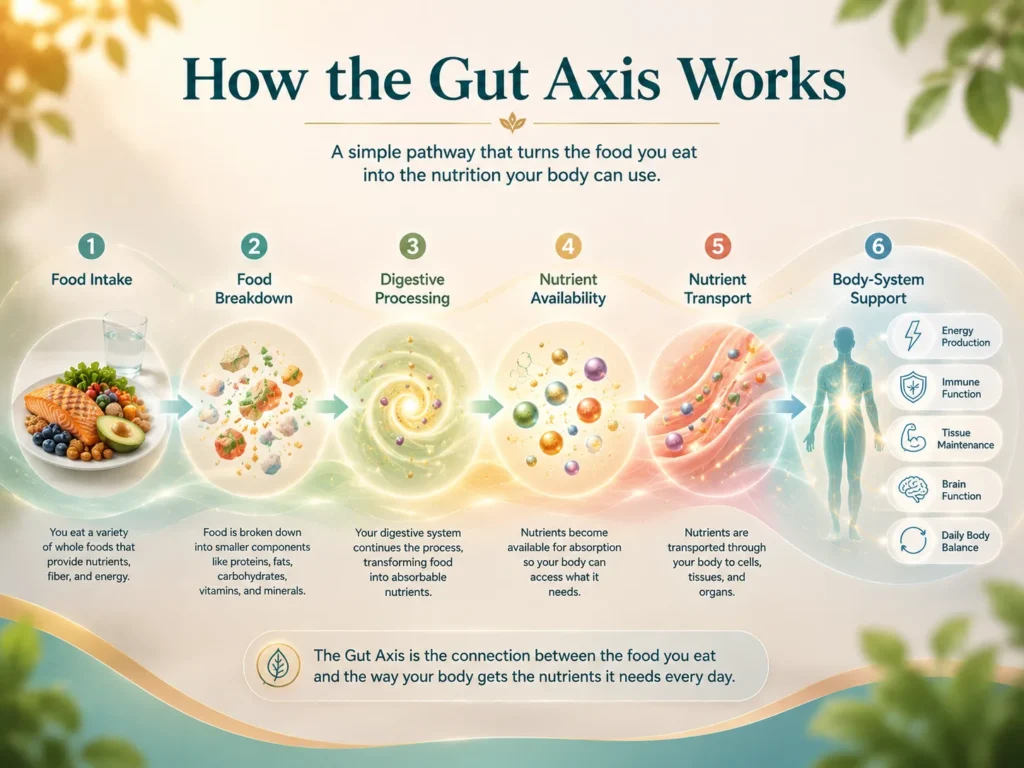
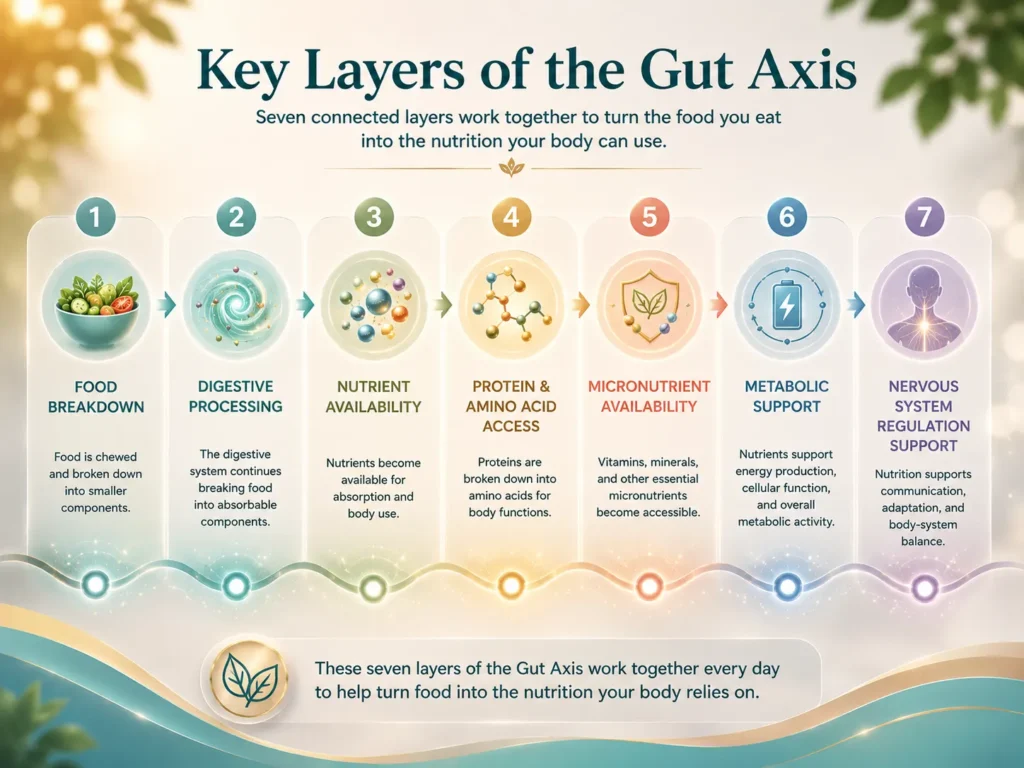
Key Layers of the Gut Axis
Food Breakdown
Food breakdown is the first layer of the Gut Axis. Before nutrients can support body systems, food must be physically and chemically processed into smaller components. Therefore, food breakdown creates the foundation for later nutrient availability.
A balanced meal may contain proteins, carbohydrates, fats, vitamins, minerals, water, and fiber. However, these nutrients are not immediately available. Instead, digestion gradually helps prepare them for absorption and transport. As a result, food breakdown serves as the starting point for the entire nutritional process.
Digestive Processing
Digestive processing refers to the coordinated work of the digestive system as food moves through different stages of preparation. During this stage, nutrients become increasingly accessible for absorption and transport.
This layer matters because nutrient presence and nutrient availability are not always the same thing. Food may contain valuable nutrients, yet those nutrients still need to move through digestion before they can support body functions. Therefore, digestive processing acts as a bridge between food intake and nutrient use.
Nutrient Availability
Nutrient availability refers to how much usable nutrition becomes accessible after digestion. This concept is important because the body relies on available nutrients rather than food presence alone.
For example, proteins, vitamins, minerals, fats, and carbohydrates must first become available before they can participate in body processes. Consequently, nutrient availability helps explain why digestion remains such an important educational topic within Nutritional Intelligence.
Protein and Amino Acid Availability
Protein digestion helps release amino acids that may contribute to tissue maintenance, enzyme activity, immune function, and body-wide support processes. Therefore, the Gut Axis connects naturally with Protein and Amino Acids education.
Many readers search for nerve food repair because they want to understand how nutrition may fit into recovery learning. Protein and amino acid availability represent one part of that discussion. However, protein should not be viewed as a direct nerve-repair solution. Instead, it can be understood as one nutritional layer within a much larger body system.
Micronutrient Availability
Micronutrients include vitamins and minerals that participate in many normal body functions. Before these nutrients become available, digestion and absorption must first occur. Therefore, the Gut Axis also connects closely with Micronutrients and Nerve Function education.
A simple way to understand this relationship is to think of digestion as the entry point. Without nutrient availability, the body cannot easily access the nutritional resources it receives from food. Consequently, digestion becomes a foundational support system.
Metabolic Support
Food provides potential energy. However, the body must first digest, absorb, and process nutrients before that energy becomes usable. Therefore, the Gut Axis naturally connects with Metabolic Support Through Diet Patterns and broader energy-regulation concepts.
Energy production depends on many factors. Nevertheless, nutrient availability remains one important layer. As a result, digestion contributes to wider discussions about body-wide demand, adaptation, and metabolic support.
Nervous System Regulation Support
The Gut Axis may connect with nervous system regulation because nutrient availability helps support many body systems. However, nervous system regulation depends on much more than digestion alone. Sleep, stress response, circulation, recovery capacity, movement, and overall health also matter.
For this reason, digestion should not be viewed as a cure or complete explanation. Instead, the Gut Axis can be understood as one support layer that may contribute to wider body-system regulation and recovery education.
Real-Life Symptom Language Bridge
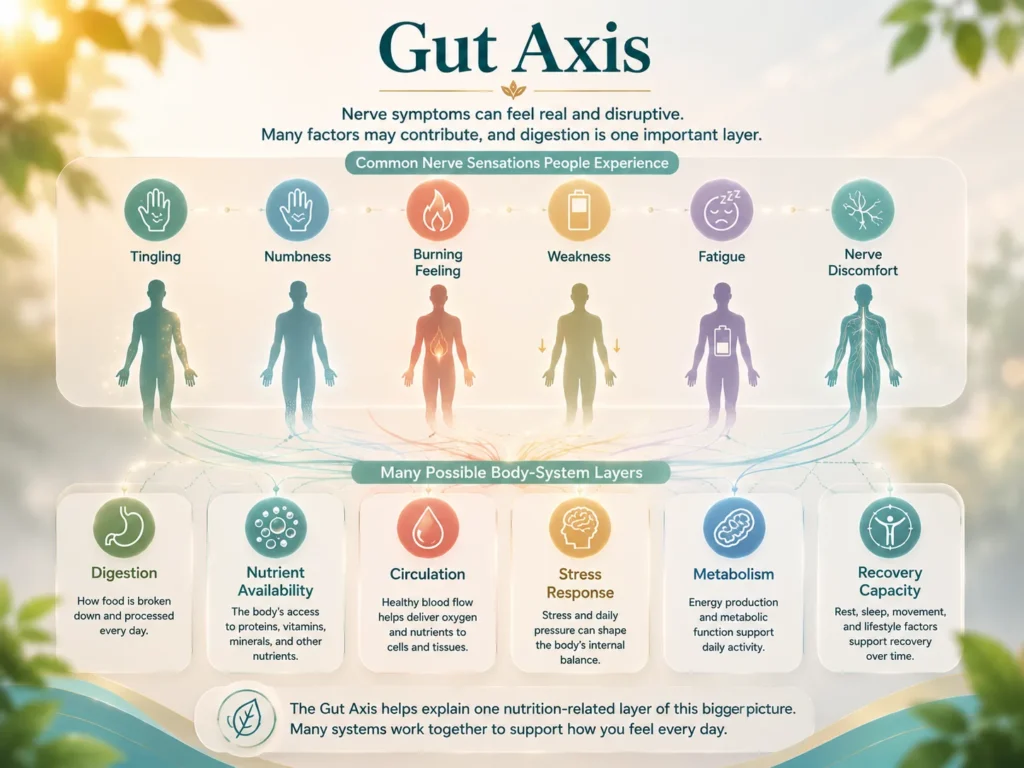
Many readers arrive at this topic because they are searching for answers about nerve pain, tingling, numbness, burning feelings, weakness, sensitivity, fatigue, or unusual body sensations. In addition, some people search for nerve food repair, nervous system regulation, autonomic response, neurological regulation, or healing your neurological system because they want to understand whether nutrition and digestion play a role in overall body function.
The Gut Axis may help explain one part of that larger picture. Before nutrients can participate in energy production, tissue maintenance, immune activity, or body-wide regulation, they must first become available through digestion and absorption. Therefore, digestion can be understood as one foundational support layer within the body’s wider systems.
However, it is important to remain balanced. Nerve symptoms can have many possible causes. Digestive patterns should never be used to explain every symptom or replace proper medical evaluation. Instead, the Gut Axis provides an educational framework that helps readers understand how food processing, nutrient availability, metabolic support, and recovery capacity may interact within the body.
For this reason, the goal of this page is not to provide a diagnosis. Rather, it is to help readers understand how digestion fits into broader discussions about nutrition, body systems, and nervous system regulation.
Gut Axis Interactions
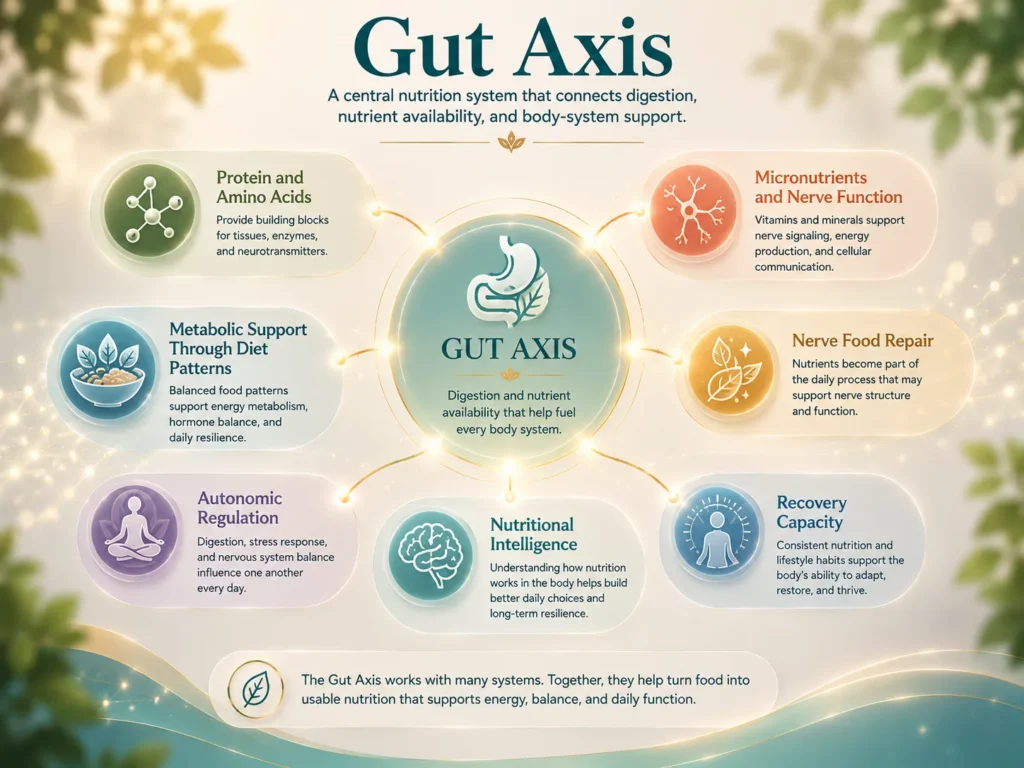
Gut Axis and Protein and Amino Acids
The Gut Axis and Protein and Amino Acids are closely connected because digestion helps make amino acids available after food is broken down. Protein contains amino acids that may contribute to tissue maintenance, enzyme activity, immune function, and many normal body processes. However, these amino acids cannot become available until digestion processes protein-containing foods.
As a result, digestion acts as a gateway rather than a direct repair mechanism. This distinction is important because many people search for nerve food repair and assume one nutrient provides a complete solution. In reality, protein availability is only one layer within a larger system. Therefore, the Gut Axis helps explain how nutrition becomes accessible rather than promising specific outcomes.
Gut Axis and Micronutrients
The Gut Axis also interacts closely with Micronutrients and Nerve Function because vitamins and minerals must become available through digestion and absorption before they can participate in normal body functions.
Many people focus only on what they eat. However, digestion helps determine how nutrients become available after food enters the body. Consequently, digestion and nutrient availability often work together. This relationship helps explain why the Gut Axis is an important educational topic within Nutritional Intelligence.
Gut Axis and Metabolic Support
Food provides potential energy. Nevertheless, that energy must first move through digestion, absorption, transport, and metabolic processing before the body can use it. Therefore, the Gut Axis naturally connects with Metabolic Support Through Diet Patterns.
This connection is especially important because many readers search for fatigue, low energy, body stress, nervous system regulation, and recovery concepts. Although digestion is only one layer of those discussions, nutrient availability helps support broader energy-management systems. As a result, the Gut Axis contributes to understanding how food becomes usable fuel.
Gut Axis and Nerve Food Repair
The Gut Axis forms an important foundation for Nerve Food Repair education. Before nutrients can contribute to body-wide support systems, digestion must first help make them available.
This does not mean digestion repairs nerves. Instead, it means digestion creates access to the nutritional resources the body may use throughout many systems. Therefore, the Gut Axis can be viewed as one support layer within wider recovery education.
Gut Axis and Nervous System Regulation
The Gut Axis may also connect with Autonomic Regulation and broader nervous system regulation concepts. Digestion relies on coordinated body processes that help manage appetite, digestive rhythm, internal balance, and nutrient processing.
Because of this relationship, many readers searching for autonomic response, nervous system regulation, and neurological regulation may benefit from understanding how digestion fits into a wider body-system framework. However, digestion alone does not explain nervous system function. Instead, it represents one interconnected layer among many.
Practical Daily-Life Examples
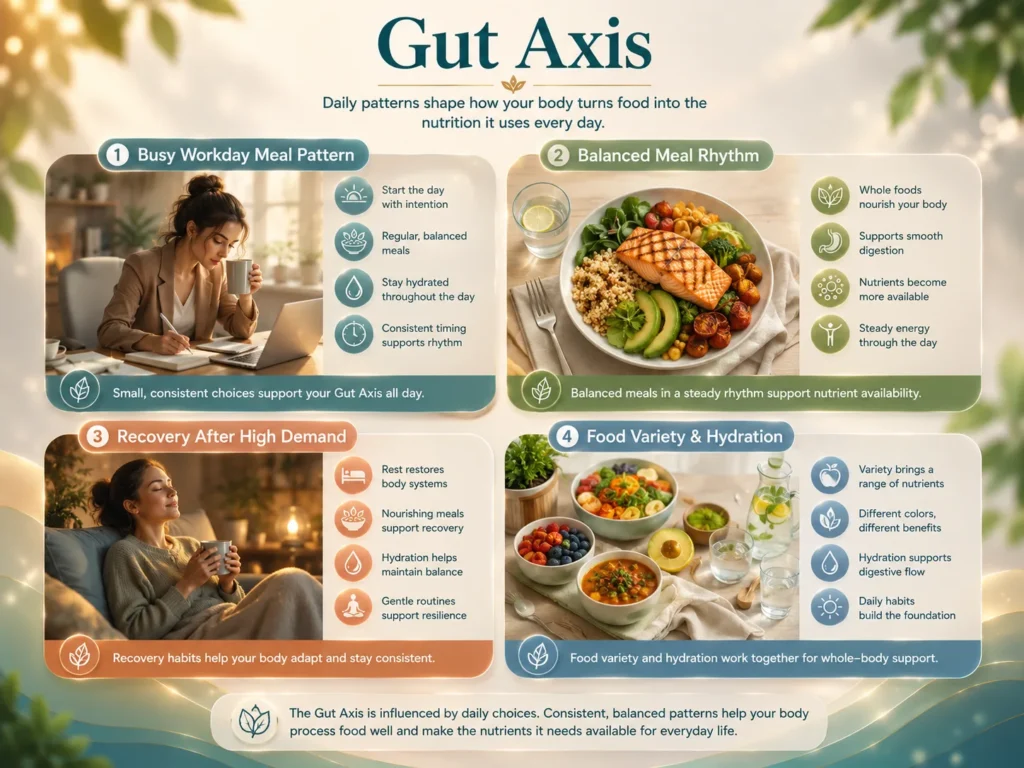
Example 1: The Busy Workday Pattern
Imagine a person who skips breakfast, rushes through lunch, drinks little water, and remains under constant work pressure. By evening, that person feels tired, unfocused, and physically drained.
The Gut Axis helps explain one part of this situation. Food intake occurred, yet digestion, hydration, meal timing, and nutrient availability may not have been ideal. As a result, the body may have fewer available resources to support normal daily demands. Therefore, digestion can be understood as one layer within a larger pattern.
Example 2: The Balanced Meal Pattern
Another person eats meals at fairly consistent times, includes a variety of foods, stays hydrated, and allows time for eating without rushing.
This example does not guarantee health outcomes. However, it illustrates how digestion may operate within a more stable routine. Consequently, nutrient availability may become more predictable as part of broader lifestyle patterns.
Example 3: Recovery After High Demand
After periods of illness, stress, travel, sleep disruption, or heavy workload, many people focus on recovery. During these periods, digestion, hydration, meal timing, and nutrient availability may become more noticeable.
The Gut Axis helps explain why digestion remains relevant during recovery education. Nevertheless, recovery depends on many systems working together rather than one factor alone.
Example 4: Food Variety and Nutritional Diversity
A varied eating pattern may provide access to proteins, amino acids, vitamins, minerals, fiber, fats, and carbohydrates from multiple food sources.
Although digestion does not determine everything, it helps make these nutritional components available. Therefore, food variety and nutrient availability often work together within the broader Nutritional Intelligence framework.
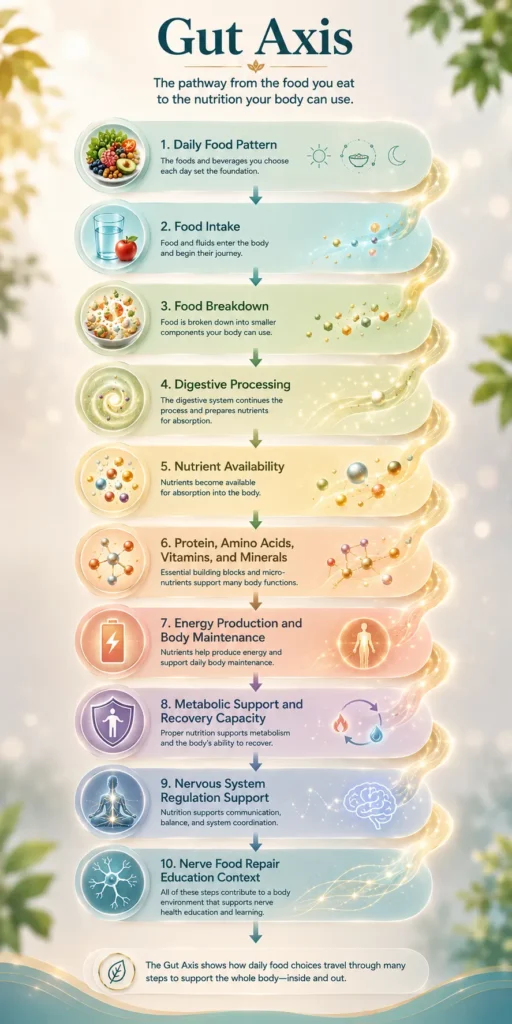
Gut Axis Visual Flow
Daily Food Pattern
↓
Food Intake
↓
Food Breakdown
↓
Digestive Processing
↓
Nutrient Availability
↓
Protein, Amino Acids, Vitamins, and Minerals
↓
Energy Production and Body Maintenance
↓
Metabolic Support and Recovery Capacity
↓
Nervous System Regulation Support
↓
Nerve Food Repair Education Context
This flow is educational rather than diagnostic. It does not mean digestion directly changes symptoms. Instead, it illustrates how food may move through several stages before nutrients become available to body systems.
The flow is also not completely linear. Sleep may influence appetite. Stress may affect digestive comfort. Hydration may affect digestion. Meanwhile, daily routines may influence meal timing and food choices. Because of this, the Gut Axis should be understood as part of a connected network rather than a single pathway.
Why the Gut Axis Matters for Nutrition and Recovery Education
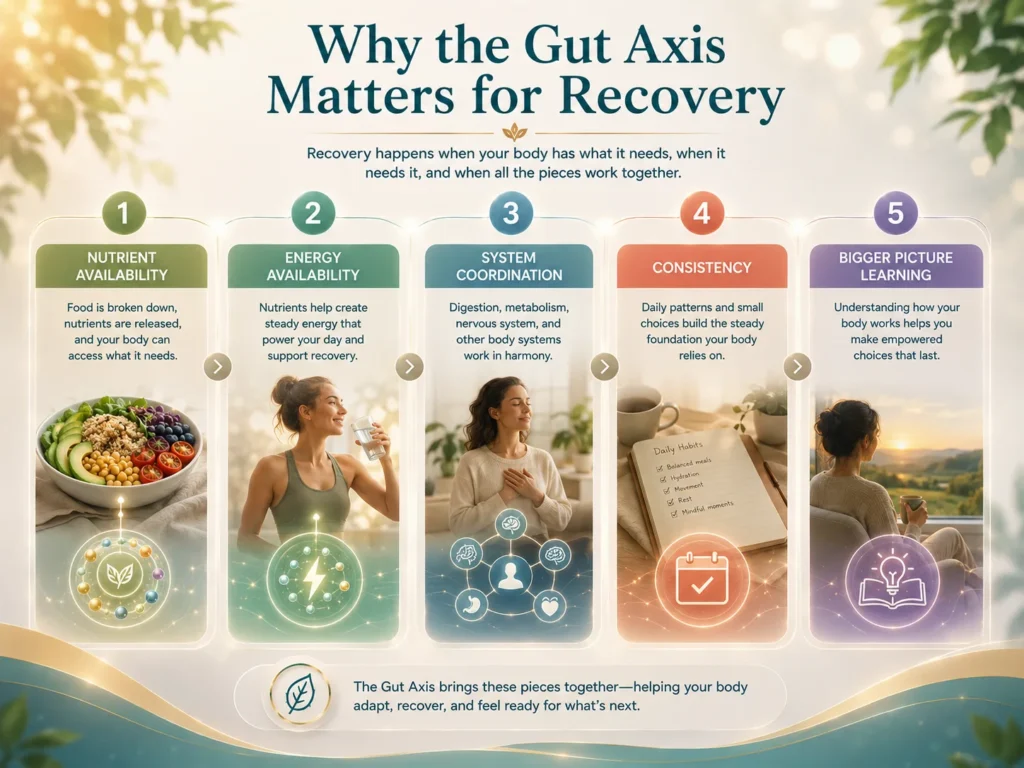
Recovery Requires Nutrient Availability
The body cannot use nutrients until they become available. Therefore, digestion plays an important role in creating access to nutritional resources.
This concept matters because many readers focus only on what they eat. However, nutrient availability helps explain how food becomes usable nutrition after digestion and absorption.
Recovery Requires Energy Availability
Energy production depends partly on nutrient processing. Food contains potential energy, yet that energy must first become available through digestion and metabolism.
For this reason, the Gut Axis naturally connects with broader discussions about metabolic support, adaptation, and recovery education.
Recovery Requires System Coordination
The body operates through connected systems rather than isolated parts. Digestion, circulation, sleep, stress response, movement, recovery capacity, immune activity, and nervous system regulation all interact.
As a result, the Gut Axis should be viewed as one support layer within a much larger network.
Recovery Requires Consistency
One meal rarely determines long-term outcomes. Instead, patterns often matter more than individual events.
Consistent meal timing, hydration, food variety, sleep quality, and recovery habits may all contribute to a more stable environment for digestion and nutrient availability. Therefore, the Gut Axis helps reinforce the importance of long-term pattern thinking.
Recovery Requires a Bigger Picture
Many people searching for healing your neurological system, neurological healing, nerve food repair, or nervous system regulation are looking for a single answer. However, recovery education is usually more complex than one food, one nutrient, or one body system.
The Gut Axis matters because it helps explain one important layer of the larger picture. Rather than offering quick solutions, it provides a clearer understanding of how digestion, nutrient availability, and body-wide systems may work together over time.
Common Misunderstandings About the Gut Axis
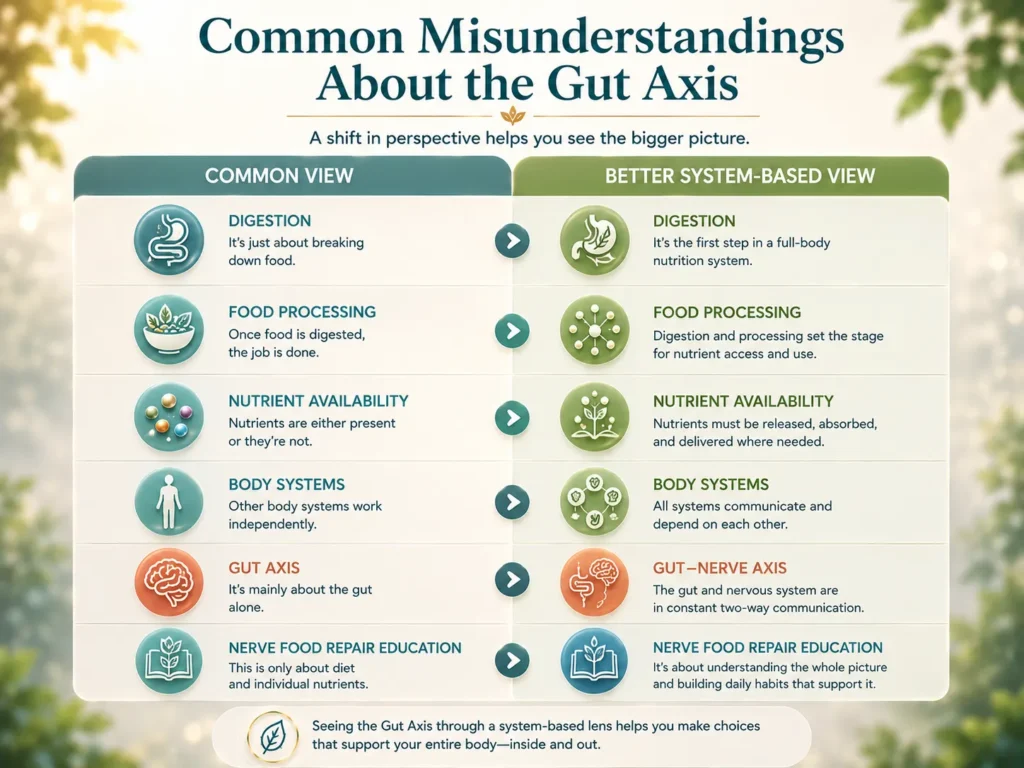
| Common View | Better System-Based View |
|---|---|
| Digestion is only about the stomach. | Digestion involves multiple processes that help make nutrients available to the body. |
| Eating healthy automatically guarantees nutrient use. | Food still needs to be digested, processed, and absorbed before nutrients become available. |
| One food can fix every problem. | Nutrition is only one layer within a larger body system. |
| Digestion explains every symptom. | Symptoms may have many different causes and require proper evaluation. |
| Nutrient availability only affects energy. | Nutrients may participate in many body-wide functions. |
| The Gut Axis is the same as the Gut–Nerve Axis. | The Gut Axis focuses on digestion and nutrient availability, while the Gut–Nerve Axis focuses on communication between digestive and nervous systems. |
Digestion Is More Than Food Processing
Many people think digestion simply means breaking down food. However, digestion also helps determine how nutrients become available for the rest of the body. Therefore, the Gut Axis can be viewed as a preparation system rather than a simple food-processing system.
Food contains proteins, amino acids, vitamins, minerals, fats, carbohydrates, fiber, and water. Yet these nutrients must first move through digestion before becoming accessible. Consequently, digestion helps create access to nutritional resources rather than acting as an isolated function.
One Food Is Not the Whole Answer
Many health discussions focus on finding a single food, nutrient, or eating pattern that explains everything. However, body systems are more complex than that.
Nutrition may contribute to recovery education, but digestion, sleep, stress response, hydration, circulation, movement, metabolic support, immune activity, and recovery capacity may also play important roles. Therefore, the Gut Axis should be understood within the wider body system rather than as a complete solution.
The Gut Axis Is Not a Diagnosis
Some readers may arrive here because they are looking for explanations for tingling, numbness, burning sensations, weakness, fatigue, or nerve discomfort. While digestion can be an important educational topic, it should never be used as a diagnosis.
Instead, the Gut Axis provides a framework for understanding how nutrient availability fits into larger discussions about body systems, nervous system regulation, and recovery education.
Related Condition Connections
The Gut Axis is not a condition page. Instead, it is an educational page that helps readers understand how digestion, nutrient availability, and food processing may connect with wider body systems. This can be useful because many people who read about nerve-related conditions also want to understand how nutrition fits into the bigger picture.
For example, readers exploring Peripheral Neuropathy, Diabetic Neuropathy, Nerve Compression, Sciatic Nerve Pain, or Post-Injury Nerve Damage may benefit from learning how digestion helps make nutrients available. Before the body can use nutrients from food, those nutrients must first be broken down, absorbed, and transported. Therefore, the Gut Axis can help explain one background layer of nerve-health education.
However, digestion should never be seen as the only reason for nerve symptoms. These conditions may involve many different factors, such as blood sugar changes, nerve pressure, injury, inflammation, circulation, immune activity, medication effects, or other medical issues. Because of this, the Gut Axis should not be used for self-diagnosis.
A safer way to understand this section is simple: the Gut Axis may help readers see how food, digestion, nutrient availability, and body-wide support systems can interact. At the same time, condition pages should guide readers toward proper education, safety language, and professional care when symptoms are severe, sudden, persistent, or worsening.
Topic Cluster Placement
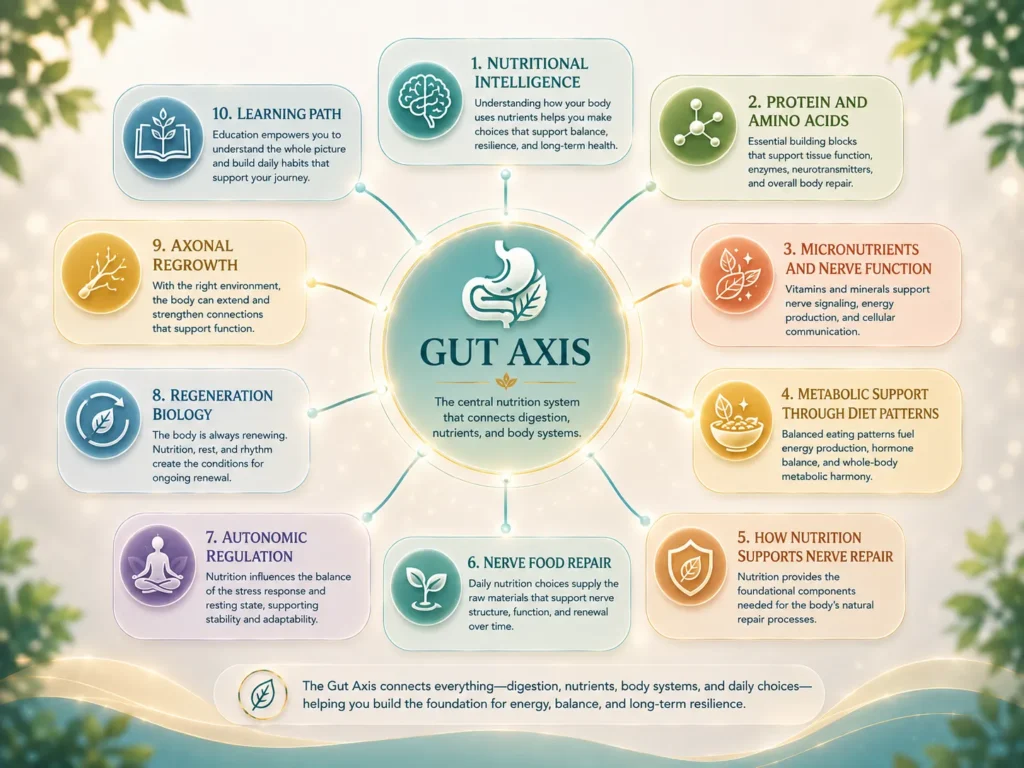
The Gut Axis belongs within the Nutritional Intelligence cluster because it explains how digestion, nutrient availability, food processing, and nutritional support systems may contribute to wider body functions. Therefore, this page acts as a bridge between food intake and the body’s ability to access nutritional resources.
This topic also connects naturally with Protein and Amino Acids, Micronutrients and Nerve Function, Metabolic Support Through Diet Patterns, and How Nutrition Supports Nerve Repair. Together, these pages help readers understand how food becomes usable nutrition and how nutrition may fit into broader recovery education.
In addition, the Gut Axis connects with Neurobiology pages such as Autonomic Regulation and Neural Signaling because digestion and nutrient availability operate within wider body-system communication networks. It also supports Regeneration Systems pages, including Nerve Food Repair and Axonal Regrowth, by explaining one foundational layer of nutritional support.
Readers who are new to nerve-health education may also continue through the Learning Path to build a broader understanding of symptoms, root causes, body systems, and recovery concepts.
Parent Page: Nutritional Intelligence
Supporting Pages: Protein and Amino Acids, Micronutrients and Nerve Function, Metabolic Support Through Diet Patterns, and How Nutrition Supports Nerve Repair
Related Neurobiology Pages: Autonomic Regulation, Neural Signaling, and Regeneration Biology
Related Regeneration Pages: Nerve Food Repair and Axonal Regrowth
Learning Path: Learning Path
Gut Axis FAQ
Is the Gut Axis the same as the Gut–Nerve Axis?
No. The Gut Axis focuses on digestion, absorption, and nutrient availability. The Gut–Nerve Axis focuses on communication between digestive and nervous systems.
Why does digestion matter for nerve food repair education?
Before nutrients can support body systems, digestion must first make those nutrients available. Therefore, digestion serves as a foundational layer within nutrition education.
Can digestion influence nervous system regulation?
Digestion may interact with many body systems. However, nervous system regulation depends on multiple factors, including sleep, stress response, circulation, recovery capacity, activity, and overall health.
Does the Gut Axis explain nerve symptoms?
No. Nerve symptoms can have many possible causes. This page is designed to support education rather than diagnosis.
Does this page recommend supplements?
No. This page does not recommend supplements, dosages, protocols, or treatments.
Is nutrient availability the same as nutrition?
Not exactly. Nutrition refers to nutrients contained in food. Nutrient availability refers to how much of that nutrition becomes accessible after digestion and absorption.
Why do people search for nervous system regulation and digestion together?
Many readers are interested in understanding how body systems interact. Digestion is one support layer that may connect with broader discussions about nervous system regulation and recovery education.
Continue Learning
Readers can continue learning through related pages that explain digestion, nutrient availability, nerve food repair, and nervous system regulation from different angles. These pages help build a clearer picture of how the Gut Axis fits inside the wider Heal Your Nerves Naturally education system.
Start with Nutritional Intelligence to understand how food patterns, digestion, nutrient availability, and body systems connect. Then continue with Protein and Amino Acids to learn how protein digestion may help create amino acid availability for normal body functions.
For deeper nutrient education, read Micronutrients and Nerve Function. This page explains how vitamins and minerals may fit into nerve-health education. In addition, Metabolic Support Through Diet Patterns can help readers understand how food patterns and energy availability may connect with body-wide demand.
Next, explore Nerve Food Repair to see how nutrition may fit into wider recovery education without treatment claims. Readers who want to understand body regulation can continue with Autonomic Regulation, which explains how internal balance and autonomic response may connect with nervous system regulation.
For broader repair and adaptation learning, visit Regeneration Biology. Finally, follow the Learning Path for a structured educational journey through nerve symptoms, root causes, body systems, and recovery concepts.
Sources / References
This page uses trusted educational sources to explain the Gut Axis in a safe, simple, and user-friendly way. These references help support the discussion about digestion, nutrient processing, protein, amino acids, and nerve-health education. However, they do not turn this page into medical advice, diagnosis, or treatment guidance.
For basic digestion education, MedlinePlus digestive system and digestion guide explains how digestion helps process food and make nutrients available. In addition, MedlinePlus dietary proteins guide explains how dietary proteins fit into normal body function.
For more practical protein education, MedlinePlus protein in diet explanation gives a simple overview of protein intake and body function. Also, MedlinePlus amino acids overview explains amino acids and their relationship to proteins in plain language.
For deeper science background, NCBI Bookshelf protein and amino acids chapter provides more detailed information about protein and amino acid biology. In addition, NCBI Bookshelf essential amino acids chapter explains essential amino acids and why the body must get some amino acids from food.
For nerve-health safety context, NINDS peripheral neuropathy overview explains peripheral neuropathy and why nerve symptoms can have many causes. As a result, this page keeps the language careful and reminds readers not to self-diagnose nerve symptoms from digestion or nutrition information alone.
Author / Editorial Trust Note
This page is part of the Heal Your Nerves Naturally educational platform. It was created to help readers understand digestion, nutrient availability, nerve food repair education, nervous system regulation concepts, and Nutritional Intelligence from a system-based perspective.
The content follows an educational approach focused on understanding body systems rather than diagnosing conditions or providing treatment recommendations. It is designed to encourage informed learning while promoting safe, evidence-aware exploration of nerve-health topics.
Readers are encouraged to continue exploring related educational pages throughout the website to build a broader understanding of nutrition, neurobiology, root-cause systems, regeneration systems, and therapeutic systems.
Educational Trust Note
This page explains the Gut Axis as part of Nutritional Intelligence and nerve-health education. It does not diagnose symptoms, replace professional care, or suggest that digestion, foods, nutrients, supplements, or dietary changes can cure nerve conditions.
Because digestion, nutrient use, metabolism, health status, medications, age, and medical history vary widely among individuals, educational information should always be interpreted within the context of personal healthcare guidance when needed.
Safety & Education Notice
This page is for educational purposes only.
It does not diagnose, treat, cure, or prevent disease. It is not a substitute for professional medical advice, diagnosis, or treatment.
Seek urgent medical care for severe, sudden, unusual, worsening, or progressive symptoms, including sudden weakness, severe numbness, loss of bladder or bowel control, severe pain, chest pain, difficulty breathing, symptoms after injury, rapidly changing neurological symptoms, unexplained weight loss, blood in stool, persistent vomiting, or severe abdominal pain.
Because digestion, metabolism, nutrition, and nerve symptoms may involve many possible causes, readers should not use this information to self-diagnose, stop medication, begin supplements, follow restrictive diets, or delay professional care.
The goal of this page is to support learning, not medical decision-making.