
Behavior Change: A Simple Guide to Lasting Habit Change
Behavior Change explains how people move from awareness to action and from action to lasting habits. Every day, people repeat patterns that influence sleep, stress, movement, food choices, emotional reactions, communication, recovery, and learning. Some actions are intentional. However, many actions happen automatically because the brain and body prefer familiar routines. Therefore, behavior change is not only about willpower. It also involves awareness, motivation, stress load, environment, repetition, support, and nervous system readiness.

Many people think behavioral change begins and ends with a strong decision. However, lasting behavior change is usually more layered. A person may know what they want to change and still struggle to take action. In contrast, small repeated steps may slowly become easier when the system has enough support. Because of this, behavior change should be understood as a process, not a single moment. This page explains how behavior patterns form, why behavioral changes can feel difficult, and how daily actions may connect with Human Systems education.
From a nerve-health education view, Behavior Change may matter because daily patterns can influence stress, coping, sleep rhythm, recovery windows, emotional regulation, and long-term consistency. However, this page does not diagnose behavior problems, treat symptoms, or give medical instructions. Instead, it explains behavior change as an educational framework. Readers can use it to understand how habits, motivation, body signals, recovery capacity, and environment may shape daily choices in a safe and realistic way.
Quick Navigation
What Is Behavior Change?
Plain Meaning / Glossary Box
How Behavior Change Works
Key Layers of Behavior Change
Real-Life Symptom Language Bridge
Behavior Change and Nervous System Function
Behavior Change Interactions
Practical Daily-Life Examples
Behavior Change Visual Flow
Why Behavior Change Matters for Recovery
Common Misunderstandings About Behavior Change
Related Condition Connections
Topic Cluster Placement
Behavior Change FAQ
Continue Learning
Sources / References
Author / Editorial Trust Note
Educational Trust Note
Safety & Education Notice
What Is Behavior Change?
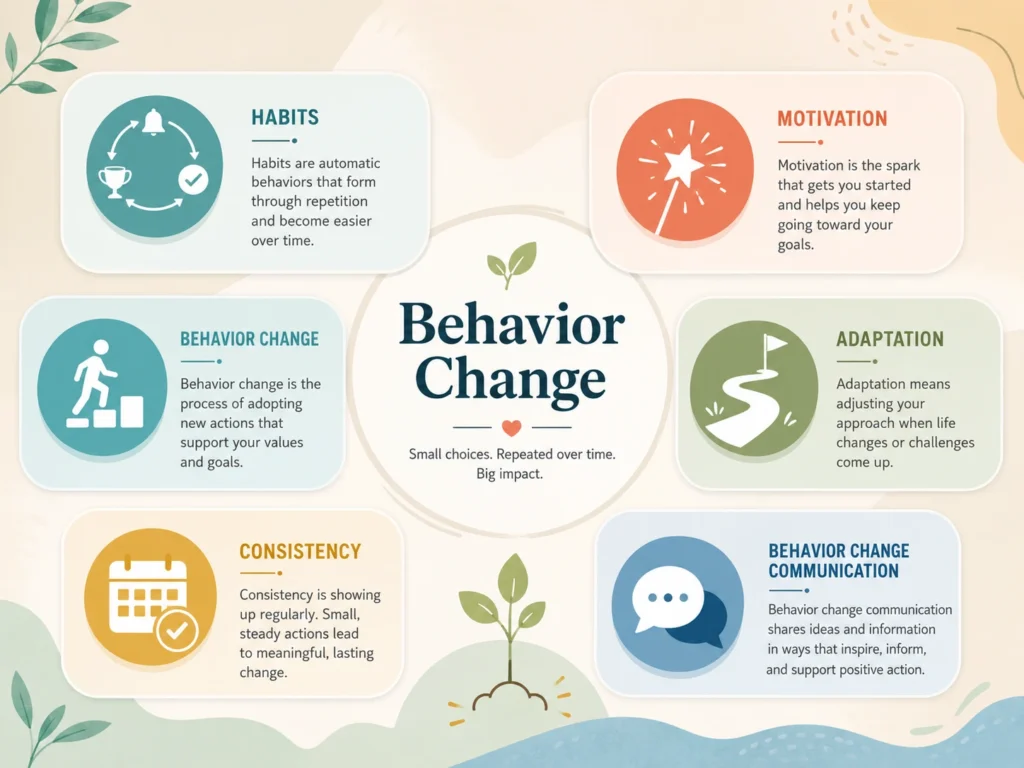
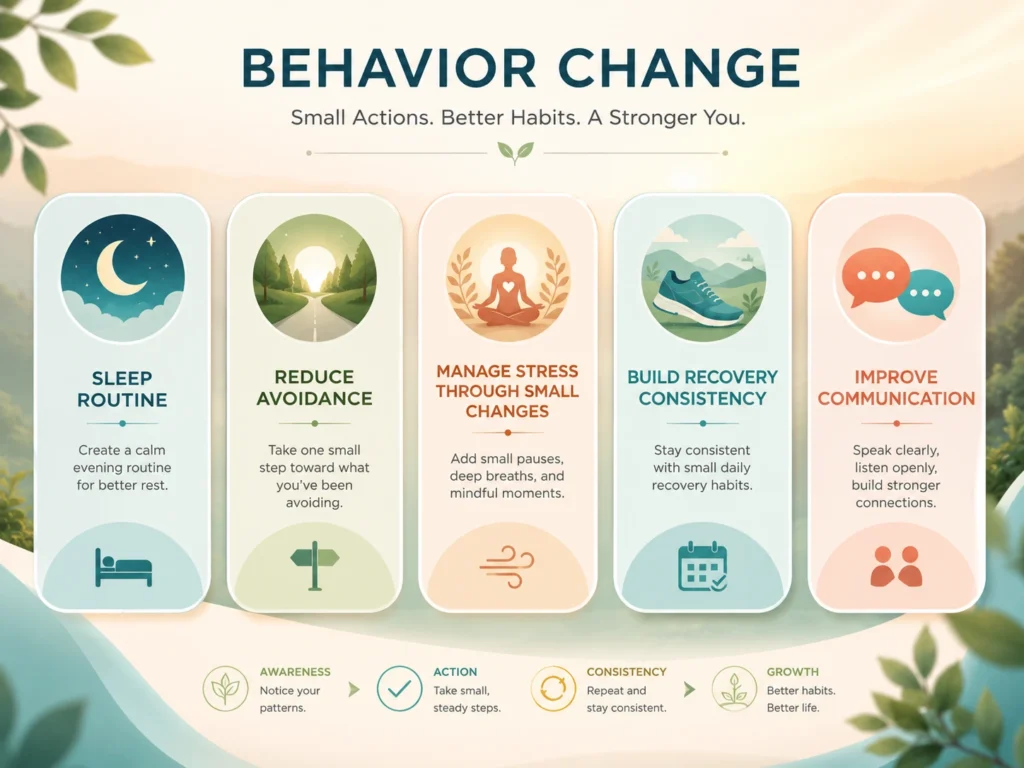
Behavior Change means changing actions, routines, responses, or habits over time. It may involve starting a helpful pattern, reducing an unhelpful pattern, or adapting behavior to a new life situation. For example, a person may try to improve sleep rhythm, reduce overworking, add gentle movement, ask for support, or respond to stress differently. Therefore, behavior change is not only about large lifestyle decisions. It also includes small daily actions that slowly shape a person’s routine.
Behavioral change often begins when a person notices that an old pattern is no longer helping. However, awareness does not always create action immediately. A person may understand the need for change but still feel tired, overwhelmed, unsure, or unsupported. As a result, change may require more than information. It may need motivation, repetition, emotional readiness, recovery space, and a supportive environment. Because of this, behavior change should be explained with patience rather than pressure.
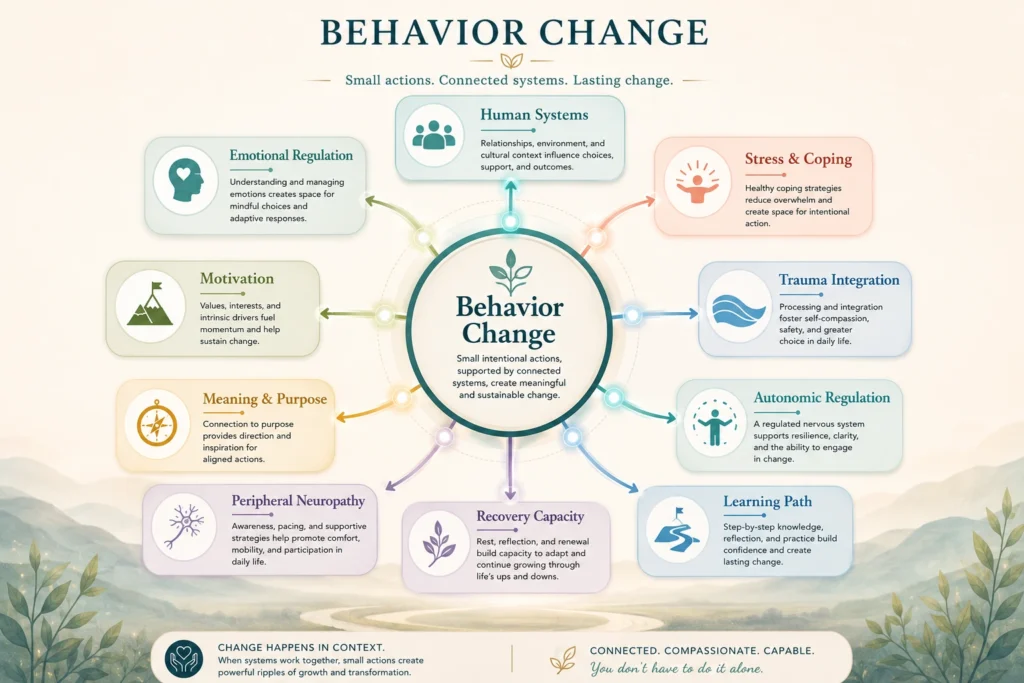
In the Human Systems cluster, Behavior Change helps connect emotions, stress, coping, motivation, meaning, trauma history, and recovery capacity. It explains why people may repeat patterns even when they want something different. At the same time, it shows how small repeated actions may slowly become more stable. Therefore, Behavior Change is best understood as a learning process. It is not a quick fix, a treatment plan, or a test of personal strength.
Plain Meaning / Glossary Box
Behavior Change
Behavior Change is the process of changing actions, habits, routines, or responses over time. It may include starting new behaviors, reducing old behaviors, or adapting existing patterns. In simple terms, it means learning to do something differently in a way that can continue beyond a single moment of motivation.
Behavioral Change
Behavioral change is another way to describe changes in actions and responses. The term is often used in education, health communication, psychology, and behavior science. On this page, behavioral change means the gradual process of changing patterns, not forcing instant transformation.
Behavioral Changes
Behavioral changes are the visible or practical changes in what a person does. For example, going to bed earlier, pausing before reacting, walking more often, asking for help, or reducing avoidance may all be behavioral changes. However, the reason behind those changes may involve emotions, stress, environment, motivation, and support.
Habit
A habit is a repeated behavior that becomes more automatic over time. Habits can be helpful, neutral, or unhelpful. Because habits reduce the need for repeated decisions, they can make daily life easier. However, this same automatic nature can make old habits difficult to change.
Motivation
Motivation is the reason, desire, or inner drive behind action. It may come from discomfort, values, goals, relationships, learning, hope, or personal meaning. However, motivation often rises and falls. Therefore, behavior change usually needs more than motivation alone.
Behavior Change Communication
What is behavior change communication? In simple terms, it means using clear, supportive messages to help people understand a behavior, why it matters, and how change may happen. However, this page uses the term educationally. It does not provide a public-health campaign or personal coaching plan.
Transtheoretical Model of Behavior Change
The transtheoretical model of behavior change explains change as a staged process. These stages often include not being ready, thinking about change, preparing, taking action, and maintaining change. However, real life is not always neat. People may move forward, pause, or return to earlier stages.
How Behavior Change Works
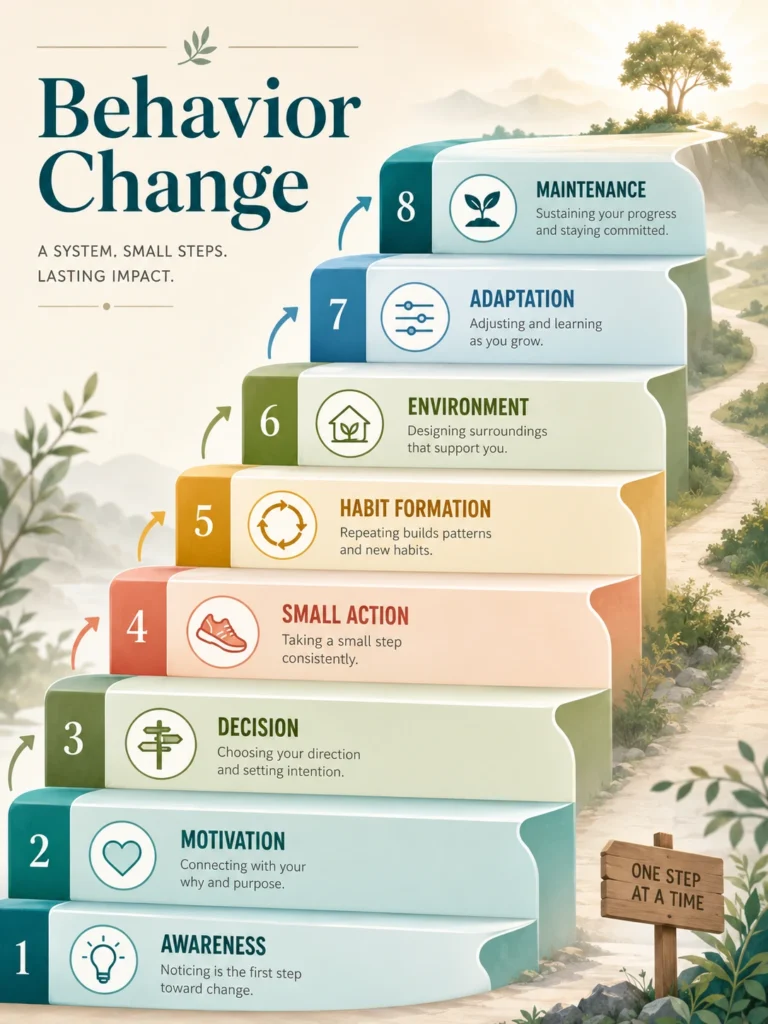
First, a person notices a pattern. This pattern may involve sleep, stress, coping, movement, eating, communication, avoidance, screen use, or emotional response. Next, the person begins to understand how that pattern affects daily life. Because of this, awareness is usually the first step. However, awareness alone may not create lasting change. A person can know what needs to change while still feeling stuck, tired, or unsure.
After awareness, motivation may appear. Many readers ask, “what motivates people to change behavior?” The answer can vary. Some people are motivated by discomfort. Others are motivated by health goals, family, identity, meaning, independence, faith, education, or the desire to feel more stable. However, motivation is not always steady. It may be strong one day and weak the next. Therefore, behavior change should not depend only on feeling motivated.
Over time, repeated action becomes important. A small action repeated many times can become easier because the brain and body learn the pattern. Meanwhile, the environment can either support or block the new behavior. For example, a calm evening routine may support sleep, while late-night screen use may make sleep harder. Therefore, behavior change works best when awareness, motivation, environment, repetition, and recovery space work together.
Key Layers of Behavior Change
Awareness Layer
The awareness layer begins when a person notices what is happening. This may include noticing a stress habit, an emotional reaction, a sleep pattern, an avoidance loop, or a repeated behavior that no longer helps. Without awareness, change is difficult because the pattern stays automatic. Therefore, awareness gives the person a chance to pause and understand the behavior before trying to change it.
For example, someone may notice that stress leads to late-night scrolling, poor sleep, and low energy the next day. Another person may notice that discomfort leads to avoidance, which then increases anxiety. These observations do not create instant change. However, they make the pattern visible. Because of this, awareness is not a small step. It is the doorway into behavior change.
Motivation Layer
Motivation is the reason a person wants to change. It may come from discomfort, hope, goals, values, relationships, or a desire for better daily function. However, motivation is often misunderstood. Many people wait until motivation feels strong before they act. Yet, motivation often grows after small actions begin. Therefore, behavior change may need action and motivation to support each other.
This is where motivation vs behavior change becomes important. Motivation is the desire for change. Behavior change is the repeated process of doing something differently. In many cases, motivation starts the process, but habits keep it going. Because motivation naturally changes, a behavior plan based only on mood or energy may become fragile. A better approach is to build small patterns that can continue even when motivation is lower.
Decision Layer
The decision layer turns awareness and motivation into choice. A person may decide to sleep earlier, speak more calmly, reduce avoidance, take breaks, move more gently, or ask for help. However, one decision is rarely enough. Most behavior change requires repeated decisions across many ordinary days. Therefore, decision-making becomes a daily part of change.
Small decisions can matter because they reduce the gap between intention and action. For example, choosing walking shoes the night before may support morning movement. Planning a short recovery break may reduce overworking. Meanwhile, removing a trigger may make an old habit less automatic. Because of this, decisions are not only mental. They can also include practical changes in the environment.
Action Layer
Action is where change becomes visible. A person may understand the pattern and feel motivated, but the behavior changes only when action begins. However, action does not need to be large. In fact, smaller actions may be easier to repeat. Therefore, a simple behavior done consistently may support long-term change more than a dramatic action that cannot continue.
For example, a person may begin with five minutes of gentle movement, a short evening routine, one calm pause before reacting, or a small reduction in screen time. These actions may seem minor. However, they teach the nervous system and daily schedule a new pattern. Because of this, action should be realistic, not extreme.
Habit Formation Layer
Habit formation happens when repeated actions become more automatic. This can be helpful because the person no longer needs to make the same decision with full effort every time. For example, brushing teeth, making tea, checking a phone, or walking a familiar route may happen with little thought. Therefore, habits can reduce mental load.
However, habits can also keep unhelpful patterns alive. If a person repeatedly uses avoidance, overworking, late-night scrolling, or emotional suppression, those behaviors may become easier to repeat. Because of this, behavior change often means replacing a pattern rather than simply removing it. A new habit needs repetition, context, and enough reward or meaning to become familiar.
Environment Layer
Environment shapes behavior more than many people realize. A person’s home, work schedule, phone habits, relationships, food access, sleep space, noise level, and daily responsibilities may all influence behavior. Therefore, behavior change is not only internal. It also depends on the conditions around the person.
For example, a person may want to rest earlier, but loud surroundings or late work demands may make that difficult. Another person may want to move more, but pain, weather, safety, or time pressure may create barriers. Because of this, sustainable behavior change should include environmental support. It is not always a matter of trying harder.
Adaptation Layer
Adaptation means adjusting the behavior when life changes. A rigid plan may work only when life is calm. However, stress, illness, travel, family needs, work pressure, or emotional overload may interrupt the plan. Therefore, long-term behavior change requires flexibility.
For example, a person may not complete a full routine during a stressful week, but they may still keep one small part of it. This keeps the pattern alive without demanding perfection. Because of this, adaptation helps protect behavior change from all-or-nothing thinking. It allows the person to continue learning even when the path is not smooth.
Maintenance Layer
Maintenance is the stage where the behavior becomes part of daily life. It does not mean the person never struggles. Instead, it means the new pattern has enough support to continue most of the time. Maintenance may require reminders, routines, support, reflection, and occasional adjustment. Therefore, behavior change is not finished once action begins.
The transtheoretical model of behavior change often includes maintenance as a key stage. This is useful because many people can start a change, but keeping it going is harder. As a result, maintenance deserves attention. Long-term change usually depends on simple systems, realistic expectations, and recovery support rather than constant pressure.
Real-Life Symptom Language Bridge
Some readers may explore Behavior Change because they feel stuck in patterns they want to change. For example, they may struggle with stress habits, poor sleep routines, avoidance patterns, emotional reactions, low energy, inconsistent recovery habits, or difficulty maintaining helpful behaviors. These experiences can feel frustrating, especially when the person knows what they want to do but cannot make the pattern last.
Other readers may arrive here while searching for information about nerve pain, tingling, numbness, burning feelings, fatigue, body sensitivity, or nervous system stress. However, symptoms should never be explained by behavior alone. Medical conditions, injuries, inflammation, metabolic factors, nerve compression, sleep disorders, medications, and many other influences may also contribute. Therefore, behavior change should never be used as a diagnosis.
At the same time, daily behaviors may influence stress load, sleep rhythm, coping capacity, movement pattern, and recovery windows. Because of this, Behavior Change may help readers understand one possible layer of daily system support. It does not replace medical care. Instead, it explains how routines, habits, and repeated actions may interact with the wider recovery environment.
Behavior Change and Nervous System Function
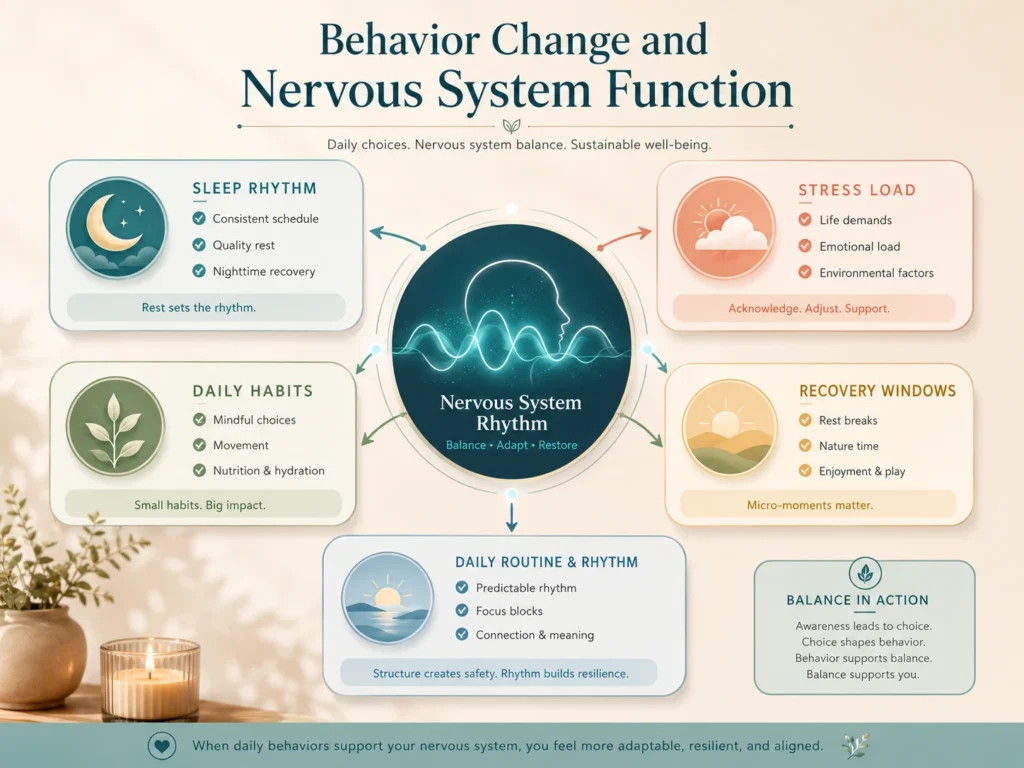
Behavior Change may connect with nervous system function because behaviors influence daily system demand. Sleep habits, stress responses, recovery routines, movement patterns, communication habits, and coping behaviors can all affect how the body experiences daily life. Therefore, behavior change is not only about external actions. It may also influence the body’s rhythm of alertness, rest, and recovery.
Meanwhile, nervous system state may influence behavior. A person who feels overwhelmed, exhausted, tense, or highly stressed may find change harder. As a result, behavior and nervous system function can affect each other in both directions. For example, poor sleep may reduce motivation, and low motivation may make sleep routines harder to maintain. This creates a loop.
Because of this relationship, Behavior Change is not simply about discipline. Instead, it involves understanding how habits, environment, stress load, recovery capacity, and nervous system flexibility interact over time. Therefore, the page connects naturally with Stress & Coping, Emotional Regulation, and Recovery Capacity and Nervous System Resilience.
Behavior Change Interactions
Emotional Regulation Interaction
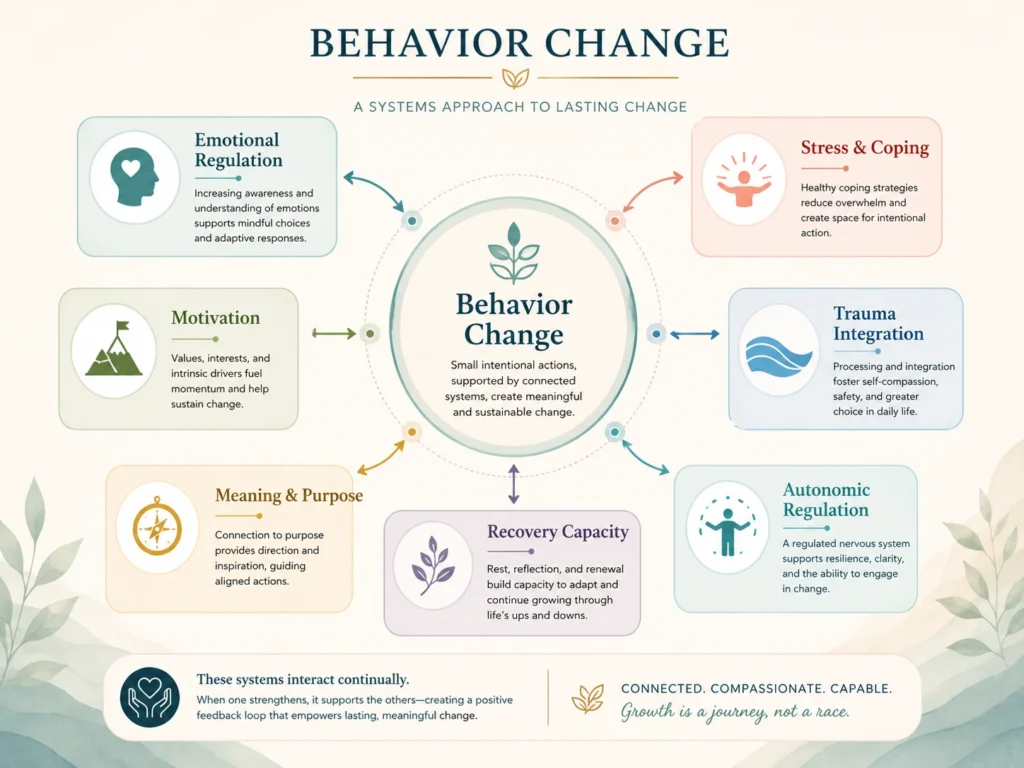
Emotional Regulation and Behavior Change often work together. Emotions may influence choices, while behavior patterns may influence emotional experiences. For example, stress may lead to avoidance, and avoidance may increase emotional pressure later. Therefore, lasting change often requires both emotional awareness and practical action.
However, emotional regulation does not mean ignoring feelings. Instead, it helps a person notice emotion without being fully controlled by it. Because of this, emotional awareness may create more space for new choices. When emotions are named and understood, behavior change may become less reactive and more intentional.
Stress & Coping Interaction
Stress & Coping may strongly influence behavior patterns because stress affects decisions, routines, attention, and energy. When stress rises, people may return to familiar coping behaviors, even if those behaviors are not helpful long-term. Therefore, coping patterns can either support or block behavior change.
For example, overworking may feel productive but reduce recovery. Avoidance may feel safe but increase pressure later. Meanwhile, supportive coping may create space for new behaviors. Because of this, behavior change should include stress awareness. It is easier to change patterns when stress load is understood rather than ignored.
Motivation Interaction
Motivation and Behavior Change are related, but they are not the same. Motivation is the desire, reason, or energy behind change. Behavior change is the repeated process of acting differently over time. Therefore, motivation may begin the process, but repeated behavior helps sustain it.
This is why motivation vs behavior change is an important topic. A person may feel motivated but still struggle because the environment, habits, stress load, or recovery level does not support action. In contrast, a person may feel only mildly motivated but still make progress through small, repeatable steps.
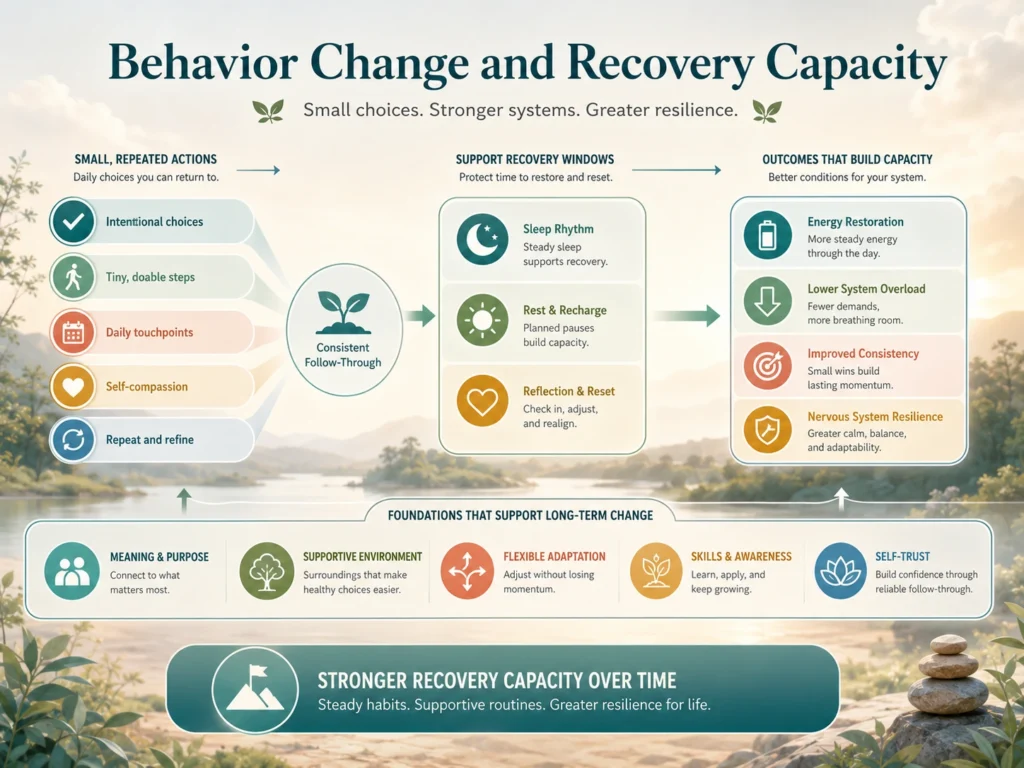
Recovery Capacity Interaction
Recovery Capacity and Nervous System Resilience may influence how much energy is available for change. When recovery is low, even simple changes may feel difficult. Poor sleep, stress, pain, emotional overload, or low support may reduce the energy needed for consistent action.
Therefore, behavior change should not be separated from recovery. A person may need smaller steps during high-stress seasons. Meanwhile, stronger recovery windows may make consistency easier. Because of this, sustainable change often depends on matching the behavior to current capacity rather than forcing a rigid plan.
Trauma Integration Interaction
Trauma Integration may matter because past experiences can shape behavior patterns. Some people may respond to stress through avoidance, overcontrol, people-pleasing, emotional shutdown, or high alertness. These behaviors may have developed as protection. Therefore, they should be understood with care rather than judgment.
Because trauma-related patterns can be complex, behavior change should not be treated as simple willpower. When trauma symptoms, severe distress, panic, or daily impairment are present, qualified mental health support may be important. This page provides education only and does not replace trauma-informed care.
Meaning & Purpose Interaction
Meaning & Purpose may strengthen long-term behavior change because meaningful goals can guide behavior when motivation drops. For example, a person may continue a recovery routine because it supports family life, independence, learning, faith, service, or personal values. Therefore, meaning can help connect small actions to a larger reason.
However, purpose does not remove difficulty. It simply gives direction. Because of this, behavior change often becomes stronger when actions are connected to something that matters. A meaningful reason can help a person return to the path after setbacks.
Autonomic Regulation Interaction
Autonomic Regulation may influence behavior because automatic body states affect energy, alertness, digestion, sleep, and stress response. When the body feels highly activated or shut down, change may feel harder. Therefore, behavior change often works best when the body has enough safety, rhythm, and recovery space.
At the same time, repeated behaviors may influence autonomic patterns. For example, sleep routines, stress coping, movement, and recovery windows may support steadier daily rhythm. This does not mean behavior change treats autonomic problems. Instead, it explains one educational connection between daily habits and body regulation.
Practical Daily-Life Examples
Starting a New Health Habit
A person may decide to improve sleep, move more, or reduce evening stress. At first, the change may feel easy because motivation is high. Later, motivation may drop when life becomes busy. However, if the new action is simple and repeatable, it may continue more easily. Therefore, starting small can make behavior change more realistic.
For example, instead of creating a perfect evening routine, a person may begin with one repeatable step, such as preparing for bed earlier or reducing one late-night distraction. This does not guarantee health improvement. However, it shows how behavior change can begin with small actions that reduce friction and support consistency.
Breaking an Avoidance Pattern
Avoidance may reduce discomfort in the short term. For example, a person may avoid a conversation, delay a task, or ignore a stressful issue. At first, this may feel relieving. However, the pressure may grow later. Therefore, avoidance can become a coping pattern that keeps stress active.
Behavior change may involve replacing avoidance with a safer small step. The person may write down the issue, ask for support, or take one realistic action. This is not about forcing bravery. Instead, it is about creating a smaller bridge between discomfort and action. Over time, repeated small steps may reduce the power of avoidance.
Building a Sleep Routine
Sleep routines often depend on repeated behavior. A person may want better sleep but still stay up late because the old pattern feels familiar. Therefore, behavior change may involve changing the evening environment, reducing stimulation, or creating a predictable wind-down pattern.
However, sleep difficulties can have many causes. This page does not diagnose or treat sleep problems. Instead, it explains how behavior patterns may influence sleep rhythm. In some cases, professional care may be needed. Still, from an educational view, repeated evening behaviors can become part of the wider sleep and recovery environment.
Managing Stress Through Small Changes
Stress can make behavior change harder because the body may prefer familiar patterns under pressure. For example, a person may overwork, scroll, avoid, snack, withdraw, or react quickly when overwhelmed. These responses may bring short-term relief, but they may also increase stress later.
Therefore, behavior change may begin with one small stress-related adjustment. A person may create a short pause before responding, reduce one source of overload, or ask for support earlier. These changes are not treatments. However, they can help readers understand how stress and behavior influence each other.
Recovery and Consistency
Consistency is easier when the behavior fits the person’s current capacity. If the action is too difficult, it may collapse under stress. However, if the action is simple enough, it may continue even on low-energy days. Therefore, behavior change should match real life rather than an ideal version of life.
For example, a person may choose a shorter routine during busy weeks and return to a fuller routine later. This flexible approach protects the habit from all-or-nothing thinking. Because of this, recovery and behavior change often work together. A sustainable pattern leaves room for rest, adjustment, and learning.
When Change Feels Difficult
Behavior change often feels difficult when stress is high, support is low, sleep is poor, or expectations are unrealistic. A person may blame themselves for not changing quickly. However, difficulty does not always mean failure. Sometimes it means the plan is too large, the environment is not supportive, or the person needs more recovery space.
Therefore, setbacks can provide useful information. They can show where barriers exist and where the plan needs adjustment. This more flexible view helps reduce shame. It also supports long-term behavioral change because the person can learn from the process rather than abandon it.
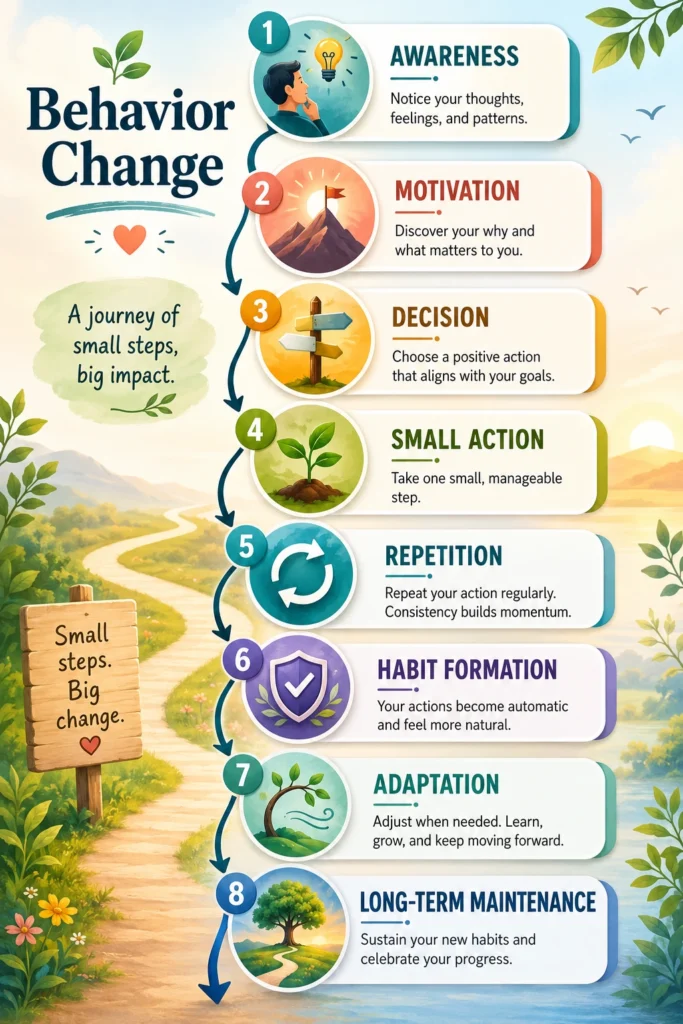
Behavior Change Visual Flow
Awareness
↓
Motivation
↓
Decision
↓
Small Action
↓
Repetition
↓
Habit Formation
↓
Adaptation
↓
Long-Term Maintenance
This visual flow shows Behavior Change as a step-by-step learning process. However, real change is not always straight. A person may move forward, pause, return to an older pattern, and then start again. Therefore, this flow should be understood as an educational guide rather than a strict rule.
The process often begins with awareness, but it becomes stronger through repeated action. Motivation may help, but it usually cannot carry the whole process alone. Over time, the behavior needs support from environment, routine, recovery capacity, and meaning. Because of this, behavior change is best understood as a system, not a single decision.
Why Behavior Change Matters for Recovery
Change Requires Awareness
People often repeat patterns automatically. Therefore, awareness provides the first opportunity for meaningful adjustment. Without awareness, old routines may continue even when they increase stress or reduce recovery. However, awareness should not become self-criticism. Instead, it should help the person notice patterns with more honesty and less blame.
From a recovery education view, awareness may help readers understand how sleep habits, coping patterns, stress reactions, and daily routines influence system demand. This does not mean behavior explains every symptom. Rather, it means behavior can be one layer of the recovery environment.
Change Requires Repetition
Single actions rarely create lasting results. Instead, repeated actions gradually shape habits and routines. Because of this, behavior change often depends on consistency more than intensity. A small behavior repeated often may become more useful than a large effort that cannot continue.
For example, a short recovery routine practiced daily may become easier than a long routine attempted once in a while. Therefore, repetition helps the brain and body learn a new pattern. This matters because recovery-related habits often need time before they feel natural.
Change Requires Adaptation
Life changes constantly. Stress levels, energy, pain, work demands, family needs, and sleep quality may shift from week to week. Consequently, successful behavior change usually requires flexibility rather than perfection. A rigid plan may fail when life becomes difficult. However, an adaptable plan can adjust and continue.
Adaptation helps protect progress from setbacks. For example, a person may reduce the size of a behavior during a difficult week instead of stopping completely. This flexible approach supports long-term maintenance. Because of this, adaptation is a key part of sustainable behavioral change.
Change Requires Recovery
Recovery supports energy, attention, and consistency. Without recovery, maintaining change may become more difficult. A tired nervous system may prefer familiar patterns because they require less effort. Therefore, rest and recovery windows can influence whether behavior change feels possible.
This does not mean recovery guarantees change. However, it may support the conditions needed for change. For example, better rest may improve patience, attention, and decision-making. Therefore, Behavior Change connects naturally with recovery capacity and nervous system resilience.
Change Requires Flexibility
Rigid systems often break under pressure. Flexible systems may adapt more effectively when challenges occur. Therefore, behavior change should not be built only for perfect days. It should also work during stressful, tired, or busy days.
For example, a flexible movement habit may include a shorter option when energy is low. A flexible sleep routine may include a basic version during stressful weeks. Because of this, flexibility can protect consistency. It allows behavior change to continue without turning setbacks into failure.
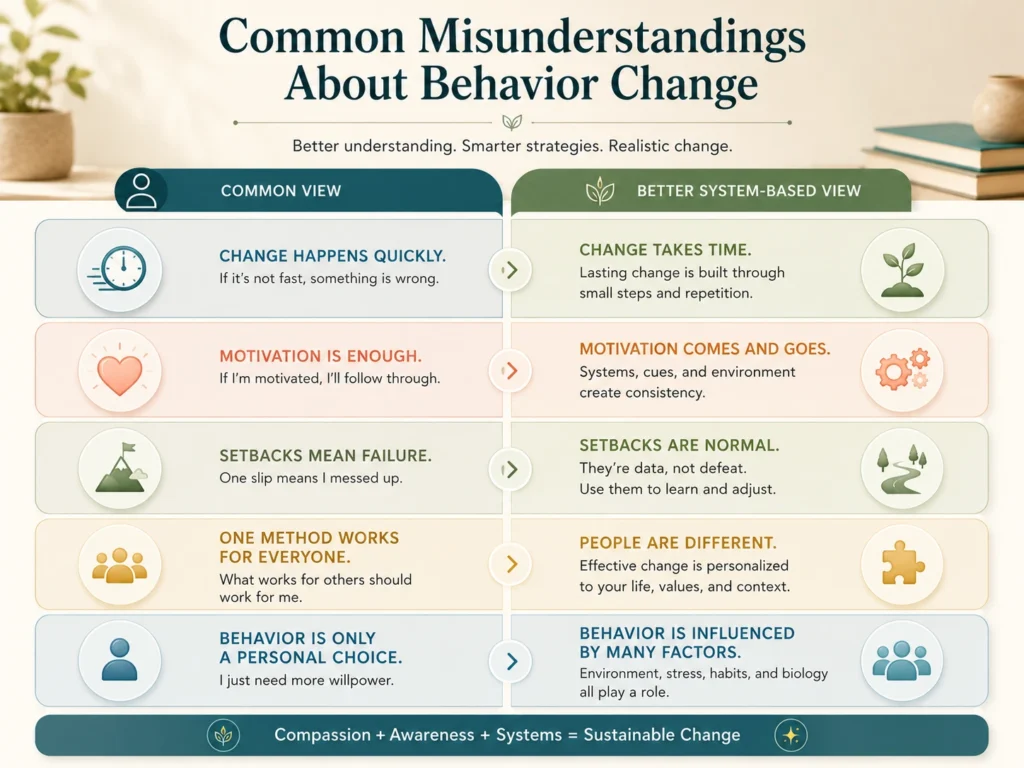
Common Misunderstandings About Behavior Change
| Common View | Better System-Based View |
|---|---|
| Change happens quickly. | Meaningful behavior change often develops gradually. |
| Motivation is enough. | Motivation helps, but habits and systems support consistency. |
| Setbacks mean failure. | Setbacks often provide useful information. |
| One method works for everyone. | Different people need different supports. |
| Change requires perfection. | Progress often develops through adaptation. |
| Behavior is only personal choice. | Behavior is shaped by stress, environment, support, and recovery capacity. |
One common misunderstanding is that behavior change should happen quickly. However, lasting change often develops through repeated small actions. Therefore, slow progress does not mean failure. It may simply mean the nervous system and daily routine are learning a new pattern. This view is more realistic and less discouraging.
Another misunderstanding is that motivation is enough. Motivation can be helpful, but it often changes. Because of this, habits, reminders, support, environment, and recovery windows matter. A person may begin with motivation, but long-term behavior change usually needs a system that supports repetition.
Many people also believe behavior is only personal choice. However, behavior is shaped by stress, sleep, pain, relationships, environment, trauma history, access, energy, and support. Therefore, behavior change should be explained with compassion. It is not only about trying harder. It is about understanding the full pattern.
Related Condition Connections
Behavior Change may influence routines connected with sleep, stress management, movement, communication, and recovery windows. However, behavior change does not diagnose, treat, or explain medical conditions. It should only be used as a safe educational bridge.
Readers exploring Peripheral Neuropathy may benefit from understanding how daily routines, coping patterns, and sleep rhythm may affect comfort and recovery demand. However, neuropathy symptoms may have many medical causes and should not be explained by behavior alone.
Likewise, Diabetic Neuropathy involves metabolic and medical factors that require professional care. Behavior Change may help readers understand daily routines, but it does not replace diabetes management, medical evaluation, or clinician guidance.
Similarly, Nerve Compression, Sciatic Nerve Pain, and Post-Injury Nerve Damage may involve physical or structural factors. Behavior patterns may influence daily load, posture, stress, or recovery routines. However, they should not be used as the main explanation for these conditions.
Topic Cluster Placement
Behavior Change belongs inside the Human Systems cluster because it explains how habits, routines, motivation, adaptation, emotional responses, stress patterns, and daily actions influence long-term learning. Therefore, this page strengthens the Human Systems cluster after Emotional Regulation and Stress & Coping.
The parent page should be Human Systems. Supporting pages include Emotional Regulation, Stress & Coping, Motivation, Meaning & Purpose, and Trauma Integration. Together, these topics help readers understand how emotions, stress, goals, identity, purpose, and life experience may shape behavior.
In addition, this page should connect with Recovery Capacity and Nervous System Resilience, Autonomic Regulation, and Learning Path. These connections help readers move from behavior education toward broader nervous system and recovery education.
Behavior Change FAQ
What is behavior change?
Behavior Change means changing actions, routines, habits, or responses over time. It may involve starting helpful behaviors, reducing unhelpful patterns, or adapting actions to new life needs. However, behavior change is usually not instant. It often develops through awareness, motivation, small actions, repetition, and adjustment.
What motivates people to change behavior?
People may be motivated by discomfort, goals, values, relationships, health concerns, independence, meaning, or personal growth. However, motivation often changes from day to day. Therefore, behavior change usually needs more than motivation. It also needs realistic steps, supportive environments, recovery space, and repeated action.
What is behavior change communication?
Behavior change communication is the use of clear messages to support awareness, learning, and informed decision-making. It may be used in public health, education, and community settings. On this page, the phrase is used simply to explain how supportive information may help people understand behavior patterns.
Motivation vs behavior change: what is the difference?
Motivation is the reason or desire behind change. Behavior change is the repeated process of acting differently over time. Therefore, motivation may start the process, but habits, systems, support, and repetition help maintain it. A person can feel motivated without changing if the environment and routine do not support action.
What is the transtheoretical model of behavior change?
The transtheoretical model of behavior change describes change as a process with stages. These may include not being ready, thinking about change, preparing, acting, and maintaining the new behavior. However, people do not always move through these stages perfectly. They may move forward, pause, or return to earlier patterns.
Why do behavioral changes sometimes fail?
Behavioral changes may become difficult when stress is high, sleep is poor, support is low, goals are too large, or the environment works against the new behavior. However, difficulty does not always mean failure. It may mean the plan needs to be smaller, more flexible, or better supported.
Can behavior change support recovery?
Behavior change may support recovery-related routines such as sleep rhythm, stress coping, movement patterns, communication, and recovery windows. However, it does not cure symptoms or replace medical care. It should be understood as one supportive educational layer within a wider recovery environment.
Continue Learning
Readers can continue with Human Systems to understand how emotions, stress, motivation, meaning, trauma history, and behavior patterns may interact with nervous system education. This parent cluster helps explain the human side of long-term learning and recovery.
For emotional pattern learning, continue with Emotional Regulation. For stress-related behavior patterns, continue with Stress & Coping. These two pages help explain why behavior is often shaped by emotion and stress load.
Readers who want to understand the “why” behind action can continue with Motivation and Meaning & Purpose. These pages explain how desire, values, purpose, and identity may influence long-term consistency.
For recovery-related learning, continue with Recovery Capacity and Nervous System Resilience and Learning Path. These pages help readers connect daily habits with wider nervous system education in a safe and structured way.
Sources / References
The sources below were used as general educational references for this Behavior Change page. They help explain behavior change, motivation, stress, mental well-being, habits, and public-health communication in simple learning language. However, these sources are not used to diagnose symptoms or give personal medical advice.
MedlinePlus — Stress helps explain how stress may affect the brain and body. It supports the page’s discussion of stress load, coping patterns, and behavior choices during pressure.
CDC — Coping with Stress gives simple public-health guidance about stress, support, and daily coping. Therefore, it supports the page’s discussion of stress-related behavior patterns without turning them into medical instructions.
NIMH — Caring for Your Mental Health explains basic ways people can care for mental well-being, including sleep, movement, social connection, and professional support when needed. In addition, it supports the page’s safety-focused discussion of behavior and well-being.
resources help explain how habits, motivation, and behavior patterns may influence health education. These sources support the page’s system-based explanation of behavioral change.
American Psychological Association — Stress and Behavior Resources supports the idea that stress may influence behavior, emotions, body response, and daily choices. Therefore, it fits the Human Systems approach of this page.
World Health Organization — Health Communication and Behavior Change Resources supports the concept that clear communication can help people understand health-related behaviors. It also helps explain behavior change communication in a broad educational way.
Author / Editorial Trust Note
This article was created by Heal Your Nerves Naturally for educational purposes. It was written using safety-focused language, non-diagnostic wording, and system-based education principles. The content is designed to help readers understand Behavior Change within the context of nervous system education, daily routines, and recovery capacity.
No diagnosis, treatment, cure, or prevention claims are made. Furthermore, this article should not replace medical advice, mental health care, or professional assessment. Readers should speak with qualified professionals for personal medical, neurological, behavioral, or mental health concerns.
Educational Trust Note
Heal Your Nerves Naturally provides educational information about nerve health, nervous system regulation, recovery capacity, body systems, and long-term learning. The purpose is to help readers understand complex topics in a calm, structured, and accessible way.
Therefore, this page focuses on education rather than treatment. Readers are encouraged to use this information as a learning resource while seeking qualified professional care for personal medical or mental health concerns.
Safety & Education Notice
This page is for educational purposes only. It does not diagnose, treat, cure, or prevent disease. It is not a substitute for professional medical advice, diagnosis, or treatment.
Seek urgent medical care for severe, sudden, unusual, or worsening symptoms, including sudden weakness, loss of bladder or bowel control, chest pain, difficulty breathing, severe numbness, severe pain, or rapidly changing neurological symptoms.
Because this topic involves behavior, stress, emotional well-being, mental health, nervous system activity, and potentially sensitive personal experiences, readers should not use this information to self-diagnose, stop medication, delay professional care, or replace qualified medical or mental health support.
If emotional distress includes thoughts of self-harm, feeling unsafe, severe panic, trauma crisis, or inability to function in daily life, seek immediate professional help or emergency support.