
Mechanical Damage System
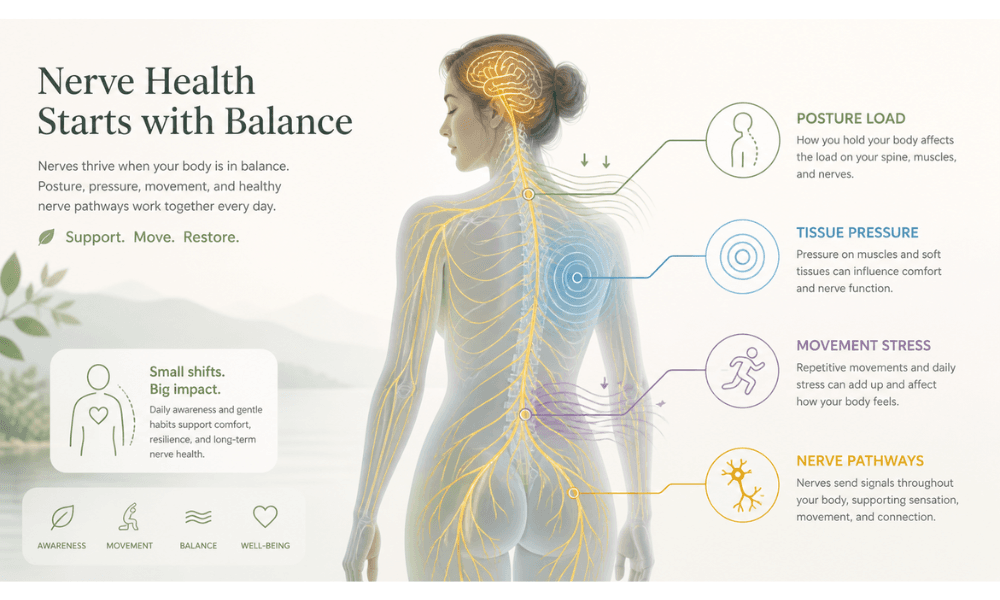
The Mechanical Damage System helps explain how physical pressure, compression, tension, posture stress, repetitive movement, injury patterns, and tissue load may influence nerve-related experiences.
This page does not describe mechanical damage as a diagnosis. Instead, it explains mechanical stress as a body-wide educational system that may interact with nerves, muscles, joints, connective tissue, circulation, inflammation, and recovery capacity.
When tissues experience repeated load or irritation, the nervous system may become more sensitive. Therefore, understanding the Mechanical Damage System can help you explore how structure, movement, pressure, and recovery demand may connect within nerve health education.
Quick Navigation
What Is Mechanical Damage System?
The Mechanical Damage System refers to the way physical forces may affect tissues and nerves over time. These forces may include pressure, compression, stretching, friction, repetitive movement, impact, poor posture, joint restriction, or prolonged positioning.
Mechanical stress can involve muscles, tendons, ligaments, fascia, joints, discs, blood vessels, and nerves. For this reason, it should not be understood as one isolated problem. Instead, it can be viewed as a network of physical load and tissue response.
A simple analogy is a garden hose. If the hose is gently bent, water may still pass through. However, if it is repeatedly squeezed, twisted, or compressed, flow may become restricted. In the body, tissues are more complex, but this analogy helps explain how pressure and load may affect communication and support.
For nerve-related education, the Mechanical Damage System matters because nerves need space, movement, oxygen, nutrients, and stable surrounding tissues. When physical stress repeatedly affects these conditions, nerve sensitivity may become part of a larger system response.
How the Mechanical Damage System Works
First, the body experiences a physical load. This may come from posture, repetitive movement, injury, compression, tight tissue, joint position, or external pressure.
Next, the surrounding tissues respond. Muscles may tighten, joints may become restricted, circulation may change, and connective tissue may carry more tension. At the same time, nerves may become more exposed to pressure or reduced movement.
As a result, the nervous system may begin to detect the area as irritated, overloaded, or less stable. This does not always mean serious damage. However, it may increase sensitivity, especially when the same pattern continues.
Over time, repeated mechanical stress may interact with inflammation, circulation, metabolic demand, and stress response. For this reason, mechanical load should be understood as part of a larger body system, not as a single isolated cause.
Key Layers of the Mechanical Damage System
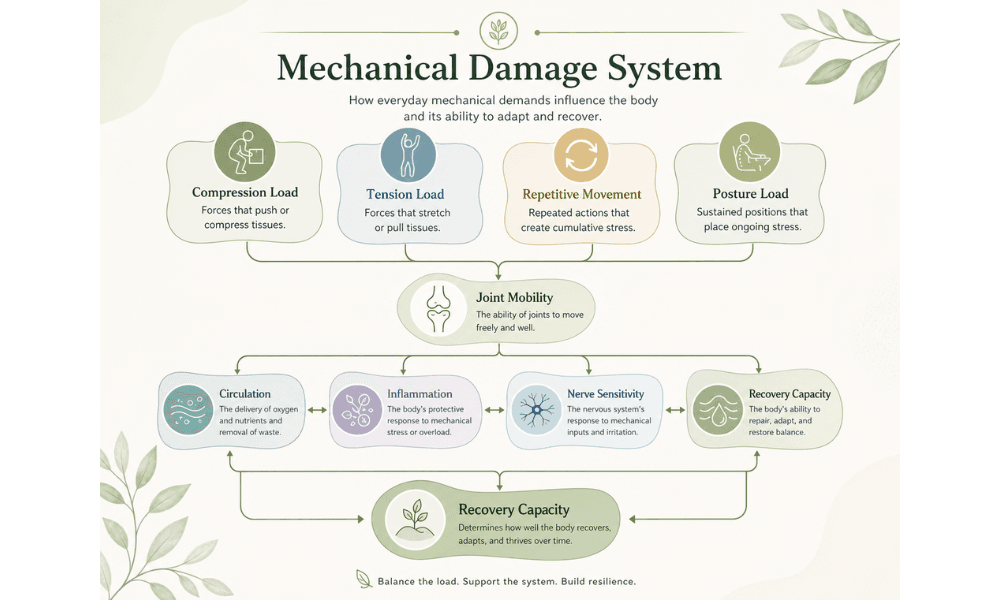
1. Compression Load
Compression load refers to pressure placed on tissues. This may happen when a nerve, blood vessel, joint, or soft tissue area has less space than usual.
For example, long sitting, awkward sleeping positions, swelling, tight muscles, or structural narrowing may increase pressure in certain areas. The body may respond with stiffness, discomfort, or altered movement.
Nerves are especially sensitive to their surrounding environment. Therefore, repeated compression may interact with nerve signaling, circulation, and tissue recovery capacity.
2. Tension and Stretch Load
Tension load refers to pulling or stretching forces across tissues. This may occur during movement, poor positioning, sudden injury, or repeated strain.
A nerve may need to glide smoothly as the body moves. However, if surrounding tissues are tight or movement is limited, the nerve area may experience more tension than usual.
This does not mean the nerve is always damaged. Instead, it means the Mechanical Damage System may be creating a pattern where movement and sensitivity become connected.
3. Repetitive Movement Stress
Repetitive movement stress happens when the same motion is performed many times without enough variation or recovery. This may involve typing, lifting, bending, gripping, walking patterns, or work-related tasks.
Small loads may feel harmless at first. However, repeated stress can accumulate when tissues do not have enough time to adapt.
Over time, repetitive mechanical demand may influence muscle tone, joint mechanics, inflammation, and nerve sensitivity. For this reason, pattern recognition is important in mechanical system education.
4. Posture and Positioning Load
Posture is not simply about “good” or “bad” position. It is more about how long the body stays in one position and whether tissues can recover from that load.
For example, sitting with the neck forward for many hours may place extra demand on the neck, shoulders, and upper back. Similarly, prolonged hip pressure may influence lower back, pelvic, or leg sensitivity.
The nervous system often responds to repeated positions. Therefore, posture load may become part of the Mechanical Damage System when it repeatedly affects tissue comfort, movement, and recovery.
5. Joint and Tissue Mobility
Joints and soft tissues help distribute movement throughout the body. When one area moves less, another area may take on more demand.
For example, limited hip movement may increase stress in the lower back. Limited shoulder mobility may increase neck or arm tension. These patterns may influence how force travels through the body.
Nerves pass through moving tissues. As a result, changes in mobility may affect how nerves glide, receive circulation, and tolerate daily movement.
6. Injury and Protective Guarding
After injury, the body may protect an area by tightening muscles, changing movement, or reducing load. This protective response can be useful at first.
However, if guarding continues for a long time, the body may develop new movement habits. These habits may place extra stress on nearby areas.
In this way, the Mechanical Damage System may continue even after the original injury has settled. The body may still be responding to protection, fear, stiffness, or altered movement patterns.
7. Tissue Recovery Capacity
Mechanical load is not only about how much stress the body receives. It is also about how well the body can recover from that stress.
Sleep, circulation, nutrition, inflammation, metabolic health, and stress regulation may all influence recovery capacity. When recovery capacity is lower, ordinary mechanical stress may feel more intense.
For this reason, mechanical sensitivity should not be viewed only through structure. It should also be understood through the wider recovery system.
Mechanical Damage System Interactions
Mechanical System and Nervous System
The nervous system receives information from muscles, joints, skin, fascia, and internal tissues. When mechanical stress increases, the nervous system may receive stronger signals from the affected area.
At the same time, the nervous system can influence muscle tone, movement protection, and pain perception. Therefore, the relationship works in both directions.
Mechanical load may influence nerve sensitivity, while nerve sensitivity may influence how the body moves and protects itself.
Mechanical System and Stress System
Stress may increase muscle tension, change breathing patterns, reduce movement variety, and heighten body awareness. These changes may increase mechanical load in certain areas.
At the same time, ongoing discomfort may increase stress. As a result, mechanical sensitivity and stress response may form a cycle.
This does not mean stress is the only cause. Instead, it means stress may interact with physical load and recovery capacity.
Mechanical System and Metabolic System
The metabolic system helps provide energy for muscles, nerves, and repair processes. When energy regulation is under pressure, tissues may recover more slowly from mechanical demand.
For example, repeated load may require more energy for tissue repair and nervous system regulation. If the body is already under metabolic stress, mechanical sensitivity may feel harder to settle.
This connection shows why mechanical stress should be understood as part of a whole-body system.
Mechanical System and Nutritional System
Nutrients help support tissue structure, energy production, nerve function, and repair processes. Mechanical load may increase the body’s demand for these support systems.
However, nutrition should not be presented as a quick fix for mechanical sensitivity. Instead, it can be understood as one layer of system support.
The Mechanical Damage System may interact with nutritional status through tissue resilience, recovery capacity, and cellular repair needs.
Mechanical System and Circulatory System
Circulation helps deliver oxygen and nutrients while clearing metabolic waste. Mechanical compression or restricted movement may influence local circulation.
For example, prolonged pressure on one area may reduce comfort and tissue freshness. Movement usually helps circulation, while immobility may increase stiffness or sensitivity.
Therefore, circulation and mechanical load often work together within nerve-related education.
Mechanical System and Inflammatory System
Mechanical stress may interact with inflammatory signaling. After injury or repeated irritation, the body may use inflammation as part of its protective and repair response.
However, repeated overload may keep tissues in a more reactive state. This may influence stiffness, tenderness, swelling, or sensitivity.
Inflammation should not be seen as only harmful. It is part of the body’s response, but balance and resolution matter.
Mechanical System and Regeneration Systems
Regeneration systems involve repair, adaptation, remodeling, and stability. Mechanical load can influence how tissues adapt over time.
Appropriate movement may support adaptation, while repeated overload may increase recovery demand. The key idea is not to avoid all load, but to understand how load, timing, and recovery interact.
For this reason, the Mechanical Damage System connects closely with regeneration education.
Patterns That Influence the Mechanical Damage System
Daily patterns can shape how mechanical load affects the body. These patterns do not diagnose a condition, but they may help explain why certain areas become sensitive.
Common patterns may include:
- Long sitting without movement variation
- Repetitive hand, wrist, neck, or back tasks
- Sleeping positions that create pressure
- Heavy lifting without recovery time
- Low movement variety during the day
- High stress with increased muscle tension
- Poor workstation setup
- Previous injury with protective movement habits
- Shoes, walking surfaces, or gait patterns
- Low sleep quality and reduced recovery capacity
For example, a person who sits for many hours may not feel discomfort immediately. However, over time, the same position may increase pressure in the hips, lower back, neck, or shoulders.
In addition, repetitive work may create tissue fatigue. When the body does not receive enough variation, circulation, and recovery time, mechanical stress may become more noticeable.
Mechanical Damage System and Nerve Function
The Mechanical Damage System may connect with nerve function through pressure, tension, movement restriction, circulation changes, and protective signaling.
Nerves are living tissues. They need blood flow, space, and the ability to move with the body. When nearby tissues become tight, compressed, inflamed, or overloaded, nerve sensitivity may increase.
This may help explain experiences such as tingling, burning, numbness, sharp sensations, fatigue, or body-wide sensitivity. However, these experiences can have many possible explanations, so they should not be reduced to one mechanical cause.
Mechanical stress may also influence signal processing. When the nervous system receives repeated warning signals, it may become more alert. Over time, this may contribute to increased sensitivity in certain areas.
For this reason, mechanical nerve education should stay balanced. It is one possible lens for understanding nerve-related experiences, not a complete diagnosis or treatment plan.
Mechanical Damage System Visual Flow
Mechanical Load / Repetitive Pressure
↓
Tissue Compression or Tension
↓
Restricted Movement or Circulation Change
↓
Inflammatory / Protective Response
↓
Nerve Sensitivity or Signal Change
↓
Movement Guarding and Recovery Demand
↓
Repeated Load Cycle
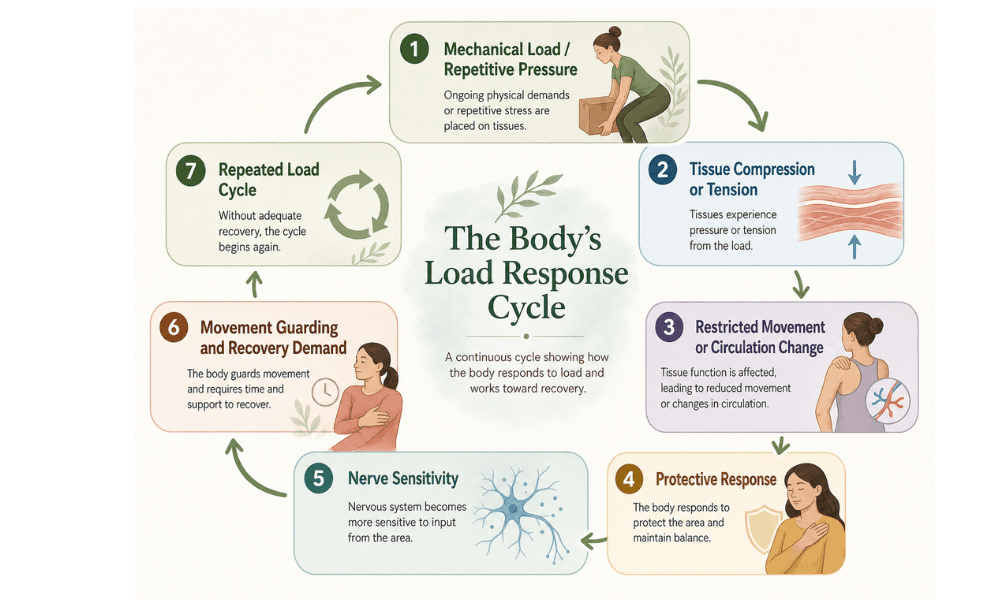
This flow is not always linear. For example, stress may increase muscle tension before tissue irritation appears. In another case, an injury may create guarding first, which then changes movement patterns.
The main idea is that mechanical sensitivity often works as a cycle. Physical load, tissue response, nervous system signaling, and recovery capacity may influence each other over time.
Visual learning is helpful here because it shows that mechanical damage is not just about one compressed nerve or one painful joint. Instead, it can involve multiple systems working together.
Why the Mechanical Damage System Matters for Recovery
1. Recovery Requires Load Balance
The body usually needs movement and load to adapt. However, too much repeated load without recovery may increase irritation.
Therefore, recovery education should consider both movement and rest. It should also consider timing, variation, and tissue tolerance.
2. Recovery Requires Space and Mobility
Nerves and surrounding tissues need enough space to move comfortably. When tissues are stiff, compressed, or guarded, the nervous system may become more sensitive.
Mobility does not mean extreme flexibility. Instead, it means the body can move through daily activities without repeated strain in one area.
3. Recovery Requires Delivery and Clearance
Circulation supports delivery of oxygen and nutrients. It also helps clear waste products from active tissues.
Mechanical pressure, immobility, or restricted movement may influence these processes. For this reason, circulation and mechanical load are closely connected.
4. Recovery Requires Nervous System Stability
When the nervous system feels threatened, it may increase protection. This can include pain sensitivity, muscle guarding, or movement avoidance.
Over time, protection may become part of the problem if it limits movement and increases load elsewhere. Therefore, mechanical education should include nervous system regulation.
5. Recovery May Be Influenced by Repeated System Stress
One heavy movement may not always create a long-term issue. However, repeated mechanical stress combined with poor sleep, stress, inflammation, or low recovery capacity may become more meaningful.
For this reason, the Mechanical Damage System should be understood through pattern thinking, not fear-based thinking.
Common Misunderstandings About the Mechanical Damage System
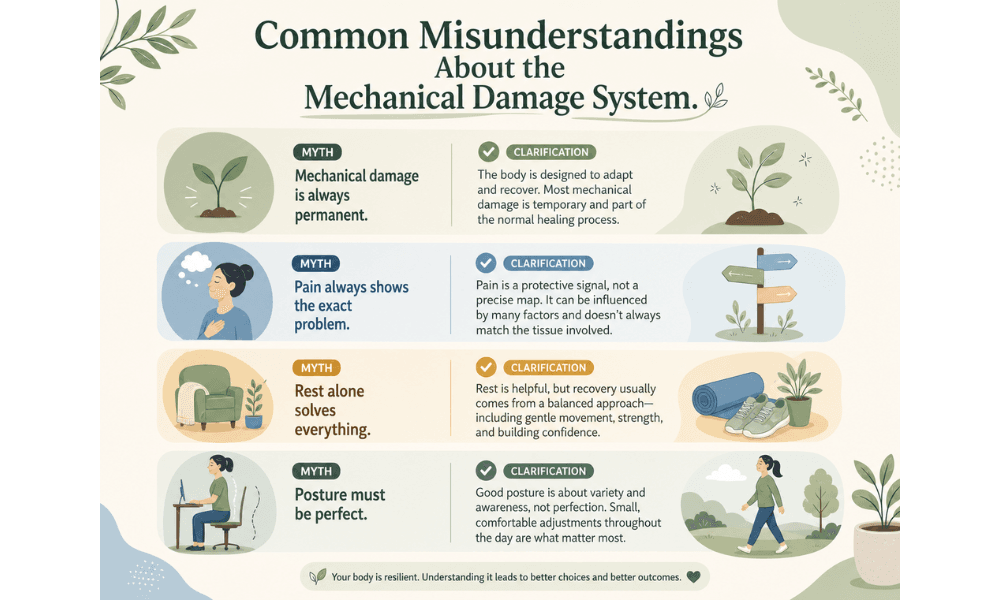
Misunderstanding 1: Mechanical damage always means permanent damage.
Clarification:
Mechanical sensitivity does not always mean permanent structural damage. Sometimes tissues are irritated, overloaded, compressed, or sensitized without a severe injury.
The body is adaptable. However, repeated stress patterns may still need careful attention and professional evaluation when symptoms are severe or worsening.
Misunderstanding 2: Pain always shows exactly where the problem is.
Clarification:
Pain and nerve sensations can be complex. A sensitive area may be influenced by nearby tissues, spinal structures, circulation, inflammation, or nervous system processing.
Therefore, it is better to understand pain as information, not as a simple map of damage.
Misunderstanding 3: Rest alone always solves mechanical sensitivity.
Clarification:
Rest may reduce load in the short term. However, too much rest may also reduce movement variety, circulation, strength, and tissue confidence.
Recovery often depends on the relationship between load, movement, regulation, and repair capacity. This page does not provide treatment instructions, but it explains why balance matters.
Misunderstanding 4: Posture must be perfect all the time.
Clarification:
There is no single perfect posture for every person. The body usually prefers movement variety over rigid positioning.
A position may become a problem when it is repeated for too long without recovery. Therefore, posture should be understood as a load pattern, not a moral rule.
Misunderstanding 5: Mechanical issues are separate from whole-body health.
Clarification:
Mechanical load interacts with inflammation, circulation, stress, nutrition, metabolism, and regeneration. A physical issue may become more sensitive when the body is already under systemic stress.
For this reason, mechanical education works best when it is part of a whole-body learning framework.
Continue Learning
To understand the Mechanical Damage System more clearly, continue exploring related areas of nerve health education.
Root-Cause Systems
Learn how different body-wide stress systems may interact with nerve sensitivity and recovery capacity.
Therapeutic Systems
Explore support-based education around movement, sleep, stress regulation, circulation, and recovery environments.
Regeneration Systems
Understand how repair, adaptation, tissue remodeling, and nervous system stability may support recovery education.
Conditions
Review nerve-related condition pages to understand common patterns and experiences without self-diagnosis.
Learning Path
Follow a step-by-step educational route if you are new to nerve health, root causes, and recovery systems.
Related Systems
Stress System
Stress may increase muscle tension, guarding, and sensitivity. It may also influence how the nervous system interprets mechanical signals.
Metabolic Damage System
Metabolic stress may influence energy availability, tissue repair, and cellular resilience. This may affect how the body responds to mechanical load.
Nutritional Deficiency System
Nutritional status may influence nerve support, tissue repair, and recovery capacity. It should be understood as one support layer, not a quick solution.
Circulatory Impairment System
Circulation supports oxygen delivery and waste clearance. Mechanical compression or immobility may interact with circulation patterns.
Inflammatory System
Mechanical irritation may interact with inflammatory signaling. Inflammation may also influence tenderness, stiffness, and sensitivity.
Toxic Load System
Environmental stressors may influence body-wide resilience. When combined with mechanical stress, overall recovery demand may increase.
Regeneration Systems
Regeneration systems help explain repair, adaptation, remodeling, and stability after repeated load or irritation.
Safety & Education Notice
This page is for educational purposes only.
It does not diagnose, treat, cure, or prevent disease. It is not a substitute for professional medical advice, diagnosis, or treatment.
Mechanical symptoms, nerve pain, numbness, weakness, tingling, burning, or sudden changes can have many possible causes. Seek urgent medical care for severe, sudden, progressive, or worsening symptoms, especially weakness, loss of bladder or bowel control, severe trauma, chest pain, difficulty walking, or rapidly spreading numbness.
Use this page as a learning resource, not as a medical decision tool.