
Stress & Coping: A Simple Guide to Nervous System Balance
Stress & Coping explains how the body and mind respond to pressure, demand, uncertainty, emotional load, and daily challenges. Stress is not only a feeling. Instead, it may involve the nervous system, breathing rhythm, muscle tension, sleep quality, attention, energy, and recovery capacity. Because of this, stress should be understood as a whole-body response rather than a simple mood problem. This page explains stress and coping in a calm, educational way so readers can understand how daily pressure may affect body signals and nervous system balance.
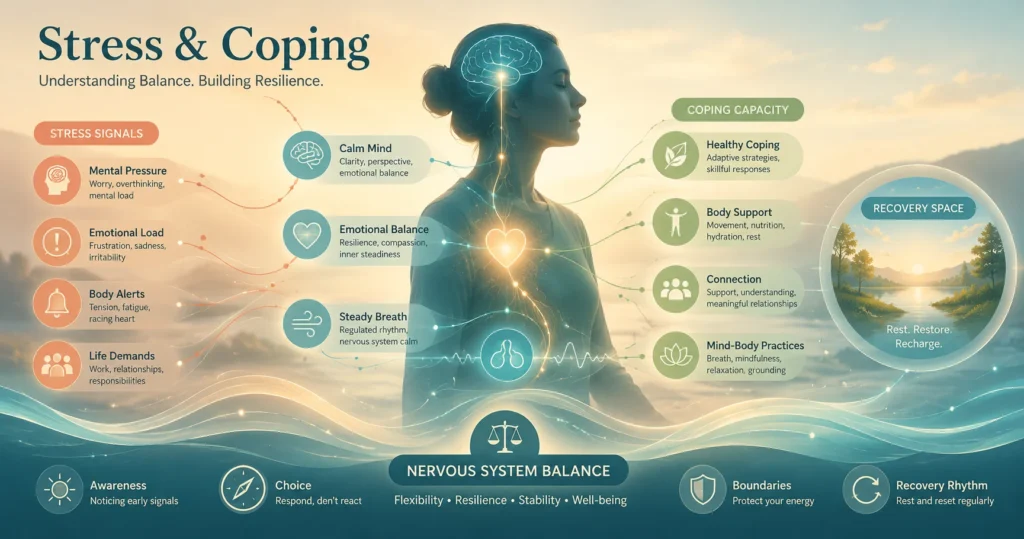
Coping means the way a person responds to stress after the body notices demand. Some coping patterns may help the body settle, while others may increase system load over time. For example, rest, supportive connection, healthy boundaries, calmer routines, and professional help when needed may support safer stress processing. However, avoidance, overworking, emotional suppression, constant worry, poor sleep, and isolation may make stress harder to manage. Therefore, coping with stress is not about being perfect. It is about understanding patterns and reducing unnecessary overload where possible.
From a nerve-health education view, Stress & Coping may matter because stress load can interact with emotional regulation, autonomic response, sensory sensitivity, pain processing, sleep rhythm, and recovery demand. However, this page does not diagnose stress disorders, treat nerve symptoms, or claim that stress explains every symptom. Instead, it explains Stress & Coping as one educational layer inside the wider Human Systems cluster. It also connects with safer stress coping strategies, coping mechanisms for stress, and coping skills for stress without turning them into medical instructions.
Quick Navigation
What Is Stress & Coping?
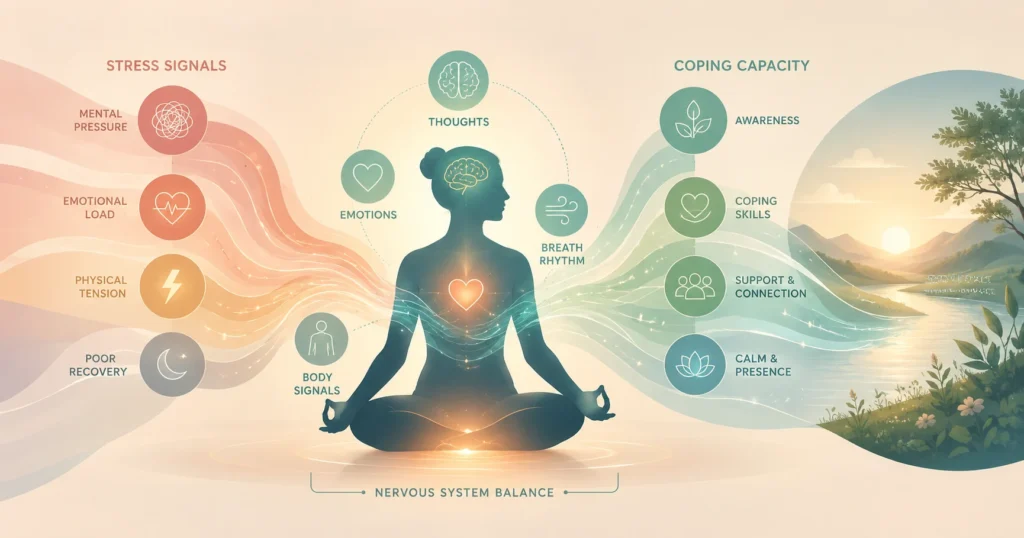
Stress & Coping refers to the way the body detects demand and the way a person responds to that demand. Stress may come from work, family pressure, illness, uncertainty, pain, financial worry, trauma history, poor sleep, sensory overload, or emotional conflict. Coping is the response pattern that follows. Therefore, this topic includes both the stress signal and the way the system tries to manage it. In simple terms, stress is the pressure signal, while coping is the response pattern that comes next.
Stress is not always harmful. In short bursts, stress may help a person focus, respond, prepare, or take action. However, when stress remains high for too long, the body may stay more alert than needed. As a result, sleep, mood, digestion, attention, muscle comfort, and recovery capacity may feel affected. This is why Stress & Coping belongs inside Human Systems education. It helps readers understand stress and coping with stress as a body-wide pattern rather than a simple weakness or mindset issue.
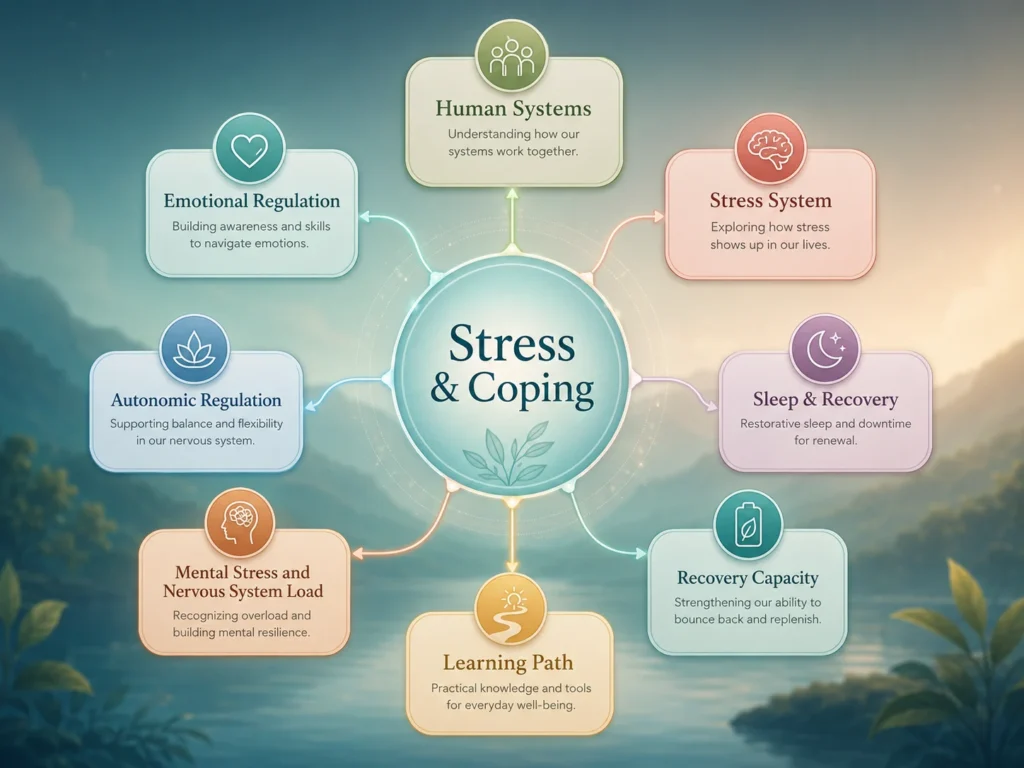
From a nervous system view, Stress & Coping may interact with Emotional Regulation, Autonomic Regulation, Mental Stress and Nervous System Load, and Recovery Capacity and Nervous System Resilience. These connections do not mean stress causes every symptom. Instead, they show how stress load may become one part of a larger system pattern. Because of this, coping strategies for stress should be explained with care. They may support understanding, but they should not be presented as cures, treatments, or guaranteed solutions.
Plain Meaning / Glossary Box
Stress
Stress is the body and mind’s response to pressure, threat, uncertainty, or demand. It may affect emotions, thoughts, muscles, breathing, heart rhythm, sleep, digestion, and energy. In simple terms, stress is the body’s way of preparing to deal with something that feels important, difficult, unsafe, or demanding. However, stress is not always visible from the outside. A person may look calm while the body is still working hard inside.
Coping
Coping means the way a person responds to stress. Some coping patterns may help the body settle, while others may keep the system under pressure. Coping is not about pretending everything is fine. Instead, it is about how a person manages demand, emotion, energy, and recovery over time. Therefore, coping methods for stress may include both inner patterns, such as self-talk, and outer patterns, such as rest, support, boundaries, or asking for help.
Stress Load
Stress load is the total demand placed on the body and mind. It may include emotional, physical, social, work-related, sensory, financial, health-related, and recovery-related pressure. Because stress load can build slowly, people may feel overwhelmed before they realize how much they are carrying. As a result, small events may feel larger than expected when the system is already overloaded. This is why stress coping tips should consider the whole load, not only one stressful event.
Nervous System Stress
Nervous system stress refers to a state where the body may feel more alert, reactive, tense, tired, or unable to settle after demand. This does not mean the nervous system is broken. Rather, it means the system may be working hard to respond to ongoing pressure. Meanwhile, poor sleep, pain, emotional strain, and constant worry may reduce the body’s ability to settle. Therefore, nervous system stress should be viewed as a pattern, not a personal failure.
Coping Capacity
Coping capacity means how much stress a person can manage before feeling overwhelmed. It may change depending on sleep, support, health, environment, pain, nutrition, emotional load, and recovery time. Therefore, coping capacity is not fixed. It can rise or fall depending on the whole system. When coping capacity is low, even normal tasks may feel difficult. Because of this, coping skills for stress should be understood as supportive tools, not signs of weakness.
Recovery Window
A recovery window is a period when the body has space to reduce alertness, restore energy, and return toward stability. These windows may come through rest, sleep, quiet time, gentle movement, safe connection, or reduced demand. However, they should not be confused with medical treatment. Instead, they are educational examples of how the body may need time to reset after pressure. Without recovery windows, stress may carry into sleep, attention, mood, and body comfort.
Overwhelm
Overwhelm happens when stress feels larger than current coping capacity. It may involve emotional pressure, mental fatigue, body tension, irritability, shutdown, racing thoughts, or difficulty settling. Because overwhelm can have many causes, it should be understood carefully and safely. For example, a person may feel overwhelmed due to life pressure, poor sleep, grief, pain, trauma history, illness, or lack of support. Therefore, overwhelm should never be dismissed as weakness.
How Stress & Coping Works
First, the body notices demand. This demand may be emotional, physical, social, mental, sensory, financial, or environmental. Next, the nervous system decides whether the situation requires attention, action, protection, or recovery. Because of this, stress may begin before a person fully understands what they are feeling. For example, tight shoulders, shallow breathing, restlessness, or a busy mind may appear before the person can clearly name the stressor.
After that, the body may shift into a more alert state. Breathing may change, muscles may tighten, thoughts may speed up, and sleep may become harder. Meanwhile, the mind may begin searching for solutions, risks, memories, or possible outcomes. This response is not weakness. Instead, it is the body’s attempt to manage demand. However, if the alert state continues for too long, the system may feel tired, sensitive, or harder to calm.
Over time, coping patterns shape what happens next. Helpful coping may create space, clarity, support, and recovery. However, unhelpful coping may increase stress load, reduce sleep quality, and keep the nervous system activated. Therefore, Stress & Coping is not only about stress itself. It is also about the response system that follows stress. This is why coping mechanisms for stress can be helpful when they reduce overload, but risky when they only hide pressure temporarily.
Key Layers of Stress & Coping
Demand Detection Layer
The demand detection layer begins when the body or mind notices that something needs attention. This may happen during conflict, illness, pain, work pressure, family responsibility, financial worry, sensory overload, or uncertainty. Sometimes the demand is obvious. However, at other times, the body may react before the person clearly understands why. For example, someone may feel tense, restless, or mentally crowded before they can name the stressor.
Because stress can begin through body signals, understanding it often starts with noticing changes in breathing, muscle tone, energy, mood, and attention. This does not mean the person is imagining the stress. Instead, it means the body may detect pressure quickly. Therefore, safer stress coping strategies often begin with awareness. Awareness creates a small pause between the stress signal and the response pattern. That pause can help the person understand the situation more clearly.
Body Alertness Layer
When stress rises, the body may increase alertness. This may involve faster breathing, tight muscles, a busy mind, irritability, restlessness, or trouble relaxing. In short bursts, this response may help a person act. However, repeated activation may make the system feel tired, sensitive, or harder to calm. As a result, even small pressures may feel larger when the body is already carrying stress.
Body alertness should not be viewed as only emotional. It may also involve the autonomic nervous system, sleep rhythm, movement pattern, sensory input, and recovery demand. Because of this, Stress & Coping connects naturally with Autonomic Regulation and nervous system balance. In addition, coping techniques for stress may help readers understand how body alertness and daily habits can influence one another. Still, this page does not provide medical treatment instructions.
Thought and Meaning Layer
Stress is shaped not only by what happens, but also by what the mind believes the event means. For example, a mistake may feel small when the person feels supported. However, the same mistake may feel threatening when the person already feels exhausted, unsafe, judged, or overwhelmed. Therefore, thoughts, beliefs, memory, and meaning can increase or reduce stress load.
This does not mean stress is imaginary. Instead, it means the brain adds interpretation to body signals and life events. Because of this, Stress & Coping connects with cognitive load, rumination, and emotional regulation. For example, repeated “what if” thinking may keep the system alert even after the event has passed. In this layer, coping with stress may include noticing when thought patterns are helping and when they are increasing overload.
Emotional Response Layer
Stress often brings emotional reactions such as fear, anger, sadness, frustration, guilt, shame, grief, or worry. These emotions can help signal that something matters. However, when emotions remain intense for a long time, they may increase system demand and make coping harder. As a result, the person may feel more reactive, more tired, or less able to make clear decisions.
At the same time, emotional response is not a character flaw. It may reflect life experience, current stress load, sleep quality, trauma history, support systems, and nervous system state. Therefore, emotional stress should be understood with care. It connects strongly with Emotional Regulation, but it should not be used to blame the person. Instead, it can help explain why coping capacity changes from day to day.
Coping Pattern Layer
Coping patterns are the actions, habits, thoughts, and behaviors people use when stress rises. Some coping patterns may be helpful in the short term but costly over time. For example, overworking may reduce anxiety for a while, but it may also reduce sleep and recovery. Similarly, avoidance may reduce immediate discomfort, while allowing pressure to build later.
Meanwhile, healthier coping may include asking for support, taking breaks, using calmer communication, creating structure, reducing overload, or seeking professional help when needed. These examples are educational, not medical instructions. Still, they show how coping strategies for stress can influence stress load and nervous system stability. Therefore, coping should be viewed as a flexible system, not a single technique.
Recovery and Reset Layer
After stress, the body needs a chance to reset. Without recovery time, stress can carry into sleep, digestion, mood, focus, pain sensitivity, and energy. As a result, the person may feel like they are always catching up but never fully settling. This can create a loop where stress reduces recovery, and low recovery makes stress harder to manage the next day.
Recovery and reset do not require perfection. Instead, they require enough space for the body to reduce alertness. Over time, regular recovery windows may help readers understand why stress management is not only about doing less. It is also about giving the nervous system room to return toward stability. Because of this, stress coping tips should include recovery timing, not only quick calming methods.
Real-Life Symptom Language Bridge
Some readers may search for Stress & Coping because they feel overwhelmed, tense, emotionally reactive, exhausted, irritable, worried, sensitive, or unable to calm down. Others may also notice nerve pain, tingling, numbness, burning feelings, muscle tightness, poor sleep, body sensitivity, fatigue, or a feeling that the nervous system is always “on.” These experiences can feel confusing, especially when the person does not know whether stress, body systems, or both are involved.
However, symptoms should never be explained by stress alone. Nerve symptoms, weakness, sensory changes, and pain may involve injury, diabetes, inflammation, nerve compression, circulation problems, autoimmune conditions, medication effects, nutritional issues, or other medical factors. Therefore, Stress & Coping should be viewed as one educational layer, not a complete explanation. Medical evaluation is important when symptoms are sudden, severe, worsening, unusual, spreading, or connected with weakness or loss of function.
At the same time, stress load may influence attention, muscle tension, sleep quality, recovery demand, and how strongly a person notices discomfort. Because of this, learning about Stress & Coping may help readers understand how emotional pressure, body awareness, and nervous system regulation may interact without encouraging self-diagnosis. This balanced view protects readers from two mistakes: blaming every symptom on stress, or ignoring stress as part of the wider body picture.
Stress & Coping and Nervous System Function
Stress & Coping may connect with nervous system function because stress changes how the body prepares, responds, and recovers. When stress rises, the nervous system may increase alertness. As a result, the body may become more watchful, muscles may tighten, and attention may focus more strongly on problems or sensations. In many cases, this is a normal protective response, but it can feel uncomfortable when it lasts too long.
Meanwhile, coping patterns may either reduce or extend this alert state. For example, repeated worry, overchecking, poor sleep, and overworking may keep stress signals active. In contrast, rest, support, boundaries, and calmer routines may help create more recovery space. However, these are not treatments. They are educational examples of how coping can affect system demand. Therefore, coping mechanisms for stress should be described as supportive patterns, not cures.
Nervous system balance depends on flexibility. A flexible system can activate when needed and settle afterward. Therefore, Stress & Coping matters because it helps explain why some people feel stuck in alertness, fatigue, sensitivity, or emotional overload. Still, persistent or worsening symptoms should be discussed with a qualified professional. From a safe education view, coping skills for stress may help readers understand the system, while professional care remains important for personal medical or mental health concerns.
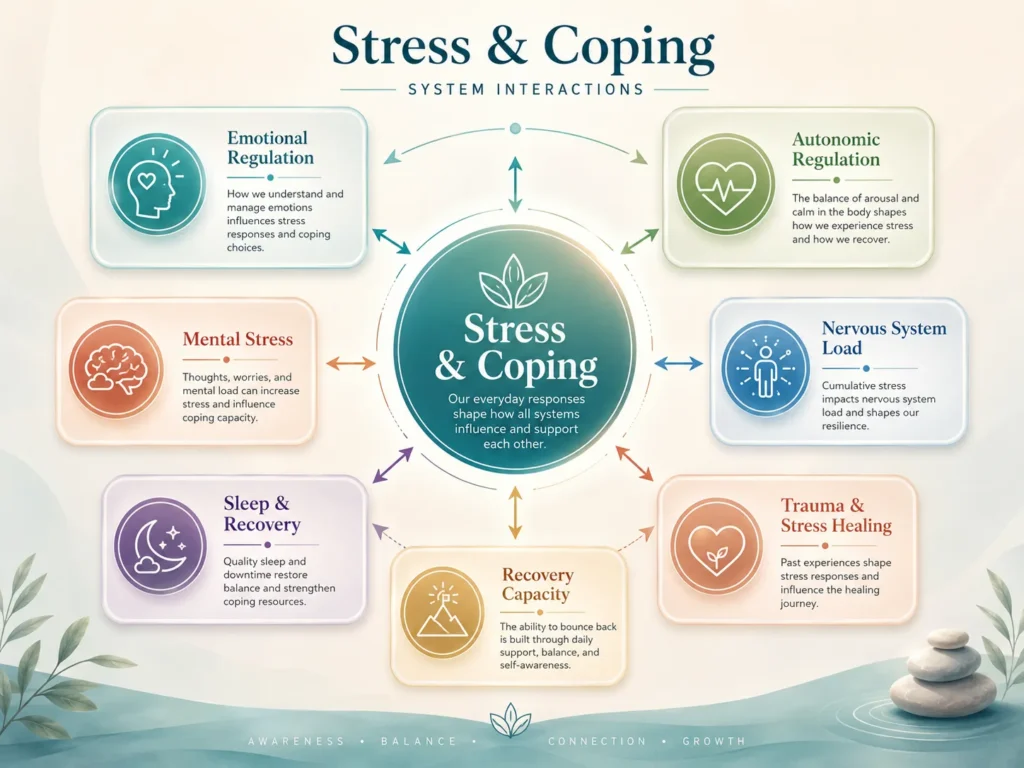
Stress & Coping Interactions
Emotional Regulation Interaction
Stress & Coping and Emotional Regulation work closely together. When stress rises, emotions may become stronger. At the same time, strong emotions may make stress harder to manage. Therefore, stress and emotion often influence each other in a cycle. For example, a person may feel stressed about a problem, then feel frustrated about being stressed, and then become even more overloaded.
Because of this, coping is not only about solving the outside problem. It may also involve noticing emotional signals and creating space before the reaction becomes too strong. This does not mean emotions are bad. Instead, emotions may show what the body and mind are carrying. Therefore, stress coping strategies often work better when emotional regulation is included as part of the wider system.
Autonomic Regulation Interaction
The Autonomic Regulation system helps manage automatic body functions such as heart rate, digestion, breathing rhythm, temperature control, and alertness. Stress may influence these rhythms because the body prepares to respond to demand. Therefore, stress and autonomic response often move together. A person may notice faster breathing, stomach changes, sweating, tension, or a sense of being unable to settle.
However, the relationship is not one-way. A body that is tired, underslept, tense, or overloaded may also feel more reactive to stress. As a result, coping capacity may feel lower. This connection helps readers understand why rest, rhythm, and recovery windows matter in nervous system education. It also shows why coping with stress should include body awareness, not only positive thinking.
Mental Stress Interaction
Stress & Coping connects strongly with Mental Stress and Nervous System Load because ongoing thinking can increase system demand. Worry, planning, problem-solving, rumination, and repeated checking may keep the mind active long after the original stressor has passed. As a result, the body may not receive a clear signal that the demand is over.
Therefore, coping may include recognizing when thinking becomes repetitive rather than useful. This does not mean thoughts are bad. Instead, it means mental load can become one part of total stress load. For example, a person may continue carrying a work problem in the body even after work is finished. In that case, coping techniques for stress may focus on creating a clearer transition from demand to recovery.
Sleep and Recovery Interaction
Stress and sleep often influence each other. A stressful day may make sleep harder. Then, poor sleep may make the next day feel more stressful. Because of this, Stress & Coping connects naturally with Sleep & Recovery. Sleep does not solve every stressor, but poor sleep may lower coping capacity and increase emotional sensitivity.
In addition, poor sleep may make body sensations feel harder to tolerate. Therefore, sleep rhythm belongs inside the larger stress education picture. It helps readers see why recovery windows matter. However, this page does not prescribe sleep treatment. Instead, it explains how stress and coping with stress may interact with rest, recovery, energy, and nervous system stability.
Trauma and Stress Healing Interaction
Past trauma or long-term stress may influence how the body reads safety, pressure, and threat. Therefore, Stress & Coping also connects with Trauma and Stress Healing and Trauma Stress and Nervous System Activation. However, trauma is sensitive and should never be reduced to simple stress management. Some stress reactions may be connected with past experiences, body memory, or safety patterns.
For some people, coping may feel difficult because the nervous system has learned to stay alert for protection. Meanwhile, others may cope through shutdown, avoidance, or emotional numbness. Because of this, serious trauma symptoms or severe distress should be supported by qualified mental health care. Stress coping tips may support education, but they should never replace therapy, crisis care, or professional support when needed.
Recovery Capacity Interaction
Stress & Coping also connects with Recovery Capacity and Nervous System Resilience. When stress is repeated and recovery windows are too small, the body may spend more time managing demand than restoring energy. Over time, this may increase fatigue, emotional sensitivity, poor sleep, and body tension. Therefore, coping patterns can shape how much recovery space the system receives.
However, recovery capacity is not only about rest. It also involves timing, support, pacing, sleep, emotional regulation, movement, and reduced overload. Therefore, coping strategies for stress may influence whether the system receives enough space to reset after stress. This is not a treatment claim. Rather, it is a system-based explanation of how stress load and recovery demand may interact.
Practical Daily-Life Examples
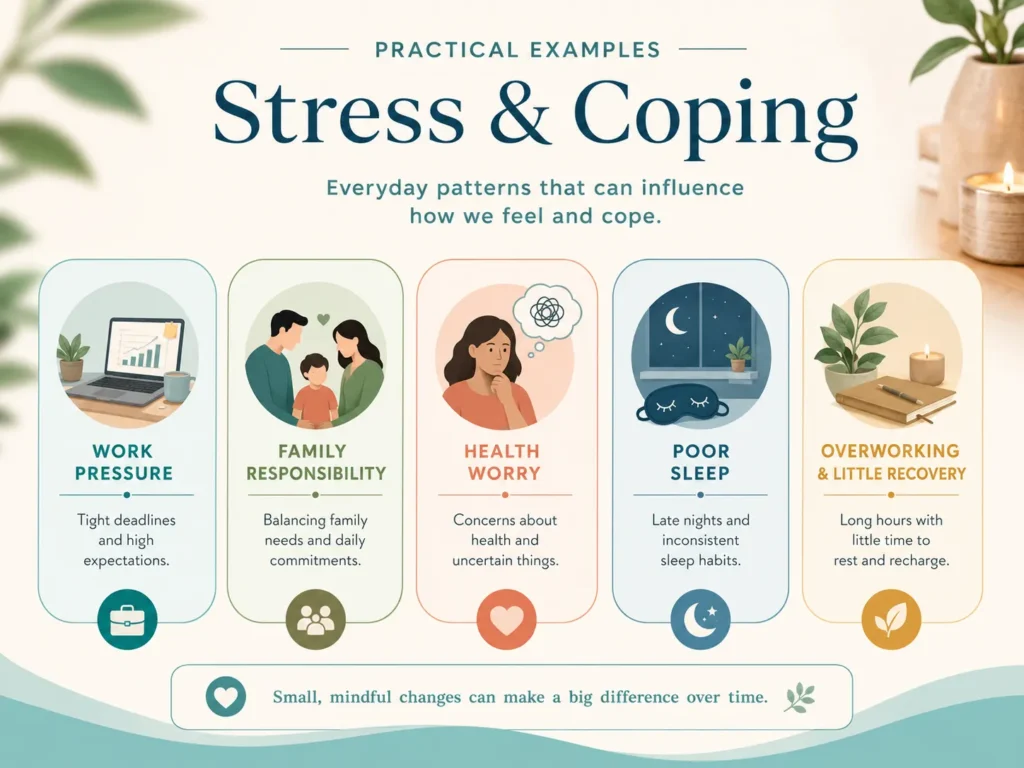
Work Pressure and Carryover Stress
Work pressure may continue affecting the body after the workday ends. For example, a person may replay conversations, check messages repeatedly, worry about deadlines, or feel tense while trying to rest. Although the work task may be finished, the nervous system may still behave as if the demand is active. As a result, the person may feel busy inside even during free time.
Therefore, coping is not only about completing the task. It may also involve helping the body notice that the demand has changed. This does not require perfect relaxation. Instead, it may mean creating a small recovery window that gives the body a clearer shift from work mode to rest mode. In this example, coping methods for stress may include transition time, reduced screen pressure, and a calmer evening rhythm.
Family Responsibility and Emotional Load
Family responsibility can bring love, meaning, pressure, and stress at the same time. A person may care for others while also feeling tired, worried, guilty, or stretched thin. Because these emotions can overlap, stress may build quietly over time. Therefore, a person may not realize they are overloaded until they feel irritable, exhausted, tearful, or unable to settle.
As a result, coping may involve recognizing that responsibility and overload can exist together. This does not mean the person is uncaring. Rather, it means the body may need support, rest, clearer limits, or help from others. From a system view, caregiving stress can affect emotional load, sleep, attention, and recovery capacity. Therefore, coping skills for stress may include support-seeking and realistic pacing.
Health Worry and Symptom Checking
Health worry may increase stress because the mind naturally wants certainty. For example, a person may check symptoms repeatedly, search online, or monitor body sensations throughout the day. At first, checking may feel helpful. However, over time, repeated checking may increase body alertness and make normal sensations feel louder.
Because of this, stress and symptom attention may form a cycle. This does not mean symptoms are imaginary. Instead, it means attention and stress may influence how strongly symptoms are noticed. Therefore, concerning symptoms should be medically evaluated, while stress patterns can be understood as one additional layer. This is a safer way to discuss stress and coping with stress without blaming the reader.
Poor Sleep and Lower Coping Capacity
Poor sleep may reduce coping capacity. After a short or restless night, small problems may feel larger, emotions may feel stronger, and body discomfort may feel harder to ignore. Meanwhile, stress may make sleep harder again the next night. Consequently, stress and sleep can become a loop that affects mood, attention, energy, and recovery.
This is why Stress & Coping should connect with sleep education. However, this page does not prescribe sleep treatment. Instead, it explains why sleep rhythm may influence how the nervous system responds to daily pressure. In daily life, coping techniques for stress may work better when the person also understands recovery windows, rest rhythm, and overload patterns.
Overworking as a Coping Pattern
Overworking can sometimes feel like control. A person may stay busy to avoid worry, sadness, fear, or uncertainty. In the short term, this may reduce emotional discomfort. However, over time, overworking may reduce rest, sleep, connection, and recovery windows. As a result, the body may become more tired and reactive.
Therefore, overworking can become a coping pattern that increases stress load. This does not mean work is bad. Instead, it means constant performance without recovery may make the nervous system more strained. A balanced system needs both action and recovery. Because of this, healthy coping mechanisms for stress should include both productive action and time to settle.
Social Support and Safer Coping
Supportive relationships may help some people process stress more clearly. A calm conversation, trusted listener, supportive community, or professional guide may reduce isolation and help organize thoughts. However, support does not mean someone else must fix every problem. Instead, safe support may help the nervous system feel less alone with the demand.
At the same time, not every relationship feels safe or helpful. Therefore, coping with stress may also include choosing support carefully. In some situations, professional help may be the safest option. From a Human Systems view, coping is not only personal. It can also involve connection, communication, trust, and the social environment around the person.
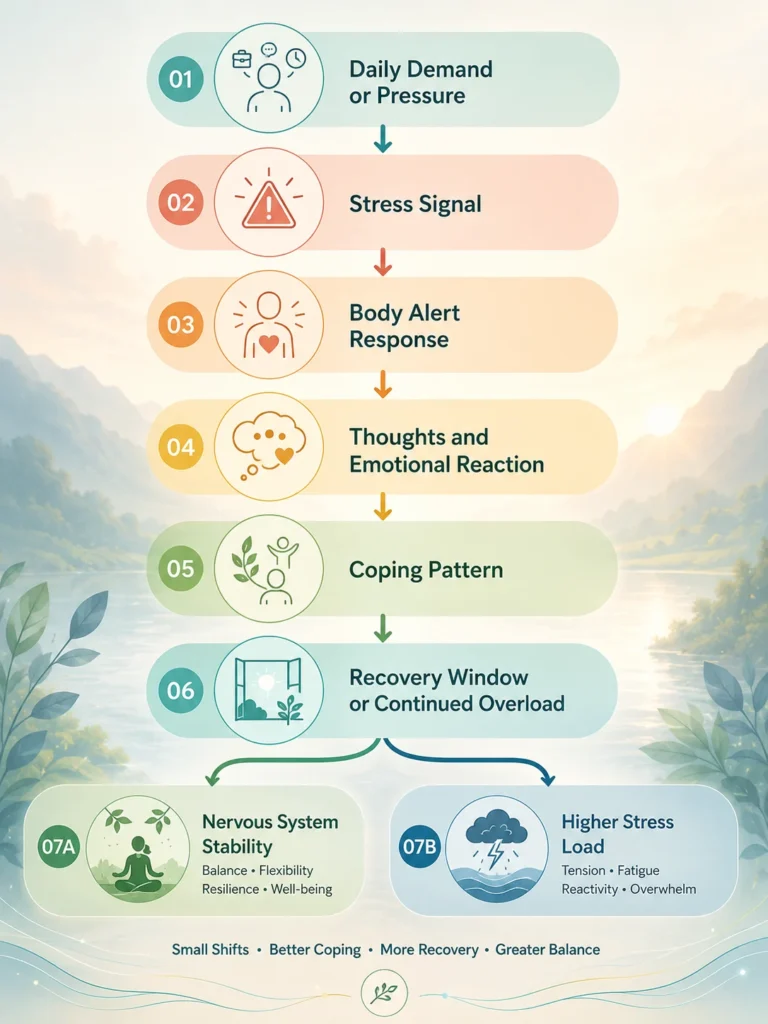
Stress & Coping Visual Flow
Daily Demand or Pressure
↓
Stress Signal
↓
Body Alert Response
↓
Thoughts and Emotional Reaction
↓
Coping Pattern
↓
Recovery Window or Continued Overload
↓
Nervous System Stability or Higher Stress Load
This visual flow is a simple educational model. In real life, stress does not always move in a straight line. Sometimes the body reacts first, and the mind understands later. At other times, repeated thoughts keep the stress signal active even after the situation has changed. Therefore, the stress and coping process may work like a loop rather than a single event.
Because each person has a different history, health status, support system, and environment, the flow may look different for different readers. For one person, stress may show up as worry. For another person, it may show up as fatigue, body tension, shutdown, or irritability. Therefore, this model should not be used for diagnosis. Instead, it helps explain how stress, coping, body signals, and recovery windows may interact.
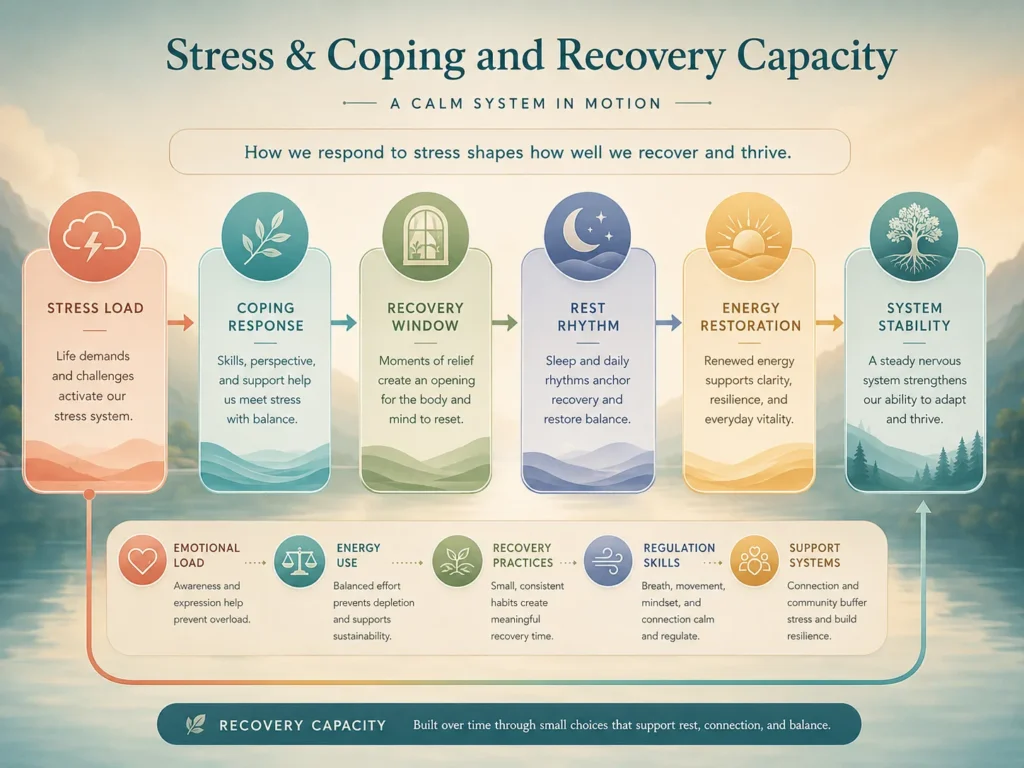
Why Stress & Coping Matters for Recovery
Recovery Requires Lower System Overload
Recovery capacity depends on the body having enough space to restore energy and reduce unnecessary demand. When stress stays high, the body may spend more effort staying alert. As a result, recovery may feel slower, and daily comfort may feel harder to maintain. This does not mean stress prevents recovery. However, it may increase the amount of demand the system must manage.
Stress does not need to disappear completely for recovery to matter. Instead, the body may benefit from lower overload, safer rhythm, and more predictable recovery windows. Therefore, Stress & Coping helps readers understand one possible layer of recovery demand. In this way, coping strategies for stress may support education by showing how patterns of pressure and recovery can interact over time.
Recovery Requires Nervous System Flexibility
A flexible nervous system can activate when needed and settle afterward. Stress may increase activation, while coping patterns may influence how long that activation lasts. Because of this, coping can shape the body’s ability to move between action and rest. If stress continues through worry, poor sleep, and overworking, the nervous system may stay activated longer.
Meanwhile, when the body receives support, rest, and clearer signals of safety, it may have more opportunity to settle. This is an educational model, not a treatment promise. Still, it helps explain why coping methods for stress are not only about calming down quickly. They may also involve rhythm, pacing, support, and recovery space.
Recovery Requires Energy and Attention
Stress uses energy and attention. When the mind is constantly scanning for problems, the body may feel more tired. In addition, attention may become focused on discomfort, uncertainty, or possible threats. As a result, coping capacity may feel smaller. This can make daily tasks feel harder even when the outside situation has not changed very much.
Therefore, stress education can help readers understand why mental load and emotional load matter. This does not mean people should ignore problems. Instead, it means the system may need both problem-solving and recovery time to function more clearly. Because of this, coping skills for stress may include choosing when to act, when to pause, and when to ask for help.
Recovery Requires Supportive Patterns
Supportive patterns may include rest rhythm, healthy connection, professional guidance when needed, realistic pacing, and reduced overload. These patterns do not cure nerve symptoms or replace care. However, they may help readers understand how the body responds to repeated demand. In many cases, stress recovery is shaped by ordinary daily choices, not only major life events.
Because stress is connected with daily life, coping patterns often happen in ordinary moments. Work habits, family roles, sleep rhythm, screen time, self-talk, and support systems may all influence stress load. Therefore, recovery education should include human behavior, not only biology. This is why Stress & Coping belongs inside Human Systems rather than only inside stress management advice.
Recovery May Be Affected by Repeated Stress
Short-term stress is part of life. However, repeated stress without enough recovery may increase body tension, emotional fatigue, poor sleep, and sensitivity. Over time, the body may feel less flexible and more reactive. As a result, stress may become easier to trigger and harder to settle.
For this reason, Stress & Coping matters within nerve-health education. It helps readers understand why stress load may influence comfort, coping, attention, and recovery demand. Still, stress should never be used as the only explanation for symptoms or medical conditions. Instead, it should be understood as one possible system layer that may interact with many other body and life factors.
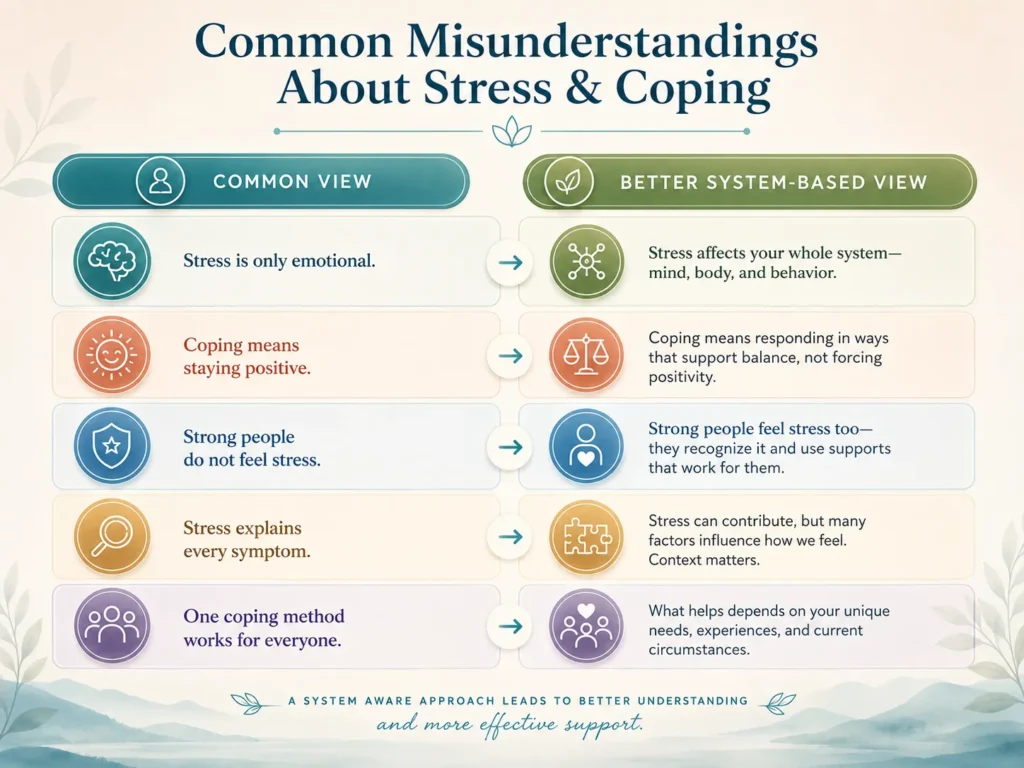
Common Misunderstandings About Stress & Coping
| Common View | Better System-Based View |
|---|---|
| Stress is only emotional. | Stress may involve emotions, body signals, sleep, attention, muscles, and recovery demand. |
| Coping means staying positive. | Coping means responding to stress in safer and more flexible ways. |
| Strong people do not feel stress. | Everyone can experience stress, especially under repeated demand. |
| Stress explains every symptom. | Symptoms may involve many systems and should not be explained by stress alone. |
| One coping technique works for everyone. | Coping depends on stress load, support, sleep, history, health, and environment. |
One common misunderstanding is that stress is only a mental issue. However, stress may affect the body, sleep, attention, muscles, energy, and emotional state. Therefore, Stress & Coping should be understood as a whole-system topic rather than a simple mindset problem. This helps readers avoid blaming themselves when stress feels physical.
Another misunderstanding is that coping means staying positive. In reality, coping may include rest, boundaries, support, reflection, problem-solving, and professional help when needed. Because of this, coping is not forced optimism. Instead, it is the way a person works with stress while trying to reduce overload. Therefore, stress coping tips should be realistic, safe, and flexible.
Many readers also believe one coping method should work for everyone. However, stress patterns are shaped by health, sleep, life history, environment, support, and current demand. Therefore, coping should be understood with flexibility. What helps one person may not be enough for another person. This is why coping techniques for stress should be presented as educational options, not universal instructions.
Related Condition Connections
Some readers may arrive at this topic because they are trying to understand symptoms, not only stress. Therefore, it is important to clarify that Stress & Coping should never be used to diagnose conditions or explain every symptom. Instead, it may help readers understand one possible layer of body-wide stress, coping, and nervous system demand.
For example, Peripheral Neuropathy may involve tingling, numbness, burning feelings, weakness, or sensory changes. Stress may influence comfort, coping ability, sleep quality, and attention. However, Stress & Coping does not explain the medical causes of neuropathy. Therefore, readers should use this connection only as educational context, not as a replacement for medical evaluation.
Likewise, Diabetic Neuropathy involves important metabolic and medical factors that require professional care. Although stress may affect daily coping and quality of life, it is not a substitute for diabetes management or medical evaluation. Because of this, Stress & Coping should be presented as a supportive learning topic, not a diabetes or neuropathy treatment page.
Similarly, Nerve Compression, Sciatic Nerve Pain, and Post-Injury Nerve Damage may involve physical and structural factors. Stress may influence muscle tension, sleep, attention, and coping capacity. However, it should not be used as the main explanation for these conditions. Therefore, this section connects condition pages safely while avoiding diagnosis, treatment, or oversimplified claims.
Topic Cluster Placement
Stress & Coping belongs inside the Human Systems cluster because it explains how stress response, emotional load, coping behavior, sleep rhythm, social support, and recovery windows may influence nervous system education. Therefore, this page supports broader understanding rather than focusing on a single symptom or diagnosis. It also strengthens the Human Systems cluster after Emotional Regulation.
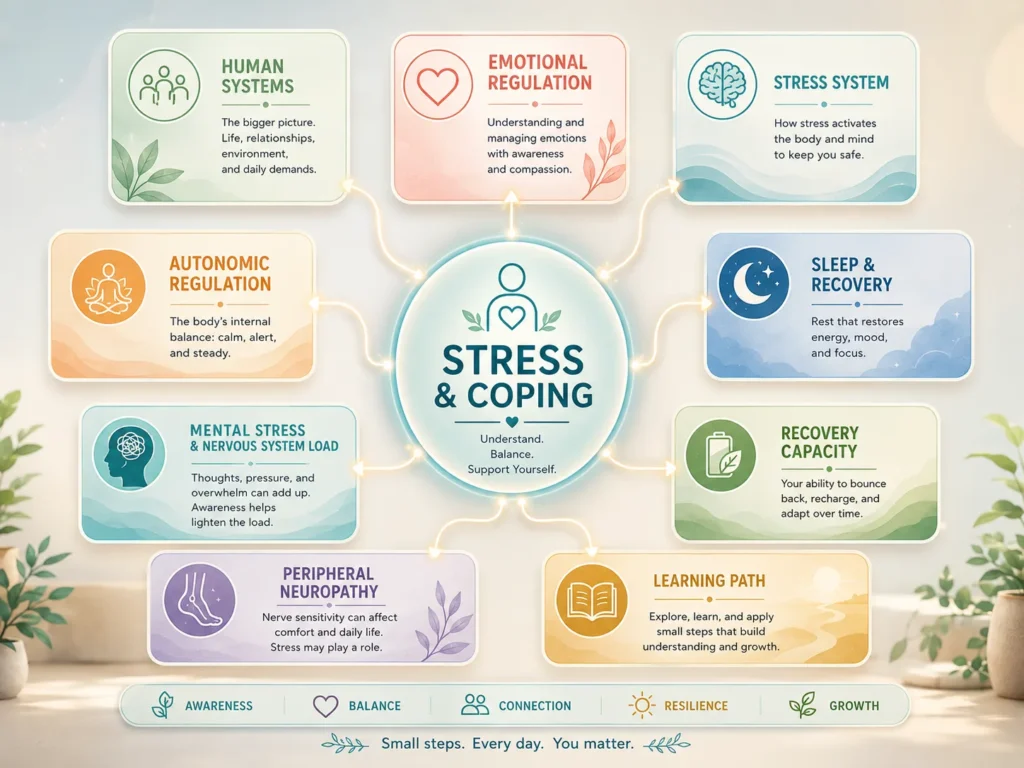
The parent page should be Human Systems. Meanwhile, supporting pages may include Emotional Regulation, Trauma Integration, Behavior Change, Meaning & Purpose, and Motivation. Together, these topics help readers understand how stress, emotions, habits, identity, purpose, motivation, and support may influence recovery capacity and nervous system stability. This creates a stronger internal learning path for visitors.
In addition, this page should connect naturally with Stress System, Autonomic Regulation, Mental Stress and Nervous System Load, Sleep & Recovery, and Recovery Capacity and Nervous System Resilience. These related systems help readers move from stress education toward broader body-system learning. Because of this, Stress & Coping can act as a bridge between emotional education, nervous system education, and recovery-capacity education.
Stress & Coping FAQ
What is Stress & Coping?
Stress & Coping refers to the way the body responds to demand and the way a person manages that response. Stress may involve emotions, thoughts, body signals, sleep, attention, and energy. Coping is the pattern used to respond to that stress. Therefore, stress and coping should be understood together rather than separately. This page explains the topic as education, not diagnosis or treatment.
What are stress coping strategies?
Stress coping strategies are patterns that may help a person respond to stress with more awareness and less overload. They may include rest, support, boundaries, safer communication, realistic pacing, and professional help when needed. However, stress coping strategies should not be presented as guaranteed solutions. Instead, they should be understood as possible supportive patterns that may help reduce system demand.
What are coping mechanisms for stress?
Coping mechanisms for stress are the ways people manage pressure, emotions, thoughts, and body reactions. Some mechanisms may help in the short term but increase stress over time, such as avoidance or overworking. Others may support recovery more safely, such as rest, support, reflection, and healthy routines. Therefore, coping mechanisms should be understood by looking at both short-term relief and long-term system load.
What are coping skills for stress?
Coping skills for stress may include noticing body signals, naming emotions, taking pauses, asking for support, setting limits, organizing tasks, and seeking professional help when distress is severe. These skills are not medical treatments. Instead, they are educational examples of how a person may respond to stress with more awareness. Because each person is different, coping skills should be adapted carefully and safely.
Are coping techniques for stress the same for everyone?
No. Coping techniques for stress are not the same for everyone because stress patterns are shaped by health, sleep, support, life history, trauma, environment, and current responsibilities. A technique that helps one person may not help another. Therefore, this page avoids one-size-fits-all advice. Instead, it explains Stress & Coping as a system that may look different in different lives.
Can stress affect the nervous system?
Yes, stress may influence nervous system alertness, breathing rhythm, muscle tension, sleep quality, attention, and recovery demand. However, stress should not be used as the only explanation for nerve symptoms, pain, numbness, tingling, or weakness. If symptoms are sudden, severe, worsening, or unusual, medical evaluation is important.
Is stress the cause of nerve pain?
No. Nerve pain can have many causes, including nerve injury, diabetes, compression, inflammation, circulation issues, autoimmune activity, medication effects, and other medical factors. Stress may influence coping, attention, sleep, and sensitivity, but it should not replace medical evaluation. Therefore, Stress & Coping should be used only as an educational support topic.
Continue Learning
Readers who want to continue learning can explore Human Systems to understand how emotions, cognition, behavior, motivation, purpose, stress, and social experiences may interact with nervous system education. This parent cluster helps connect human behavior with body-wide learning in a calm and structured way.
For deeper stress education, continue with Stress System and Mental Stress and Nervous System Load. These pages explain how body-wide stress patterns may influence recovery capacity, alertness, and nervous system regulation. Together, they help readers understand stress and coping with stress from both root-cause and human-systems perspectives.
To explore body rhythm and automatic response, continue with Autonomic Regulation. This topic explains how alertness, rest, digestion, heart rhythm, and recovery may connect with stress response. In addition, readers interested in recovery can continue with Recovery Capacity and Nervous System Resilience to understand recovery windows, adaptability, and system stability.
For a structured educational journey, continue with Learning Path and explore related systems step by step. This helps visitors move from symptoms and stress language toward safer body-system education, condition awareness, root-cause understanding, and recovery concepts without jumping to diagnosis or treatment claims.
Sources / References
The sources below were used as general educational references for this Stress & Coping page. They help explain stress, coping, mental health, sleep, body response, and emotional well-being in simple public-health language. However, these sources are not used to diagnose symptoms or give personal medical advice.
MedlinePlus — Stress explains how stress can affect both the brain and body. It is useful for understanding how pressure may connect with alertness, body tension, sleep, and stress response. Therefore, it supports the page’s explanation of Stress & Coping as a body-wide process.
CDC — Coping with Stress gives simple public-health guidance about managing stress in daily life. It discusses breaks, connection, relaxation, and support. As a result, it supports the practical examples in this page without turning them into medical instructions.
NIMH — Caring for Your Mental Health explains basic ways people can care for mental well-being, including sleep, movement, connection, and professional support when needed. In addition, it supports the page’s safe message that coping is part of well-being, not a replacement for care.
NINDS — Brain Basics: Understanding Sleep explains why sleep matters for brain and body function. This source supports the connection between stress, sleep rhythm, recovery capacity, and nervous system stability. Because sleep and stress often influence each other, this reference is useful for the Sleep and Recovery sections.
NCCIH — Stress explains stress as a physical and emotional reaction to life challenges. It also describes how the body may respond through breathing, heart rate, blood pressure, and muscle tension. Therefore, it supports the page’s discussion of stress load and body-based stress response.
Cleveland Clinic — Stress gives a user-friendly overview of stress, symptoms, and stress management. It is helpful for explaining how stress may affect daily comfort, energy, sleep, and emotional well-being. However, the page still avoids treatment claims and keeps the information educational.
American Psychological Association — Stress Effects on the Body explains how stress may affect multiple body systems. This source supports the page’s system-based view that stress may interact with the body, rather than staying only in the mind. Therefore, it fits the Human Systems approach of this article.
Author / Editorial Trust Note
This article was created by Heal Your Nerves Naturally for educational purposes. It was written using safety-focused language, non-diagnostic wording, and system-based education principles. The content is designed to help readers understand Stress & Coping within the context of nervous system education.
No diagnosis, treatment, cure, or prevention claims are made. Furthermore, this article should not replace medical advice, mental health care, or professional assessment. Readers should speak with qualified professionals for personal medical, neurological, or mental health concerns.
Educational Trust Note
Heal Your Nerves Naturally provides educational information about nerve health, nervous system regulation, recovery capacity, body systems, and long-term learning. The purpose is to help readers understand complex topics in a calm, structured, and accessible way.
Therefore, this page focuses on education rather than treatment. Readers are encouraged to use this information as a learning resource while seeking qualified professional care for personal medical or mental health concerns.
Safety & Education Notice
This page is for educational purposes only. It does not diagnose, treat, cure, or prevent disease. It is not a substitute for professional medical advice, diagnosis, or treatment.
Seek urgent medical care for severe, sudden, unusual, or worsening symptoms, including sudden weakness, loss of bladder or bowel control, chest pain, difficulty breathing, severe numbness, severe pain, or rapidly changing neurological symptoms.
Because this topic involves stress, emotional well-being, mental health, nervous system activity, and potentially sensitive personal experiences, readers should not use this information to self-diagnose, stop medication, delay professional care, or replace qualified mental health support.
If emotional distress includes thoughts of self-harm, feeling unsafe, severe panic, trauma crisis, or inability to function in daily life, seek immediate professional help or emergency support.