
Gut–Nerve Axis
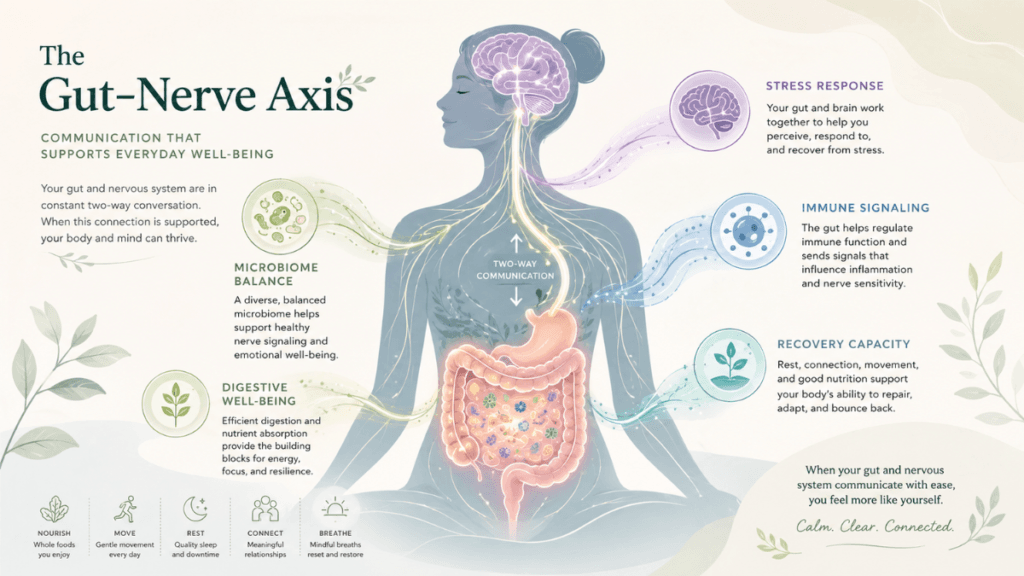
The Gut–Nerve Axis helps explain how digestion and the nervous system communicate with each other. It brings together several important body systems, including gut signaling, microbiome balance, immune activity, nutrient absorption, inflammation, stress response, circulation, and nervous system regulation.
However, this page does not describe the gut–nerve connection as a diagnosis. Instead, it presents the Gut–Nerve Axis as a body-wide educational system that may help explain how digestion, nerves, metabolism, inflammation, stress, and recovery capacity can interact.
The gut and nervous system are closely connected. In fact, they communicate constantly through nerves, hormones, immune signals, and chemical messengers. Because of this, changes in digestion, stress levels, food tolerance, immune activity, or recovery demand may influence how the body processes signals.
For example, when the digestive system is under stress, the nervous system may become more alert. At the same time, nervous system stress may influence digestion, appetite, gut movement, and sensitivity. This two-way communication shows why the gut–nerve relationship should be understood as a connected system, not as one isolated issue.
For nerve-related education, the Gut–Nerve Axis can be viewed as one helpful lens for exploring sensitivity, fatigue, discomfort, regulation, and whole-body resilience. Therefore, understanding this connection may help users see how digestive patterns, stress response, immune balance, and recovery capacity may work together within the body.
Quick Navigation
What is the Gut–Nerve Axis?
The Gut–Nerve Axis is a communication network that connects the digestive system with the nervous system. It includes several important layers, such as gut movement, immune signaling, microbiome activity, nutrient absorption, stress response, and nerve communication. In simple terms, this axis helps explain how the gut and nervous system exchange information throughout the body.
The gut does more than break down food. In addition, it acts as a signaling hub that sends messages to the brain and nervous system. These messages may travel through chemical messengers, hormones, immune pathways, and nerve pathways. For example, changes in digestion, nutrient availability, or gut comfort may influence how the body responds to appetite, energy, mood, stress, and internal balance.
A Two-Way Communication System
A helpful way to understand the Gut–Nerve Axis is to think of it as a two-way messaging system. The gut sends information upward to the brain and nervous system. At the same time, the nervous system sends instructions back to the gut and other body systems. When these messages are clear and balanced, the body may regulate digestion, energy, comfort, and stress response more smoothly.
However, when the system is repeatedly stressed by poor sleep, emotional pressure, digestive discomfort, inflammation, irregular routines, or environmental load, the signals may become more reactive. As a result, the body may become more sensitive to internal sensations, discomfort, fatigue, or stress-related changes.
Why This Matters for Nerve Education
For nerve-related education, the Gut–Nerve Axis matters because nerves depend on steady support. They need energy, nutrients, circulation, immune balance, and stable regulation. Therefore, gut–nerve communication may influence how the body responds to sensitivity, discomfort, fatigue, stress, and recovery demand.
At the same time, it is important not to oversimplify this connection. Gut–nerve patterns may interact with anxiety, low mood, digestive discomfort, fatigue, and body-wide sensitivity, but they should not be used as a self-diagnosis. Instead, the Gut–Nerve Axis can be understood as one educational lens for exploring how digestion, nervous system regulation, immune activity, and recovery capacity may work together.
How the Gut–Nerve Axis Works
First, the digestive system receives many types of inputs throughout the day. These include food, fluids, stress signals, daily routines, sleep patterns, emotional pressure, and environmental cues. Together, these inputs help shape how the gut responds, how smoothly digestion works, and how the body communicates internal needs.
Next, the gut begins processing these inputs through several connected steps. It breaks down food, absorbs nutrients, moves contents through the digestive tract, and interacts with the microbiome. In addition, the gut works closely with immune signaling, which helps the body respond to irritation, imbalance, or outside stressors.
At the same time, the nervous system monitors what is happening inside the gut. It tracks comfort, stretch, pressure, inflammation, fullness, bloating, and internal balance. Because of this ongoing monitoring, the gut can send signals that may influence mood, stress response, energy levels, immune activity, and sensitivity.
In addition, the nervous system can also change digestion. For example, emotional stress, tension, poor sleep, or heightened alertness may influence gut movement, appetite, comfort, and digestive rhythm. As a result, digestion and nervous system regulation often affect each other in both directions.
Over time, repeated digestive stress, inflammation, nutrient imbalance, poor recovery, or constant nervous system activation may influence the wider body system. For this reason, the Gut–Nerve Axis should be understood as an interconnected communication network, not as one isolated digestive issue.
Instead, this system-based view helps explain how digestion, stress response, immune activity, energy regulation, and nerve sensitivity may work together. Therefore, understanding the Gut–Nerve Axis can support a clearer, calmer, and more balanced way to learn about whole-body regulation.
Key Layers of the Gut–Nerve Axis
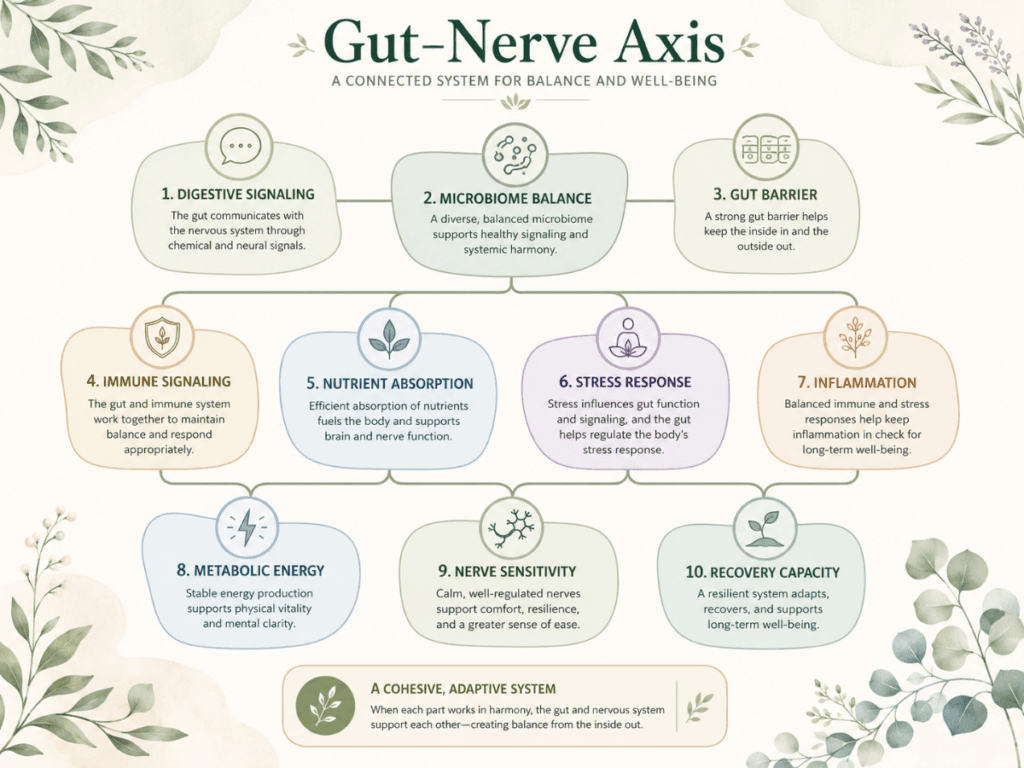
1. Digestive Signaling
Digestive signaling refers to the way the gut communicates with the nervous system during eating, digestion, movement, and comfort.
For example, the gut may signal fullness, bloating, hunger, irritation, urgency, or discomfort. These signals help the body understand internal conditions.
When digestive signaling becomes more reactive, the nervous system may become more alert to internal sensations. This may influence body awareness, discomfort, stress response, and nerve-related sensitivity.
2. Microbiome Balance
The microbiome refers to the community of microorganisms living in the gut. This community interacts with digestion, immune activity, nutrient processing, and chemical signaling.
A balanced microbiome may support smoother communication between the gut and the rest of the body. However, changes in routine, stress, diet patterns, illness, medications, or poor sleep may influence microbiome patterns.
This does not mean the microbiome is the only cause of nerve sensitivity. Instead, it is one layer of the Gut–Nerve Axis that may interact with inflammation, metabolism, stress, and recovery.
3. Gut Barrier and Immune Signaling
The gut barrier helps separate the inner digestive space from the rest of the body. It also helps manage what is absorbed and how the immune system responds.
When the gut is repeatedly irritated or stressed, immune signaling may become more active. This may influence inflammation, fatigue, body sensitivity, and recovery demand.
The Gut–Nerve Axis matters here because immune signals can communicate with the nervous system. Therefore, gut-related immune activity may become part of wider system regulation.
4. Nutrient Absorption and Energy Support
The body needs nutrients to support nerve function, tissue repair, energy production, and cellular regulation. Digestion and absorption help make these resources available.
If digestive patterns are irregular, the body may have more difficulty maintaining stable energy and recovery support. This may influence fatigue, resilience, and sensitivity over time.
Nutrition should not be framed as a cure. However, nutrient availability can be understood as an important support layer within the Gut–Nerve Axis.
5. Stress and Gut Motility
Stress can influence gut movement. Some people notice faster digestion, slower digestion, bloating, appetite changes, nausea, or discomfort during stressful periods.
This happens because the nervous system helps regulate digestive movement. When the body is alert, digestion may shift away from calm, steady processing.
At the same time, gut discomfort can increase stress. This creates a two-way relationship between the Stress System and the Gut–Nerve Axis.
6. Inflammation and Sensitivity
Inflammation is part of the body’s protective and repair system. In the gut, inflammatory signaling may occur in response to irritation, infection, immune activity, food-related stress, or other burdens.
When inflammation is repeated or poorly resolved, the nervous system may become more responsive to body signals. This may contribute to sensitivity, fatigue, or discomfort.
This does not mean inflammation is always harmful. Instead, balance and resolution matter within the Gut–Nerve Axis.
7. Recovery Capacity and Regulation
The Gut–Nerve Axis depends on recovery. Sleep, steady routines, calm digestion, hydration, movement, stress regulation, and adequate nourishment may all support system balance.
When recovery capacity is lower, the gut and nervous system may become more reactive to ordinary inputs. A normal meal, busy day, poor sleep, or emotional stress may feel more demanding.
For this reason, the Gut–Nerve Axis should be understood through regulation, rhythm, and recovery capacity—not fear-based thinking.
Gut–Nerve Axis Interactions
Gut–Nerve Axis and Nervous System
The gut and nervous system communicate in both directions. The gut sends internal signals, while the nervous system helps regulate digestion, movement, and sensitivity.
When the nervous system is highly alert, digestion may become more reactive. At the same time, gut discomfort may increase nervous system alertness.
This two-way relationship helps explain why digestion and nerve sensitivity may appear connected in some patterns.
Gut–Nerve Axis and Stress System
Stress may influence appetite, digestion, gut movement, breathing, muscle tension, and body awareness. These changes may affect gut comfort and signaling.
At the same time, gut discomfort, bloating, urgency, or food uncertainty may increase stress. As a result, stress and digestion may form a repeating cycle.
This does not mean stress is the only explanation. Instead, stress is one system that may interact with gut–nerve communication.
Gut–Nerve Axis and Metabolic System
The metabolic system depends on energy intake, digestion, absorption, blood sugar regulation, and cellular energy production. The gut is an important entry point for these processes.
If gut function is under stress, energy regulation may become less steady. At the same time, metabolic stress may influence digestion, fatigue, and recovery capacity.
For this reason, the Gut–Nerve Axis connects closely with metabolic education and energy balance.
Gut–Nerve Axis and Nutritional System
The nutritional system is directly connected to digestion and absorption. Nutrients help support nerves, immune balance, tissue repair, and energy production.
However, nutrition should not be presented as a one-size-fits-all solution. Food patterns can affect people differently depending on digestion, stress, sleep, medical history, and tolerance.
The Gut–Nerve Axis helps frame nutrition as system support, not as a quick cure or rigid protocol.
Gut–Nerve Axis and Circulatory System
Circulation supports digestion by delivering blood flow to the gut and carrying absorbed nutrients throughout the body.
Stress, dehydration, low movement, or recovery burden may influence circulation patterns. At the same time, circulation helps support gut tissue, nerve function, and recovery demand.
This connection shows that digestion does not work alone. It depends on delivery, clearance, and whole-body regulation.
Gut–Nerve Axis and Inflammatory System
The gut contains a large immune interface. This means gut activity and inflammatory signaling may be closely connected.
When the immune system becomes more reactive, the nervous system may also receive stronger signals. This may influence sensitivity, fatigue, and general body awareness.
Inflammation should not be viewed only as a problem. It is part of protection and repair, but balance matters.
Gut–Nerve Axis and Regeneration Systems
Regeneration systems require energy, nutrients, sleep, circulation, immune balance, and nervous system stability. The gut may influence several of these support layers.
For example, digestion helps provide materials for repair. Meanwhile, gut discomfort or inflammation may increase recovery demand.
This is why the Gut–Nerve Axis can support a wider understanding of repair, adaptation, and long-term resilience.
Patterns That Influence the Gut–Nerve Axis
Daily patterns can strongly influence how the Gut–Nerve Axis behaves. These patterns do not diagnose a disease. Instead, they help explain how digestion, stress response, nervous system alertness, and sensitivity may become connected over time.
For example, the gut may respond differently when meals are irregular, sleep is poor, stress is high, or recovery time is limited. At the same time, gut discomfort may increase worry, which can further influence digestion and body sensitivity.
Common patterns may include:
- Irregular meal timing
- Limited food variety or low fiber diversity
- Poor hydration
- Eating quickly or while stressed
- Poor sleep or inconsistent sleep timing
- High stress without recovery breaks
- Low movement variety
- Frequent digestive discomfort
- Food fear or repeated food restriction
- High caffeine or stimulant load
- Repeated antibiotic exposure or recent illness
- Environmental changes or travel
- Low recovery time after illness, stress, or overwork
Daily Routine Patterns
First, irregular meal timing may make digestion feel less predictable. When the body does not have a steady routine, appetite, energy, and digestive rhythm may become more reactive.
In addition, limited food variety may reduce the range of nutrients and fibers available to the gut. This does not mean every person needs the same diet. However, variety can be one helpful educational factor when thinking about gut–nerve communication.
Poor hydration may also influence digestive comfort. For instance, low fluid intake may affect stool movement, gut rhythm, and general body comfort. As a result, the digestive system may feel slower or more sensitive.
Stress, Sleep, and Food Relationship
Eating quickly or eating during stress can also affect the gut. When the nervous system is highly alert, digestion may not feel as calm or steady. Therefore, rushed meals, work pressure, or emotional stress may influence gut movement, appetite, and comfort.
Sleep is another important pattern. When sleep is poor or irregular, the body may have less time for repair and regulation. Over time, this may influence digestion, stress tolerance, energy balance, and nerve sensitivity.
Movement patterns may also matter. A very sedentary routine may reduce movement variety and circulation support. On the other hand, gentle daily movement may help the body shift between activity, digestion, and recovery more smoothly.
In addition, frequent digestive discomfort can create a feedback loop. Bloating, gas, urgency, or abdominal discomfort may increase worry. As a result, that worry may activate the nervous system, which may then influence gut rhythm and sensitivity again.
Food fear or repeated restriction may also place stress on the system. Instead of creating a calm relationship with eating, strict avoidance patterns may increase worry around food choices. For this reason, gut–nerve education should avoid fear-based food rules.
Caffeine, stimulants, illness history, antibiotics, travel, and environmental changes may also influence the Gut–Nerve Axis. However, these factors affect people differently, so they should be understood as patterns, not automatic causes.
Why Pattern Thinking Matters
For example, someone may eat lunch quickly while working, sleep poorly, feel stressed, and later notice more bloating or digestive sensitivity. Over time, this repeated pattern may influence digestion, energy, inflammatory signaling, nervous system alertness, and recovery demand.
Therefore, pattern thinking is important. The goal is not to blame one food, one habit, or one symptom. Instead, the goal is to understand how daily routines, stress load, digestion, sleep, movement, and recovery may interact within the wider Gut–Nerve Axis.
Gut–Nerve Axis and Nerve Function
The Gut–Nerve Axis may connect with nerve function through several important body systems. These include nutrient availability, inflammation, immune signaling, energy balance, stress response, circulation, and nervous system regulation. Together, these layers help explain why digestion and nerve sensitivity may sometimes appear connected.
Nerves need steady support to function well. For example, they depend on energy, nutrients, oxygen, circulation, immune balance, and a stable internal environment. When digestion, nutrient absorption, inflammation, or stress response are under pressure, the nervous system may become more alert. As a result, nerve sensitivity may become part of a wider body-wide response.
During periods of digestive stress or systemic overload, some people may notice tingling, burning, fatigue, discomfort, body-wide sensitivity, or changes in sensation. However, these experiences can have many possible causes. Therefore, they should not be explained by the gut alone or used as a self-diagnosis.
In addition, the Gut–Nerve Axis may influence how the nervous system processes signals from the body. When internal gut signals become stronger or more frequent, the nervous system may become more responsive to other body signals as well. Over time, this may contribute to a pattern of increased awareness, sensitivity, or discomfort.
For this reason, gut–nerve education should stay balanced and careful. The Gut–Nerve Axis can be understood as one helpful educational lens for exploring how digestion, immune activity, stress response, energy balance, and nerve sensitivity may interact. However, it should not be treated as a diagnosis, treatment plan, or complete explanation for every symptom.
Gut–Nerve Axis Visual Flow
Diet / Stress / Routine Pattern
↓
Digestive Signaling and Gut Response
↓
Microbiome / Immune / Barrier Activity
↓
Inflammatory or Metabolic Response
↓
Nervous System Alertness
↓
Nerve Sensitivity or Signal Amplification
↓
Recovery Demand
↓
Repeated Gut–Nerve Cycle
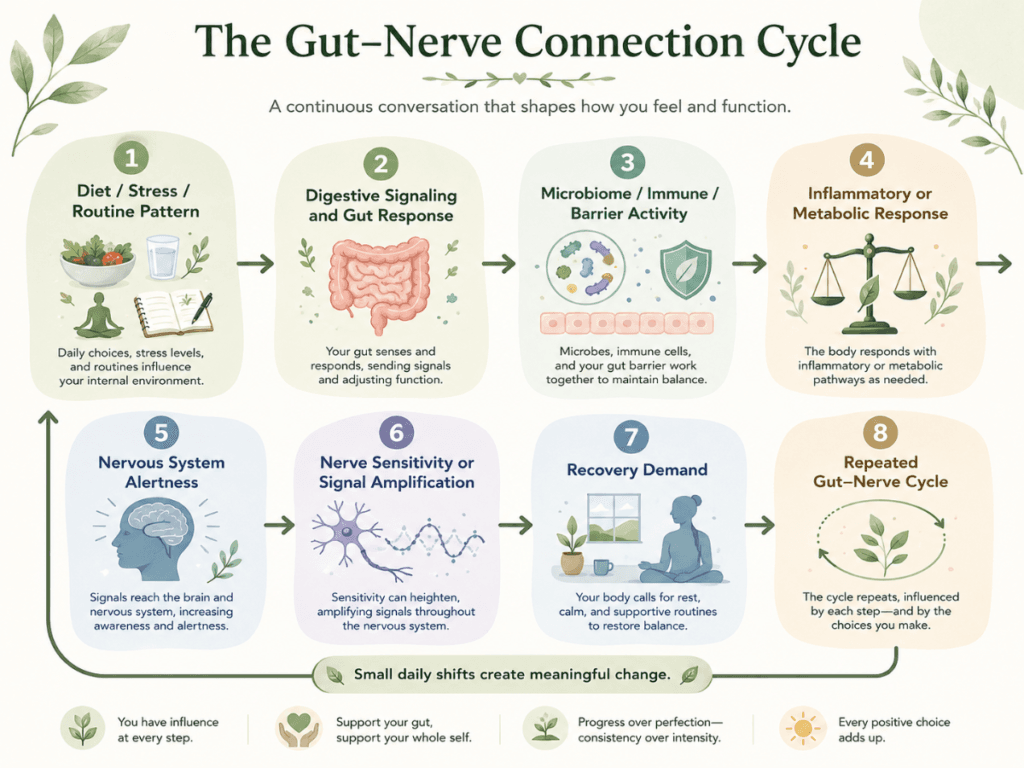
The relationship between the gut and the nervous system is complex and not always straightforward. For example, stress can impact digestion even before a person notices changes in appetite or eating habits. Conversely, feelings of digestive discomfort can increase anxiety, which may then affect breathing, appetite, sleep, and overall muscle tension.
In many instances, the Gut–Nerve Axis operates more like a cycle than a linear pathway. Digestion, immune signaling, stress responses, metabolism, and nervous system sensitivity all interact over time. As a result, stress in one system can place additional demands on another.
For instance, stress may disrupt digestion, leading to increased discomfort, which in turn heightens alertness in the nervous system. This repetitive cycle can eventually influence energy balance, immune signaling, sensitivity, and the demand for recovery.
This is why visual learning techniques, such as simple flow diagrams, can be beneficial. They illustrate that the gut–nerve connection is not solely about food or digestion. Instead, it represents a comprehensive communication network within the body that encompasses digestion, nerve function, immune activity, energy regulation, stress response, and recovery capacity.
Therefore, it is essential to understand the Gut–Nerve Axis as an interconnected system. This perspective helps individuals recognize how various bodily patterns interact without oversimplifying the issue to a single cause.
Why the Gut–Nerve Axis Matters for Recovery
1. Recovery Requires System Balance
Recovery depends on many systems working together. The gut, nervous system, immune system, metabolism, and circulation all contribute to internal balance.
When gut signaling is repeatedly stressed, the body may spend more energy on regulation. This may influence recovery capacity over time.
2. Recovery Requires Nutrient Availability
Nerves and tissues need nutrients for energy production, repair, and regulation. Digestion and absorption help make these resources available.
This does not mean nutrition cures nerve problems. Instead, nutrient availability is one support layer in a larger recovery system.
3. Recovery Requires Inflammatory Balance
The gut and immune system communicate closely. When inflammatory signaling is balanced, the body can protect, repair, and return toward stability.
However, repeated irritation or poor recovery may keep the system more reactive. This may increase body sensitivity and recovery demand.
4. Recovery Requires Nervous System Regulation
The nervous system helps regulate gut movement, digestive comfort, appetite, and stress response. When the nervous system is highly alert, digestion may become less steady.
At the same time, gut discomfort may increase alertness. Therefore, regulation matters in both directions.
5. Recovery May Be Influenced by Repeated Gut–Nerve Stress
One stressful meal, poor night of sleep, or difficult day may not create a lasting issue. However, repeated gut–nerve stress without recovery may increase system demand.
For this reason, the Gut–Nerve Axis should be understood through rhythm, pattern, and resilience rather than fear.
Common Misunderstandings About the Gut–Nerve Axis
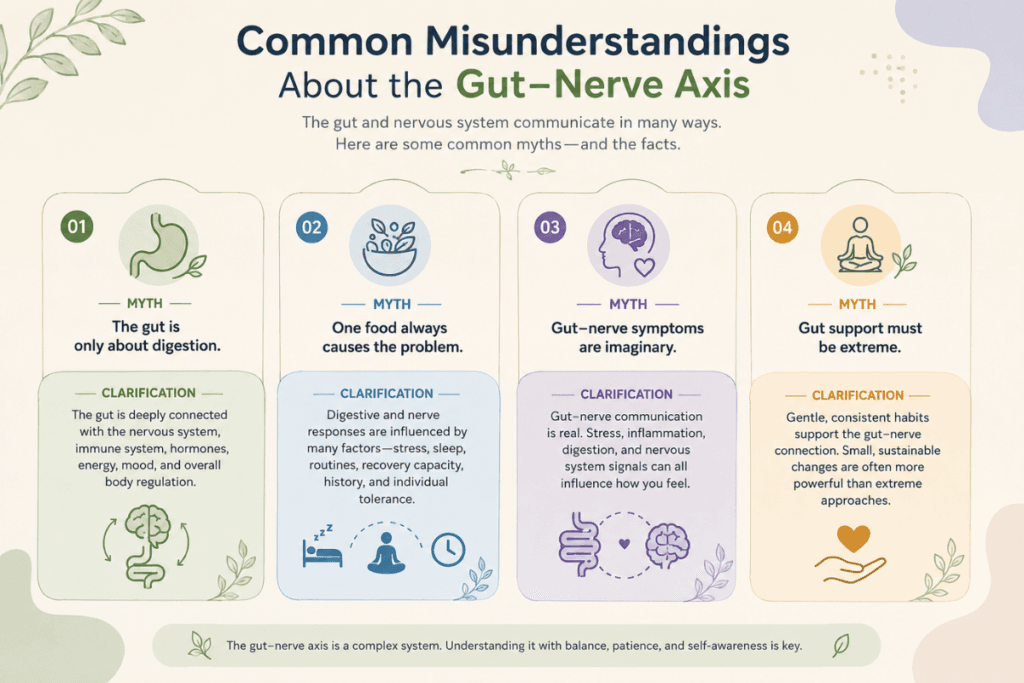
Misunderstanding 1: The gut is only about digestion.
Clarification:
The gut is deeply involved in digestion, but it also interacts with the nervous system, immune system, metabolism, hormones, and recovery capacity.
For this reason, gut health education should not be limited to food breakdown alone. It can also include signaling, regulation, and system balance.
Misunderstanding 2: Gut issues always mean one specific food is the problem.
Clarification:
Food can influence digestion, but gut patterns are rarely explained by one food alone. Stress, sleep, hydration, timing, movement, illness history, and recovery capacity may all matter.
This page does not provide diet rules. Instead, it explains how patterns may influence gut–nerve communication.
Misunderstanding 3: Gut–nerve sensitivity means symptoms are imaginary.
Clarification:
Gut–nerve signals are real body signals. Stress, inflammation, bloating, discomfort, fatigue, and sensitivity can all involve physical communication between systems.
Understanding the Gut–Nerve Axis does not dismiss symptoms. It helps explain how different body systems may interact.
Misunderstanding 4: The microbiome is the only thing that matters.
Clarification:
The microbiome is important, but it is only one layer. Gut movement, immune signaling, stress response, nutrient absorption, circulation, sleep, and recovery capacity also matter.
A system-based view prevents oversimplification and supports better education.
Misunderstanding 5: Gut support must be extreme.
Clarification:
Gut support does not have to mean extreme diets, fear-based restriction, detox claims, or supplement-heavy protocols.
For this website, the Gut–Nerve Axis is explained as education only. Any medical or diet-related decision should be made with a qualified professional when needed.
Continue Learning
To understand the Gut–Nerve Axis more clearly, continue exploring related areas of nerve health education.
Root-Cause Systems
Learn how different body-wide stress systems may interact with nerve sensitivity and recovery capacity.
Stress System
Explore how stress response, nervous system alertness, sleep disruption, and body tension may influence sensitivity.
Metabolic Damage System
Understand how energy regulation, cellular stress, and metabolic patterns may interact with nerve function.
Nutritional Deficiency System
Learn how nutrient availability may support nerve education, cellular repair, and system resilience.
Therapeutic Systems
Explore support-based education around sleep, movement, breathing, digestion, stress regulation, and recovery environments.
Regeneration Systems
Understand how repair, adaptation, tissue remodeling, immune balance, and nervous system stability may support recovery education.
Conditions
Review nerve-related condition pages to understand common patterns and experiences without self-diagnosis.
Learning Path
Follow a step-by-step educational route if you are new to nerve health, root causes, and recovery systems.
Related Systems
Stress System
Stress may influence digestion, gut movement, appetite, breathing, sleep, and body sensitivity. Gut discomfort may also increase stress, making this a two-way relationship.
Metabolic Damage System
Metabolic patterns may interact with digestion, energy availability, blood sugar regulation, fatigue, and nerve sensitivity.
Nutritional Deficiency System
Nutrient availability depends partly on digestion and absorption. This may influence nerve support, energy production, and recovery capacity.
Circulatory Impairment System
Circulation helps deliver nutrients and oxygen while supporting clearance. Gut function and nerve recovery both depend on delivery and regulation.
Inflammatory System
Gut immune activity may interact with inflammatory signaling throughout the body. This may influence sensitivity, fatigue, and recovery demand.
Toxic Load System
Environmental exposures, food quality, illness history, and detoxification burden may interact with digestive and immune stress. This should be discussed carefully without detox claims.
Mechanical Damage System
Mechanical load may interact with gut–nerve patterns through posture, breathing, abdominal tension, movement habits, and stress response.
Regeneration Systems
Regeneration systems require nutrient availability, immune balance, sleep, circulation, and stable regulation. The Gut–Nerve Axis may influence several of these support layers.
Safety & Education Notice
This page is for educational purposes only.
It does not diagnose, treat, cure, or prevent disease. It is not a substitute for professional medical advice, diagnosis, or treatment.
Digestive symptoms, nerve pain, numbness, weakness, tingling, burning, unexplained weight loss, blood in stool, persistent vomiting, severe abdominal pain, fever, fainting, chest pain, severe dehydration, or sudden worsening symptoms can have many possible causes. Seek urgent medical care for severe, sudden, progressive, or worsening symptoms.
This page does not provide diet instructions, supplement advice, detox protocols, fasting guidance, or medical treatment plans. Use it as a learning resource, not as a medical decision tool.