
Brain–Body Integration
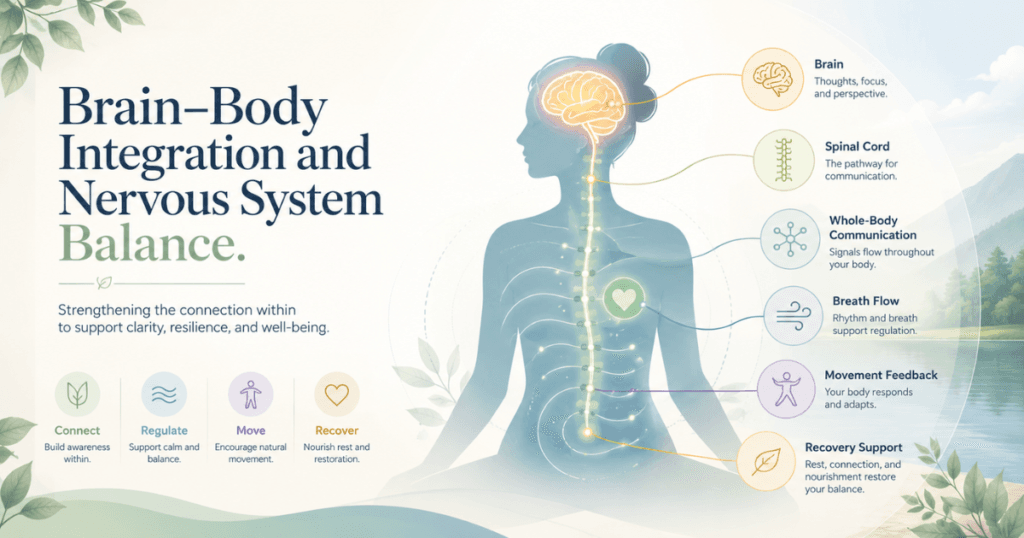
Brain–Body Integration describes how the brain, spinal cord, nerves, organs, movement patterns, stress signals, and internal body messages may work together as one connected system. In simple terms, the brain does not work alone, and the body does not work separately. Instead, both communicate continuously through the nervous system.
This page explains brain–body integration from an educational view. It does not diagnose, treat, cure, or prevent disease. However, it may help readers understand why nerve health, body state, stress load, pain processing, movement, sleep, and recovery capacity are often connected.
The nervous system carries messages between the brain and the rest of the body, and neurons communicate through electrical and chemical signals. These basic communication processes help explain why body sensations, stress responses, movement, and internal regulation can influence how the nervous system responds over time.
Quick Navigation
What Is Brain–Body Integration?
Brain–body integration means the brain and body are constantly sharing information. The brain receives signals from the body. At the same time, the body responds to signals from the brain.
This communication may include sensory input, movement feedback, breathing rhythm, heart rate changes, digestion signals, emotional state, posture load, pain signals, and stress response. Because of this, the nervous system can be understood as a whole-body communication network.
From a system view, brain–body integration matters because nerve function is not only about one nerve. It may also involve how the brain interprets signals, how the body responds to demand, and how the system adapts over time.
For example, a person may notice sensitivity, fatigue, tension, tingling, burning, numbness, or discomfort. These symptoms can have many possible layers. Therefore, this page should not be used to self-diagnose. Instead, it offers a calm educational framework for understanding how systems may interact.
Brain–body integration also connects closely with Neural Signaling, Pain Processing, Autonomic Regulation, and Neuroplasticity.
How Brain–Body Integration Works
Brain–body integration works through ongoing communication between the brain, spinal cord, peripheral nerves, sensory receptors, muscles, organs, and internal regulation systems.
First, the body sends information to the nervous system. This may include touch, pressure, temperature, movement, pain-related signals, internal organ signals, or changes in body state.
Next, the spinal cord and brain help process this information. The brain does not simply receive signals. Instead, it interprets them based on context, memory, attention, stress level, and current body demand.
After that, the brain and nervous system send signals back to the body. These signals may influence movement, muscle tone, breathing rhythm, heart rate, digestion, alertness, or protective responses.
Over time, repeated patterns may shape how the system responds. For example, long-term stress, poor sleep, limited movement, inflammation, or repeated pain signals may influence nervous system sensitivity.
Because of this, brain–body integration is not a single event. It is an ongoing feedback loop. The body informs the brain, and the brain guides the body.
Key Layers of Brain–Body Integration
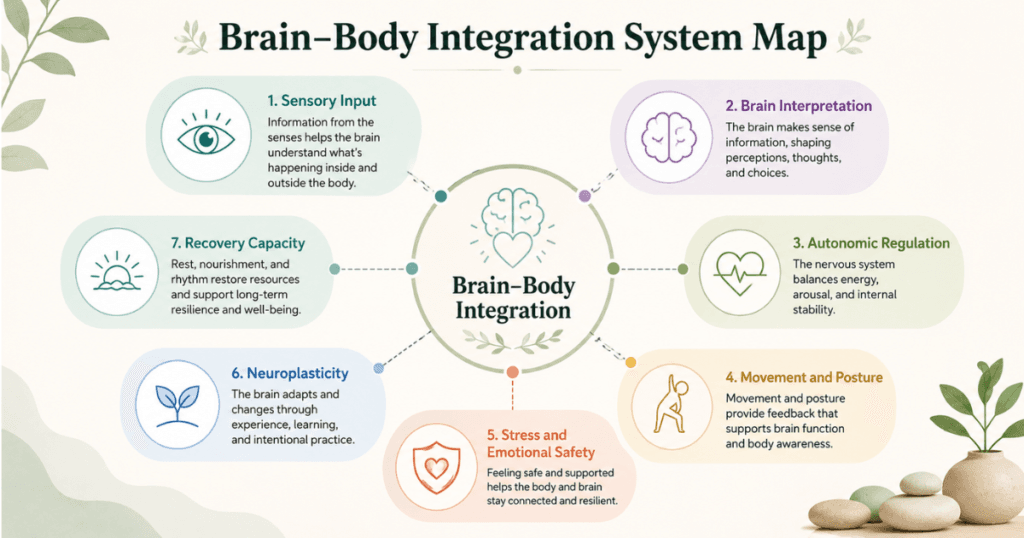
1. Sensory Input Layer
The sensory input layer includes information coming from the skin, muscles, joints, organs, and nerves. This information helps the brain understand what is happening inside and outside the body.
For example, pressure, temperature, stretch, vibration, and pain-related signals may all travel through sensory pathways. Then, the nervous system filters and interprets these signals.
However, sensory input does not always equal damage. Sometimes, the nervous system may become more sensitive to signals. Because of this, sensations may feel stronger, more frequent, or more noticeable.
This connects closely with Pain Processing, because the brain plays an important role in how signals are interpreted.
2. Brain Interpretation Layer
The brain interpretation layer involves how the brain gives meaning to incoming signals. In simple terms, the brain asks, “Is this safe, important, threatening, familiar, or ignorable?”
This process may be influenced by stress, memory, sleep, emotion, attention, inflammation, and previous experiences. Therefore, the same signal may feel different depending on the state of the system.
For example, a mild sensation may feel more intense during high stress or poor sleep. Meanwhile, the same sensation may feel less noticeable when the body feels calmer and supported.
This does not mean the sensation is imaginary. Instead, it means the nervous system is active, adaptive, and context-sensitive.
3. Autonomic Regulation Layer
The autonomic nervous system helps regulate many body functions that happen automatically. These may include heart rate, breathing, digestion, blood pressure, sweating, and body temperature. MedlinePlus and NCBI describe autonomic function as part of body processes that occur without conscious effort.
This layer matters because the body state can influence how safe, alert, tense, or calm the system feels. For this reason, Autonomic Regulation is closely connected to brain–body integration.
When the autonomic system is under load, the body may stay more alert. As a result, sensory signals may feel stronger, and recovery demand may increase.
Still, this does not mean one system is “broken.” It means body regulation and brain interpretation may be interacting.
4. Movement and Posture Layer
Movement and posture provide constant feedback to the brain. Muscles, joints, fascia, and balance systems all send information about body position and load.
For example, prolonged sitting, repetitive movement, poor ergonomics, or limited movement variety may change the type of input the brain receives. Over time, this may influence tension, sensitivity, and body awareness.
However, this should not be understood as a simple cause-and-effect rule. Many factors may shape how movement is felt. Therefore, movement patterns are best understood as one layer within a larger system.
This layer may also connect with Root-Cause Systems such as mechanical load, circulation, stress, and lifestyle patterns.
5. Stress and Emotional Safety Layer
Stress and emotional safety can influence brain–body communication. When the system senses pressure, uncertainty, threat, or overload, the body may shift toward higher alertness.
Because of this, stress may affect muscle tone, breathing rhythm, sleep quality, digestion, and sensory sensitivity. In addition, repeated stress patterns may increase the demand placed on the nervous system.
This does not mean symptoms are “only stress.” Instead, stress is one possible system layer that may interact with many others.
For this reason, brain–body integration should be explained with respect and care. Real symptoms may involve real nervous system responses, even when many factors are involved.
6. Neuroplasticity and Adaptation Layer
Neuroplasticity refers to the nervous system’s ability to change and adapt. This may include changes in signaling, sensitivity, learning, movement patterns, attention, and response habits.
Brain–body integration depends on this adaptive capacity. Over time, repeated experiences may shape how the system filters signals and responds to body input.
For example, repeated protection, pain attention, stress load, or movement avoidance may influence how the system learns. Meanwhile, safer and more varied body experiences may support better system flexibility from an educational perspective.
This connects with Neuroplasticity because adaptation is central to how the brain and body communicate.
7. Recovery Capacity Layer
Recovery capacity describes how well the body may return toward balance after demand. It may involve sleep, nutrition, circulation, stress regulation, inflammation balance, movement rhythm, and rest.
When recovery capacity is limited, the system may have less room to adapt. As a result, normal signals may feel more demanding.
At the same time, better recovery support may help the system manage load more smoothly. However, this is not a treatment claim. It is a system-based educational view.
Brain–body integration matters here because recovery is not just local. It involves whole-system coordination.
System Interactions
Brain–body integration interacts with several nervous system and body systems. These systems do not work in isolation. Instead, they may influence one another through feedback loops.
Nervous System Interaction
The nervous system is the main communication network between the brain and body. It receives signals, processes information, and sends responses.
Because of this, brain–body integration depends on clear nervous system communication. This includes the brain, spinal cord, peripheral nerves, sensory pathways, and autonomic pathways.
Neural Signaling Interaction
Neural Signaling helps explain how nerve cells communicate. Signals may travel through electrical activity and chemical messengers.
When signaling patterns change, the way the brain and body communicate may also change. Therefore, neural signaling is a core part of brain–body integration.
BrainFacts explains that neurons communicate through electrical and chemical signals, including sensory signals, action potentials, and synapses.
Pain Processing Interaction
Pain Processing involves how the nervous system receives, filters, and interprets pain-related signals.
Brain–body integration matters because pain is not only a signal from tissue. It also involves nervous system interpretation, context, attention, and protective response.
Because of this, pain-related sensations may be influenced by stress load, sleep, inflammation, movement patterns, and previous experiences.
Neuroinflammation Interaction
Neuroinflammation may influence how sensitive the nervous system becomes to input. From an educational view, inflammatory signaling may interact with pain processing, fatigue, and body-wide sensitivity.
However, this does not mean inflammation is always the cause of symptoms. Instead, it may be one possible layer in a larger system.
Myelin System Interaction
The Myelin System supports signal insulation and efficient communication along nerve pathways.
Brain–body integration depends on communication quality. Therefore, myelin health is relevant when explaining how signals travel within the nervous system.
Still, this should be discussed carefully. Changes in sensation can have many causes and should not be self-diagnosed.
Neuroplasticity Interaction
Neuroplasticity supports learning and adaptation. It may influence how the brain and body respond to repeated inputs.
Because of this, brain–body integration is not fixed. It may change over time based on repeated patterns, body state, stress load, movement experience, and recovery support.
Autonomic Regulation Interaction
Autonomic Regulation affects automatic body functions such as breathing, heart rate, digestion, and blood pressure regulation.
This matters because body state can shape nervous system sensitivity. For example, high alertness may increase signal awareness, while calmer regulation may support better tolerance.
Metabolic System Interaction
The metabolic system supports energy availability. The brain, nerves, muscles, and organs all require energy to function.
When energy balance is under stress, the nervous system may have less capacity to process input smoothly. Therefore, metabolic patterns may interact with brain–body integration.
Circulatory System Interaction
Circulation supports the delivery of oxygen and nutrients and helps remove metabolic byproducts. Because nerves and tissues depend on delivery and clearance, circulation may influence recovery demand.
This interaction is also connected to Root-Cause Systems and Therapeutic Systems.
Patterns That Influence Brain–Body Integration
Many daily patterns may influence brain–body integration. These patterns do not act alone. Instead, they may build up over time.
Sleep Rhythm
Sleep helps the body restore energy, regulate stress, and process information. Poor sleep may increase sensitivity, fatigue, and nervous system load.
Because of this, sleep rhythm may influence how the brain interprets body signals.
Stress Patterns
Stress patterns may affect breathing, muscle tone, digestion, heart rate, and attention. Over time, repeated stress may keep the system more alert.
This may influence how sensations are noticed and interpreted.
Movement Patterns
Movement gives the brain updated information about the body. Limited movement, repetitive strain, or long static posture may reduce input variety.
As a result, the nervous system may become less flexible in how it processes body signals.
Posture Load
Posture load can influence muscles, joints, breathing, and circulation. However, posture should not be blamed as a single cause.
Instead, it is one part of a larger brain–body pattern.
Breathing Rhythm
Breathing rhythm may influence autonomic state. For example, shallow or tense breathing may be connected with higher alertness.
At the same time, breathing is not a cure or treatment by itself. It is one communication pathway between the body state and the nervous system regulation.
Nutrition Quality
Nutrition quality may support energy balance and general body function. Because the nervous system uses energy, poor nutritional patterns may add stress to the system.
Still, this page does not give diet rules, supplement advice, or protocols.
Hydration
Hydration supports general body function, circulation, and tissue comfort. Mild dehydration may make the body feel more stressed or fatigued.
However, hydration is only one layer and should not be seen as a complete explanation for symptoms.
Circulation
Circulation helps deliver oxygen and nutrients to tissues. It also supports clearance and temperature regulation.
For this reason, circulation may influence how comfortable, resilient, or responsive the body feels.
Inflammatory Load
Inflammatory load may influence sensitivity, fatigue, and body-wide discomfort. Still, inflammation is complex and should not be self-diagnosed.
From a system view, it may interact with stress, sleep, metabolism, and the nervous system processing.
Emotional Safety
Emotional safety can affect the body’s threat response. When the system feels unsafe, it may stay more guarded.
Because of this, emotional state may influence muscle tone, breathing, pain sensitivity, and recovery capacity.
Recovery Capacity
Recovery capacity reflects how much load the body can handle and then return from. If recovery capacity is low, even normal signals may feel more intense.
Therefore, recovery capacity is central to brain–body integration.
Brain–Body Integration and Nerve Function
Brain–body integration may relate to nerve function because nerves help carry information between the brain, spinal cord, and body. This includes sensory signals, movement signals, autonomic signals, and pain-related signals.
When this communication system is under load, the way signals are processed or felt may change. For example, a person may notice tingling, burning, numbness, pain, fatigue, tension, or body-wide sensitivity.
However, brain–body integration should not be described as the direct cause of these symptoms. Symptoms can have many possible causes. Some may require medical evaluation.
Instead, brain–body integration may help explain how body state, stress response, sleep, movement, inflammation, circulation, and signal processing can interact.
Seek urgent medical care for severe, sudden, unusual, or worsening symptoms. This is especially important for sudden weakness, loss of bladder or bowel control, chest pain, difficulty breathing, severe numbness, loss of coordination, sudden vision changes, confusion, fainting, or rapidly changing neurological symptoms.
Brain–Body Integration Visual Flow
Body Signal Input
↓
Sensory and Internal Nervous System Pathways
↓
Brain Interpretation and Context Filtering
↓
Autonomic, Movement, and Stress Response
↓
Sensitivity or Regulation Change
↓
Recovery Demand
↓
Feedback to the Brain and Body
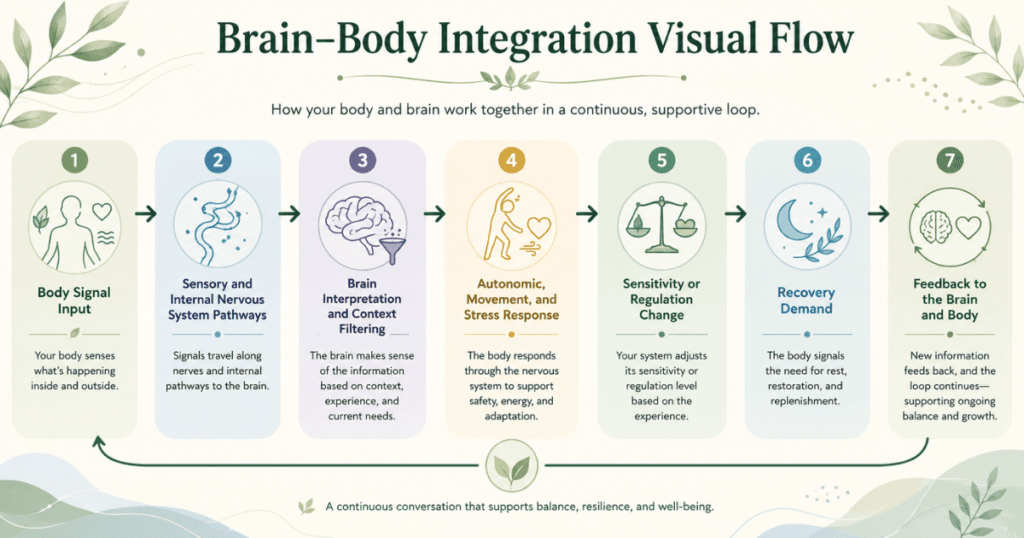
This visual flow is a simple educational model. It shows how the brain and body may communicate through feedback loops.
However, real body processes are not always linear. Many systems may interact at the same time.
Therefore, this model should not be used as a diagnosis. It is a learning tool for understanding how nervous system communication may work from a whole-system view.
Why Brain–Body Integration Matters for Recovery
1. Recovery Requires Communication
Recovery depends on communication between the brain, nerves, tissues, and body systems. The nervous system needs information to adjust movement, regulate body state, and respond to demand.
Because of this, brain–body integration may help explain why recovery is not only about one body part.
2. Recovery Requires Flexible Regulation
A flexible system can shift between activity and rest more smoothly. It can respond to demand and then return toward balance.
When regulation is less flexible, the body may remain more alert or guarded. As a result, the nervous system may have a harder time settling.
3. Recovery Requires Energy Balance
The brain and nerves require energy. Muscles, organs, immune processes, and repair systems also need energy.
Therefore, metabolic balance may influence how much capacity the system has for adaptation and recovery.
4. Recovery Requires Signal Tolerance
Signal tolerance means the nervous system can receive body input without overreacting. This does not mean ignoring symptoms.
Instead, it means the system may become better able to process normal signals without excessive alarms.
5. Recovery Requires Whole-System Support
Brain–body integration shows why recovery is often whole-system. Sleep, stress, movement, nutrition, circulation, inflammation, and emotional safety may all play a role.
Because of this, isolated explanations are often too simple.
6. Recovery Requires Safe Learning
The nervous system learns from repeated experiences. If the body repeatedly experiences overload, the system may become more protective.
Meanwhile, safer and more manageable experiences may support more balanced learning. However, this should not be understood as a treatment protocol. It is an educational concept.
Common Misunderstandings About Brain–Body Integration
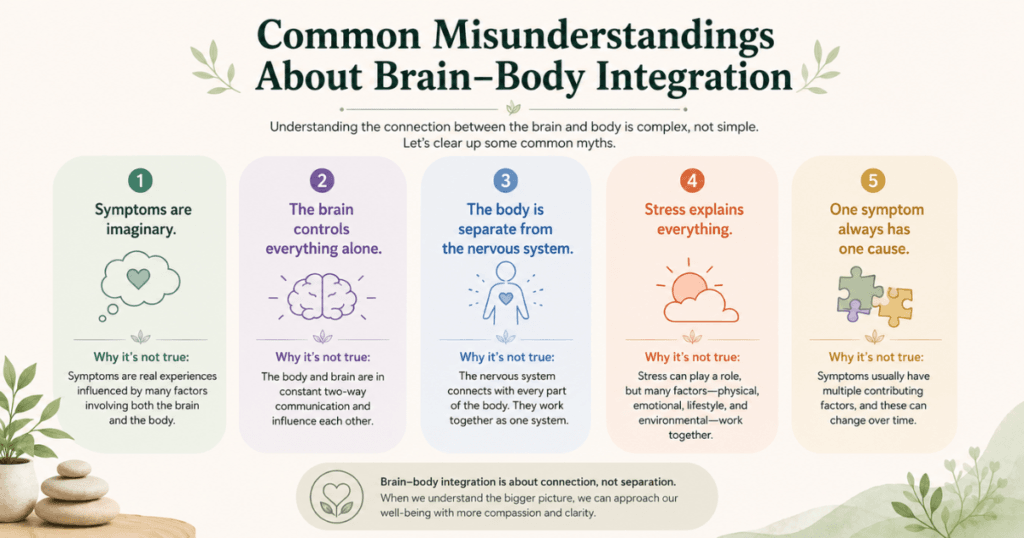
Misunderstanding 1: Brain–Body Integration Means Symptoms Are Imaginary
Clarification:
This is not correct. Brain–body integration does not mean symptoms are fake.
Instead, it means real body sensations may be shaped by nervous system processing, body state, stress load, inflammation, sleep, and context.
Misunderstanding 2: The Brain Controls Everything Alone
Clarification:
The brain is important, but it does not work alone. The body sends constant information back to the brain.
Because of this, body state can influence brain interpretation, and brain interpretation can influence body response.
Misunderstanding 3: The Body Is Separate From the Nervous System
Clarification:
The body and nervous system are deeply connected. Muscles, organs, blood vessels, immune signals, and sensory receptors all communicate with the nervous system.
Therefore, nerve health education should include whole-body patterns.
Misunderstanding 4: Stress Explains Everything
Clarification:
Stress can influence brain–body integration, but it does not explain everything.
Symptoms may involve multiple layers, including nerve signaling, inflammation, circulation, metabolism, tissue load, sleep, and medical conditions.
Misunderstanding 5: Brain–Body Work Is a Quick Fix
Clarification:
Brain–body integration is not a quick fix or treatment promise.
Instead, it is a framework for understanding communication, regulation, and adaptation over time.
Misunderstanding 6: One Symptom Always Has One Cause
Clarification:
Many symptoms can have more than one contributing layer. For example, sensitivity may involve signal processing, stress response, inflammation, sleep quality, and recovery capacity.
Because of this, simple explanations may miss the bigger system picture.
Continue Learning
To understand this topic more deeply, continue with these related pages:
- Learn how nerve cells communicate through Neural Signaling.
- Explore how the nervous system interprets discomfort in Pain Processing.
- Understand system sensitivity through Neuroinflammation.
- Review signal insulation in the Myelin System.
- Learn how the nervous system adapts through Neuroplasticity.
- Study automatic body regulation in Autonomic Regulation.
- Explore broader support layers in Root-Cause Systems, Therapeutic Systems, and Regeneration Systems.
- Follow the full education sequence in the Learning Path.
For general educational background, readers may also explore BrainFacts’ explanation of how neurons communicate and the Cleveland Clinic’s overview of the nervous system.
Related Systems
Neural Signaling
Neural signaling explains how nerve cells send and receive information. It is one of the foundations of brain–body integration because communication depends on signals moving through the nervous system.
When signaling patterns are under load, the body may experience changes in sensitivity, awareness, or response demand.
Pain Processing
Pain processing explains how the nervous system filters and interprets pain-related signals. This is important because pain is not only about signal arrival. It also involves brain interpretation and context.
Therefore, pain processing is closely connected to brain–body integration.
Autonomic Regulation
Autonomic regulation involves automatic body functions such as breathing, heart rate, digestion, and blood pressure regulation.
Because these functions influence body state, they may also influence how the brain interprets signals from the body.
Neuroplasticity
Neuroplasticity explains the nervous system’s ability to adapt and change. Brain–body integration depends on this adaptability.
Repeated patterns may shape how the system responds to stress, movement, pain, and recovery demand.
Neuroinflammation
Neuroinflammation may influence nervous system sensitivity and body-wide response patterns.
From an educational view, it may interact with pain processing, fatigue, sensitivity, and recovery capacity.
Metabolic Damage System
Learn how energy imbalance, oxidative stress, and cellular load may affect nerve sensitivity
Circulatory Impairment System
Circulation supports oxygen and nutrient delivery. Autonomic regulation also influences blood flow and vascular response.
Because of this, they are important support systems within whole-body nerve health education.
Safety & Education Notice
This page is for educational purposes only. It does not diagnose, treat, cure, or prevent disease. It is not a substitute for professional medical advice, diagnosis, or treatment.
Seek urgent medical care for severe, sudden, unusual, or worsening symptoms. These may include sudden weakness, loss of bladder or bowel control, chest pain, difficulty breathing, severe numbness, severe pain, loss of coordination, sudden vision changes, confusion, fainting, irregular heartbeat, sudden severe headache, difficulty speaking, or rapidly changing neurological symptoms.
Because this topic involves medically sensitive nervous system and body-related processes, readers should not use this information to self-diagnose, stop medication, begin supplements, follow detox protocols, attempt self-treatment, force intense exercises, or delay professional care.