
Nerve Recovery Phases: What Happens During Each Stage of Nerve Healing?
When we planned this guide, we started with a simple question: what does a person actually want to know when they search for the stages of nerve healing?
Usually, they are not looking for a list of scientific terms. They are trying to make sense of something happening in real life.
Maybe the pain has improved, but the numbness has not. Maybe the tingling comes and goes. Maybe walking feels easier one day and harder the next. Maybe a doctor has said the nerve needs time, but nobody has explained what “time” means. Or maybe the biggest question is simply: Is this nerve actually healing, and what should I be doing while I wait?
That is the problem this page is designed to solve.
Recovery phasing is our way of organizing nerve recovery into a practical journey. It looks at what may be happening biologically, what a person may notice, what can reasonably be supported at home, what habits may help or get in the way, and when the pattern deserves medical reassessment.
Nerve recovery is rarely a straight line. A nerve can be irritated without being structurally severed. A compressed nerve can behave differently from an axon that has been disrupted. A person with diabetic neuropathy has a different recovery problem from someone recovering after a localized injury. In addition, pain, sensation, strength, balance, and function do not always improve at the same speed.
So we do not treat recovery as a countdown clock. Instead, we use a more useful set of questions:
- What may be happening now?
- What caused the nerve problem in the first place?
- What should be protected?
- What can be supported at home?
- What should be rebuilt gradually?
- What signs suggest useful progress?
- What changes should not be ignored?
Important: This page is for education. It cannot diagnose the type or severity of a nerve problem. New or progressive weakness, rapidly spreading numbness, major trauma, sudden major loss of function, saddle-area numbness, or new bladder or bowel changes need prompt medical assessment.
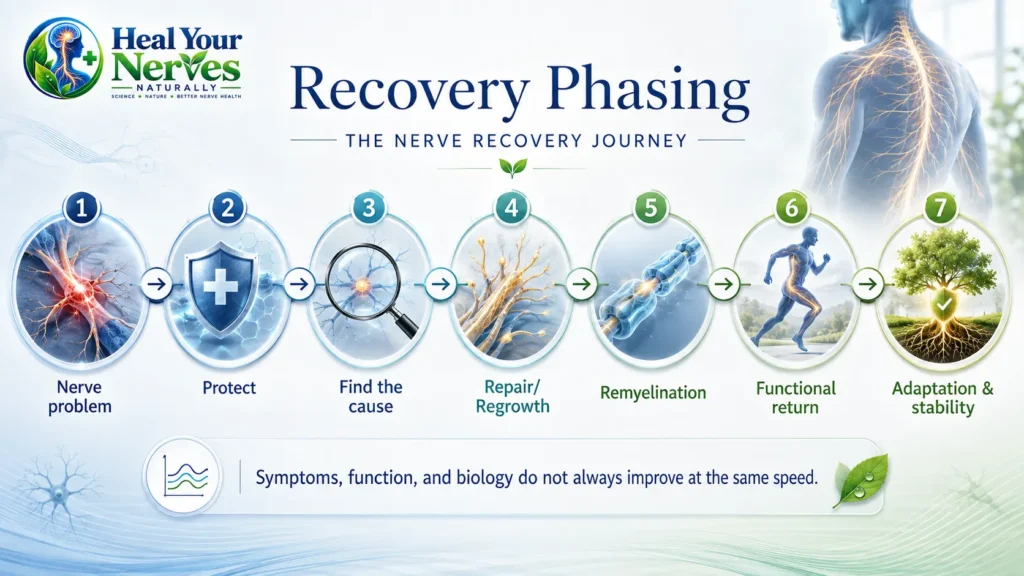
Quick answer: Recovery phasing can be thought of as overlapping goals: protect the nerve, identify and address the cause, allow cleanup and repair, support axonal regrowth where possible, restore myelin and signaling, rebuild function, and then work toward long-term stability.
Recovery Phasing at a Glance: What Are the Stages of Nerve Healing?
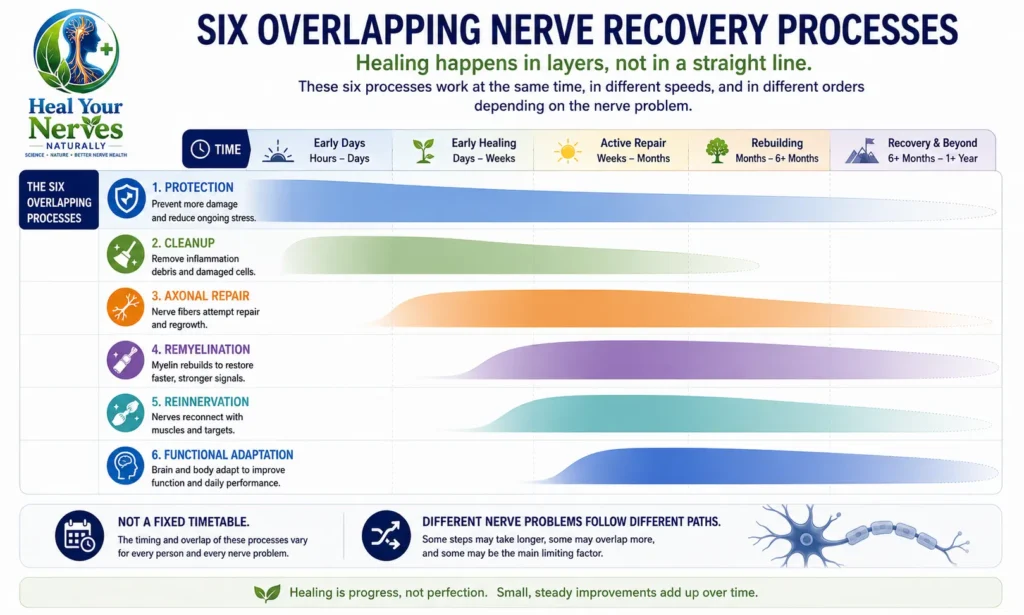
If we had to explain the stages of nerve healing to a family member in two minutes, we would not start with a rigid six-step calendar. We would explain that several processes can overlap.
Recovery Phasing Stage 1: Protect the Nerve and Understand What Happened
The first job is often to reduce avoidable stress and work out what kind of nerve problem is present. A nerve that is temporarily compressed is not the same as a nerve that has suffered major structural damage.
Recovery Phasing Stage 2: Cleanup and Preparation for Repair
If an axon is significantly injured, the damaged portion beyond the injury can break down through a process called Wallerian degeneration. Cells then clear debris and reorganize the local environment.
Recovery Phasing Stage 3: Axonal Regrowth or Reconnection
Where biology allows it, surviving neurons may extend new axonal growth. However, growth is only useful if the regenerating axon reaches an appropriate target.
Recovery Phasing Stage 4: Remyelination and Better Signal Conduction
Peripheral nerves rely on Schwann cells to form myelin. Remyelination can help improve the way electrical signals travel along recovering nerve fibers.
Recovery Phasing Stage 5: Reinnervation and Return of Useful Function
A nerve can be biologically improving while strength, touch, balance, coordination, or endurance still lags behind. The nerve has to reconnect, and the person may also need rehabilitation.
Recovery Phasing Stage 6: Adaptation and Long-Term Stability
Later, the emphasis often shifts toward doing normal things more reliably: walking, working, exercising, sleeping, using the hand, tolerating daily loads, and avoiding repeated irritation.
These are useful nerve recovery phases, not six boxes everyone must pass through on the same schedule.
A mild conduction block can recover very differently from an injury that disrupts the axon. Clinical nerve-injury references also classify injuries by severity because structural damage has a major effect on prognosis. For the technical background, see the NCBI Bookshelf clinical overview of peripheral nerve injury.
For the broader site-level overview, see our Nerve Healing Guide.
Why Recovery Phasing Matters in Real Life
The reason we use a phase-based framework is simple: the right question changes as recovery changes.
Early on, the question might be, “How do I avoid making this worse?”
Later, it may become, “How much movement can I tolerate?”
After that, the problem may be, “Why is my strength still behind even though the pain is better?”
And much later, the real goal may be, “How do I return to normal life without triggering the same problem again?”
What People Are Really Asking About Recovery Phasing
In our view, most recovery searches are decision searches.
People want to know:
- Should I rest or keep moving?
- Is tingling a good sign or a bad sign?
- Why is numbness still there?
- When can I return to work?
- Is exercise helping or irritating the nerve?
- Does food matter?
- Should I take vitamins?
- Is a flare-up normal?
- Why is this taking so long?
- When should I go back to a clinician?
That is why this page does not stop at biology. Each major section connects the science to something a person can actually do, observe, or discuss with a professional.
Why Pain Alone Is Not a Recovery Phasing Score
Pain matters, but it is not the whole nervous system.
A nerve can affect sensation, muscle activation, balance, coordination, temperature awareness, reflexes, and autonomic functions. The NINDS overview of peripheral neuropathy explains that neuropathy can involve sensory, motor, and autonomic nerves, with different patterns depending on the cause and nerve fibers involved.
So instead of asking only, “Is my pain lower?”, we would also ask:
- Is strength stable or improving?
- Is the numb area changing?
- Can I tolerate more activity?
- Am I walking or using my hand better?
- Do flares settle faster?
- Is anything clearly getting worse?
That wider view is far more useful than treating pain as a single recovery meter.
Recovery Phasing Begins With the Cause: What Actually Happened to the Nerve?
One of the biggest mistakes in nerve recovery content is to talk about “nerve damage” as if it were one condition.
It is not.
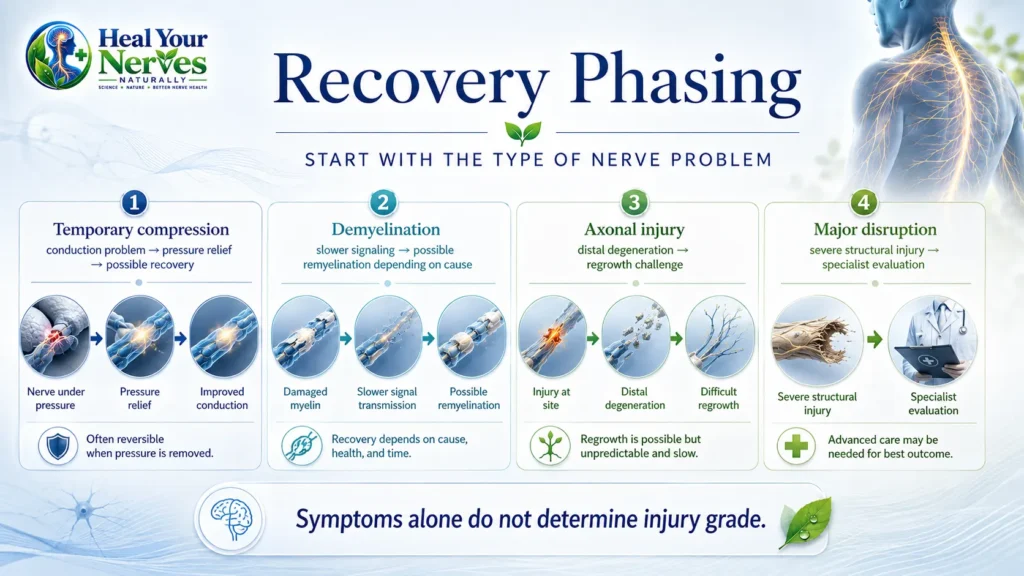
A nerve may be temporarily compressed, mechanically irritated, stretched, bruised, affected by swelling, demyelinated, metabolically injured, partially disrupted, completely severed, or affected by a systemic disease.
That difference matters because it changes the entire recovery pathway.
Recovery Phasing When the Nerve Is Irritated or Compressed
A mild compression can disturb signaling without destroying the axon. If the pressure is removed early enough, recovery may be relatively favorable.
However, a long-standing or severe compression can produce more significant structural injury. That is why persistent numbness or weakness should not be dismissed simply because the original cause “was only compression.”
If posture, position, repetitive pressure, or an entrapment seems to be part of the problem, read our guide to nerve compression and recovery.
Recovery Phasing When the Axon Itself Is Damaged
When the axon is disrupted, the recovery problem becomes more complex. The portion beyond the injury can undergo Wallerian degeneration, and meaningful recovery may depend on regrowth toward the target.
For the deeper biology, see how damaged axons regrow.
Recovery Phasing When Symptoms Are Widespread
If both feet, both hands, or several nerves are involved without one clear local injury, we would not assume this is simply one nerve “healing slowly.”
The more useful question is:
What is continuing to affect the nerves?
That could involve diabetes, nutritional deficiency, medication effects, toxins, autoimmune disease, inherited disorders, or other neurological causes.
Our peripheral neuropathy guide explains the broader pattern.
Recovery Phasing Stage 1: Protection and Early Damage Response
At the beginning, our practical priority would be protect first, interpret second, progress later.
This does not mean complete inactivity. It means avoiding unnecessary stress while the problem is still being understood.
What Might You Notice Early in Recovery Phasing?
Depending on the nerve, symptoms can include pain, burning, tingling, numbness, altered temperature sensation, weakness, clumsiness, poor balance, or reduced tolerance for normal tasks.
The difficult part is that symptom intensity does not tell you exactly how structurally damaged the nerve is.
A lot of pain does not prove that the nerve is severely disrupted. Likewise, a relatively painless numb area can still matter.
What We Would Focus on at Home During Early Recovery Phasing
Habit to review: Look for repeated pressure.
Do you lean on an elbow while working? Does your wrist stay bent while sleeping? Are your shoes tight around a numb area? Do you sit in one position for several hours?
Home safety: Protect reduced sensation.
If part of a hand or foot is numb, check the skin. Look for redness, cuts, blisters, swelling, or pressure marks that you may not feel normally.
Temperature safety: Be careful with heat.
A heating pad or very hot water can cause injury if the area cannot detect temperature properly.
Movement: Avoid repeatedly provoking severe symptoms just to “test” the nerve.
If movement is safe, gentle normal movement may be reasonable. However, the amount should fit the actual diagnosis and any medical restrictions.
What we would not conclude from early tingling
We would not call tingling proof of nerve regeneration.
Tingling can occur with irritation, compression, neuropathy, altered signaling, and recovery. It needs context.
When this stops being a home-monitoring problem
New weakness, rapidly spreading numbness, major loss of function, or severe symptoms after trauma deserve medical assessment.
Recovery Phasing Stage 2: Cleanup and Preparing for Repair
One reason nerve recovery can feel confusing is that important biology may be happening before the person notices obvious functional improvement.
When an axon is significantly injured, the distal portion can undergo Wallerian degeneration. Cellular debris has to be cleared. Schwann cells change their behavior. The local environment reorganizes.
In other words, the body may be doing repair work that does not immediately feel like progress.
Why Schwann Cells Matter in Recovery Phasing
Schwann cells are central to peripheral nerve repair. After injury, they can enter a repair-supporting state and help create pathways that guide regenerating axons.
For a deeper scientific review, see this PubMed Central review of peripheral nerve regeneration.
Does Inflammation Mean Recovery Phasing Is Going Wrong?
Not necessarily.
Short-term inflammatory activity can be part of cleanup and repair. However, persistent disease-driven inflammation is a different problem.
This is where we would be careful not to oversimplify.
If an autoimmune or inflammatory neurological condition is actively damaging nerves, supportive habits are not a substitute for disease-specific medical treatment.
For the regeneration-side context, see inflammation resolution during nerve repair.
Recovery Phasing Stage 3: Axonal Regrowth
This is the stage most people imagine when they hear the phrase “nerve healing.”
The common question is:
Is my nerve growing back?
Peripheral nerves do have regenerative capacity, but that does not mean every damaged nerve fully regrows or that recovery follows a predictable personal clock.
How Fast Can a Peripheral Nerve Regrow During Recovery Phasing?
You may see “about 1 mm per day” used as a rough teaching estimate for certain regenerating peripheral axons.
We would never use that number as a promise.
Functional recovery depends on much more than axonal extension. It also depends on injury grade, the distance to the target, scar tissue, the condition of the neuron, metabolic health, whether surgery was required, and whether the target muscle or sensory structure remains able to reconnect.
The NCBI peripheral nerve injury review discusses approximate growth rates while also emphasizing anatomy and injury severity.
Why Distance Matters in Recovery Phasing
Imagine two similar axonal injuries.
One is close to the muscle it needs to reconnect with. The other is much farther away.
Even if both axons regenerate at a similar rate, the second has a much longer distance to travel. That can make meaningful recovery far slower.
Why Regrowth Does Not Mean Recovery Phasing Is Complete
An axon has to reach an appropriate target. Then the connection has to work. After that, strength, sensation, coordination, and movement patterns may still need retraining.
This is why we separate axonal regrowth from functional recovery.
For a deeper explanation, read how damaged axons regrow.
Recovery Phasing Stage 4: Remyelination and Signal Recovery
Myelin helps many nerve fibers transmit electrical signals efficiently.
In the peripheral nervous system, Schwann cells form myelin. So, even when an axon survives or regrows, signal quality may continue to change as the nerve remyelinates.
Can Strange Sensations Happen During Recovery Phasing?
Yes.
People may report tingling, pins and needles, altered touch, intermittent burning, or a sensation that feels “different” from normal.
However, we would not label one particular sensation as proof of remyelination.
The NINDS peripheral neuropathy overview explains that nerve conduction studies can help evaluate patterns involving axonal damage and myelin abnormalities.
Why Can Pain Improve Before Numbness During Recovery Phasing?
Pain and normal sensation are not the same function.
Different fibers can be affected differently, and they may recover at different rates. A person may therefore feel less pain while touch or temperature sensation remains abnormal.
For a deeper internal guide, read how myelin is rebuilt during nerve recovery.
Recovery Phasing Stage 5: Reinnervation and Functional Recovery
This is where recovery becomes very real.
A person may hear that the nerve is improving and still think:
Then why can’t I use my hand normally?
Or:
Why is walking still tiring?
The answer is that nerve repair and functional recovery are related, but they are not identical.
What Is Reinnervation in Recovery Phasing?
Reinnervation means recovering nerve fibers reconnect with target tissues, such as muscles or sensory structures.
Why Weakness Can Remain During Recovery Phasing
A muscle may have been partly denervated or underused. The person may also have developed protective movement patterns during months of pain or weakness.
So, even when nerve signaling improves, the body may still need to rebuild strength, timing, coordination, and endurance.
What We Would Work On During This Recovery Phasing Stage
Where medically appropriate, the focus may include:
- graded movement,
- strength,
- balance,
- coordination,
- mobility,
- endurance,
- and task-specific practice.
For the broader system, read movement therapy for nerve recovery.
For practical routines, the site’s nerve recovery exercises page is the natural next destination once that content is fully developed.
Recovery Phasing Stage 6: Adaptation and Long-Term Stability
Later in recovery, the question often changes from “Is the nerve healing?” to “Can I live normally and trust this body again?”
That is a different recovery challenge.
The priorities may include:
- walking farther,
- lifting normally,
- using the hand without constant monitoring,
- returning to work,
- sleeping without repeated positional irritation,
- exercising without boom-and-bust flares,
- and protecting areas where sensation remains reduced.
Can the Nervous System Adapt During Recovery Phasing?
Yes.
Neuroplasticity, skill learning, strength, and compensation can improve function even when biological recovery is not perfect.
That does not mean the nervous system “thinks away” nerve damage. It means the brain and body can sometimes learn more efficient ways to use the function that remains or returns.
For that deeper topic, see how the nervous system adapts during recovery.
What Long-Term Stability Looks Like in Recovery Phasing
We would call recovery more stable when useful activity is repeatable.
For example, a person can walk, work, exercise, or use the hand on multiple days without a major crash after every attempt.
That reliability matters more than one unusually good day.
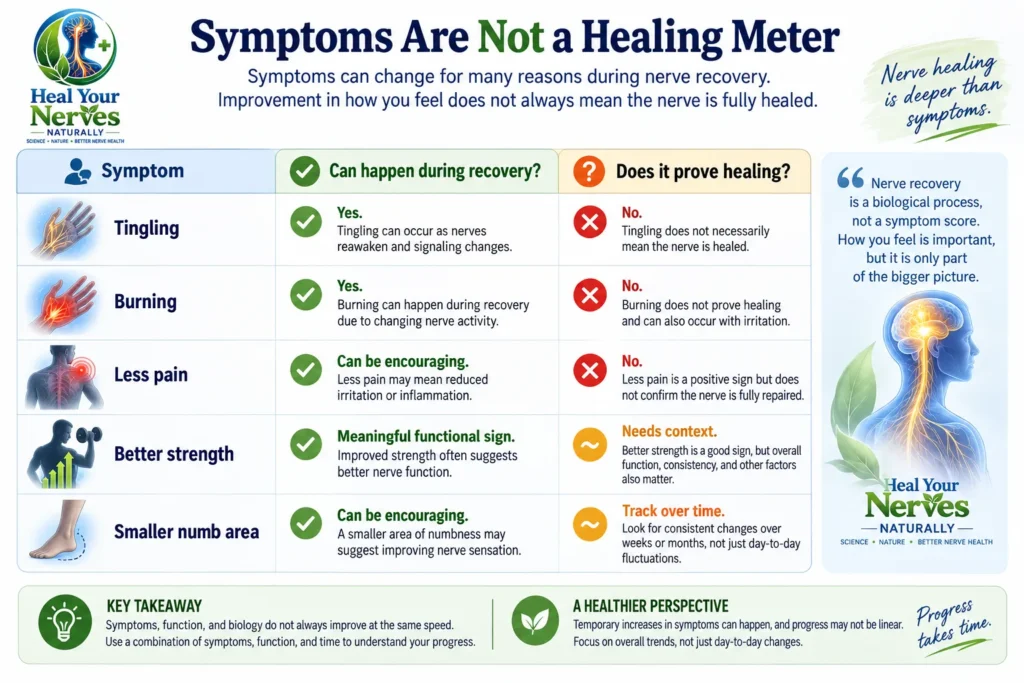
Recovery Phasing Question: How Can I Tell If My Nerve Is Healing?
If someone on our team asked for one rule here, it would be this:
Do not judge recovery from one symptom or one day. Look for a pattern.
Does Less Pain Mean Recovery Phasing Is Working?
It may be encouraging, but it is not proof of structural recovery.
Pain can improve because irritation is lower, pressure is reduced, medication is helping, inflammation has changed, movement is better, or the nervous system is less sensitized.
So we would put pain beside other measures instead of using it alone.
Signs That May Be More Useful to Track During Recovery Phasing
Depending on the nerve, you might watch for:
- a smaller area of numbness,
- better touch sensation,
- improved temperature awareness,
- stronger muscle contraction,
- better grip,
- longer walking tolerance,
- fewer trips or balance errors,
- shorter flares,
- or better ability to do daily tasks.
What Matters More Than a Good Day in Recovery Phasing?
A trend across several weeks.
A good afternoon is not proof of recovery. A difficult day is not proof of failure.
If function is gradually becoming more reliable, that is often more useful than a small change in pain score.
Recovery Phasing Question: Does Tingling Mean a Nerve Is Healing?
This is one of the most common questions, and it deserves a careful answer.
Tingling can occur during recovery. It can also occur with compression, irritation, neuropathy, metabolic problems, or abnormal nerve signaling.
So we would not tell someone, “Tingling means your nerve is definitely growing back.”
A Better Recovery Phasing Question to Ask
Instead, ask:
Is the tingling happening alongside stable or improving strength, better function, and an overall recovery pattern that makes sense?
What If Tingling Increases During Recovery Phasing?
Look at the details.
Did you suddenly walk much farther? Did you lift more? Did you spend hours in one position? Did the sensation settle afterward? Is there new weakness? Is numbness spreading?
A short-lived sensory flare can be very different from progressive neurological loss.
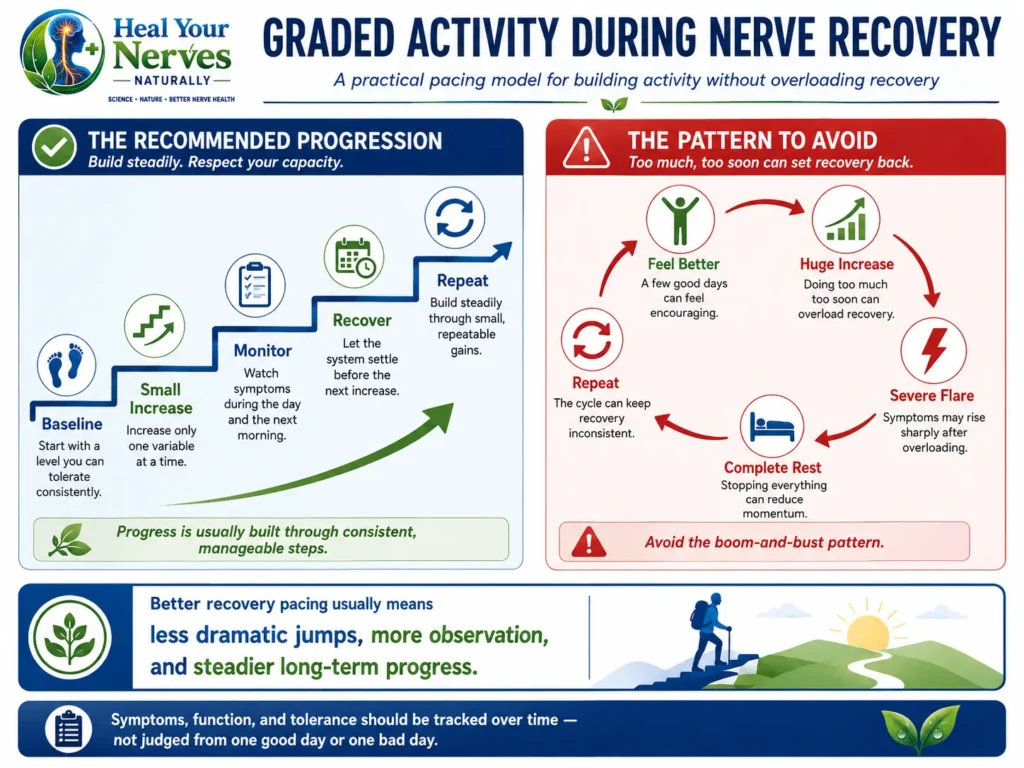
Habit-based fix: avoid the boom-and-bust cycle
A pattern we would want to break is:
Feel better → do far more → flare badly → stop everything → repeat.
A better strategy is to increase activity in smaller steps and use the response as feedback.
For that framework, read how to increase activity without overloading recovery.
Why Can a Healing Nerve Burn, Sting, or Feel Electric?
Neuropathic symptoms can feel dramatic.
People describe burning, electric shocks, shooting pain, pins and needles, or pain from light touch.
The NINDS peripheral neuropathy overview explains that neuropathic pain can result from abnormal nerve signaling and altered sensory processing.
Does more pain mean more healing?
No.
Pain intensity is not a regeneration meter.
A painful day does not prove that repair is accelerating. A painless day does not prove that the nerve is fully recovered.
What we would try at home first
Reduce repeated irritation. Avoid constant rubbing, pressure, or friction over a sensitive area.
Adjust the environment. Softer clothing, different bedding, or better-fitting footwear can sometimes reduce avoidable triggers.
Protect numb skin. Use caution with hot water, heating pads, or anything that could burn an area with poor sensation.
Escalate when needed. If neuropathic pain is severe, persistent, or disrupting sleep and function, talk with a clinician about treatment rather than relying only on home remedies.
Recovery Phasing Question: How Long Does Nerve Recovery Take?
This is the question everyone wants a clean answer to.
We would not give one.
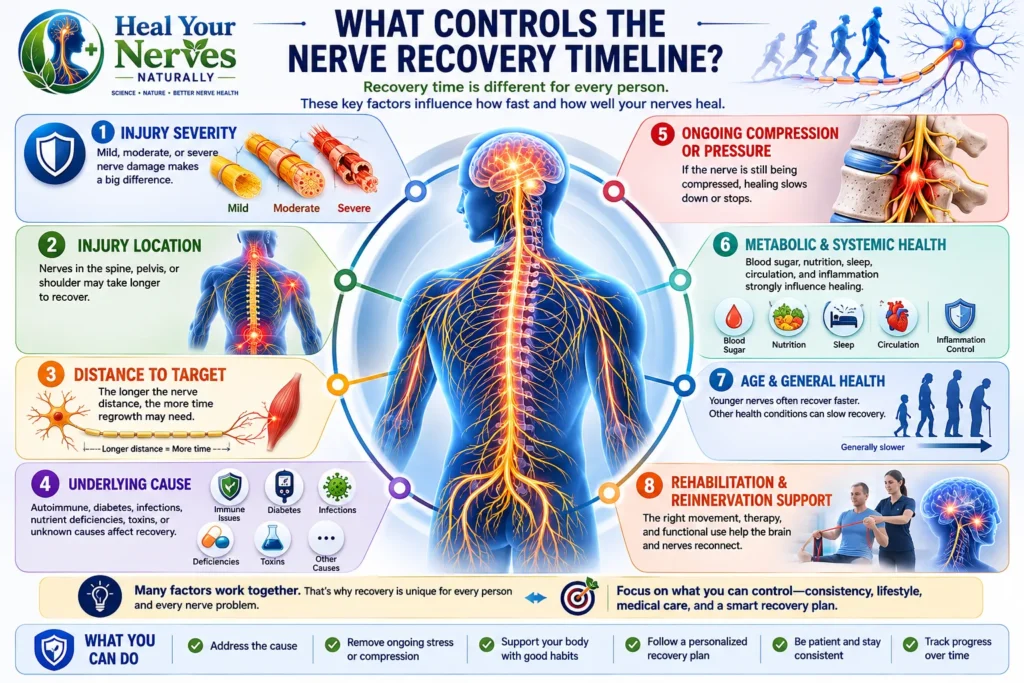
There is no universal nerve-recovery timeline because the underlying problems are too different.
What Actually Controls the Recovery Phasing Timeline?
Important factors include:
- the type of injury,
- the severity of injury,
- where the injury occurred,
- how far the axon must travel,
- whether the axon is still intact,
- whether compression is ongoing,
- scar tissue,
- metabolic health,
- circulation,
- age,
- the underlying disease,
- and whether surgery was required.
Can nerve recovery take months?
Yes.
Significant axonal recovery may take months. In addition, useful functional gains can continue after the early biological repair phase.
Can it take years?
Some people continue improving function for a long time.
However, this does not mean that every nerve continues regenerating indefinitely or that waiting longer guarantees full recovery.
What Does a Plateau Mean in Recovery Phasing?
A plateau does not have one explanation.
The cause may still be active. The nerve may have reached the limit of spontaneous recovery. Reinnervation may be incomplete. Strength and endurance may now be the limiting factors. Or progress may simply be too slow to notice day to day.
That is why a long plateau is something to reassess, not something to automatically fear or ignore.
Why Am I Better One Day and Worse the Next?
Recovery can be noisy.
Sleep changes. Activity changes. Stress changes. Workload changes. Blood glucose changes. Posture changes. Even the amount of time spent sitting can change.
That means symptoms can fluctuate even when the overall direction is positive.
Does a Bad Day Mean Recovery Phasing Has Failed?
Not necessarily.
We would look at the pattern before making that conclusion.
Ask:
- What changed in the last 24–48 hours?
- Did activity rise suddenly?
- Did I sleep badly?
- Was there more pressure on the nerve?
- Did the flare settle?
- Did strength change?
- Did the numb area spread?
- Did function stay worse afterward?
A Simple Recovery Phasing Flare Log
Write down:
- what you did,
- how long you did it,
- when symptoms changed,
- how strong the response was,
- and how long it took to settle.
That turns a frustrating symptom into useful information.
For a more formal approach, see using feedback systems during recovery.
Recovery Phasing at Home: What Can I Do Today?
When people ask for a “home solution,” we think it is important to separate two ideas.
A home strategy can support recovery. It should not pretend to replace diagnosis or treatment of the cause.
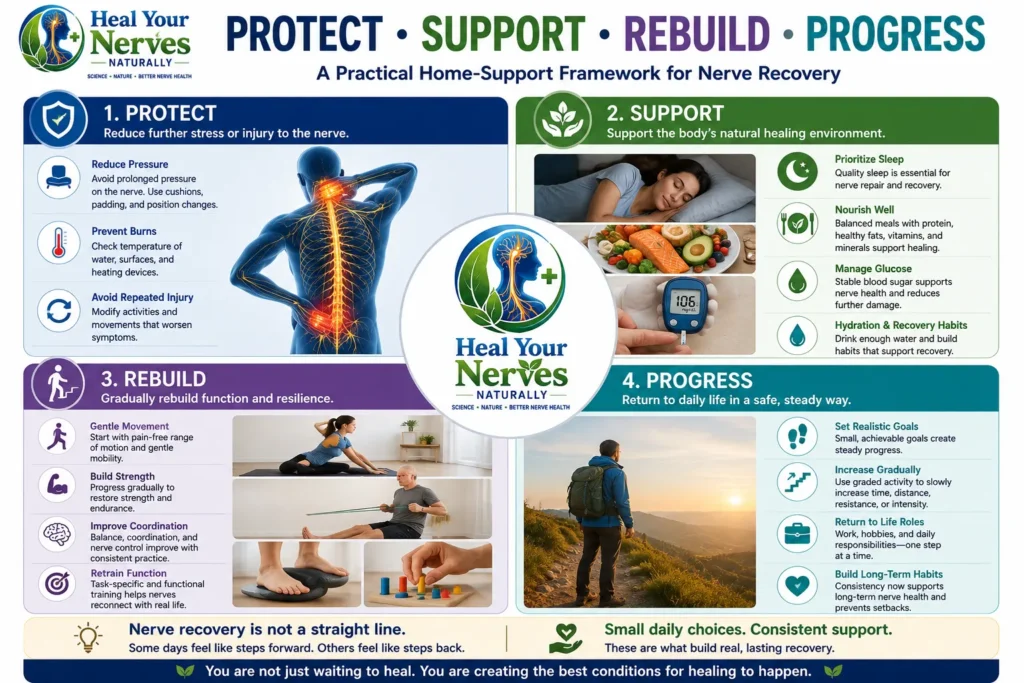
Our practical framework is:
Protect → Support → Rebuild → Progress
Protect
Reduce avoidable pressure and repeated irritation.
Protect numb skin from burns, cuts, and pressure injuries.
Follow any splint, brace, wound, or positioning instructions you have been given.
Support
Build reliable basics:
- regular sleep,
- adequate meals,
- enough protein,
- hydration,
- safe movement,
- prescribed medications,
- and management of conditions such as diabetes.
Rebuild
When medically appropriate, gradually rebuild:
- mobility,
- strength,
- balance,
- coordination,
- endurance,
- and task-specific function.
Progress
Increase normal activity in small steps.
Do not jump from protection to full load because you had two good days.
Habit-Based Support: Which Daily Habits Matter Most?
Habits are not nerve-regeneration switches. Still, they can create a better or worse recovery environment.
Habit 1: Stop repeating the same compression
Look at how you sit, sleep, work, and use your hands.
Do you lean on the elbow? Keep the wrist bent at night? Sit with pressure behind the thigh? Wear tight shoes? Use vibrating tools for long periods?
If a mechanical habit is part of the problem, correcting it may matter more than adding another supplement.
Habit 2: Keep sleep reasonably regular
Poor sleep can increase fatigue and pain sensitivity.
That does not mean sleep directly “regrows nerves.” It means poor sleep can make symptoms and recovery behavior harder to manage.
For the deeper sleep connection, read why sleep matters for nerve regeneration.
Habit 3: Do not treat smoking as neutral
Smoking is not helpful for overall tissue or vascular health.
NINDS includes smoking cessation among lifestyle approaches that support nerve health. See the NINDS peripheral neuropathy guide.
Habit 4: Review alcohol exposure
Excessive alcohol use can contribute to neuropathy and nutritional problems.
If alcohol may be part of the cause, reducing the exposure is more relevant than searching for a “nerve-repair drink.”
Habit 5: Manage blood glucose if diabetes is involved
This is a foundational issue, not an optional wellness add-on.
Long-term high blood glucose and blood fats can damage nerves and the small blood vessels that support them. The NIDDK overview of diabetic neuropathy explains this relationship.
Home-Based Safety: What Changes When a Hand or Foot Is Numb?
Reduced sensation changes the rules.
If you cannot feel pressure, heat, or injury normally, you have to use your eyes and habits more deliberately.
Check the skin
Look for:
- redness,
- blisters,
- cuts,
- swelling,
- pressure areas,
- or signs of infection.
Be cautious with heat
A heating pad can feel harmless until an area with poor sensation is burned.
If temperature sensation is reduced, test the temperature with an unaffected area or use a safer method.
Be careful with bare feet
Poor foot sensation makes small injuries easier to miss.
For people with diabetes, NIDDK specifically recommends regular foot checks because neuropathy can reduce awareness of injury. See the NIDDK diabetic peripheral neuropathy guide.
Recovery Phasing and Movement: Should I Rest or Move?
This is a question we would never answer with “always rest” or “always push through.”
The right amount of movement depends on the diagnosis, the stage, and any restrictions.
When protection matters more
Protection may be more important after:
- significant trauma,
- surgery,
- an unstable injury,
- severe symptom aggravation from movement,
- or a known mechanical compression that has not been addressed.
When movement becomes useful
Once movement is safe, graded activity can help rebuild function, confidence, strength, and tolerance.
The word graded matters.
Should I exercise through tingling?
We would not use a blanket rule such as “tingling is safe.”
Look at:
- how intense it is,
- how long it lasts,
- whether it settles,
- whether numbness spreads,
- and whether weakness changes.
A simple pacing method
- Choose an activity level you can repeat.
- Watch the response during the activity.
- Check again several hours later.
- Check the next morning.
- Increase one variable at a time.
For walking, for example, increase time before you also increase speed and hills.
What If Exercise Causes a Flare During Recovery Phasing?
That is a reason to review the plan.
Possible explanations include too much load, poor technique, too little recovery time, an inappropriate exercise, persistent compression, or an untreated cause.
For deeper guidance on pacing and progression, read movement therapy for nerve recovery and recovery load management.
Recovery Phasing and Nutrition: Can Food Support Nerve Recovery?
Nutrition matters, but this is where exaggerated claims are common.
Food supports energy metabolism, cellular function, and tissue maintenance. Specific deficiencies can also cause neurological problems.
However, no meal plan can force a severely damaged nerve to regenerate on command.
What we would focus on first
Think about adequacy rather than “superfoods.”
A practical pattern can include:
- enough protein,
- vegetables and fruit,
- fiber-rich carbohydrates,
- unsaturated fats,
- and attention to possible nutrient deficiencies.
For the food-first guide, see what to eat to support nerve recovery.
Why vitamin B12 matters
Vitamin B12 supports normal neurological function and healthy nerve cells.
See the NIH Office of Dietary Supplements vitamin B12 fact sheet.
Correcting a real deficiency is different from taking large doses when B12 status is already adequate.
Why vitamin B6 deserves caution
B6 is essential. Too much supplemental B6 can also cause sensory neuropathy.
The NIH vitamin B6 fact sheet warns about nerve damage from prolonged excessive supplemental intake.
That is why “B vitamins are good for nerves” is not a safe reason to megadose B6.
Do I need supplements?
Not automatically.
Supplements make the most sense when there is a dietary gap, diagnosed deficiency, or evidence-based clinical reason.
For deeper nutrient science, read micronutrients involved in nerve function.
For the mechanism-level overview, see how nutrition supports nerve repair.
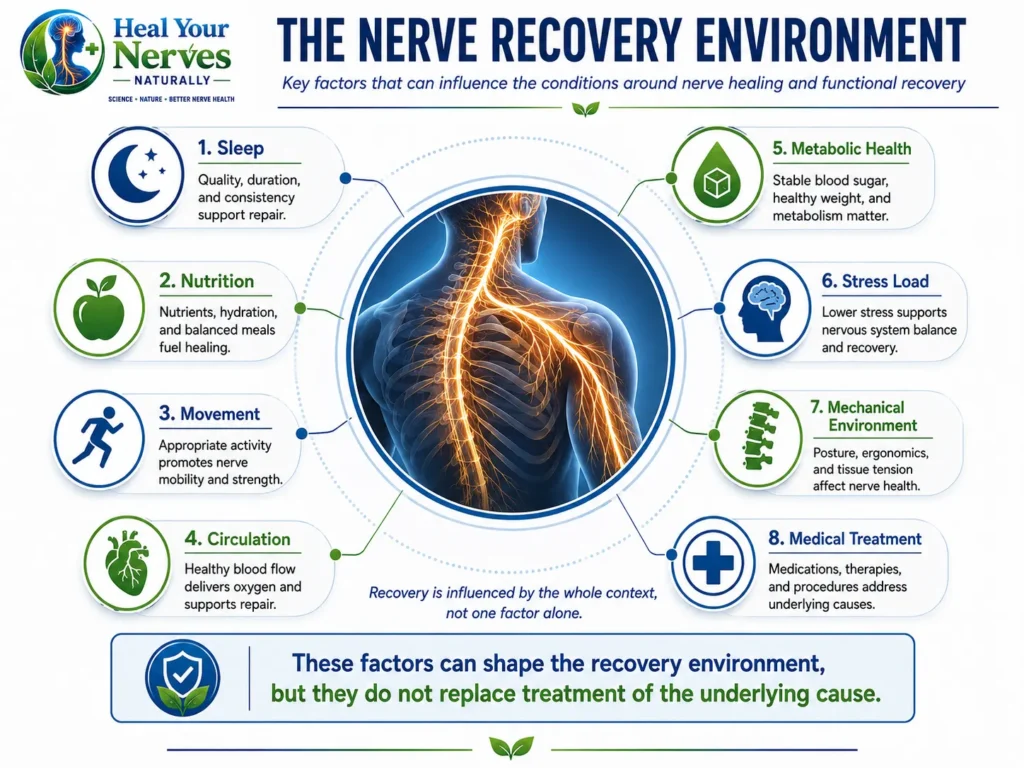
Sleep, Stress, and Circulation: What Kind of Recovery Environment Are You Creating?
A healing nerve exists inside a whole person.
That person sleeps, works, eats, worries, moves, sits, and has a metabolic and cardiovascular system.
So we think of sleep, stress, and circulation as part of the recovery environment rather than miracle treatments.
Sleep
Sleep does not directly flip a switch that makes axons regrow.
However, poor sleep can increase fatigue and pain sensitivity. It can also make activity, rehabilitation, and coping harder.
A useful home goal is a reasonably regular sleep schedule and treatment of problems that repeatedly interrupt sleep.
For deeper reading, see why sleep matters for nerve regeneration.
Stress
We would not tell someone that stress “stops nerve healing.” That is too simplistic.
Stress can, however, affect sleep, pain sensitivity, muscle tension, activity patterns, and how overwhelming symptoms feel.
Breathing and relaxation practices may therefore support regulation and coping. They should not be marketed as direct axonal-regrowth techniques.
Circulation
Nerves need oxygen and nutrients, and small blood vessels help supply them.
In diabetes, high blood glucose can damage both nerves and the small vessels that nourish them. See the NIDDK diabetic neuropathy overview.
Walking can support general circulation and function when it is safe. Still, walking is not a universal treatment for every nerve problem.
For the deeper system, read how oxygen delivery supports nerve function.
Recovery Phasing by Cause: Does a Compressed Nerve Recover Differently?
Yes.
A compressed nerve has a different problem from a severed nerve or a widespread neuropathy.
What happens after pressure is removed?
In a mild conduction problem, signaling may improve relatively quickly.
If the compression caused axonal injury, recovery may take much longer.
Why can numbness remain after decompression?
Removing pressure does not instantly undo previous structural damage.
If compression was severe or long-standing, the nerve may still need time to recover after the mechanical problem is corrected.
What we would change in daily life
Habit: Reduce repeated pressure.
Work setup: Review posture and workstation position.
Sleep: Avoid positions that consistently reproduce symptoms.
Home safety: Protect numb skin.
Reassessment: Persistent or progressive weakness deserves review.
For the full pathway, see nerve compression and recovery.
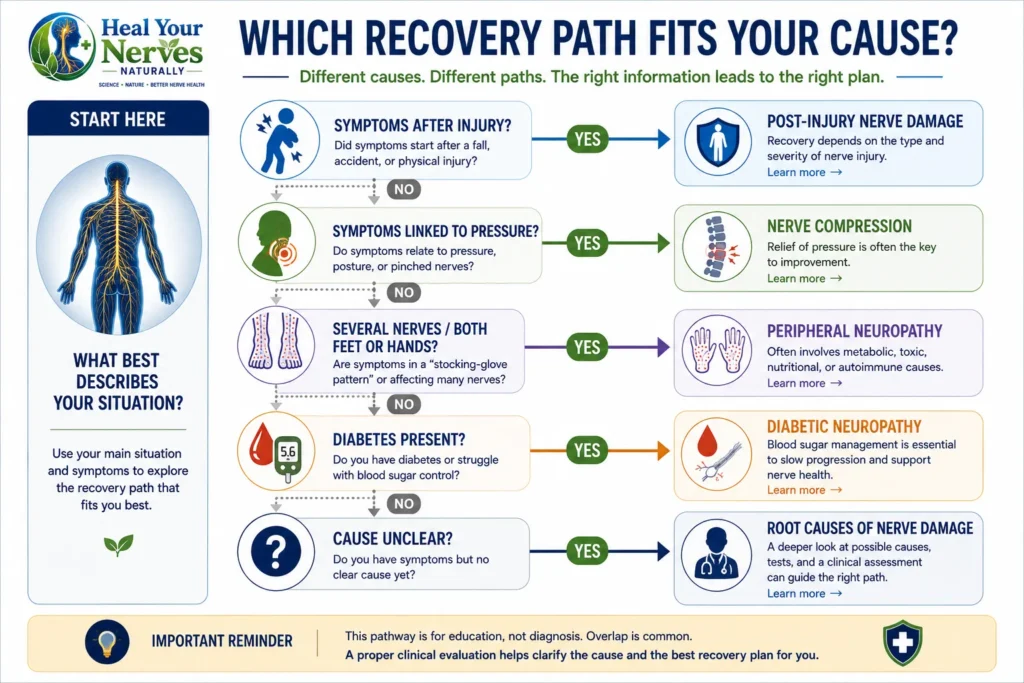
Recovery Phasing by Cause: What if Symptoms Started After an Injury?
Trauma can produce everything from temporary irritation to severe nerve disruption.
A stretched nerve, bruised nerve, partial injury, and complete severing do not have the same prognosis.
What comes first?
Protect the area and establish severity.
What comes later?
If the injury is stable and regeneration is possible, the emphasis may move toward regrowth, reinnervation, movement, and functional rehabilitation.
What we would do at home
Follow wound, splint, brace, and activity instructions if they apply.
Avoid repeatedly stressing an unstable area.
Track strength and function, not only pain.
When professional care matters
Major trauma, severe weakness, or persistent functional loss may require specialist evaluation.
See nerve damage after an injury.
Recovery Phasing by Cause: What if I Have Peripheral Neuropathy?
Peripheral neuropathy changes the logic of recovery.
If many nerves are affected, this may not be a one-time injury followed by a simple healing phase.
The more important question may be:
What is continuing to damage or disturb the nerves?
Possible causes include diabetes, nutritional deficiency, medication effects, toxins, autoimmune disease, inherited disorders, and other neurological conditions.
NINDS describes peripheral neuropathy as a broad group of disorders with different patterns and causes. See the NINDS overview.
For a broader overview, read peripheral neuropathy symptoms and causes.
Recovery Phasing by Cause: What if Diabetes Is Involved?
Diabetic neuropathy is not simply a nerve that was injured once and then left to heal.
It develops inside an ongoing metabolic environment.
That means disease management is part of recovery support.
Long-term high blood glucose and blood fats can damage nerves and the small vessels that support them. The NIDDK diabetic neuropathy overview explains this relationship.
In practical terms, the plan may include glucose management, foot safety, activity, medication, and regular medical care.
Read diabetic neuropathy for the condition-specific pathway.
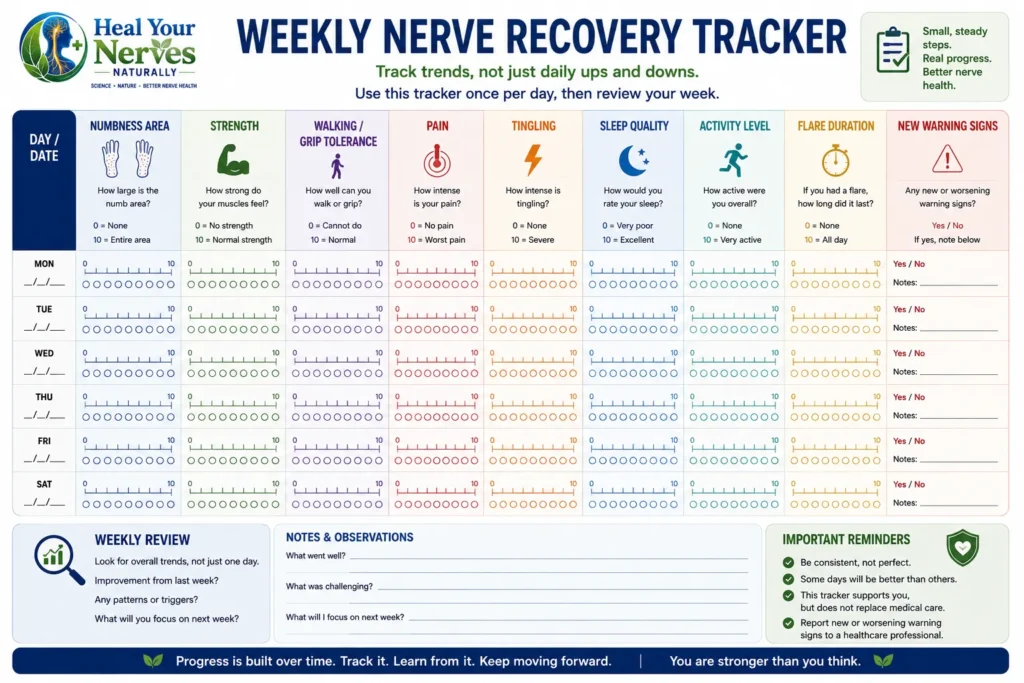
Recovery Phasing Tracker: How Would We Measure Progress in Daily Life?
A useful tracker does not need to be complicated.
It needs to capture the things that matter.
For a hand problem
You might track:
- grip,
- typing tolerance,
- buttoning clothes,
- touch sensation,
- dropping objects,
- and fine motor control.
For a leg problem
You might track:
- walking distance,
- standing time,
- stairs,
- balance,
- foot clearance,
- numbness area,
- and fatigue.
Is pain score enough?
No.
Pain can improve while weakness gets worse. The reverse can also happen.
That is why we would use several measures.
Should I map the numb area?
You can note whether the area is shrinking, stable, or spreading.
Do not repeatedly test numb skin with sharp objects or extreme temperatures.
How often should I compare progress?
Daily changes can be noisy.
For slow recovery, weekly or multi-week comparisons often make more sense.
A simple recovery dashboard
Symptoms: pain, tingling, numbness
Function: strength, walking, grip, balance
Tolerance: how much activity you can do
Recovery: how long a flare lasts
Context: sleep, stress, unusual load
Safety: new weakness or spreading sensory loss
For the deeper concept, read recovery feedback systems.
What Can Slow or Stall Nerve Recovery?
Sometimes the most useful question is not “What should I add?”
It is:
What is still getting in the way?
Ongoing compression
A nerve cannot be expected to recover normally if the same significant mechanical stress continues.
Severe structural injury
More structural damage can mean less spontaneous recovery and a longer pathway.
Long distance to the target
A regenerating axon may need a long time to reach the muscle or sensory target it must reconnect with.
Metabolic disease
Poorly controlled diabetes can continue to damage nerves and their blood supply.
Nutritional deficiency
A true deficiency, such as B12 deficiency, can contribute to neurological dysfunction.
Excessive supplementation
The opposite problem also exists. Too much vitamin B6 can cause neuropathy.
Smoking and excessive alcohol
Both can work against overall nerve health, directly or indirectly.
Repeated overload
Constantly pushing beyond tolerance can make rehabilitation chaotic.
Complete inactivity
Once movement is safe, unnecessary long-term avoidance can contribute to weakness, low endurance, and reduced confidence.
Delayed diagnosis
Waiting indefinitely for “natural healing” can delay treatment of a correctable cause.
That is why every recovery plan should occasionally return to the question:
Is the cause still active?
Recovery Phasing Question: Can I Speed Up Nerve Healing?
This is one of the easiest questions to answer badly.
The internet is full of products and routines that claim to “regrow nerves fast.”
We would not frame recovery that way.
Is there a home method that makes a severely damaged nerve regenerate much faster?
There is no proven household method that forces dramatic nerve regeneration.
What can I do instead?
Focus on the conditions that make recovery more favorable:
- identify and treat the cause,
- reduce avoidable compression,
- manage diabetes,
- correct true deficiencies,
- avoid harmful supplement excess,
- sleep adequately,
- eat adequately,
- use graded rehabilitation,
- protect numb tissue,
- and follow medical treatment when it is needed.
That may sound less exciting than a “nerve healing hack,” but it is much closer to how real recovery works.
Recovery Phasing Mistakes: What Would We Avoid?
A practical guide should also tell you what not to do.
We would avoid:
- treating pain as the only recovery measure,
- doubling activity after two good days,
- aggressively stretching a nerve because someone says it “breaks scar tissue,”
- repeatedly tapping or pressing an irritated nerve to test it,
- applying high heat to numb skin,
- megadosing B vitamins, especially B6,
- ignoring progressive weakness,
- and delaying evaluation because “nerves take a long time to heal.”
We would also avoid comparing your recovery too closely with another person’s.
Two people can both say “I have nerve damage” while having completely different injuries, causes, and prognoses.
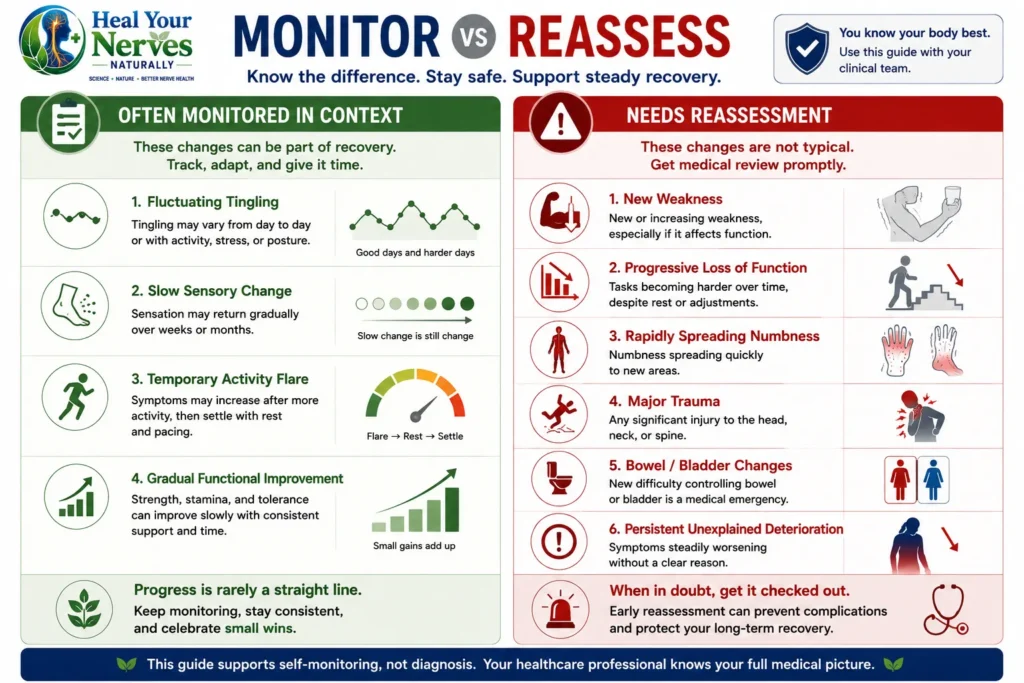
Recovery Phasing Safety: When Should Symptoms Be Medically Reassessed?
This is one of the most important sections on the page.
A good home-recovery plan needs a clear exit point: when should self-monitoring stop and professional reassessment begin?
Seek prompt medical assessment for
- significant new weakness,
- rapidly spreading numbness,
- major loss of function,
- worsening neurological symptoms,
- or severe symptoms after major trauma.
Seek urgent evaluation when neurological symptoms include
- new bladder or bowel dysfunction,
- saddle-area numbness,
- major sudden changes in walking,
- or other signs of serious neurological compromise.
What if nothing is improving?
No obvious improvement does not automatically mean permanent damage.
However, persistent symptoms without a clear diagnosis deserve reassessment.
Depending on the situation, a clinician may consider neurological examination, strength testing, sensory testing, nerve conduction studies, EMG, imaging, blood testing, or specialist referral.
NINDS explains that EMG and nerve conduction studies can help assess nerve and muscle function. See the NINDS peripheral neuropathy guide.
What if weakness is getting worse?
Progressive motor loss matters.
We would not call worsening weakness a normal recovery phase without evaluation.
Daily-Life Recovery: How Should Work and Household Tasks Change?
A recovery page that only talks about exercise misses most of real life.
People spend far more time working, cooking, driving, carrying bags, using a phone, sitting at a desk, sleeping, and doing household tasks than they spend in a clinic.
Can I keep working while a nerve is healing?
Sometimes yes.
The answer depends on the nerve, the amount of weakness or numbness, and what the job requires.
A desk worker may need posture and pressure changes. Someone who lifts heavy loads, uses vibrating tools, drives for hours, or works at height may need a very different plan.
A better work question
Instead of asking only, “Can I work?”, ask:
- Which task increases symptoms?
- Does function actually worsen?
- Can the task be shortened?
- Can it be rotated with another task?
- Can pressure or posture be changed?
- Is weakness creating a safety problem?
What small work changes can help?
Examples include:
- changing keyboard height,
- reducing elbow pressure,
- taking short movement breaks,
- alternating tasks,
- changing tool grip,
- or avoiding one fixed position for hours.
What about household chores?
Use pacing.
Instead of cleaning the whole house in one long session, split the task into smaller parts. If carrying groceries aggravates symptoms, divide the load or use a cart.
The goal is not to avoid normal life forever. It is to make the load more repeatable while recovery is still limited.
Return to Normal Activity: How Do I Know When to Increase the Load?
Returning to normal life is usually a series of small tests, not one big “I’m recovered” moment.
Start with a stable baseline
If your current activity level is repeatable and does not create a large or long-lasting flare, a small increase may be reasonable.
Then watch the response.
Change one variable at a time
For walking, increase time before speed.
For strength work, increase repetitions before load.
For work, increase duration before complexity.
This makes it easier to understand what your body is responding to.
What if symptoms rise later in the day?
Delayed symptoms can happen.
That is why we would not judge an activity only by how it feels in the moment.
Check several hours later and the next morning.
What does useful progress look like?
A practical sign is more function for the same or less recovery cost.
For example:
- longer walking with a similar symptom level,
- better grip without a longer flare,
- more work time before symptoms rise,
- or faster recovery after activity.
Those changes are often more meaningful than chasing a perfect pain score.
Recovery Phasing and Age: Does Age Change Nerve Healing?
Age can influence recovery, but it is not a simple cutoff.
Older adults may have slower repair, more medical conditions, lower muscle reserve, or more pre-existing nerve changes.
That does not mean useful recovery is impossible.
What matters more than age alone?
We would still look at:
- injury severity,
- cause,
- distance to the target,
- circulation,
- metabolic health,
- muscle condition,
- and rehabilitation.
What deserves extra attention in older adults?
Safety.
Balance changes, foot numbness, weakness, and medication effects can increase fall risk.
Home setup may therefore deserve as much attention as the nerve itself.
Recovery Phasing After Surgery: What Changes?
Some nerve problems require surgery.
Examples include decompression, repair of a severed nerve, grafting, or treatment of a nearby structural cause.
Does surgery mean the nerve is immediately fixed?
No.
Surgery may correct the structure or remove pressure. Biological recovery still takes time.
After decompression, the nerve may need time to restore function. After nerve repair, axons may still need to regrow toward their targets.
Should I follow a generic online timeline?
No.
Postoperative restrictions depend on the procedure.
The surgeon’s and rehabilitation team’s instructions take priority over general guidance on this page.
What if numbness remains after decompression surgery?
Persistent numbness does not automatically mean the procedure failed.
Long-standing compression may have caused axonal injury before surgery. That injury may still need time to recover.
However, the treating team should guide expectations and reassess unexpected changes.
Nerve Testing During Recovery: What Can EMG and Nerve Conduction Studies Tell Us?
People often want one test that says, “Your nerve is 70% healed.”
That is not how nerve testing works.
What does a nerve conduction study measure?
It measures how electrical signals travel through selected nerves.
This can help identify patterns suggesting axonal loss, demyelination, or entrapment.
What does EMG add?
Electromyography looks at electrical activity in muscles.
It can help show whether a muscle has lost nerve supply and whether signs of reinnervation may be present.
Can one normal test rule out every neuropathy?
No.
Some small-fiber neuropathies may not show up on standard nerve conduction testing.
That is why testing must match the clinical question.
When might repeat testing be considered?
A clinician may repeat testing when weakness progresses, the diagnosis is uncertain, symptoms change, or recovery needs to be evaluated over time.
For a general diagnostic overview, see the NINDS peripheral neuropathy guide.
Weather and Temperature: Why Do Symptoms Sometimes Change?
Some people notice more tingling, stiffness, or pain in cold weather. Others find heat more irritating.
That does not automatically mean the nerve is being damaged again.
Why can cold feel worse?
Cold can change blood flow, muscle tension, and sensory perception.
If the nerve is already sensitive, those changes may make symptoms more noticeable.
Should I keep the area warm?
Comfortable warmth may help some people.
However, numb skin needs extra caution because it may not detect excessive heat.
Travel: How Can I Reduce Flares on Long Trips?
Travel combines several common triggers:
- long sitting,
- limited movement,
- carrying bags,
- poor sleep,
- dehydration,
- and unfamiliar chairs or beds.
On a long car or bus trip
If it is safe, change position regularly and use breaks to move.
Avoid prolonged direct pressure over a nerve that is already vulnerable.
On a flight
For many nerve problems, flying itself is not the main issue. The bigger problem may be prolonged sitting, swelling, or carrying luggage.
Recent surgery or certain medical conditions may have separate travel restrictions, so individualized advice matters.
Footwear: Can Shoes Affect Nerve Symptoms?
Yes, especially when numbness or nerve pain affects the feet.
Tight footwear can add pressure to an already sensitive area.
What we would look for
Shoes should:
- fit properly,
- avoid crowding the toes,
- avoid obvious pressure points,
- and provide stable support.
If sensation is poor, inspect the feet after wearing new footwear because rubbing may not be felt normally.
Sleep Position: Can the Way I Sleep Irritate a Nerve?
Yes.
Prolonged pressure and extreme joint positions can aggravate some nerves.
A simple observation exercise
Notice how you wake up.
If symptoms are consistently worse after sleeping with the elbow bent tightly, the wrist flexed, or the arm under the body, that pattern is worth discussing with a clinician or therapist.
What about a brace at night?
Night splints are used for some conditions, such as carpal tunnel syndrome.
However, the right device and position depend on the diagnosis. Do not assume that any brace is appropriate for any nerve problem.
Mental Load: Why Can Recovery Feel Hard Even When Tests Look Better?
Nerve recovery can take up a lot of mental space.
People worry about permanent damage, work, money, sleep, exercise, and whether every new sensation means something is wrong.
That can lead to constant checking.
Can constant symptom checking make recovery harder to cope with?
Yes.
The symptoms can still be real. The issue is attention.
If you check every few minutes, normal fluctuations can start to dominate the day.
A better strategy may be planned check-ins—for example, once in the morning and once in the evening—unless a clinician has advised otherwise.
What helps reduce uncertainty?
A clear plan.
Know:
- what you are tracking,
- what changes are expected,
- what warning signs matter,
- and what the next action is if the trend changes.
That can reduce the need to interpret every sensation in real time.
Family Support: How Can Other People Help Without Taking Over?
Recovery often affects the household.
Family members may help with transport, shopping, heavy tasks, childcare, or emotional support.
What should they understand?
A person can look completely normal and still have numbness, weakness, neuropathic pain, or poor endurance.
Nerve symptoms are not always visible.
What kind of help is useful?
The best support usually protects independence.
For example, someone may carry the heavy bag while the recovering person still does safe walking and normal light tasks.
The goal is not to make the person passive. It is to remove unnecessary overload while useful function is rebuilt.
Long-Term Protection: How Do I Reduce the Risk of Repeating the Same Problem?
Recovery is not complete if the same cause keeps returning.
If compression caused the problem
Change the mechanical habit.
Review posture, work setup, sleep position, tools, and repetitive pressure.
If diabetes contributed
Continue long-term metabolic management even after symptoms improve.
If a nutrient deficiency contributed
Find out why the deficiency occurred.
Correcting the level without addressing the reason can allow the problem to return.
If injury happened during work or sport
Review technique, equipment, load, and recovery time.
If the cause is still unclear
Do not invent one.
Continue working with the appropriate clinician to clarify the pattern.
For broader prevention, read long-term nerve health protection.
Recovery Phasing Outcome: What Does Successful Nerve Recovery Actually Look Like?
Successful recovery is not always “zero symptoms.”
Some people return to work, exercise, or normal daily life while still having mild tingling or a small area of altered sensation.
Others improve function without regaining everything they lost.
Is being pain-free the same as being fully recovered?
No.
Pain relief is valuable, but it is not the same as restored nerve function.
What would we judge instead?
We would look at several dimensions:
- symptom burden,
- nerve function,
- strength,
- sensation,
- independence,
- participation in daily life,
- and stability over time.
Can function improve even if biological recovery is incomplete?
Yes.
Strength, rehabilitation, skill learning, environmental changes, and neuroplastic adaptation can all improve function.
That is why neuroplastic adaptation during nerve recovery belongs near the end of the pathway.
Recovery Phasing vs Healing Sequencing: What Is the Difference?
We keep these concepts separate on purpose.
Recovery phasing asks:
What process or stage may be happening now?
Healing sequencing asks:
Which recovery priority should come first?
For example, cause control may come before aggressive rehabilitation. Protection may come before loading. Deficiency correction may come before supplement experimentation. Stabilization may come before progression.
For that framework, read how recovery priorities should be sequenced.
Recovery Phasing vs Protocol Design: What Is the Difference?
A recovery phase helps orient you in the journey.
Protocol design is about building a plan around assessment, goals, load, response, and progression.
Protocol design is a separate planning concept rather than a recovery stage. If you want a more action-oriented overview, use our step-by-step nerve recovery protocols.
Recovery Phasing FAQ: Real Questions People Ask at Home
Can a nerve heal without treatment?
Sometimes mild nerve problems improve after the cause resolves.
Other problems need medical treatment, surgery, rehabilitation, metabolic management, or correction of a deficiency.
The cause matters more than the label “nerve damage.”
Does tingling mean the nerve is waking up?
It can happen during recovery, but it also happens with compression and neuropathy.
It is not proof of regeneration.
Why is numbness often slower to improve?
Different nerve fibers and functions can recover at different rates.
Severe sensory injury may also recover slowly or incompletely.
Can I massage a healing nerve?
Gentle work on surrounding tissues may be part of some rehabilitation plans.
Aggressive pressure directly over an irritable nerve can worsen symptoms.
Can stretching help?
Stretching may help surrounding tissues.
Aggressive “nerve stretching” can provoke symptoms, so nerve-mobility work should be graded and condition-specific.
Can I work while the nerve is healing?
Often, yes—with the right modifications.
The answer depends on the job, the nerve involved, weakness, sensation, and safety.
Can I drive?
Driving depends on strength, sensation, reaction time, pain, medication effects, and legal or medical restrictions.
If foot or hand control is affected, get individualized advice.
Can I exercise at the gym?
Possibly, if the condition is stable and the activity is appropriate.
Modify movements that repeatedly worsen neurological symptoms.
Should I use ice?
Ice can reduce pain in some musculoskeletal problems.
However, numb skin has a higher risk of cold injury.
Should I use heat?
Heat can feel soothing, but poor temperature sensation increases burn risk.
Does protein help nerves heal?
Protein supports normal tissue maintenance and repair.
Extra protein does not force nerve regeneration.
Does vitamin B12 help?
Correcting B12 deficiency matters because deficiency can cause neurological problems.
Taking extra B12 without a deficiency is a different question.
See the NIH vitamin B12 fact sheet.
Can too much vitamin B6 damage nerves?
Yes.
High supplemental intake over time can cause sensory neuropathy.
See the NIH vitamin B6 fact sheet.
Does sleep help?
Sleep supports overall recovery, pain regulation, and daily function.
It should not be presented as a direct cure for nerve damage.
Can stress make symptoms worse?
Yes.
Stress can influence pain sensitivity, sleep, movement, and coping.
It does not explain every neurological symptom.
Can a compressed nerve recover?
Many can improve, especially when pressure is relieved before severe permanent damage occurs.
Long-standing or severe compression may recover slowly or incompletely.
Can a severed nerve heal on its own?
A complete nerve disruption is a major injury and may require surgical repair or specialist care.
Why does recovery feel so slow?
Nerve repair is biologically complex, and axons may need to travel long distances before reconnecting with targets.
Can recovery stop?
Yes.
A plateau may reflect a persistent cause, severe structural injury, incomplete reinnervation, or the limit of spontaneous recovery.
How do I know if I am doing too much?
Look for repeated patterns.
If each activity increase causes a large, long-lasting flare or worsens neurological function, the load may be too high.
How do I know if I am doing too little?
If the condition is stable and movement is safe, complete avoidance can contribute to weakness and reduced tolerance.
What is the biggest recovery-phasing mistake?
Treating every phase the same.
Early protection, later rebuilding, and long-term stability have different goals.
A Simple Weekly Recovery Review
Instead of checking the nerve every hour, review the pattern once a week.
Symptoms
- Is pain lower, higher, or unchanged?
- Is the numb area smaller, larger, or stable?
- Is tingling more or less frequent?
Function
- Can I walk farther?
- Can I grip better?
- Can I stand longer?
- Am I dropping objects less often?
- Is balance improving?
Tolerance
- Can I do more before symptoms rise?
- Do flares settle faster?
Habits
- Am I sleeping regularly?
- Am I avoiding repeated compression?
- Am I pacing activity?
- Am I eating enough?
Safety
- Is there new weakness?
- Is numbness spreading quickly?
- Is function clearly getting worse?
What to do with the answer
If the trend is improving, keep the plan consistent.
If the trend is flat, review load, cause, and expectations.
If the trend is worsening, seek reassessment.
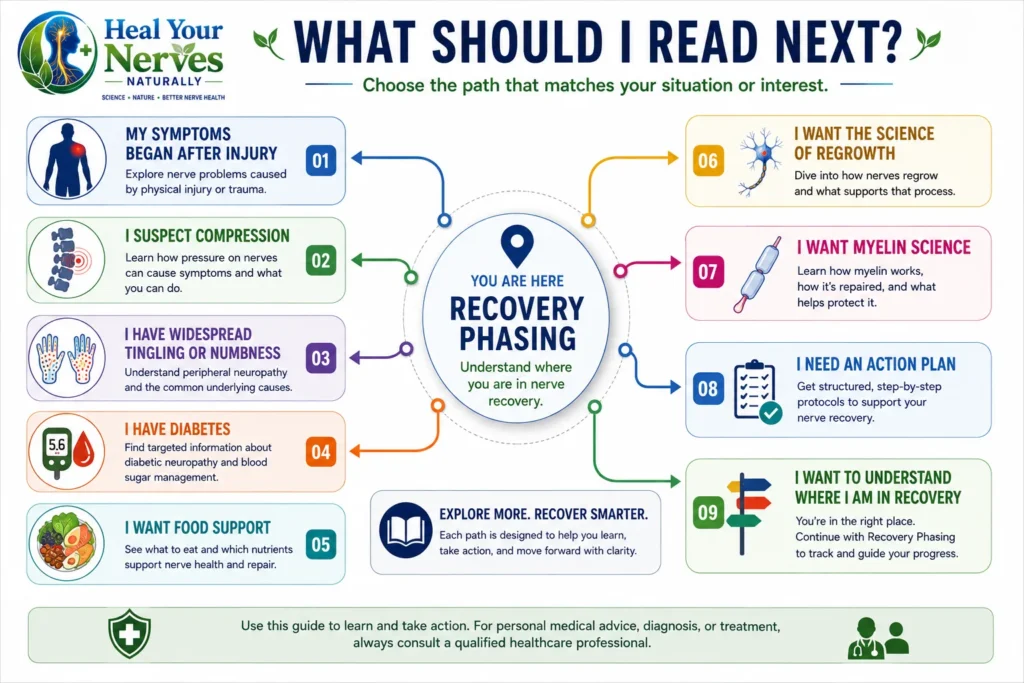
Recovery Phasing Decision Path: What Should I Read Next?
A long guide is only useful if it helps you find the next relevant step.
Symptoms started after an injury
→ Nerve Damage After an Injury
Symptoms seem linked to pressure or position
Tingling or numbness affects several areas
Diabetes is involved
You want to understand possible causes
You want practical food guidance
You want the biology of regrowth
You want to understand myelin repair
You need a structured action plan
You want to understand recovery order
You want to understand how a plan is built
Recovery Phasing Takeaway: How We Would Think About the Whole Journey
If you remember only one thing from this guide, make it this:
Nerve recovery is not one event, and it is not one symptom.
Early on, the main job may be protection and diagnosis.
Later, the biology may involve cleanup, axonal regrowth, and remyelination.
After that, the person may still need to rebuild strength, coordination, endurance, confidence, and normal daily function.
That is why the stages of nerve healing are better understood as overlapping processes than as a fixed countdown.
Pain can improve before numbness.
Strength can lag behind signal recovery.
A temporary flare can happen without a new structural injury.
A good day does not prove complete healing.
A bad day does not automatically mean recovery has failed.
Most importantly, recovery should always come back to the cause.
A compressed nerve needs the pressure problem addressed.
A severe injury may need specialist treatment.
Diabetic neuropathy needs metabolic management.
A true nutrient deficiency needs correction.
An inflammatory neurological condition may need disease-specific treatment.
Home support still matters. Good habits, sensible movement, adequate nutrition, regular sleep, pacing, skin protection, and symptom tracking can all make daily recovery more manageable.
But we would always use those strategies as support, not as replacements for appropriate care.
The practical question we would leave you with is this:
What is most likely limiting recovery now, what can I safely support today, what should I track, and what would tell me that I need more help?
That is the real value of recovery phasing.