
Nerve Recovery Protocol Design: How Goals, Priorities, Load and Feedback Shape the Plan
Nerve recovery protocol design turns information about symptoms, function, diagnosis, daily life and recovery capacity into a plan that can be prioritized, tested and adjusted.
Sleep, movement, rehab, nutrition, disease management and daily habits may all matter. However, they do not all have the same job, priority or timing.
So the real question is not simply, “What can I add?” It is, “What matters most now, how much is suitable, what should I measure, and what would make the plan change?”
This guide explains that decision process. It does not give one universal nerve-treatment plan. Instead, it shows how a broad recovery framework can become a smaller set of clear priorities, useful goals, realistic actions, measurable feedback and review rules.
If you have not mapped the larger recovery picture yet, start with Nerve Recovery Protocols. That page explains what a coordinated recovery framework may need to consider. This page starts one step later:
Given the recovery picture in front of us, how should the plan be designed?
NICE’s 2025 guideline on rehab for chronic nerve-related disorders, including acquired peripheral nerve disorders, supports this kind of structured planning. It recommends a broad review, goals that matter to the person, tailored rehab plans, attention to timing, intensity and frequency, and regular review. See NICE’s rehabilitation planning and delivery recommendations.
Nerve Recovery Protocol Design Starts With the Problem, Not the Remedy
When symptoms are uncomfortable or frightening, action feels urgent.
You may search for:
- the best supplement for nerves;
- the best exercise for neuropathy;
- a nerve-healing diet;
- a walking target;
- a stretching routine;
- a device;
- a massage technique;
- a recovery timeline.
But the first design question is not:
“What can I add?”
It is:
“What problem are we really trying to change?”
That question sounds simple. However, it prevents many poor decisions.
The same action can have other jobs
Walking could be used for general conditioning, confidence, glucose management, gait practice or simply daily independence.
A brace may improve safety while weakness persists.
Medication may help control pain without changing the root cause.
Meanwhile, a supplement may correct a confirmed deficiency. If nutrient status is already adequate, it may add little value.
If you do not know the job, you cannot judge whether the action is working.
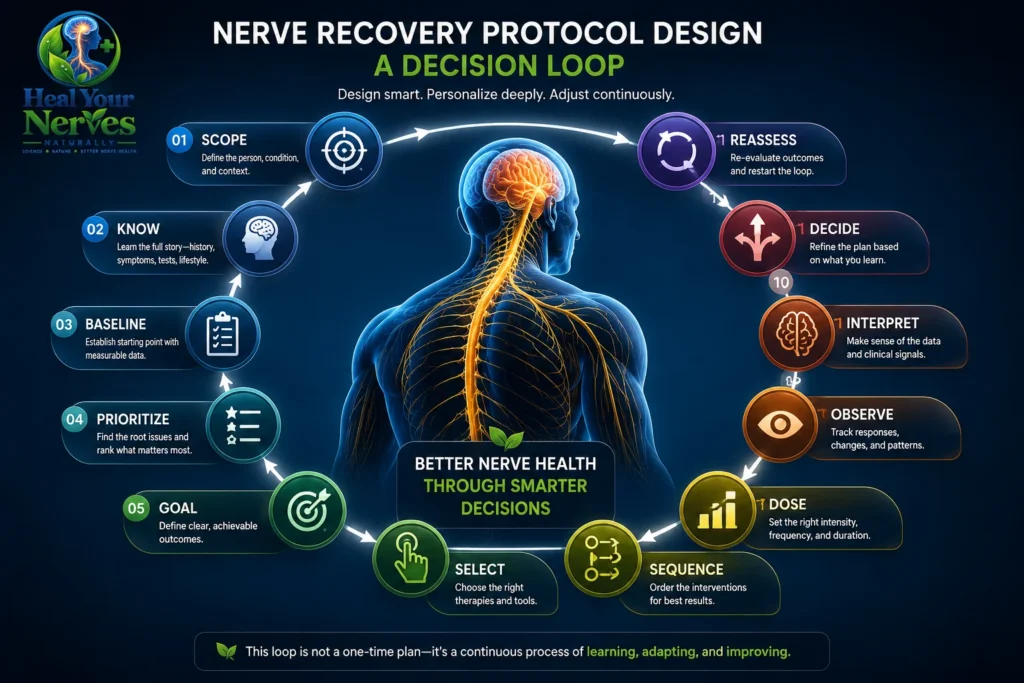
The HYN Nerve Recovery Protocol Design Loop
The page is organized around one practical loop:
SCOPE → KNOW → BASELINE → PRIORITIZE → GOAL → SELECT → SEQUENCE → DOSE → OBSERVE → understand → DECIDE → REASSESS
This is not a validated medical scoring system. It is an educational decision framework designed to keep the plan connected to the person, the evidence and the changing recovery picture.
Each step asks a other question.
Scope: Is this suitable for self-management guidance, or does the case need professional evaluation first?
Know: What is established, suspected or still unknown?
Baseline: Where are symptoms and function starting from?
Prioritize: What matters most now?
Goal: What useful outcome are we trying to change?
Select: Which action or support domain has a clear job?
Sequence: What should happen before, alongside or after something else?
Dose: How much demand is suitable?
Observe: What will we track?
understand: Is the change useful, random, delayed or concerning?
Decide: Keep, progress, reduce, pause, replace—or reassess the problem?
Reassess: Has the recovery picture changed enough to redesign the plan?
As a result, the plan does more than look organized. It can learn from feedback.
Nerve Recovery Protocol Design Step 1 — Scope the Problem First
The first safety question is:
Is this a recovery-planning problem, or is it first a diagnosis/treatment problem?
Some situations are suitable for general self-management guidance. Others require medical review before a detailed plan should be built.
Stable, already evaluated problem
If the condition and major safety issues are understood, it may be suitable to focus on function, activity, sleep, daily routines and other parts that support recovery.
Changing nerve problem
If weakness is progressing, numbness is rapidly spreading, walking is deteriorating or new autonomic symptoms are appearing, the priority may shift away from self-directed experimentation and toward review.
Post-surgical or repaired nerve
The treating surgeon or rehab professional may have specific restrictions and progress criteria. A generic online protocol should not override them.
unclear cause
If the diagnosis is incomplete, design the plan around what is safely known while keeping the uncertainty clear.
The site’s Nerve Dysfunction Diagnosis and Root Causes of Nerve Damage pages are useful when the cause layer still needs attention.
The scope rule
Do not use precise planning to create the illusion of diagnostic certainty.
Step 2 — Separate What Is Known From What Is Assumed
In nerve recovery protocol design, uncertainty should stay clear. Otherwise, a neat-looking plan can rest on a weak assumption.
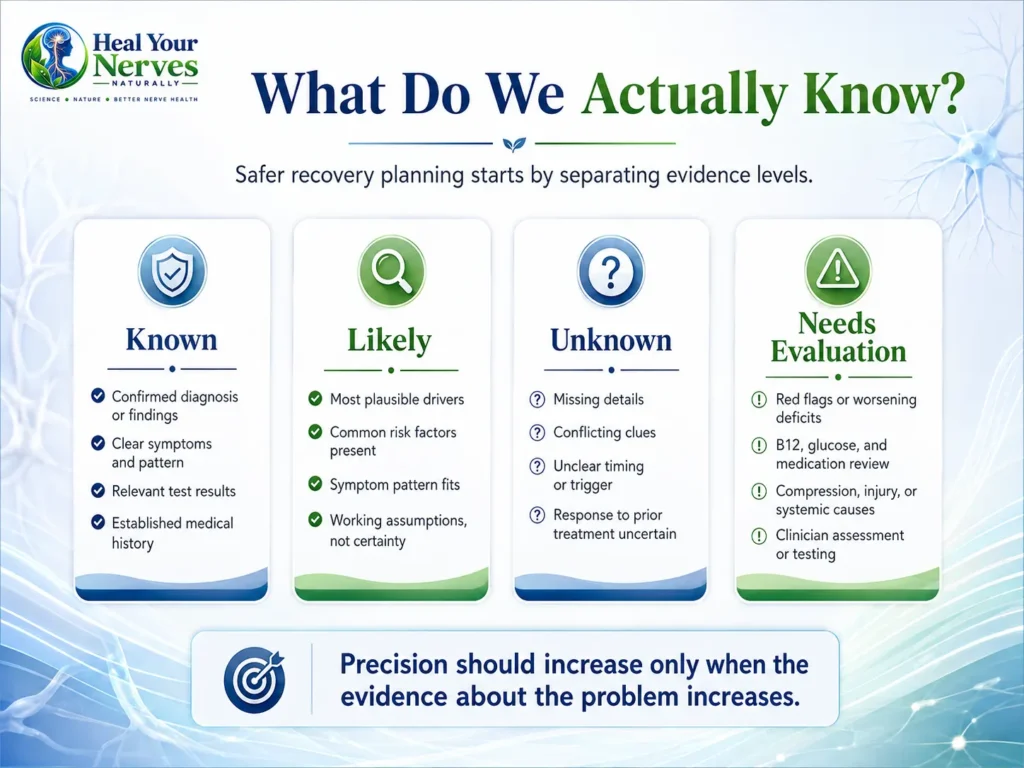
First, make four columns before choosing actions.
Known
What has been established by history, examination, tests or diagnosis?
Examples:
- confirmed diabetic neuropathy;
- documented vitamin B12 deficiency;
- imaging showing a relevant compression;
- a known traumatic nerve injury;
- a surgeon-defined post-operative state;
- abnormal nerve-conduction findings.
Likely or suspected
What is plausible but not confirmed?
For example, a work posture may seem to provoke symptoms. A medication may also be under review as a possible contributor. In another case, the pattern may suggest compression while the workup is still incomplete.
Unknown
What remains unexplained?
The cause of numbness? The significance of new weakness? Whether symptoms are arising from one problem or many?
Needs evaluation
Which unknowns could materially change the plan?
This is the most key column.
As a result, a recovery design becomes safer when it states uncertainty instead of quietly building around it.
Nerve Recovery Protocol Design Step 3 — Establish a Baseline
If you change five things on Monday and feel other on Friday, what changed the outcome?
Perhaps one action helped. other may have irritated the nerve. Symptoms may also have changed on their own. In addition, sleep or workload may have shifted.
Without a baseline, memory tends to rewrite the story.
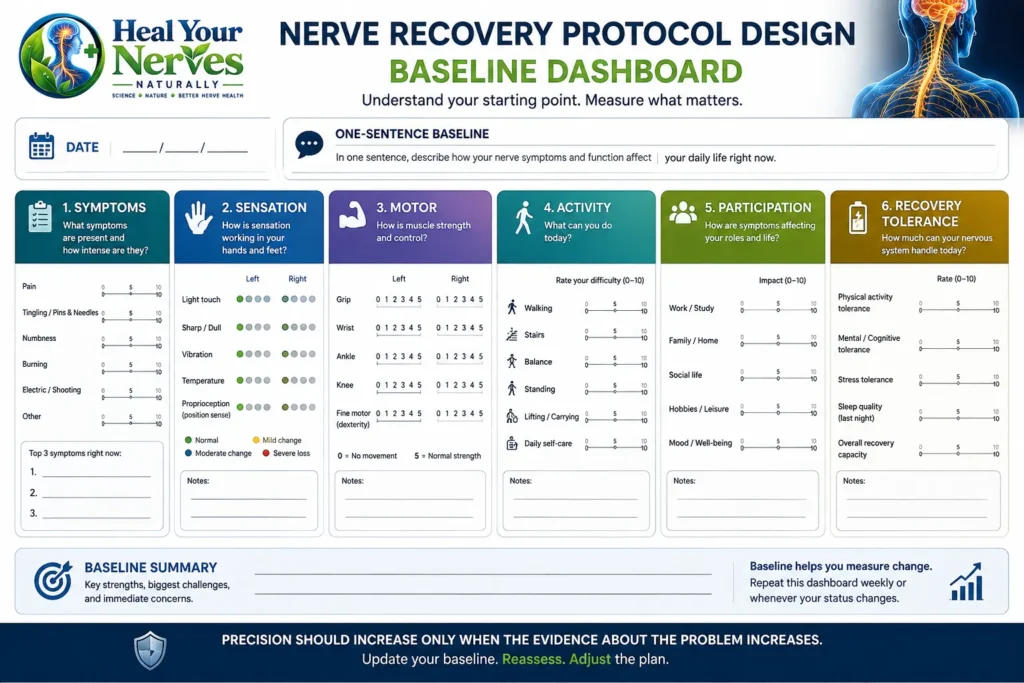
In fact, a baseline does not need to be complicated.
Symptoms
Record the main symptom and a simple description.
Examples:
- burning mainly at night;
- numbness across the outer foot;
- electric pain with one position;
- tingling after 30 minutes of sitting.
Sensory function
Is the numb area stable? Are you losing protective sensation? Are hot/cold sensations reliable?
Do not intentionally expose numb skin to potentially harmful temperatures or repeated painful testing.
Motor function
What can you control?
For example: grip, toe lift, ankle control, balance, finger dexterity or the ability to rise from a chair.
Activity
How much can you really do?
Walking time. Standing time. Typing. Cooking. Showering. Stairs. Driving. Exercise.
Daily Life
Which parts of life are affected?
For example: work, caregiving, hobbies, social activity or independence.
Recovery tolerance
What happens after the activity?
Do symptoms settle within minutes or hours? Are you near baseline by the next morning? Or does a routine task trigger a setback that lasts for days?
WHO’s International Classification of Functioning, Disability and Health supports this broader view by considering body function, activity, daily life and environmental context.
A simple baseline sentence
Try writing:
“Right now I can ______ for ______ before ______ changes, and I usually return to baseline after ______.”
That sentence is more useful for protocol design than “my neuropathy is bad.”
Step 4 — Identify the Dominant Constraint
In nerve recovery protocol design, the loudest symptom is not always the main barrier to progress. Therefore, identify what is limiting safety, function or recovery capacity most.
This may be the most useful design question on the page:
What is currently limiting progress the most?
However, the answer is not always the most painful symptom.
A biological or medical constraint
The root disease may not be controlled. A deficiency may still need treatment. In another case, major compression or active inflammation may be the main limit.
A mechanical constraint
A position, movement, repetitive exposure or structural problem continues to provoke the nerve.
Explore the site’s Mechanical Damage System when that is relevant.
A functional constraint
Strength, balance, range of motion, motor control or endurance limits what the person can do.
A recovery-capacity constraint
Sleep is severely disrupted. Workload is high. The person cannot recover between rehab sessions. The rest of life is consuming the same limited capacity.
An environmental constraint
The person lives alone, cannot access therapy, has an unsafe home environment, lacks transport, or has a job that cannot easily be modified.
A behavioral constraint
The plan is too complicated to follow. Fear has led to near-total avoidance. Good days repeatedly trigger large activity spikes. The person changes the plan every few days.
A knowledge constraint
No one has clearly explained the diagnosis, goal or reason for the actions.
NICE recommends a holistic rehab-needs review that includes physical health, impairment, day-to-day activity, work, relationships and useful activities. See NICE’s assessment and goal-setting recommendations.
Nerve recovery protocol design becomes more useful when it works on the dominant constraint instead of collecting more actions.
Nerve Recovery Protocol Design Step 5 — Set a Goal That Matters
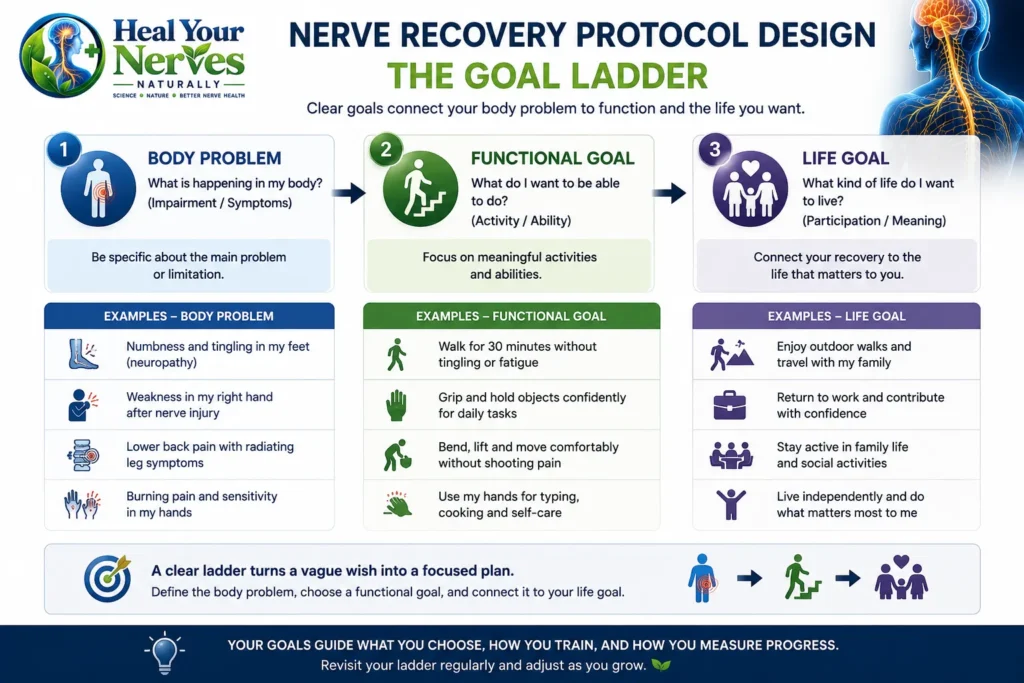
“Heal the nerve” is a hope. It is not yet a design target.
Therefore, a useful goal makes the plan easier to test.
Start with the body problem
Examples:
- ankle weakness;
- reduced protective sensation;
- burning pain at night;
- hand numbness;
- poor balance.
Translate it into a functional goal
Examples:
- improve foot clearance while walking;
- reduce falls;
- use kitchen tools safely;
- tolerate a work task;
- sleep for longer periods.
Translate it into a life goal
Examples:
- walk to the local shop independently;
- return to a full workday;
- cook dinner without needing help;
- drive safely after suitable clearance;
- return to a hobby.
NICE recommends collaborative goals that focus on what is most key to the person and on daily life in useful areas of life.
The Goal Ladder
Body concern → Functional target → Life outcome
For example:
weak ankle control → safer foot clearance → walk outside independently
or:
night burning → fewer sleep disruptions → function better at work
The action should be able to explain how it connects to that ladder.
Step 6 — Decide What Matters First
A strong nerve recovery protocol design gives each problem the right level of urgency. As a result, extra support does not crowd out safety, diagnosis or function.
A protocol can fail because every issue is treated as equally urgent.
So, use a priority matrix.
Safety-key
What could threaten health, nerve function or immediate safety?
So, safety comes before convenience.
Primary constraint
What currently blocks progress most?
key support
What does not drive the problem but materially improves the ability to recover or participate?
Can wait
What may be useful later but does not need attention now?
This is where the dedicated Healing Sequencing page becomes useful. Nerve recovery protocol design identifies that order is needed; Healing order goes deeper into ordering and dependencies.
A real-life example
Suppose someone has:
- new foot weakness;
- poor sleep;
- a list of supplements they want to try;
- a desire to start strength training.
The priority is not automatically the supplement list.
The change in motor function may need evaluation first. Sleep may matter for function and tolerance. Strength training may need to wait until the clinical case and suitable loading are clearer.
Good nerve recovery protocol design often means not doing the most interesting thing first.
Nerve Recovery Protocol Design Step 7 — Match the Plan to Capacity
A plan can be medically sensible and still be badly designed for the person who has to live with it.
This matters because capacity is not the same as motivation.
For example, someone may be highly motivated yet still have limited physical tolerance, severe sleep loss, a demanding job, caregiving duties or other health problem.
Ask what the person can recover from
A useful design question is:
“What level of demand can I currently absorb and recover from?”
However, this does not mean avoiding challenge forever. It means starting from the capacity you have now.
Capacity can be limited by more than the nerve
Examples include:
- poor sleep;
- pain that repeatedly interrupts activity;
- deconditioning;
- another illness;
- demanding physical work;
- prolonged sitting;
- caregiving;
- emotional stress;
- travel to appointments;
- limited food access;
- low confidence after a frightening flare.
A plan that ignores these factors may look disciplined on paper but collapse in ordinary life.
Capacity can also improve
Over time, better function, sleep, confidence and conditioning may allow a person to handle more.
That is one reason protocol design should include review rather than treating the first plan as permanent.
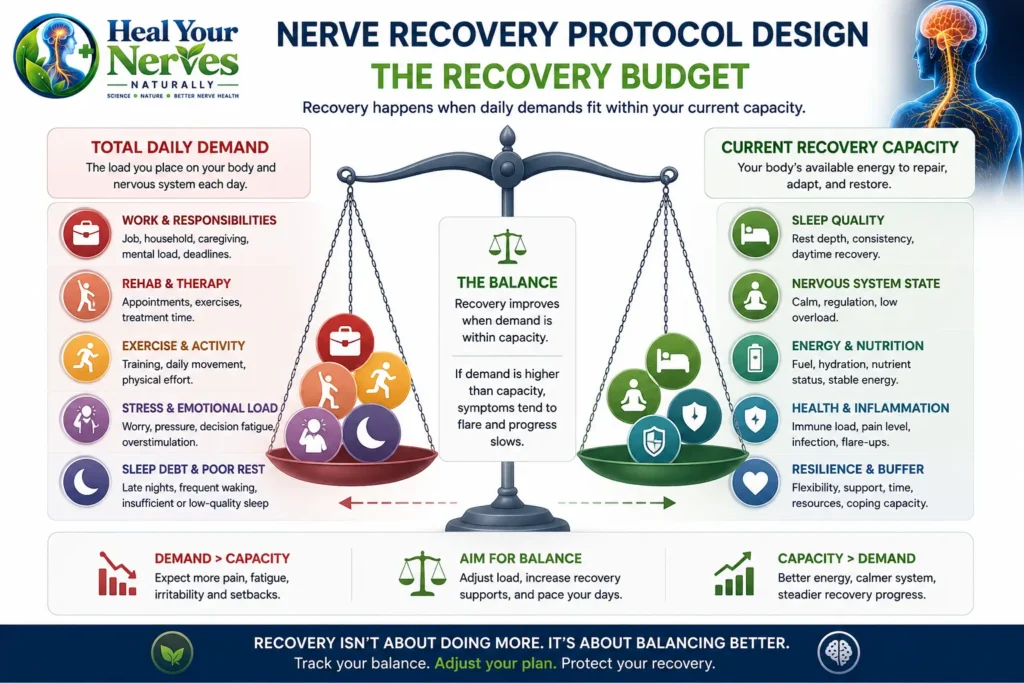
The Recovery Budget: Look at Total Demand, Not One Exercise
For nerve recovery protocol design, total daily demand matters more than one isolated task. In practice, work, exercise, poor sleep and family duties can add up.
Imagine your current recovery capacity as a budget.
This is not a biological equation. It is a practical way to notice that other demands can accumulate.
Your day might include:
commute + eight hours of work + stairs + rehab exercises + grocery shopping + poor sleep + family responsibilities
On its own, each item may be suitable.
Together, they may produce a very other response.
Physical load
Walking, lifting, standing, exercise, repetitive work and rehab tasks.
Sensory or mechanical exposure
Pressure, vibration, repetitive positioning, prolonged posture or environmental exposures relevant to the condition.
Cognitive and emotional load
Concentration, uncertainty, stressful work, fear, caregiving and pain-related vigilance.
Recovery opportunity
Sleep, breaks, nutrition, rest between tasks and the ability to change position.
So, the goal is not to calculate a perfect score.
Instead, notice when one type of demand keeps rising while the rest of the day is ignored.
For a deeper framework on this issue, continue later to Load Management.
Step 8 — Use Only the Complexity You Need
Good nerve recovery protocol design uses only the complexity the problem really needs. Therefore, every added component should have a clear job.
A good recovery plan does not need to be simple just for the sake of simplicity.
It should be as simple as the problem allows.
For example, some people need many forms of medical care, rehab and daily-life support. Complex problems may need complex plans.
The design goal is other:
Use enough complexity to address the key problems, but not so much that the plan becomes impossible to follow, understand or review.
Why unnecessary complexity hurts
It increases:
- cost;
- time burden;
- decision fatigue;
- supplement duplication;
- difficulty identifying what changed;
- risk that key actions are buried among extra ones;
- temptation to abandon the entire plan when one part becomes hard.
A five-action plan may be simpler than a two-action plan
If all five have clear roles, predictable timing and professional coordination, the plan may be coherent.
By contrast, two random actions that keep changing may be more confusing.
That is why minimum needed complexity is about organization, not an arbitrary number of treatments.
Nerve Recovery Protocol Design Step 9 — Choose Actions by Job
Before anything enters the protocol, ask:
What job does this action have?
If the answer is vague—“good for nerves”—the design is not finished.
Cause-directed job
The action addresses the root condition.
Protection job
It reduces ongoing mechanical stress, injury risk or other threat.
Symptom-control job
It reduces pain or other distressing symptom.
Functional job
It improves strength, balance, mobility, dexterity, endurance or task performance.
Recovery-support job
It supports a useful area such as nutrition, sleep, general health or daily routine.
Adaptation job
It helps the person function safely despite residual impairment.
This framework also makes internal linking cleaner.
For movement and function, use Movement Therapy.
For nutrition support, use Nutrition for Nerve Repair or the practical Nerve Food Repair guide.
When sleep is a major limit, use Sleep Recovery.
When stress, mental load or regulation is interfering with daily life, explore Mental Recovery and Nervous System Regulation.
Where circulation is clinically relevant, use Circulation and Oxygenation.
Nerve recovery protocol design does not need to become the full treatment page for any of those domains. Its job is to show why a domain is being selected.
Why Changing Everything at Once Can Hide the Answer
In nerve recovery protocol design, too many simultaneous changes can make feedback hard to understand. However, needed medical care should never be delayed just to create a cleaner self-test.
Suppose you begin:
- a new exercise plan;
- three supplements;
- a major diet change;
- a standing desk;
- a sleep aid;
- a massage routine.
Then you feel better.
What helped?
Now suppose you feel worse.
What caused it?
This is the interpretation problem.
One change at a time can improve clarity
When it is safe and practical, changing fewer variables can make the response easier to read.
But this principle has an key limit.
needed care should not be delayed for cleaner self-tracking
A clinician may appropriately start many coordinated treatments together. A diagnosed deficiency may need correction while rehab continues. A post-operative plan may include many simultaneous components.
Therefore, the goal is not experimental purity.
Instead, aim for enough clarity to understand the role of each component.
A practical compromise
When multiple changes are needed, document:
- what started;
- why;
- when;
- expected job;
- what you will monitor.
This creates a much better record than simply writing, “I started a nerve protocol.”
Step 10 — Sequence Dependencies
order is a core part of nerve recovery protocol design because some actions depend on safety, diagnosis, healing stage or functional readiness.
Some actions make more sense before others.
Others need to happen together.
Nerve recovery protocol design should ask:
What must be addressed before, alongside or after other priority?
Before
A safety or diagnostic issue may need attention before progress.
Alongside
Metabolic management and rehab may need to occur together rather than in separate “phases.”
After
A more demanding strengthening task may come after adequate motor control or recovery status is established in a specific injury.
A peer-reviewed review of traumatic peripheral nerve injuries describes rehab phases in which protection, range of motion, motor re-guidance, strengthening and endurance/function are linked to clinical or electrodiagnostic evidence of recovery. See the peripheral nerve injury rehabilitation review.
This does not mean every neuropathy should follow that post-injury sequence. It illustrates the principle that progress can depend on biological and functional readiness.
For the site’s dedicated order layer, see Healing Sequencing.
Nerve Recovery Protocol Design Step 11 — Define Dose and Load
The word “dose” is easy to associate only with medication.
In recovery engineering, dose can describe the amount of demand created by an action or activity.
Exercise dose
- frequency;
- duration;
- intensity;
- resistance;
- repetitions;
- complexity.
Work exposure
- duration;
- repetition;
- posture;
- force;
- vibration;
- breaks.
Rehab Task Dose
- difficulty;
- volume;
- assistance;
- range;
- speed;
- cognitive demand.
Behavior-change dose
Changing meals, sleep schedule, alcohol intake, activity routine and supplements all at once can create a large behavioral burden even if none is physically intense.
Recovery interval
How much time is available before the next major demand?
NICE specifically recommends considering the timing, intensity and frequency of actions and how they relate to one other in a coordinated nerve-related rehab plan.
That is a powerful reminder: an action is not defined only by what it is, but also by how much, how often and when.
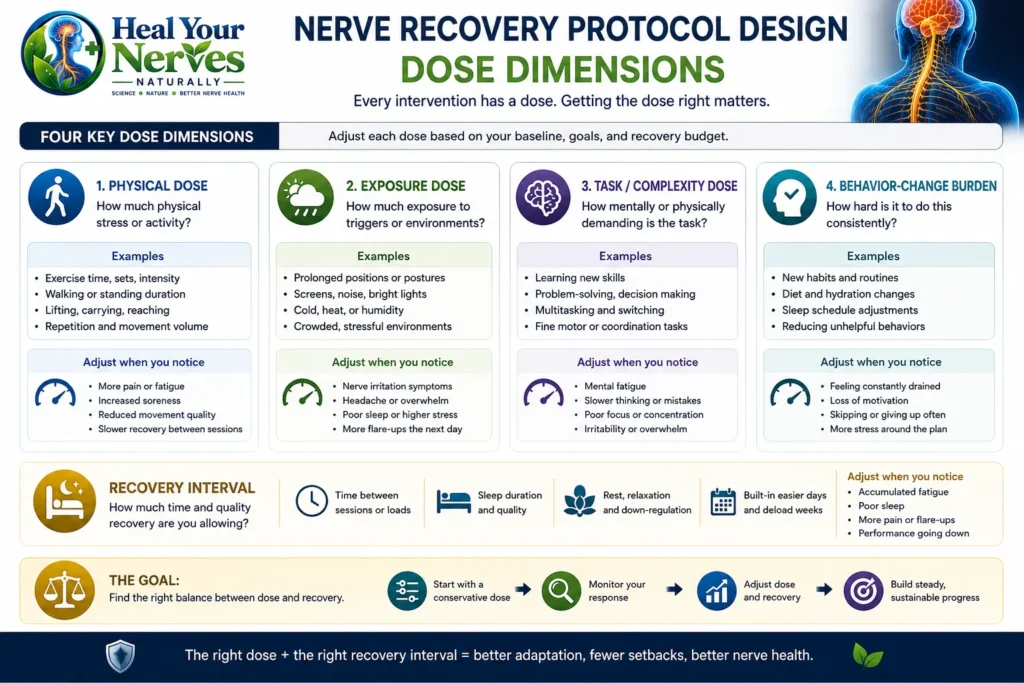
How Much Is Too Much?
This is where nerve recovery protocol design shifts from a fixed number to a response-based question. The useful dose depends on the condition, the task and what happens afterward.
This is one of the questions people most want a number for.
A universal number would be convenient. However, it would be unreliable across very other nerve conditions.
Instead, nerve recovery protocol design looks at response.
What happens during the activity?
Does motor control get worse? Is there a sharp rise in pain? Has numbness changed? Is balance unsafe?
What happens immediately afterward?
Are you functioning normally, or has the activity clearly reduced your ability?
What happens later?
Some responses are delayed.
For example, a session that feels easy at 10 a.m. may be followed by a hard evening.
What happens the next day?
Has the person returned toward baseline, or is there a sustained setback?
What happens across repeated sessions?
One unusual response may be noise. In contrast, a repeated pattern is more informative.
Function matters more than toughness
Importantly, the goal is not to prove that you can tolerate pain.
The question is whether the load is helping you move toward the functional goal without creating a pattern that suggests the plan needs review.
If you need a deeper dedicated framework for this, continue to Load Management.
Step 12 — Define progress criteria Before You Progress
In nerve recovery protocol design, progress should have a reason. Therefore, define what must be true before demand increases.
Many plans use time as the only signal:
“Do this for two weeks, then increase.”
Time can matter. However, time alone may not be enough.
In some peripheral nerve injuries, progress in rehab is connected to evidence of reinnervation, motor control and functional recovery. Mayo Clinic also notes that peripheral nerve injury treatment depends on the extent, cause and how well the nerve is healing. See Mayo Clinic’s peripheral nerve injury guidance.
A progress criterion answers:
“What would need to be true before we increase the demand?”
Depending on the condition and professional plan, this may involve:
- stable or improving motor control;
- adequate safety;
- better tolerance;
- recovery to baseline within an expected period;
- achievement of a functional milestone;
- clinician-defined post-operative criteria.
This is not permission to invent your own medical clearance
If a surgeon or therapist has given restrictions, those take priority.
So, the design lesson is simpler:
Progress because the relevant criteria support it—not because the calendar alone changed.
The dedicated Recovery Phasing page can take this stage logic deeper without turning Protocol Design into a duplicate.
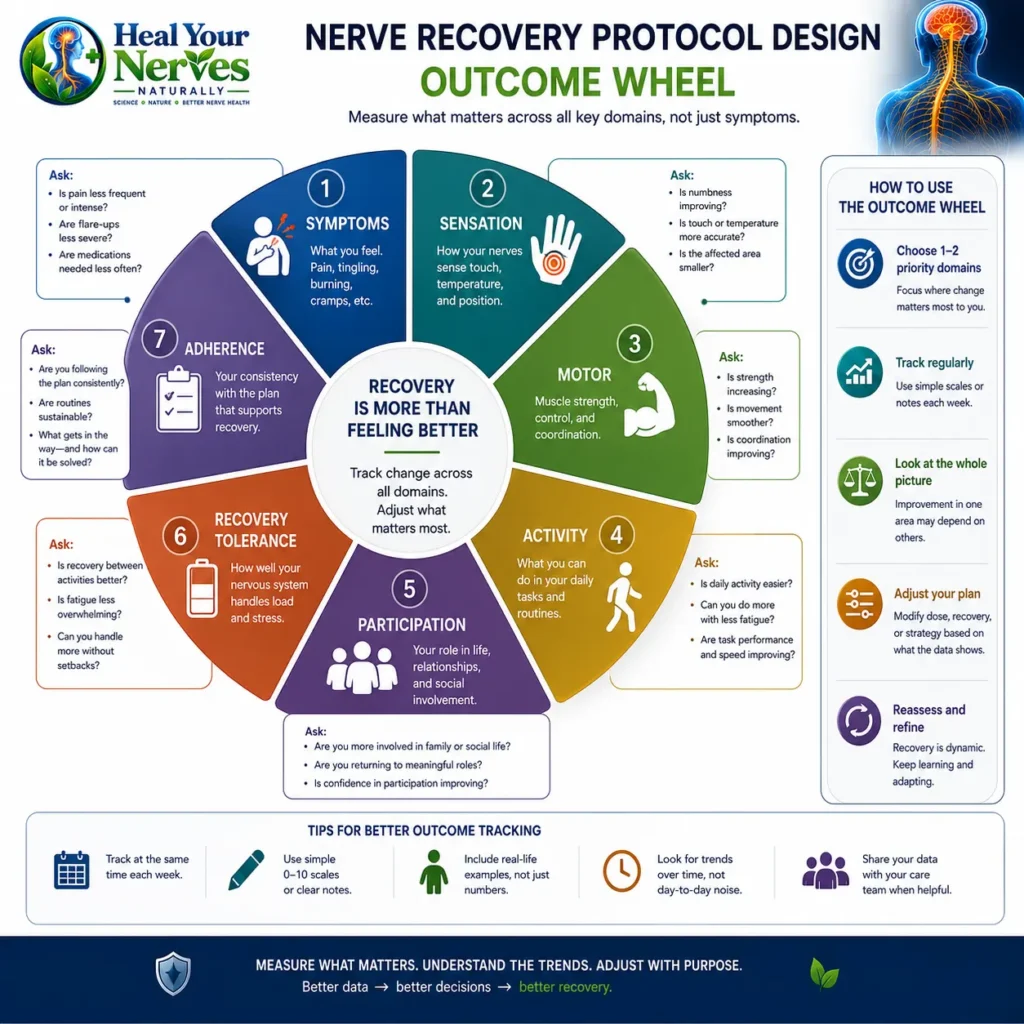
Nerve Recovery Protocol Design Step 13 — Decide What You Will Measure
Therefore, a plan is hard to judge if the outcome was never defined.
Use more than one domain.
Symptoms
Pain, burning, tingling, numbness, allodynia.
Sensation
Area, protective sensation and relevant sensory changes.
Motor control
Strength, coordination, foot clearance, grip, dexterity.
Activity
Walking, standing, stairs, typing, lifting, cooking, exercise.
Daily Life
Work, family roles, hobbies, social activity, independence.
Recovery tolerance
How well the person recovers after demand.
This mirrors a broader rehab philosophy: the goal is not just to reduce an impairment but to improve or protect useful function and daily life.
Add one measure of adherence
Did the person really follow the plan?
A plan cannot be judged fairly if it was never realistically delivered.
When Symptoms and Function Tell other Stories
A major strength of nerve recovery protocol design is that it separates symptoms from function. That prevents one better or worse symptom score from controlling the whole decision.
This is where nerve recovery protocol design becomes more useful than a symptom diary.
Imagine four people.
Pain is lower, but walking is worse
That is not a simple “improvement.”
Perhaps pain treatment is working while weakness, balance or other problem is progressing. The functional decline changes the interpretation.
Pain is unchanged, but walking tolerance is better
That may still represent useful recovery progress.
The person can do more even though the symptom score has not moved much.
Tingling is stronger, but motor control is improving
The sensory change alone does not prove healing or getting worse. You need the larger trend.
Pain is better, but numbness is spreading
Again, the positive symptom change should not erase a potentially key nerve-related change.
The design rule
So, one metric cannot tell the whole recovery story.
This is why the HYN protocol framework tracks symptoms, sensory change, motor control, activity, daily life and recovery tolerance separately.
Nerve Recovery Protocol Design Step 14 — Decide What Each Response Means
As a result, a plan is easier to use when decision rules are set before a hard week.
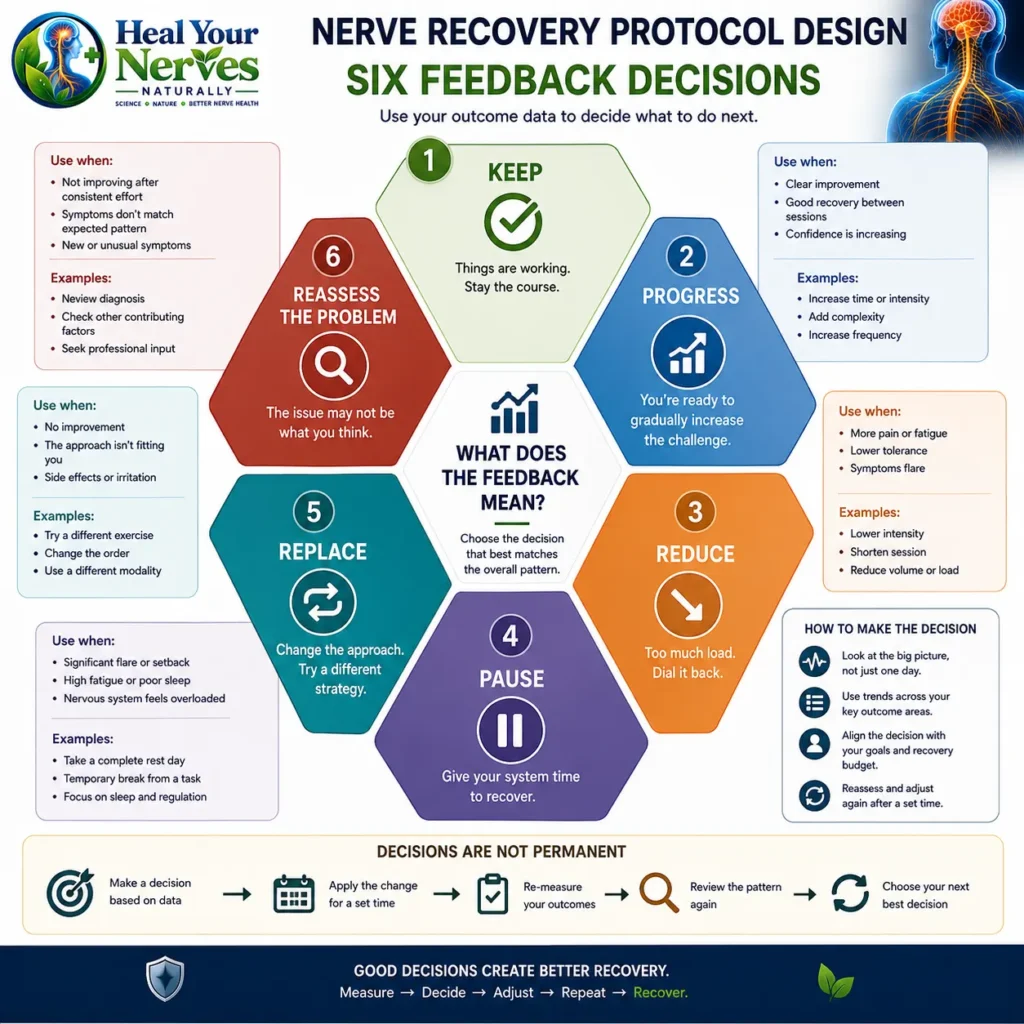
Every key action should eventually face one of six decisions.
KEEP
The action still has a clear job, remains tolerable and appears suitable to continue.
PROGRESS
The relevant criteria support a carefully increased challenge.
REDUCE
The action may still be useful, but the current dose or exposure seems too high.
PAUSE
The action needs to stop temporarily while the response, safety or clinical case is clarified.
REPLACE
The action is not meeting its intended job, is not feasible, or another approach is more suitable.
REASSESS THE PROBLEM
This is the most key option.
Sometimes the action is not the real issue. The original assumption about the diagnosis, dominant constraint, goal or phase may be wrong.
A sophisticated protocol is willing to question its own starting model.
Is This Noise, a Trend, or a Warning Signal?
Useful nerve recovery protocol design does not react to every fluctuation in the same way. Instead, it separates one-off noise, repeated trends and warning signals.
However, not every change deserves the same reaction.
Noise
A single unusual day.
Poor sleep, a long commute, an unrelated illness, stress, weather, an unusually active day or random symptom variability can change how you feel.
Still, noise may not justify redesigning the whole plan.
Trend
A repeated directional change.
Examples:
- walking tolerance has fallen for three weeks;
- grip has gradually improved;
- numbness is consistently spreading;
- the same activity repeatedly creates the same delayed flare;
- recovery time after work is getting shorter.
Trends deserve attention because they are harder to dismiss as random variation.
Warning signal
A clinically concerning change that should not wait for more self-tracking.
Examples can include progressive weakness, major gait deterioration, major new sensory loss, bowel or bladder changes, saddle-area numbness or other acute nerve-related changes.
The boundary between “track it” and “get assessed” is a core safety feature of nerve recovery protocol design.
Do not turn self-monitoring into surveillance
There is a downside to tracking too much.
If you rate every sensation every hour, normal fluctuation can become the center of your day.
So, a useful protocol measures enough to make decisions—not so much that monitoring becomes other burden.
What Does a Flare really Tell You?
In nerve recovery protocol design, a flare is information. However, it is not automatically proof of healing, harm or a specific diagnosis.
A flare is a response. Therefore, it is not automatically a diagnosis.
A rise in symptoms can mean many things:
- the total activity load exceeded current tolerance;
- a particular mechanical trigger was repeated;
- sleep or other recovery factor was poor;
- a new action changed symptoms;
- the root condition is fluctuating;
- the response is part of a broader getting worse pattern.
So, the correct interpretation depends on context.
Ask five questions
- What changed before the flare?
- Did function also worsen?
- How long did the change last?
- Has this happened with the same trigger before?
- Is the overall trend still improving, stable or getting worse?
Do not use “flare” to explain away a warning sign
If new weakness or major nerve-related decline is present, the safest response is not to assume it is merely a recovery flare.
Good Days Can Produce Bad Protocol Decisions
Good nerve recovery protocol design uses better days as data, not as permission to double every demand at once.
A good day can feel like permission.
You slept better. Pain is lower. Walking feels easier. So you double your steps, catch up on chores, add an exercise session and stay on your feet for hours.
Then the next day is hard.
This pattern is common enough that it deserves a design rule.
Progress from the trend, not the excitement
A good day is useful evidence that capacity may be changing.
It is not proof that your safe load has doubled overnight.
Protect the gain
When function improves, consider increasing one useful variable rather than every variable at once.
That makes the response easier to understand.
Do not fear good days
Instead, the answer is not to avoid activity whenever you feel better.
It is to use better days as part of a progress strategy rather than an all-or-nothing test.
Bad Days Can Produce Bad Protocol Decisions Too
Likewise, nerve recovery protocol design should not collapse after one hard day. First, ask whether the broader trend or function really changed.
Likewise, a bad day can make the whole plan feel wrong.
You may want to stop walking, stop rehab, cancel work and wait until every symptom disappears.
That can be just as reactive as overdoing it on a good day.
First, check the trend
Was it one day or the start of a repeated pattern?
Next, check function
Did you lose strength, balance or control—or did the symptom feel worse while function remained stable?
Then, look at what came before it
Was there a clear change in sleep, workload, activity, illness or routine?
Use the pre-defined decision rule
So, if the plan already says what would trigger a reduction, pause or review, you are less likely to redesign everything while distressed.
Step 15 — Before Calling the Plan a Failure, Check Whether It Was really Usable
Real-world nerve recovery protocol design must fit the person who has to live with it. A plan that cannot be followed is not a successful plan on paper or in practice.
In practice, a plan that looks perfect but cannot be followed is not well designed.
NICE’s nerve-related rehab guidance recommends that plans reflect the person’s goals, preferences, work, home and real-life setting. It also recommends considering who will deliver actions and how they will fit together.
This matters because adherence is not only about discipline.
Was there enough time?
A person working full-time may not have two spare hours every evening.
Was the plan understandable?
If the person cannot explain why an action is being done, adherence often becomes mechanical.
Was the plan affordable?
Specialist foods, repeated private treatments, devices and supplements can make a plan unsustainable.
Was transport available?
A clinic-based plan can fail because getting to the clinic is hard.
Did the plan fit work?
A posture-change strategy that requires a break every ten minutes may be unrealistic in some jobs unless the workplace can be modified.
Did symptoms create fear?
Someone who has experienced a severe flare may need a graded confidence-building approach rather than repeated instructions to “just move more.”
Was the person asked what matters?
A person is more likely to engage with a goal that returns something useful to life.
The 2025 NICE guideline explicitly recommends goals that focus on daily life in the aspects of life most key to the person. Review the NICE goal-setting recommendations.
When the Plan Is Not Working, Diagnose the Plan
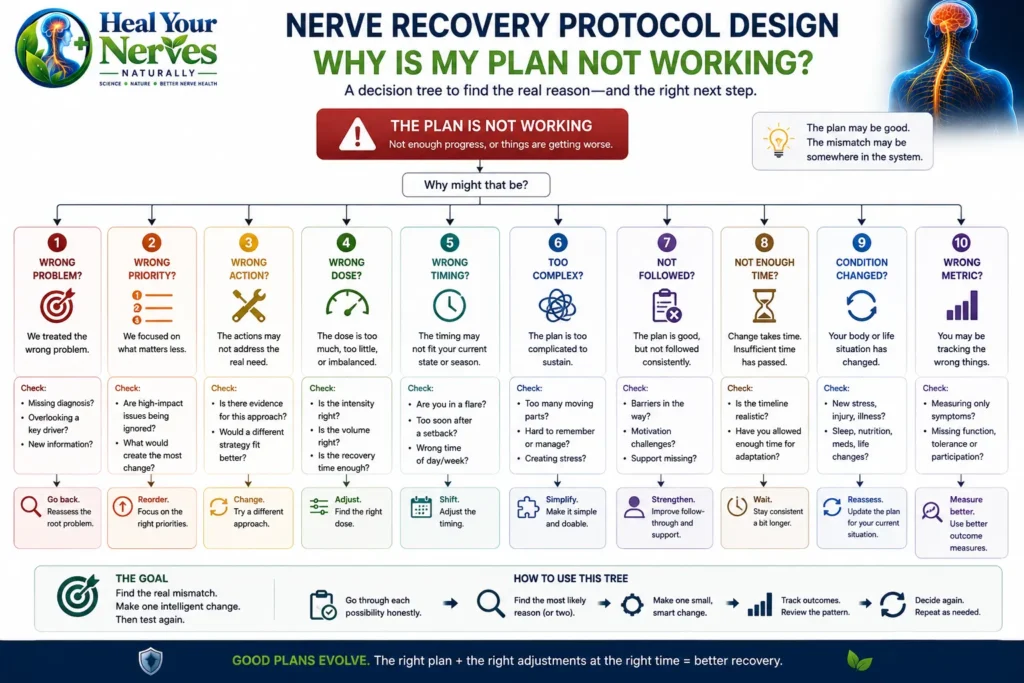
When nerve recovery protocol design is not producing the expected result, do not automatically add more treatment. Instead, inspect the assumptions, priority, dose, timing and outcome measure.
Therefore, do not jump straight to “I need a stronger action.”
Walk through the failure points.
Wrong problem?
Perhaps the plan was built around pain while the main functional issue is motor weakness.
Wrong assumption?
Maybe a presumed mechanical trigger is not the whole explanation.
Wrong priority?
An extra support action may be getting more attention than an unresolved medical cause.
Wrong action?
The selected action may not address the intended target.
Wrong dose?
The action may be suitable but too much—or too little—to be useful.
Wrong timing?
A demanding action may have been introduced before the person was ready for it.
Too much complexity?
The person may be spending so much effort managing the plan that normal life becomes harder.
Poor fit with daily life?
A technically suitable plan can fail because it cannot survive the person’s work, family or financial reality.
Not enough time?
Nerves can recover slowly. Some outcomes should not be expected quickly.
Mayo Clinic notes that maximal recovery after some peripheral nerve injuries may take many months or years, and regular checkups are used to monitor whether recovery is on track.
The condition changed?
A new nerve-related pattern can make the previous plan obsolete.
Wrong outcome measure?
Pain may not change even while function improves.
The failure analysis is one of the strongest reasons to review a protocol rather than simply accumulate more treatments.
Plateaus Are Information, Not a Diagnosis
A plateau is also useful feedback for nerve recovery protocol design. It can point to slow biology, the wrong load, an unresolved constraint, a narrow outcome measure or a changed recovery picture.
A plateau can feel like a verdict. However, it is not.
A period of little clear change may mean:
- the biology of recovery is slow;
- the current load is no longer challenging enough;
- the load is too high to tolerate consistently;
- a constraint has not been addressed;
- the outcome measure is too narrow;
- the person has reached a useful functional level even though symptoms persist;
- the diagnosis or prognosis needs review.
A plateau should generate a question, not an automatic conclusion.
Ask what really plateaued
Pain? Strength? Walking? Sensation? Work capacity? Recovery time?
other plateaus may have other meanings.
Compare with the starting goal
If the original goal was to walk safely to the local shop and that has been achieved, a stable pain score does not mean the plan did nothing.
Reassess when the plateau is unexpected
If function should be improving but is clearly not, or if new deficits appear, professional review may matter more than adding another self-directed therapy.
Nerve Recovery Protocol Design for Work, Family and Ordinary Life
This section matters because most recovery decisions happen between appointments.
The desk worker
Potential design questions:
- How long can the person work before symptoms change?
- Is a certain position consistently provocative?
- Can tasks be alternated?
- Can breaks be built around work rather than added as other impossible requirement?
- Is the workstation the problem—or only one piece of the problem?
Useful internal pathway: Movement, Posture and Nerve Regulation.
The physical worker
Potential questions:
- Which tasks involve force, vibration, prolonged standing or repetitive load?
- Which functions are safety-key?
- Can duties be temporarily modified?
- What would a graded return to full demand require?
The caregiver
A caregiver may not be able to “rest for a week.”
The protocol may need to prioritize safe ways to perform essential tasks, recruit temporary help and avoid adding a burdensome routine that cannot be sustained.
The shift worker
Sleep and meal timing may be inconsistent.
A plan built around perfect morning routines may fail immediately.
The person with limited rehab access
Home-based strategies, telehealth where suitable, community resources, guidance and carefully chosen priorities may matter more than an idealized clinic schedule.
The person with limited budget
The framework should distinguish high-priority care from extra products.
Expensive complexity should not be mistaken for advanced protocol design.
The person rebuilding confidence
Fear can shrink activity even after some physical capacity has returned.
The plan may need to include safe, useful re-engagement with daily life rather than focusing only on symptom avoidance.
Nerve recovery protocol design becomes credible when it can survive an ordinary Tuesday afternoon, not only a perfect recovery day.
What If More Than One Cause or Constraint Is Present?
Mixed problems are common, so nerve recovery protocol design should allow more than one cause or constraint to be active at the same time.
In real life, many recovery problems are not clean.
A person can have diabetes and a focal nerve compression. Another may have a previous injury, poor sleep, low activity and a medication that complicates symptoms. Someone can have a documented deficiency but also a mechanical problem that the deficiency does not explain.
Nerve recovery protocol design becomes more useful, not less useful, when the picture is mixed.
Do not force one cause to explain everything
Ask which findings fit each known or suspected contributor.
A length-dependent numbness pattern may not behave like a single focal compression. A local positional trigger may still matter even when a systemic neuropathy is present.
Prioritize by consequence
Which issue is most likely to:
- cause ongoing damage;
- threaten safety;
- limit function;
- block other action;
- require disease-specific treatment?
Let other actions have other jobs
One part of the plan may address metabolic control. A second may reduce mechanical exposure. Balance or walking may need a separate focus. In addition, better sleep may help the person take part in rehab.
The point is not to find one magical explanation. It is to prevent the protocol from becoming a confused pile of treatments.
For deeper cause-level thinking, use Root Causes of Nerve Damage and the relevant condition pages.
Build the Plan in Layers: Non-Negotiable, Core, Supportive and Experimental
Layering makes nerve recovery protocol design easier to simplify without losing what matters most. It also keeps extra products below safety-key and core care.
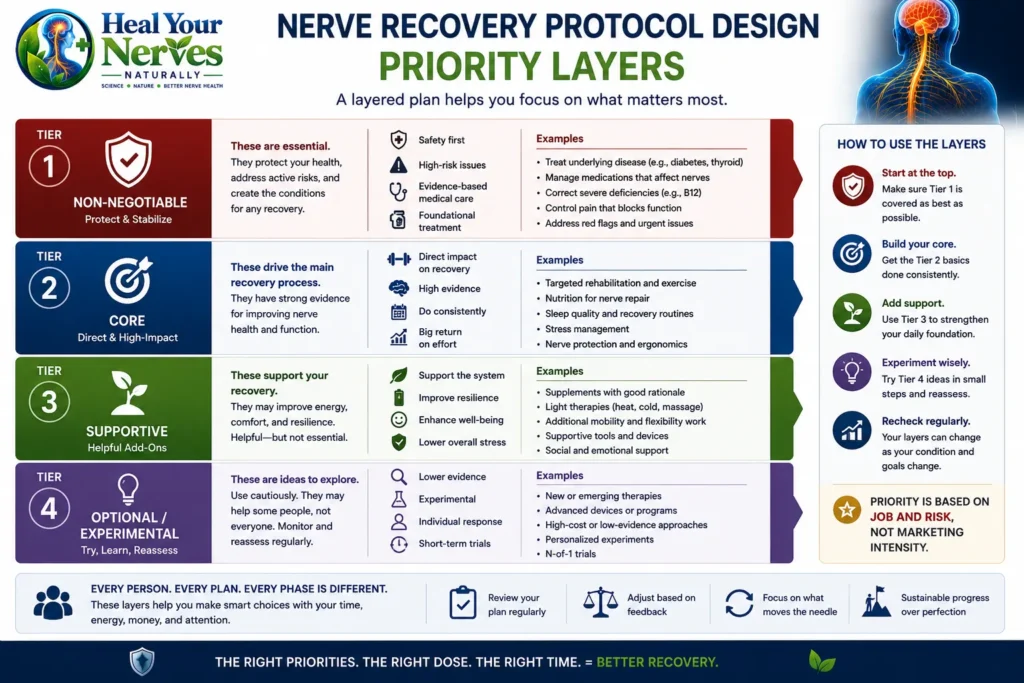
A useful way to reduce confusion is to label each component by how essential it is.
Non-negotiable
These are safety-key or medically needed elements.
Examples may include disease-specific treatment, post-operative restrictions, foot protection with major sensory loss, or clinician-defined precautions.
Core
These directly support the main functional goal.
A balance program, work modification, motor retraining or a specific rehab task may belong here depending on the condition.
Supportive
These improve the broader environment for recovery or daily life.
Sleep support, practical nutrition, general conditioning and routine management may fit here when relevant.
Experimental or extra
These are ideas with unclear personal value that may be suitable to test only when safety, cost and evidence boundaries are clear.
This layered structure makes it easier to answer a question people often struggle with:
“If I am overwhelmed, what can I simplify without losing the part that matters most?”
It also protects against separate problem: extra products gradually becoming more key than the actions that address the actual cause or function.
Choose a Feedback Window That Matches the Question
Timing matters in nerve recovery protocol design because other outcomes change at other speeds. Therefore, the review window should match both the outcome and the level of risk.
Not every outcome changes on the same timescale. Therefore, the review window matters. Reviewing too early can make a useful plan look ineffective. Reviewing too late can allow a poor fit to continue.
Some responses are immediate
A position change may alter a mechanical trigger quickly. A brace may change walking safety immediately. A medication side effect may appear soon after a change.
Some responses need repeated exposure
Work tolerance, conditioning, balance confidence and movement skill may need repeated practice before a pattern is clear.
Some biological outcomes are slow
Peripheral nerve recovery after major injury can take months or longer. Mayo Clinic notes that maximal recovery may take many months or years in some cases.
Some outcomes should not be “waited out”
Progressive weakness, major gait change or other concerning nerve-related decline belongs in review—not in a long experiment.
The practical rule is:
Match the review window to the outcome you are measuring and the level of risk.
This keeps protocol review from becoming either impatient or passive.
Write Down the Reason Before You Change the Plan
A written reason strengthens nerve recovery protocol design because it preserves the logic behind each change.
When a protocol changes, record one sentence:
“I am changing ______ because ______, and I will judge the change by ______.”
Examples:
“I am reducing this walking dose because the same amount has produced a repeated next-day loss of function, and I will judge the change by walking tolerance and recovery time.”
“I am keeping the sleep routine unchanged because sleep continuity improved and the routine is sustainable.”
“I am seeking review rather than adding other exercise because weakness is progressing.”
Over time, this small habit creates a record of reasoning.
Months later, you do not have to rely on memory to reconstruct why the plan changed.
That is what turns nerve recovery protocol design from a sequence of reactions into a learning system.
Shared Decisions: Where Self-Observation Ends and Clinical Care Begins
Safe nerve recovery protocol design also defines which decisions can be observed at home and which ones need professional input.
A protocol can include things you observe yourself. It can also include decisions that belong with a clinician, therapist or other qualified professional.
So, keeping that boundary clear is part of good nerve recovery protocol design.
suitable self-observation
You can often track:
- symptom timing;
- activity tolerance;
- sleep disruption;
- work triggers;
- how long a flare lasts;
- which daily tasks are easier or harder;
- whether a plan is practical enough to follow.
Decisions that may need professional input
Depending on the case, professional input may be needed for:
- diagnosis;
- progressive weakness;
- major sensory loss;
- medication changes;
- supplement-drug interactions;
- post-operative restrictions;
- whether surgery is indicated;
- disease-specific treatment;
- interpretation of electrodiagnostic testing;
- assistive devices or rehab progress;
- return-to-driving or safety-key work questions.
NICE recommends collaborative rehab planning, with the person involved in decisions and practitioners coordinating when multiple needs are present. That is not a loss of independence. It is a way of matching the decision to the level of expertise it requires.
Three Worked Protocol-Design Examples
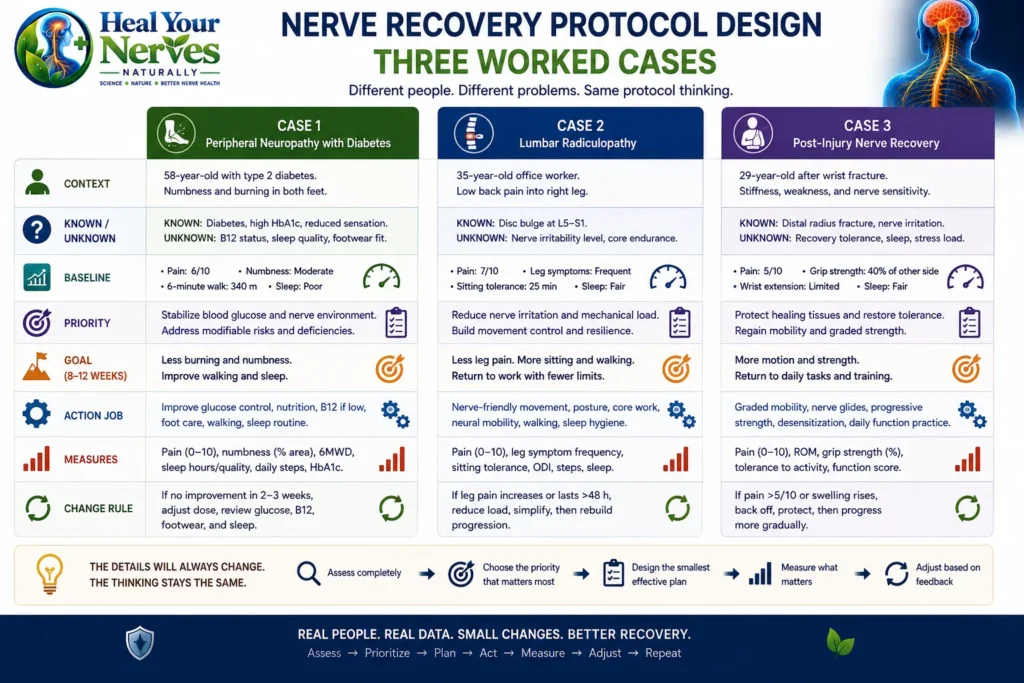
The examples below show nerve recovery protocol design as a reasoning process, not as a treatment prescription.
These examples are educational. In other words, they show the reasoning process, not a treatment prescription.
Example 1 — Desk work, hand tingling and suspected compression
Context: Symptoms increase during long computer sessions. The person is worried because grip sometimes feels weaker.
What is known: Symptoms are position-related.
What remains unclear: Whether there is a clinically major nerve compression and whether the perceived weakness is objective.
Baseline: Tingling starts after about 40 minutes of uninterrupted work. Grip-intensive household tasks feel harder by evening.
First priority: Clarify the nerve-related picture and reduce unnecessary provocation while continuing suitable daily function.
Life goal: Complete a workday without progressive hand dysfunction.
Possible action jobs: Workstation changes may reduce exposure; task variation may change mechanical load; therapy may address function if indicated.
What to measure: Symptom onset time, grip function, work tolerance, any spread of numbness or progress of weakness.
What would change the plan: Clear motor decline, persistent sensory expansion or findings that identify a another cause.
Internal path: Nerve Compression → Mechanical Damage System → Load Management.
Example 2 — Diabetic neuropathy and low walking confidence
Context: Both feet are numb. The person is less active because walking feels unclear and is worried about falling.
What is known: Diabetes and diagnosed peripheral neuropathy.
Baseline: Walking is limited more by confidence and balance than by pain. Foot sensation is reduced.
First priorities: Disease management with the healthcare team, foot safety and maintaining useful mobility.
Life goal: Walk to nearby shops safely and regularly.
Possible action jobs: Diabetes care addresses the root metabolic context; footwear and foot checks address safety; rehab may address balance and mobility; activity supports general health and daily life.
What to measure: Falls or near-falls, walking tolerance, foot injuries, balance, activity recovery, ability to complete the target trip.
What would change the plan: New weakness, getting worse gait, new foot injury or major change in sensory pattern.
Internal path: Diabetic Neuropathy → Metabolic Damage System → Movement Therapy.
Example 3 — Post-injury nerve recovery with returning movement
Context: Movement is beginning to return after a major peripheral nerve injury. The person wants to start heavy strengthening immediately.
What is known: A specific nerve injury has been diagnosed and is being followed clinically.
Baseline: Early voluntary movement has returned, but control and endurance are limited.
First priority: Match rehab to the biological and functional stage defined by the treating team.
Life goal: Regain useful limb function for work and self-care.
Possible action job: Motor retraining may come before higher-load strengthening if control and reinnervation are still developing.
What to measure: Motor control, range of motion, functional use, clinician-defined signs of recovery, fatigue and compensatory movement.
What would change the plan: Failure to progress as expected, new pain or nerve-related change, or updated clinical findings.
A review of traumatic peripheral nerve injury rehab describes progress from protection and range-of-motion work toward motor re-guidance, strengthening and endurance/function as recovery status changes. Read the peer-reviewed rehabilitation review.
Internal path: Post-Injury Nerve Damage → Axonal Regrowth → Recovery Phasing → Adaptation Engineering.
Your Nerve Recovery Protocol Design Canvas
Use this as the main return tool for the page.
Do not fill every box with perfect language. The goal is to make the logic clear.
| Design question | Your current answer |
|---|---|
| What problem matters most now? | |
| What is known about the cause? | |
| Which parts remain unclear? | |
| Where is my baseline now? | |
| Which function or life goal matters most? | |
| Main constraint right now | |
| First priority | |
| Action or support domain with a clear job | |
| How much load or exposure is realistic now? | |
| Which outcomes will I measure? | |
| How will I define useful progress? | |
| When should I reduce or pause? | |
| When should I seek professional review? |
The most key box is the last one
A recovery plan is safer when the escalation rule is defined before a hard change occurs.
<!– IMAGE 12 PLACEHOLDER PLACEMENT: After Protocol Design Canvas CONCEPT: Full-page printable “Protocol Design Canvas” with the 13 fields above and a date/review-date line. SUGGESTED FILENAME: nerve-recovery-protocol-design-canvas.webp SUGGESTED ALT: Printable Nerve Recovery Protocol Design canvas for planning goals, load, measures and reassessment –>
Your Weekly Nerve Recovery Protocol Design Review
In practice, a weekly review is often more useful than reacting to every sensation.
Use the same questions.
What improved meaningfully?
Not just “pain was lower on Tuesday.”
What changed in function, daily life or recovery tolerance?
What stayed the same?
Still, stability can matter, especially if the condition had been getting worse.
What became worse or other?
Describe the change.
What did I really follow?
Do not evaluate a plan you did not really use.
What was too hard to sustain?
Time? Cost? fatigue? work? complexity? fear?
What did I change that may have affected the result?
New medication, supplement, exercise, work schedule, illness, travel, sleep pattern?
What decision follows from the pattern?
Keep, progress, reduce, pause, replace or reassess?
What is my next review date?
A protocol that is never reviewed slowly turns into a habit—even if the case has changed.
<!– IMAGE 13 PLACEHOLDER PLACEMENT: After Weekly Protocol Review CONCEPT: Weekly review card: Better / Same / Worse / Different + Followed? + Burden? + Decision + Next Review Date. SUGGESTED FILENAME: nerve-recovery-protocol-design-weekly-review.webp SUGGESTED ALT: Weekly nerve recovery protocol review for better, same, worse or different changes –>
When Nerve Recovery Protocol Design Should Stop and Review Should Start
Some changes should not be treated as a normal feedback experiment.
Seek prompt professional review for major new or getting worse nerve-related changes such as:
- new or progressive weakness;
- major change in gait or balance;
- repeated falls associated with nerve-related decline;
- sudden or rapidly spreading sensory loss;
- new bowel or bladder dysfunction;
- saddle or groin-area numbness;
- serious nerve-related symptoms after trauma;
- major autonomic changes such as fainting;
- symptoms suggesting stroke or other emergency.
This is not an exhaustive list.
If symptoms are sudden, severe or potentially life-threatening, emergency care is more suitable than waiting for a protocol review.
Nerve recovery protocol design is useful only inside its proper boundary.
Where Nerve Recovery Protocol Design Hands Off to the Rest of the Site
This page is the orchestrator, not the final destination for every question.
Need the broad recovery framework first? Return to Nerve Recovery Protocols.
To decide “What should come first, second and later?”, continue to Healing Sequencing.
When the question is “How should priorities change as recovery changes?”, use Recovery Phasing.
For “How much activity or rehab load is suitable?”, use Load Management.
To answer “How do we organize and understand feedback?”, continue to Feedback Systems.
For “Why should the plan differ from one person to other?”, use Personalization.
To explore “How do we gradually build capacity?”, continue to Adaptation Engineering.
For “How do many domains work together?”, use Integration.
Finally, for “How do we protect gains over time?”, continue to Stability.
Finally, the point is not to read every page at once.
Instead, identify the next decision you really need to make.
Evidence and Further Reading
The evidence base below supports the review, goal-setting, rehab, function and review principles used in this nerve recovery protocol design guide.
The following sources support the rehab-planning, function, goal-setting, nerve-injury and review principles used in this guide:
- NICE — Rehabilitation for chronic neurological disorders including acquired peripheral nerve disorders
- NICE — Assessing rehabilitation needs and goal setting
- NICE — Rehabilitation planning and delivery
- NICE — Rationale and impact for coordinated rehabilitation planning
- WHO — International Classification of Functioning, Disability and Health
- WHO — Rehabilitation and Functioning in the 2030 Agenda, July 2026
- Mayo Clinic — Peripheral nerve injuries: diagnosis and treatment
- NINDS — Peripheral Neuropathy
- Assessment, management and rehabilitation of traumatic peripheral nerve injuries
- Characteristics of goal-setting tools in adult rehabilitation: scoping review