
Lifestyle Degeneration
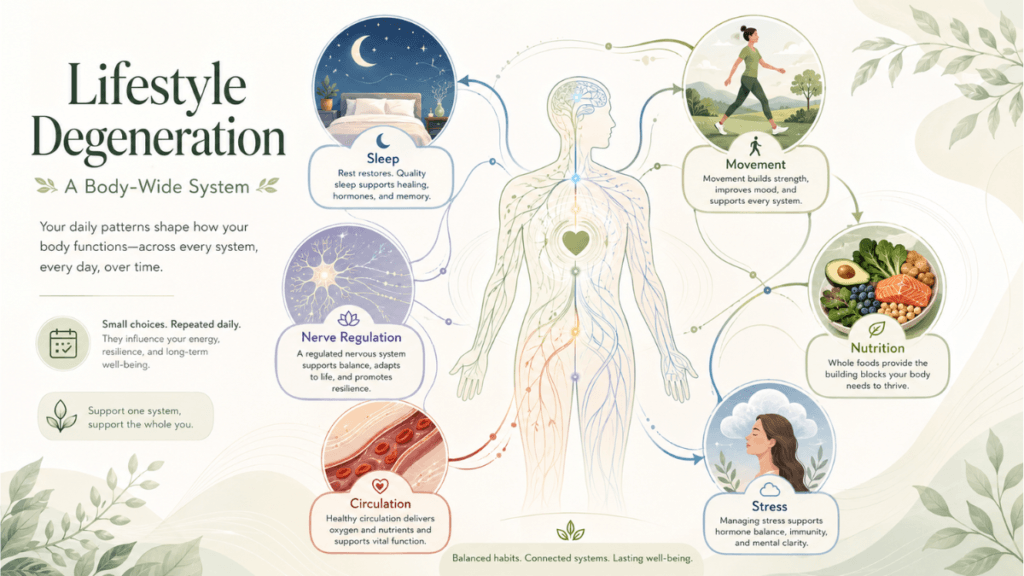
Lifestyle Degeneration is an educational way to understand how repeated daily patterns may gradually influence the body’s regulation systems, energy balance, tissue resilience, and nerve sensitivity. It does not describe one single disease. Instead, it looks at how habits, stress load, movement patterns, sleep rhythm, nutrition quality, recovery time, and environmental demands may interact over time.
From a nerve health perspective, this topic matters because nerves do not function in isolation. They depend on circulation, metabolism, inflammation balance, stress regulation, oxygen delivery, nutrient availability, and repair capacity. Therefore, when daily life repeatedly places pressure on these systems, nerve-related experiences may become easier to understand through a wider body-system lens.
However, Lifestyle Degeneration should not be viewed with blame or fear. Many patterns develop slowly because of work pressure, poor sleep, long sitting, emotional stress, limited movement, irregular eating, or lack of recovery time. For this reason, this page explains Lifestyle Degeneration as a calm educational framework, not as a diagnosis, treatment plan, or personal failure.
Quick Navigation
What Is Lifestyle Degeneration?
Lifestyle Degeneration refers to the gradual decline in system resilience that may happen when daily patterns repeatedly place stress on the body without enough recovery support. In simple terms, it describes how the body may become less adaptable when sleep, movement, nutrition, stress regulation, posture, hydration, and rest are repeatedly out of balance.
This does not mean that one habit directly causes nerve problems. Instead, Lifestyle Degeneration is better understood as a layered system pattern. For example, poor sleep may influence stress hormones. Long sitting may affect circulation and mechanical load. Irregular meals may affect energy stability. Over time, these patterns may interact with inflammation, metabolism, and nervous system sensitivity.
A simple analogy is a phone battery. One night of low charge may not be a major issue. However, if the phone is used heavily every day, rarely charged fully, overheats often, and runs too many apps at once, performance may decline. In a similar educational way, the body may become more sensitive when demand repeatedly exceeds recovery capacity.
For nerve-related education, this system matters because nerves require stable support. They need oxygen, nutrients, healthy circulation, balanced signaling, and repair-friendly conditions. Therefore, Lifestyle Degeneration helps explain how daily life patterns may influence the environment in which nerves function.
How Lifestyle Degeneration Works
First, Lifestyle Degeneration often begins with repeated small stresses rather than one dramatic event. These may include short sleep, long working hours, low movement, irregular meals, emotional pressure, poor posture, or limited recovery time. At first, the body may adapt well because it has built-in regulation systems.
Next, when these patterns continue, the body may need to work harder to maintain balance. For example, the stress system may stay more active, the metabolic system may have to manage unstable energy patterns, and the circulatory system may respond to inactivity or tension. In addition, the inflammatory system may become more involved when tissues experience repeated load or poor recovery.
As a result, the nervous system may receive more background signals from the body. These signals may come from tight muscles, tired tissues, unstable energy levels, inflammation, poor sleep, or stress activation. Over time, this may influence how the body processes sensation, fatigue, pain, tingling, burning, or general sensitivity.
Over time, Lifestyle Degeneration may become a cycle. A person may feel tired, so they move less. Because they move less, circulation and tissue conditioning may decline. This may increase discomfort, which may affect sleep. Poor sleep may then increase stress sensitivity. For this reason, the system is best understood as a network, not a single cause.
Key Layers of the Lifestyle Degeneration
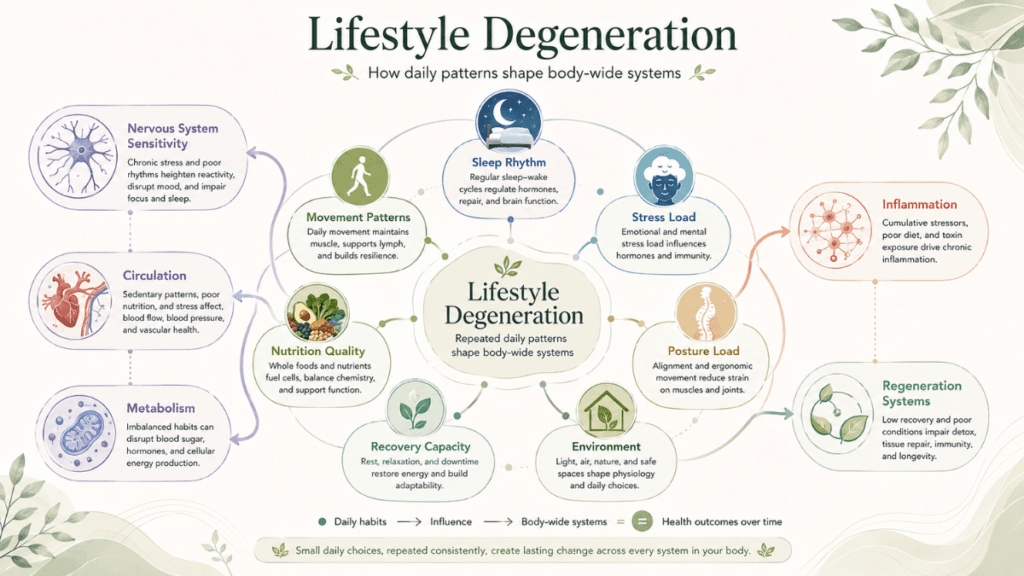
1. Sleep Rhythm Layer
Sleep is one of the body’s most important regulation windows. During sleep, the nervous system, immune system, metabolic system, and repair systems all shift into different patterns. Therefore, when sleep is repeatedly short, irregular, or poor quality, the body may lose some of its recovery rhythm.
For example, a person who sleeps at different times every night may still get some rest, but the body may not receive a stable signal for recovery. Over time, this may influence energy, mood, stress tolerance, inflammation balance, and pain sensitivity.
From a nerve health education perspective, sleep rhythm matters because nerves are part of a living system. They do not only need rest; they also need stable regulation. In addition, poor sleep may make normal body sensations feel stronger or more uncomfortable.
2. Movement and Inactivity Layer
Movement supports circulation, oxygen delivery, joint mobility, muscle balance, and tissue communication. However, modern lifestyle often includes long sitting, desk work, screen time, and low physical variety. As a result, some tissues may receive less movement-based stimulation throughout the day.
This does not mean that everyone must exercise intensely. Instead, the key idea is that the body responds to repeated patterns. If the same posture is held for long periods, certain muscles may become overloaded while others become underused. Over time, this may affect mechanical stress, circulation, and nerve space in some areas.
For nerve function, movement matters because nerves pass through muscles, joints, and connective tissues. Therefore, reduced movement variety may influence mechanical load, tissue stiffness, and sensitivity. At the same time, too much aggressive movement without recovery may also increase system demand.
3. Stress Load Layer
Stress is not only emotional. It can also be physical, mental, social, financial, environmental, and sensory. In many cases, Lifestyle Degeneration develops when stress load becomes frequent but recovery time remains limited. Therefore, the body may stay in a more alert state.
When the stress system remains active, the nervous system may become more responsive to signals. For example, discomfort that once felt mild may feel stronger during periods of poor sleep, pressure, or emotional overload. This does not mean the feeling is imaginary. Instead, it shows how the nervous system and body state may influence perception.
Over time, stress load may also interact with inflammation, metabolism, digestion, circulation, and sleep. For this reason, Lifestyle Degeneration is not only about habits. It is also about the total demand placed on the body.
4. Nutrition and Energy Stability Layer
Nutrition supports energy production, tissue repair, immune balance, and nervous system function. However, Lifestyle Degeneration may involve irregular meals, low nutrient variety, highly processed food patterns, poor hydration, or inconsistent energy intake. As a result, the body may have less stable support for daily function.
For example, long gaps between meals followed by heavy meals may influence energy swings for some people. In addition, low protein, low micronutrient variety, or poor hydration may affect how the body supports tissues. This page does not provide diet instructions, but it explains why nutrition patterns matter from a system perspective.
Nerves require energy and supportive nutrients to function properly. Therefore, unstable nutrition patterns may interact with fatigue, sensitivity, and recovery capacity. However, nutrition is only one layer, not the whole story.
5. Posture and Mechanical Load Layer
Posture is not simply about sitting “perfectly.” It is about how the body distributes load across muscles, joints, nerves, and connective tissues. A repeated posture may become stressful when the body does not get enough variation, strength, mobility, or rest.
For example, leaning forward toward a screen for many hours may increase load on the neck, shoulders, upper back, and arms. Over time, this may interact with muscle tension, circulation, and nerve sensitivity. Similarly, standing in one position all day may create a different kind of repeated load.
From an educational perspective, posture becomes important when it is understood as a pattern. One position may not be harmful by itself. However, repeated mechanical stress without recovery may become part of a wider Lifestyle Degeneration cycle.
6. Recovery Capacity Layer
Recovery capacity means the body’s ability to restore balance after stress, work, movement, inflammation, or daily demand. It depends on sleep, nutrition, circulation, stress regulation, immune balance, and rest. Therefore, when several lifestyle patterns are strained at the same time, recovery capacity may feel reduced.
For example, a person may tolerate one stressful week. However, if poor sleep, high workload, low movement, irregular meals, and emotional pressure continue together, the body may need more recovery resources than it receives. As a result, fatigue and sensitivity may become more noticeable.
This layer is especially important for nerve education because recovery is not only about one tissue. It is a whole-system process. Nerves, muscles, blood vessels, immune cells, and metabolic systems all participate in maintaining stability.
7. Environmental and Routine Layer
Daily environment can influence body regulation. Light exposure, screen time, noise, air quality, work setup, temperature, social stress, and daily routine may all affect how the body responds. In addition, modern routines often create constant stimulation without enough quiet recovery time.
For example, late-night screen use may influence sleep timing. A noisy or stressful environment may keep the nervous system alert. Poor workstation setup may increase mechanical load. Over time, these small influences may combine into a larger pattern.
This layer matters because Lifestyle Degeneration is often built from repeated environmental signals. Therefore, the body may not only respond to what a person does, but also to what the person is exposed to every day.
Lifestyle Degeneration Interactions
Nervous System Interaction
The nervous system constantly reads signals from the body and environment. When daily lifestyle patterns increase stress load, reduce sleep quality, or limit movement, the nervous system may receive more signals related to tension, fatigue, or discomfort.
At the same time, a more sensitive nervous system may make lifestyle challenges feel harder to manage. For example, poor sleep may increase sensitivity, and increased sensitivity may make sleep harder. Therefore, the relationship is two-way.
Stress System Interaction
The stress system helps the body respond to demand. However, repeated lifestyle strain may keep this system more active than necessary. This may include work pressure, emotional strain, poor rest, or constant stimulation.
Over time, stress activation may interact with sleep, digestion, inflammation, and pain perception. For this reason, Lifestyle Degeneration and the Stress System often overlap in nerve-related education.
Metabolic System Interaction
The metabolic system manages energy production, blood sugar stability, and fuel use. Irregular meals, low movement, poor sleep, and chronic stress may all influence metabolic patterns.
In addition, metabolic instability may affect fatigue, tissue repair, and nervous system regulation. Therefore, Lifestyle Degeneration may interact with the Metabolic Damage System as part of a broader energy-balance pattern.
Nutritional System Interaction
The nutritional system provides raw materials for repair, signaling, and energy. When food quality, hydration, or nutrient variety is low over time, the body may have less support for normal function.
However, nutrition should not be viewed as a single cure or solution. Instead, it is one support layer within a larger system that includes sleep, stress, movement, circulation, and recovery.
Circulatory System Interaction
Circulation helps deliver oxygen and nutrients while removing waste products. Long sitting, low movement, dehydration, and tissue tension may influence circulation patterns.
As a result, tissues may feel more fatigued or sensitive when delivery and clearance are not well supported. This is one reason Lifestyle Degeneration may connect with the Circulatory Impairment System.
Inflammatory System Interaction
Inflammation is part of the body’s normal defense and repair process. However, repeated lifestyle stress may influence inflammatory signaling, especially when sleep, nutrition, stress, and recovery are strained together.
This does not mean lifestyle alone explains inflammation. Instead, lifestyle patterns may be one part of a broader inflammatory environment.
Regeneration Systems Interaction
Regeneration systems depend on energy, repair signals, nutrient availability, circulation, immune balance, and nervous system stability. Therefore, Lifestyle Degeneration may matter because it may influence the conditions needed for repair-friendly regulation.
In simple terms, recovery does not happen in a vacuum. It happens inside the total environment created by daily body patterns.
Patterns That Influence the Lifestyle Degeneration
Lifestyle Degeneration may be influenced by repeated daily patterns. These patterns are not always dramatic. In many cases, they are small and familiar.
For example, sleeping late, skipping meals, sitting for long hours, working under pressure, drinking too little water, and rarely taking restorative breaks may each seem minor. However, when combined repeatedly, they may increase system load.
In addition, modern life often creates a mismatch between demand and recovery. The mind may remain active all day, while the body moves very little. The body may need rest, but screens and stress may delay sleep. Over time, this mismatch may affect regulation.
Common patterns may include:
- Irregular sleep and wake timing
- Long sitting or low movement variety
- High stress with low recovery time
- Poor hydration patterns
- Low nutrient variety
- Frequent screen exposure late at night
- Repeated posture strain
- Limited outdoor light exposure
- Overwork without rest cycles
- Poor balance between activity and recovery
However, these patterns should not be used for self-blame. Instead, they are useful because they help explain how daily life may shape the body’s internal environment.
Lifestyle Degeneration and Nerve Function
Lifestyle Degeneration may connect with nerve function through several pathways. First, nerves depend on stable energy. When sleep, nutrition, and metabolic balance are strained, the body may have less consistent support for normal nerve activity.
Next, nerves depend on healthy circulation. If movement is limited, posture is repetitive, or hydration is poor, tissues may experience changes in delivery and clearance. As a result, certain areas may feel more tired, tight, or sensitive.
In addition, nerves are influenced by inflammation and immune signaling. Repeated stress, poor sleep, and low recovery may interact with inflammatory patterns. This may affect how the nervous system reads and responds to signals.
Lifestyle Degeneration may also influence pain perception. When the nervous system is under repeated load, sensations such as tingling, burning, numbness, fatigue, or discomfort may become more noticeable. However, these symptoms can have many causes, and this page does not diagnose them.
From an educational perspective, this system helps explain why nerve-related experiences may sometimes reflect whole-body conditions. A nerve symptom may feel local, but the body environment around it may be shaped by sleep, stress, movement, metabolism, circulation, and repair capacity.
Lifestyle Degeneration Visual Flow
Repeated Daily Pattern
↓
System Load Builds Gradually
↓
Sleep / Stress / Movement / Nutrition Imbalance
↓
Metabolic, Circulatory, and Inflammatory Response
↓
Nervous System Sensitivity
↓
Higher Recovery Demand
↓
Reduced Resilience Over Time
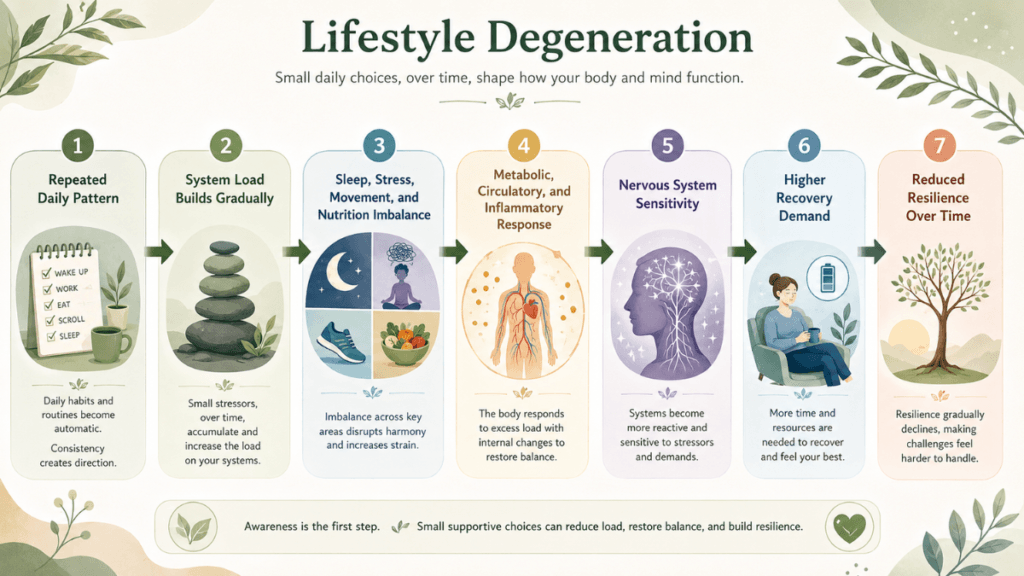
This flow is not always linear. In many cases, it works like a cycle. For example, stress may reduce sleep quality. Poor sleep may increase fatigue. Fatigue may reduce movement. Reduced movement may affect circulation and posture. As a result, discomfort may increase, which may create more stress.
Therefore, Lifestyle Degeneration should be understood as a pattern of interaction. It does not mean one habit causes one symptom. Instead, it shows how repeated lifestyle signals may shape the body’s regulatory environment over time.
Why Lifestyle Degeneration Matters for Recovery
1. Recovery Requires System Balance
Recovery depends on many systems working together. The nervous system, immune system, metabolic system, circulatory system, and regeneration systems all need coordination. Therefore, lifestyle patterns matter because they may influence this coordination.
When daily life repeatedly creates overload, the body may spend more energy maintaining balance. As a result, less energy may be available for repair, adaptation, and stability.
2. Recovery Requires Energy and Regulation
The body needs energy to repair tissues, regulate inflammation, support nerves, and maintain healthy function. However, energy is not only about calories. It also involves sleep, oxygen, nutrient availability, and metabolic stability.
For this reason, Lifestyle Degeneration may matter when the body feels constantly tired, overstimulated, or under-recovered. These patterns may increase recovery demand without necessarily providing enough recovery support.
3. Recovery Requires Delivery and Clearance
Circulation helps deliver oxygen and nutrients. It also supports clearance of waste products and inflammatory byproducts. Therefore, movement, hydration, posture, and vascular support may all matter from an educational perspective.
When delivery and clearance are less supported, tissues may feel more sensitive or slow to settle. This is one way Lifestyle Degeneration may interact with nerve-related discomfort.
4. Recovery Requires Nervous System Stability
A stable nervous system helps the body interpret signals accurately. However, poor sleep, high stress, repeated pain, and constant stimulation may increase sensitivity.
As a result, the nervous system may become more alert to normal signals. This may influence how strongly the body experiences discomfort, fatigue, or sensory changes.
5. Recovery May Be Influenced by Repeated System Stress
Repeated system stress can increase the demand on repair and regulation. Over time, the body may need more rest, more stability, and more supportive conditions to maintain resilience.
This does not mean recovery is impossible. Instead, it means recovery education should look beyond one symptom and consider the wider body environment.
Common Misunderstandings About the Lifestyle Degeneration
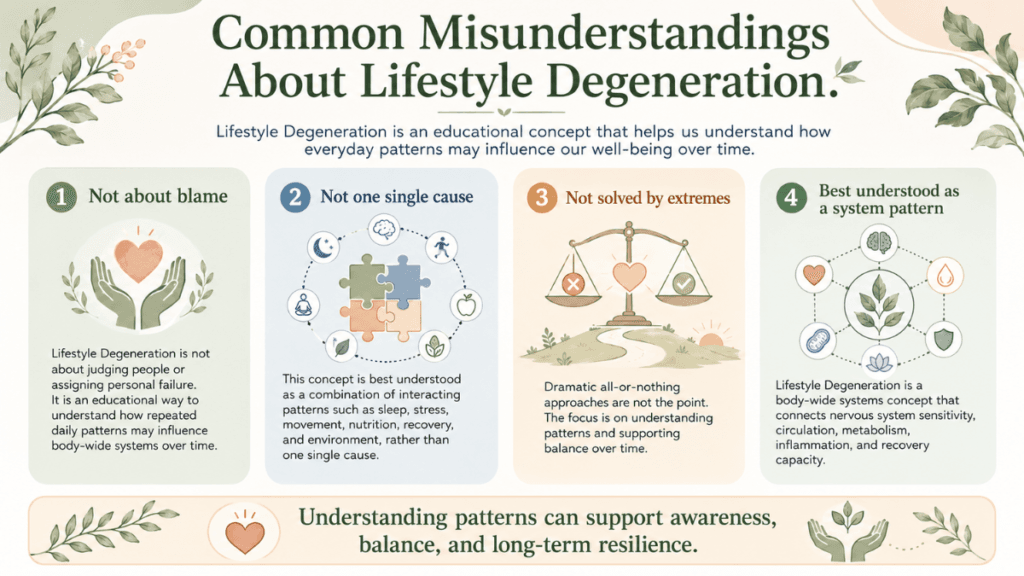
Misunderstanding 1: Lifestyle Degeneration means someone is lazy.
Clarification:
This is not true. Lifestyle patterns are often shaped by work, stress, family duties, finances, environment, pain, fatigue, and available resources. Therefore, this concept should be used for understanding, not blame.
Misunderstanding 2: One bad habit causes nerve problems.
Clarification:
Lifestyle Degeneration is not about one habit. It is about repeated patterns and how they may interact with body systems over time. Nerve symptoms can have many possible causes, and professional evaluation may be needed for concerning symptoms.
Misunderstanding 3: More exercise always solves the problem.
Clarification:
Movement can be important, but more is not always better. Some people may need gradual, appropriate, and safe activity based on their condition. This page does not provide exercise instructions. Instead, it explains why movement patterns matter.
Misunderstanding 4: Lifestyle change is the same as medical treatment.
Clarification:
Lifestyle education can support understanding, but it is not a replacement for medical care. Symptoms such as sudden weakness, severe numbness, or rapidly worsening pain should be evaluated by a qualified professional.
Misunderstanding 5: Recovery depends only on willpower.
Clarification:
Recovery capacity is influenced by many systems, including sleep, stress, nutrition, inflammation, circulation, and nervous system regulation. Therefore, it should not be reduced to willpower alone.
Continue Learning
To understand Lifestyle Degeneration more clearly, continue exploring related system pages:
- Root-Cause Systems — learn how body-wide patterns may influence nerve sensitivity and recovery demand.
- Therapeutic Systems — explore educational support systems without treatment claims or protocol instructions.
- Regeneration Systems — understand how repair, adaptation, and stability may depend on whole-body conditions.
- Conditions — explore nerve-related experiences and how they may connect with broader body systems.
- Learning Path — follow a structured step-by-step educational route through nerve health topics.
Related Systems
Stress System
Lifestyle Degeneration often interacts with stress load. Poor sleep, overwork, emotional pressure, and limited rest may keep the body in a more alert state.
Metabolic Damage System
Irregular meals, poor sleep, and low movement may influence energy stability. Therefore, Lifestyle Degeneration may overlap with metabolic stress patterns.
Nutritional Deficiency System
Low nutrient variety or poor hydration may affect the body’s support systems. This may influence energy, tissue repair, and nervous system stability.
Circulatory Impairment System
Long sitting, low movement, and repeated mechanical strain may influence circulation. Circulation matters because tissues need delivery and clearance.
Inflammatory System
Repeated lifestyle stress may interact with inflammatory signaling. However, inflammation is complex and should not be reduced to lifestyle alone.
Toxic Load System
Environmental exposure, poor air quality, and daily chemical load may be relevant for some people. This system should always be explained carefully without fear-based detox claims.
Mechanical Damage System
Posture, repetitive strain, and movement patterns may influence mechanical load on nerves, muscles, joints, and connective tissues.
Gut–Nerve Axis
Sleep, stress, food patterns, and routine may influence gut-brain communication. Therefore, Lifestyle Degeneration may overlap with gut–nerve education.
Autoimmune Patterns
Lifestyle patterns may interact with immune regulation, but autoimmune conditions are medically sensitive. This connection must always be explained cautiously and without self-diagnosis claims.
Regeneration Systems
Recovery capacity depends on repair signals, energy, circulation, sleep, immune balance, and nervous system regulation. Lifestyle patterns may shape the environment where regeneration occurs.
Safety & Education Notice
This page is for educational purposes only. It does not diagnose, treat, cure, or prevent disease. It is not a substitute for professional medical advice, diagnosis, or treatment.
Lifestyle Degeneration is an educational system concept. It should not be used to self-diagnose nerve disorders, autoimmune conditions, metabolic disease, circulation problems, or chronic pain conditions.
Seek urgent medical care for severe, sudden, unusual, or worsening symptoms, including sudden weakness, loss of bladder or bowel control, chest pain, difficulty breathing, severe numbness, severe pain, fainting, confusion, or rapidly changing neurological symptoms.
If you have ongoing nerve symptoms, significant pain, numbness, weakness, balance issues, or unexplained changes in sensation, consult a qualified healthcare professional.